A 5,000-Word Postmortem: How an $1.1 Billion Acquisition Reveals OpenAI's Second Act

OpenAI's Three Turning Points
OpenAI's Triple Inflection Point
 👦🏻 Author: Jingshan
🥷 Editor: Koji
🧑🎨 Layout: NCon
 💡
💡
Lately, the AI industry has been serving up blockbuster headlines almost daily: new model releases, capital market bets, Big Tech power plays — each one more dramatic than the last.
This pace creates a kind of urgency that feels like "every time you open your eyes, you might miss an inflection point in history." Against this backdrop, Crossing is rolling out a series taking stock of the AI giants. Last week, we published our piece on Google: "6,000-Word Retrospective: How Google AI Got Its Bite Back — From Nano Banna, Genie 3, and Veo 3 to Gemini 2.5's Counterattack"
This week, we're turning the lens toward OpenAI.
Our angle this time isn't model updates or product launches, but an acquisition — one that refracts OpenAI's latest strategic ambitions.
Forget the tech. Now it's all about winning.
Last week, OpenAI announced its $1.1 billion acquisition of Statsig. No doubt everyone's eyes locked onto the price tag. But that may well be the least important part of this story.
The real answers lie buried in three inflection points: a meticulously orchestrated "acqui-hire"; an imminent "survival test"; and an ongoing "identity transformation."
The world's largest AI unicorn — the company that arguably defined the AI era — now faces a double bind: its technological halo is being "contested," and its business model is being "competed against."
The Statsig acquisition and the return of "growth queen" Fidji Simo aren't isolated business moves. They're the opening acts of OpenAI's full-scale transformation, as it unhesitatingly copies Silicon Valley's growth playbook:
Buy the companies you need most. Hire the people who know growth best.
🚥
To understand this OpenAI metamorphosis, we'll break it down through 3 core lenses:
🚦
【1】A Meticulously Orchestrated Acquisition
【2】Why Is OpenAI Suddenly Targeting Product Companies?
【3】OpenAI's Full-Scale Shift from "Lab" to Product Company
A Meticulously Orchestrated Acquisition
1) What's Statsig's Background?
Statsig isn't a traditional analytics company. Its mission is to provide teams with an all-in-one product growth toolkit.
It lets product teams complete the full loop on a single platform:
From hypothesis → experiment validation → feature launch → impact analysis.
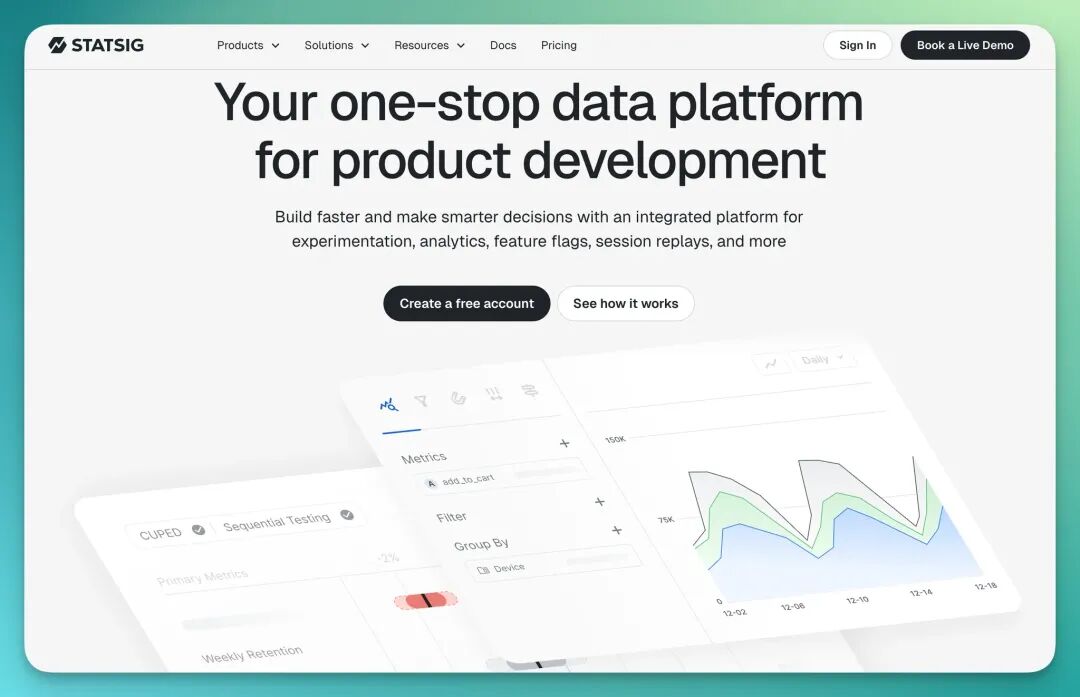
Its core value lies in automating the complex data science work behind product experiments.
To that end, it offers an integrated suite of tools. We've compiled the main ones:
【1】A/B testing (experiments);
【2】Feature flags (feature management);
【3】Product analytics and session replay.
These tools let enterprises "build products faster and make smarter decisions."
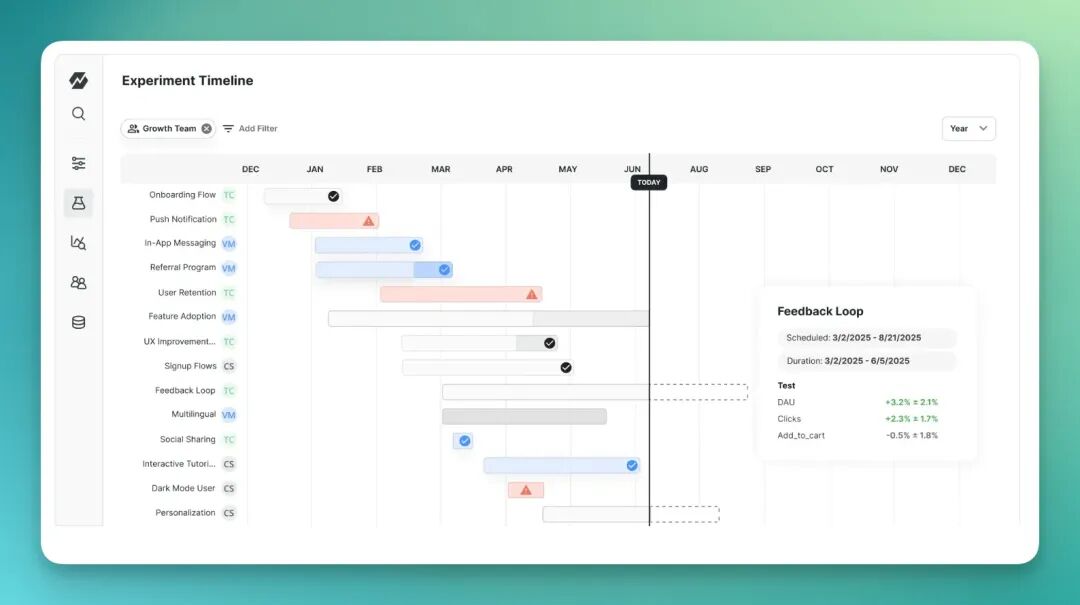
At scale, Statsig has reached industrial-grade performance. As of October 2024, it was processing over 1 trillion events per day, supporting 2.5 billion unique experimental subjects monthly, with 99.99% uptime.
By the first half of 2025, that number had doubled again, with daily event volume surpassing 2 trillion.
What does that number mean?
For comparison: platforms like TikTok and YouTube, with hundreds of millions of DAU, generate click volumes in the billions. The 2 trillion level encompasses the full lifecycle data stream — experiment data, logs, impressions, performance metrics, and more.
This battle-tested infrastructure is exactly what high-growth companies need, especially AI startups like OpenAI that are urgently translating foundational model technology into products.
Statsig's value is also borne out in customer cases. Here are three examples we found.
【1】Fintech company Brex used Statsig to cut data scientist staffing costs by 50%;
【2】Genealogy tech company Ancestry increased experiment velocity 9x;
【3】Productivity software Notion — one we all know — expanded experiment scale 30x.
These aren't simple efficiency optimizations. They're genuine productivity leaps.
As Statsig declares in its mission: "Help people build better products with data" — a goal that aligns precisely with what OpenAI urgently needs to internalize.
2) Buying a Company, or "Buying" People?
In this regard, Meta has undoubtedly set the template for OpenAI.
Last month, the much-discussed Scale AI deal involving Alexandr Wang shares significant DNA with this OpenAI-Statsig acquisition: a foundational AI model company buying a downstream service provider, then placing its key talent in the most critical positions within its own organization.
On the surface, it's buying companies and filling service gaps. In reality, it's acquiring talent and strengthening teams. In Silicon Valley, this maneuver has a specific name — "acqui-hire" (acquisition + hire).
Why do we say this?
A notice from Madrona (one of Statsig's investors) pointed out:
OpenAI has long been a significant customer of Statsig.
In other words, OpenAI was already a core Statsig client before the acquisition. Post-deal, OpenAI not only brings this critical product development and experimentation capability in-house, but can directly accelerate iteration in its applications division.
This enables OpenAI to iterate on ChatGPT and future products with "the same speed and data-driven capabilities as Silicon Valley's most agile product companies."
Meanwhile, this transaction is about technology, but even more about talent — arguably, talent carries the greater weight.
Statsig founder and CEO Vijaye Raji has deep credentials. He spent time at Microsoft, but more notably, a full decade at Facebook (Meta), rising from engineer to VP, ultimately leading the entertainment business.
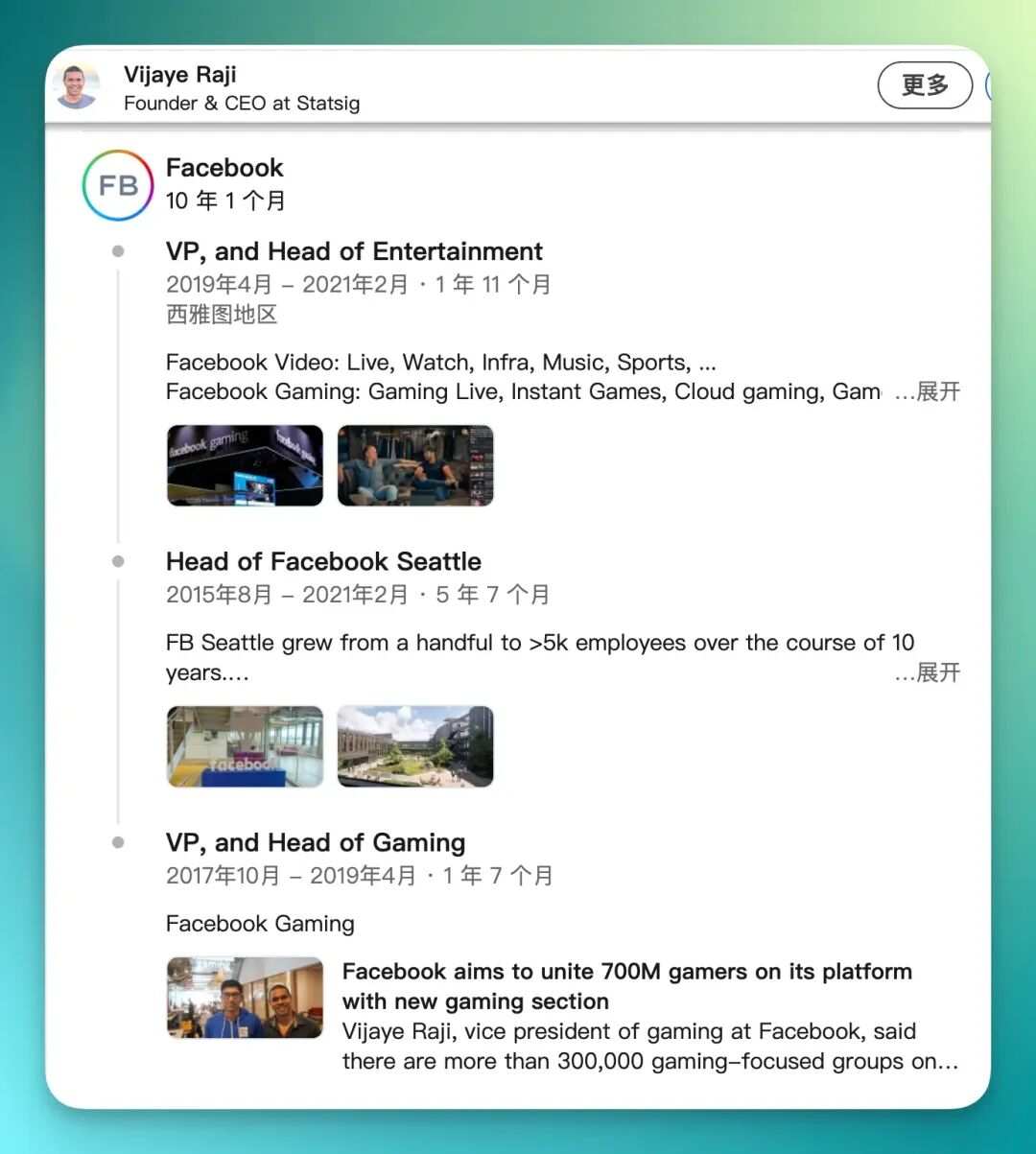
Raji was steeped in Facebook's "data-driven, experiment-obsessed" culture. And it's precisely this culture that was key to scaling Facebook's products to billions of users.
Now, he's been appointed CTO of Applications in OpenAI's newly created applications division, reporting directly to new applications CEO Fidji Simo — who also has Meta DNA — forming a clear chain of command focused on product engineering and execution.
And it's not just Raji. OpenAI explicitly stated in its announcement:
Including Vijaye, all Statsig employees will become OpenAI employees
This means OpenAI is actively building a team and culture parallel to its research division — one centered on product.
Vijaye Raji's career embodies "builder culture": In his view, every decision must be backed by data, every dispute resolved through experiment rather than empty conference room debate.
By bringing Raji and his entire team on board, OpenAI is effectively injecting this "aggressive, fast-shipping, data-first product culture" directly into its commercial arm — and giving Fidji Simo the ideal right-hand person.
3) Silicon Valley Giants Have Tasted the Sweetness of Talent Acquisitions
This acquisition isn't actually OpenAI's first talent-centric purchase.
Back in August 2023, OpenAI bought Global Illumination, a small digital product company founded by veterans from Instagram, Facebook, YouTube, and Google.
The entire team was subsequently absorbed into OpenAI to work on core products including ChatGPT.
The intent was unmistakable: OpenAI didn't want the product — it wanted top-tier talent "battle-tested in design and product experience."
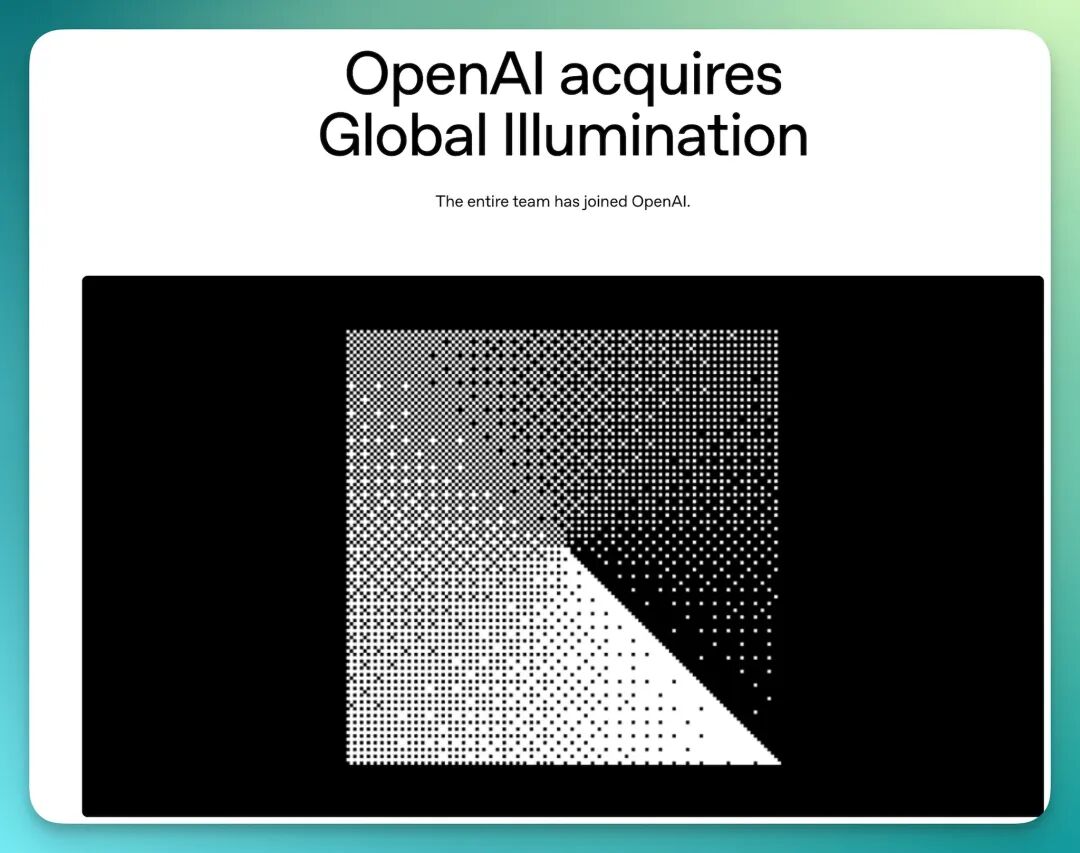
Combined with this Statsig acquisition, a clear pattern emerges:
OpenAI has recognized its weaknesses in product design, user experience, and growth engineering — and chosen to fill these gaps through acquisition rather than building from zero.
And this is just the tip of the iceberg.
Beyond directly absorbing key teams, OpenAI's ambitions clearly run larger.
It's acting like a venture capitalist, placing bets globally to lock up startups that can unlock its "technological potential." Here's a CB Insights summary:
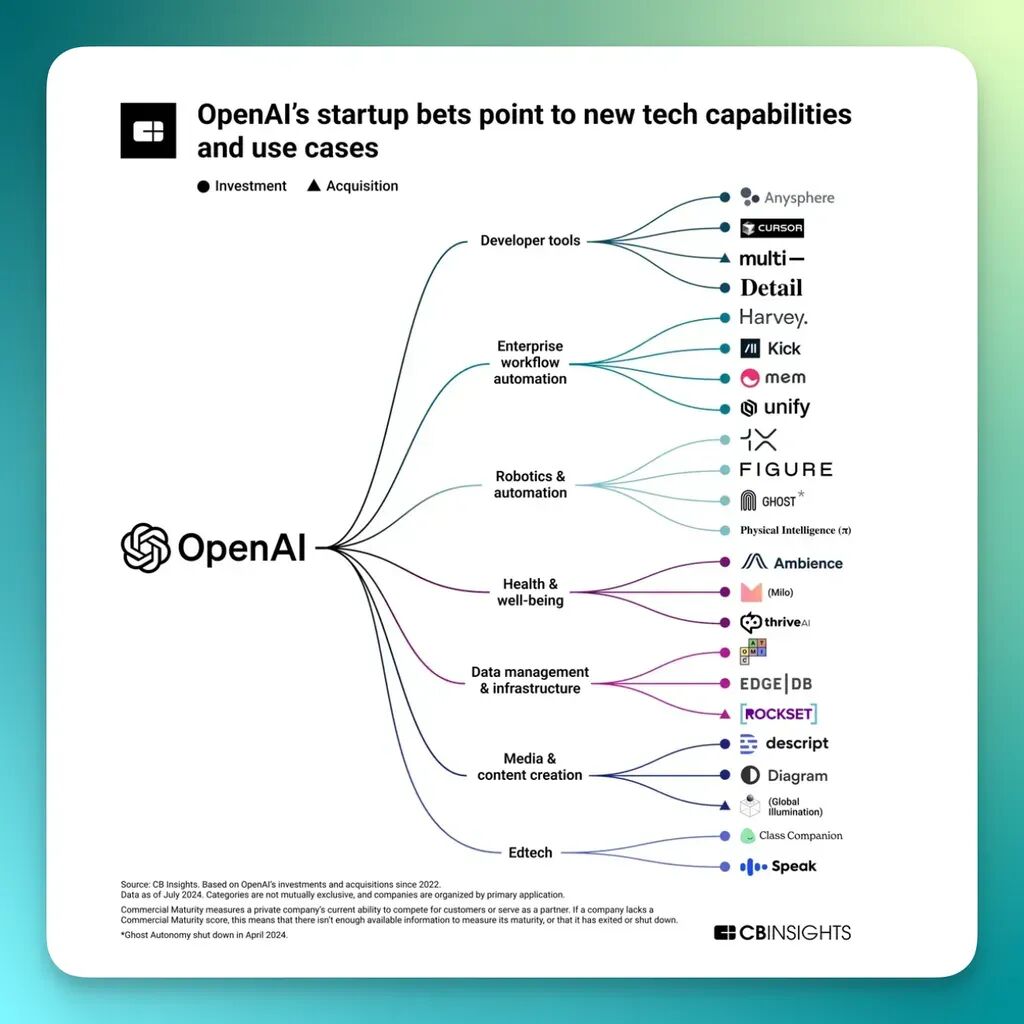
As we can see above: from infrastructure to application layer, from developer tools to healthcare — across 6 vertical segments, OpenAI is using capital to mark out its allies.
More interesting is the acquisition price itself, which often reveals the nature of a deal.
Statsig had just completed its Series C in May 2025, raising $100 million at a valuation of $1.1 billion. OpenAI's acquisition price? Exactly $1.1 billion.
In other words: zero premium.
Multiple media outlets noted the same thing: the acquisition valuation "matched its most recent funding round valuation."
In typical competitive acquisitions, buyers pay well above the previous round's valuation. When the price matches the latest funding round, it usually signals: this wasn't a bidding war, but a pre-arranged strategic integration.
This approach — buying another company primarily to absorb its team and leadership rather than its product — is common in Silicon Valley.
Meta offers a textbook example: it took $14.3 billion for a 49% stake in Scale AI. Result? Scale founder and CEO Alexandr Wang became head of Meta's Superintelligence Labs, with even veteran scientist Yann LeCun reporting to him.
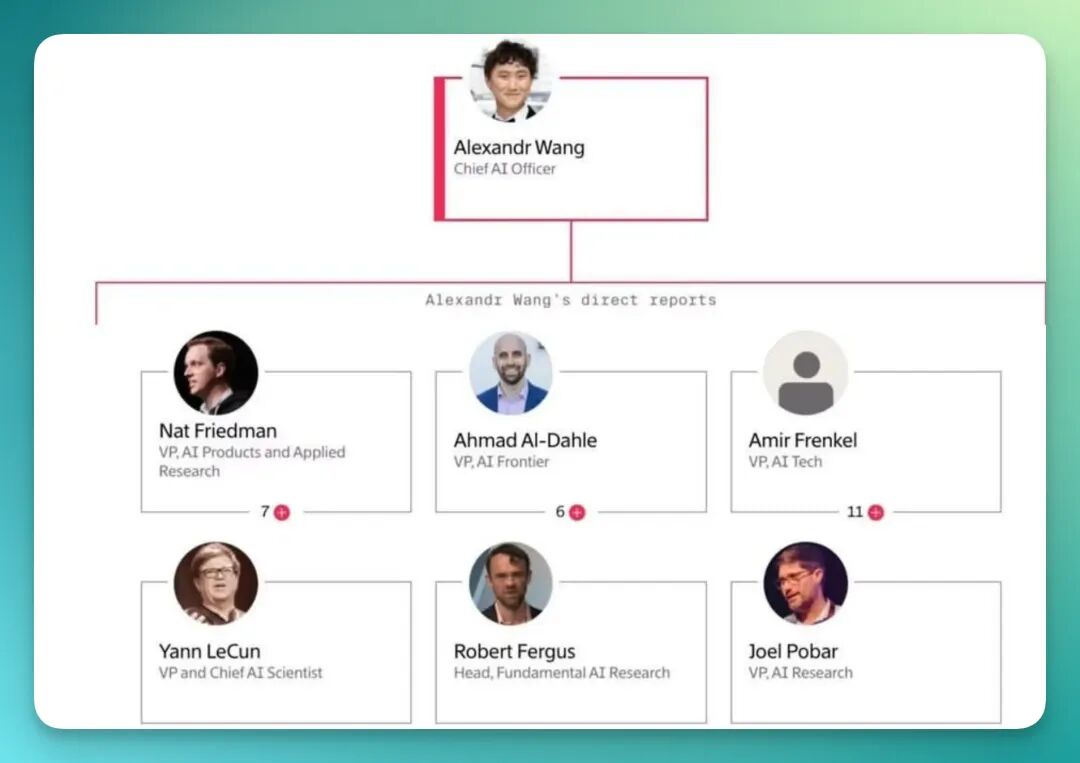 Source: @alvinfoo
Google hasn't been idle either. A few months back, it spent $2.4 billion to acquire core executives from AI coding startup Windsurf (including the CEO and co-founders), bringing them directly into DeepMind with partial technology licensing — rather than buying the whole company.
In the end, only rank-and-file employees were left out in the cold. This direct-and-indirect talent-buying approach even sparked backlash against the Windsurf executives at the time.
From OpenAI's "gap-filling" to Meta's "high-stakes talent buy" to Google's "targeted poaching" — Silicon Valley giants have tasted the sweetness of acquiring talent.
Behind this lie at least three industry realities:
【1】Talent scarcity trumps everything.
These people's value has far exceeded conventional compensation systems — they're more important than any single technology or product.
【2】Time is the ultimate cost.
Using capital to buy time rapidly fills capability gaps.
【3】What's acquired isn't just people.
A mature team brings its own honed workflows, product philosophy, and innovation culture.
Looking ahead, talent competition in Silicon Valley's AI circle will only intensify.
Why Is OpenAI Suddenly Targeting Product Companies?
Why has OpenAI's Statsig acquisition stirred such industry reaction? Is it simply because $1.1 billion is a big enough number?
Not really.
The amount is substantial, but it's not the key. The real reason:
The pressure on OpenAI for commercial growth has reached unimaginable levels.
1) External Threat: Gemini and Claude Surging Ahead
For most of 2023, ChatGPT dominated and OpenAI was the undisputed AI unicorn.
But entering 2024 and 2025, the industry landscape fundamentally shifted.
Google's Gemini family and Anthropic's Claude family not only caught up to OpenAI across key benchmarks, but surpassed it on certain tasks.
As we catalogued in "6,000-Word Retrospective: How Google AI Got Its Bite Back — From Nano Banna, Genie 3, and Veo 3 to Gemini 2.5's Counterattack", Google — perhaps not as quick out of the gate as OpenAI, but with deep technical reserves — has mounted a full counterattack and scored solid results.
Today, benchmarks and AI capability leaderboards have become crowded, volatile battlegrounds where models from OpenAI, Google, Anthropic, and others fiercely compete for top position.
This clearly shows:
"Best model" is no longer a settled question.
And this battle isn't merely technical. More critically, user perception is shifting.
In mid-2025, a Menlo Ventures report "2025 Mid-Year LLM Market Update: Foundation Model Landscape + Economics[1]" revealed a reversal in the enterprise AI market (report link at article's end).
In 2023, OpenAI held 50% of enterprise AI market share, while Anthropic held just 12%. By mid-2025, Anthropic's Claude had surged to 32% market share, overtaking OpenAI which had fallen to 25%.
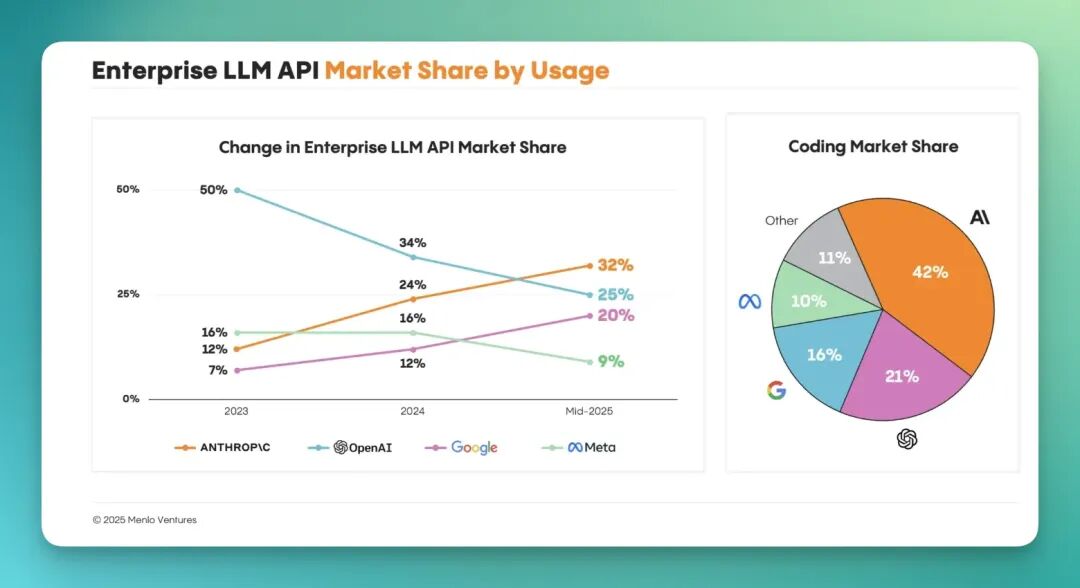
We previously cited the chart below in "OpenAI's Last Stand | 6 Things You Probably Missed About GPT-5":
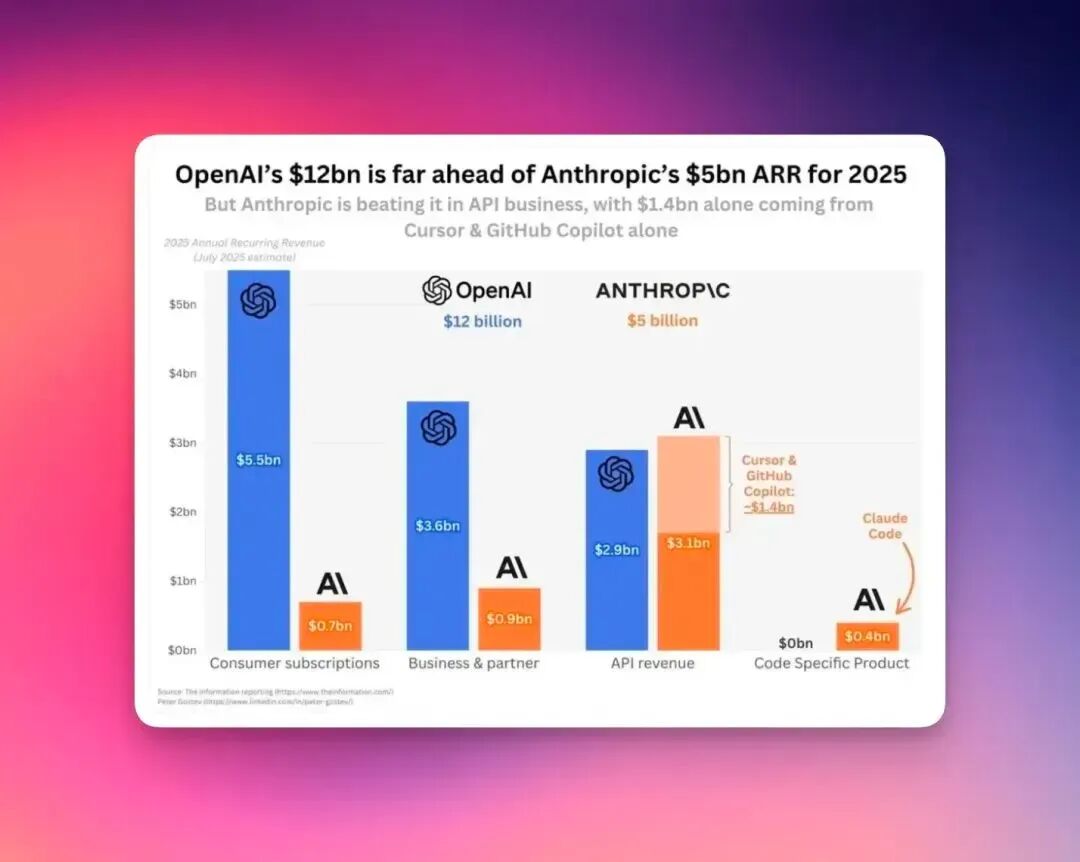
Clearly, Anthropic's Claude has begun rapidly overtaking OpenAI in several domains. Behind this shift: enterprise customers pivoting from pure benchmark scores toward actual business outcomes.
Most critically, user perception is changing:
Claude handles enterprise tasks; ChatGPT falls slightly short.
This perception shift is not a good omen for OpenAI.
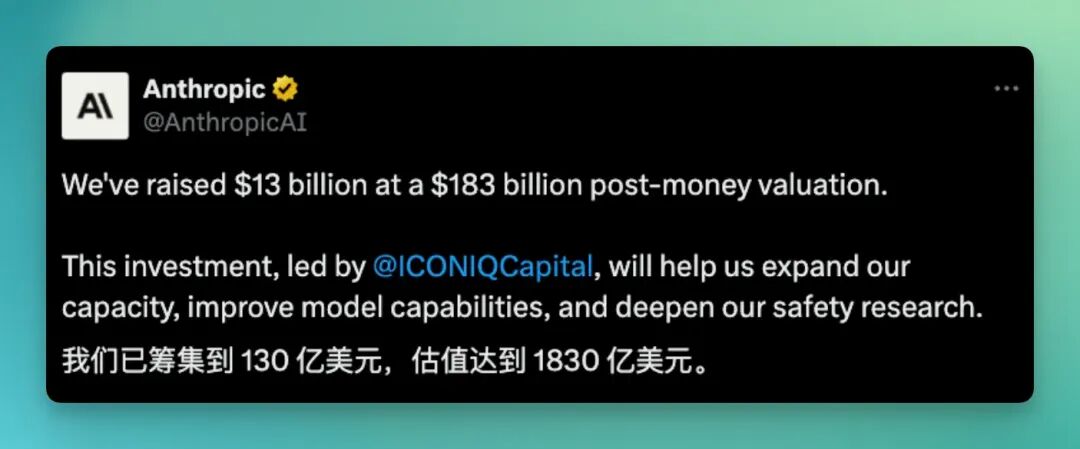
Just one week ago, Anthropic announced a $13 billion Series F at a $183 billion post-money valuation — from March to September, its valuation tripled in just six months.
The world now has its second-largest AI foundation model unicorn. And OpenAI now faces its fastest-expanding competitor.
2) Internal Woes: Subscriptions Alone Can't Deliver Profit
Against this backdrop of fierce competition, what truly has tech observers sweating for OpenAI may not be external rivalry, but its own profit performance.
On the surface, OpenAI's revenue growth looks staggering: projected to jump from $3.7 billion in 2024 to $12.7 billion in 2025. That's "more than tripling revenue this year."
Yet this revenue pales against massive expenditures.
In 2024, on $3.7 billion in revenue, OpenAI "achieved" a $5 billion net loss, with operating costs hitting $9 billion. Training a frontier model costs tens of millions; ChatGPT's daily operating costs alone are estimated at $700,000.
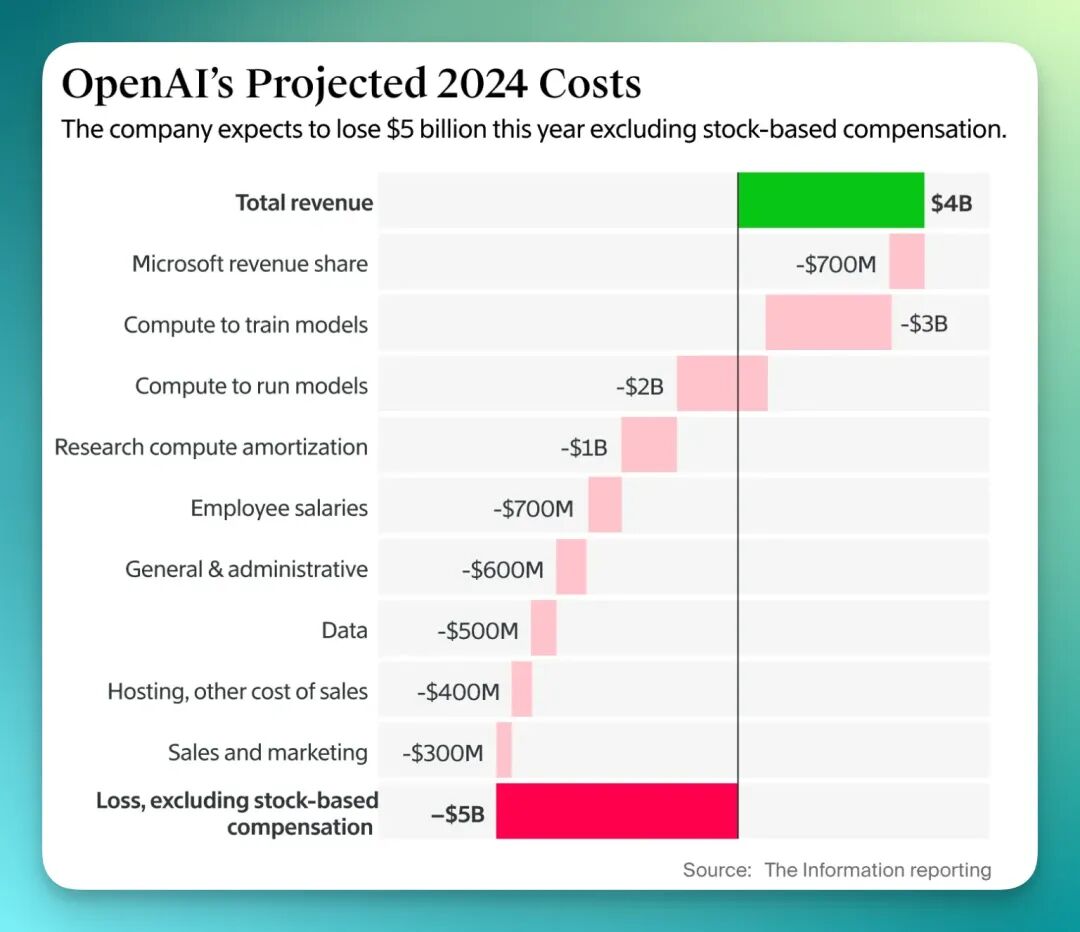 From the Information
Despite breakneck revenue growth, OpenAI doesn't expect positive cash flow until 2029 — by which point Sam Altman projects $100 billion in annual revenue.
That roughly equals Tesla's 2024 revenue ($97.69 billion). In other words, if expectations hold, OpenAI — a company less than 10 years old — will match the business scale of Tesla, which has "spent 20 years deep in the industry across multiple consumer and tech sectors," within just a few years.
P.S. I recall the last time Sam Altman mentioned profitability, he was saying 2027.
ChatGPT's heavy reliance on consumer subscriptions (~73% of 2024 revenue) places enormous pressure on OpenAI, forcing it to develop more profitable, scalable, higher-margin enterprise products — and to do so hastily.
OpenAI's ChatGPT pricing is well-known: $20, $200 — two tiers.
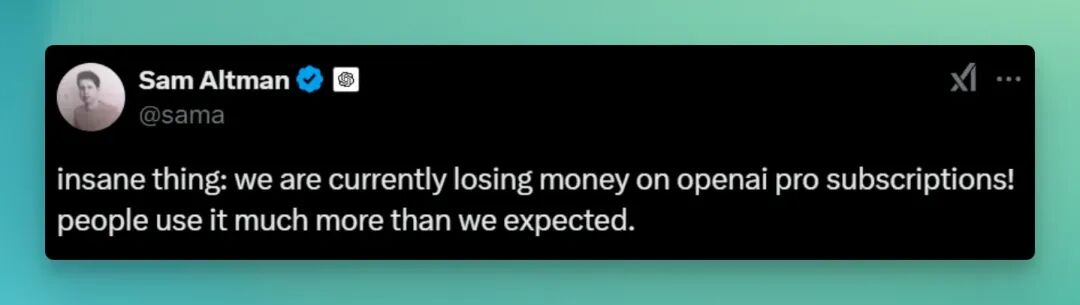
Eight months ago, on a Sunday, Sam Altman vented:
$200/month ChatGPT Pro is still losing money. Losing badly.
So while no one doubts OpenAI's technical pioneering, we must admit:
OpenAI's "technical moat" hasn't translated into a commercial "profit machine."
In other words, how to make money remains the core problem staring OpenAI in the face.
OpenAI's Full-Scale Shift from "Lab" to Product Company
If we connect the Statsig acquisition with another recent major move, we can better understand OpenAI's series of actions.
OpenAI is undergoing an identity transformation: from "AI lab" to full-fledged product company.
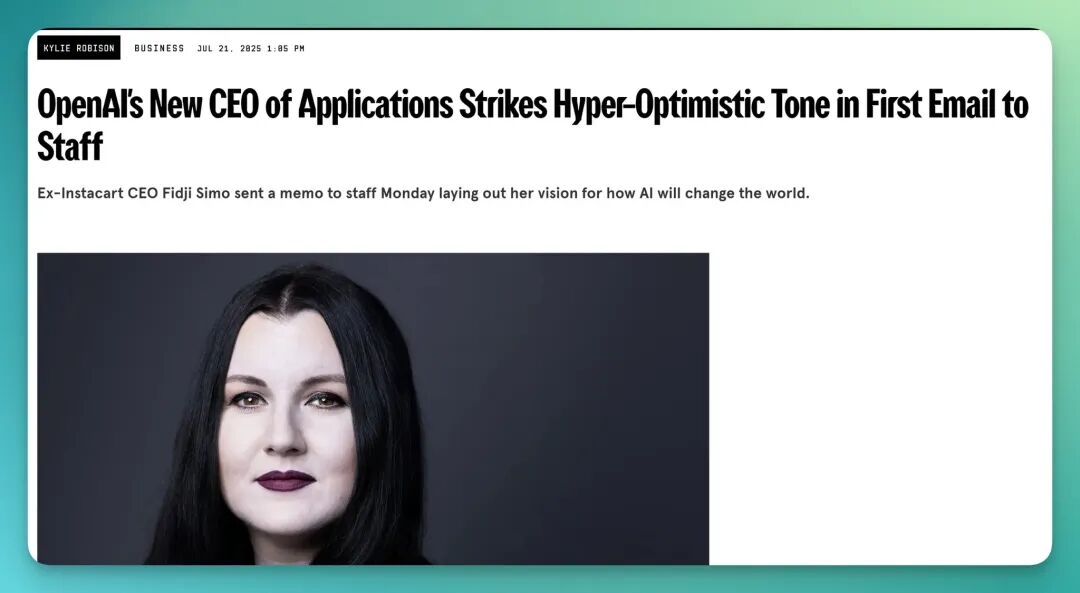
Its latest core move: Sam Altman — often slammed by Elon Musk as "too authoritarian" — appointed former Facebook (now Meta) executive Fidji Simo as CEO of a newly created applications division, a move widely seen externally as "ceding power."
1) "Growth Queen" Fidji Simo Goes Live
Simo's decade at Facebook (2011–2021) was the golden period of her career. She rose through the ranks to become the top executive running the Facebook App.
Simo's most celebrated achievement: serving as core architect of Facebook's mobile monetization strategy.
Her team built foundational ad formats including feed ads and video ads, successfully transitioning Facebook's revenue center from desktop to mobile.
Ultimately, the ad business her team built generated $55 billion in annual revenue.
Moreover, when Zuckerberg made "video" a strategic priority, the team that translated that directive into a global product was Simo's.
They essentially built Facebook Live and Facebook Watch from zero.
This fully demonstrates her ability to transform a top-level strategy into a globally scaled, sustainably revenue-generating mature product.
2) New Top-Level Design
Simo's appointment isn't an ordinary executive shuffle. It creates a new, enormously powerful "Applications" division within OpenAI.
As CEO of this division, she will oversee product, business, technology, and engineering — covering nearly the entire commercial side of the company — reporting directly to Sam Altman.
Her partner, brought in through the Statsig acquisition, is founder Vijaye Raji as CTO. One excels at strategy and commercialization, the other at product engineering and execution — together forming a golden combination forged during Meta's high-growth era.
Their core mission is singular:
Transform OpenAI's research output into products that can rapidly generate profit and win in the market.
At this point, we can see Simo's "commercial growth" approach becoming OpenAI's main roadmap for the second half of the year.
🚥
For the past two years, we've grown accustomed to seeing OpenAI as an idealistic AI lab, a "dragon-slaying youth" born to pursue AGI.
But this, one of its largest acquisitions ever, together with a series of senior leadership changes, tells a new story:
For technology to reach the world, it must pass through products and business models to touch billions of users.
Under the new structure, Sam Altman can still focus on AGI's long-term vision, chasing those grand objectives.
As for Simo, whether she can leverage sufficient authority to truly build a disciplined, self-sustaining commercial engine — this may be the most worth-watching development under OpenAI's new architecture.
Ultimately, all signals point to the same conclusion:
OpenAI is directly injecting the DNA of Silicon Valley's most successful growth and commercialization engine (Facebook / Meta) into its organizational core.

References
[1] 2025 Mid-Year LLM Market Update: Foundation Model Landscape + Economics: https://menlovc.com/perspective/2025-mid-year-llm-market-update/