8 million people have already started living with Samantha from *Her*.

Let AI keep us company during those moments when we're all alone.
Let AI keep us company through those moments when we're all alone.

👦🏻 Author: Jingshan
🥷 Editor: Koji
🧑🎨 Layout: NCon

Vision-language models (VLMs) are spreading fast.
Four months ago, OpenAI's o3 model sent fresh shockwaves through AI venture capital circles with its visual reasoning capabilities and evolutionary intelligence, unlocking a wave of new "wrapper" startup opportunities. As we predicted in "Thanks OpenAI, Thanks o3: New 'Wrapper' Startup Opportunities Are Here | 12 Promising Directions", VLMs have indeed opened up new entrepreneurial possibilities.
And the most eye-catching application scenario among them? The "game companion industry".
Like Samantha in Her, VLMs can turn AI into a friend who understands exactly what you're going through right now.
At this year's 2025 ChinaJoy, a product called "Doudou AI" demonstrated this possibility, drawing considerable attention online.
Below, we share our in-depth review of this product along with some observations. There were genuine "aha moments," but also room for improvement.
PS: After reaching out to the Doudou AI team, they've provided us with 30 membership redemption codes. Supplies are limited — interested readers can follow our WeChat official account and reply "DOUDOU" in the backend to enter the raffle. We've placed the raffle page at the end of this article. Hope everyone gets a chance to try it out ~
What Was "Doudou AI" at ChinaJoy?

Doudou AI booth at 2025 ChinaJoy
Doudou AI is a game companion platform powered by VLM (visual recognition) technology. It can recognize what's on your screen in real time, then chat with you through a cute "desktop pet" that keeps you company.
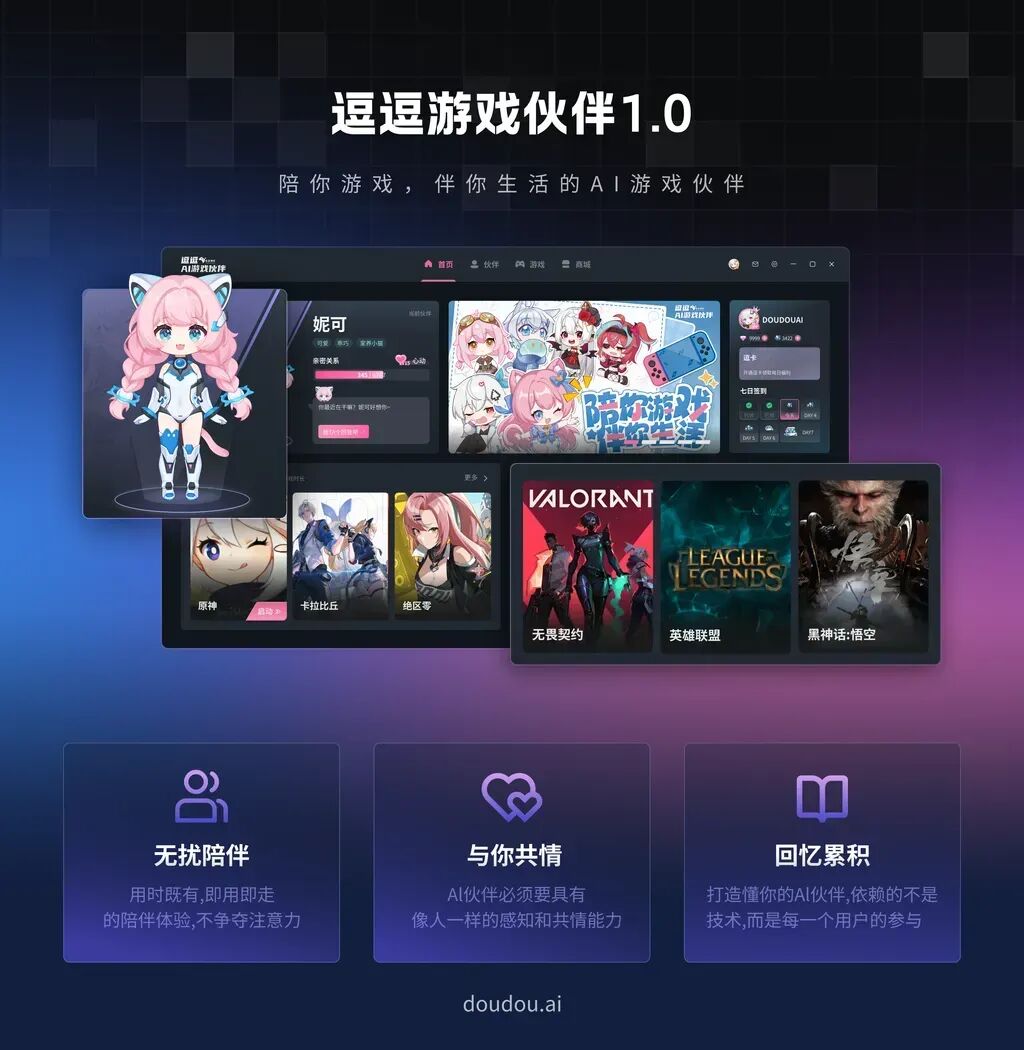
This is where you'll find many virtual characters that typically only appear in AI emotional companion apps — we'll refer to them collectively as "AI companions" below. Simply put, like Samantha in the movie Her, they're AI friends who can talk back and forth with you.
Doudou AI offers a wide selection of virtual characters. Beyond officially designed anime-style characters, the workshop features some distinctive ones — like "Er Hunzi" (based on Ge You), Zixia the Fairy, and others we'll test out below.
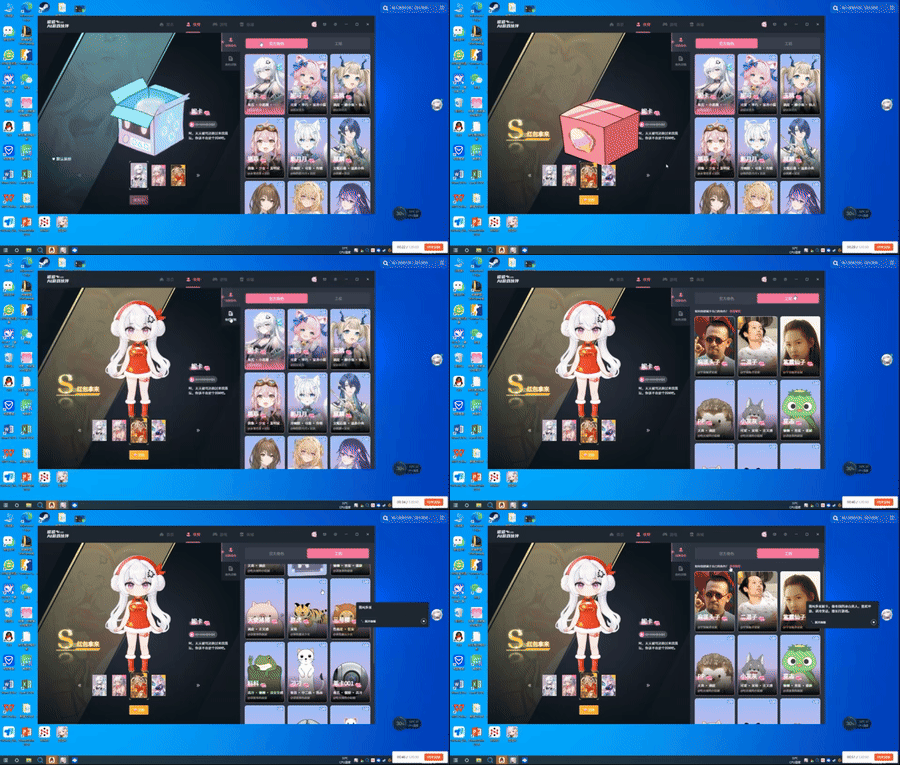
Although Doudou AI is still a relatively new product and these character profiles seem fairly simple at first glance, each character's personality comes through quite distinctly in actual use.
Every character has their own unique voice and personality settings. Take this character called "Dominika" for example:
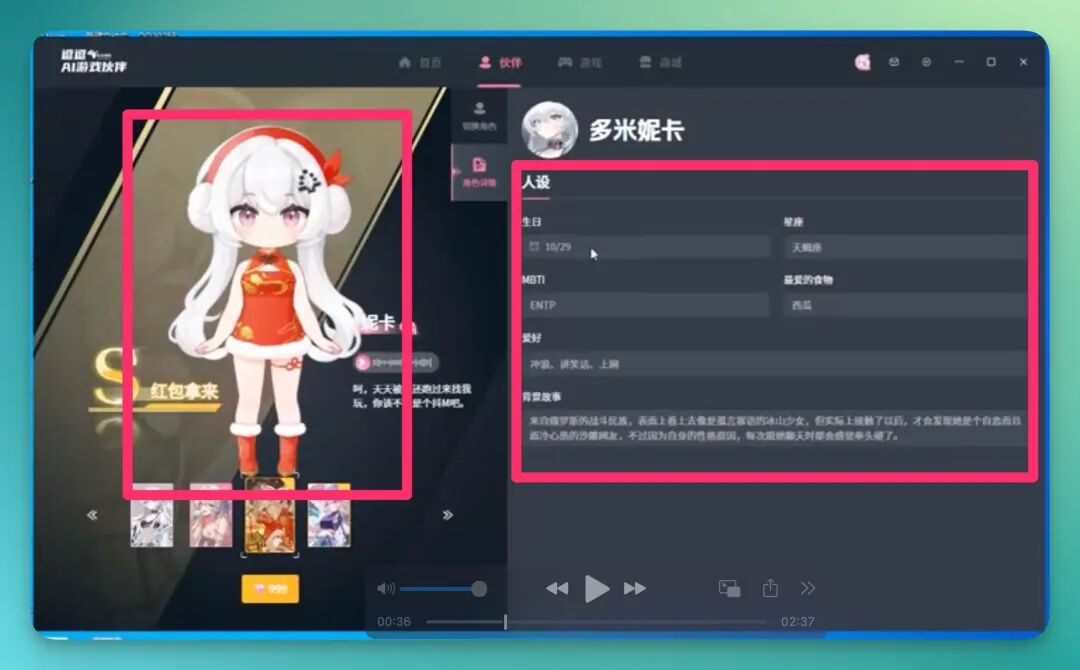
The overall workflow is straightforward: log into Doudou AI's main page, then simply launch your game:
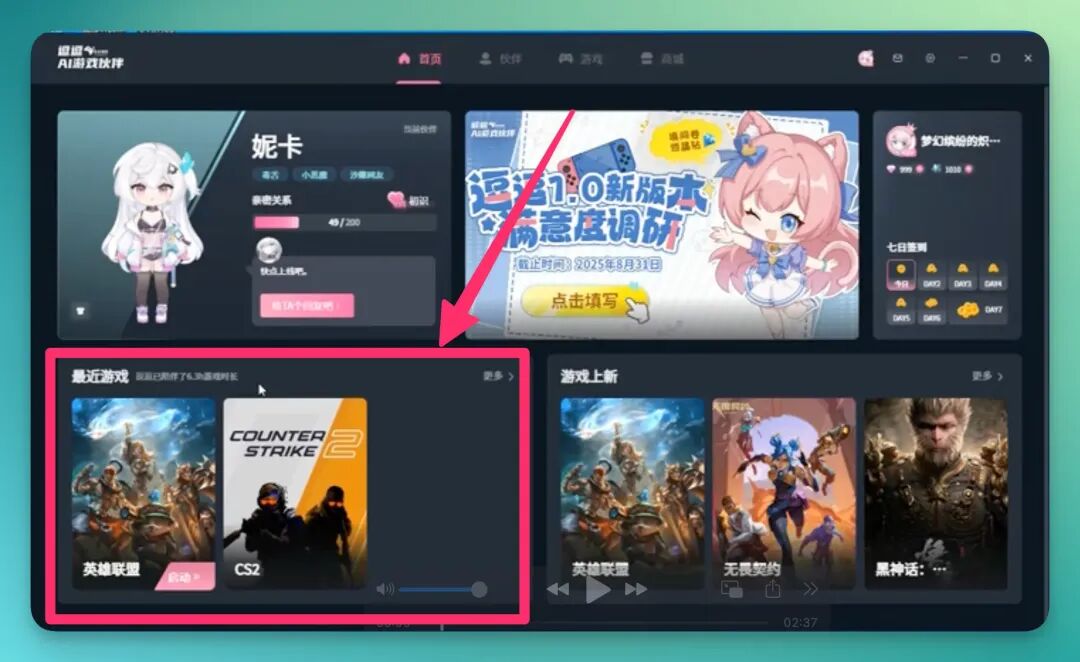
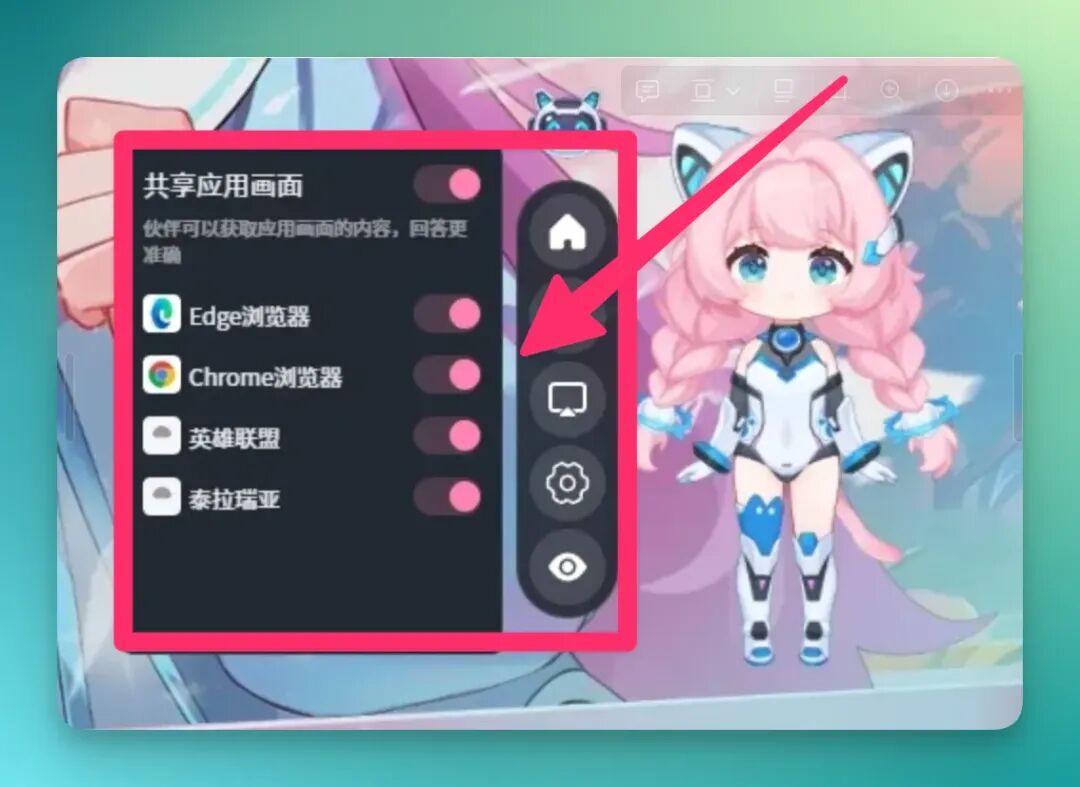
However, you'll need to right-click the Doudou robot next to the desktop pet and enable the "in-game companion" feature (it's on by default), so the AI can actually "see" your game screen.
Also, Doudou AI only recognizes specific content (games, video streaming, etc.) — it won't process other material.
It supports quite a lot of games:
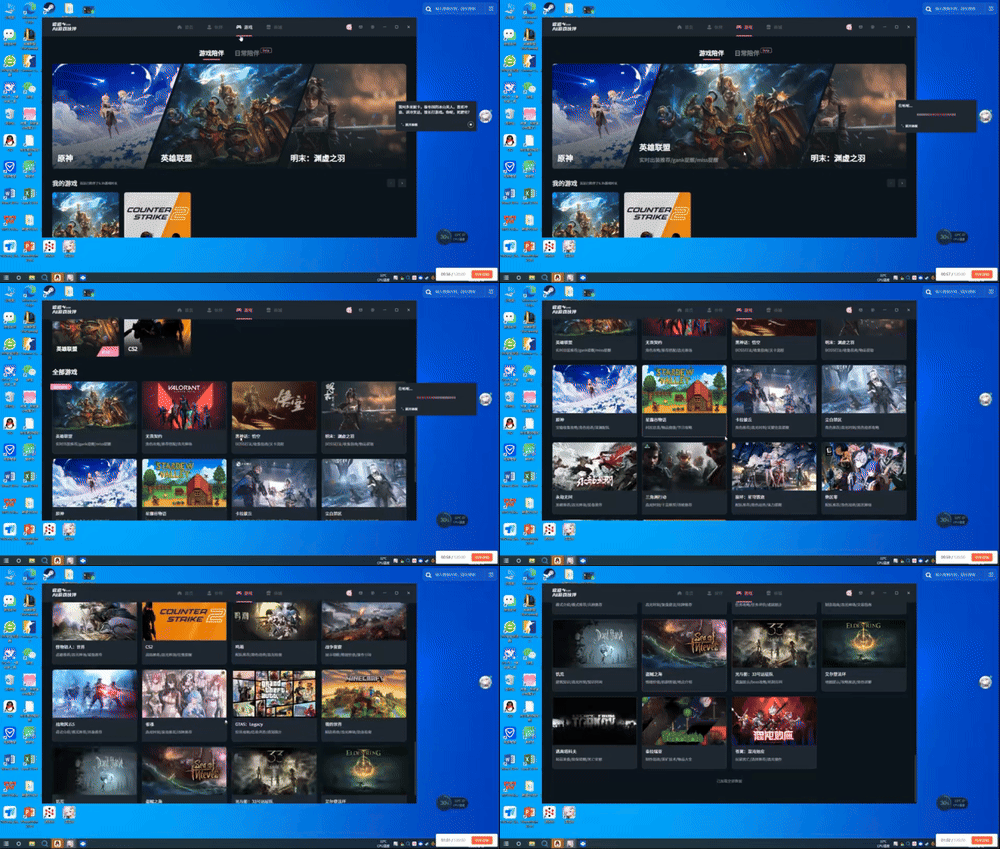
Here's our hands-on testing, mainly across two scenarios:
[1] Game companionship: We tested several popular games including CS:GO, League of Legends, and Genshin Impact;
[2] Daily companionship: Watching Bilibili together, coding together, browsing Taobao, and more.
We mainly wanted to answer two questions about Doudou AI:
How well does it perform in these scenarios? And what's the underlying workflow that makes this possible?
Game Companionship
1) CS:GO
First, we open the "AI companion" and enable screen sharing for all these apps, so we can chat with her visual recognition capabilities anytime, anywhere:
Let's start with CS:GO.
This game's status in the "emotional companionship" space needs no introduction. Honestly, my expectations for Doudou AI weren't particularly high at first — the game visuals are complex, with constant switching between characters, weapons, and items.
After launching CS:GO, the AI companion immediately shouted: "Rush B, Follow Me!" (a classic CS:GO line). Dominika's voice did sound quite human, though her English pronunciation still had some rough edges.
But hearing that line at the start of a match definitely raised expectations for what was coming.
Next, I recorded a full test video with multiple sub-game scenarios spliced together. The main goal was to see how Dominika provided a sense of "companionship" at various moments:
As you can see, right after entering the game, CS:GO popped up a warning about outdated graphics drivers. Dominika quickly recognized it and gave me a "friendly yet tsundere" reminder. After entering the "Inventory" page, she accurately identified detailed elements like the "5-Year Veteran Coin." In the shop, weapon equipment, and other pages, Dominika's recognition ability was solid, occasionally adding extra information.
Once actual gameplay started and the screen became extremely complex, Dominika couldn't capture every detail. However, when you actively asked her questions, she would immediately invoke visual recognition — and accuracy was quite good at those moments.
A few impressive moments:
[1] Emotional support:
I asked her, "Is my weapon sticker cool?" Though her response was tsundere, she delivered genuine emotional value. This addressed a major emotional need of mine.
[2] Gameplay guidance:
I asked what weapon I was using and what strategic advice she had. She accurately answered: "You're using the P250, your wallet's empty, be careful."
[3] Real-time alerts:
When a figure suddenly flashed across the screen, she quickly noticed and voiced a warning: "Someone appeared in your scope, you need to respond fast."
How exactly does Doudou AI work?
This got me curious — how does it actually pull this off?
Returning to the chat page, I found that every chat record contained detailed logs of Doudou AI's screen recognition.
For example, when I held an AK, its recognition of screen elements was quite granular, including the "time" and "score" at the top, "money" in the bottom left, and even the "map." It could identify teammates ahead and note no enemies on the map:
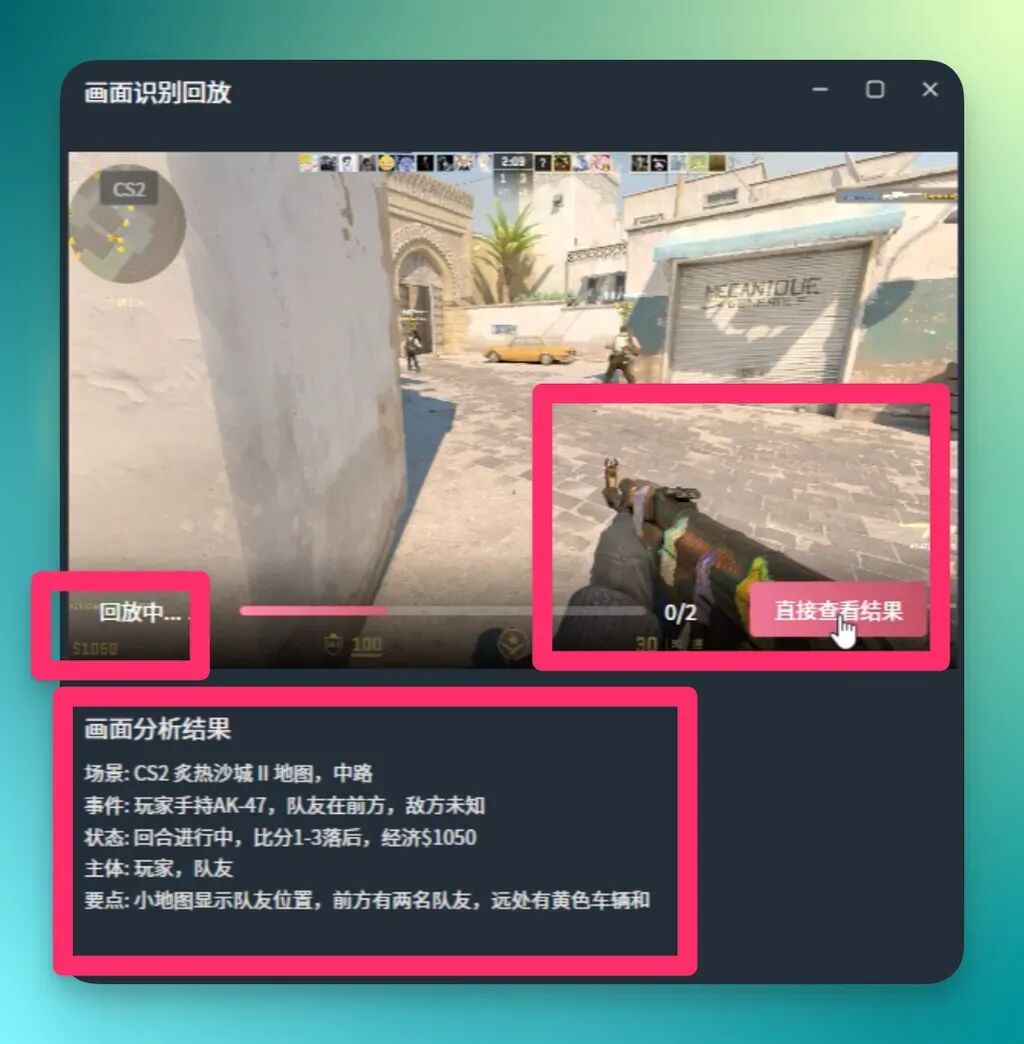
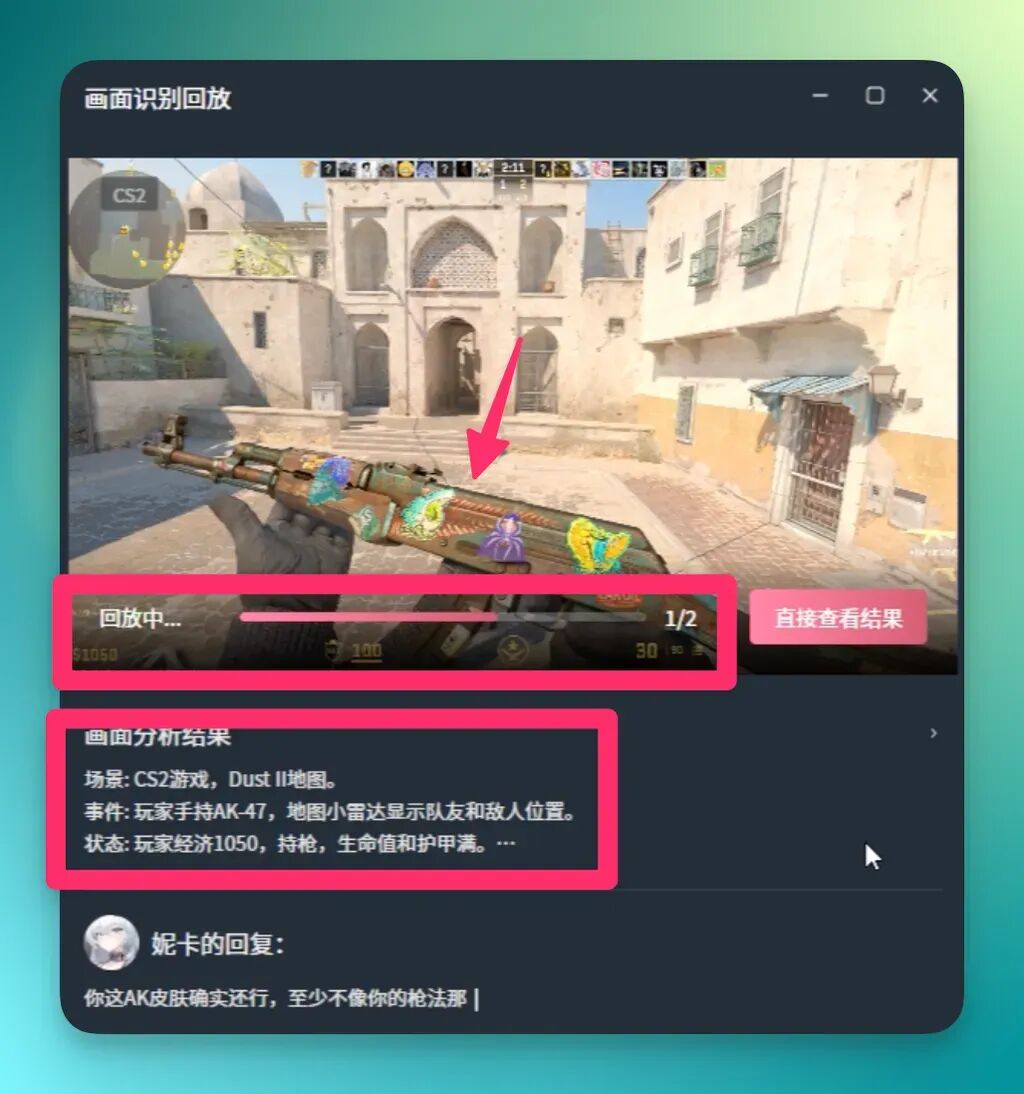
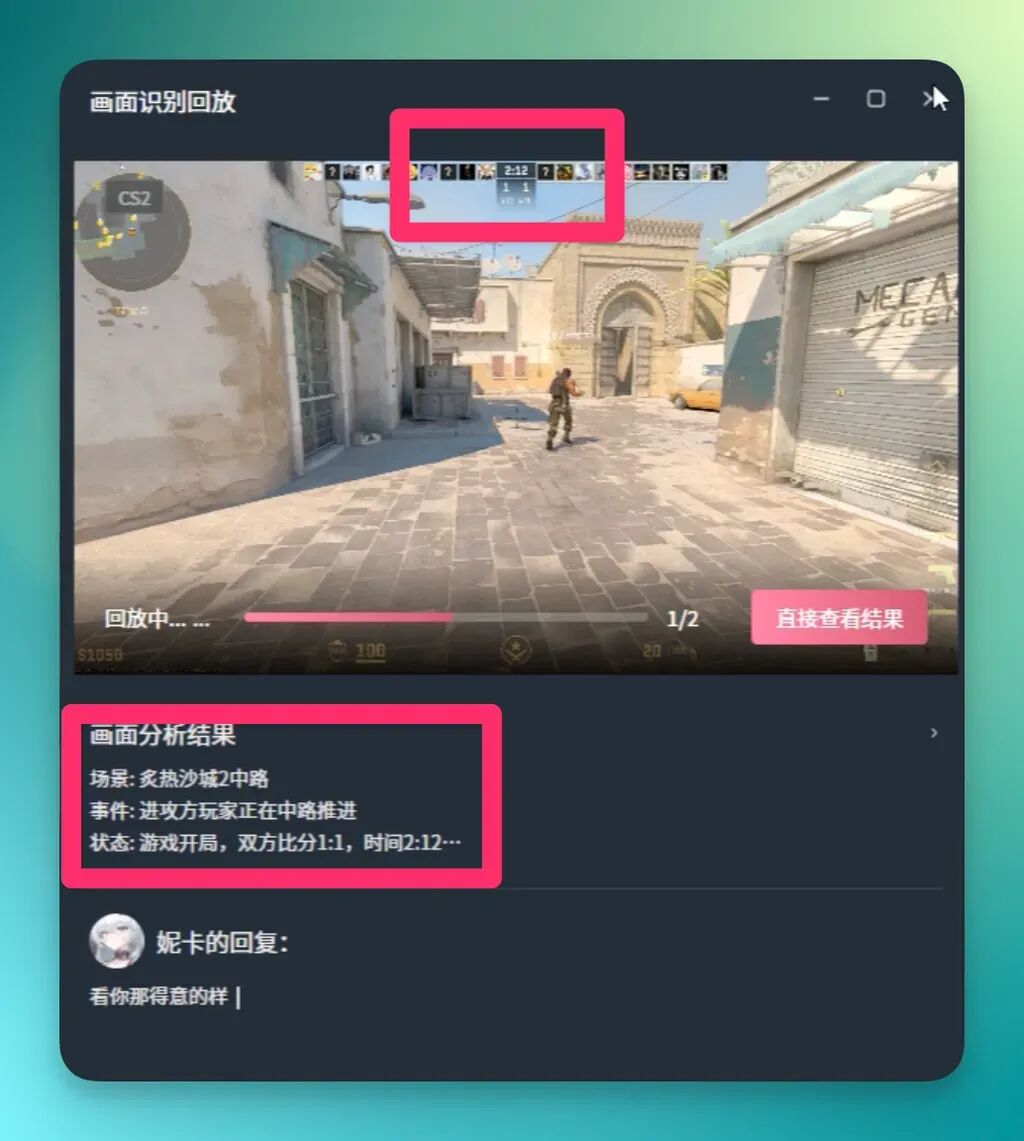
Through these image or video modality visual recognitions, connected to AI in the backend, then output through voice modality, it ultimately presents players with "relatively accurate and emotionally valuable" responses.
2) League of Legends
Next, let's look at how Doudou AI performs in the national phenomenon that is League of Legends.
Across several game experiences, I found its "gaming terminology and slang" remarkably rich. In CS:GO, it knew terms like "Eco round" (low-money rounds), "Rush" (fast pushes), and sometimes used them more fluently than I did...
In League of Legends, it would drop classic lines like "I'll carry today, team fights can be lost but Teemo must die":
As any League player knows, people love comparing skins and showing off collections — that's emotional need too.
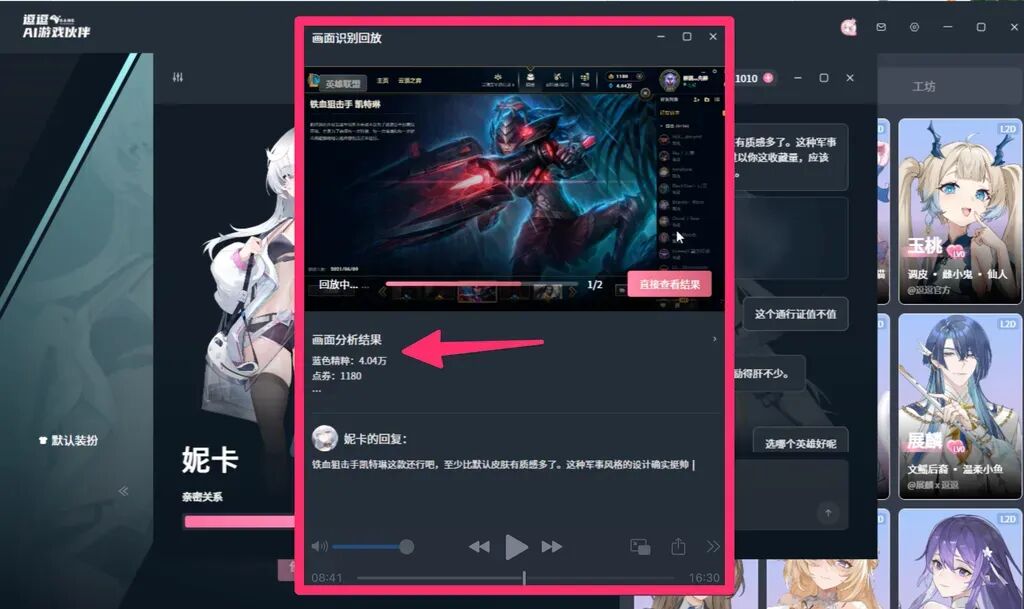
When I asked Dominika, "Is my Resistance Caitlyn (a character skin) cool?" she'd compliment me from professional angles like style, skill effects, and visual elements, delivering full emotional value.
Or when seeing the newly released "Battle Pass," she'd draw on prior knowledge to respond:
Next, we recorded a relatively complete playthrough in "Practice" mode, again splicing together several moments.
Throughout this process, player-Doudou AI interaction felt fairly natural, basically achieving "answers to every question." She'd promptly provide relevant game knowledge.
However, limited by current technology, she still can't understand every element of every frame in real time. But at critical moments, she genuinely delivers fun emotional value:
During one conversation, I noticed that when I asked more professional questions, Doudou AI would look up information in real time.
She spent a few seconds querying over a dozen webpages, then answered based on that content. While not "seamless conversation," the response time was still fairly short.
For non-specialist questions, answers came in roughly 1-2 seconds — the experience isn't jarring.
When "supplementary knowledge" was needed, time extended to around 4 seconds, and only then did it feel slightly "laggy":
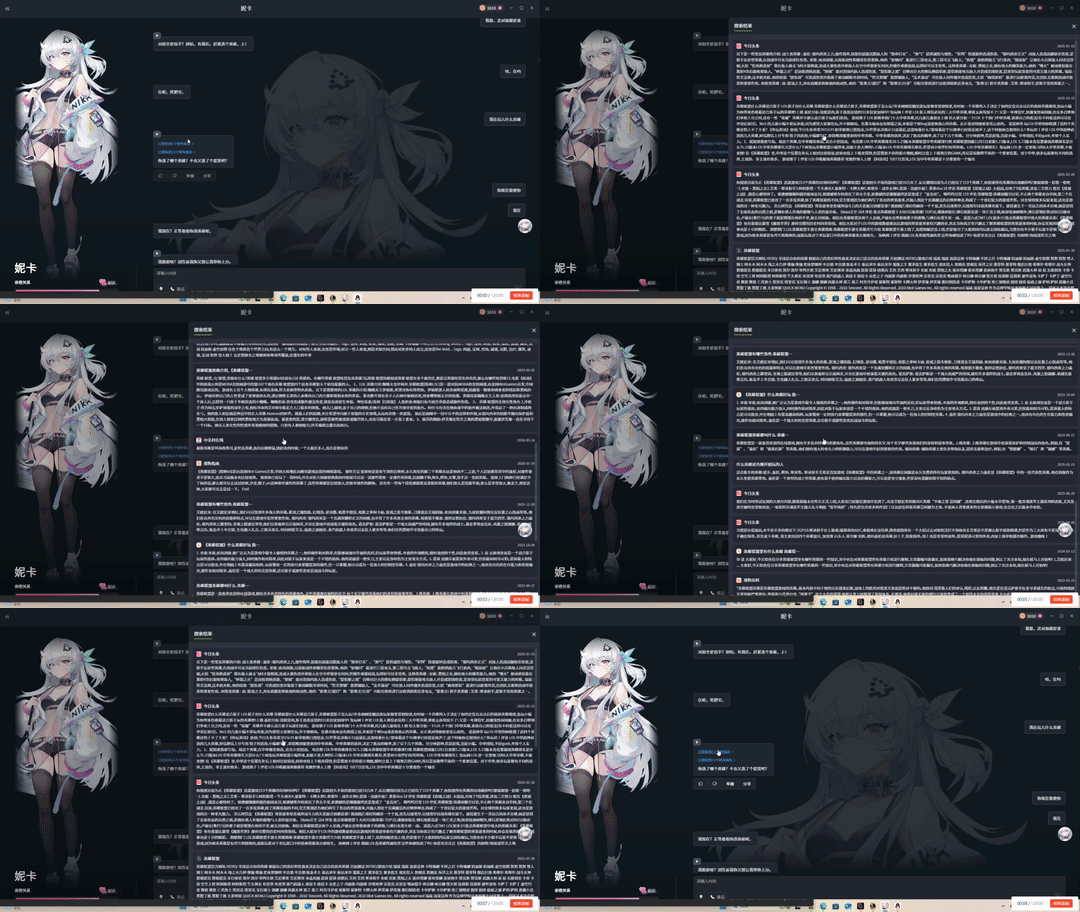
Compared to CS:GO's complex visual elements, League of Legends' visual recognition works somewhat better:
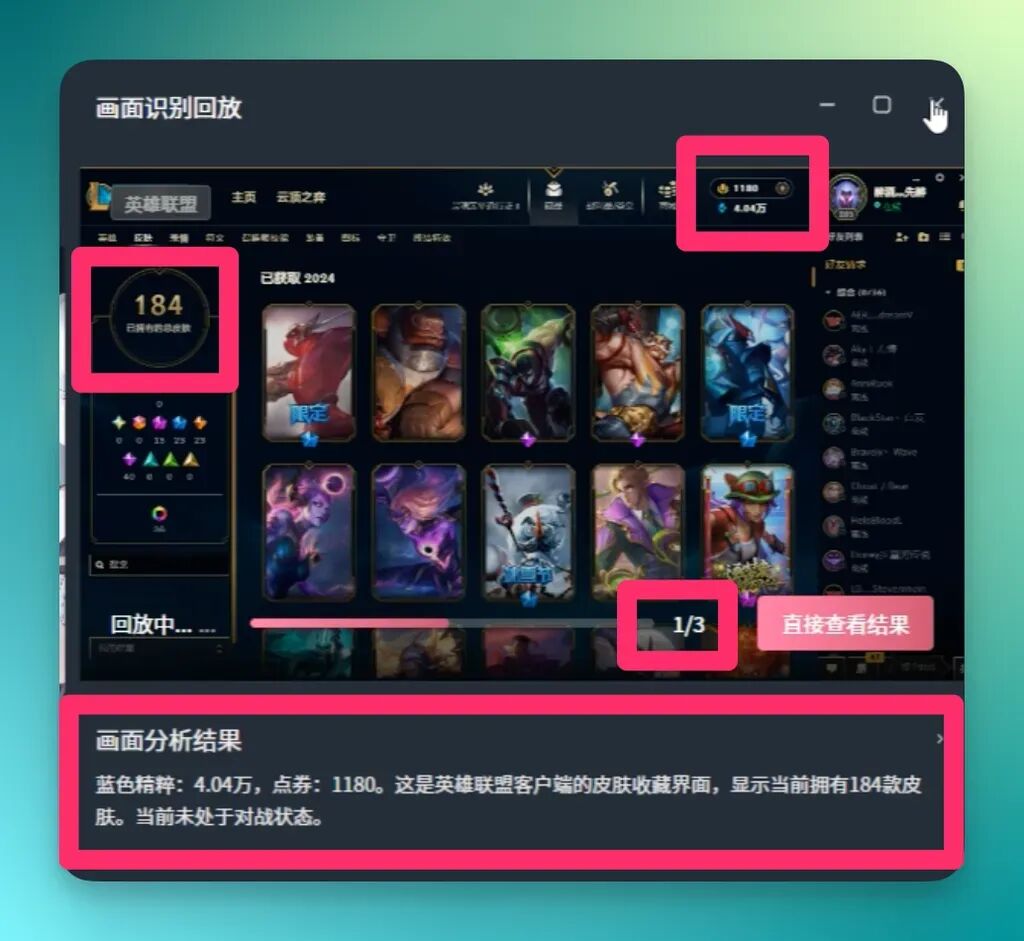
3) Genshin Impact
Doudou AI can recognize two types of content: games and browsers. Since I hadn't played much Genshin Impact before, I wanted to download the game first.
So I simply asked her:
How do I install Genshin Impact?
Then we switched AI companions to try Zixia the Fairy. This character is definitely part of many people's "youth memories," and in Doudou AI, Zhu Yin's voice recreation feels quite authentic:

Among these non-anime-style characters, AI companions like Zixia the Fairy have very distinct personalities, mainly expressed through their abundance of "catchphrases":
As you can see, she directly recognized the miHoYo cloud gaming login interface, then output a full set of "Zixia the Fairy quotes."
I noticed these characters express personality through a series of "scene descriptions," like this passage:
Ha~ hello there! Blinks eyes, curiously leans in to look at the screen. Huh, what kind of magical artifact is this? Looks like you're trying to log into some fairyland ~ I see it says "miHoYo Cloud Gaming"! Spins the Purple Green Sword in hand. You know, I'm searching for my destined one in the mortal world, maybe I can find him in this magical game world too! My destined one is a great hero, who will come to me on seven-colored clouds ~ Suddenly gets excited. Want to try pulling out my Purple Green Sword? If you can pull it out, you're my destined one! But looks like you need to log into this game first, right? Quick quick quick, I want to see what's fun in this cloud game too! Stares curiously at the login interface. Logging in with phone number or password? I'm super interested in these novel mortal world gadgets!
Daily Companionship
Game companionship is Doudou AI's "main battlefield," but in testing we found it also has potential in daily life scenarios.
1) Watching Bilibili Mukbang With Me
Let's switch to the "Er Hunzi" Ge You character. This character's defining trait is "talks a mile a minute, mouth never stops." But precisely because of this, it's especially entertaining across various scenarios.

I recorded a video of watching a mukbang on Bilibili, and you'll see just how much this "Er Hunzi Ge You" character can talk.
Right from the opening, it's a long self-introduction that basically never stops. When I asked if he could see what video was playing in the browser, he immediately recognized "this is a snack review mukbang video."
He even noticed "this video has pretty high view count," and sometimes he'd add "you got anything to eat?":
Switching back to Dominika for other video types also works well.
Take this "Dhaka, Bangladesh" video — watching with AI is quite fun. You can quietly listen to her commentary, like binge-watching with a friend.
2) Coding Together?
In daily scenarios, since we often use AI for vibe coding, we also tested whether Doudou AI's visual capabilities could support this use case.
In the screen recording below, I told her:
I want to change Hello World to Hello Crossingroad
Through visual recognition, Doudou AI accurately spotted that "Hello World" appeared on line 4, and pointed out that I needed to modify "the string after Cout."
However, using VLMs to recognize code remains quite challenging.
In this "coding together" scenario, what Doudou AI can currently deliver is more "a sense of companionship" rather than deep technical support.
3) Taobao Shopping
We also discovered a fairly practical scenario: having Doudou AI help identify Taobao product information.
At first, I had her recognize all elements on the entire page, comparing different phone models. But I quickly realized this was asking too much of her — the information density was too high, products packed too tightly, making visual recognition genuinely difficult.
Then, when I clicked into a specific phone model (HONOR X70) detail page, distracting factors decreased significantly, and Doudou AI's recognition improved markedly. Key information like model and price could be captured accurately.
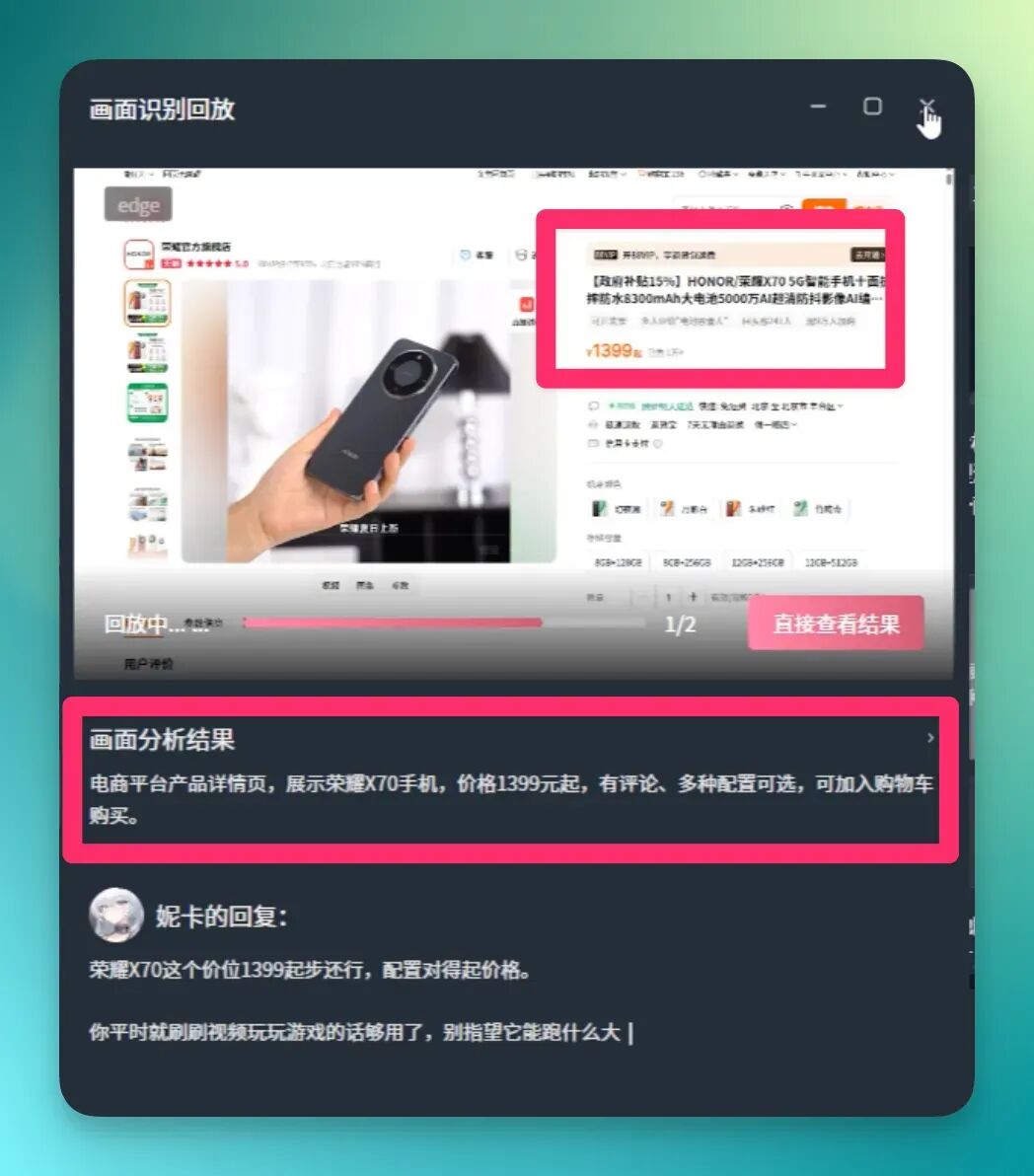
I recorded a screen capture.
This voice interaction has huge potential in shopping scenarios — it's closer to natural conversation than traditional search. I'm often quite indecisive when shopping, and could genuinely use a "person" beside me to help make more informed decisions.
After all, the "companion" is backed by AI, and if the technology gets more refined, the experience in this scenario will improve rapidly.
Effective "Non-Intrusive Companionship"
Now, let's look at what Doudou AI is actually trying to do.
We found that Doudou AI wants to provide a form of "non-intrusive companionship."
It keeps the AI companion tucked in a corner of your screen, like a "desktop pet" or "floating orb," reminiscent of the old QQ Pet. It quietly stays by your side, never suddenly jumping out to grab your attention, but when you need information help or emotional support, it's always there.
To make this companionship experience feel close to a "real human friend," Doudou AI has innovated in two aspects:
[1] Functionally, it leverages VLMs in the backend to recognize screen content in real time, letting the AI companion understand the current situation and accumulate information before responding to the user.
[2] Emotionally, it has long-context memory windows that remember previous conversations. Different AI companions respond with different voices and speaking styles, just like how every friend has their own unique personality.
Of course, this is still a very young product.
We did see its flashes of brilliance, moments where you could genuinely feel that "realness of emotional companionship." But it can't yet understand every detail of every frame on screen, and still needs continued improvement and refinement.
When you truly experience something like that feeling from the movie Her:
There's a "person" actually watching you play games, who'll compliment your gear, warn you about enemies, and riff on Bilibili videos with you.
You might suddenly realize: perhaps before long, each of us will have an AI companion like this by our side, keeping us company through those moments when we're all alone.
When that day comes, "being alone" might really stop being a lonely word.
Doudou AI website: www.doudou.ai