What's Behind the AhaCreator 3.0 Update: How AI Is Reshaping the Creator Marketing Industry

Why Is "Influencer Marketing" a Piece of the Pie That Claude Code Can't Cut Out?
Why "Influencer Marketing" Is a Piece of Cake Claude Code Can't Cut

👦🏻 Author: GaKi
🥷 Editor: Koji
🧑🎨 Layout: NCon

AhaCreator has updated to 3.0, another major release. The core modules — AI-native matching, risk screening, full-process execution, and content review — have all been overhauled this time.
It's always been a product at the center of attention. For many companies going global, or purely overseas products, ads are getting more expensive, community growth is slow, and SEO takes time. Influencer content may seem less standardized, but it's closer to users and better suited for explaining a new product clearly.
Since its initial release under the name Head AI (later renamed due to trademark registration issues), it hasn't stopped generating buzz. Across various communities, you hear all kinds of takes. Some think it's carved out a new path; others dismiss it as just an automated email tool. And some are watching the moves of big tech and capital behind it. After all, according to official AhaCreator information, the platform has 100,000+ registered creators, making it one of the world's largest AI-native influencer marketing networks, with corresponding "momentum" in the influencer marketing space.
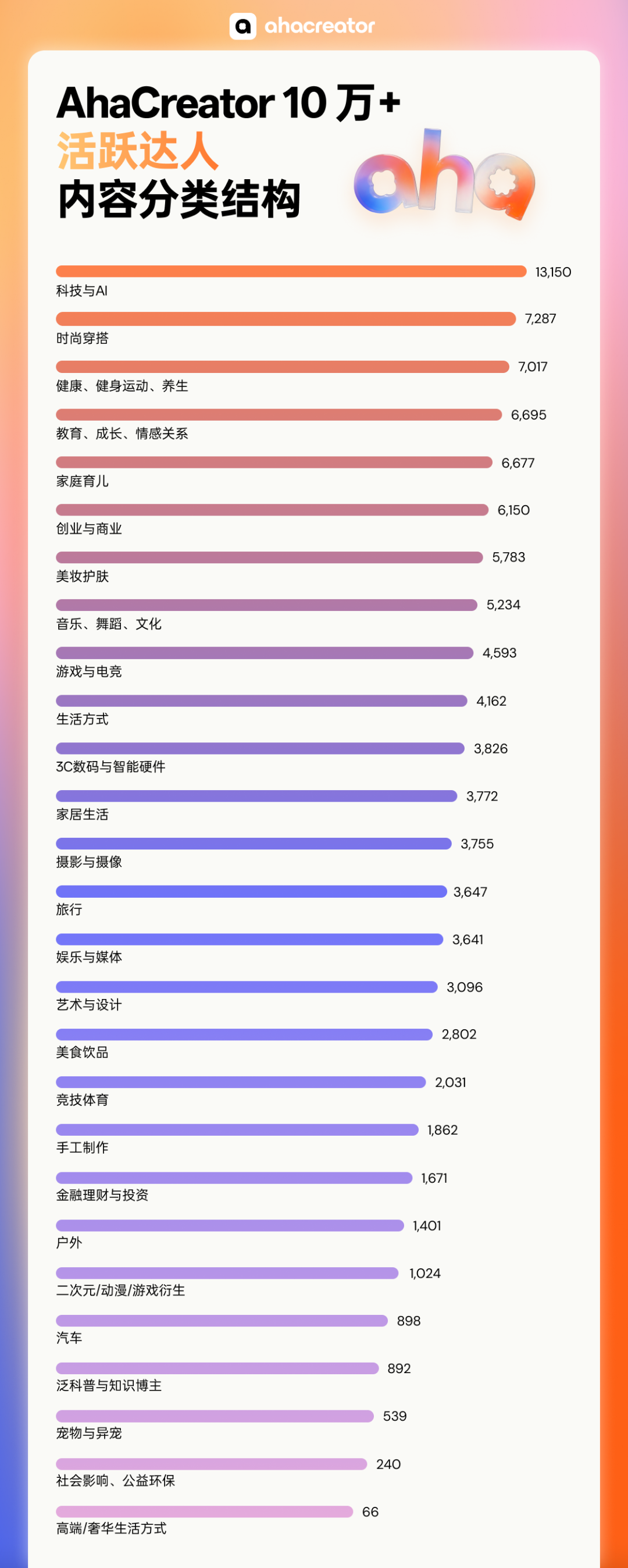
A quick overview of what AhaCreator is:
AhaCreator does overseas influencer marketing, essentially as an AI-native platform. When brands want to find overseas creators for product promotion and content, the traditional process relied entirely on people to screen creators, send outreach emails, negotiate back and forth, chase deliverables, and finally collect data for review. AhaCreator chose to hand this long chain over to an AI-native platform to push forward, with humans positioned to make judgments and set strategy.
In the Aha 3.0 version, AhaCreator has innovatively offered a new answer —
Not only did it build a 7×24 AI Agent product, but it went further to construct an AI-native two-sided platform, gradually moving brands, creators, and the entire influencer marketing workflow onto the same platform.
This approach is somewhat reminiscent of early Uber: connecting demand on one side and supply on the other, continuously improving matching and fulfillment efficiency through technology. As more brands and creators complete collaborations on the platform, the transaction data, fulfillment experience, and network effects accumulated become new competitive advantages.
🚥
For this Aha 3.0 update, our Crossing team did first-hand testing.
Beyond the product test itself, we also spoke with AhaCreator's Founding Engineering Team about technical details. AhaCreator's CPO Francis Yang is a former core product manager at TikTok Creator Marketplace. The Engineering Team includes Ray Lei, a Tsinghua University competition admit and former Dora AI engineer; Kade Wu, an AI engineer from Liftoff; and senior AI engineers from ByteDance, Grab, Meituan, and other companies. Some of the content below also comes from this exchange.
We tested several core modules updated in Aha 3.0 and tried them all hands-on. Here's our walkthrough in actual usage order.
Creating a Campaign
This time we'll use SeaArt as a typical case study. SeaArt, developed independently by domestic company SeaArt Entertainment, is a one-stop, full-category AI creation platform. As one of the earlier entrants in the AIGC track domestically, it has grown into one of the world's leading AI content creation communities, with ARR exceeding $50 million and monthly active users (MAU) surpassing 25 million.
SeaArt's product pace has always been fast. To keep up with industry changes and respond more quickly to user needs, the team has made weekly iterations and 2-3 day minor updates the norm. This R&D rhythm ensures product agility but also places higher demands on team capacity. Therefore, how to improve content production and collaboration efficiency became the key background for SeaArt's adoption of AhaCreator.
"Speed of competition is critical. AI product globalization requires faster testing, faster iteration. Human efficiency can't expand infinitely, but growth tasks keep increasing — traditional execution methods can't keep up," shared Meiling Liu, PR Director at SeaArt Entertainment. "In the future, growth teams will evolve into an influencer marketing model of 'humans defining goals + AI executing processes.' Those who adapt to this approach earlier will see prettier growth curves. That's why we chose AhaCreator."
We ran through SeaArt's complete influencer marketing workflow on the platform (thanks to the SeaArt team for sharing their experience and data).
Looking first at the campaign creation step, Aha 3.0 has significantly restructured the overall product flow. When creating a new campaign, you can directly input a product URL, and AhaCreator will scrape the website's product information, summarize it, and extract key information points.
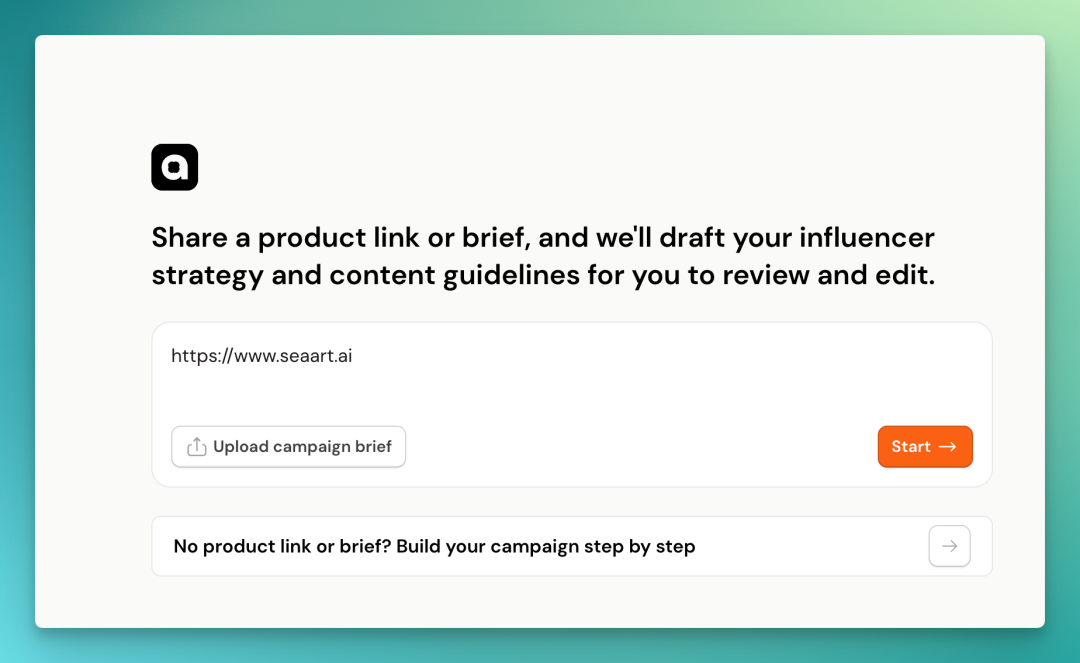
After entering the target product URL, the system scrapes and organizes information, then immediately has you select the platforms for distribution. That is, you can directly choose which social platforms you want to use for influencer marketing, and the system will proceed with subsequent creator matching based on these selections.
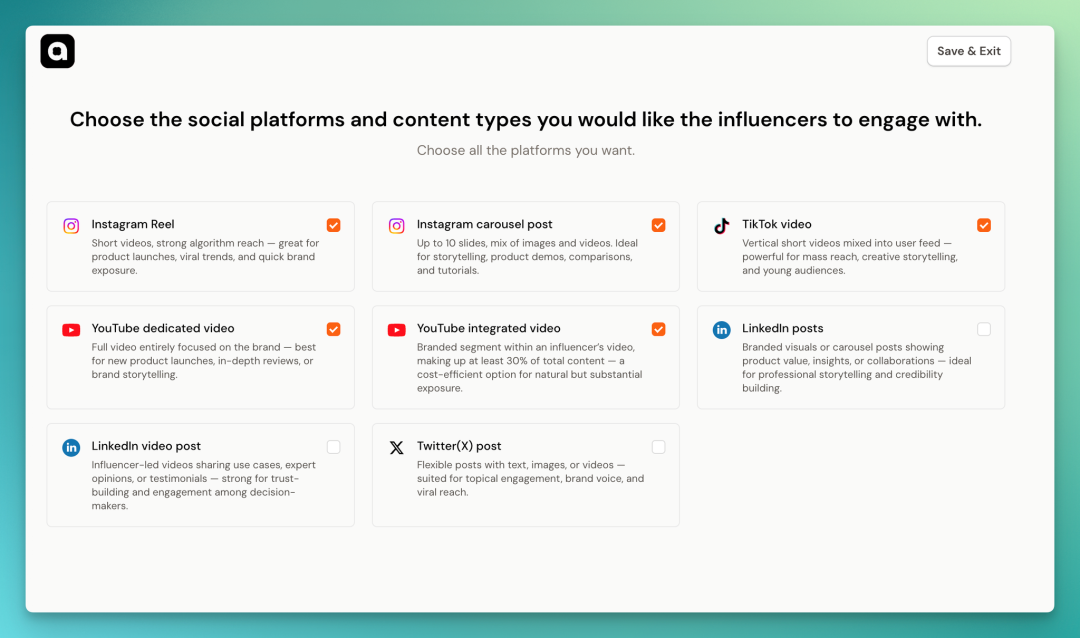
Having already entered the product URL and with AhaCreator having scraped the product information, the user selects which social platforms to advertise on; at this step, the system has you set distribution conditions for each platform separately, such as platform, country/market, creator collaboration direction, content format, etc., preparing for the subsequent AI creator matching.
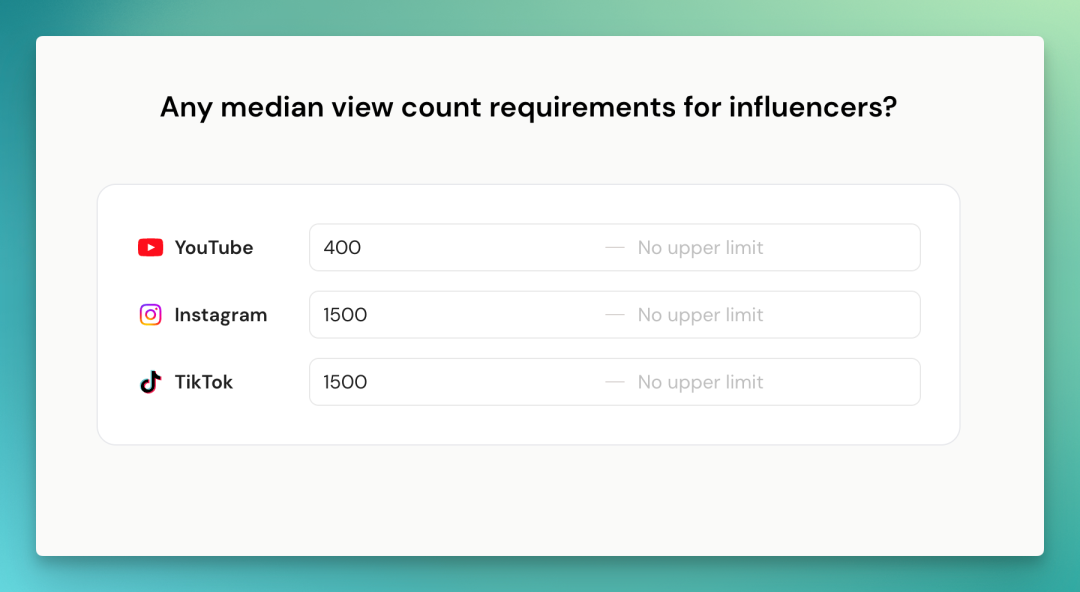
Next comes generating the creator Profile for this campaign — the target creator persona. Users can supplement reference creator links, competitor links, or other product-related information here to help the AI more accurately understand the target audience, thereby generating creator personas that better match project needs.
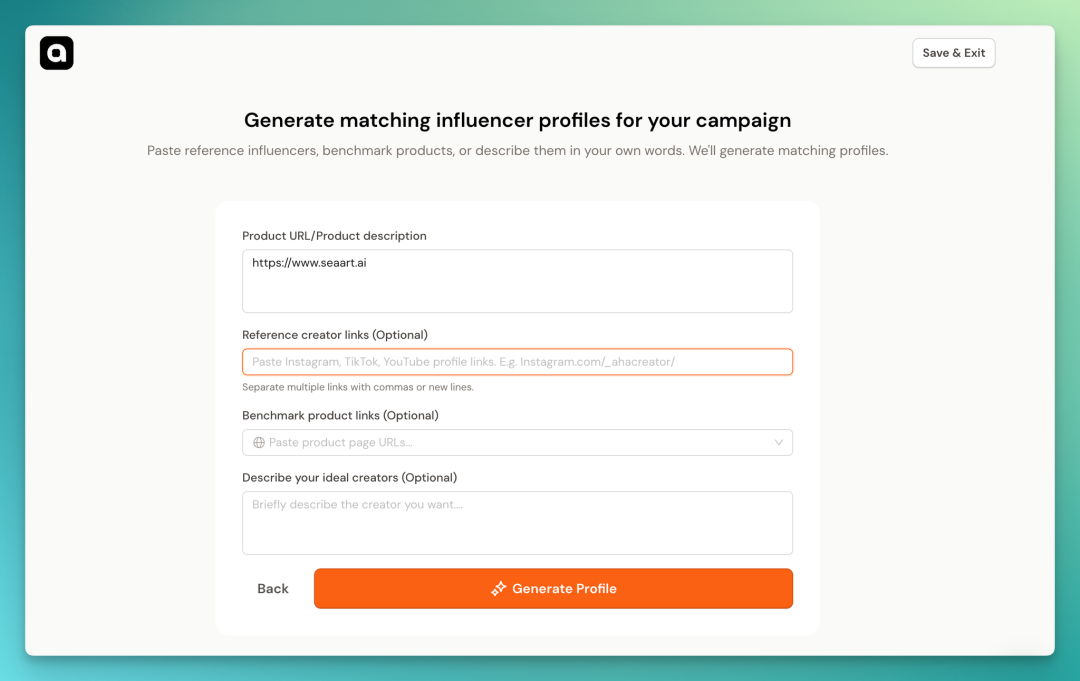
After completing the basic configuration, AhaCreator further generates creator Profiles. These Profiles aren't specific individual creators, but rather sets of ideal creator personas.
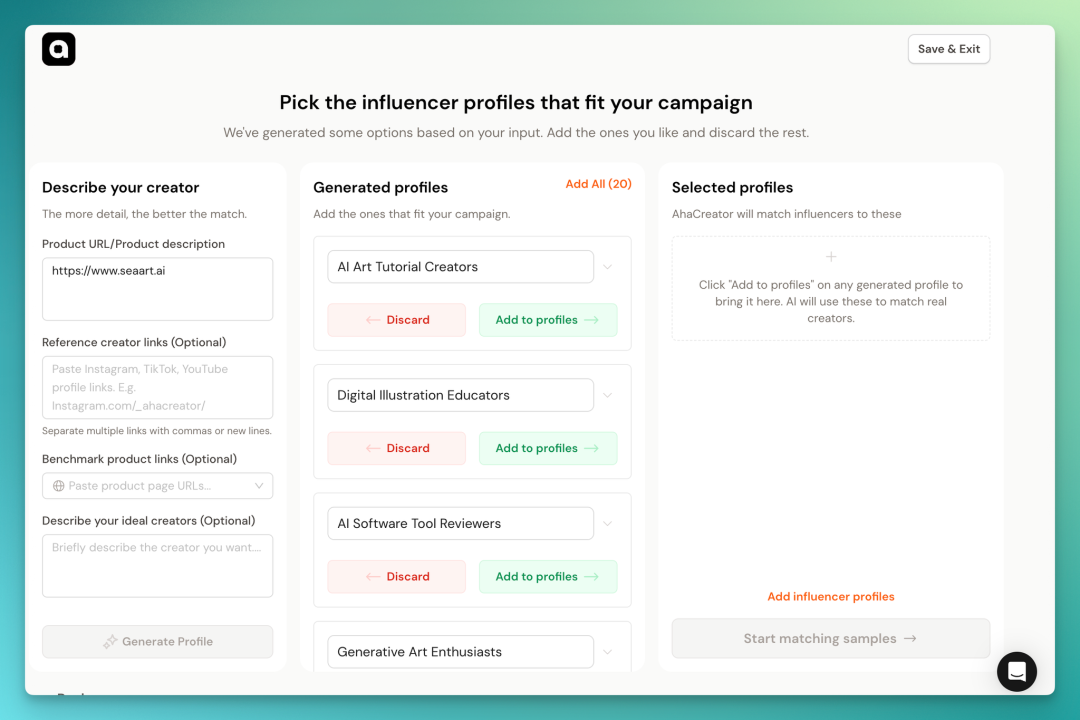
Based on SeaArt's product characteristics, AhaCreator automatically generated multiple creator persona groups.
Users can keep, delete, or continue modifying these personas, ultimately combining the creator pool that best fits campaign needs.
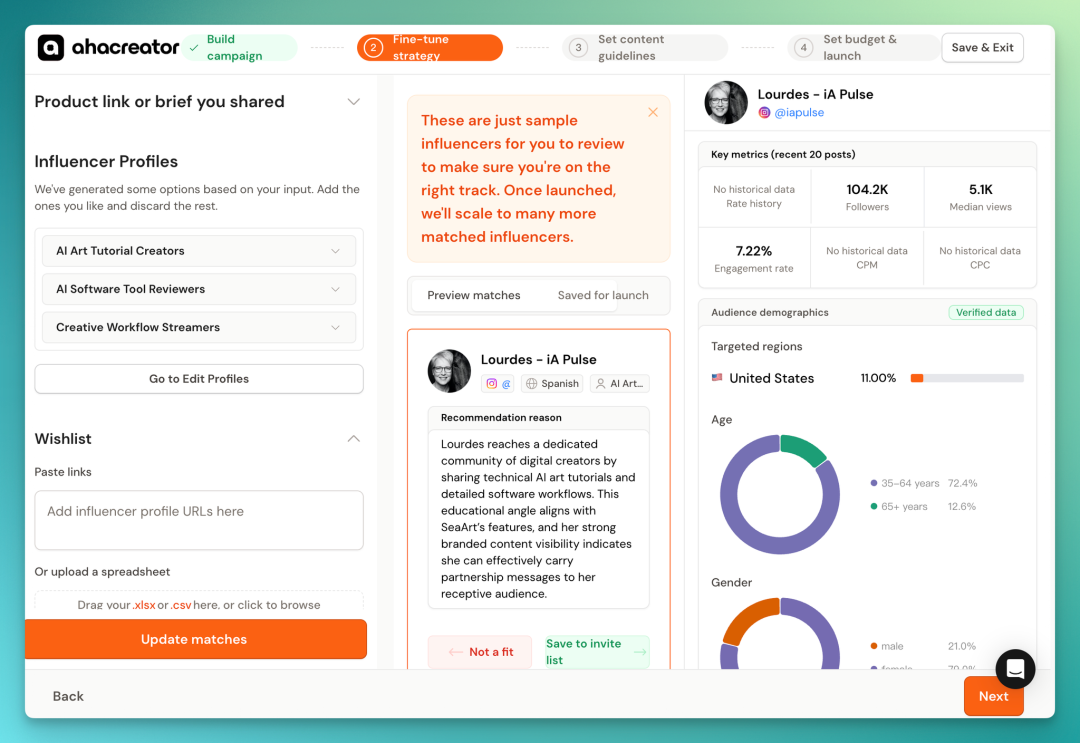
Once the information is received, product keywords, target creator personas, core selling points — these fields are all analyzed and pre-filled by the AI Agent itself, with very precise output that only requires human judgment.
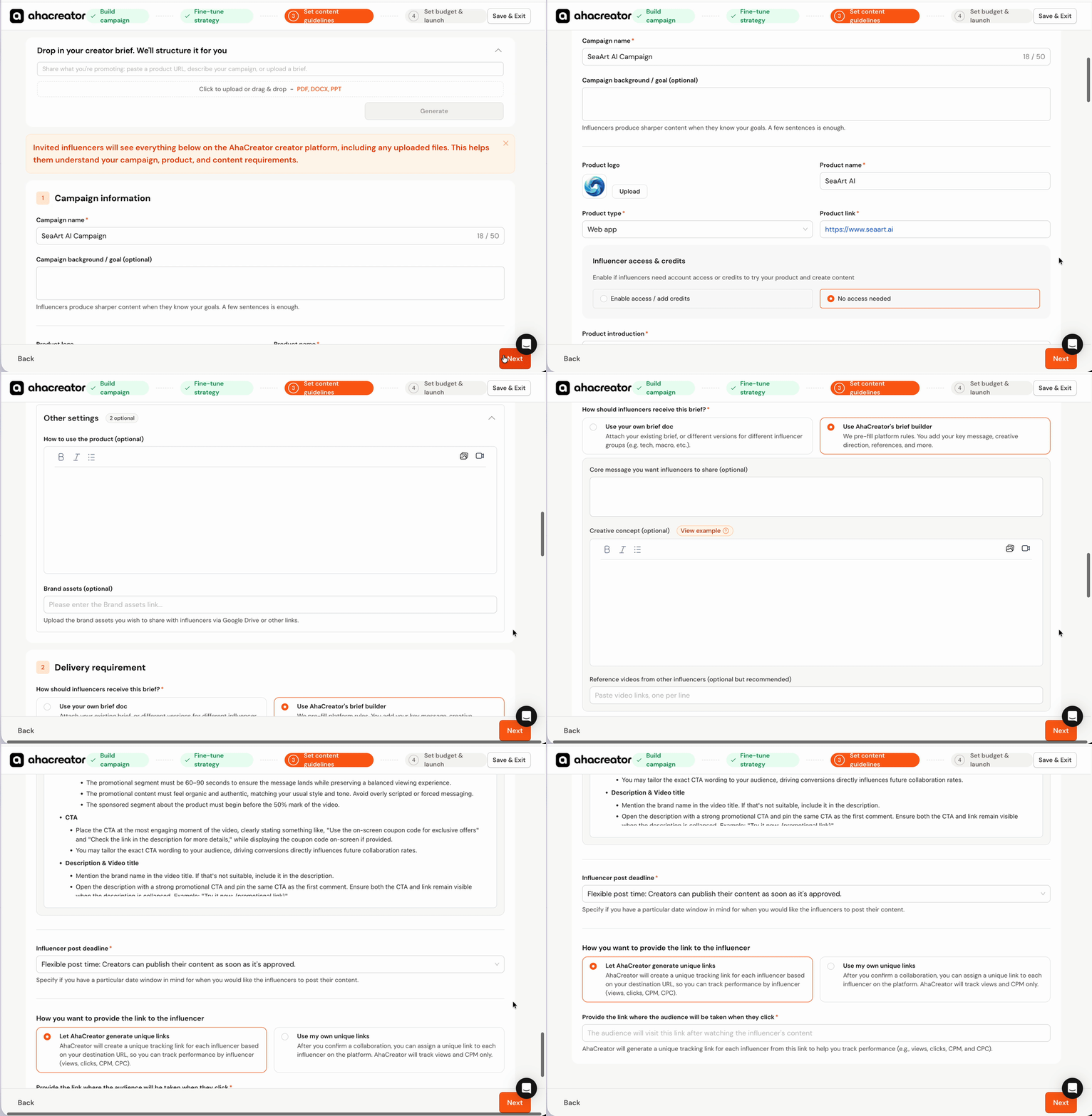
The next step is to establish a guideline confirmed by the brand for the actual content production of the entire influencer marketing effort — a clear operational guide. This guide tells creators what to pay attention to when producing content, ensuring the output aligns with brand tone and marketing strategy.
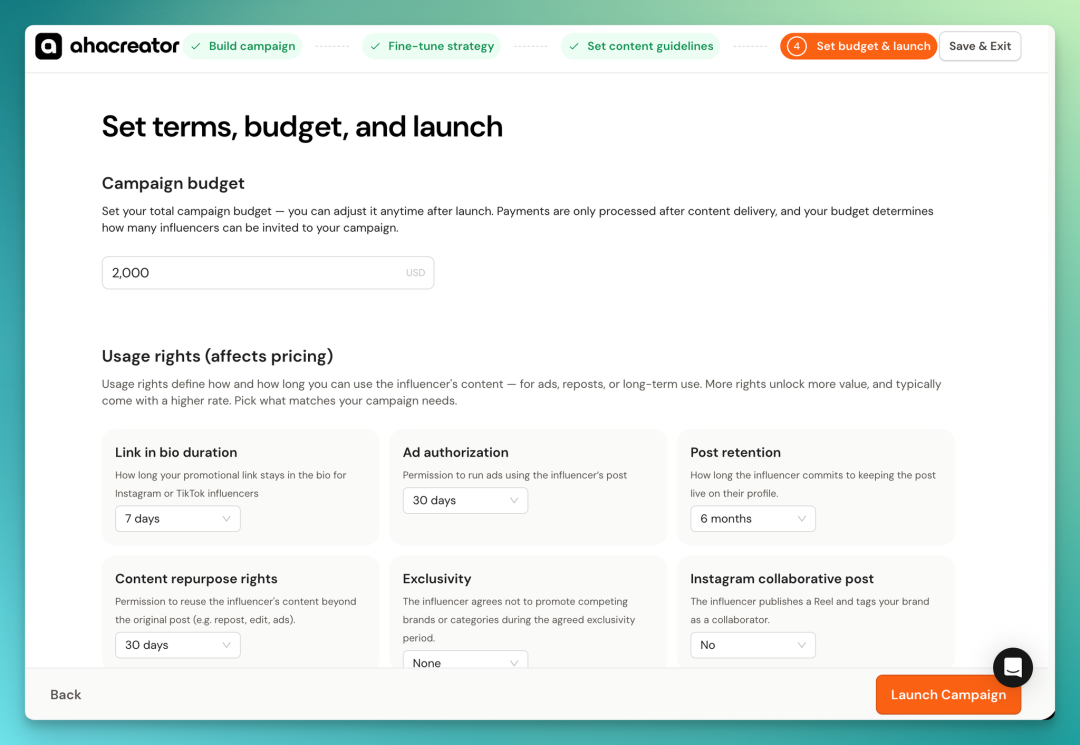
Below that is setting the overall budget for the entire influencer marketing campaign, plus usage quotas:
(The data in the image below is virtual data entered by Crossing for testing)
Real Backend
Entering the real backend, the most intuitive element is the campaign status flow. You can see a campaign progress from launched, matching & inviting, influencer interested, all the way through to quoting and application processing.
Brands don't need to track progress via spreadsheets; the backend lets you directly see where each step is stuck.
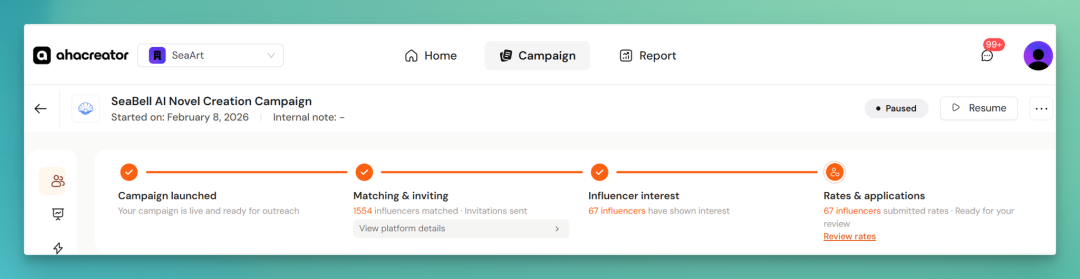
Individual creator collaborations are broken into multiple trackable nodes, including outreach, script production, awaiting publication, payment, and collaboration cancellation status. Influencer marketing appears to be content collaboration on the surface, but it's actually more like a set of scattered small project management tasks. AhaCreator 3.0 centralizes these processes into the same backend, letting brands see at any time how far each creator has progressed, reducing significant manual follow-up costs.
According to the AhaCreator team, 3.0's matching no longer looks only at data metrics like follower count and view count, but also incorporates multimodal information including video content, audio, and comment sections, allowing the AI's understanding of creator style, brand fit, and potential risks to approach that of human operators.
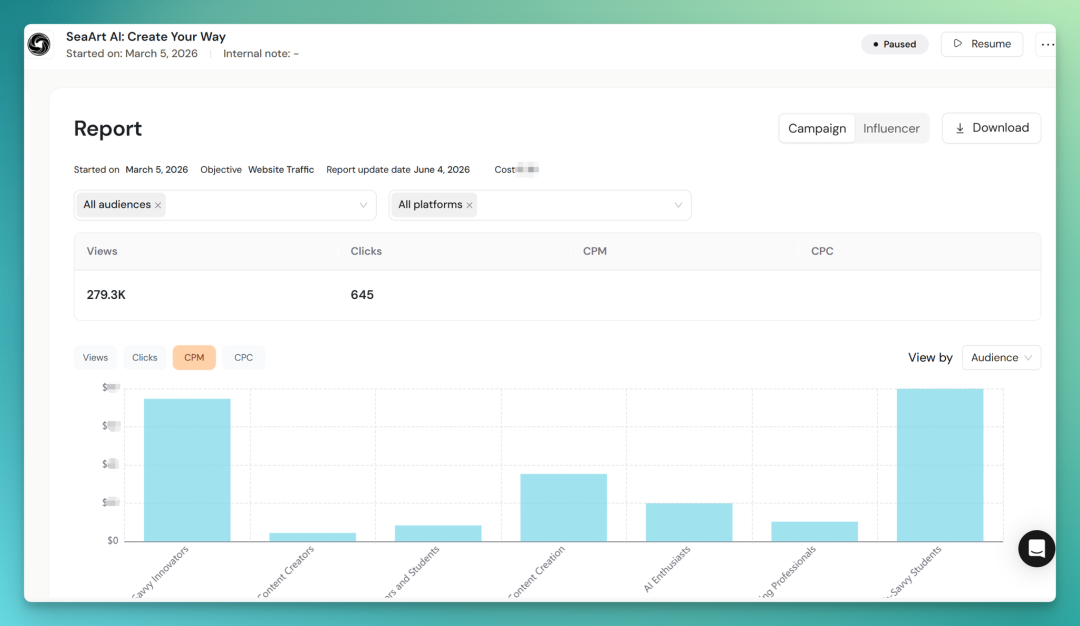
In the Aha 3.0 backend, brands can see a complete campaign data report. The report aggregates core metrics like total impressions, reads, and clicks for the entire project, while also breaking down the specific performance of each piece of published content, making it easy to quickly evaluate the actual effectiveness of different creators and content pieces.
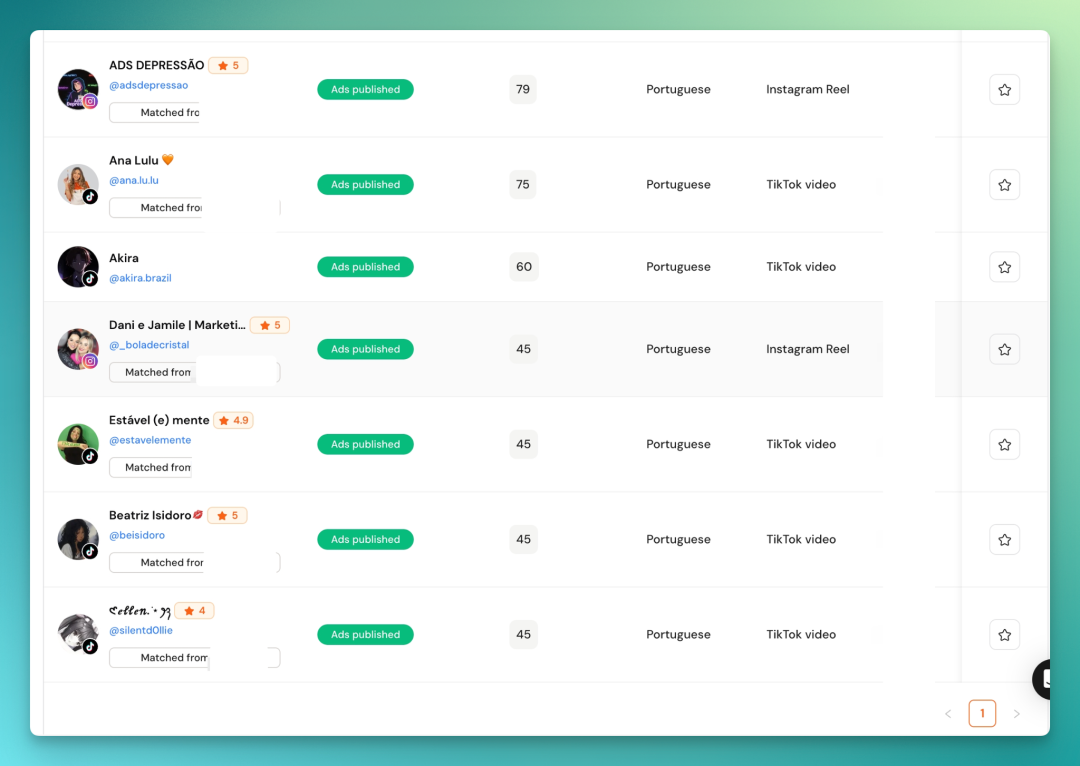
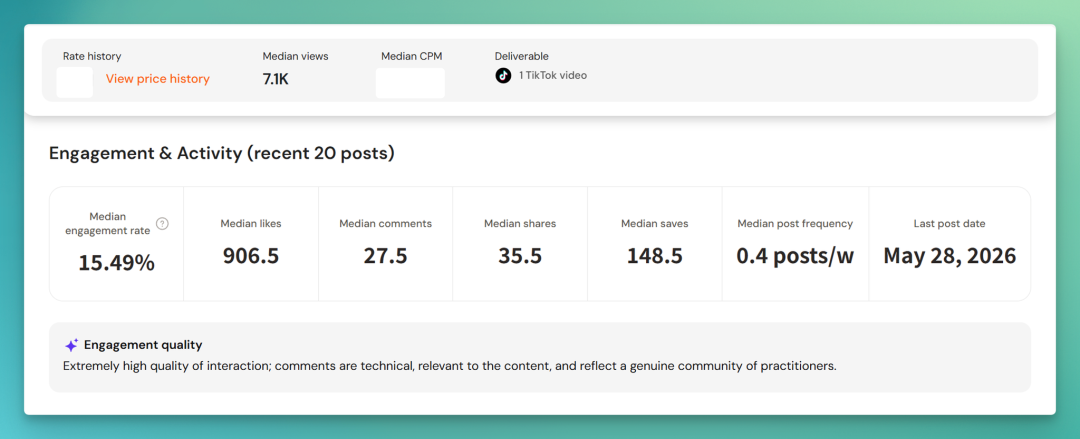
In the Aha 3.0 backend, each KOL displays AI-integrated scoring dimensions and provides key data on their approximately 20 most recent posts, including engagement, audience reach, and performance trends, helping brands comprehensively evaluate creator quality and content effectiveness.
Meanwhile, before confirming collaboration, the system conducts risk screening: fake followers and comments, abnormal comment sections, controversial content, mismatched audience demographics, or unstable content quality — these issues are flagged early at the list stage, avoiding subsequent collaboration risks.
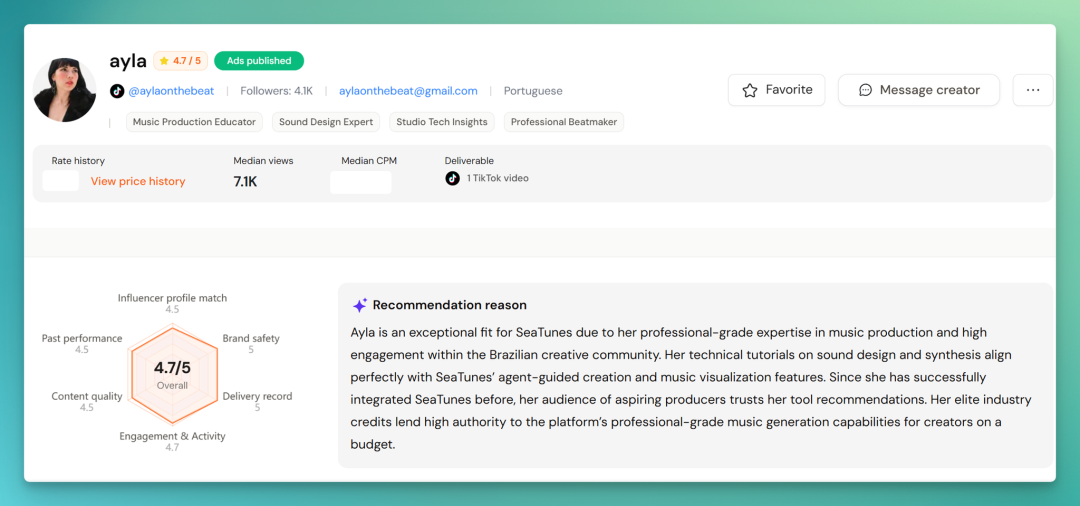
Regarding this creator's audience analysis, Aha 3.0 presents it in considerable detail, including audience age distribution, gender ratio, geographic location, and ultimately provides a matching score between this KOL's audience and the target campaign, helping brands judge how well their target demographic is covered. It also covers creator data analysis, such as comments and likes on their last 20 posts, even including the publication date of their most recent post, and so on:
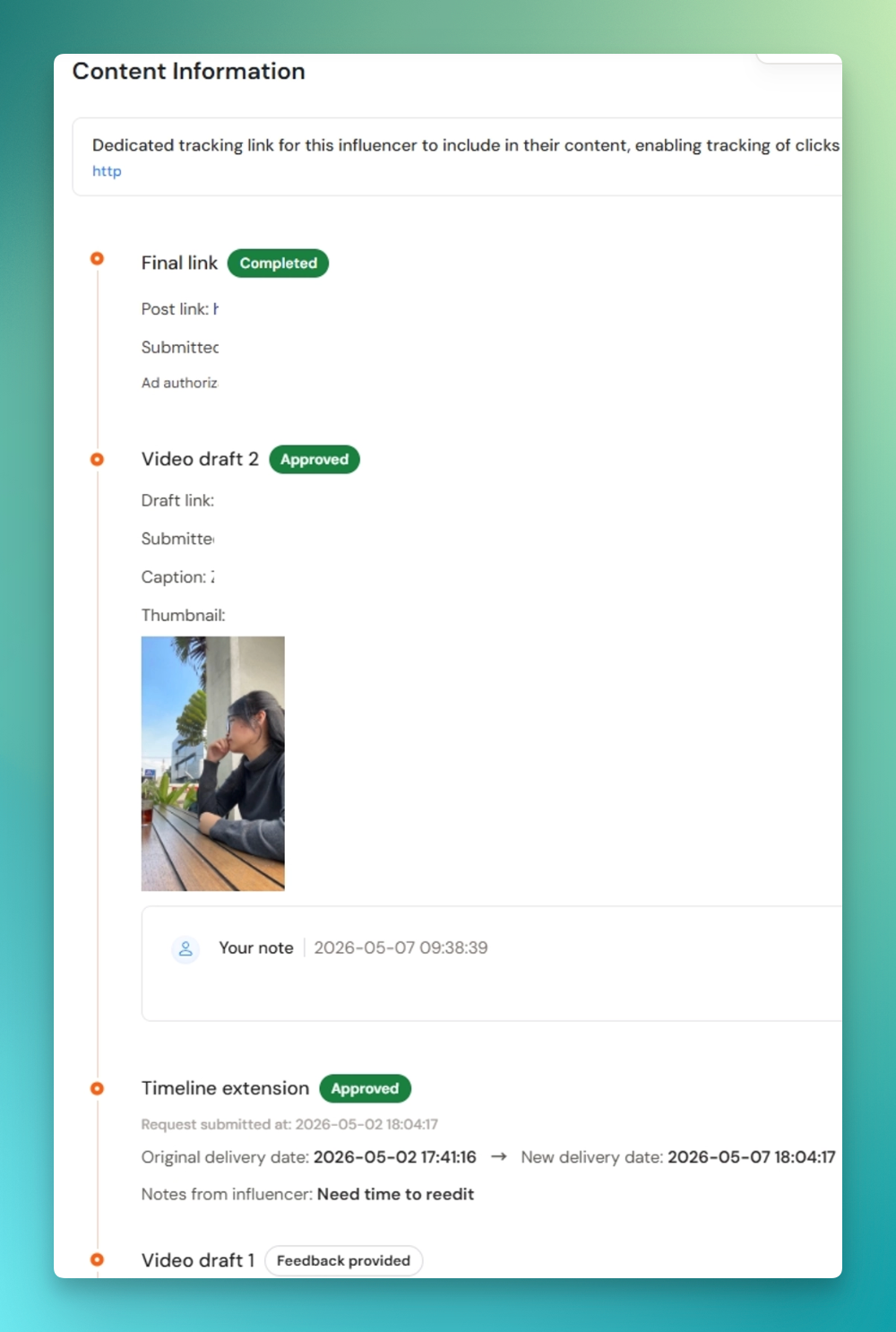
Throughout the content publishing and revision process, Aha 3.0 allows brands to communicate directly with KOLs in real-time within the backend, without switching to other tools, making content proofreading, feedback, and confirmation processes more lightweight and efficient.
All KOLs who participate in collaborations and complete content publication are centrally managed in the backend. From creator screening, communication records to content delivery and data performance, relevant information can be viewed in one place.
Finally, regarding human efficiency and AI content review, AhaCreator's comparison shows: regular clients can typically scale from collaborating with roughly 50 creators per month to 200; clients with larger budgets can collaborate with around 500 per month. The people responsible for operations used to need to immerse themselves all day in tedious, complex processes; now they only need to come to the platform to make review decisions and check performance data.
Aha 3.0's AI content review is also a major highlight after the upgrade. According to the AhaCreator team, AI can already handle over 95% of draft review work: as long as brands include review criteria in the brief, the AI checks text scripts, image-text drafts, and video drafts item by item, with humans mainly doing a final confirmation of whether the AI's conclusions are reasonable.
Moreover, AI review is positioned before creators submit drafts, allowing creators to self-check first, reducing friction from back-and-forth revisions with brands.
Similarly, on the creator side, Aha 3.0 has also undergone an upgrade. The main changes focus on collaboration process management. After the Android app, push notifications, and new workspace went live, creators can more promptly receive brand invitations and revision feedback, with pending tasks, project progress, and estimated earnings all viewable on the same page.
For creators handling multiple collaboration projects simultaneously, the entire process becomes clearer and easier to keep pace with brands.
Why is "influencer marketing" a piece of cake that large model vendors can't cut? Beyond the hands-on testing, this time we want to spend more space clarifying one thing:
Why platforms like AhaCreator aren't easily eaten by large model vendors.
If you only look at product features, it's easy to understand it as an efficiency tool. But in essence, powerful efficiency features are the core reason brands and creators are willing to come here. And attracting all the "people" and "scenarios" in the industry to the platform, forming strong user stickiness and exclusive data moats, may be the real definition of platforms like AhaCreator.
Let's start with who's using it.
To date, according to information provided by AhaCreator, there are over 300 paying enterprise users, distributed across AI, e-commerce, consumer goods, and gaming. Not only star AI tools like SeaArt, Hakko AI, and ONLYOFFICE, but also well-known brands like WonderBiotics and Sportneer.
There's one collaboration worth mentioning separately: Lark, under ByteDance.

According to reports from 36Kr and other media, AhaCreator has integrated with Lark as a native component, allowing enterprises to complete creator matching, communication, fulfillment, and performance tracking directly within Lark.
A company called Hakko AI (a domestic team doing AI game companionship) provided a fairly typical use case. They gave the AhaCreator AI overseas influencer marketing employee on Lark an interesting name: "Tie Dun'er" (Iron Lump). Tie Dun'er promptly reports key information requiring decisions in the group chat, proactively helping them use AhaCreator for influencer marketing work:

AhaCreator is the first overseas influencer marketing AI agent partner in the Lark ecosystem. Beyond that, Jinqiu Fund has been investing in it since the seed round.
We don't intend to overinterpret this; a partnership is a partnership. But putting this information together, a signal emerges: whether big tech or AI leading platforms, continued investment is flowing toward the influencer marketing direction.
Not only that, BlueFocus and Miaozhen Systems have each established strategic partnerships with AhaCreator. According to 36Kr reports, Alibaba is also a platform user.
That big tech is using it means the product itself has solved at least some problems. And this business, in fact, has no low barriers to entry.
Where is the threshold for two-sided matching in influencer marketing? If AhaCreator were just a creator search tool, its value would be very limited. What's more worth watching is that it connects both the brand side and the creator side simultaneously.
If you analyze the AhaCreator product itself carefully, it's not hard to see that on one end are enterprises of various sizes across different countries globally, plus tens of thousands of Chinese SMEs going overseas — needs are fragmented, categories are vertical. On the other end are hundreds of millions of scattered overseas creators globally, with high mobility and strong individuality. What AhaCreator needs to do is connect these two ends.
This is basically one of the more difficult models to cold-start in business, with a technical term: "two-sided network."
The essential difficulty lies in: without merchants, creators aren't willing to come; without creators, merchants aren't willing to enter either. Both sides are waiting for the other to show up first, or neither moves.
It can be roughly analogized simply as:
Which came first, the chicken or the egg.
In the internet era, there's a classic case: Handy (home services platform).
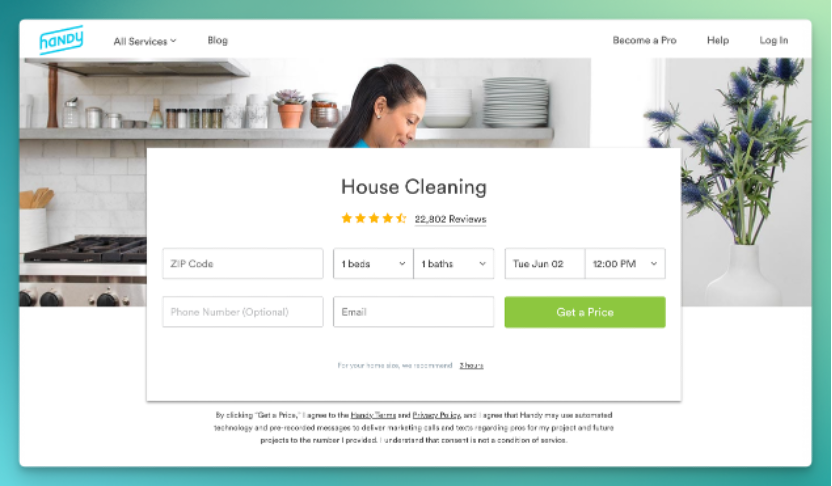
They encountered the same problem. Handy chose to first make a landing page for users to book professionals; once someone booked, the team frantically found suitable professionals to fulfill within 7 days. Once the professional finished the job and got paid, persuading them to join the platform became much easier.
Because they had already genuinely earned money through the platform. This is almost the same logic as "creators actively joining the creator-side app after taking their first order and getting paid."
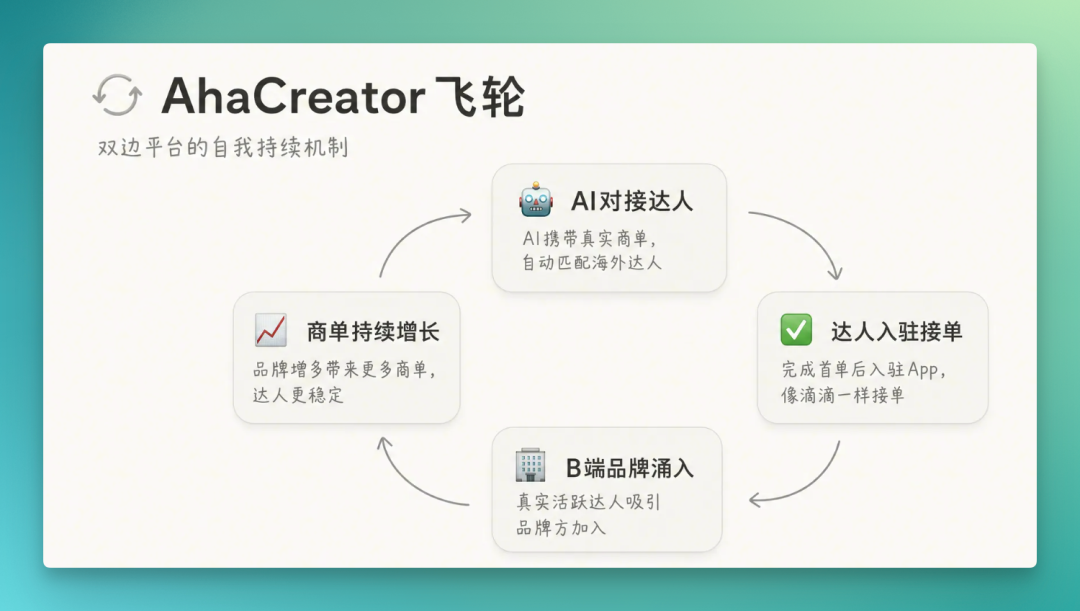
AhaCreator's solution to this problem is somewhat similar: letting AI approach creators with real business deals.
The platform had a relatively large creator database early on, with AI automatically approaching overseas creators with brands' real collaboration needs. What creators received was a business deal they could directly accept and earn money from. This step is relatively critical; many who view AhaCreator as merely an automated email tool may be underestimating this logic.
Once a creator takes their first order and gets paid, the situation changes.
They will actively join the platform's creator-side app. This creator side is somewhat reminiscent of DiDi's order acceptance: the platform has jobs to distribute, creators view and accept orders and deliver on them. After completing their first order, the creator's trust and stickiness with the platform gradually increases.
With more creators who are active, B-side brands are also attracted, because here they can find real, responsive, willing-to-work creators. With more brands, there are more business deals, making the creator side even more stable.
Once this positive cycle gets going, it doesn't need subsidies to promote — it sustains itself. This is precisely the hardest part of two-sided platforms, which AhaCreator accelerated using AI.
Once a two-sided network is operational, it brings another thing: data.
The mainstream models in this track are two:
【1】Selling tools
【2】Doing subscriptions
They share a common bottleneck: the platform can't get real transaction data from the brand side and creator side, and thus can't form a closed loop.
AhaCreator connects both brands and creators simultaneously, completing the full chain from creator selection to content delivery, and therefore masters transaction data like how creators are selected, transaction prices, content performance, and cost efficiency.
Similar paths have appeared in internet history. Airbnb early on helped landlords take photos and set standards; Meituan early on relied on ground teams to negotiate with merchants one by one. One of the assets they left behind was data accumulated from large volumes of real transactions. AhaCreator is accumulating the same class of asset: creators' real accepted floor prices, conversion effects with the water squeezed out, and cross-border fulfillment credit records — things unobtainable from the open web.

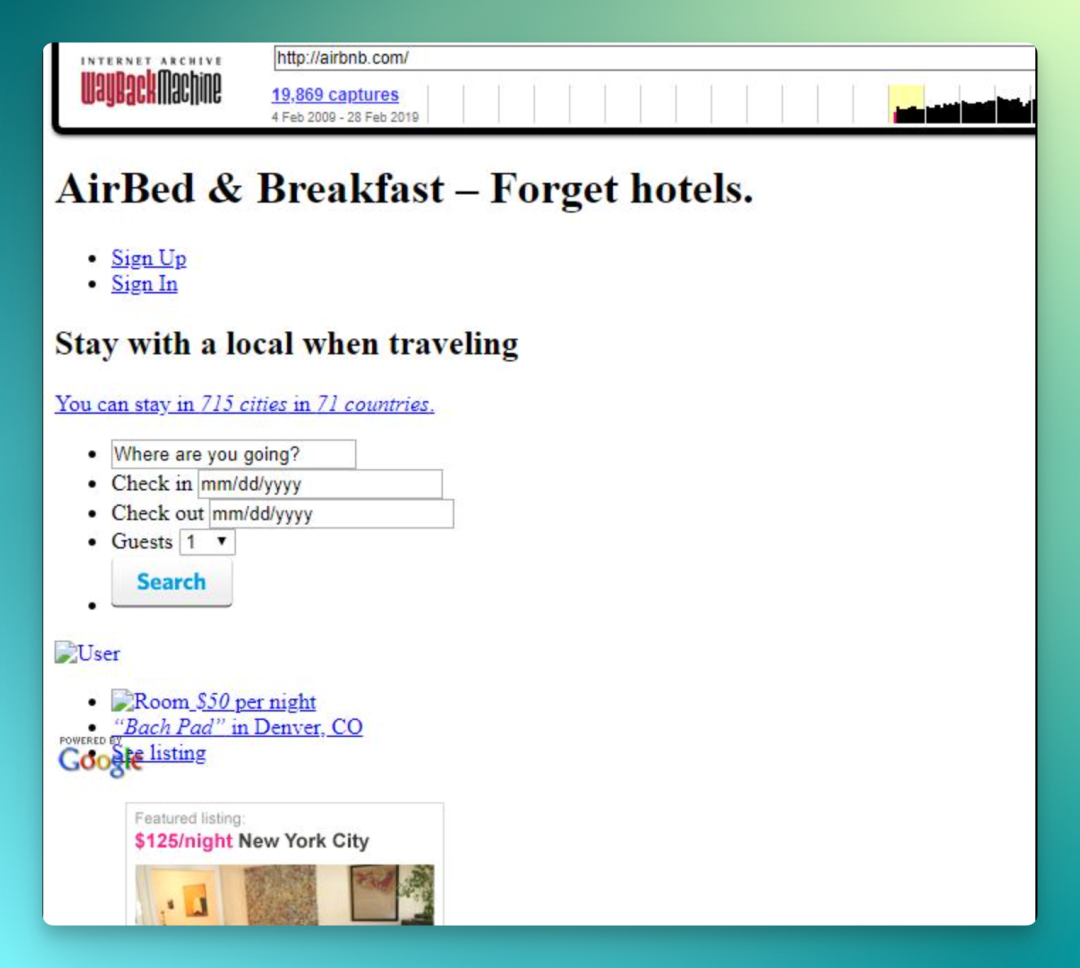
If you examine Airbnb more carefully, it's easy to regard it as one of the most successful cases of the sharing economy. But in its early startup days, it fit almost all the characteristics of a failing project.
During the 2008 financial crisis, when Airbnb launched, its core idea was "letting strangers stay in strangers' homes." This concept didn't sound sexy at the time, even somewhat absurd. Investors questioned safety issues, users didn't trust unfamiliar landlords, and landlords didn't believe the platform could bring real bookings. Even after entering YC, Airbnb's growth remained very slow, hovering near the line between life and death for a long time.
The real turning point wasn't some technological breakthrough, but rather a "small thing" later repeatedly mentioned by countless entrepreneurs.
In 2009, Airbnb's co-founders discovered that booking conversion rates for New York listings consistently wouldn't improve. Rather than continuing to study data reports, the two founders flew directly to New York and visited landlords door-to-door. They found that large numbers of listings had extremely poor photo quality, making it impossible for users to judge the accommodation environment.
So the two rented professional cameras and personally photographed for landlords, revised display pages, and understood landlord needs. This action that seemed completely unscalable increased booking volume for New York listings by 2 to 3 times, with revenue doubling in a short time.
This is recorded in the memoir blog of Y Combinator co-founder Paul Graham:

More importantly, this door-to-door visit wasn't just about optimizing image quality. The founding team truly understood the real needs of users on both sides of the platform for the first time.
Later, Airbnb沉淀 this experience into professional photography services, landlord operation systems, and platform rules, gradually expanding into a standardized network covering the globe. What people see today is a platform with millions of landlords, but the real starting point was actually founders carrying cameras and knocking on door after door.
This is also a process that many two-sided platforms experience. When the market hasn't yet formed, the platform can't rely on scale effects for growth; it can only rely on large amounts of seemingly "unscalable" manual work to fill the trust gap between supply and demand.
Once these "trust gaps" are slowly filled, they become沉淀 as rules, data, and network effects. Only then does the platform truly enter the scalable growth phase.
Airbnb was like this, and so were many later platform companies, including AhaCreator.
So what AhaCreator is accumulating is essentially the same kind of asset: creators' real willingness to collaborate, accepted prices, actual conversion effects, and fulfillment records and credit networks formed through long-term cross-regional, cross-platform collaboration.
This also leads to a frequently mentioned question:
If large models get stronger and stronger, will they directly eliminate products like this? Just as many people discuss whether Claude will compress the survival space of AI coding products?
From the current structure, the two don't completely overlap in function. The stronger the underlying model and the cheaper the compute, the lower the development and operation costs for platforms like this, and the less friction for AI agents understanding brand intent and cross-border communication.
Large models can process language and information, but cross-cultural trust, compliance in different countries, small-value high-frequency cross-border settlements, and the real transaction data mentioned above all need to be completed deal by deal in concrete business.
This part isn't easily covered by large models in the short term.
This is also why, at this point in time, AhaCreator is able to cut off a piece of cake from large model vendors.
🚥
From launch to now, AhaCreator has remained at the very center of various voices. It's been bullishly viewed and questioned; dismissed as an automated email tool and regarded as a bet by big tech.
If a product stays at the center of controversy for a long time, it has a certain "function" for itself.
Because this means it's constantly being watched by the outside world, constantly being tested. Every pushback drives it to make its long workflow more solid, rather than stopping at the demo stage. That it can iterate to a third major version under this kind of attention itself says something. 3.0 is its latest response.
Finally, returning to the field itself: why does overseas influencer marketing need an AI-native platform?
Because doing this with people alone isn't efficient enough, and a single tool can't solve it either. On one end are thousands of brands globally with varied needs; on the other end are hundreds of millions of scattered creators across 140+ countries speaking different languages.
To efficiently connect these two ends involves cross-cultural communication, massive long-tail matching, and small-value high-frequency cross-border fulfillment. These links have limited efficiency through human methods, and single-point tools don't provide full coverage. What's needed is an AI-native platform that can cover the entire chain.
From this perspective, the reminder AhaCreator 3.0 offers is simple:
When AI-native platforms enter commercial scenarios, what they often first touch are the most tedious, most granular, most human-consuming execution tasks.
If it can continue handling these tasks well, brands' imagination space for influencer marketing will also be reopened.
Crossing is looking for freelance writers to write AI product and model reviews. If you've written similar articles: "Hands-on PixVerse C1", "Hands-on LibTV", please contact zeo0811@gmail.com. Email content should include: ① personal introduction, ② AI review articles you've written. We offer competitive compensation. Looking forward to observing and recording the AI era with you 🎪

References
[1] Aha TeamAhaCreator | Bring aha moments to creator collabs with AI: https://www.ahacreator.com/