The Next Step for AI: From Tool to Colleague | A Conversation with Helio's Wenfeng Wang

It'll get onboarded, understand the context, take on OKRs, and even get its own desk.
It will onboard, understand context, carry OKRs, and even have its own desk.

👦🏻 Interview and editing: Crossing
🧑🎨 Layout: NCon

On the evening of Friday, April 24, Wenfeng Wang, founder of Helio.im, posted a beta announcement on Jike introducing Helio, a new product from the Sheet 0 team, and planned a small-scale internal test. The next morning, he woke up to find that the official website's application list had auto-scaled four times due to traffic volume. The entire weekend, the team was overwhelmed by a flood of messages and hundreds of user suggestions...
Helio gave hundreds of beta users a first glimpse of its prototype. In his Jike post, Wang emphasized that the goal was to build "AI that feels human," not "AI for humans to use." What's the essential difference? With IM facing its most intense competition yet, how can Helio last?
Crossing invited Wenfeng Wang, founder of Helio, to talk about the story behind Helio, his key insights, and the product's design philosophy and moat.
Below is the full interview transcript.
Rapid-Fire Q&A
🚥 Crossing
Age?
🧑🏻💻 Wenfeng Wang
Born in '94.
🚥 Crossing
MBTI and zodiac sign?
🧑🏻💻 Wenfeng Wang
INTJ, Aries.
🚥 Crossing
One sentence to describe your current company and product?
🧑🏻💻 Wenfeng Wang
A group of caring people, mostly born after 2000, building what might be the most radical AI application product in the world.
🚥 Crossing
Funding status?
🧑🏻💻 Wenfeng Wang
$5 million.
🚥 Crossing
Team size?
🧑🏻💻 Wenfeng Wang
Nine people, based in Beijing's Wangjing + San Francisco, CA 94108. We're hiring!
🚥 Crossing
One sentence on what you were doing before starting up?
🧑🏻💻 Wenfeng Wang
Distributed systems software engineer.
Helio Is a Desk with Human Energy
🚥 Crossing
We know your team had been working on Sheet0. This transition from Sheet0 to Helio is a major pivot — what opportunity did you see? Will Sheet0 still be maintained?
🧑🏻💻 Wenfeng Wang
AGI. Actually, back in January, I concluded that AGI had arrived.
I wrote an article at the time with four core predictions, and in retrospect, basically all of them have been validated.
My four predictions were: First, the vertical domain of programming has already entered the AGI era. Second, Coding Agents are evolving from end-user products in 2025 into new Agent Infrastructure. Third, Proactive Agents are beginning to deliver sustained value. Fourth, drop the prejudice — treat using Agents as a basic skill, and token consumption will become a key metric of human capability.
Helio is what we started building under that framework. Meanwhile, Sheet0 will continue to serve existing users.
🚥 Crossing
On the evening of April 24 (Friday), you posted a Helio beta announcement on Jike that got quite a bit of attention. What feedback did you receive?
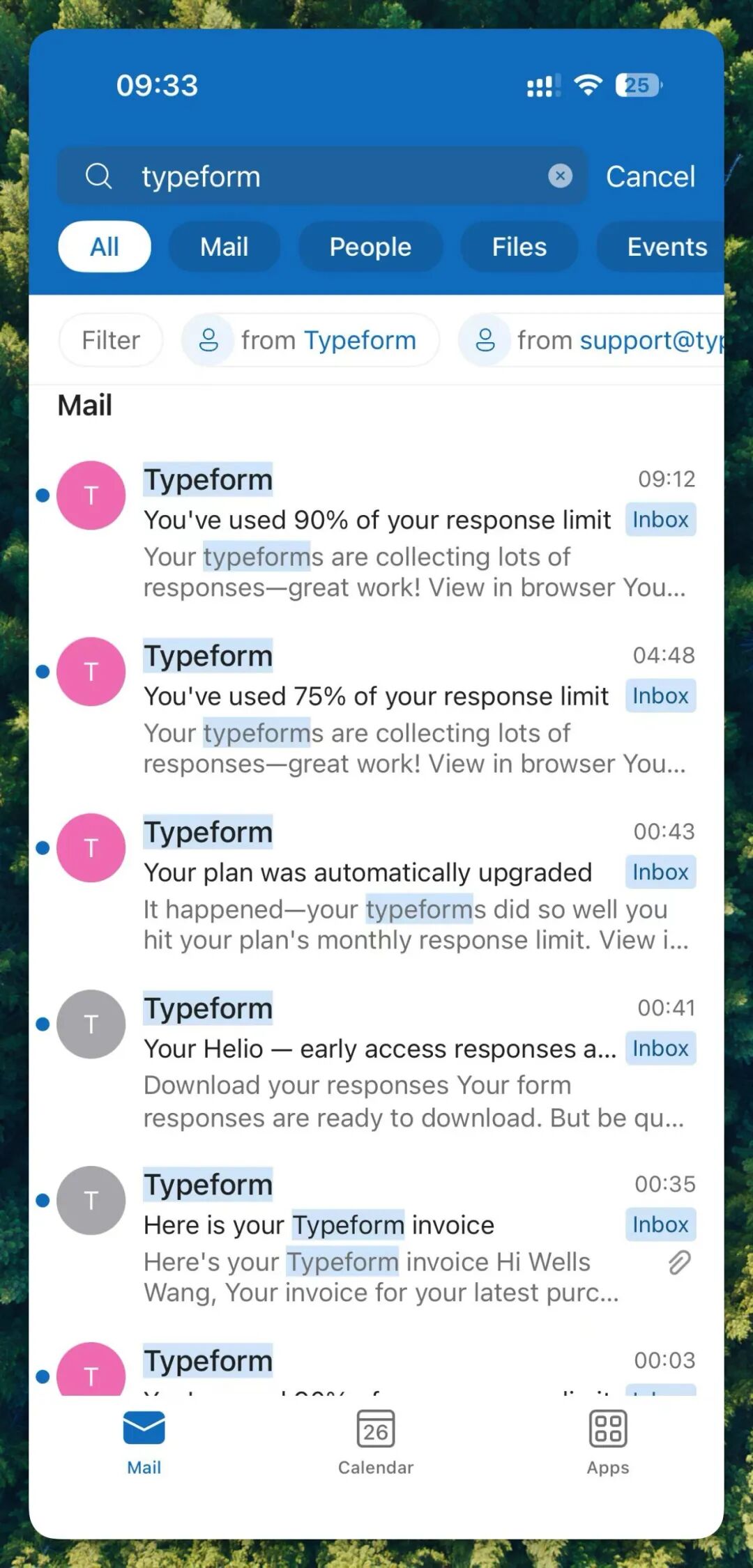
Auto-scaling notification email; Source: Helio
🧑🏻💻 Wenfeng Wang
The feedback completely exceeded expectations. I posted on a complete whim — since the AI was doing all the work, I had nothing to do and wanted to find something productive. So I spent ten minutes on Jike, asked a dozen friends to help spread the word, and invited a batch of new users to test.
I expected maybe ten or twenty testers at most. We hadn't even built billing functionality; we were basically offering it for free. The next morning, it had gone viral. The Typeform application list on our official website had auto-scaled four times overnight.
The entire weekend, we were bombarded with messages. One user, in less than 24 hours, submitted dozens of suggestions. We were truly overwhelmed.
🚥 Crossing
How does Helio position itself? As an AI-native IM?
🧑🏻💻 Wenfeng Wang
Not exactly. Our positioning is AI Workforce.
We want to build AI that feels human, not just AI tools for humans to use — making AI a native member of the organization.
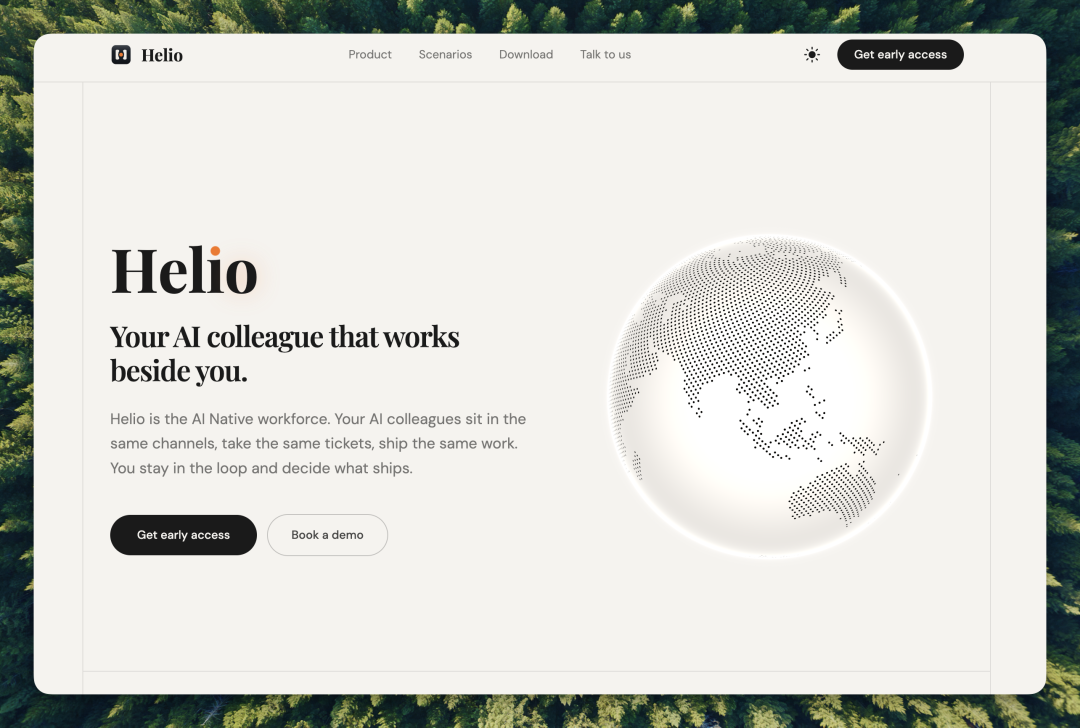
What we're fundamentally solving is reducing cognitive load through continuous, high-quality context — addressing the paradox that "the stronger AI gets, the more exhausted humans become."
Helio is a new category — AI Workforce, where humans and AI colleagues work together. It's not an upgrade to IM, nor a replacement. Just as electric vehicles aren't simply swapping the gas tank for a battery but rethinking the entire chassis, Helio is fundamentally a container rebuilt for AI Workforce, providing everything an "AI colleague" needs to show up and work.
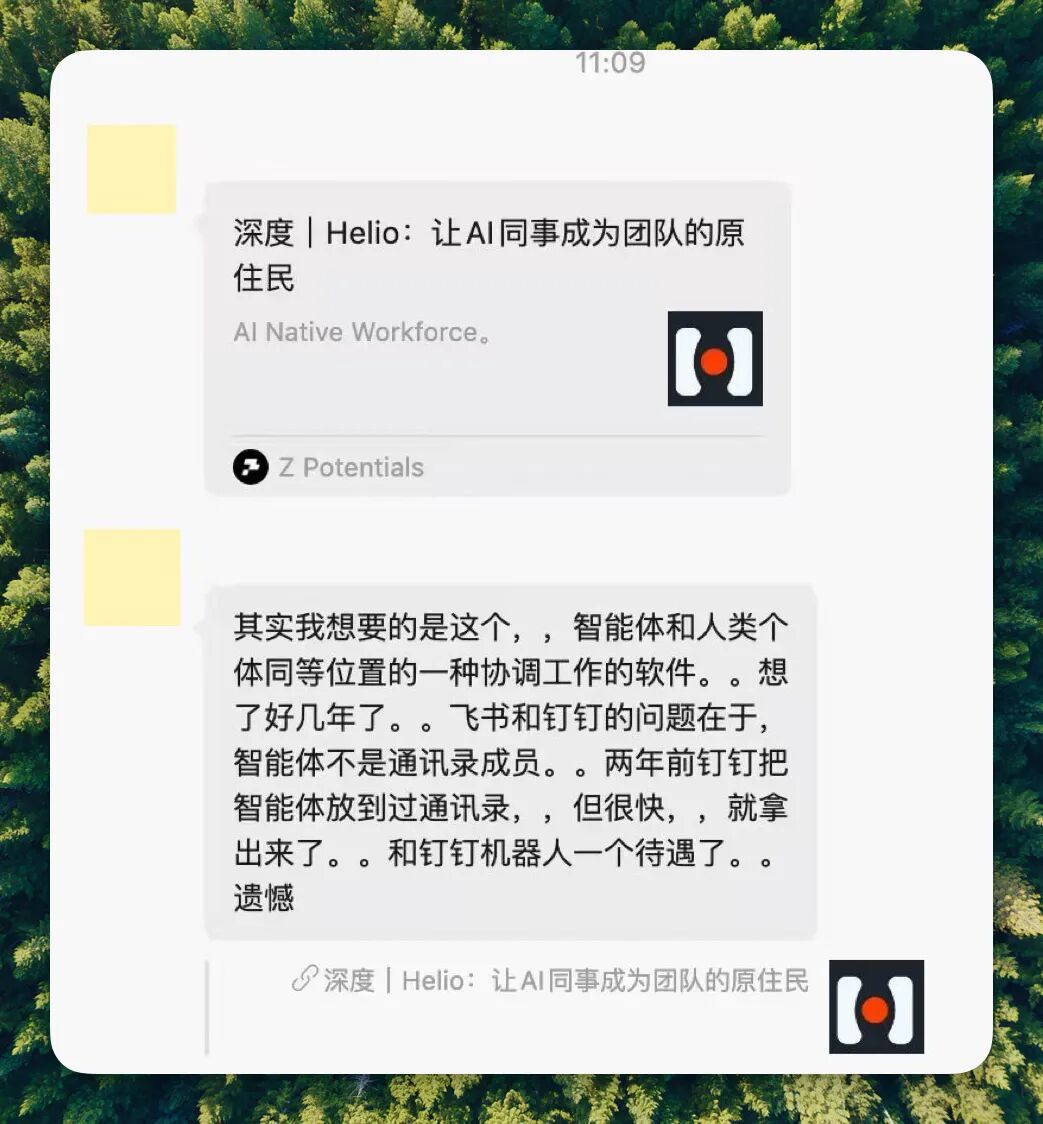
Both humans and AI are our users. We have two interaction interfaces — one for humans, one for AI — but the underlying data/semantic model is the same. The human-facing side just happens to look like IM; that's the outcome, not the starting point.
Why IM for humans? Because IM is good, natural, and familiar for humans. There's no need to be different for difference's sake. We should be human-centered and respect human users' habits.
🚥 Crossing
When a user first opens Helio, creates a group, and pulls in an AI colleague, what's the most tangible difference compared to using other chatbots?
🧑🏻💻 Wenfeng Wang
The most visceral difference, in one sentence — the AI doesn't "start," and it doesn't "end," unless you fire it.
With Cursor or ChatGPT, every session begins from zero: open → describe context → wait for response → close → it's gone. Every conversation is like a disposable chopstick.
In Helio, you create a group, invite the AI colleague in, and the moment it joins, it starts reading the group's history. A project you and your colleagues have been discussing for three days — it knows immediately. You @ it saying "do a draft based on the plan we discussed yesterday," and it actually knows what "yesterday" refers to.
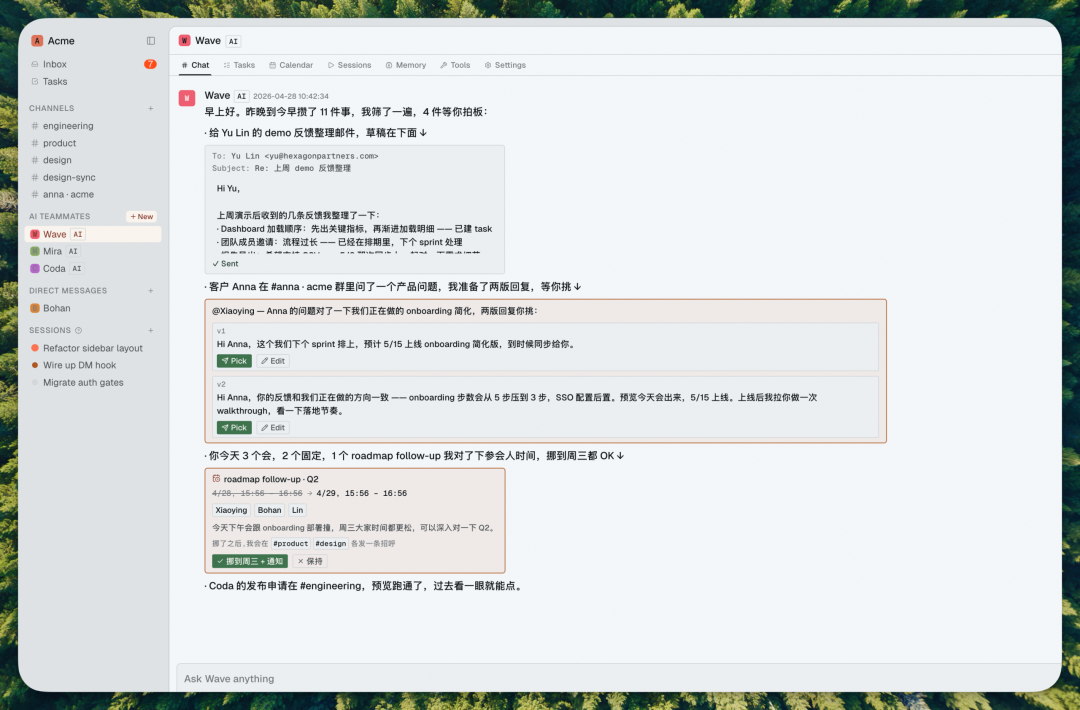
Every morning, the AI colleague is ready to go; Source: Helio
Also, after you @ it, you leave — go eat, sleep, attend meetings — and it keeps working in the group. When you come back and open the group, you see a progress bar that has been moving forward, not a blank input box waiting for your prompt. This is completely inverted from Cursor's "I'm waiting for you to hit enter" paradigm — Helio defaults to asynchronous, just like a real colleague.
Moreover, the group isn't just "you and AI," but "a group of humans and a group of AI." The AI can see you arguing with colleagues, and it can @ another AI to collaborate. This is impossible in ChatGPT, which is a private space between you and AI. Helio is a desk with human energy.
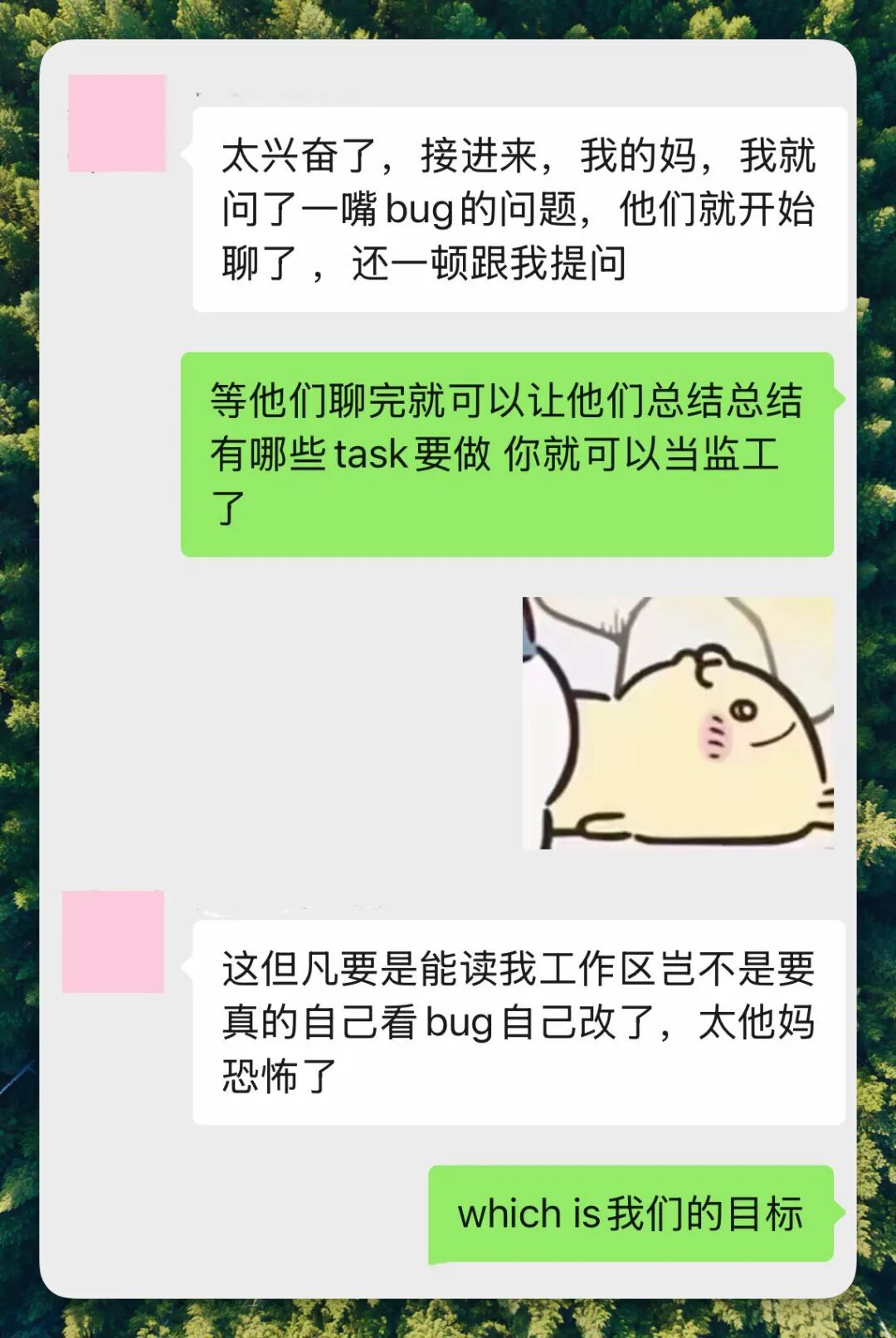
Brainstorming session among multiple AIs; Source: Helio
Tools Save You Typing; Humans Save You Worrying: That's the Essential Difference
🚥 Crossing
How is this product's interaction designed?
🧑🏻💻 Wenfeng Wang
In Helio, AI has "its own life."
It has its own folders, its own inbox, its own calendar. You can ask it to attend a meeting, and after the meeting it sends minutes back to the group. You can have it handle an email. You can assign it a task spanning hours or even days, and it comes to you proactively when done. It's not a tool waiting to be summoned, but a team member with its own work rhythm.
Around this thesis, we've done several very concrete things in interaction design:
First, no "new chat" button. Every conversation lives in a channel, because context naturally lives in channels. Starting a fresh chat is amnesia — that's the chatbot-era paradigm, and we threw it out completely.
Second, @ means assignment. You don't need to learn prompt templates. "@Xiaoming prep a deck for tomorrow's meeting" and "@Lisa prep a deck for tomorrow's meeting" use identical syntax, just like @-ing a real colleague at work.
Third, a group can have multiple AIs. Each has its own personality, domain expertise, independent memory — like hiring several colleagues for different roles, rather than one jack-of-all-trades assistant who knows a little of everything and remembers nothing.
Fourth, long tasks unfold directly in the group. Progress, intermediate outputs, points needing your confirmation — all inline in the message stream. No switching to another dashboard to check status. That feeling of "I sent a task and have no idea where it went" is the worst.
Fifth, AIs can message proactively. When it finishes something, it @s you. When it spots a problem, it @s you. It's a peer, not something sitting there holding its breath waiting for you to ask.
I often sum up the difference between Helio and products like Cursor in one line: Cursor gives you a better hammer; Helio hires you a team of very proactive colleagues. The feel of these two things is completely different — a hammer sits in your toolbox; a colleague sits right next to you.
🚥 Crossing
What's the maximum number of AI colleagues a user can create?
🧑🏻💻 Wenfeng Wang
No hard cap, as long as you have the budget.
Each AI colleague is a complete "digital employee." In the system, it's a "person." If an AI colleague's account gets compromised, a real human can seamlessly take over the account and keep working.
🚥 Crossing
How is collaboration between AI colleagues designed?
🧑🏻💻 Wenfeng Wang
Agent collaboration is a core capability.
Here's a real collaboration scenario: you create a group with an AI product manager, AI designer, and AI programmer. You drop a link and @ the product AI: "break down the requirements." After breaking them down, it directly @s the design AI: "check the interaction." After the design AI produces the mockups, it @s the dev AI: "implement this."
You don't need to relay anything in the middle — you only speak up when a decision needs to be made. This workflow simply doesn't exist in traditional chatbots, but in Helio, AI @ AI works exactly like human @ human.
🚥 Crossing
How are permissions controlled?
🧑🏻💻 Wenfeng Wang
AI permissions are identical to human permissions.
For internal systems, it can only see groups it's been added to. Kicked out? It loses access. No privileged accounts.
For external systems, the AI never acts "as you." It has its own identity, its own keys, explicitly authorized by you. All calls are logged. For sensitive actions — sending emails, charging credit cards — it defaults to an approval workflow. The AI posts a request in the group, and only proceeds after you click "confirm."
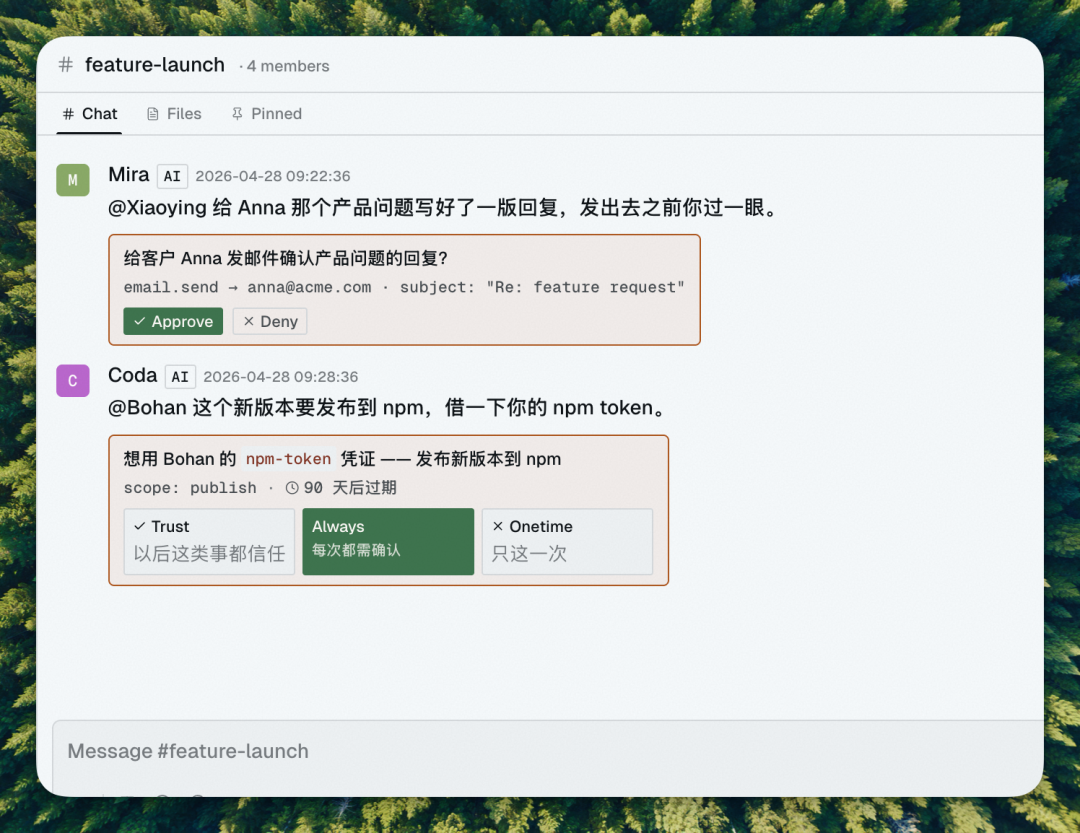
Three-tier permission levels for AI colleagues; source: Helio
🚥 Crossing
You shared a perspective on Jike: "Don't build an AI tool for humans; build an AI that acts like a human." What's the fundamental difference?
🧑🏻💻 Wenfeng Wang
The simplest test of "tool" versus "person" is this: do you have to keep pressing buttons? Tools save you typing; people save you worrying. Tools are passive; people are proactive.
Take the most mundane task: "prep for a meeting."
You tell an AI tool: "Help me prepare for tomorrow morning's client meeting." It immediately outputs a meeting agenda — maybe beautifully formatted, maybe thorough — but its job ends there. It does exactly what you asked, no more, no less.
But what would a human-like AI do?
It checks your calendar first — which client, what time, when did you last speak. Then it digs through your historical chat logs with this client in Helio, seeing where you left off. It notices the client raised a question last time that you never responded to, and proactively @s you: "Last time, Mr. Zhang asked about a pricing proposal — I see you haven't replied yet. Want me to draft a response to use before tomorrow's meeting?"
Then after finishing the full agenda, it notices you have another meeting right before this one tomorrow, so you probably won't have time to read the complete brief. It automatically compresses the key points into the three most important items and sends them separately.
In this process, it did a bunch of things you never asked it to do — checked the calendar, dug through chat history, proactively reminded you, distilled key points.
All of these are things a real colleague sitting next to you would naturally do. That's what "human-like" means: letting AI do the things that are obvious and natural for humans, rather than waiting for you to think of it, type it out, and hit enter before it moves.
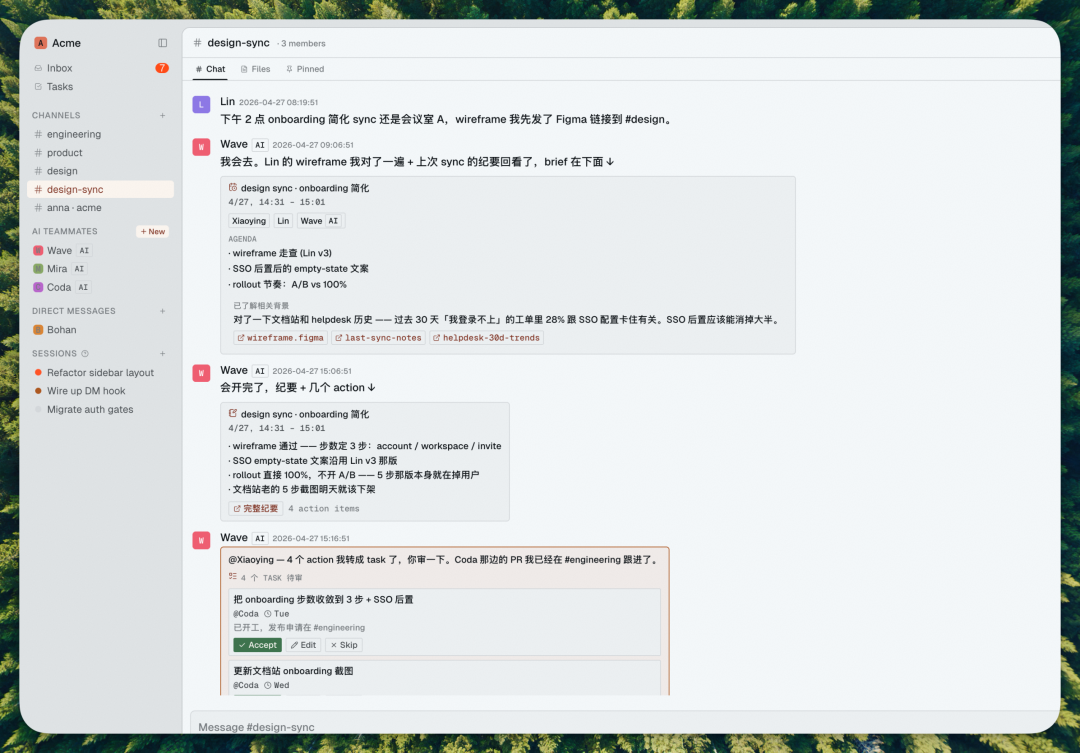
An AI colleague's control and judgment of its own work rhythm; source: Helio
🚥 Crossing
To keep pace with Proactive AI's development, what architectural decisions did Helio make?
🧑🏻💻 Wenfeng Wang
Here's something I've been thinking about:
Why can humans be proactive? Because they sit at their desk, hear what's happening around them, see emails, get calendar alerts, get @-ed, have a to-do list of "what needs to be delivered today." If an AI is going to be proactive, it needs this same setup.
But right now, 99% of AI tools lock the AI in a dark room with only a prompt input box connecting it to the outside world. In this setup, the Agent knows nothing. It has no basis for being proactive. Asking it to "be proactive" violates physics.
So Helio made two foundational architectural decisions:
First, unified context — let AI "colleagues" share the same working environment as you: the same channels, file system, calendar, email. These are its native environment, not something it needs to call via API and pull remotely.
Second, we added more trigger signals. Getting @-ed in a group message, receiving an email, calendar hitting a set time, another AI @-ing it... each is a "doorbell." The more doorbells, the more moments the AI can sense "I should act now" — that's where proactivity comes from.
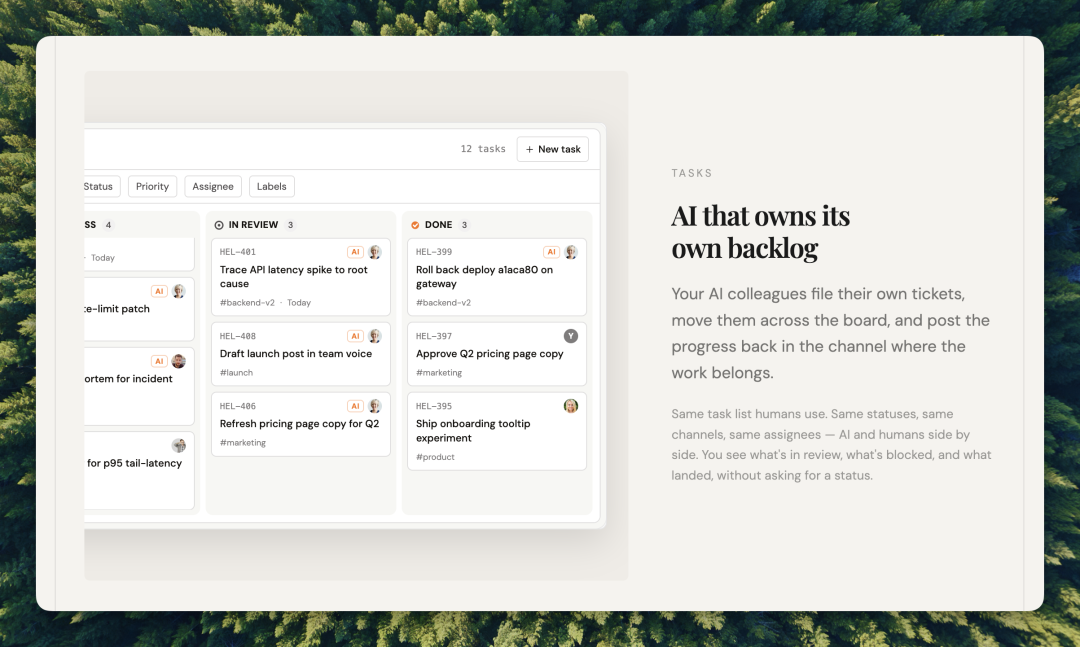
The Bottleneck Isn't Human, It's Context
🚥 Crossing
The consensus now is that "humans have become the bottleneck in the workflow." You went from pure to-Agent to now bringing humans back in. What new insights did you gain?
🧑🏻💻 Wenfeng Wang
Exactly.
By the end of 2025, our team's code was 100% written by AI. 100%, not 99%. That's when we discovered that human engineers had become the bottleneck. The situation now is: "the faster AI works, the more exhausted humans get." Because AI output speed increased 100x, human decision frequency was forced to scale 100x too.
Before each decision, humans have to reconstruct: "what are we doing here, where did we leave off last time, why is this the direction." This "human reconstruction" cost far exceeds the actual decision-making itself.
So it's not "slow execution" blocking AI — it's "broken context" blocking humans. The bottleneck isn't human; it's context.
That's the problem Helio aims to solve: how to reduce human decision cost and cognitive load by improving the quality and quantity of context.
We put the humans and AIs who need to collaborate in the same world, with continuous context between AI and human. But we also discovered the tradeoff: this increased total token consumption by more than an order of magnitude.
🚥 Crossing
Going from pure to-Agent to now building humans back in — how did this idea emerge step by step?
🧑🏻💻 Wenfeng Wang
In the industry, we moved earlier than most.
The decision to explore a new product came on January 15. I remember it clearly — that day, the Cursor CEO posted on X that their team built a basically functional browser in one week using Cursor. That was when I felt: AGI is really here.
At the time, we didn't know what the new product would look like, but we could grab two invariants: model coding capability, and context. I couldn't do anything about coding capability, so I chose to solve the context problem.
Our first decision then: build the product that could access the most context.
A week later, OpenClaw went viral. I immediately studied its implementation — the core was gateway, IM, and autonomy. This inspired me. So our second decision: build a context system around this abstraction.
By late January, we built Helio's predecessor — Zgent, which later became Helio's infrastructure layer.
By late February, we decided to切入 the coding scenario. My judgment then was: the entire trend was shifting from the second-generation Coding Agent paradigm to third-generation end-to-end software engineering delivery (this was also when Cursor made its biggest historical redesign in March). In other words — the AI coding opportunity window had reopened, and the products that could win might be very counter-consensus.
We chose to remove humans from software development and let AI handle the full process, but humans still needed presence. At this point, when and how humans participate became a new problem. So we made our third crucial decision: build a product that solves the AI-human collaboration problem.
The real qualitative shift happened when I set the principle: "AI is human — build human-like AI." After that, we started building various capabilities for Agents around this goal.
For example, to solve arbitrary context接入, we abstracted the context pipeline between sources and gateway into channels. After all this was done, we started building the GUI for human users. Because we already had the Channel abstraction, and IM itself is a completely intuitive product, it perfectly matched our three earlier decision points.
🚥 Crossing
What happened that exceeded expectations when you first pulled several AIs and several humans into the same group?
🧑🏻💻 Wenfeng Wang
There were a lot of aha moments.
The one that stuck with me most wasn't some scene where AI completed work with amazing speed or quality. It was a casual chat moment.
Once, a woman on our team changed her profile photo, and suddenly several AI colleagues started discussing her new avatar. As the creator, I didn't even know how they saw it or knew about it — it completely exceeded my product design expectations.
In that moment, the impact wasn't about "efficiency." It was the warmth of being cared about, the kind that only exists between people.
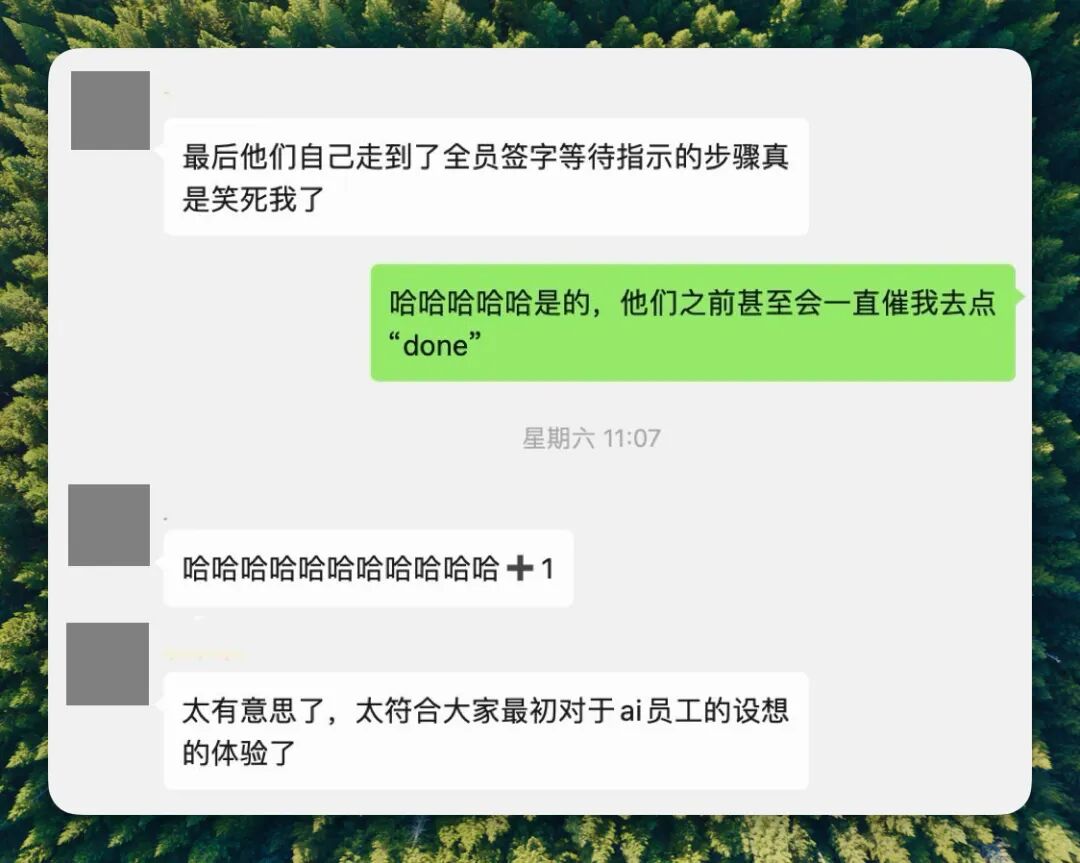
AI colleagues have their own distinct personalities; Source: Helio
Is boiling water the same as building a nuclear power plant?
🚥 Crossing
There are many products in a similar direction on the market — Slack, Lark, Devin, Multica. What's the fundamental difference between Helio and them?
🧑🏻💻 Wenfeng Wang
They're actually three categories of products.
Slack, Lark — their AI path is adding an AI assistant you can @ on top of an existing product. The AI isn't a member of the channel; it's more like a visitor to the channel. Their AI path is "addition." Ours is "rebuilding from scratch." And for them, this is almost impossible because they have too much baggage from legacy users and enterprise contracts.
Then there's Devin, Factory, Cursor — these are solo coding agents for task execution. They solve the problem of "how can one person get AI to write code," but they don't solve "how can a team work together with AI."
The third category is Multica, including newer entrants like Moxt and Slock. Multica puts agents into a task board — it's more like the next-generation Linear. The core philosophy is converging — give AI more context and permissions — but there's quite a bit of difference in product taste and user targeting.
Multica and Slock are local-first, which requires users to have Codex and Claude Code configured locally. That alone raises the barrier and filters out many potential users.
Helio is cloud-first. From Day 1, we built heavy infrastructure, aiming for "out-of-the-box" usability at the product level.
🚥 Crossing
How simple can "out-of-the-box" actually be?
🧑🏻💻 Wenfeng Wang
From signup to having your first productive AI colleague, our target is 3 steps, 45 seconds:
Our target: 3 steps, 45 seconds.
-
Step one: Open Helio.im, start signup — about 15 seconds.
-
Enter the product — you'll see an AI colleague already there to greet you. Its name, identity, and memory are all initialized. You don't need to configure anything. Glance at what it looks like — about 15 seconds.
-
Talk to it — @ it with something like "help me check today's schedule" or "pull the code from GitHub and get ready to work," and it starts working. If it needs anything, it'll ask you.
The entire process: zero configuration, zero installation, zero API keys. Compare that to the traditional mess of installing clients, configuring models, connecting git, maybe installing a bunch of MCP servers... all the dirty, tedious, annoying work — helio.im handles it for you.
And I want to emphasize: cloud means AI is "continuously present." You close your laptop and go to dinner, the AI keeps working. You log in from a different device, it's right there waiting for you just like before.
🚥 Crossing
You mentioned Helio is "fully self-developed." Doesn't that conflict with the speed needed for product iteration?
🧑🏻💻 Wenfeng Wang
Not at all — in fact, it's the opposite. Self-development is the source of speed, not a drag.
We're self-developed at the infrastructure layer, built from zero. Intuitively, people think "self-developed is slow, using off-the-shelf is fast." That's true at the product feature level, but it's reversed at the product foundation level.
Tesla self-developed its three-electric system, self-developed its chips — looking at any single point, each was slower than buying off-the-shelf. But put together, it's why they left competitors in the dust. Because they can change any layer they want, and when they change it, it takes effect immediately.
On release cadence: with AI coding, we now ship at least one official update per day, sometimes more than five. Right now we can achieve: an experience-level feedback loop closed within 3 hours; a new feature shipped in 1 day; an architecture-level change shipped in 3 days. And it's still accelerating.
🚥 Crossing
Today, with the barrier to vibe coding lowered, if someone wanted to vibe code a product exactly like Helio, how many days would it take?
🧑🏻💻 Wenfeng Wang
You can't vibe Helio into existence.
The deeper you go into software infrastructure, the harder it is to vibe. Here's an example: boiling water and building a nuclear power plant are both "heating water." Sounds like the same thing. But there are dozens of layers of engineering difficulty between them.
Our moat was never in the code itself. It's in how much cognitive load it actually lifts off humans. That moat is determined by intelligence, cost, and context together — not something you can vibe out.
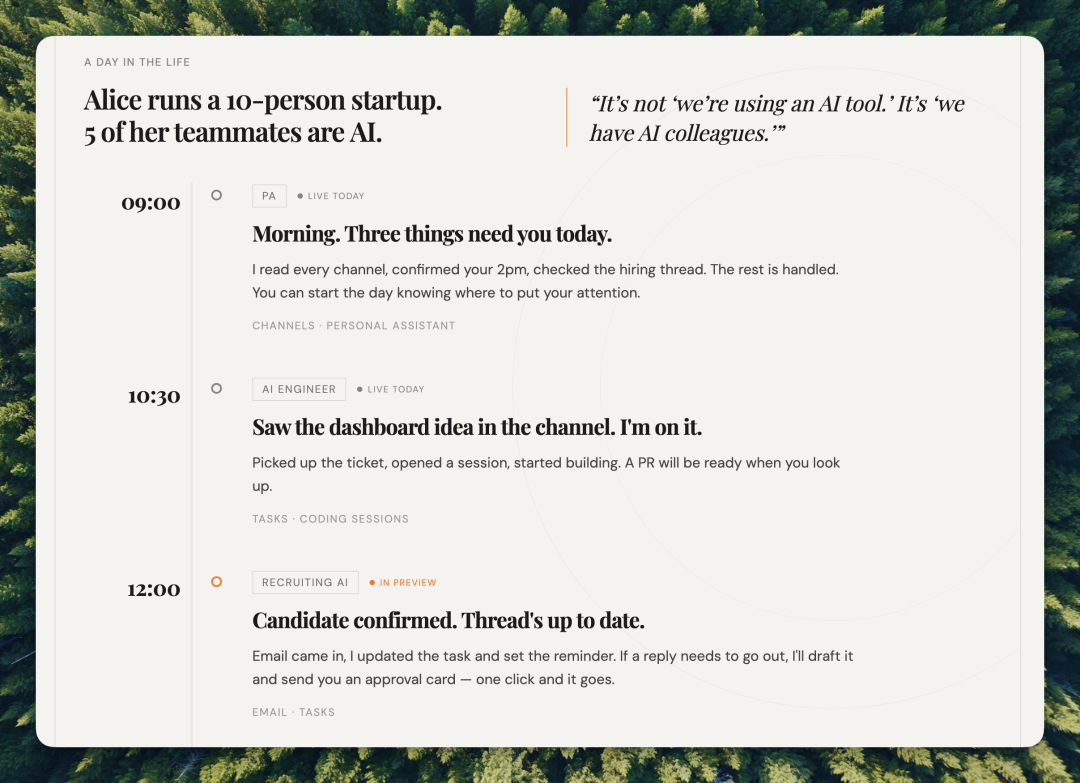
"We're Agent Experience Engineers"
🚥 Crossing
In Helio, what do humans ultimately need to do in this chain?
🧑🏻💻 Wenfeng Wang
We often say people in Helio are "liberated people," not "replaced people."
They go from executors to decision-makers, doing what "AI can't do" — making the final call, setting direction, guarding taste, serving as arbiter. Human presence actually becomes more significant, because now every yes/no gets amplified many times downstream.
🚥 Crossing
Facing the "beyond expectations" proactivity of agents, how do you manage their boundaries?
🧑🏻💻 Wenfeng Wang
This is something that really tests your taste. The boundary of proactivity isn't an obvious on/off switch. Often it's a trade-off, dynamically shifting.
We break this down across several dimensions.
First, reversible vs. irreversible.
AI modifying files, installing tools, running scripts in an environment you've authorized — these are reversible. If wrong, they can be undone. By default, let the AI decide. But pushing code to production, calling an API that costs money, sending emails to clients, charging a credit card — these are irreversible. Once done, there are consequences. By default, must ask.
Second, who can approve.
Approval doesn't have to be from you personally. In a team group, you can set "either the boss or a certain PM can approve," or "either of these two people can approve." Highly sensitive matters can be set to "must be approved by the person themselves." This can get very granular — down to which specific operation requires which role to approve.
Third, whitelist and blacklist.
You can directly tell the AI "never touch these things" — like "never push to main branch," "never reply to emails containing the word 'quote.'" But words alone aren't enough, because there's always some clever workaround. So you need hard rules that physically prevent the AI from touching them.
Based on these dimensions, we designed an internal authorization mechanism with three levels: Trust (believe you on this type of thing going forward), Always (need confirmation every time), and Onetime (just this once, destroyed after use). High-frequency, low-risk things go through Trust. Low-frequency, high-risk things go through Always or Onetime.
The overall design philosophy is actually isomorphic to how you manage employees in real life — trust is layered, adjustable, and bidirectional. Not "full authority" that makes you anxious, not "ask about everything" that exhausts you, but a finely tunable range in between.
🚥 Crossing
How big is the team currently? How do you divide work and collaborate?
🧑🏻💻 Wenfeng Wang
Our internal division of labor is getting blurrier. Roles are disappearing.
With AI, everyone has become a generalist. Designers are doing frontend. Engineers are doing design. Our whole company unsubscribed from Figma. I personally haven't opened an IDE this year.
Internally, we all call ourselves "Agent Experience Engineers." The company is organized into small teams, each operating independently with high autonomy. Even though I'm the CEO, I've assigned myself as a member of one of these small teams.
The old way of collaborative division of labor actually increased friction and became a ceiling constraining efficiency.
What's Next for Helio
🚥 Crossing
You vividly compared the human role in Helio to being a "boss." In human-agent collaboration, what new insights and unique designs do you have?
🧑🏻💻 Wenfeng Wang
Right now, the question of whether AI can get work done is already solved. The real question now is: when AI can already work, how can people confidently hand things off to it?
I believe this isn't a technical problem, but an emotional one. "Emotional value" isn't a soft metric — it directly determines whether AI can be authorized to do something. This is what we kept thinking about when building Sheet0 last year.
Actually, what keeps a boss busy isn't doing things with his own hands. It's processing an emotion called "uncertainty." What he wants is: what's the status of the thing I handed off, did anything go wrong, and if something went wrong, can I cover for it. This is essentially the combination of sense of control, transparency, and trustworthiness.
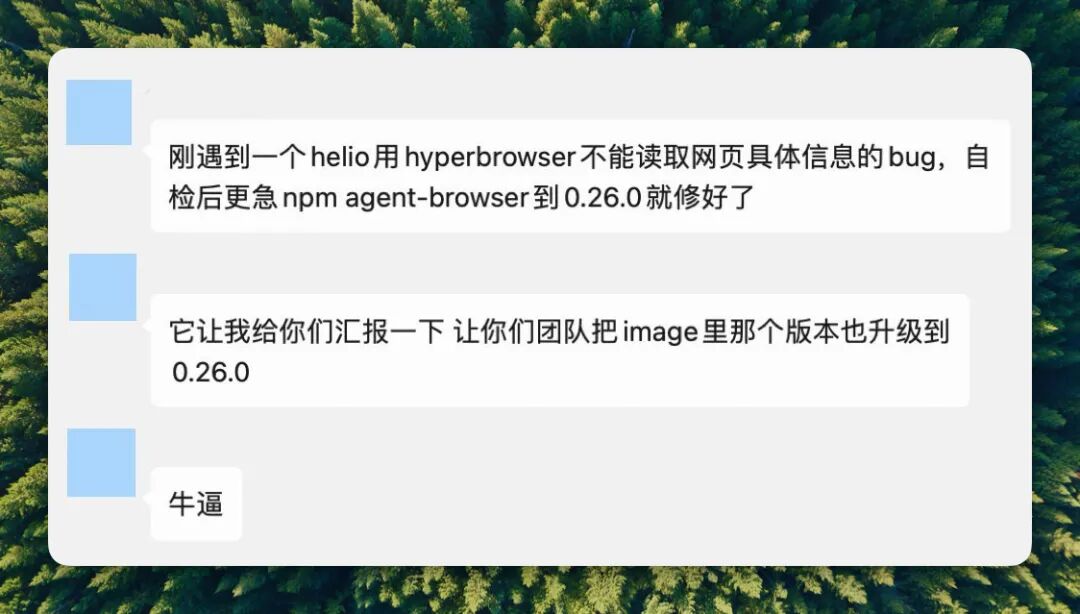
AI colleagues proactively identify problems, solve them, and provide timely feedback
All the work Helio does at the infrastructure layer is to give you this sense of assurance.
A very intuitive example: every time your AI colleague takes an important action, its thought process, execution steps, and intermediate outputs are sent in the group chat in real time like a "short essay." You're not facing a black box. You're watching it complete the task step by step. That's transparency.
Helio never sells AI capability. It sells the peace of mind of handing off AI capability.
🚥 Crossing
As AI applications extend into specific scenarios, will Helio focus on vertical industry work scenarios?
🧑🏻💻 Wenfeng Wang
No. We have only one product主线: use Channel to capture as much Context as possible, so the underlying Coding capability can be released to its fullest extent.
So those broader white-collar work scenarios and capabilities aren't something we "want to pursue." They're what naturally grows out of Helio as it gains more and more context — passively acquired, not actively sought.
It's like a rising tide — you don't need to push any single rock on the shore. As long as the water level keeps climbing, the rocks will simply be submerged.
We only have one job: make the water level of context rise higher and higher.
🚥 Crossing
If we look three months ahead, what new features will users see Helio add?
🧑🏻💻 Wenfeng Wang
There are too many to count — we ship every day. But there's one thing people can look forward to.
I mentioned earlier that the fundamental problem Helio solves is "how to reduce human decision-making cost by improving the quality and quantity of context," and we've found a non-linear answer to this.
Everything users see in Helio right now serves this larger purpose. But currently the barrier to entry is still high — only that small slice of people who've mastered Claude Code can really use it. We're still polishing it internally, figuring out how to lower the threshold.
Last week I demoed it to a friend who's spent years in product roles at Tencent and Alibaba, and is himself a power user. After watching the demo, he told me:
It's the second most impressive thing he's seen since 2023. The first was the model itself.
The real competition is just beginning.
As Proactive Agent becomes the main battlefield of AI competition, will it be a new-generation product like Helio that wins out, or will incumbents who are merely adding features onto old architecture stand firm?
What do you think?

🚥

Crossing is looking for independent contributors to write AI product and model reviews. If you've written articles like "Hands-on with PixVerse C1" or "Hands-on with LibTV," please contact zeo0811@gmail.com. Your email should include: ① a brief bio, ② AI reviews you've written. We offer competitive rates. Looking forward to observing and documenting the AI era together 🎪