AI Answers Everything, But It Can't Replace Your Self-Discipline | Keep Still Has a Chance

Ten years, 400 million users, 14 billion exercise records — Keep finally reached the moment to put them to use.
Ten years, 400 million users, 14 billion workout records — Keep has finally reached the moment to put them to use.
👦🏻 Author: Jingshan
🥷 Editor: Koji
🧑🎨 Design: NCon

The last time you opened Keep — was it because you wanted to work out, or because the app pushed you a notification?
Keep 9.0 wants to change how you use it.
🚥
These past two years, overseas AI fitness products have been breaking through with increasing frequency.
Future App's AI personal trainer adjusts plans in real time based on training feedback, sustaining high renewal rates through its $39 monthly subscription — one of the few cases in fitness where an AI coach has actually made the subscription model work.
Whoop positioned itself as a health prediction device, driving daily opens with prompts like "what should you train today," achieving remarkably high user stickiness. Tonal, meanwhile, tied strength training to AI feedback. Three different paths, but one common thread:
They're all "understanding" your exercise, becoming all-around AI health managers.
Shift the focus back to China, and Keep is unavoidable in the fitness product landscape.
This veteran has spent ten years building China's leading fitness content library, weathering plenty of rough patches along the way. In 2025, it finally turned profitable, posting adjusted net income of 25.22 million yuan.
The number isn't huge, but capital markets are finally seeing this company as more than a "fitness video content library."
On April 24, Keep released version 9.0 and unveiled Keepace.ai, a large model purpose-built for exercise and health scenarios. The AI strategy that's been mentioned repeatedly in earnings reports gained another anchor point:
The all-around AI manager
🚥
The Crossing team got hands-on with Keep 9.0, ran through the major features, and here's our review.
First, the tab priorities in the interface have changed
Keep 9.0 has been completely redesigned, and the most obvious change is the bottom row of tabs — the priorities are entirely rearranged. In the new version, courses come first, and the entire homepage has been stripped down to just two core entry points: "Courses" and "Plans."
Compare this to the old version, where the homepage was crammed with everything — lots of features, but also more clutter. That's largely why many people found old Keep somewhat bloated.
This 9.0 update is essentially about subtraction. Leaving only courses and plans on the homepage makes the whole experience more focused, closer to Keep's original positioning as a fitness tool.
This time, Keep 9.0 has also significantly expanded its course offerings, with noticeably broader coverage. Free courses are available, as are advanced ones. Overall, course volume is substantially higher than in the previous version.
Additionally, AI coach "Kaka" has been given top priority. It appears in the upper right corner as soon as you enter the homepage, with entry points practically everywhere — a permanent, always-accessible feature.
This is also the most core element of this version. Its capabilities are fairly comprehensive: intelligently generating training plans, providing form guidance during workouts, photo-based logging, and multi-dimensional data analysis — all housed within it.
Interaction is simple too: one tap from any page starts a conversation. Fundamentally, it's an always-available AI agent that threads through the entire product.

Beyond the general-purpose Kaka coach, Keep 9.0 has also brought in more specialized AI coaches. There's the NRC running coach, and "Teacher Xiao Ke" for fitness assessments. These are more vertical — one focused on running, the other on assessment and feedback.
The exercise module itself hasn't changed much, remaining largely similar to the old version. User feedback here was already positive, so it was carried over directly. Usage remains the same: you can have the AI coach participate and accompany you through your training.
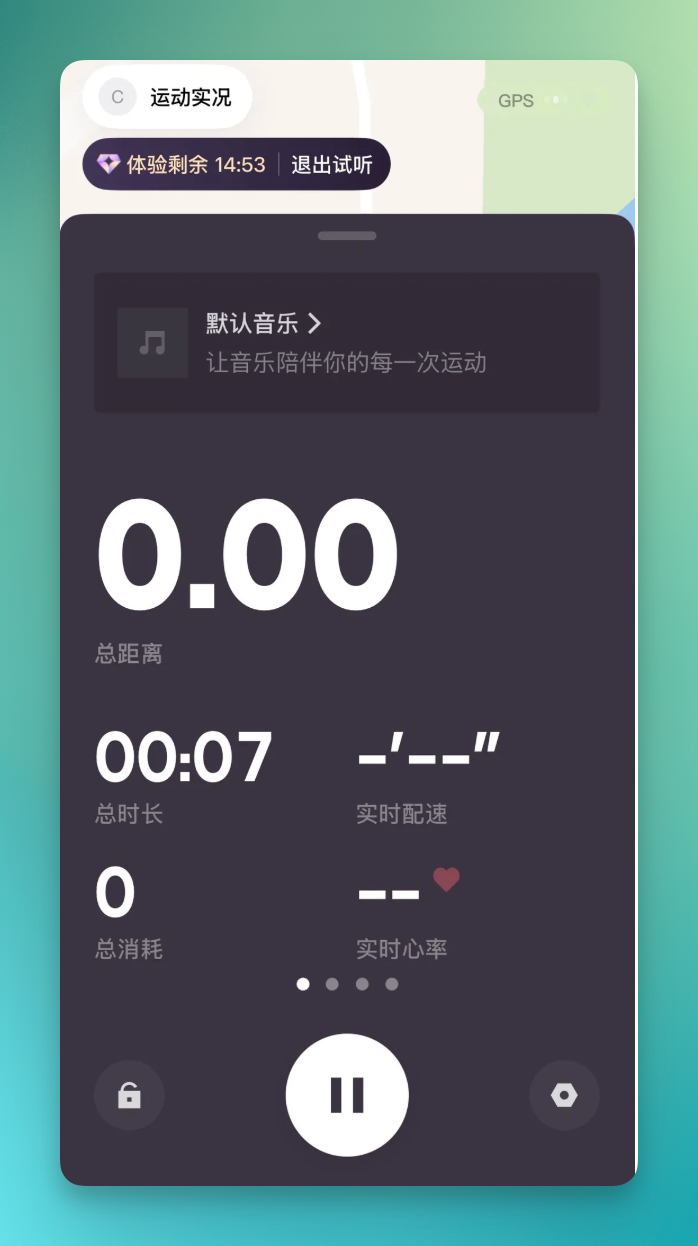
The ubiquitous "Coach Kaka"
Let's talk about AI coach Kaka specifically. It's now basically the highest-priority entry point in Keep 9.0, visible everywhere.
It functions like an AI agent, available for conversation at any time. Operations have been greatly simplified too. Take diet logging: unlike traditional tracking apps where you select foods and enter data step by step, you simply upload a photo, say a few words, and it handles recognition — logging calories, timing, and other information together.

Another neat touch: it has built-in image generation. When I went to share, I found it would take my uploaded photo, add the total intake for that meal, organize it into a table, and generate a shareable image directly.

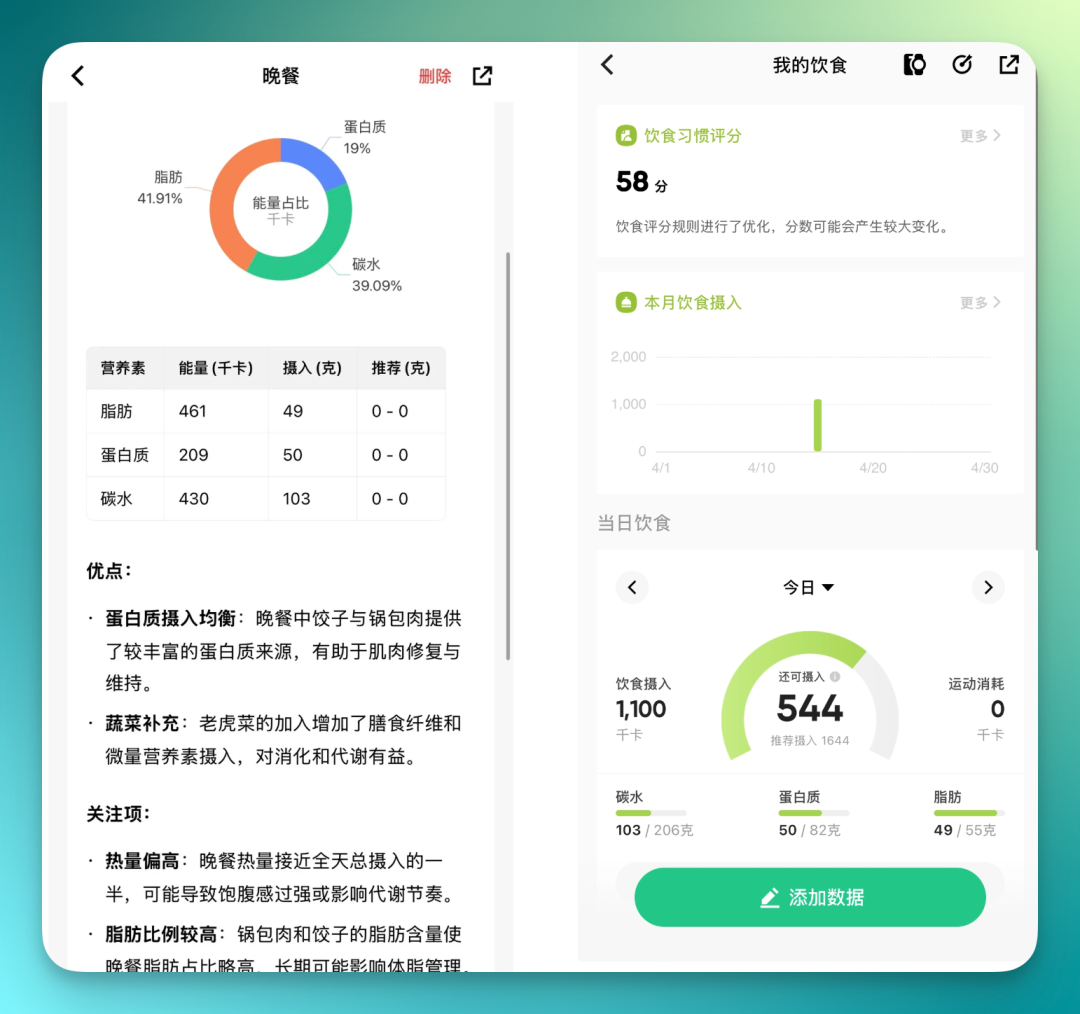
Kaka's diet analysis is now more concentrated and easier to use. When I upload a dinner photo, it automatically breaks down protein, fat, and carbs into a table, flagging which items need attention.
It also visualizes your monthly diet trends at a glance.
Kaka's most core capability right now is still intelligent workout plan recommendations.
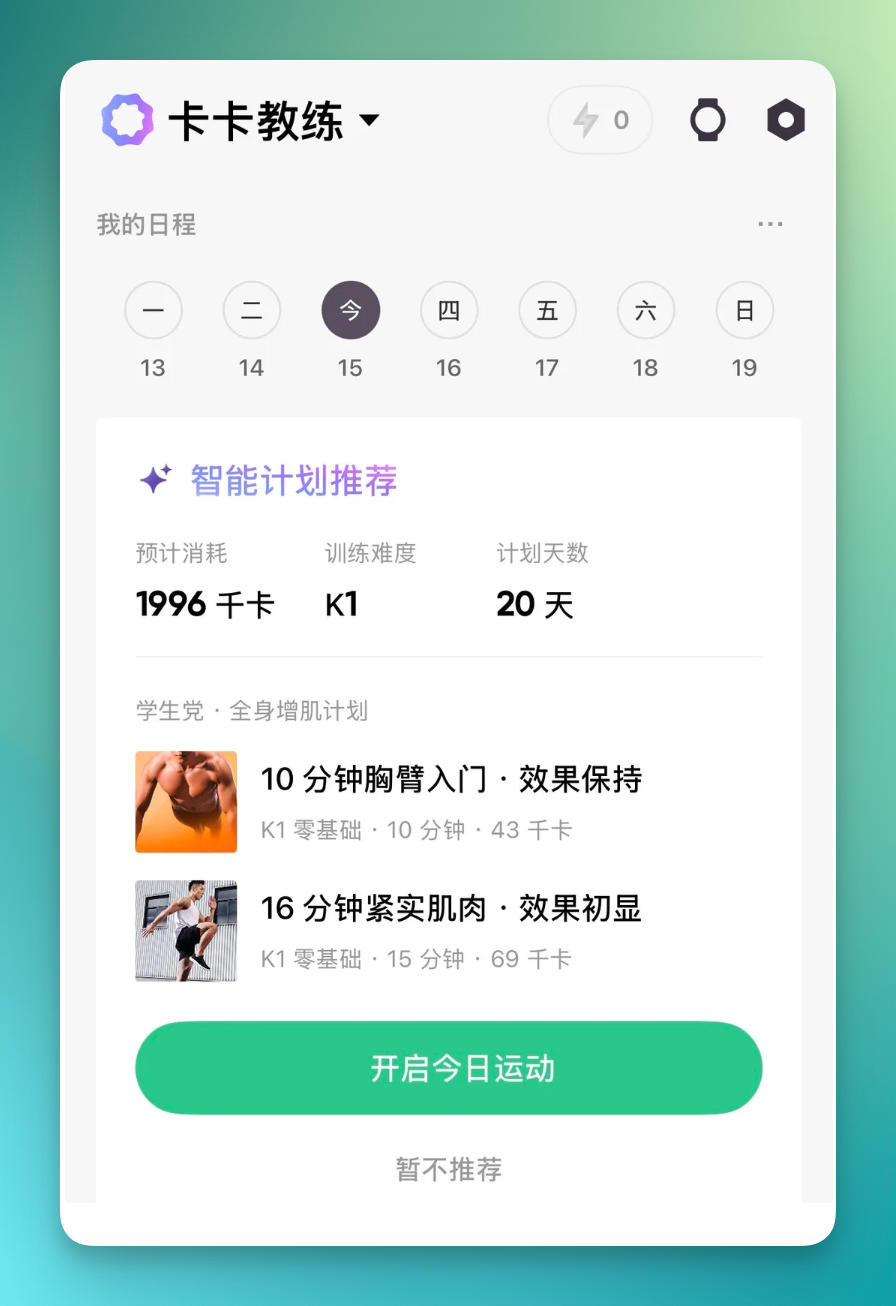
You start by giving it basic information — weekly running distance, any injuries, your fitness goals. Kaka integrates all of this and generates a personalized plan, like full-body fat loss.
Recommendations shift dynamically based on what you enter. If you have an injury or your condition changes, your training plan adapts accordingly.

Each training plan is fully structured, laid out from Day 1 through Day 7, with workout content and cardio ratios included.

Kaka coach now handles more than just diet. You can also import local sleep data and other metrics — everything gets unified into this single entry point.

Data integration, plus AI insights
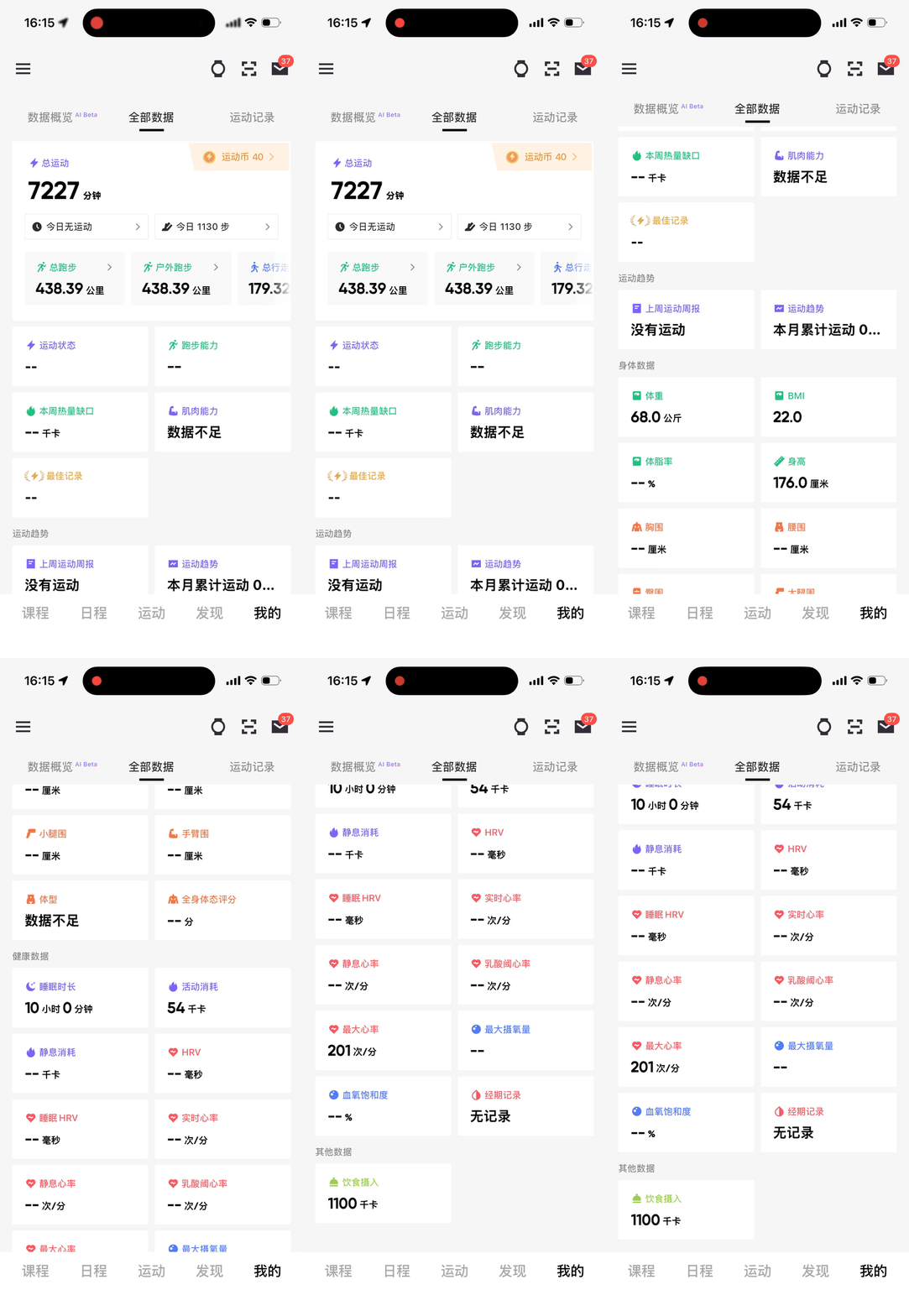
Finally, data integration. This has always been a critical piece of products like this, and users genuinely prefer seeing data visualized. In Keep 9.0, virtually all data is consolidated under the "Me" tab. The "All Data" section below, for instance, represents every record I've accumulated over my years using Keep.
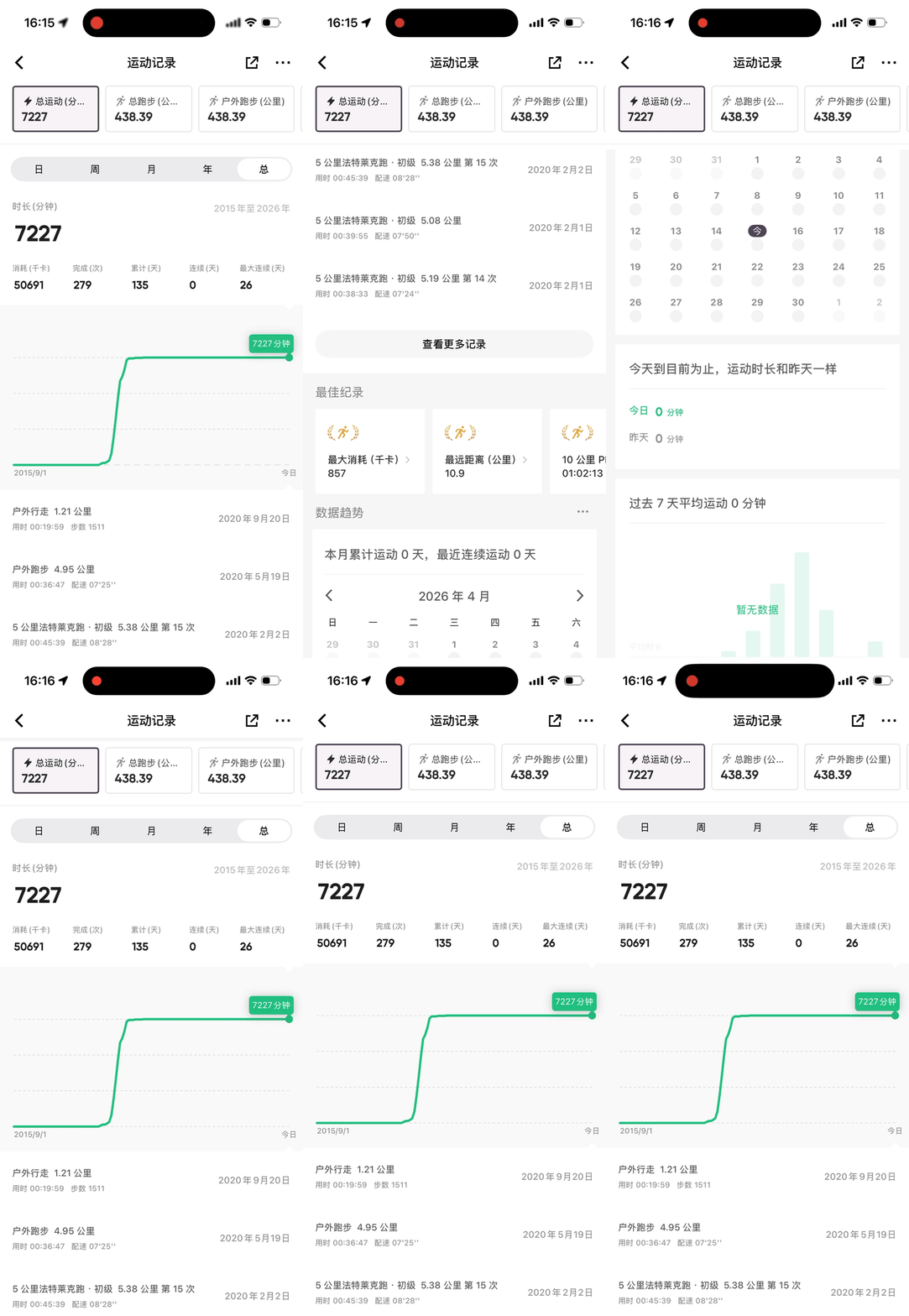
This exercise record, for example, strings together all my data from when I started using Keep in 2015 to the present.
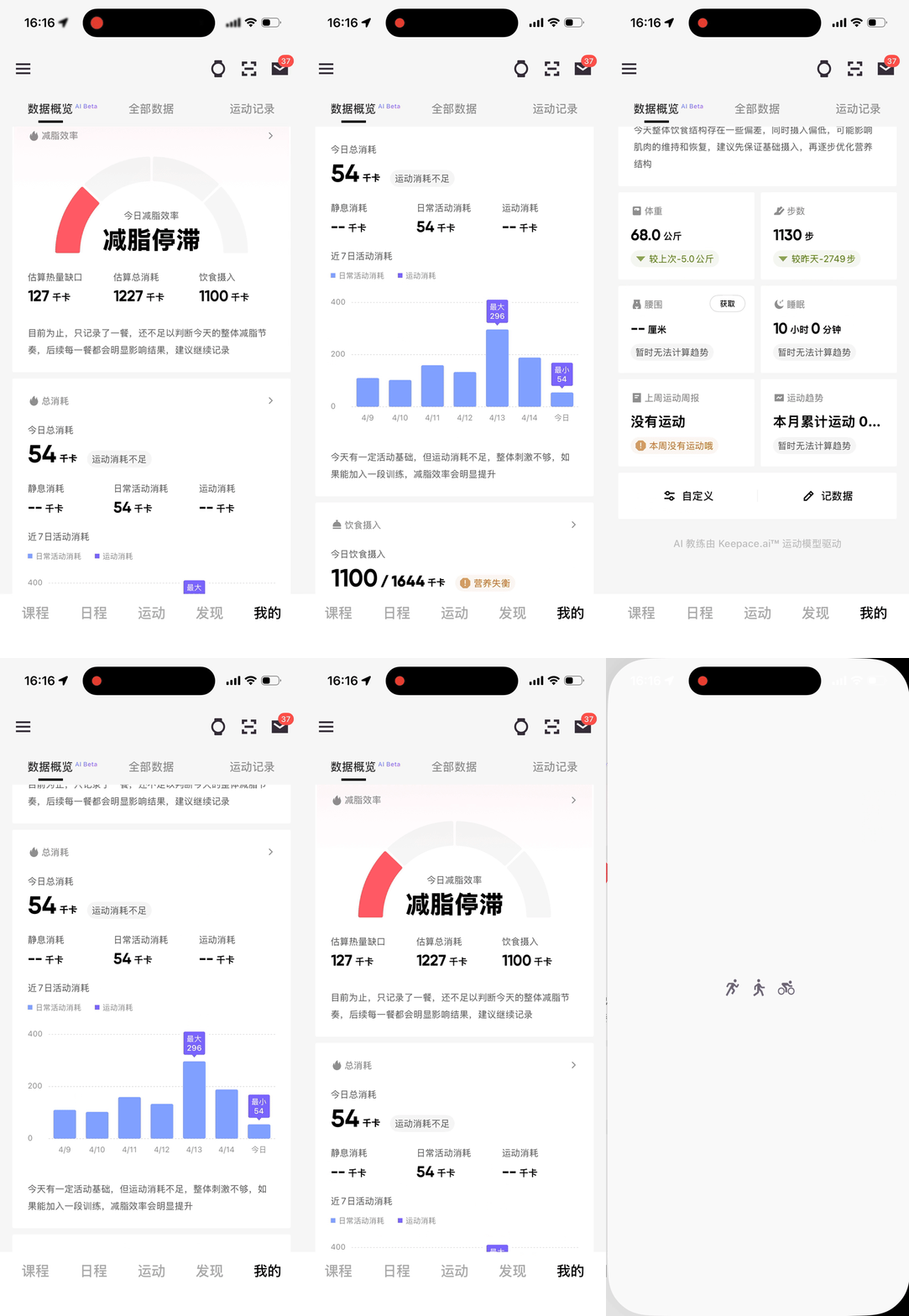
Beyond basic data consolidation, there's now a Data Overview (AI beta). It automatically pulls together your daily dietary intake and exercise expenditure for analysis, then cross-references your initial goals to deliver a direct assessment of fat-loss efficiency.
Beyond the data, it gives you the most intuitive summary and alerts.
Why exercise needs a vertical large model
Moving from product experience to the technical layer, these features are powered by Keepace.ai, the vertical large model.

Why does exercise need a vertical large model? Because this scenario looks like Q&A, but functions more like real-time judgment. When a user asks "my back hurts, can I still train," what's being processed isn't just a knowledge point — it's connected to recent training frequency, pain location, injury history, today's fatigue level, available equipment, whether this movement will amplify the risk.
Miss one variable and the conclusion skews, potentially triggering complete user distrust and even "opinion fission" across social platforms.
Exercise advice also has strong continuity. What you can train today usually needs to be read against last week's running volume, recent sleep, heart rate variability, and recovery rhythm. Looking at any single conversation in isolation easily leads to shallow, unprofessional-seeming answers — and users are acutely sensitive to this. Plus, fitness advice on the internet has always been a mess; popular tips spread fast, sound right, but applied to specific individuals, results often diverge wildly.
A classic case: one shoulder exercise might draw ten different methodologies from ten different fitness coaches.
So what this赛道 ultimately competes on is depth of understanding of real exercise scenarios, whether your data is sufficient and complete, and whether advice can be pushed to sufficient granularity. Overseas AI fitness products have been validating this path these past two years.
There's an excellent example in consumer products.
Oura rolled out Oura Advisor fully to members in 2025. Per official disclosure, among 3,655 testers in Oura Labs, over 1 million messages were sent to Advisor, 60% of members used it at least weekly, 83% found responses reliable, and more than half said it transformed previously incomprehensible data into health actions with practical value.
By September 2025, Oura had sold 5.5 million rings, with revenue doubling two years straight. By April 2026, it had built a separate women's health large model, pulling out high-context issues around cycles, pregnancy, and menopause for dedicated handling.
This move itself speaks volumes. Once a product goes deep, general-purpose AI quickly hits boundaries; you inevitably have to return to vertical scenarios, vertical data, and vertical knowledge.
The real difficulty of exercise health AI has always lain in data, scenarios, and feedback loops.
Keep's hardest-to-replicate asset sits right here: ten years of exercise data, over 400 million registered users, 14 billion real workout records. This data wasn't scraped from public datasets — it was generated by users, one session at a time, in real training. If truly leveraged, this becomes Keep's unshakeable moat.
This is also the foundation of Keepace.ai. How to sequence courses, how to adjust intensity, which data changes indicate user progress, which signals mean it's time to pull back on the training plan — all require long-term data and scenario feedback to gradually calibrate. Keepace.ai also needs to embed recommendations into real training workflows.
Of course, we should still note that the actual extent of what can be achieved remains to be seen.
In the first half of this year, Keep will successively launch its full AI suite:
Exercise vertical large model
24/7 proactive AI agent
Boundless skill ecosystem
Exercise domain large model evaluation system and open platform
Together, these layers form the expected complete technical architecture for Keep's AI-powered exercise health direction. From a product logic standpoint, Keep's positioning is shifting: moving closer to AI health management services.
After turning profitable, what drives Keep's next decade
Having covered product and model, the natural question becomes: after turning profitable, what comes next for Keep?
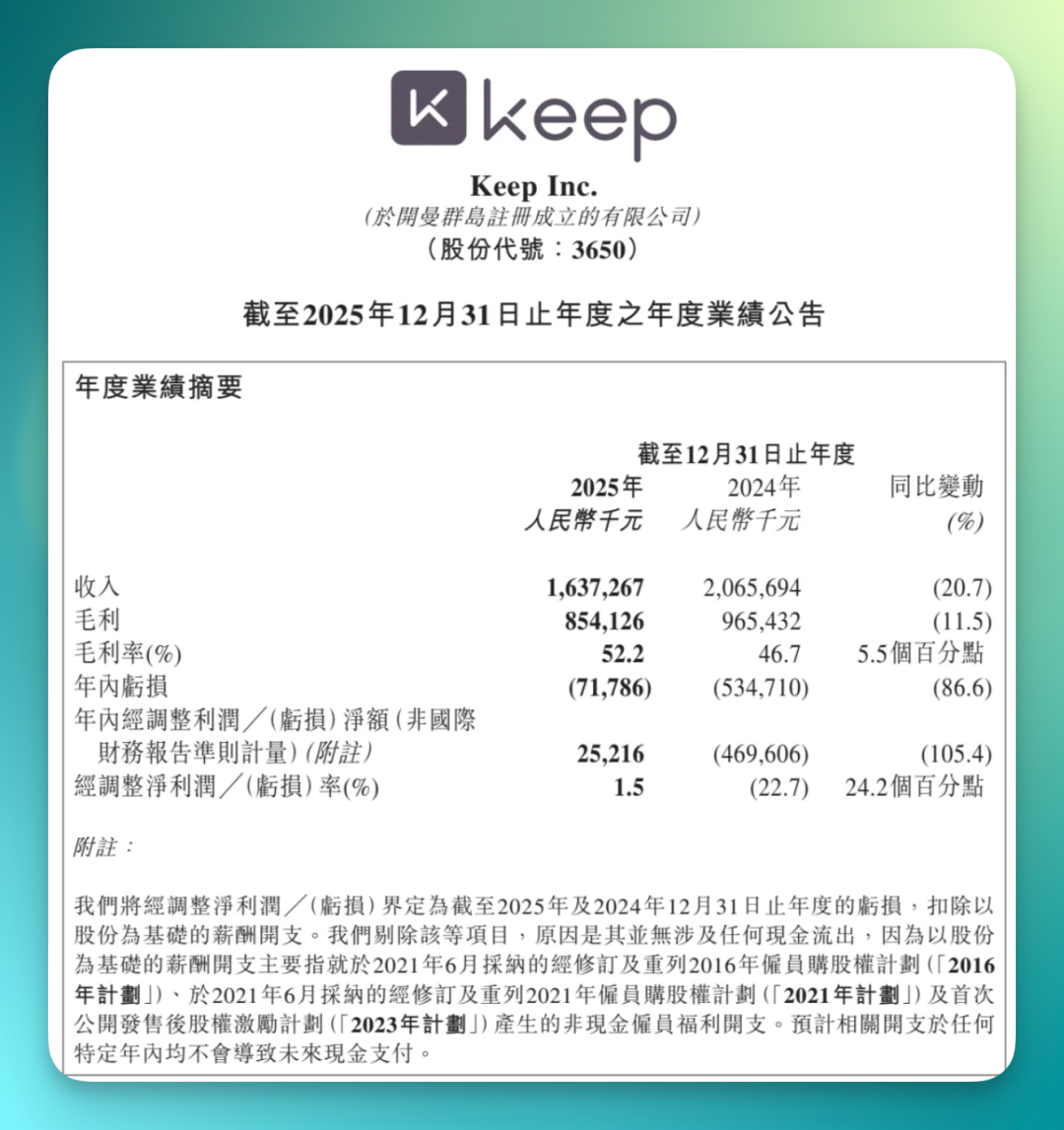
2025's profitability is an important milestone for Keep, but it's only a beginning.
Profits from cutting hardware product lines and shrinking business scale have ceilings. Keep needs to prove to markets that it can not only save money, but also find new growth engines.
Judging from this 9.0 update, the answer points to AI.
Viewed within the industry, this is precisely where AI health products are most clearly stratified right now. Products that can explain sleep scores, summarize heart rate changes, and offer a few suggestions in response to user questions are increasingly common; the barrier to building a health assistant that "seems to understand you" is falling.
The real difficulty lies in the next step: whether recommendations can plug into training workflows, whether plans can adjust in real time based on fatigue state, whether movements can be automatically substituted when knees act up, and after a run, whether the system can judge whether you should increase load, maintain, or pull back.
Whoever goes deep on this layer captures more than just a single Q&A session — users will place their long-term training decision-making authority in that product.
AI coach Kaka, built on ten years of data accumulation and deep engagement with specific exercise scenarios, now faces this same question: how much can it actually contribute across the real links of plan creation, execution monitoring, data analysis, and recommendation delivery.
These questions still need answers from the market and users.
Of course, whether this capability can translate into scalable commercial returns also needs time to validate.
9.0 is a beginning. Keepace.ai is a beginning. The ecosystem after the full AI suite lands is the real variable worth watching.
Over the next decade, can it evolve from a "works fine" tool into an AI service that's "indispensable"? That's the question Keep truly needs to answer.
Crossing is seeking independent contributors to write AI product and model reviews.
If you've written articles like: "Hands-on with PixVerse C1", "Hands-on with LibTV", please contact zeo0811@gmail.com. Your email should include: ① personal introduction, ② AI review articles you've written.
We offer competitive compensation. Looking forward to observing and documenting the AI era together 🎪