Anthropic Co-founder: Liberal Arts Majors Can Enter AI's Inner Sanctum Too
Generalists are an underrated advantage
The Generalist Is an Underrated Advantage
👦🏻 Author: Shirley
🥷 Editor: Koji
🧑🎨 Layout: NCon

Compared to Dario, Anthropic's other co-founder Daniela Amodei keeps a low profile and rarely speaks publicly.
In this 47-minute conversation, she opened up about a few things Anthropic doesn't often explain externally: why they voluntarily delayed the release of the Mythos model, why she chose to leave OpenAI back then, and why they decided not to put ads in Claude.
Taken together, these choices illustrate the opening line: the desire to do good and the ability to do it well are strongly correlated.
Guest Background
Daniela Amodei is co-founder and president of Anthropic.
She graduated with a degree in English literature, and her early career focused on international development and global health. She worked on Capitol Hill, on political campaigns, and at early-stage Stripe before joining OpenAI in 2018.
In December 2020, she left OpenAI with her brother Dario and five other co-founders — seven in total — and founded Anthropic in 2021.
Key Takeaways
1. The Generalist Path: There's More Than One Way Into AI
Daniela's résumé looks nothing like a typical AI industry leader's: English literature, international development, Capitol Hill, campaigns, Stripe, and only then OpenAI and Anthropic. She defines the underlying capability as generalist: staying curious, learning across disciplines, and knowing your comparative advantage.
The AI industry doesn't just need people who write code. It also needs people who can translate, connect, and judge across different domains.
2. Running Toward, Not Away From: The Logic Behind Anthropic's Founding
The seven founders didn't leave OpenAI because of conflict. They had a clearer vision for "how AI should be built": "We were running toward something, not running away from something." This is also why Anthropic chose to register as a public benefit corporation.
Daniela's test for all would-be co-founders is simple: Have each of you draw "what we're going to build." If one draws a unicorn and the other draws a platypus, don't partner.
3. Radical Responsibility: Safety Is a Business Action, Not a Slogan
Anthropic defines "AI safety" as radical responsibility: thinking through how technology could be misused before problems actually emerge.
The most concrete stress test came from Anthropic's own Mythos model. This was a frontier model with extremely strong capabilities that customers wanted delivered as soon as possible, but it carried significant potential abuse risks in cyberattacks.
Anthropic launched "Project Glasswing" for additional safety evaluation and remediation, actively delaying release. Daniela put it plainly: the hard part today isn't "whether to do safety," but that model capabilities are outpacing safety evaluation by too wide a margin.
4. AI and Employment: Not Replacement, but Reconfiguration of Work
Anthropic's Economic Index research shows that AI is currently more complementary than substitutive, with near-term substitution concentrated mainly in areas like customer service.
Daniela emphasizes that many jobs won't simply disappear — their boundaries will be redrawn. For people skilled at cross-domain translation, interpretation, and judgment, this reconfiguration is actually an opportunity.
5. Escaping the Silicon Valley Bubble: The Global South Is More Optimistic About AI
Silicon Valley's AI adoption rate is a highly anomalous sample. Actual usage shows clear demographic variation: education, gender, race, wealth, and region all affect adoption.
The Global South (broadly referring to developing and emerging economies in Asia, Africa, and Latin America) is generally more optimistic about AI than developed countries. In resource-scarce regions, AI is seen more as a force that can level the playing field.
6. Cognitive Offloading: The Biggest Risk Is People Voluntarily Giving Up Thinking
Anthropic's qualitative interviews with 81,000 people surfaced a throughline: people could have thought for themselves, but because AI delivers answers so quickly and smoothly, they simply stopped.
This phenomenon is defined in cognitive science as "cognitive offloading" — a deeper erosion of capability than "phone-scrolling distraction."
Claude's Learning Mode is a counterattempt: instead of giving answers directly, it guides users back into the thinking process like a tutor.
7. The Re-pricing of Human Capabilities: Explanation, Companionship, Judgment, and Relationship
When AI can handle diagnosis, coding, and analysis, the ability to be present with people, explain things, and care for them becomes more precious instead.
Daniela uses doctors as an example: AI will increasingly excel at diagnosis, but cannot truly observe or comfort you. She cited a medical study finding that patients who have good relationships with their doctors have better clinical outcomes than those who don't like their doctors.
Bedside manner will become a core metric for measuring a doctor's value. For people with humanities training, this is a clearer signal: abilities once labeled "soft skills" or "not hard enough" — listening, empathy, cross-boundary judgment, relationship-building — are being re-priced by the market.
Full Transcript Below
From English Literature to OpenAI: How a Generalist Enters AI
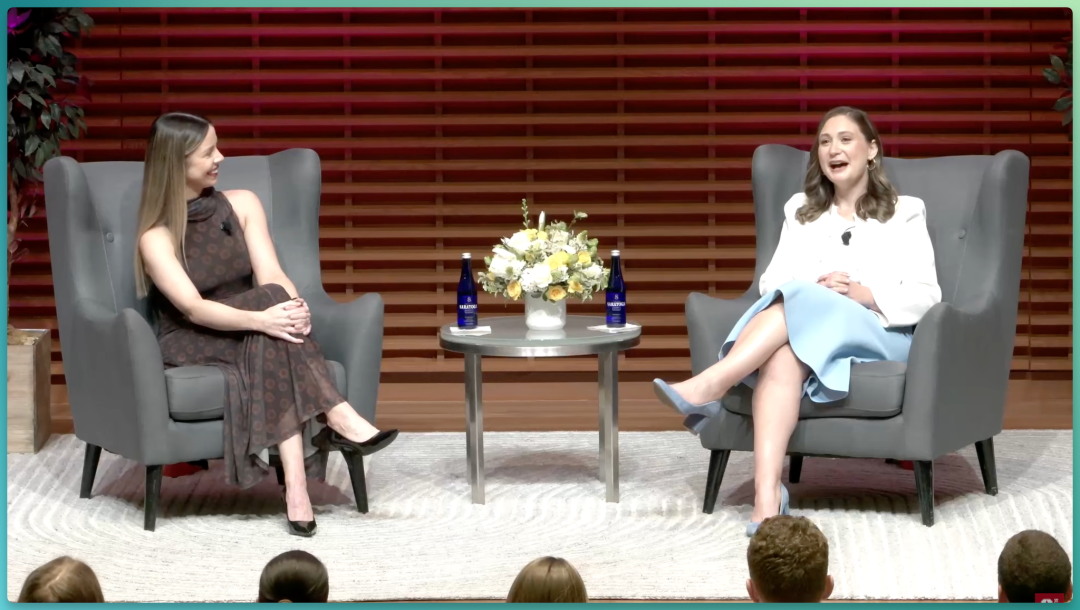
🙍♀️ Interviewer:
You and your brother built one of the most important AI companies in the world, but you didn't plan for any of this growing up. Your background is in the humanities — you studied English literature, and your early career was in politics. Can you talk more about what your original career plan was?
👩🦳 Daniela Amodei:
Oh my goodness. First of all, the fact that you're using the word "plan" here is already very kind. I don't know if I would have described myself as having a plan at any stage.
I think this is actually a story that a lot of people have — people who end up founding companies, or people whose life trajectories take some unusual paths. I was just following whatever was most interesting to me at the time, looking for that intersection of what am I good at, what am I interested in, and what can have a big impact on the world.
For me, coming out of college — and by the way, I graduated in 2009, which was not a particularly happy graduation year. You're thinking: "I have a literature degree, I have no skills, who's going to hire me?" But at the time I had a very strong impulse to make the world a better place.
I think this is something Dario and I both had growing up. For me, that impulse initially led toward work in international development and global health.
At the time I was thinking: How can we make the world more fair? How can we give everyone access to the most basic things like food, water, and medicine?
Although this isn't what I'm directly working on now, that early experience gave me a foundation for thinking about "how to do good in the world." How do you build something meaningful, with real purpose, given that you're going to spend 50 to 60 hours a week on it.
From there it was a winding journey: I worked on Capitol Hill, worked on campaigns, then came back to Silicon Valley (I'm from San Francisco myself) and joined a small company no one had heard of at the time, Stripe. My friends on Capitol Hill said at the time: "You're leaving to do what? Payments?" In retrospect it was a great decision, but at the time the company probably had about 40 people.
And then from there things just snowballed, I went to OpenAI, and then co-founded Anthropic.
🙍♀️ Interviewer:
You've moved across different domains without being limited by what you previously studied or did. Where does this mindset come from? What made you feel that your background doesn't have to define your next step?
👩🦳 Daniela Amodei:
I think in some sense I really see myself as a generalist.
If you look at my background, you'd think: "What is this lady actually good at?" I don't have a law degree, I'm not a computer scientist. But I think the ability to stay curious, to learn across disciplines, and to persist in wanting to have impact in whatever field you're working in — this is an underrated quality.
I see this quality often in people I hire at Anthropic, and in many excellent people I've worked with in the tech industry. They're curious, they're smart, they want to learn, they want to help — and this is really the core job description for every role other than "engineer." For other roles you don't say "I need this degree, that degree," you need these qualities.
But for me, it's always been interest- and impact-driven.
At the time I was thinking: "I was born in the United States, I have access to all these basic resources we take for granted, but there are people in the world who simply don't, just because of where they were born. How can I make this more fair?" From there I started to feel that I wasn't reaching the level of impact I wanted, that I needed some skills.
So I went into campaigns, and found that a small group of young, hardworking, motivated people really can change the world.
Later, going to Silicon Valley wasn't actually that surprising. You find there that you can also change the world, but startups have more money, and the pace is a bit easier than campaigns at 80 hours a week.
But I think those core qualities are about really following your passion. Because when you care about what you're doing, you naturally want to put in more effort, whether out of interest or some sense of meaning.
🙍♀️Host: Your AI career started in 2018 when you joined OpenAI, back when it was still a small lab. Suddenly you were in rooms where people were talking about neural networks, Transformer architectures, and scaling laws. How did you learn to speak that language?
👩🦳Daniela Amodei:
I think I had decent preparation on two dimensions.
First, I'd been at Stripe for nearly six years and had worked with a lot of engineers. Research and engineering are different, of course, but there's some overlap and common ground.
Second, I'd grown up with a very smart, technically-minded physicist — my brother, Anthropic's co-founder — since childhood. Plus the other five co-founders, who were all engineers or researchers.
But I think the most important thing was that these two experiences gave me a "don't be afraid of technology" mindset.
It ultimately comes down to a set of skills, and while these skills are highly valued, they're learnable by anyone. The foundations underneath — the terminology and jargon — can definitely feel overwhelming at first.
But as long as you're willing to keep asking questions, and you have patient people around you (I was very lucky in this regard), you can keep asking until you actually understand.
The second point is being clear about where your responsibilities end and others' begin. There are many things the researchers could do that I probably couldn't. I probably couldn't train GPT, definitely not GPT-2 or GPT-3. But I could bring things to the table that they couldn't.
So understanding your comparative advantage, knowing how you fit into the larger ecosystem — that itself requires a lot of interpersonal skills.
Curiosity is an innate trait, but it's also trainable. These things together gave me the ability to do reasonably well in this kind of role.
Founding Anthropic: Not an Escape, but a Shared Vision
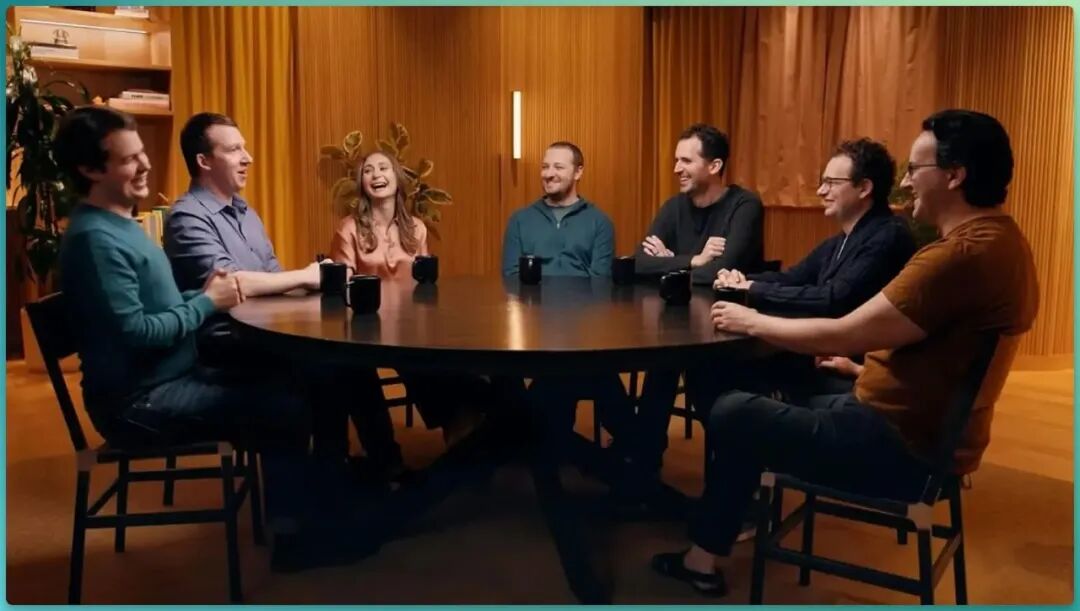
🙍♀️Host: In December 2020, you, your brother, and a group of colleagues left OpenAI together. Why did you and Dario decide to start Anthropic?
👩🦳Daniela Amodei:
There were seven of us who left initially — me and Dario, plus five co-founders — and a few more came shortly after. For us, the fundamental thing was focusing on what impact this technology should ultimately have.
The seven of us were all different people, but we were all very principled, very concerned about the consequences of what we were building.
We eventually felt that creating the kind of vision we wanted to see would be much easier in a new company than in the existing one.
I get asked about this a lot, so I want to say: we were really running toward something, not running away.
We wanted to create an organization where the values that mattered to us — around safety and responsibility — became the premise of everything we did.
That's why we chose to incorporate as a Public Benefit Corporation. It took us a while to figure out "what form should this take" — yes, we'd be a commercial entity, we believe AI will create enormous economic value — but doing this the right way matters enormously to us.
That's what united the seven of us. We'd all worked on model capabilities, safety, and policy at OpenAI, so building this structure in a new company would be easier.
🙍♀️Host: You're not just building Anthropic with your brother, but with five other co-founders. Many people here will soon be choosing co-founders for the first time, and we all know this often ends badly. What does it take to make it work?
👩🦳Daniela Amodei:
I think I'm just very fortunate — our seven-person group is a very unusual one.
The first thing I want to say is that relationships matter even more than you think.
For example, how do you handle conflict? Dario and I have been "fighting and making up" for 40 years, because he's my brother, and I stole his toys growing up.
So we know how to get through conflict together, and there's no question we'll still love each other at the end.
With the other co-founders, I've known Jared for about 15 years, and Chris for 15 years too.
Tom and Sam were roommates; Jared and Sam worked together during their PhDs at Stanford. So we have a long history. Dario and I had previously managed several of the other co-founders — they either reported to one of us, or to both of us, mostly the latter, back at OpenAI.
So we already had an existing structure of "we know how to give each other feedback, how to work together, and we understand each other."
Another important thing is that you have to make sure you have very strong alignment on what you're trying to do.
If you locked you and your co-founder in a room and had each of you write or draw "what are we building," the result shouldn't be one person drawing a unicorn and the other drawing a platypus.
That's a situation where you think you're working on the same thing, but you're not, and that kind of partnership usually doesn't end well.
In a sense, we were "pre-selected" — we'd been in an environment where we all felt "something's not right, we want to do something else," and we already had consensus on what that "something else" was.
So the test is to stress-test as much as possible. Before starting a company, go on vacation together, share a room. If you come back thinking "I really want to spend more time with you," that's great.
But if you're thinking "I need another vacation to recover from this vacation," you probably picked the wrong person.
Radical Responsibility: Safety Isn't a Slogan, It's a Business Decision
🙍♀️Host: I want to come back to something you said earlier. Anthropic is deeply associated with AI safety, but I want to make sure people really understand what that means. When you say "AI safety," what exactly are you referring to?
👩🦳Daniela Amodei:
That's a great question. This term has gotten somewhat overused in the past few years — it's become a catch-all in many contexts.
But for us, the top-level framework is this: a radical responsibility for the technology we're developing.
We often use social media companies as an analogy — it's now quite fashionable to publicly complain about them, so I'll join in.
If you go back in time, the people who founded these tech companies weren't thinking "I want to create an epidemic of eating disorders among teenage girls." That wasn't their intention.
What they were thinking was "what metric am I optimizing for?" They wanted to build a company, they saw explosive growth, so they built toward that. There wasn't really a reason to do more at the time, because we'd never seen scale and adoption velocity at that magnitude.
But you can imagine going back and saying to the people about to start Facebook, Instagram, Snapchat, Twitter: "What if I really thought through all the ways this technology could go wrong, all the unexpected externalities, and tried to get ahead of preventing some of the bad things?"
This generation of AI has a bit of an advantage — the previous generation of technology already made mistakes for us, and we can say "haha, we won't repeat those." But that's an enormous privilege. We can say "you made that kind of mistake, we're not making it this time."
We have to be careful, we have to think, because we understand this technology better — can we use that understanding to identify and avoid the paths where things could go wrong ahead of time?
How do you imagine a world where everything goes well, and also a world where everything fails?
For us, "safety" encompasses all the big things — like preventing people from using our technology to develop chemical and biological weapons, which by the way, AI does have the potential to enable — as well as cyber warfare.
We recently made a lot of news for deciding to shelve the release of our Mythos model, and there's a lot of work around user health, child safety, misinformation, electoral integrity.
These aren't new things we invented. We're standing on the shoulders of previous safety and security teams, learning from the most important tech companies of the past, and asking ourselves "how can we do better?"
🙍♀️Host: Anthropic is an AI safety company, but it also needs to generate revenue. How do you balance the tension between those two?
👩🦳Daniela Amodei:
We get asked this a lot too. I'd say that these two things come into conflict far less often than you'd imagine.
Most of our revenue comes from enterprise customers, and no enterprise wants an unsafe model. No one says "I wish Claude would hallucinate more," or "it would be great if Claude output harmful content when you ask it questions." So until quite recently, these two things were 100% aligned.
Safety is good for business, because enterprises are inherently risk-averse — they don't want unpredictable or unreliable AI technology.
That said, we're now entering a new phase — model capabilities are advancing so quickly that the tension is really about time.
It's not that the models can't do amazing things, but we haven't fully understood yet (and this will become more apparent): how serious are these risks? What are all the risks? How do we mitigate them?
This sometimes means we have to make unusual moves, like Project Glasswing.
We said: "this new class of models, it would be amazing to release to all our customers, they'd all want to use it, but we're not confident enough yet.
We need more time to do some work to make the model safer to use." That feels uncomfortable. It's uncomfortable to say that to customers too — they'll say "we all believe in cyber defense, but I really want to use that model."
In moments like these, we go back to our mission. We say: "We hear you. We want to get this technology into your hands as quickly as possible too.
But releasing it before we're confident all the necessary fixes are in place would be irresponsible."
How AI Is Changing Work, Education, and Global Adoption
🙍♀️ Moderator: We can't deny that when people talk about AI, there's a lot of fear. The worry that AI will reduce job opportunities because the need for human judgment will decline. Do you think this fear is justified?
👩🦳 Daniela Amodei:
I think this is actually a very complex question. My view is that AI will change the types and forms of work.
There are jobs today that exist because of AI that didn't exist five years ago; and there will be jobs that no longer exist in the future because of AI. Our Economic Index research specifically looks at how people are actually using AI technology.
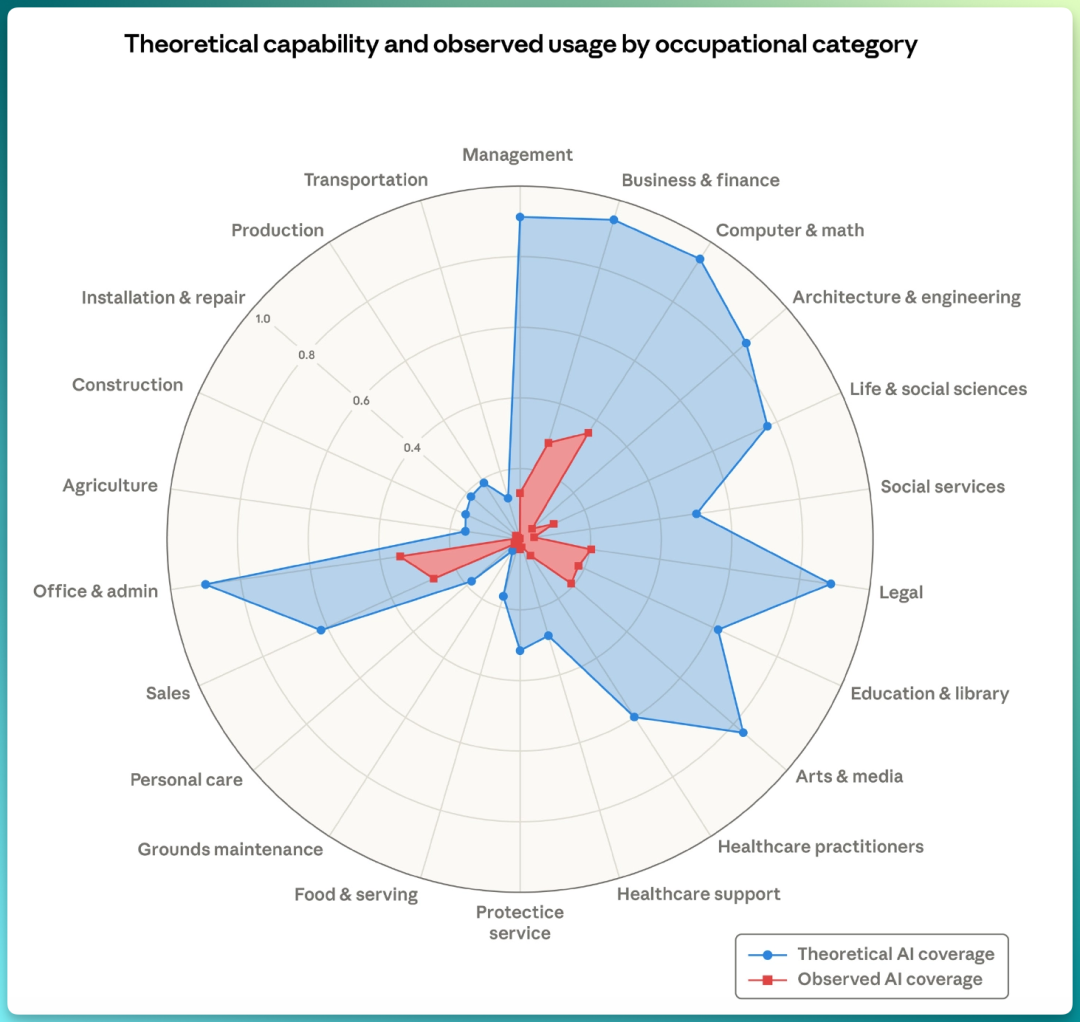
In most cases, AI shows up as a complementary skill: AI is empowering work, not replacing it. With very few exceptions, like customer service being heavily displaced by AI.
Anthropic's report on AI's impact on the labor market noted that the gap between AI's theoretical coverage and actual deployment remains substantial. Take computer and mathematical occupations: LLMs could theoretically affect 94% of tasks in this field, but in Claude's actual usage data, only 33% are truly covered. Office and administrative occupations have a theoretical exposure of 90%, yet actual coverage is similarly just a fraction. In other words, large-scale technological displacement isn't happening comprehensively right now — AI is still far from reaching its theoretical ceiling.
👩🦳 Daniela Amodei:
If you email Comcast in the future, you probably won't get a real person responding anymore, but I'm not sure that customer service is fundamentally different from what it was five years ago.
So I expect that there will be jobs in the future that are similar to jobs today but not exactly the same — we don't know what these new forms will look like.
The most discussed example today is of course programming, software developers. In many business conversations I've been in, CEOs often lean in slightly and lower their voices to ask: "My daughter's a sophomore at Stanford, she was going to major in CS — should she not?" My answer is: we don't know.
But my guess is that software developers will still exist, they just won't write as much code. Software developers do far more than "hands on keyboard" — they talk to product managers, they work closely with customers.
That portion will expand, while the parts more easily done by AI will contract, but this will make the boundary of "what's possible" completely different.
🙍♀️ Moderator: At the education, leadership, and societal levels, what needs to happen for people to feel prepared and inspired rather than just anxious?
👩🦳 Daniela Amodei:
I think there are a few things.
First, we need to start from and orient around humility, acknowledging that we don't have the answers, but committing to studying them. What Anthropic has tried to do is be as radically transparent as possible. We've consistently said: "We don't have all the answers, we do need to study this so we can tell you what we're seeing."
Sometimes people fairly say: "Hey, you guys are sharing too much negative information." We do say "here's what we think might happen in the future," but what's more important is starting this conversation earlier, because we don't want people to be caught off guard. We publish our Economic Index reports to say: "here's how people are using AI today," because we want people to understand "where we think this is heading."
Second, we need creative, experimental efforts at many different levels. How can AI become not just "something I use at work" but a foundational and connective element in people's lives? Work is important, but we also need to rethink the connections between work, meaning, and social life. These things will all look very different in the future, and we need to practice learning them.
Third, this goes beyond what any single tech company can solve alone — it becomes a social and political issue. If people feel their jobs are being displaced by AI, they will care. "I'm anxious about what AI means for my future, I'm anxious about my children's future" — you see this in polls.
So this needs to be a larger discussion at multiple levels, in government, civil society, and universities: When AI can do many of the things humans do today, what kind of world do we still want?
🙍♀️ Moderator: But the core is really adoption. At Stanford we interact with AI every day, but Stanford and Silicon Valley aren't the whole world. What's blocking AI adoption outside of Silicon Valley?
👩🦳 Daniela Amodei:
You're so right. For us at Anthropic (and maybe at Stanford too), it feels like all anyone wants to talk about is AI. Though to be fair, people only want to talk to me about AI, so that might be my problem.
But you're absolutely right — in other parts of the United States, AI isn't yet a comfortable topic, and many people don't know how to use it with high proficiency.
You'll see those staggering numbers about how many people are using AI tools. But there's a demographic skew: users tend to be college-educated (not exclusively, but disproportionately), more male than female, with racial disparities, with wealth disparities. If you look globally, the distribution is uneven.
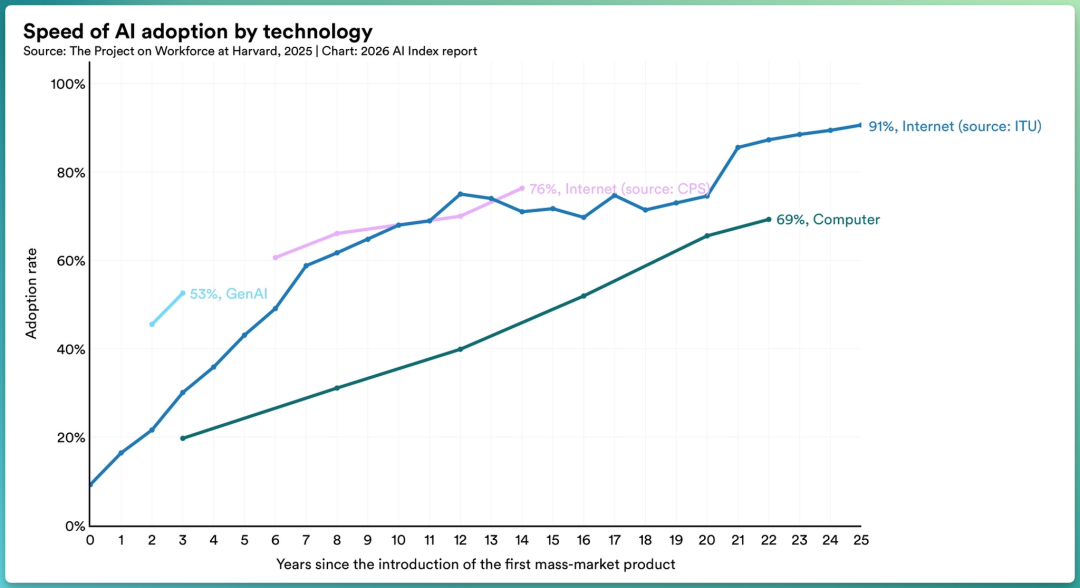
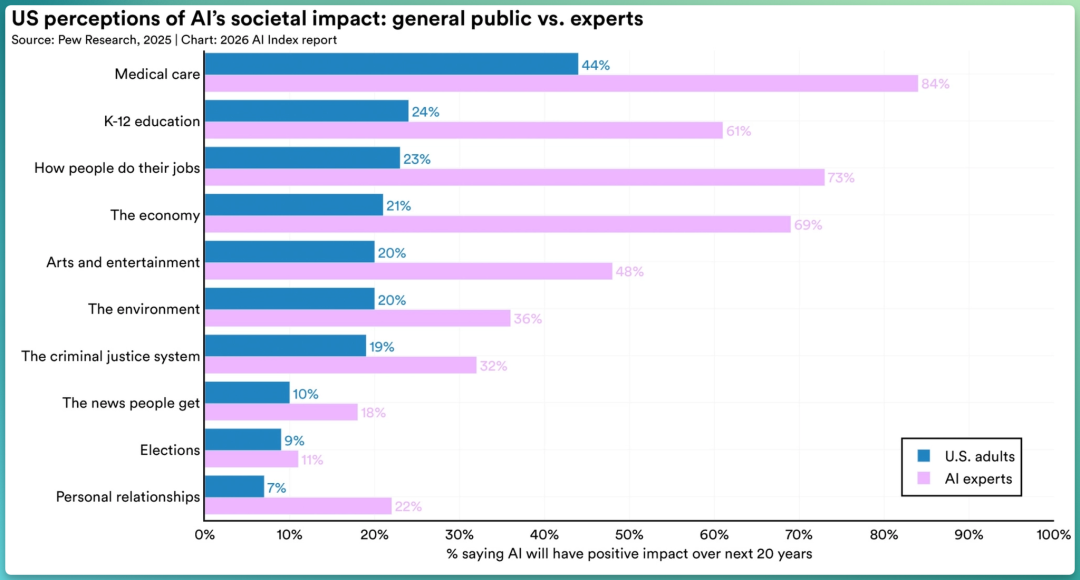
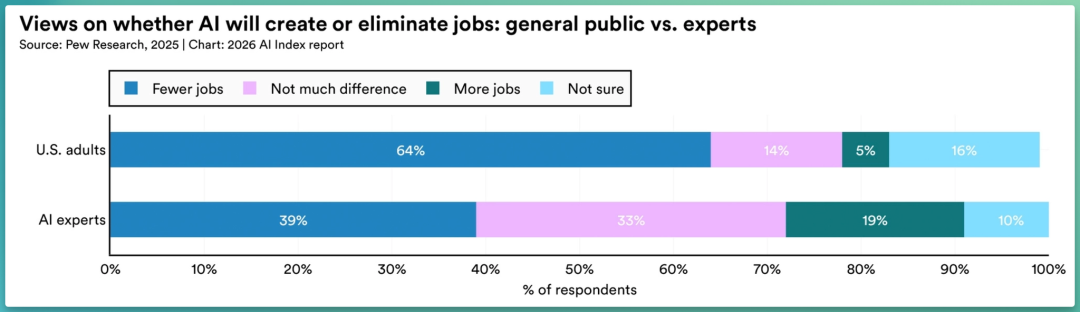
Stanford University's previously released 2026 AI Index Report noted that generative AI's adoption speed has broken historical records, yet a massive perception gap exists between tech elites and the general public on AI's impact on employment and the economy. Regarding how AI will affect human work over the next 20 years, 73% of experts believe AI will have a positive impact, while only 23% of the general public share that view; nearly 64% of Americans expect AI to reduce jobs. On assessments of AI's impact on healthcare and the economy, there are similarly optimism gaps exceeding 40 percentage points.
👩🦳 Daniela Amodei:
What's interesting is putting this together with another dataset we collected: people in developing countries are far more optimistic about AI than those in high-income countries. They almost universally say: "Wow, this is a huge opportunity for us."
This could be a force that levels the playing field, that makes the world more fair. Whereas in the United States, Europe, and certain parts of Asia, there's much more anxiety: "I like things the way they are, I don't want AI coming in and disrupting all of this."
How do we use this information? I don't know. But what's interesting is that the questions around access and adoption of this technology are different.**
We're actually still very, very early in the game — something easy to lose sight of in the Silicon Valley bubble, where all the software engineers say "I'm using Claude Code, I'm using Codex," but this is far from the reality for the vast majority of developers worldwide.
The race has just started, and we still have enormous opportunities to positively shape how this technology will be used, developed, what access to it looks like, and ultimately what values are embedded in it.
What We Might Lose: When AI Stops You from Starting to Think
🙍♀️ Moderator: Let's fast-forward to a future where AI is already widely used. If we delegate too many things to AI, what might we lose?
👩🦳 Daniela Amodei:
At Anthropic we did a very large qualitative study (possibly the largest of its kind): we talked to 81,000 people about their AI usage, including Claude users and users of other AI tools.
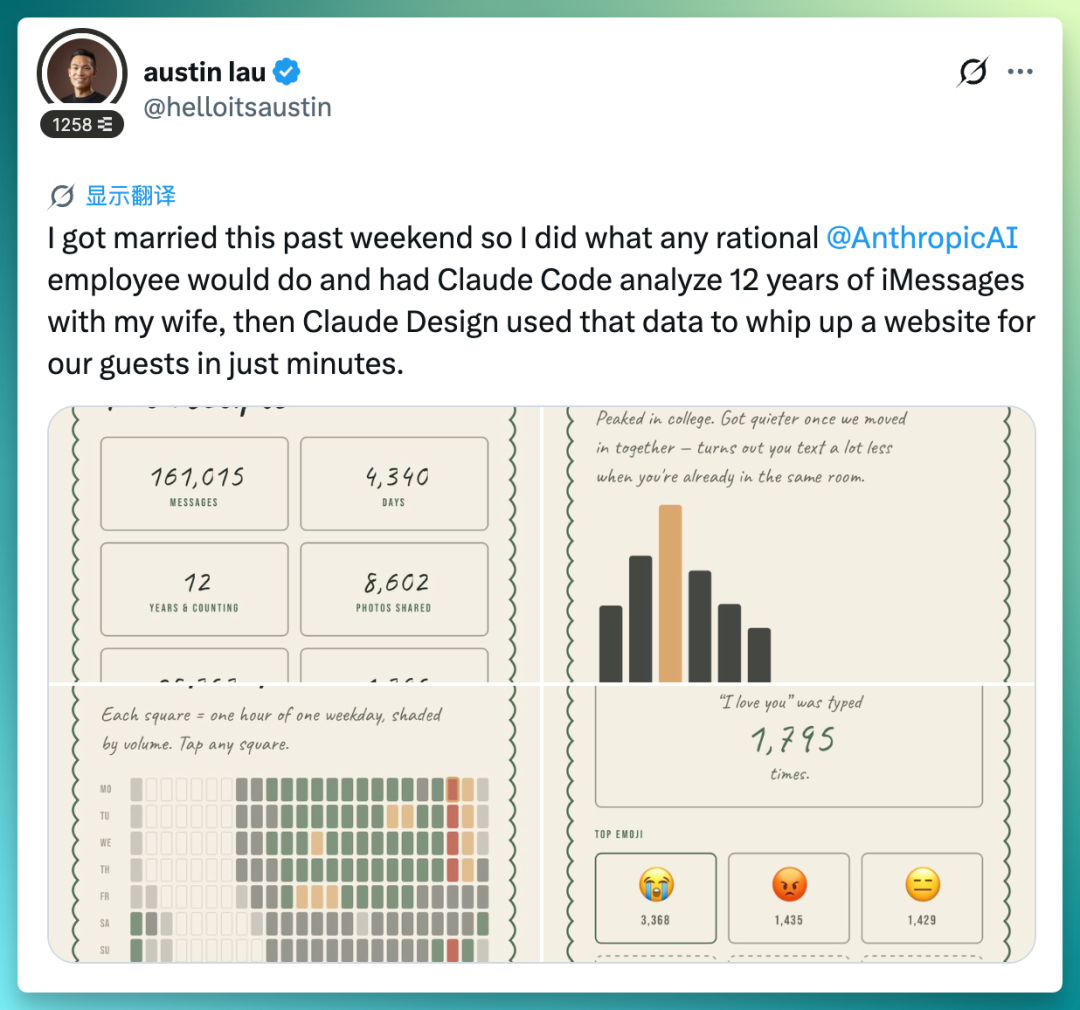
People have many different feelings about AI. Some say: "It let me do things I never thought I could do." I'm an example myself — I never thought I could build a website, but now with Claude, I click a few times and Claude builds it for me. If I did it myself, it might take a year and wouldn't look very good.
👩🦳 Daniela Amodei:
But others expressed a feeling of: "I didn't make myself think through it, because I didn't need to." It's different from the feeling of scrolling on your phone — more like: "I could have reached for that idea, I could have figured it out, but not doing that and just trusting the answer AI gave me was so much easier."
I actually think this is the true source of most anxiety about AI: humans have an innate desire to learn, to stay curious, to push the boundaries of what they know. AI can amplify that in some sense, but if used incorrectly, it can also disable it.
I catch myself doing this too — I could have looked it up, could have figured it out myself, but I just ask AI and blindly trust that what it says is right.
By the way, it's not always right. Claude sometimes makes mistakes. Admitting that feels a bit heretical, but it's true.
The anxiety here is about how we actually set up guardrails so that "not thinking" isn't impossible, but you have to really work at it to do it.
Some of the work we're doing in the university space might be an interesting microcosm of this problem.
We have a feature called Learning Mode. One version is: you dump your homework into ChatGPT (let me switch examples here), it gives you the answer directly, you go "haha, awesome," but there's a word for that — it's called cheating.
Another version is you use Claude's Learning Mode. You say, "I'm stuck, I'm writing a paper but something about the formatting isn't working," and Claude acts almost like a personalized tutor who knows you. It says: "Let me help you untangle this knot. Do you want to reread this section together? Can we talk through it?"
That's the version where AI tools make you smarter, where they expand the boundaries of what you think you can learn. The other version is "turn off your brain."
As an industry, I hope we choose the former, not the latter.
Bedside Manner: Human Skills Repriced for the AI Era
🙍♀️Host: If you had to rank them, which human skills are most likely to become more important in an AI-driven world?
👩🦳Daniela Amodei:
I have my own view. I think, as we discussed, a lot of specific, task-oriented work — financial analysts, developers, copy editors — those jobs will change dramatically. Much of that work will be doable by AI tools.
But I think ultimately there's a very real phenomenon: humans like being with humans. We enjoy spending time with each other, learning from each other, being creative, taking time to understand another person. We're social animals.
I imagine that in a world where AI can handle much of the day-to-day productive work, these interpersonal skills become more important, more valued.
Because ultimately, if you're in a work environment and you say "I could just have Claude write a bunch of code," you'll still choose to talk to the developer who can explain to you why something broke, why we designed the tool this way in the first place.
To take this outside tech, I often use the example of medicine.
Today we hire doctors because they're good diagnosticians. You ask "Can you tell me what's wrong with me?" and they give you a list of possible conditions.
Guess what? AI is going to be very good at that. But what AI can't do is truly look at you, examine you, understand how you're feeling, help you feel better.
There's reasonable evidence in the medical literature that patients who have good relationships with their doctors (not just being polite, but genuinely liking them) have better clinical outcomes than those who don't.
It's hard to explain, but it's probably because the doctor put in slightly more effort to understand what was bothering you, maybe ran a few extra tests that weren't expected.
This bedside manner, in a world where AI takes over diagnosis, becomes five times more important than it is today. It's no longer just something barely squeezed onto the checklist of doctor qualifications — it becomes a core metric of a doctor's value.
What Claude Has Taught Me: From Writing Team Feedback to Getting New Parents Through It
🙍♀️Host: When you think about the future, what AI use case personally excites you the most?
👩🦳Daniela Amodei:
Oh my god. For me personally, I'm a manager — I spend most of my time dealing with people. There's this phenomenon where everyone thinks AI won't come for their job because they're special, and I'm guilty of this too. But I genuinely think Claude is incredibly powerful as a management coach, something that can make you a better leader.
I use Claude to write performance reviews. I upload information about reports I've worked with for three or four years. Fundamentally they're still the same person, you give them feedback, but how much has really changed in the past six months?
Claude is incredibly strong at helping me identify behavioral patterns in a person.
If you look back over three or four years of working with someone, you realize "wow, for the past three or four years, you two have been circling around this specific topic." Maybe they need some extra coaching, or support from someone other than you.
This kind of thing is easy to miss in day-to-day work because you're inside it.
Conversely, Claude is also good at giving you feedback. I upload all my reports' feedback about me to Claude, and Claude will sometimes gently say: "Sounds like you haven't made progress on this over the past year, maybe you should get some extra coaching, Daniela."
I think Claude is incredibly powerful at helping people be the best version of themselves.
The second use case is, I have two kids — one almost 5, one almost 1. I have to tell you, the best thing Claude ever did was help me survive potty training. It was not a fun experience.
Claude made it slightly better. Very empathetic, very actionable, and there were diagrams — I don't need to describe the specifics. But Claude is incredibly useful for overwhelmed new parents because the quality of parenting information online is so uneven, and there are too many bad answers.
Every time you Google "is something wrong with your child," the answer is always "yes."
Claude is more measured, and it can be interactive. That's a genuinely useful way to engage.
Two Sentences for the Next Generation of Builders
🙍♀️Host: Daniela, before we turn to student questions — when you think about the next generation of AI leaders and builders here today, what's the one thing you most hope they take away from your journey?
👩🦳Daniela Amodei:
Can I say two?
The first sounds so cliché I almost don't want to say it. But I genuinely believe that following what you truly care about, what you're genuinely passionate about, is the most important thing you can do.
There are so many good ideas in the world, but if you don't have that burning feeling of "this needs to exist in the world, I will run through a wall to make it happen," it's hard to keep going when it's not fun anymore.
That's when it matters — when it's not fun, when it's terrible — because you have to be able to tell yourself "I remember why this mattered to me, I remember why it was meaningful."
Whether it's personally meaningful to you, or because you want to see some kind of change in the world. We've had those moments at Anthropic where we thought "this really isn't the most fun part," and some parts are genuinely hard.
But being able to trace it back to why you chose to do this in the first place — that's incredibly important.
The second thing, especially for this generation, has probably been true for the past 5 to 10 years: doing business doesn't have to be opposed to doing good. This is a very new idea, and I'm incredibly impressed by how this generation of founders and creators thinks this way — this fusion of innovation and social impact.
There used to be this sense that "only mean, difficult people build businesses." I don't think that's true, and I'm increasingly convinced that the desire to do good and the ability to do well are strongly correlated.
Student Questions: Bubbles, Regulation, and Privacy
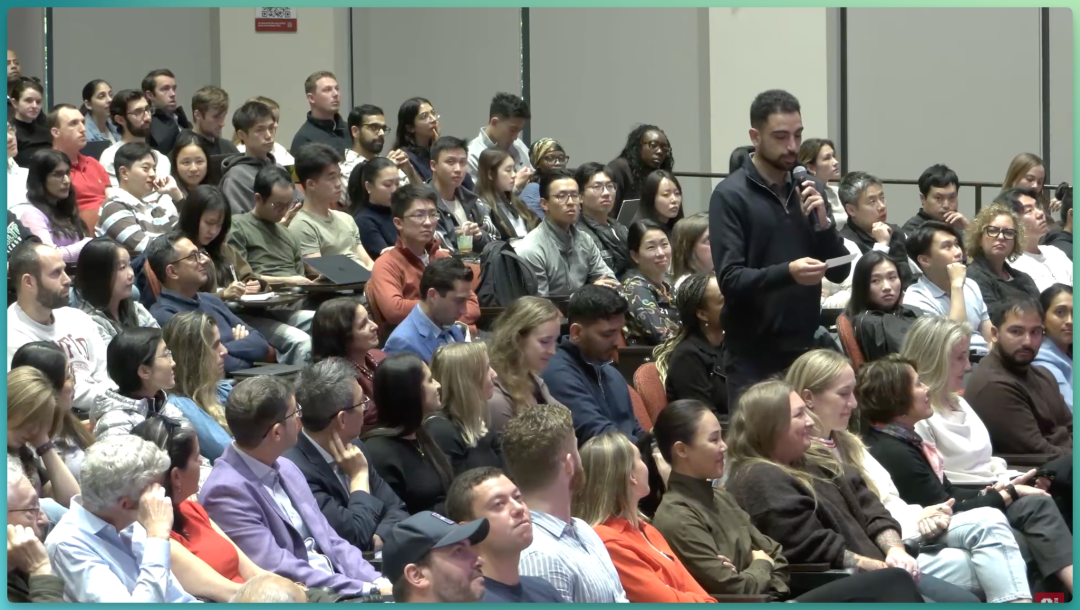
🙋♂️Brandon:
Hi Daniela, I'm Brandon, an MBA second-year here, thanks for coming.
There's a discussion about "are we in an AI bubble," and when people say "bubble" they usually mean three different things: company valuations, company spending on infrastructure, or whether the pace of AI progress itself can continue. Which of these three worries you the most? Which are people most misled about?
👩🦳Daniela Amodei:
That's a great question. When you say "bubble," we actually have to distinguish: do you mean an air bubble or a glass bubble? They're very different, but I know what you mean.
I probably wouldn't say "most worried," but I think as a legitimate concern for the industry overall, AI is a high capital expenditure business.
That inherently carries some risk. You all probably know that training these models is extremely expensive. It requires massive compute, and compute supply is scarce.
When you put those two things together — massive demand, limited supply — I'm not an economics professor, but I'm guessing prices go up.
Compute is essentially the lifeblood of these companies. You have to buy it far in advance, so you're essentially making a bet on the future: "We think we're going to need this much compute at some point in time."
That's a huge expenditure, and working at any company like this is actually somewhat terrifying.
If someone tells you "this is fine" (excluding cash-rich public companies like Google), they're probably not being fully honest. For Anthropic and OpenAI, you're making a calculated bet that you'll be able to earn that money back in the future.
We're obviously very bullish on this. We constantly hear VCs say: "This has never happened before in the history of venture capital." It's hard to imagine a business reaching this revenue scale in such a short time.
Both companies are buying massive compute for the future, but if that changes, it becomes a problem.
So it's a legitimate concern. We obviously think we're in a great position, and the industry overall is too, but this could change at any moment. The important thing is to remember that this is fundamentally a bet.
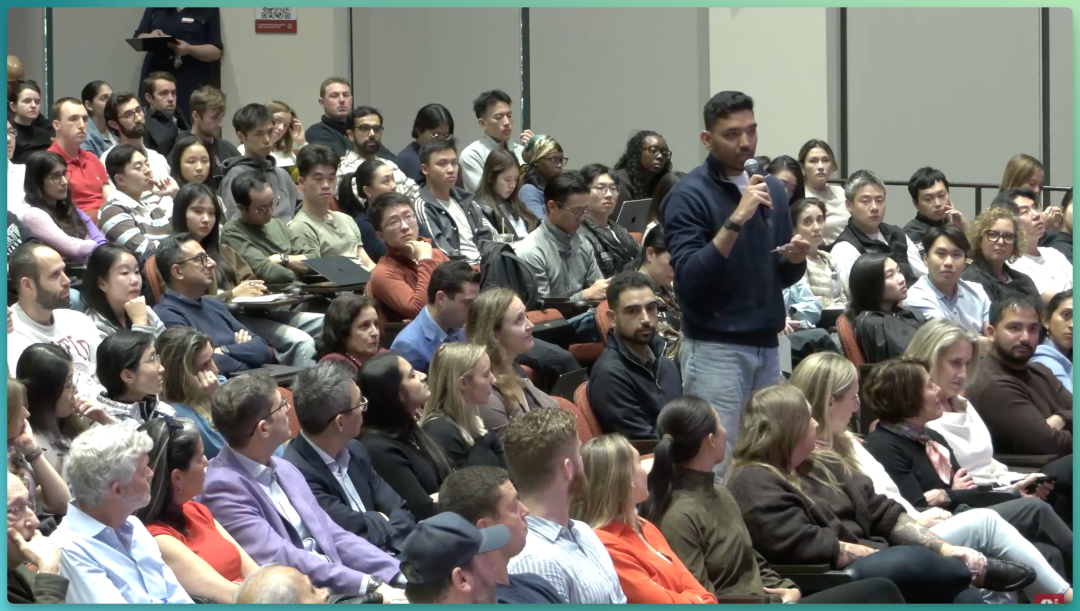
🙋♂️Yash:
Hi Daniela, I'm Yash, an MBA student. My question is, what does Anthropic think is the right balance between government regulation and AI innovation? What would you like to see governments around the world do differently?
👩🦳Daniela Amodei:
Great question. This is an area where I find the current discourse unfortunate — like today's political environment, it's hard to have nuanced discussions.
It's a real shame, because this is a genuinely nuanced issue. I think sensible regulation will be part of the AI story.
We also understand that as a company, you need some breathing room to experiment and build great products that the next generation will actually want to adopt. My core hope for this discussion is that it doesn't become politicized.
I'm worried it already has, as if "regulation = bad, innovation = good" or "innovation = bad, regulation = good." It's genuinely complicated. Some areas of regulation don't matter much; others are absolutely critical.
In an ideal world, I'd love to see tech companies and regulators work hand in hand. Our Safeguards team and safety team see every day how this technology can be misused, while regulators understand how to provide frameworks and systems that can actually be enforced.
Maybe I'm overly optimistic, but I still have hope that both sides can agree on this: how do we make sure we keep developing the next great technology that doesn't exist yet, the next Google or Meta, while also using some common-sense regulation to protect people.
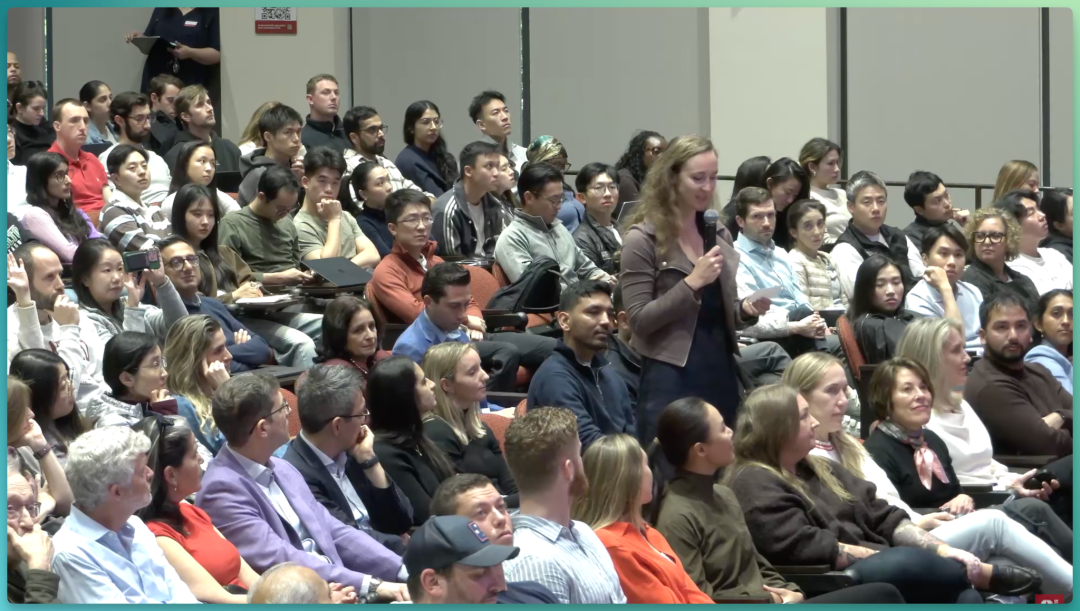
🙋♂️Jackie Kimmel:
Hi Daniela, thank you for being here. My name is Jackie Kimmel, and my question is: AI is gaining access to more and more sensitive personal data, like our health data. What do you think individuals should actually do to protect their privacy?
👩🦳Daniela Amodei:
First, I have to say, you'd be surprised how common it is for people to ask Claude medical questions. I do it myself all the time — "what's wrong with my son," "something's off with me, help me out."
I think there are two sides to this. First, companies have a responsibility to use and protect your data carefully. That's extremely important.
People should hold companies accountable for carefully using their data, because it's so personal. For example, part of why we decided not to put ads in Claude was based on this belief — AI technology is different. The conversations people have with AI tools are far more private than anything they'd put on Instagram or any form of social media.
So knowing that, tech companies have a greater responsibility to protect your data.
The second side is, from an individual perspective, I don't have a perfect answer. I can tell you that a lot of people use it for medical questions, but from a safety standpoint, I'd advise: don't blindly trust models on medical matters.
My own experience is that Claude gives the correct answer on complex medical cases more often than my doctor does, but I would never act on anything without verifying it with a licensed medical professional.
We're very transparent that "models sometimes hallucinate, they get confused, they don't know you, they can't examine you," so maintaining some healthy skepticism is really important.
But you can think of it as "you have a friend who's a very good doctor, but not a specialist in a particular area." You say, "I'm going to see a specialist, and I want someone to help guide me through the conversation with the doctor."
Claude is a great tool for that — it's good at helping you think of possibilities you might not have been aware of.
But my number one recommendation is still: please don't do anything medical-related just because an AI tool says "do X." Look at it with a skeptical eye, and talk to a professional.
View from the Top: Rapid Fire
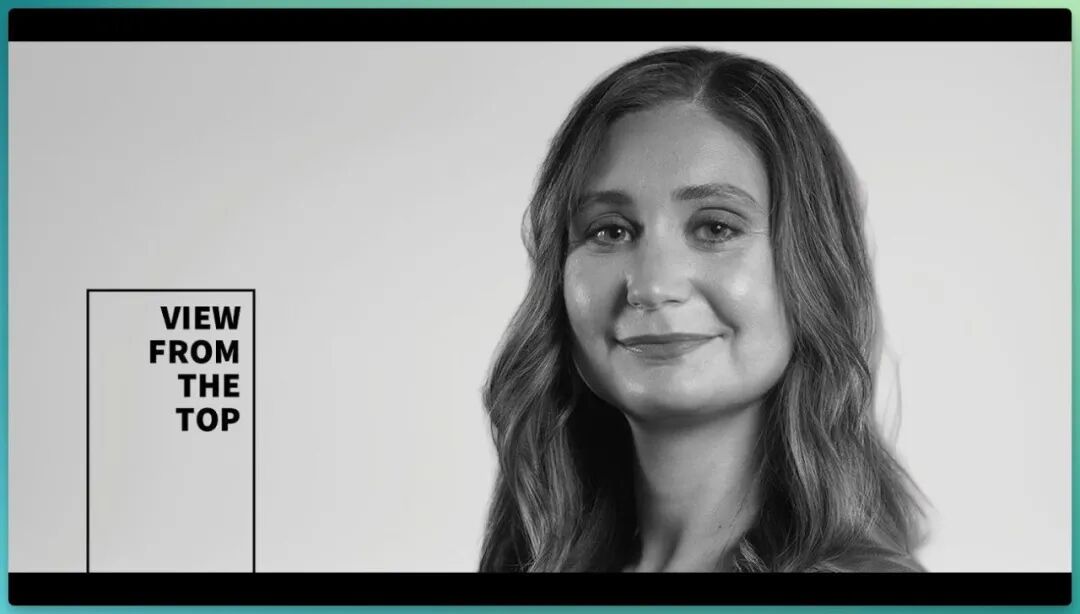
🙍♀️Moderator: Thank you to all the students for your questions. Daniela, we'll end with the View from the Top rapid-fire round. If you could go back to college, what would you major in?
👩🦳Daniela Amodei:
If I said business, would that get me out of this entirely? What would I major in? I'd probably still major in literature. I know it sounds crazy. I love reading.
🙍♀️Moderator: What's your favorite thing about working with your brother?
👩🦳Daniela Amodei:
Oh, Thanksgiving dinner. No, just kidding. I'd say, we know each other so deeply that we can say things to each other that no one else in the company can. Sometimes we can do things that other people feel like "I can't do that."
🙍♀️Moderator: Least favorite?
👩🦳Daniela Amodei:
Thanksgiving dinner. Kidding! I think it's needing to maintain some distance between the personal relationship and the working relationship. We specifically schedule time to spend together outside the office — we've been siblings for a long time, and we'll be siblings for a long time to come, so we need to keep nurturing that relationship so it's not just the work part.
🙍♀️Moderator: Favorite book you've discovered in the office library?
👩🦳Daniela Amodei:
Let me think. I'm not sure I've discovered a new book there, which maybe means I should go more often — I just said "I love reading."
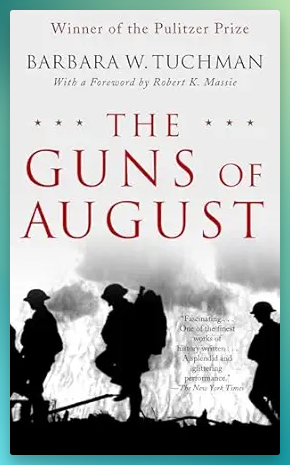
But one favorite I was reminded of is The Guns of August. Is anyone interested in World War I? I'm seeing some blank faces, maybe not. It's a wonderful book if you're interested in WWI... I pulled it from the library and reread it. I think I read it right after college. It examines how specific individuals and personalities led, step by step, to the outbreak of WWI.
🙍♀️Moderator: Great. If Anthropic had ended up with a different name, what would it have been?
👩🦳Daniela Amodei:
Oh god. We went through some really bad ideas before landing on Anthropic. For some reason we were weirdly obsessed with birds at the time.
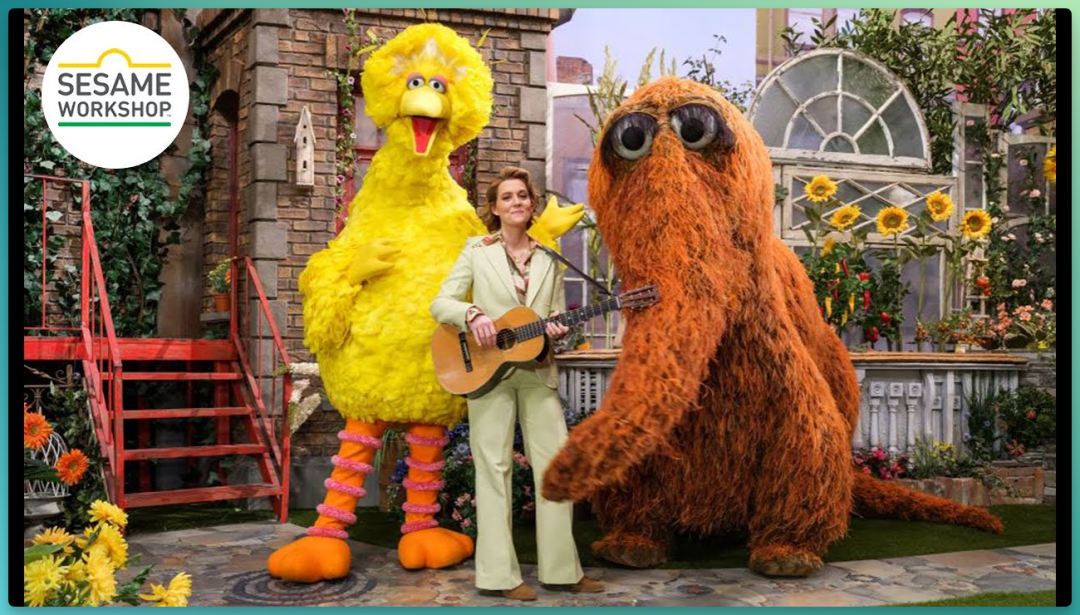
We considered calling it Sparrow Systems — I don't know where that came from. Looking back, some of our early model names were also birds. We had Bert, then Snuffleupagus (a Sesame Street character, not a bird). Good thing we wisely chose Anthropic in the end — it's impossible to imagine it being called anything else now.
🙍♀️Moderator: Last question — what's the best advice you've ever received?
👩🦳Daniela Amodei:
Let me think about the best advice... I'd probably say, when we were thinking about "should we leave" — looking back now, everyone says "of course you left OpenAI and started Anthropic," but it didn't feel that way at the time.
We were thinking, "this is a really crazy thing to do, maybe we should stay, maybe we can make it work."
I talked to a friend and mentor outside of work, and she said: "Honestly, I don't think you need to be on the phone with me about this. You already know what the right answer is."
👩🦳Daniela Amodei:
I think in many cases, when you're in a moment of "is this the right thing for my life," you already know what the right answer is.
I think that's really good advice.
🙍♀️Moderator: Daniela, thank you so much for today.
👩🦳Daniela Amodei:
Thank you all, thanks for having me.
Crossing is looking for freelance writers to produce AI product and model reviews.
If you've written articles like: "Hands-on with PixVerse C1", "Hands-on with LibTV", please contact zeo0811@gmail.com. Your email should include: ① a personal introduction, ② AI review articles you've written.
We offer competitive rates. Looking forward to observing and documenting the AI era with you 🎪