Behind Cerebras' Billion-Dollar IPO: An Inflection Point for AI Compute Power

A Bet on the Future of AI Compute
A Bet on the Future of AI Compute

👧🏻 Author: Shirley Wu
🥷 Editor: Koji
🧑🎨 Layout: NCon

On May 14, 2026, Cerebras Systems listed on the Nasdaq.
The IPO priced at $185 per share, with the range raised from an initial $115–125 all the way to $150–160, then bumped again in the final days of the roadshow. The offering size also expanded from 28 million to 30 million shares. In a single IPO, it raised $5.5 billion.
More dramatically, the stock jumped to $385 at the opening bell, up 108% from the issue price — the largest US tech IPO since Uber went public in 2019.
The Hottest Chip IPO on Record
According to TechCrunch, the stock pulled back to around $330 intraday and closed at $311, implying a market cap of roughly $66 billion; after-hours trading pushed the valuation toward the $100 billion range.
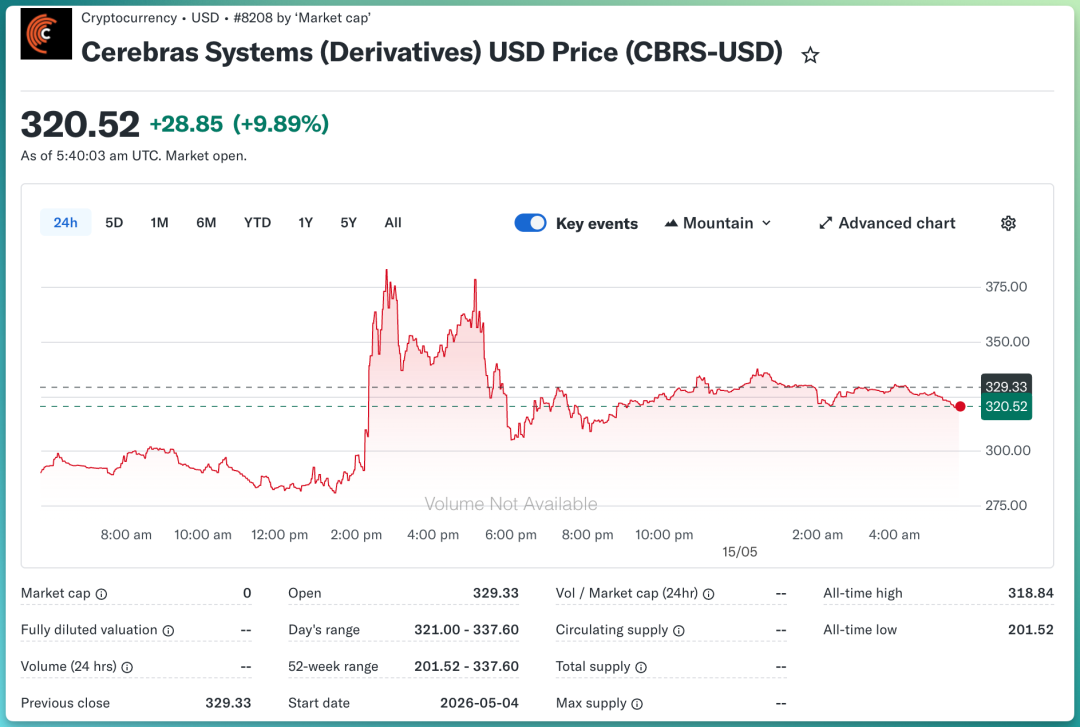
Yet just one year earlier, all of this seemed impossibly distant.
Cerebras had filed its prospectus back in 2024, but the IPO was shelved after Abu Dhabi's sovereign fund G42 triggered a prolonged CFIUS review, compounded by revenue heavily concentrated in that single customer.
It wasn't until April 2026, when the company reported 2025 revenue of $510 million (up 76% year-over-year) and swung to a profit of $237.8 million after losing nearly $500 million the prior year, that market sentiment reignited.
If there's one clearest footnote to this moment, it's this: a year after AI compute was widely assumed to "only equal NVIDIA," the market delivered a different answer in real dollars.
Three Days Before the IPO, Ben Thompson Wrote a Counter-Prophecy
Dramatically, Stratechery's Ben Thompson released a podcast and essay titled The Inference Shift just days before the IPO.
The piece didn't comment on Cerebras's valuation, but it offered a structural framework for re-examining this listing.

Ben sliced LLM-era inference workloads into two categories, arguing they would diverge toward fundamentally different hardware destinies:
Answer Inference
The defining feature: "someone is waiting." Whether it's a ChatGPT conversation, code completion in Claude Code, or voice interaction on a future AI wearable — whenever a human is on the receiving end, token generation speed becomes the core constraint. This is the battlefield where NVIDIA's HBM, Cerebras's SRAM, and Groq's LPU all compete.
Agentic Inference
The defining feature: "no one is waiting." When an agent architecture runs an overnight long-horizon task, when machines dispatch work to other machines, the term "user experience" no longer applies. Ben notes that what this workload truly lacks isn't bandwidth or speed, but memory capacity — context, state, history, embedding vectors, intermediate artifacts in object storage, all of it needs to be "remembered" without needing to be "remembered quickly."
From this, Ben delivers a crucial judgment: if latency ceases to be the binding constraint, then the entire architectural assumption of "paying premium for low latency" loosens. Agentic inference prioritizes cheaper DRAM, more generous capacity, and sufficient compute — not top-tier HBM and the fastest NVLink.
Under this new workload, GPUs get unbundled; CPU tool-use speed matters more than GPU token speed.
Ben's ultimate conclusion: NVIDIA still dominates training; answer inference is a "meaningful but relatively niche" market where Cerebras and Groq's SRAM machines hold structural advantages; but agentic inference will be the largest market, because it's constrained not by human time but by compute runtime.
Jensen Huang has repeated for years that "Moore's Law is dead," meaning progress requires system-level innovation; but Ben offers a sharper version:
When agents can truly work continuously without human intervention, Moore's Law doesn't matter — because the compute we already have is enough.
Drop this framework onto the Nasdaq on IPO day, and an unsettling small question emerges: the market priced Cerebras at $66 billion to $100 billion, but it priced the answer inference track.
If Ben is right, that means the market isn't betting on the bulk of future compute.
How the Founder Tells the Story, vs. the SemiAnalysis Report
Cerebras CEO Andrew Feldman knew exactly which psychological barriers he had to clear before the IPO. When asked "what were the three most important things you did to persuade investors during this roadshow," his answer distilled to three core arguments:
Infinite demand, plural supply paths, and CUDA moat overestimated
These three arguments together form Cerebras's standard listing narrative.
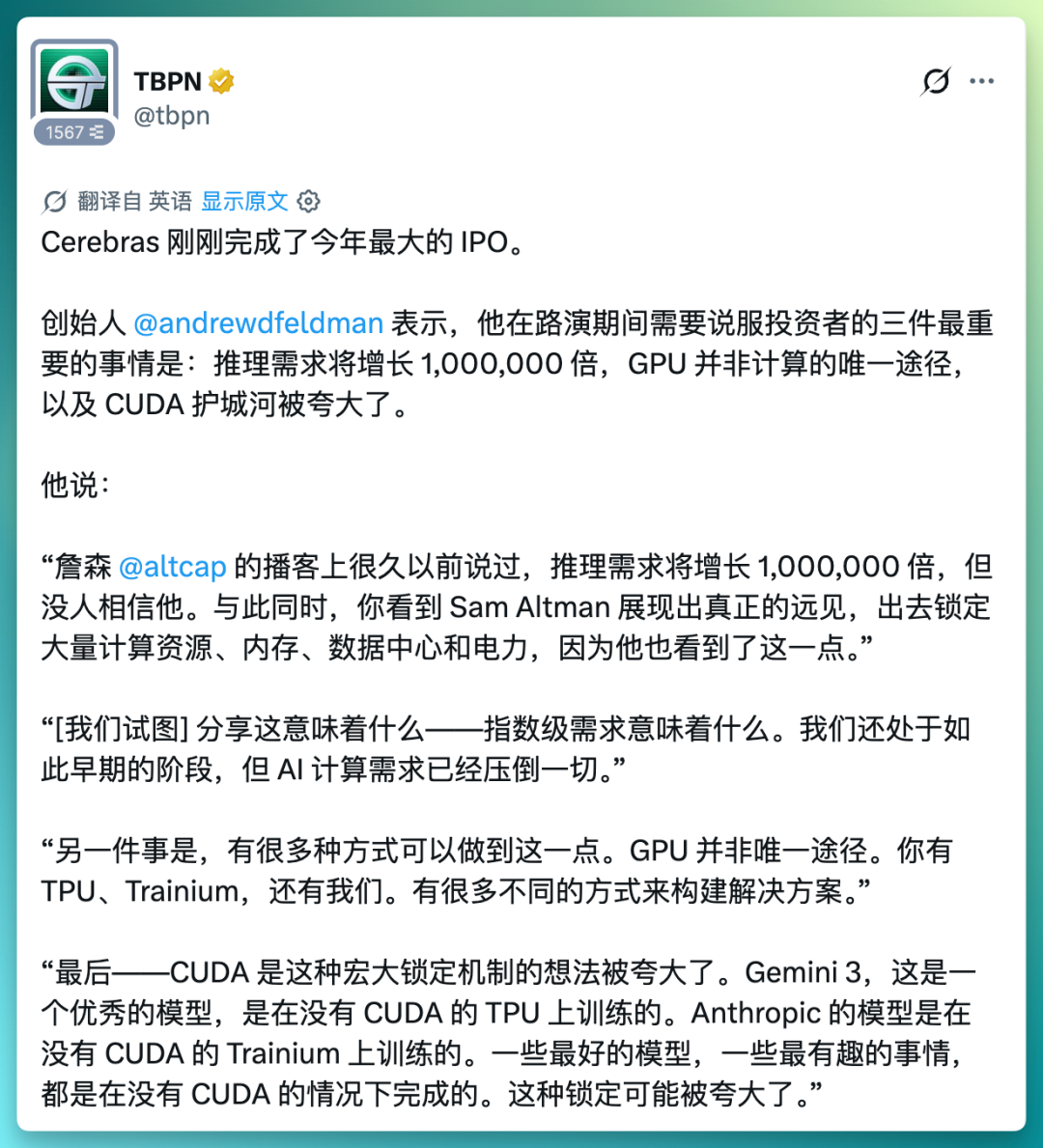
But shift the lens to SemiAnalysis's pre-IPO longform Cerebras — Faster Tokens Please (roughly four of their standard articles in length; we excerpt key portions below), and that narrative gets repeatedly stress-tested by technical and commercial reality. Three layers stand out:
Technical Layer: Cerebras's Capability Boundary Is Already Being Hit by Today's Agentic Workloads
SemiAnalysis confirms two facts about Cerebras simultaneously: on one hand, the WSE-3 wafer-scale chip has 44GB of SRAM and delivers 21 PB/s of memory bandwidth — roughly 6,000x the HBM bandwidth of NVIDIA's H100. This is the entirety of its "fast" credibility.
On the other hand, inter-wafer communication bandwidth is only 150 GB/s — about one-sixth of the interconnect bandwidth between NVIDIA GPUs (NVLink 5).
The direct consequence of this bandwidth constraint: Cerebras is forced into pipeline parallelism when serving large models.
Picture an assembly line: each wafer handles only certain layers of the model, passes the "semi-finished product" (activations) to the next wafer, and the whole line collaborates to complete one inference pass. This approach only requires passing small intermediate results between adjacent wafers, rather than moving massive model weights across wafers.
This works for small models; it gets ugly for large ones:
-
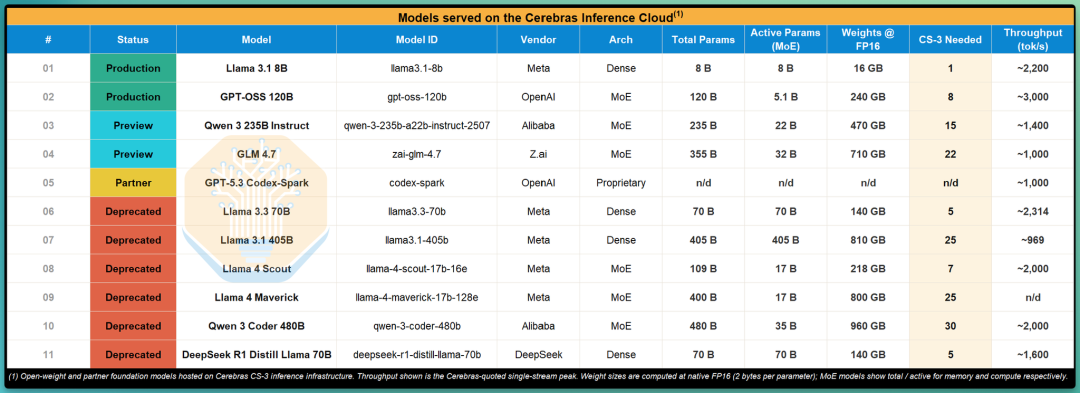
Cerebras's public cloud currently supports production models only up to GPT-OSS (120B parameters); the largest preview model is GLM 4.7 (355B).
-
Llama 3.1 405B, Qwen 3 Coder 480B, Llama 4 Maverick, Llama 3.3 70B, and other previously available large models have all been deprecated. SemiAnalysis speculates the unit economics of serving these models became unsustainable.
-
DeepSeek V3 and Moonshot AI's K2 — two widely-used open frontier models — never appeared on Cerebras's public endpoints.
-
The maximum context window on public endpoints is pinned at 128K.
More critically, SemiAnalysis's own production-side data.
They collected real requests from agentic coding tools including Claude Code, Codex, Cursor, and OpenCode through an anonymous proxy — roughly 432,000 requests, ~80 billion tokens.
The conclusion: "The typical P50 input sequence length (ISL) is approximately 96.3K tokens, not 64K or less... Nearly 50% of our requests exceed 128K, which is the maximum context window currently supported by Cerebras's public endpoints."
The chart clearly shows the 128K line falling between P50 and P75 — exactly where Cerebras's public endpoint maxes out.
In other words, the median request in today's agentic coding market already pushes against Cerebras's hard ceiling; nearly half of requests simply exceed its service capability. More notable is the long tail on the right: P90 approaches 500K tokens, P95 exceeds 670K — the natural workload shape when agent tools heavily load skills, system prompts, and tool-use context, not edge outliers.
Bring this chart back into Ben Thompson's framework: his judgment that agentic inference's true scarcity is memory capacity, not speed — this distribution is the empirical mirror of that claim in production data. What Cerebras faces on the agentic track isn't "not fast enough," but structurally "can't fit."
The current WSE-3 wafer architecture faces not only SRAM capacity locked by wafer area, but also off-wafer bandwidth that limits memory pooling across multiple wafers.
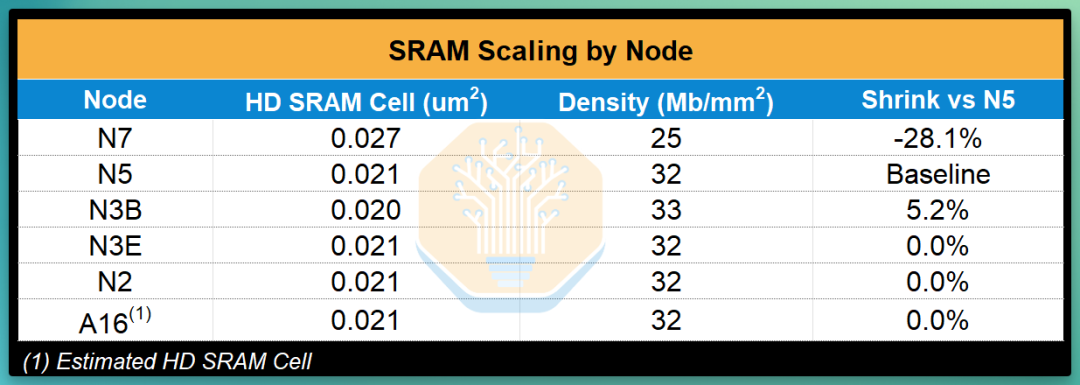
Compounding this, SRAM process dividends are nearly exhausted: WSE-1 had 18GB at 16nm, WSE-2 jumped to 40GB at 7nm, but WSE-3 only reached 44GB at 5nm (+10%). SemiAnalysis notes that at N3E and beyond, SRAM barely shrinks further (see chart below); the next-gen CS-4 system, if using the same WSE-3 silicon, would need to trade higher power for higher clock frequencies.
In other words, Cerebras has no cheap next step on the capacity front.
Commercial Layer: OpenAI's Triple Bind Is Both Core Valuation Support and Vulnerability
OpenAI plays an outsized role in Cerebras's future. SemiAnalysis details the master collaboration agreement signed in December 2025:
Purchase Commitments
OpenAI committed to procuring 750 megawatts of AI inference compute in batches from 2026–2028, each with 3–4 year terms extendable to 5 years; plus an option for an additional 1.25 gigawatts, potentially scaling total deployment to 2 gigawatts.
Remaining Performance Obligations
As of December 31, 2025, Cerebras's disclosed unfulfilled obligations totaled $24.6 billion — nearly all from OpenAI alone.
Working Capital Loan
OpenAI also provided a $1 billion working capital loan at 6% annual interest; if repaid through compute or hardware delivery, interest is waived; if the agreement is terminated for reasons other than OpenAI material breach, Cerebras may be required to repay principal and interest immediately.
Warrants
Cerebras issued warrants for 33,445,026 shares of Class N (non-voting) common stock to OpenAI; upon full dilution, OpenAI could hold approximately 12% of Cerebras.
Stack these three together, and OpenAI is simultaneously Cerebras's largest customer, largest creditor, and one of its largest single shareholders.
Of Cerebras's $510 million 2025 revenue, what proportion truly came from independent, sustainable market demand versus strategic procurement by a customer-shareholder-creditor locking up supply — this question has no visible answer in the prospectus yet.
Model Layer: The GPT-5.3-Codex-Spark That Made Cerebras Famous Was Actually a Distilled Small Model
Finally, SemiAnalysis offers one more reminder.
OpenAI's February 2026 release of GPT-5.3-Codex-Spark, which ran on Cerebras at a headline-grabbing 2,000 tokens per user per second, wasn't the actual GPT-5.3-Codex. It was a version distilled from GPT-5.3-codex onto the gpt-oss-120B architecture — more than 10x smaller than the original model.
Today, what runs on Cerebras are lightweight, specialized models like this; what actually carries OpenAI's core revenue are frontier models above 1 trillion parameters. Fitting models at that scale into Cerebras's architecture would likely require substantial cost and latency tradeoffs.
A Narrative Misalignment That Went Unnoticed
Place Ben Thompson's framework and SemiAnalysis's report side by side on IPO day, and three layers of misalignment become clear:
First: Narrative vs. Future
The market priced Cerebras at $66 billion to $100 billion, pricing in the expandability of the fast tokens track.
But by Ben's judgment, the true bulk of AI compute's future is agentic inference, whose core demand is large-capacity memory hierarchies and sufficient compute, not bandwidth and speed. Cerebras's bet sits directly against this long-term trend.
Second: Narrative vs. Production
SemiAnalysis's own agentic coding request sample shows that mainstream agentic workloads already hit or exceed Cerebras's 128K public endpoint ceiling.
Today, the largest customers still paying for "fast" are human-waiting code generation scenarios; but once agents truly break out of human loops to run independently, speed preferences give way to capacity and state-retention preferences. This is happening now, not in the future.
Third: Narrative vs. Customer Structure
Cerebras's prospectus shows $24.6 billion in backlog (remaining performance obligations), but when customer, creditor, and shareholder stack onto the same counterparty, that number's accounting meaning and economic meaning aren't equivalent.
OpenAI's willingness to lock in 750 megawatts at once partly reflects genuine fast tokens demand; but the more pragmatic reason may simply be: as a company scrambling to lock up compute supply everywhere, adding a niche but differentiated vendor like Cerebras to its portfolio is reasonable hedging.
This doesn't directly falsify Cerebras's long-term value, but it does mean that $24.6 billion measures more of OpenAI's compute strategy breadth than Cerebras's standalone commercial strength.
Yet it must be acknowledged: Cerebras is one of the boldest and most validated engineering bets in hardware over the past decade. Turning an entire 300mm wafer into a single addressable chip, while solving yield, power delivery, and 25kW cooling — is itself a remarkable engineering achievement.
Second, the fast tokens track is a real market.
SemiAnalysis itself discloses that 80% of its AI budget (peak annualized $10 million) goes to Opus 4.6 Fast — paying 6x price for 2.5x speed.
NVIDIA's December 2025 "acqui-hire" of Groq further proves the SRAM machine market isn't imaginary. Cerebras is the genuine winner in this track.
Moreover, CEO Andrew Feldman's judgment that "CUDA lock-in is overestimated" — borne out by Gemini 3 on TPU, Anthropic on Trainium — is indeed being validated.
Cerebras's very existence broadens the industry's supply curve, which is good for everyone.
Therefore, we won't deliver a conclusive verdict of "overvalued" or "bubble." What we want to say is:
This IPO's market pricing likely did not price in the fundamental architectural restructuring that agentic inference implies for compute, nor did it fully price in the asymmetric risk of extreme customer concentration.
Markets always hear the noise before seeing the structure. IPO-day buzz belonged to fast tokens, but what will truly determine Cerebras's long-term fate is its position in the larger shift to agentic inference.
Ben Thompson's article won't change the market outcome on IPO day, but it may prove the most valuable reference coordinate when we look back a year from now.

Crossing is seeking independent contributors to write AI product and model reviews. If you've written pieces like: "Hands-on with PixVerse C1", "Hands-on with LibTV", please contact zeo0811@gmail.com. Your email should include: ① personal introduction, ② AI review pieces you've written. We offer competitive compensation. Looking forward to observing and documenting the AI era with you 🎪
References
[1] https://stratechery.com/2026/the-inference-shift/
[3] https://techcrunch.com/2026/05/14/cerebras-raises-5-5b-kicking-off-2026s-ipo-season-with-a-bang/