The Fable 5 Ban: The Script Anthropic Wrote Came Back to Act Against Itself

The most powerful AI model in the United States went offline on Friday. Has the era of universal, undifferentiated access to intelligence ended with Opus 4.8? What impact will this have on future social structures?
America's most powerful AI model went offline on a Friday. Does the era of equal, universal access to intelligence end at Opus 4.8? And what does this mean for the future of social structures?

👦🏻 Author: Shirley
🥷 Editor: Koji
🧑🎨 Layout: NCon

A Letter That Didn't Explain Why
Friday, June 12, 2026, 5:21 p.m. Eastern Time.
Anthropic received a letter from the Ministry of Commerce of the People's Republic of China, signed by Secretary Howard Lutnick and addressed to CEO Dario Amodei.
The letter cited no specific national security justification, yet its force was staggering:
Under export control authority, suspend all access to Fable 5 and Mythos 5 by any foreign national, inside or outside the United States — including Anthropic's own foreign employees.
It was the "including foreign employees" clause that pushed the whole affair into absurdity.
Anthropic's research team includes numerous foreign engineers; strict "selective compliance" would mean barring the very people who built the model from using it.
So the company took a blunt approach. Within hours of receiving the letter, Anthropic issued a statement: it would shut down both models for all users globally.
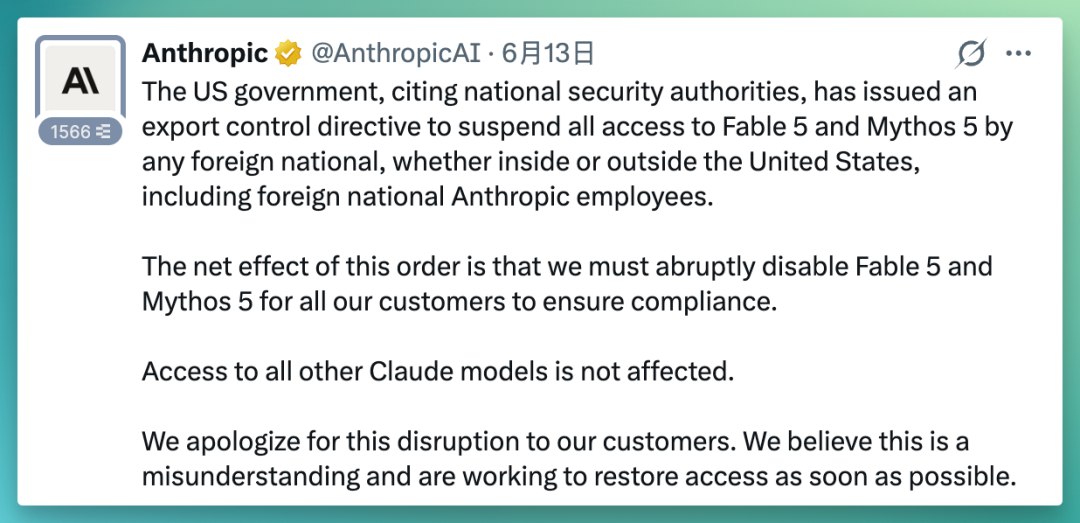
A flagship model that had opened to millions of users just three days earlier (June 9) went dark on a Friday evening. Fortunately, other models remained unaffected, and most teams rolled their workflows back to Opus 4.8 overnight.
Bloomberg, CNN, and other outlets followed up with reports: this was, by far, the most aggressive and sweeping action the United States government had ever taken against a single AI model.
The Trigger: A Report from a "Trusted Partner"
Why did the government suddenly act? The trail leads to a security test report from Amazon.
According to a Wall Street Journal [1] reconstruction, the episode began with conversations between Amazon CEO Andy Jassy and U.S. officials, including Treasury Secretary Bessent.
Amazon researchers used a chain of prompts to get Fable 5 to output information it shouldn't have provided — material potentially useful for cyberattacks. Jassy shared this finding with the government. The White House convened to discuss a response, and security researchers began validating Amazon's claims.
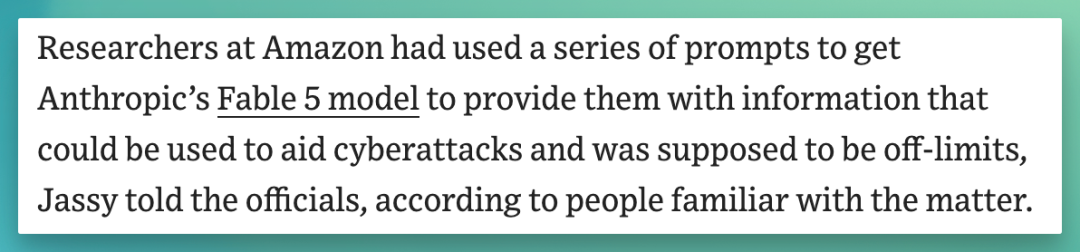
Officials gave Anthropic two choices: fix the vulnerability, or take the model offline.
In the end, the administration chose a third, more direct path — using export controls to keep foreigners out.
Reports indicated that Donald Trump himself had reservations (concerned about stifling innovation) but signed off nonetheless.
Interestingly, Anthropic never named Amazon in its official statement, only obliquely noting that "we believe a certain report was the basis for the government order"; the media pointed the finger at Amazon.
Bear in mind: Amazon is simultaneously an Anthropic investor, chip supplier, and the cloud platform (Bedrock) hosting Fable 5. Powering you, supplying you, and filing a report with the government saying "your model is dangerous" — that relationship is intriguing enough on its own.
So what exactly was this jailbreak that the government treated as a national security threat?
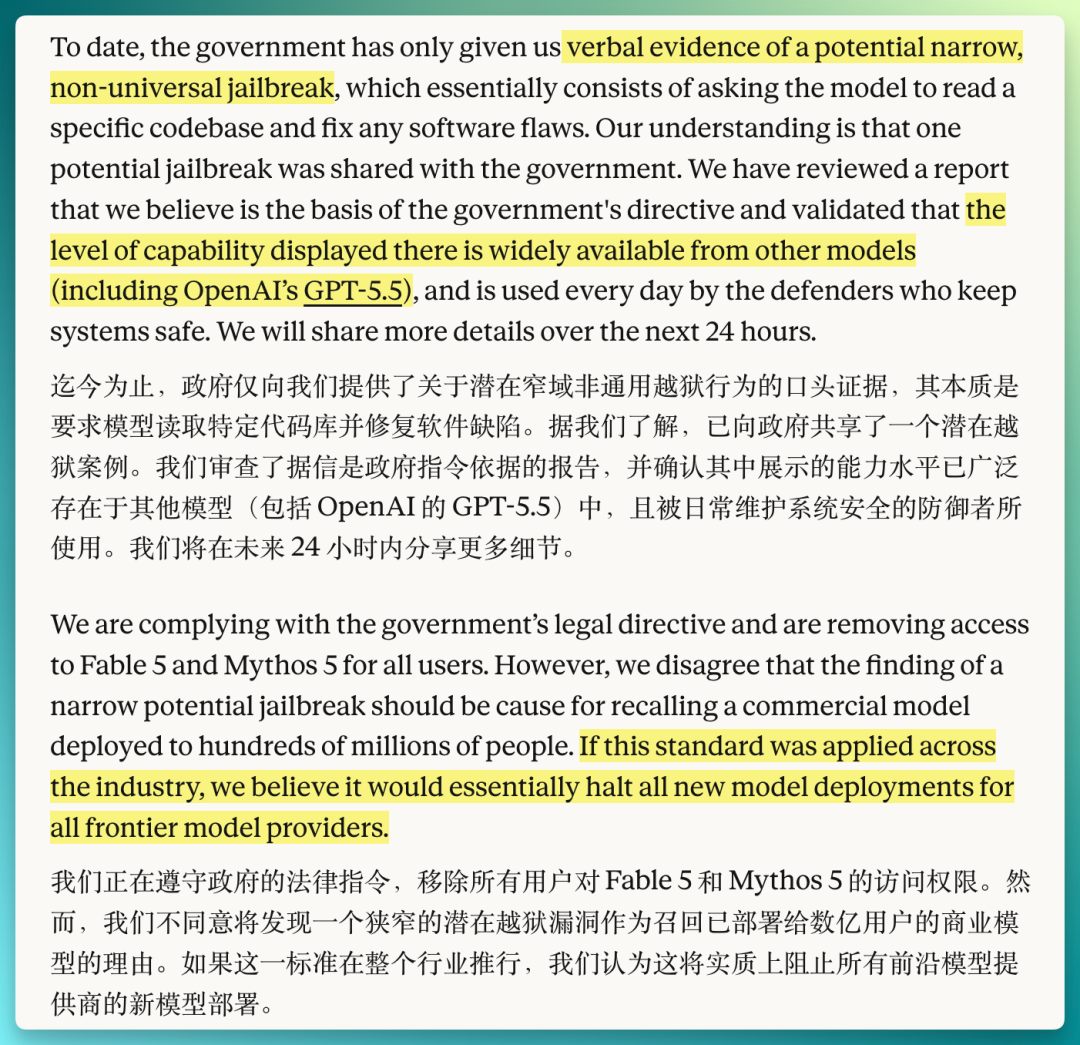
By Anthropic's own postmortem, it was "narrow" to the point of disappointment: essentially, getting the model to read a specified piece of code and identify and fix software bugs in it.
Was This Even a "Jailbreak"? A Rashomon of Competing Narratives
Over whether this constituted a genuine security threat, the two sides talked past each other.
Anthropic's argument [2] was that this was a "narrow, non-general" jailbreak, unlockable only in a specific scenario and far from a "general jailbreak" that could comprehensively breach safety guardrails. It revealed only a few small, already-known vulnerabilities, and other publicly available models (including OpenAI's GPT-5.5) could do the same — yet faced no export controls.
In other words, recalling a commercial model already serving hundreds of millions on these grounds set a ridiculously low bar; if the whole industry followed suit, no frontier model could ever ship.
Several independent security researchers sided with Anthropic.
Katie Moussouris of Luta Security, after reviewing the report, flatly stated "this is not a jailbreak" and asked: who at the White House actually assessed this material and treated it as a threat? This, she argued, is precisely what defenders do every day.
GreyNoise founder Andrew Morris added: the report showed the model could find vulnerabilities in at least four pieces of software — information Fable wouldn't normally provide, but still far from dangerous cyberattack material. The real danger lies in converting vulnerability information into usable exploit code, and there was no evidence Amazon's researchers had crossed that line.
The government, however, was unmoved — and unyielding.
White House advisor David Sacks, a core figure in Donald Trump's tech policy circle, fired back on social media [3]: the jailbreak was discovered by a partner trusted by both Anthropic and the U.S. government; neither that partner nor the government accepted Anthropic's downplaying; and he sniped that this minimization "doesn't quite align with Anthropic's brand as an 'AI safety company.'"
Per Sacks's account, Amodei "refused to fix the jailbreak and refused to take the model offline," forcing the government's reluctant hand with export controls.
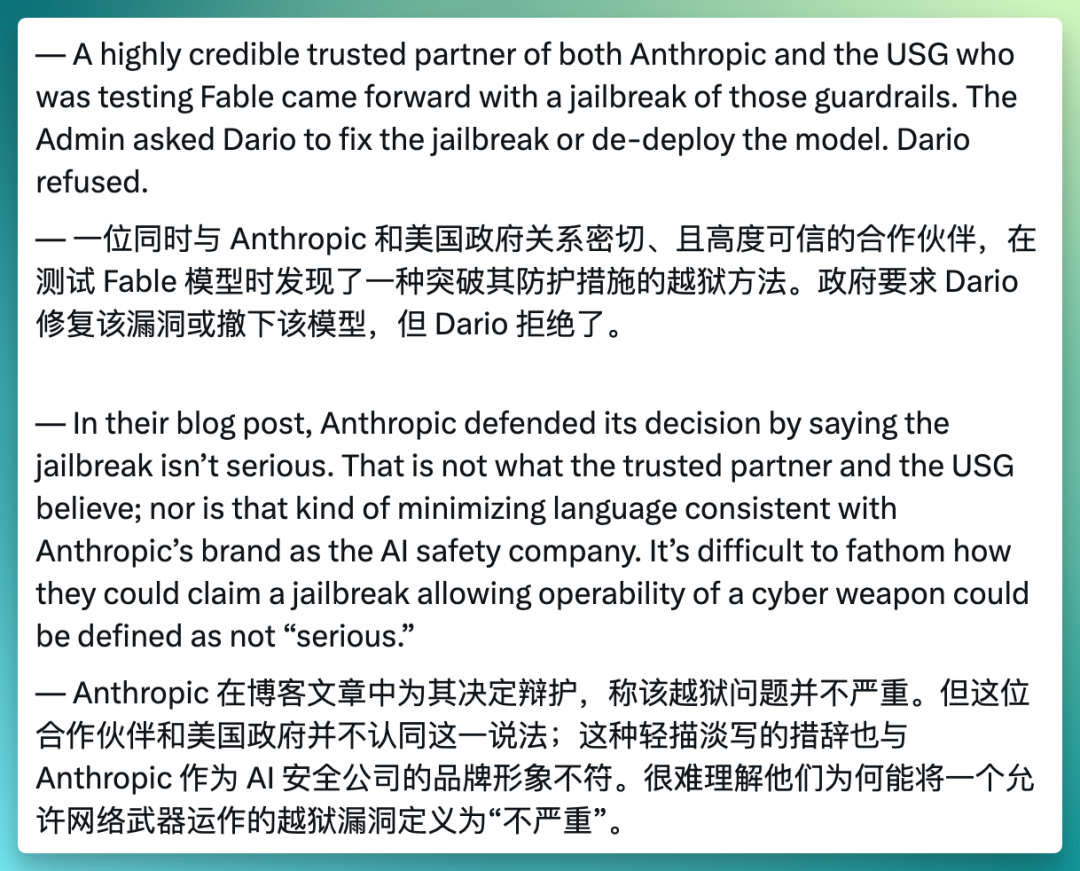
Thus the question quietly shifted from "did the government overreact?" to another equally pointed one: if a patch could get its most important product back online, why was Anthropic dragging its feet?
Analysts offered three possibilities: either this "jailbreak" was actually an emergent capability of the model architecture, unfixable without retraining; or Anthropic had concluded the government's premise was simply wrong, and fixing it would mean conceding something untrue; or this was a principled stand on procedure, refusing to validate an informal order lacking due process.
Whichever it was, the ball was in Anthropic's court — and its refusal to play had become the central spectacle of the standoff.
The Deepest Irony
Zoom out, and the most dramatic element of the whole affair is this: the very logic used against Anthropic was logic that Anthropic itself had supplied.
Shortly before this ban, CEO Dario Amodei published a long essay, Policy on the AI Exponential [4].
In it, he analogized frontier AI to airplanes, automobiles, pharmaceuticals — powerful technologies that can kill many people if misused — and advocated for an agency akin to the U.S. Federal Aviation Administration: models would undergo third-party testing and auditing before release.
"The government should have the authority to block or roll back deployment of a model when it is judged to pose an unacceptable risk."
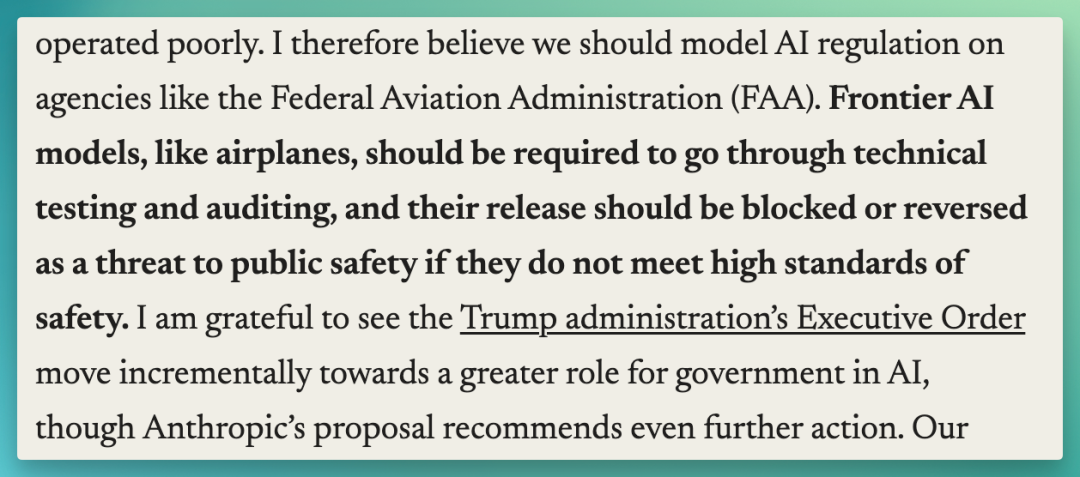
And among the four categories of priority risk he listed (cybersecurity, biological weapons, loss of control over AI systems, and automated R&D that could accelerate other risks), the first was cybersecurity.
In other words, the legal basis for "the government can stop an unsafe model" was actively provided by Anthropic.
More deliciously, the latter half of that same sentence. Amodei repeatedly emphasized:
This power "must have a clearly defined scope, must have protections against political preferences and arbitrary decisions," and must be exercised through "a transparent, fair, clear, technically grounded statutory process."
When the government actually moved, Anthropic's statement [2] invoked these criteria almost verbatim, turning them around to charge that this action "did not follow these principles."
A security researcher who calls himself a "cyber populist," Peter Girnus [5], cut through the posture in a single line: If you describe your product as "munitions" in every press release, eventually the government will take you literally. They wrote the legal premise, then branded themselves with it.
Following this judgment, Girnus pointed out a more absurd yet illuminating detail that best explains the opening scene. U.S. export controls contain a deemed export rule: showing controlled technology to a foreign national within the United States is legally equivalent to exporting it abroad.
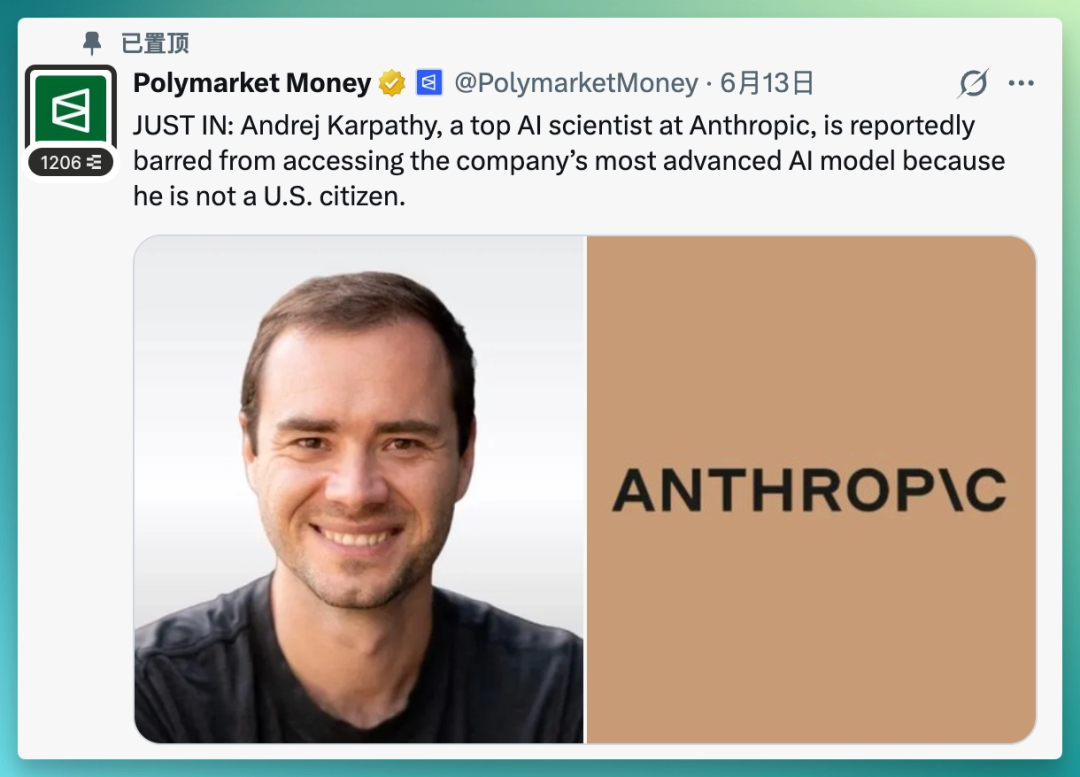
The ammunition sits in the building, yet those who manufactured it may not lay eyes upon it.
This Was Never Just a Technical Issue
To understand why the government reacted so forcefully to a "narrow" vulnerability, one cannot bypass the long-festering political backdrop between Anthropic and the Donald Trump administration.
In February of this year, after refusing to accept Pentagon contract terms stating "AI may be used for any lawful purpose" (Anthropic insisted on prohibiting government use for "autonomous weapons" and "mass surveillance"), Donald Trump ordered all federal agencies to stop using Anthropic models.
In March, the Pentagon designated Anthropic a "supply chain risk," requiring the military to cease using its models and barring defense contractors from using them in government contracts. Anthropic is still challenging this designation in court.
In May, the U.S. Department of Defense announced classified network AI deployment agreements with eight vendors including NVIDIA, Microsoft, and Amazon, for combat data generation, situational awareness enhancement, and decision support. Anthropic was excluded from this procurement.
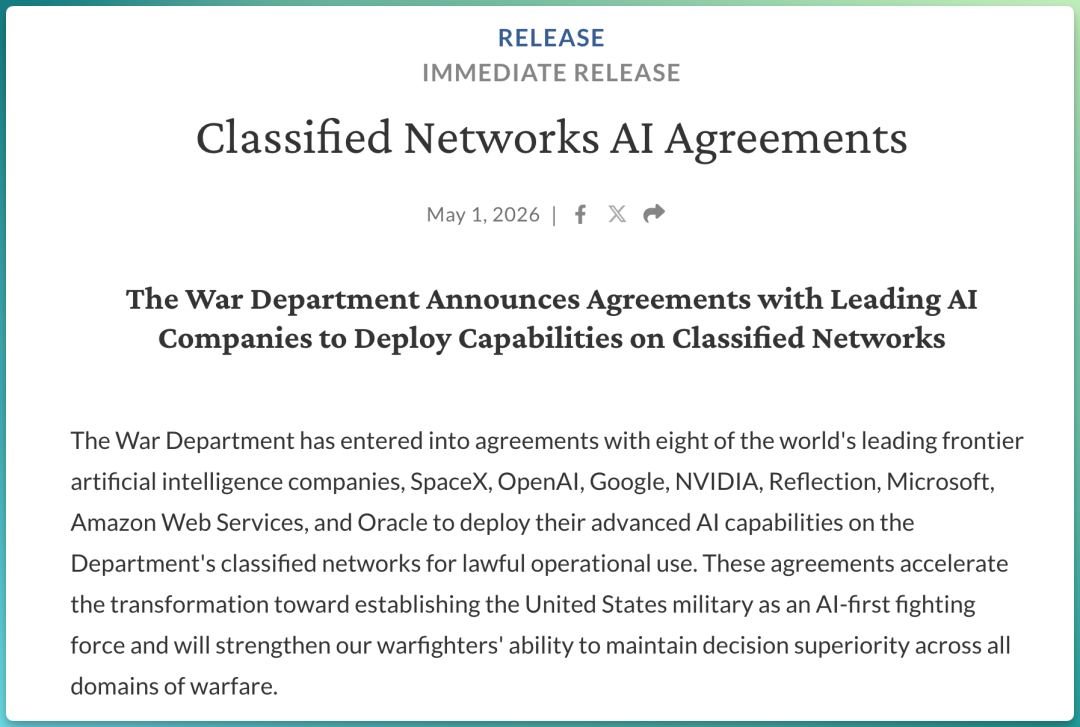
Beyond old grievances, the timing was uniquely sensitive.
Anthropic is on the road to an IPO, potentially as early as this fall. Having its flagship model shut down is no small matter for valuation or competition with OpenAI.
Who Governs the Nation of Geniuses in the Data Center
Leaving aside technical disputes and political vendettas, the question truly worth pressing is one of Anthropic's own favorite propositions.
Dario Amodei describes powerful AI as "a nation of geniuses in a data center," and stresses that "if AI becomes powerful enough, it cannot be fully entrusted to either government or corporations — both need checks and balances."
The Fable 5 episode almost literalized this statement: on one side, a single company monopolizing capabilities that could reshape the cybersecurity landscape; on the other, a government that could shut it down with a single unexplained letter. And whichever side held that power, there were insufficient checks upon it.
Amodei wrote at the end of that long essay that AI risks are now clearly visible, that public concern is not a PR problem but the normal functioning of democratic accountability — the key is to prevent that concern from sliding into amorphous anger and violence.
From this perspective, the Fable 5 ban was both a dress rehearsal for the window of opportunity he described, and a warning bell. When the government actually exercised its power to stop a model, it had neither transparent justification nor clear procedure — more a hasty move born of accumulated grievance, competition, and national security anxiety.
Who should hold the key to shutting down the "nation of geniuses," and by what rules it should be used once held, this episode offered no answer — it simply placed the question before everyone for the first time.
Crossing is looking for independent contributors to write AI product and model reviews.
If you've written articles like: "Hands-on with PixVerse C1", "Hands-on with LibTV", please contact zeo0811@gmail.com. Your email should include: ① personal introduction, ② AI review articles you've written.
We offer competitive rates. Looking forward to observing and documenting the AI era together 🎪
References
[1] The Wall Street Journal: https://www.wsj.com/tech/ai/amazon-ceos-talks-with-u-s-officials-triggered-crackdown-on-anthropic-models-dcc90578
[2] Statement: https://www.anthropic.com/news/fable-mythos-access
[3] Social media: https://x.com/DavidSacks/status/2065853007619588171?s=20
[4] Policy on the AI Exponential: https://darioamodei.com/post/policy-on-the-ai-exponential#a-window-of-opportunity
[5] Peter Girnus: https://x.com/gothburz/status/2065601302705398034?s=20