"That's Quite the Claim!" — Flowith Built an Operating System | Hands-On First Look at FlowithOS

Just as Windows or macOS provides the runtime environment for software, Flowith OS provides the environment for AI agents to think and act.
Just as Windows or macOS provides the runtime environment for software, Flowith OS provides the environment for AI Agents to think and act.

👦🏻 Author: Jingshan
🥷 Editor: Koji
🧑🎨 Layout: NCon

Three notable events have unfolded recently in the AI Agent space worth marking:
First, on October 16, Microsoft announced deep integration of Agent Manus into the Windows 11 operating system. Microsoft is attempting to push Agents beyond the ChatBot layer, granting them genuine system-level agency.
Second, on October 22, OpenAI released Atlas, an AI browser. This new entry point, widely perceived as a "multimodal Agent browser," enables AI to not merely "read webpages" but to reason, decide, and operate within real web environments.
Third, Flowith officially launched an entirely new product: a new species called Flowith OS. It has chosen an "alternative path," attempting to build an entirely new AI-Native operating system for AI Agents.

Their direction is essentially the same: trying to address the pervasive "disconnect between thinking and execution" in current AI — difficulty executing across webpages and environments, breakpoints and fragmentation in long tasks, plus "permissions withheld, execution insufficient."
🚥
So what exactly is Flowith OS? How specifically does it build this native environment for Agents? And what answer does it offer?
With these questions in mind, we conducted an in-depth hands-on experience and observation.
First, what is Flowith OS?
The name "Flowith OS" sounds novel and bold, using "OS" — operating system — as its namesake.
After deep hands-on experience, we decided to clarify this name first.
We're all familiar with the term "Agent." Simply put, if ChatGPT represents "intelligence that thinks" — understanding, reasoning, generating content — then Agent is "intelligence that acts," autonomously completing tasks.
However, currently, "getting AI Agents to act" remains extremely difficult.
Why?
Because this means it must step out of the chatbox and enter complex, variable, unstructured real environments. It needs to read webpage text, understand button functions, recognize form purposes, and comprehend logical connections between different software applications.
To date, traditional Agents still face three limitations:
[1] Environmental constraints
Agents are trapped in "sandboxes." They may perform well within a single webpage or plugin, but once tasks involve cross-page, cross-platform, or multi-website collaboration, they falter.
[2] Memory deficiency
Traditional Agents still have weak control over memory. After multiple steps completing a task, memory connections fragment and lack continuity — unable to accumulate knowledge, optimize strategies, or comprehend users' long-term goals.
[3] A certain "phobia" around permissions
Frankly, this last issue resembles more of a "psychological barrier" for traditional Agent products.
Though some products have attempted to grant Agents permission to request user authorization, most developers still seem somewhat "apprehensive" about this, trying to complete tasks without touching users' private permissions.
But this prevents Agents from freely calling system resources like humans do, or running independently for extended periods. Once tasks cross platforms or require sustained monitoring, they immediately hit a wall.
Flowith OS aims to address these three points from the ground up by providing an AI-Native OS operating system. Just as Windows or macOS provides the runtime environment for software, Flowith OS provides the environment for AI Agents to think and act.
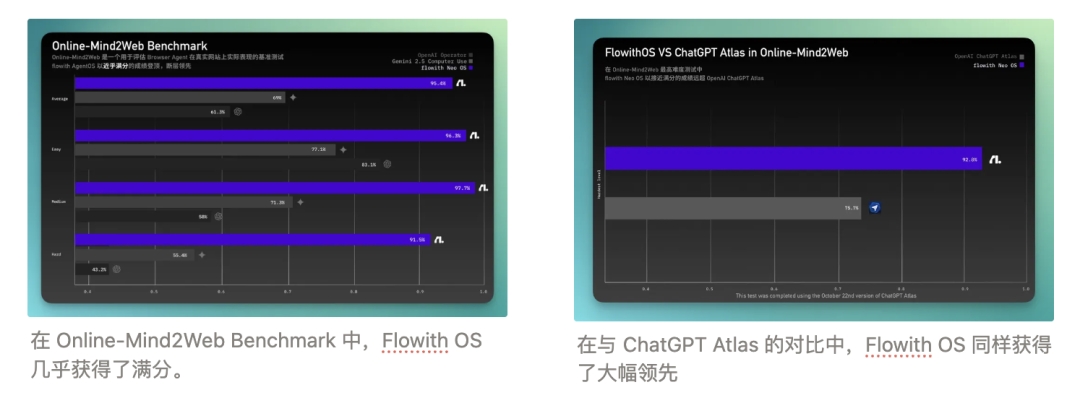
However, unlike Manus, which digs deep into the Microsoft Windows 11 system底层, Flowith OS has chosen to start from integrating the browser — the tool that encompasses the most information and services on the internet.
Having梳理完 the conceptual portion, let's see what answers Flowith OS can offer to these three problems.
A Fully Automated Taobao Shopping Experiment
With the Crossing team traveling between Singapore and Shanghai more frequently lately, I decided to test whether Flowith OS could automatically prepare a complete set of business trip essentials for me on Taobao.
The experience turned out more like "watching a competent assistant shop for you" than I had anticipated.
Flowith OS runs on a standalone software platform. This platform integrates Flowith Agent — Neo, which we tested in our previous article 【全网首发】一手体验全新 AI Agent:Neo 是谁?从哪来?到哪去? (found in the left sidebar), along with Google Chrome (for direct search). The core component is the Flowith OS panel in the center.
Here, you simply input a task prompt and click "Run Task," and the Agent automatically begins executing the entire operation.
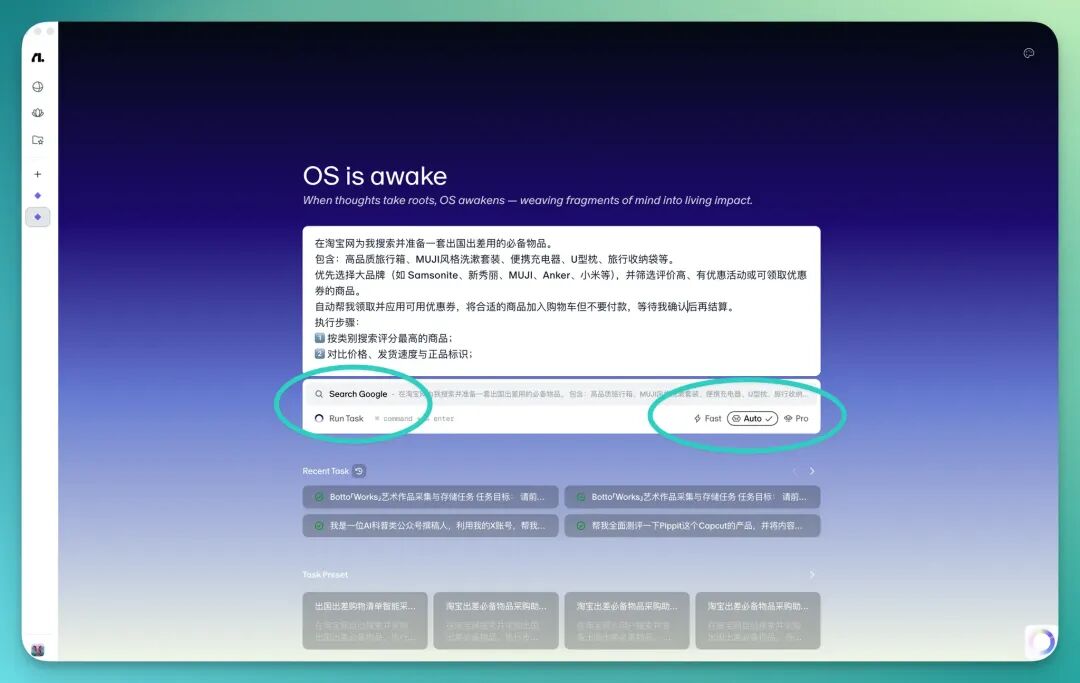
The right side displays its workflow diagram in detail, with three thinking modes available representing Agent thinking intensity. Generally, Auto mode is sufficiently smooth.
This task asked Flowith OS to prepare the following business trip essentials on Taobao, with this prompt:
Search and prepare a set of essential items for an overseas business trip on Taobao. Include: high-quality luggage, MUJI-style toiletry set, portable charger, U-shaped neck pillow, travel organizer bags, etc. Prioritize major brands (such as Samsonite, Samsonite [Chinese name], MUJI, Anker, Xiaomi, etc.), and filter for highly-rated products with promotional activities or available coupons. Automatically claim and apply available coupons, add suitable items to cart but do not pay, wait for my confirmation before checkout. Execution steps: 1️⃣ Search for highest-rated products by category; 2️⃣ Compare prices, shipping speed, and authenticity verification; 3️⃣ Claim and apply coupons; 4️⃣ Add selected optimal products to cart; 5️⃣ Do not pay yet, wait for my confirmation.
After clicking "Run Task," Flowith OS immediately began execution. The console in the lower right showed progress, with the entire process remarkably fast — roughly 30 seconds to complete login and initial search.
At this point, Taobao prompted me to log in.
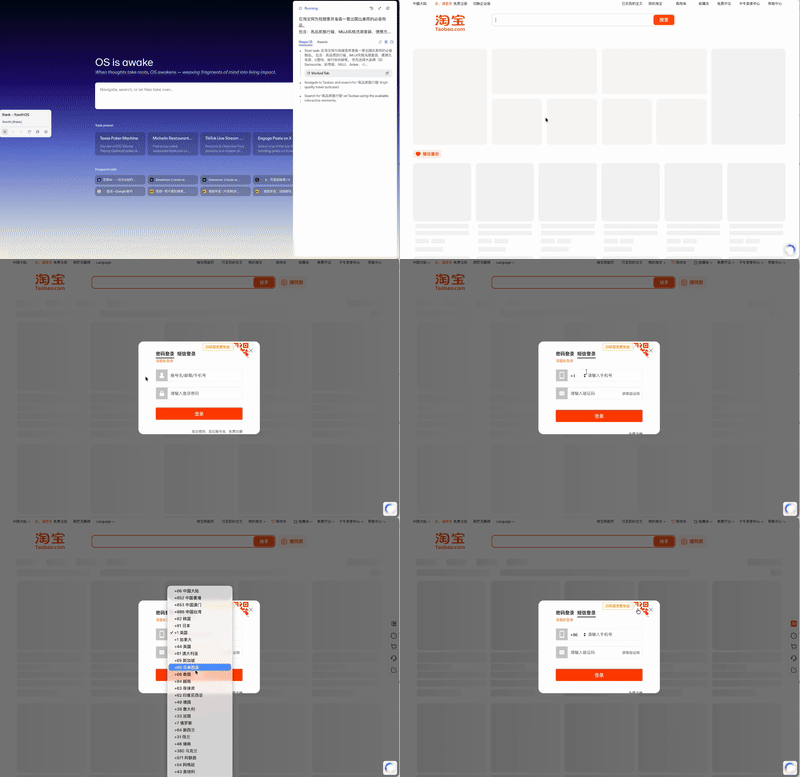
Video sped up; original operation took approximately 30 seconds
After I scanned the QR code to log into Taobao, it first searched for "high-quality luggage."
With virtually no pause, it opened the Diplomat flagship store page and precisely added a suitcase to cart.

Then it returned to the Taobao homepage and continued searching for "MUJI style toiletry set."

Interestingly, I deliberately observed here. On this single Taobao page alone, there were numerous Muji toiletry sets:

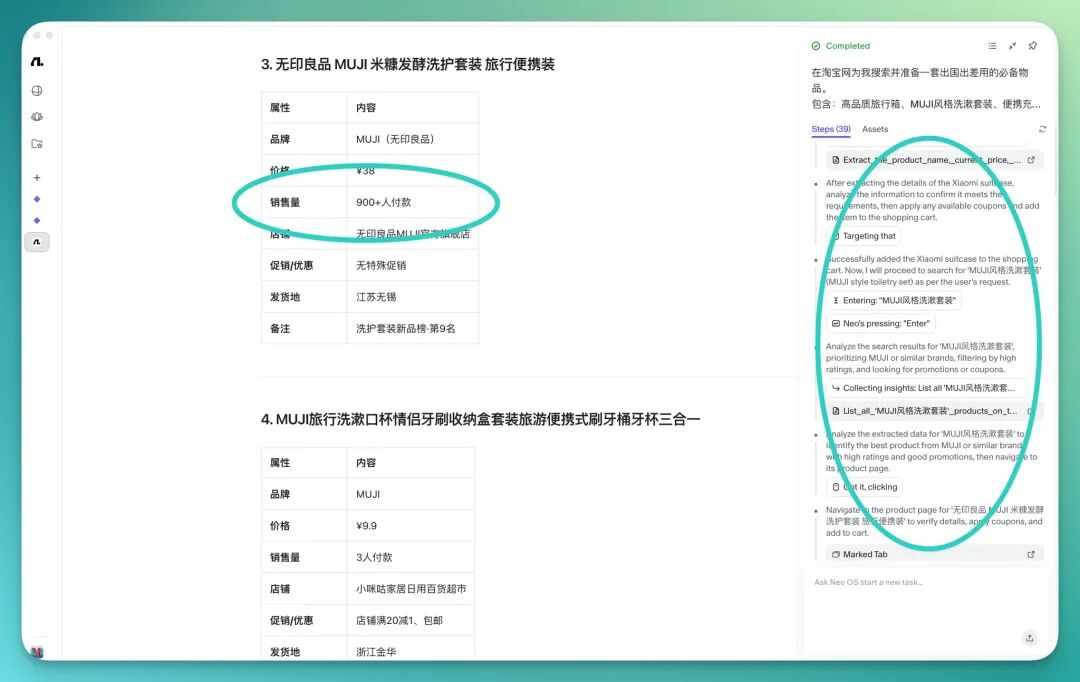
From the final result, it actually chose the 1st column, 4th item — "MUJI Rice Bran Fermentation Toiletry Set Travel Portable Size" — which is rather interesting.

Checking the log files reveals that during the recognition phase, it extracted page information and judged based on two criteria: "highest sales volume + keyword match."
This indicates it wasn't "randomly clicking" but actually analyzing.
Next, it searched for "portable U-shaped neck pillow" and entered a MINISO Taobao store.
To my surprise, while not achievable in all scenarios, Flowith OS can indeed scroll through more product information by clicking page progress bars.

However, there was one small issue. Since many Taobao product pages have very small "Add to Cart" button areas while large areas are "Buy Now," Flowith OS was prone to errors at these moments.
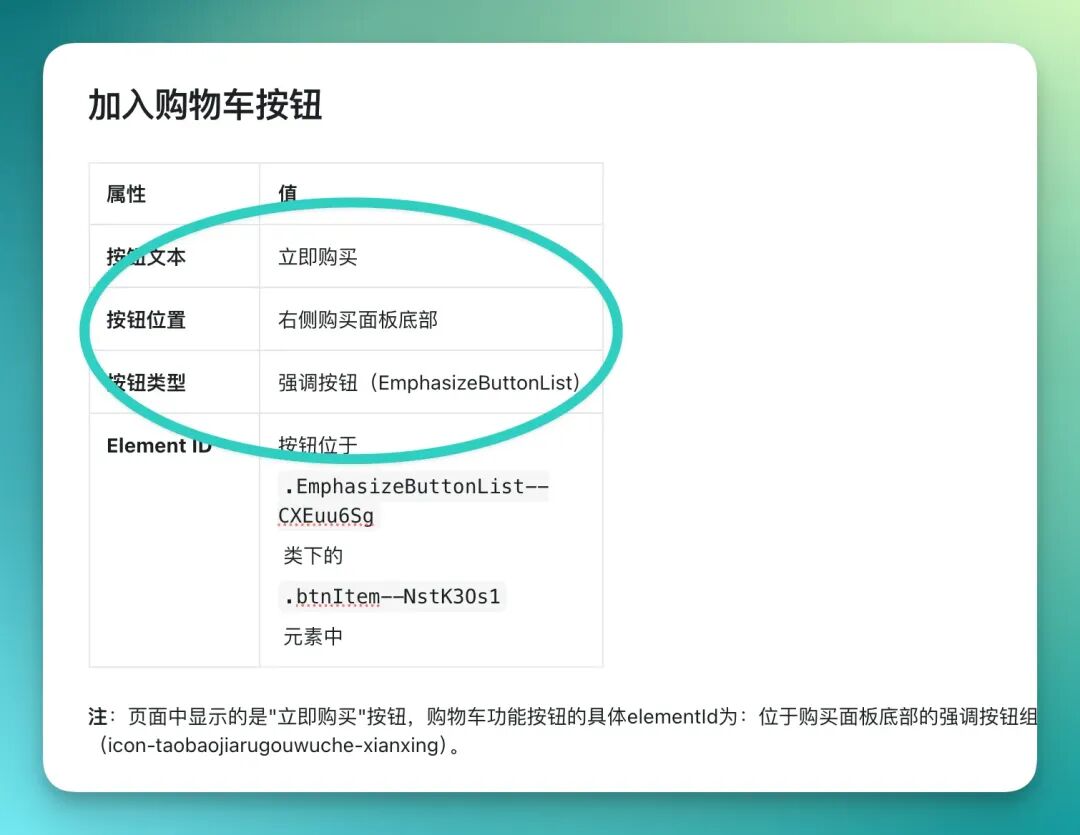
The log files show several failed attempts where it misidentified "Buy Now" as "Add to Cart":
But after failure, it automatically retried until successful:
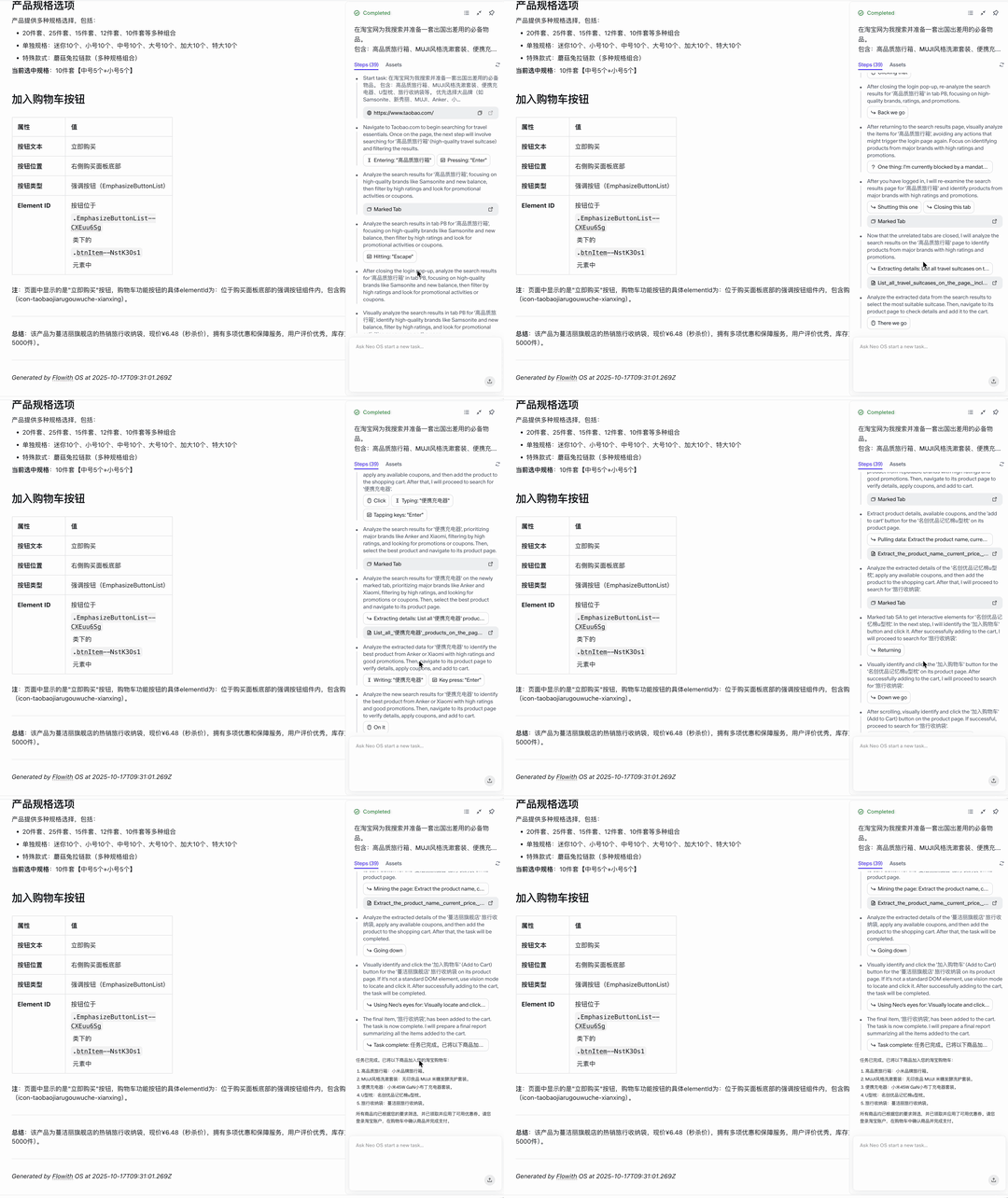
The entire task lasted roughly 5 to 10 minutes. Compared to traditional AI Agents, its execution speed was noticeably faster and steps more stable. And it gave me a feeling of "remarkable proficiency."
Let's see whether Flowith OS completed all tasks:

You can see that Flowith OS did add "high-quality luggage, MUJI-style toiletry set, portable charger, U-shaped neck pillow, travel organizer bags" to cart.
However, one imperfection: it added 2 "high-quality luggage" items — one Diplomat suitcase and one Xiaomi suitcase.
I originally thought it simply added items to cart, but later when checking coupons, I discovered it actually automatically claimed a Diplomat luggage coupon:

Flowith OS completed this task in 39 steps total.
From a step-count perspective, Flowith OS performed relatively proficiently without wasting excessive tokens.
From Product Review to Trending Weibo Post
After completing the Taobao shopping test, I began to realize: Flowith OS isn't just capable of simple search and add-to-cart tasks.
It simultaneously processes multiple webpages, extracts information, and executes actions in the background — meaning it possesses the potential to tackle more complex scenarios.
So I decided to challenge it with a higher-difficulty task.
Prompt:
Help me comprehensively review Pippit, this product from CapCut, and write the content into a review article to post on Weibo, and see if it can create synergy with trending topics on Weibo's hot search
Honestly, Flowith OS exceeded expectations in this test.
Upon execution, Flowith OS immediately opened YouTube and the Pippit official website, automatically extracting relevant information and key summaries.


Shortly, it generated a structured product information table:
Pippit is an AI content creation platform launched by CapCut, primarily for rapidly generating marketing videos and posters. Currently available information is sourced from one YouTube review/tutorial video.
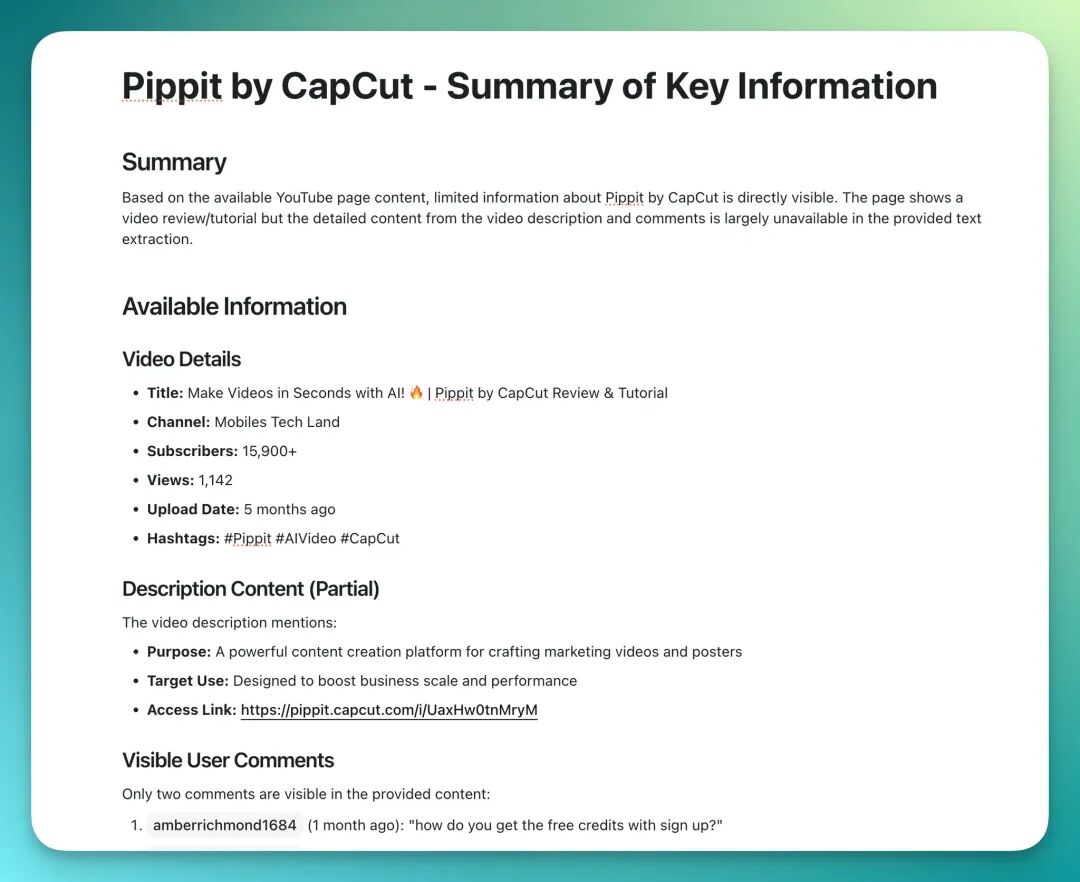
However, during the first execution, its behavior was somewhat fragmented: it generated Weibo body text and hashtags but didn't actually enter the Weibo page to publish.

I ran it again.
This time, Flowith OS's workflow was noticeably smoother. After completing Pippit information extraction, it directly jumped to the Weibo homepage and prompted me to scan and log in.
After login, it immediately auto-opened Weibo's trending topics list and began locating information:
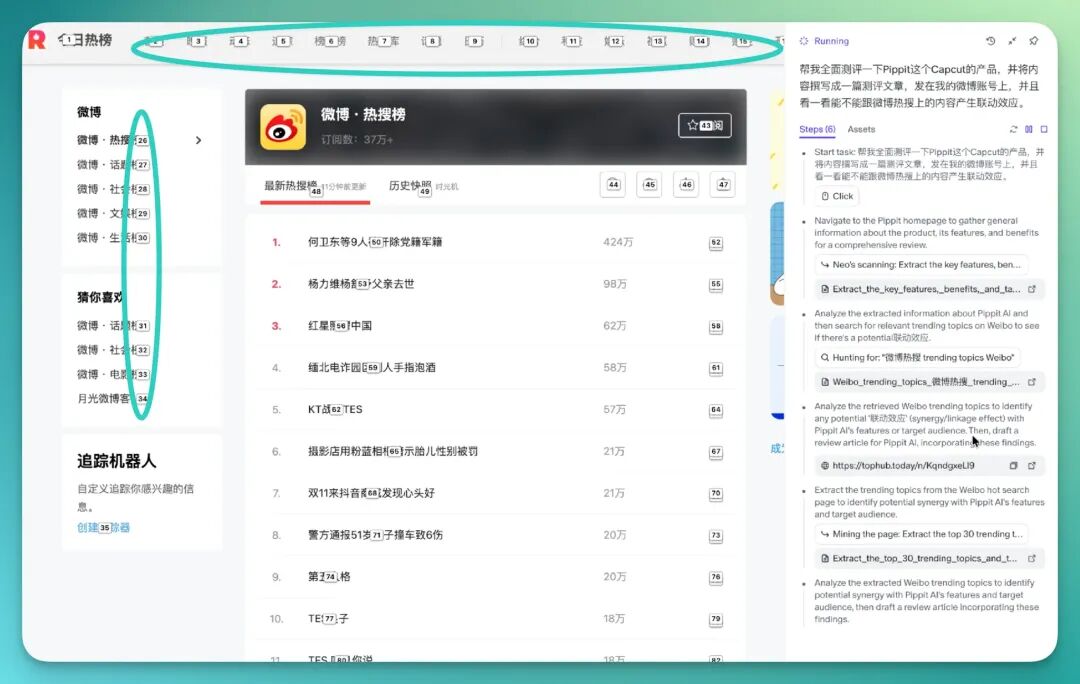
Next, it generated a complete 1,000–2,000 character Weibo post. I recorded the full process:
It didn't simply append trending topics at the end. Instead, it naturally integrated the review subject with hot topics based on content logic:

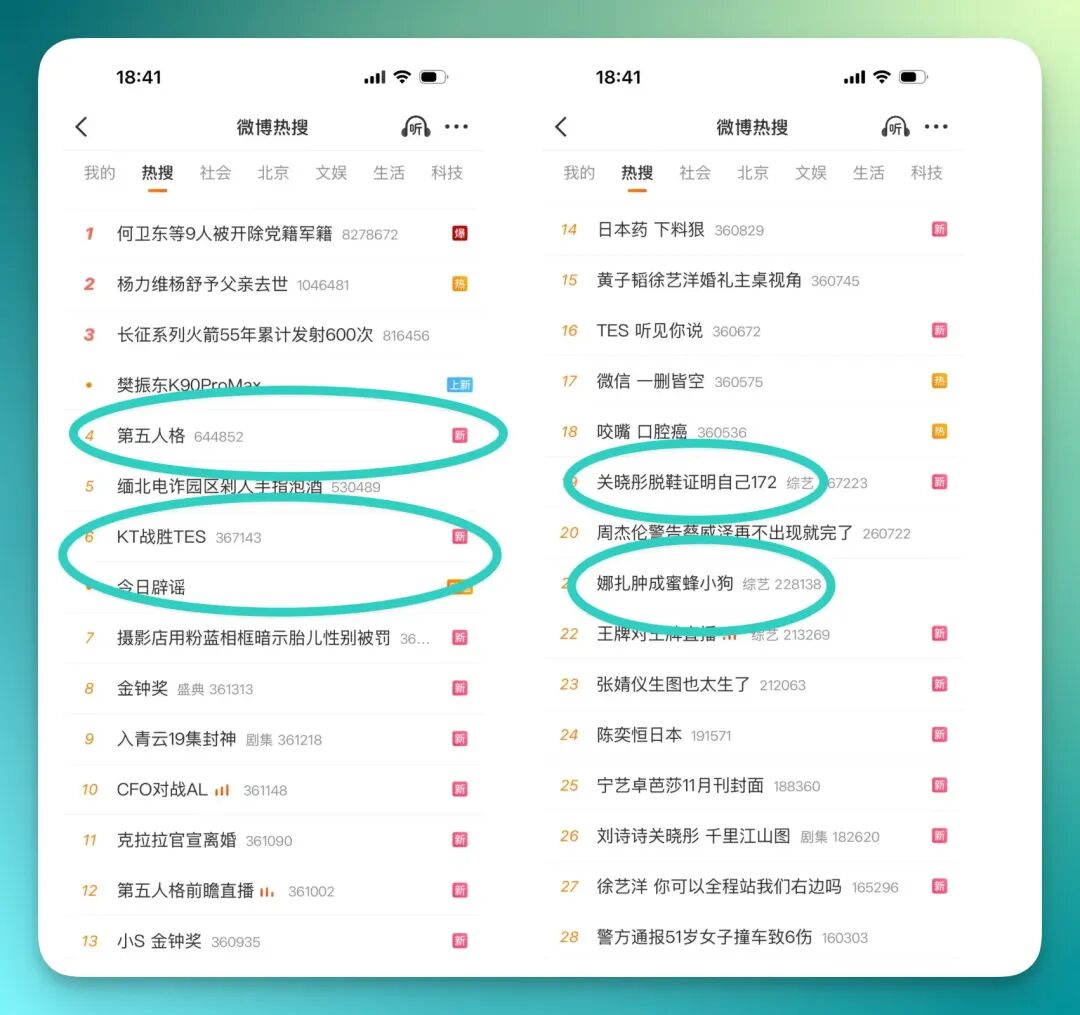
This wasn't actually the end. Because I specifically requested in the prompt: to connect with that day's news trends and Weibo hot search topics.
So I checked the results to see whether it actually accomplished this.
Below are the 3 scenario-based articles Flowith OS wrote:
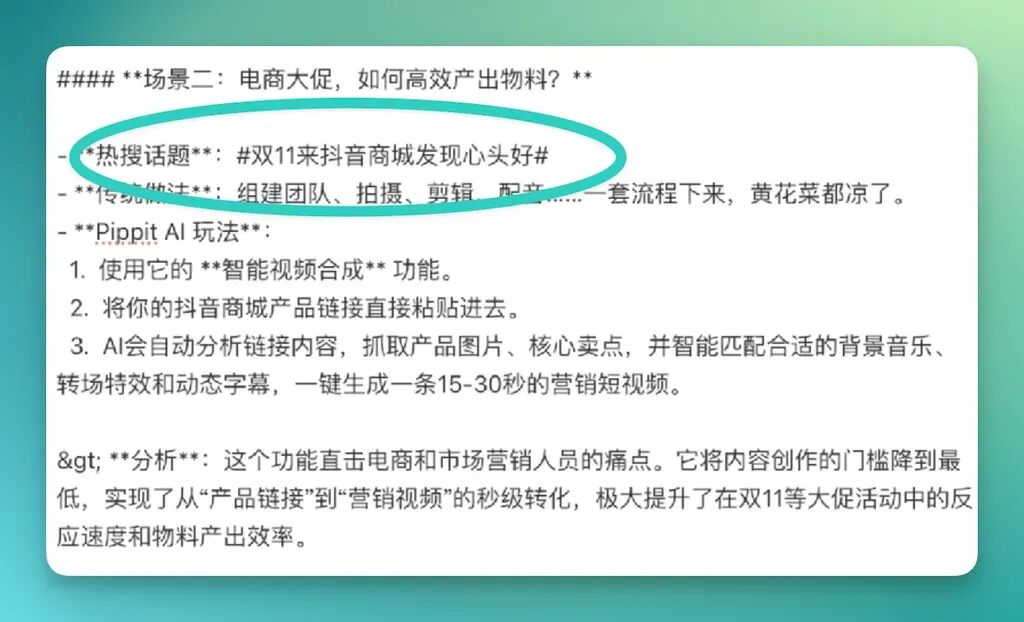
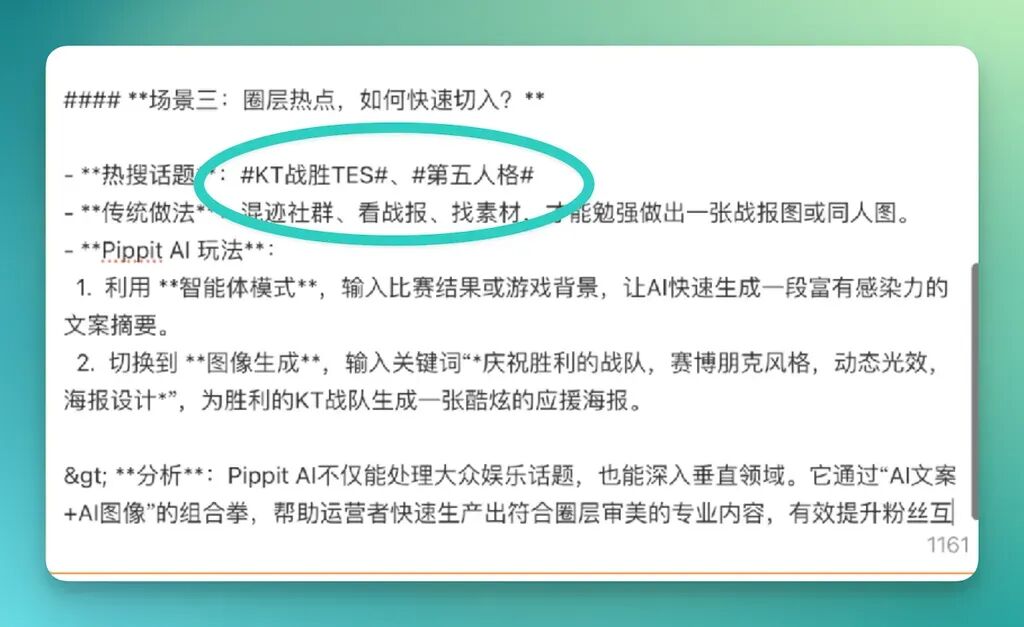
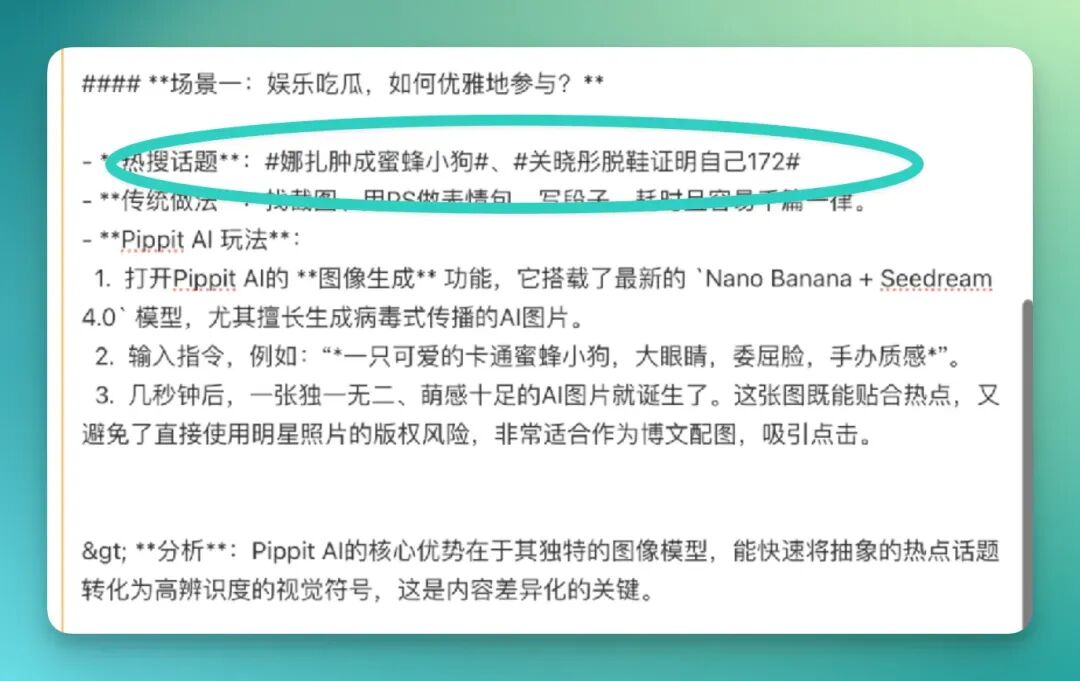
These three pieces corresponded precisely to that day's Weibo trending topics list.
But what truly surprised me wasn't its ability to "ride the trend" — it was how cleverly it wrote.
It wasn't the kind of content that awkwardly slaps trending labels on, like casually mentioning "swollen bee puppy" and calling it done. On the contrary, it could naturally integrate the Pippit features I asked it to review with these topics.
For example, when "bee puppy" was trending that day, it smoothly wrote:
Pippit can actually use the latest generation model to create a cute cartoon bee puppy poster, both responding to the trending topic and demonstrating the tool's actual functionality.
Of course, such structured output still has minor flaws. For instance, when generating long-form content, heading hierarchy, layout styling, and even certain code block formats may not fully align with Weibo platform's optimal display effects, requiring manual fine-tuning.
But overall, Flowith OS has already demonstrated a promising possibility.
Not Perfect Yet, But the Direction Is Right
Regular readers of tech topics on X know that after many celebrities post, their comment sections are often flooded with various "water armies."
So I wondered: since Flowith OS can post to Weibo so smoothly, could it "play" a water army member and automatically spam comments?
My prompt was:
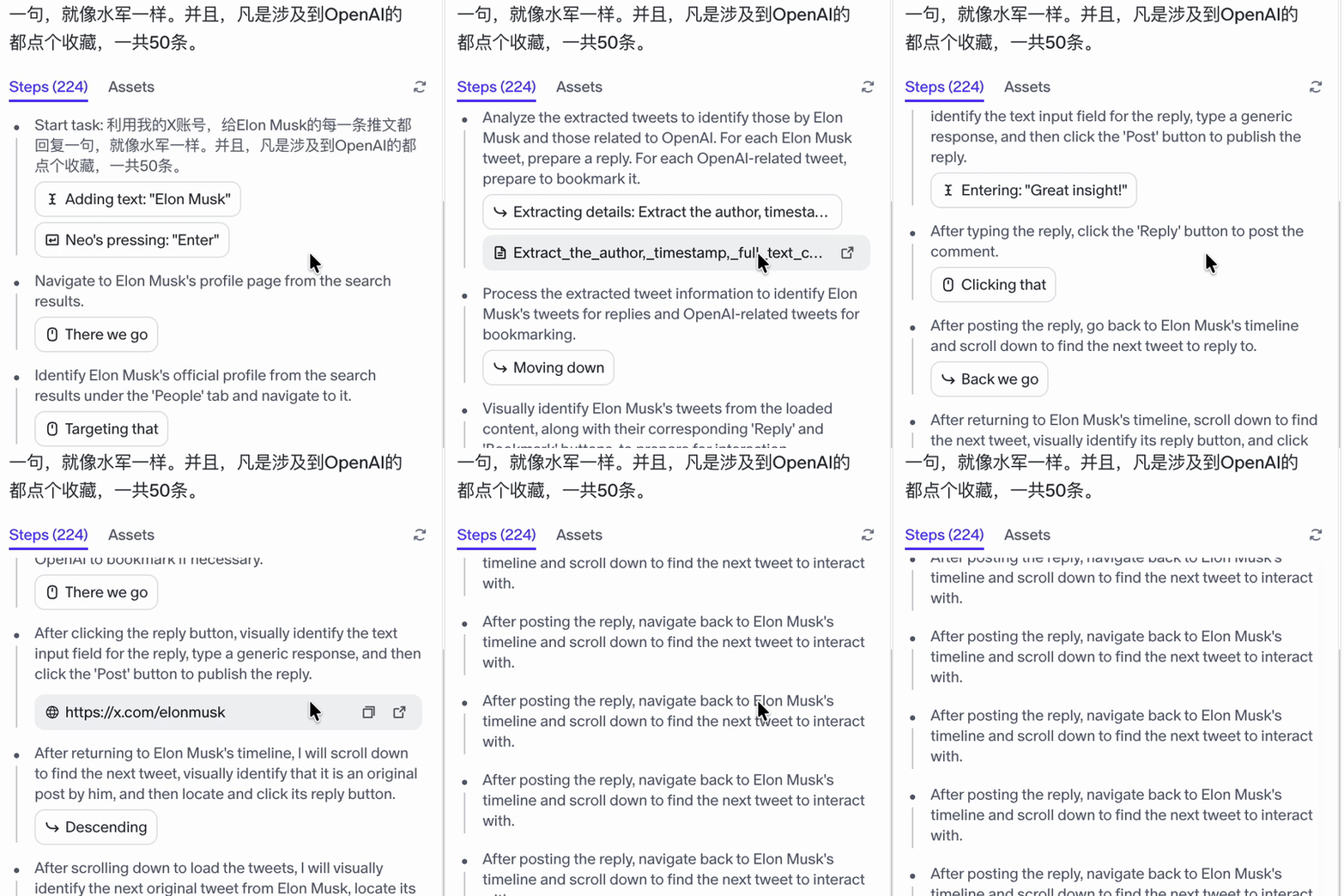
Use my X account to reply to every tweet Elon Musk has liked or commented on, just like a water army. And for anything involving OpenAI, bookmark it. 50 tweets total.
After execution, Flowith OS immediately sprang into action:

This task took it 224 steps.
Within these 224 steps, I deliberately checked and found no significant errors:
Many might wonder: does Flowith OS make mistakes? And what does it look like when it errs?
I constructed a more complex case, asking it to automatically scrape data from an AI artwork sales website called Botto.
The site looks like this: artworks displayed on the left, brief text information on the right.
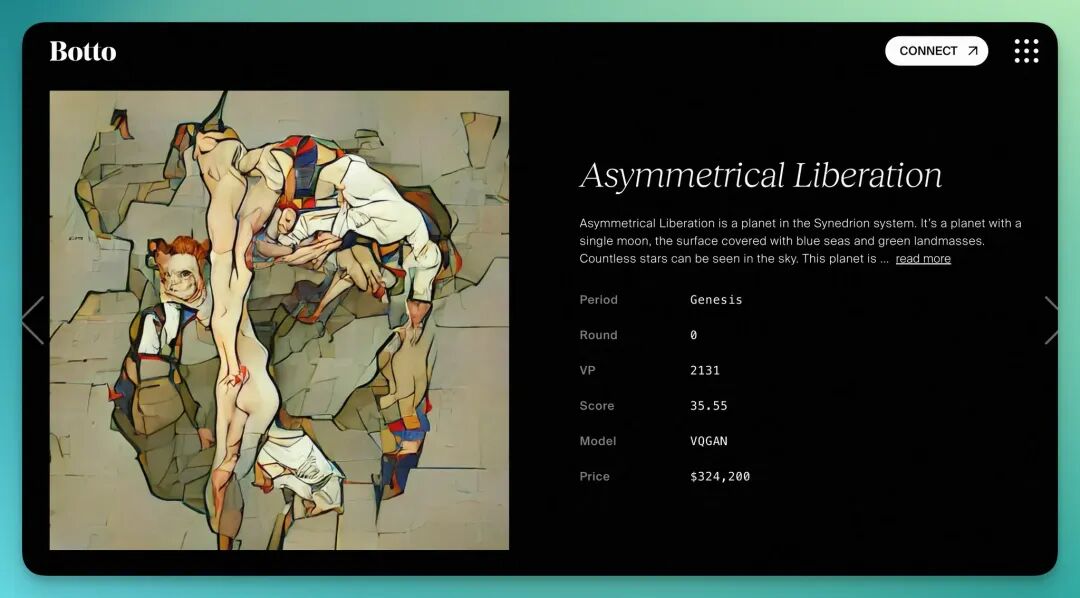
My prompt was:
Botto "Works" Artwork Collection and Storage Task Task Objective: Please visit https://botto.com/ and navigate to the "Works" section. This page displays multiple artwork series categorized by "Period." Execution Steps: Open the Botto official website and navigate to the "Works" page. Locate each Period on the page (such as Genesis, Rebirth, Eclipse, etc.). For each artwork, execute the following operations sequentially: Download or save artwork images (high-definition or display versions). Copy and extract all basic information from the right side, including: Artwork title (e.g., Asymmetrical Liberation) Artwork description (e.g., "Asymmetrical Liberation is a planet in the Synedrion system…") Period name (e.g., Genesis) Round (issue number) VP value Score Model type (e.g., VQGAN) Price (in USD) If the page contains "read more" or expandable text, click and extract complete content. Organize all extracted data into a structured table with the following fields: Artwork Name Description Period Round VP Score Model Price Image URL Organize by Period, with each Period as a separate group, sorted descending by Score or VP value. Additional Task: ✅ Automatically write all collected content (including image URLs and artwork information) into my web-based Lark Bitable, creating or updating corresponding fields. If the table doesn't exist, automatically create a new table named "Botto Works Database." Field mapping consistent with the table above. Image field should support image preview. Each record's unique key is "Artwork Name + Period."
Honestly, this task was rather complex. It involved local image saving operations, which actually exceed its current capabilities.
But what truly surprised me was its behavior after encountering errors and execution failures.
Past AI Agents, when facing tasks beyond their permissions or capabilities, often fell into infinite loops, getting stuck on one step, retrying endlessly, eventually just "giving up."
Flowith OS is different. Even when it cannot directly save locally, or when websites don't expose APIs, it still actively seeks alternative solutions.
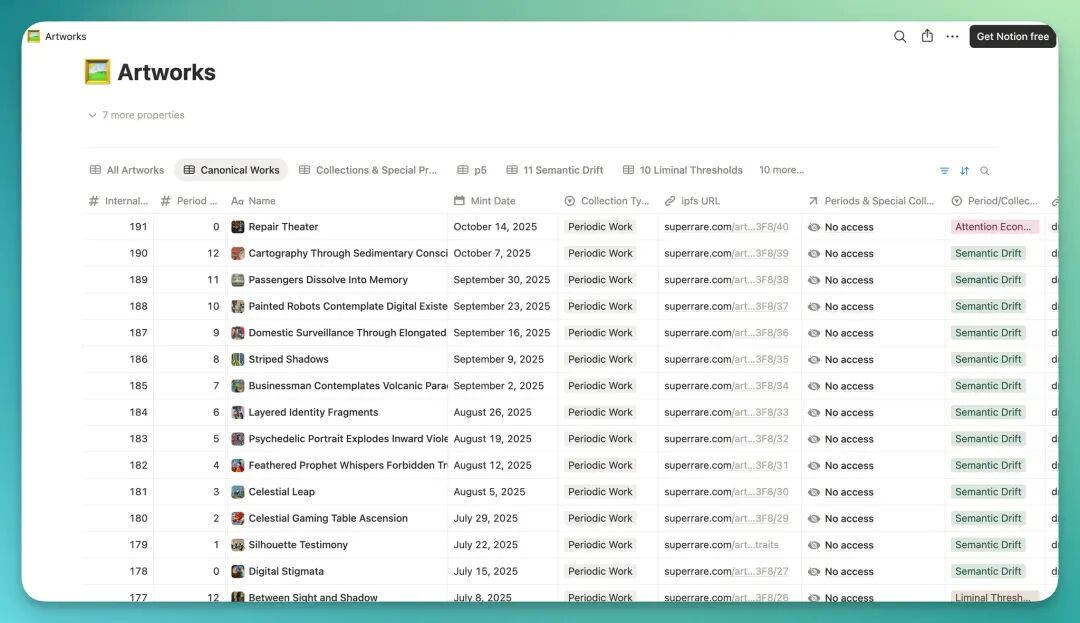
One particularly typical example: it first realized it couldn't directly download website content and couldn't find an API, so it began autonomously searching for possible interfaces. Finding none, it shifted approach and actually discovered a hidden Notion database embed page in Botto's official documentation, attempting to extract data from there:
This task, Flowith OS attempted for a full 172 steps, discovering many solution paths: direct scraping, API interfaces, extracting from the hidden Notion database in Botto's official docs, even going through GitHub projects, etc.
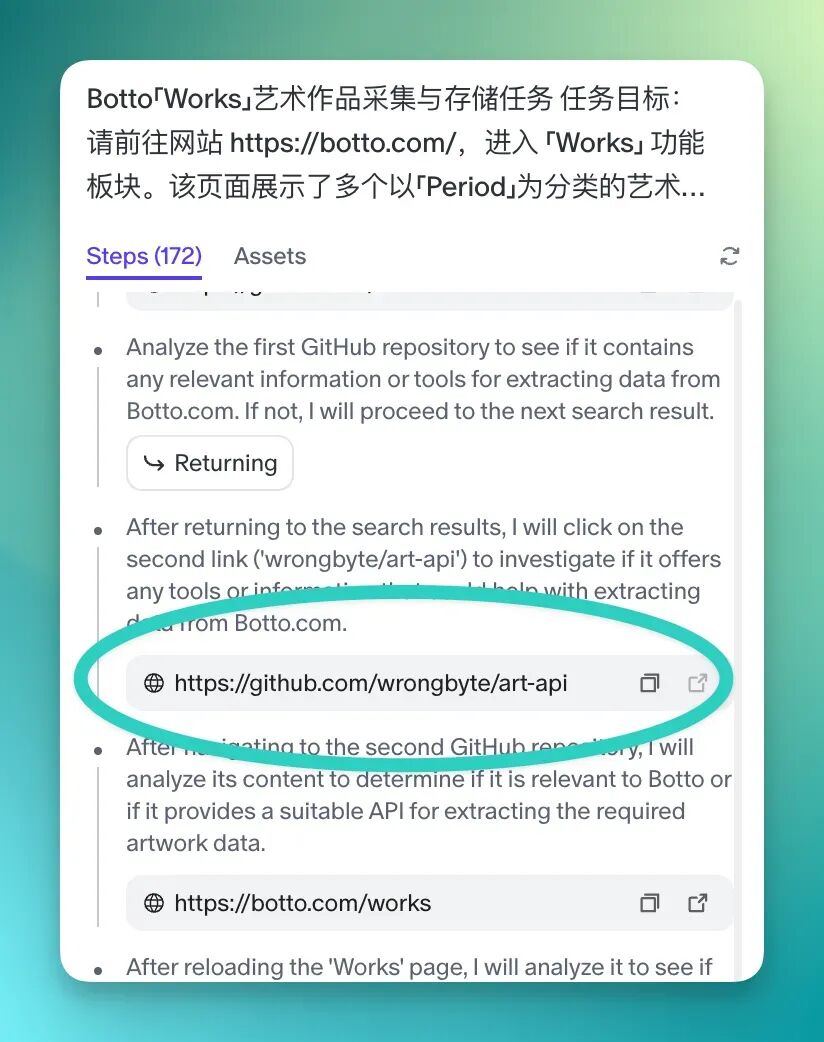
In other words, Flowith OS has already demonstrated: actively seeking possibilities to solve problems under conditions of limited resources and incomplete information.
More interestingly, Flowith's founder has already "secretly" been using Flowith OS to automatically publish blogs on Xiaohongshu:

Below, let's summarize the core logic of this new species, Flowith OS.
Having gone through the previous rounds of testing — from Taobao automated shopping, to Weibo trending topic synergy, to AI artwork data scraping — you'll notice it differs from Agents we've previously encountered.
Flowith OS's thinking pattern clearly resembles more of an "individual capable of growing in complex environments."
It no longer relies on single interfaces or plugins, but directly executes tasks in a native browser environment — opening webpages, extracting information, clicking buttons, comparing results, even automatically adjusting paths based on context.
More importantly, when Flowith OS encounters obstacles, it doesn't immediately give up or error out, but tries new paths, searches for alternatives, even actively explores external resources.
🚥
Flowith OS is an extremely young, extremely young Agent product, revealing its team's clear goal behind it: "Building Agents and next-generation internet products based on new interaction paradigms."
In short-range tasks (within 200-300 steps), it has already demonstrated "pleasantly surprising" fluidity and execution power. This confirms the "flow" in Flowith OS's concept — Agents can follow intent to find information across the entire web, then transform "ideas" into results.
When task chains extend and step counts reach hundreds, we see its rapidly iterating and growing "workflow connection" capabilities. Facing high-value, high-complexity tasks (such as the specific website information scraping case I assigned), the "attitude of striving to find solutions" it demonstrates is itself a valuable, active exploration.
As this young team puts it, for the future AI world we imagine, today is merely "Day 1."
So now we'd like to hear from you:
If you had Flowith OS execute one task for you, what's the first "result" you'd most want to see?