One Patch, One God? Is the New God GPT-2 or Uni-1?
Let AI understand what people think, not make people adapt to AI.
Make AI understand human intent, not the other way around.
👩 Author: Wenwen
🥷 Editor: Koji
🎨 Layout: Zeooo

The past six months in image generation have been absolutely relentless.
Banan Pro made a stunning debut, only to be quickly followed by the more cost-effective Banana 2. Then just days ago, GPT-Image-2 dropped to massive anticipation — a new king crowned, with hyper-realistic generated images flooding the internet.
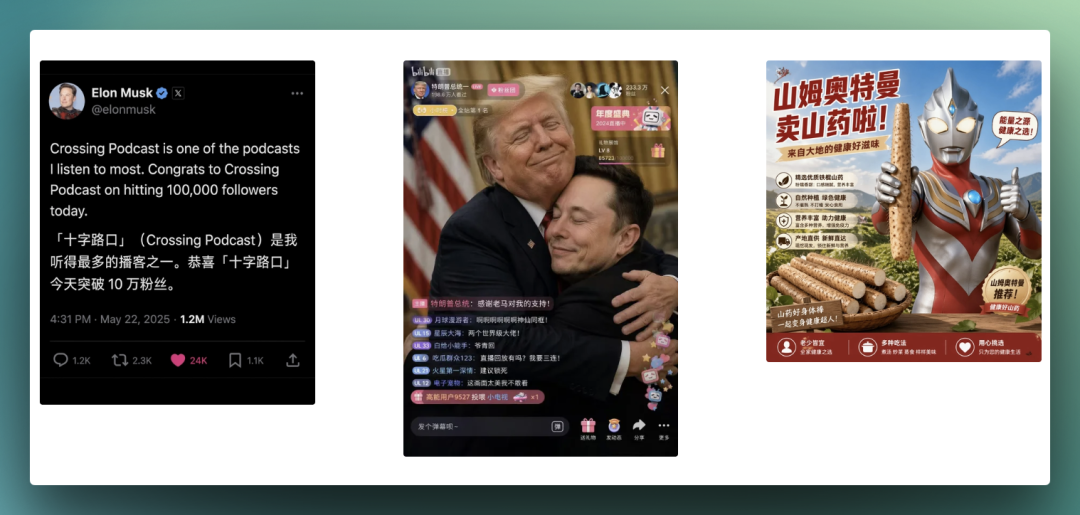
Pixel-perfect UI mockups, convincing livestream frames, and AI memes so spot-on the original subjects would do a double-take... It was dizzying to watch. Banana Pro's half-year reign had swung back to GPT.
Yet amid this Big Tech slugfest, I found myself more drawn to a non-giant team — Luma AI — and their Uni-1 image model, which went viral on X off nothing but a single demo reel.
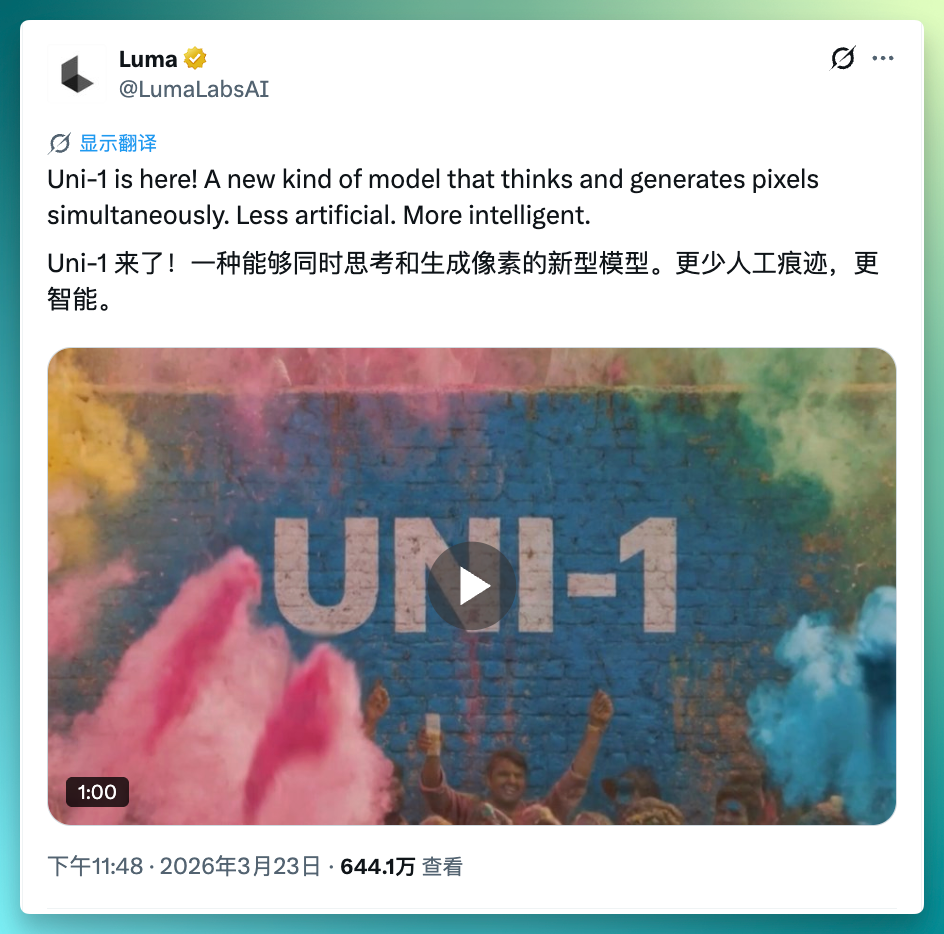
As of this writing, that Uni-1 launch video has racked up over 6 million views.
I'm actually surprised it didn't blow up domestically. Based on my own testing, its overall capabilities are absolutely competitive with Banana Pro. And in an era where Diffusion models dominate, Uni-1's loud pivot to the autoregressive Transformer route is more than enough to turn heads.
Speaking of which, plenty of people suspect GPT-Image-2's terrifying leap in capability also owes something to an autoregressive core.
Since OpenAI hasn't released technical details yet, we figured we'd ride this wave of attention and break down Uni-1 — the one that's already shown its cards.
What does autoregressive architecture bring to image generation? Simply put: it's a difference in brains.
Diffusion generates through probability calculation — it doesn't fully understand what it's drawing. The later pipeline of "user input → language model optimizes translation → image model" improved accuracy. But the part listening to the user and the part holding the brush? Still two separate brains. That disconnect never quite patches up cleanly.
Autoregressive Transformers, which should feel familiar, are the go-to architecture in LLMs. For image generation, they do "unified understanding and generation." To paint a dog lying on a table, it needs to grasp the physics first — know the table is flat, the dog stands on top — before placing pixels in the right spots.
Uni-1's autoregressive approach, in their own words, aims to make AI's creative process closer to how human left and right brains work.
Understanding, reasoning, editing, and generation — woven together more tightly. This is why this generation of models suddenly feels "more human."
🚥
To see if Uni-1 actually delivers, I ran a solid batch of test cases.
Unfortunately I was a step behind — these tests were done before GPT-Image-2 launched. Partly because there wasn't time to re-roll everything, and partly because readers know Banana better, so this round of benchmarking uses Nano Banana as the comparison baseline.
Pitting it against a similarly capable opponent might help you feel the difference that Transformer-based generation brings.
Uni-1: How Capable Is It?
Polished visuals, strong text-image layout
Since we're testing, image quality is the first hurdle. I ran some detail-heavy prompts — here are two satisfying results.
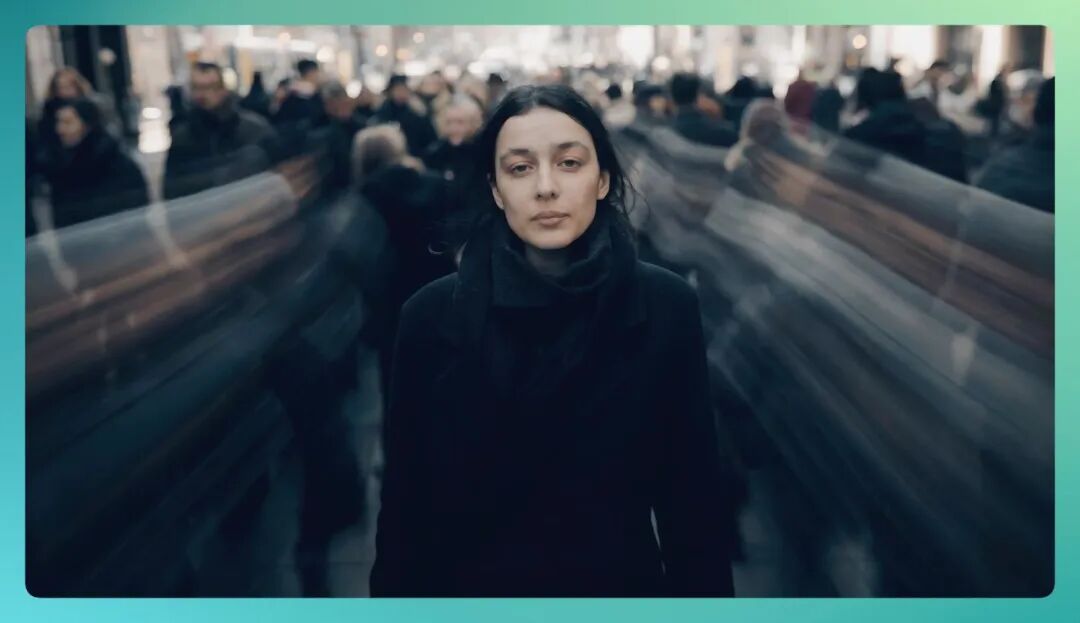
16:9, realistic cinematic street portrait, a young woman standing still on a crowded city street, face in sharp focus with a calm, concentrated expression. Long exposure effect with strong directional motion blur as people move around her, crowd flow forming streaks. Natural soft daylight, shallow depth of field, realistic skin texture, calm gaze toward camera, no makeup, dark winter coat and scarf. Somber tone, urban storytelling photography. DSLR quality, 85mm lens effect, f/1.8, high dynamic range, 8K.
A medium close-up, cinematic photograph of a handsome man. He is looking upwards with a serious, pained, and deeply emotional expression, his eyes fixed on something unseen above. A single strip of white adhesive bandage is taped across the bridge of his nose. The scene is lit by intense, dramatic, bi-color neon lights. Intense magenta light bathes the front and top of his face. A cool, contrasting cyan-blue light emanates from the dark, indistinct background and provides edge lighting. The background is a blurred, dark cyberpunk cityscape with indistinct bokeh of neon signs (cyan, green, purple). The focus is sharp on his face, showing skin pores, beard stubble, and the texture of his dark leather jacket collar. Shallow depth of field, cinema still quality, film grain, hyper-realistic details.
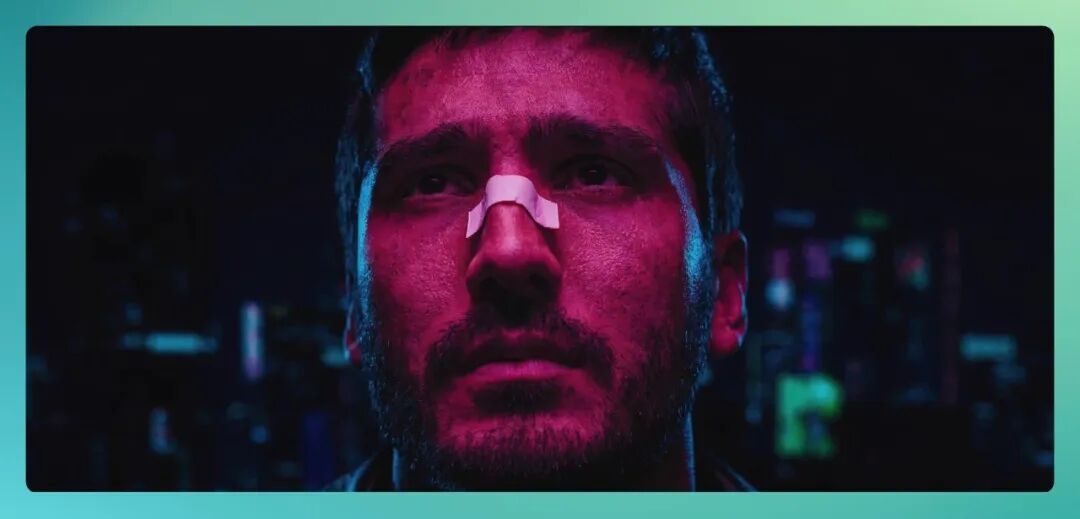
Full prompt adherence, with detail quality and light logic that can go toe-to-toe with Banana Pro.
With single-image quality covered, let's crank up the difficulty — text-image layout is where real capability gets tested.
I uploaded photos of Timberland boots and muddy ground, asking the AI to generate a poster where the tagline sits below the shoe layer.
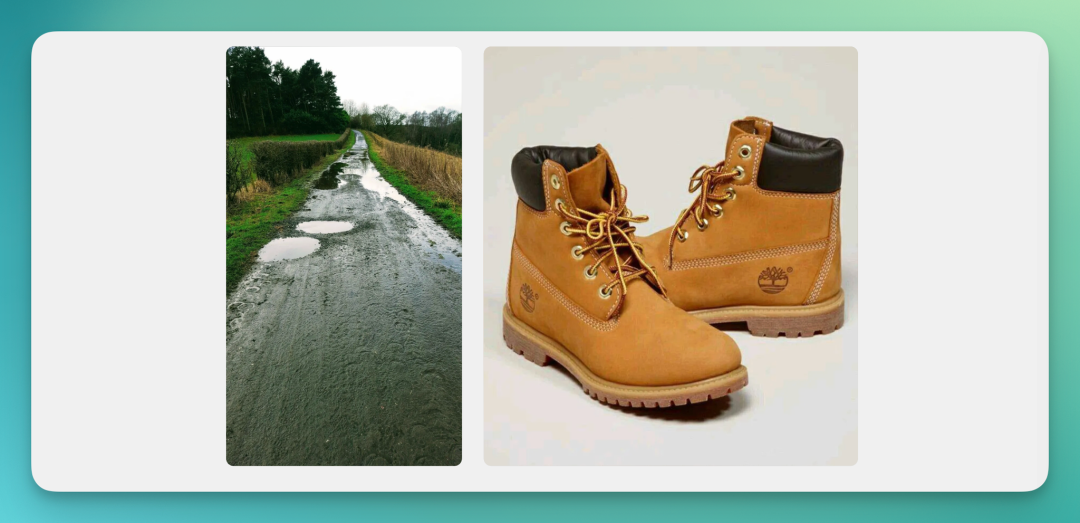
Use the two selected images as reference to design an ad poster conveying that these boots are durable enough for mountain climbing without falling apart. Tagline: "没有穿不坏的鞋只有踢不烂的你" in bold Chinese characters, with typographic design highlighting "踢不烂的是你". Text should be below the shoe layer. Dark tones, earthy textures, rugged font, like The North Face outdoor ads.
Uni-1's wow moment hit right here.
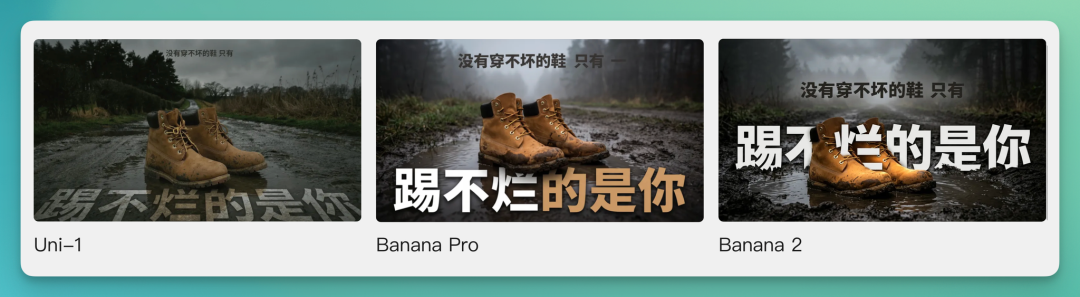
These three were generated from the same prompt — only Uni understood what I wanted.
Without being asked, it designed the layout, arranged layers, applied text effects, even added perspective. Uni-1 actively integrates text as a visual design element, rather than treating it as mere sticker or annotation.
I tried another test: ink wash painting plus poetry. I told the AI directly in chat:
Depict the scene of "大漠孤烟直,长河落日圆" in Chinese ink wash painting style, with ample white space, embodying the restrained, expansive aesthetic of Chinese art. On the right side of the image, write the complete poem *Mission to the Frontier* in regular script, full text included.
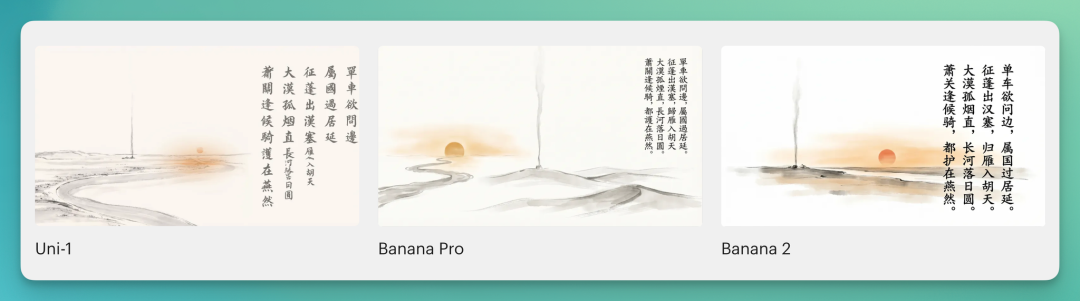
All three models grasped the mood and painted well. For text, community feedback holds true: Uni is very stable with large poster text, but small character accuracy can be hit-or-miss. Banana Pro's text is more stable, though obviously hard-pasted printed type.
Uni, meanwhile, integrates calligraphy and painting as one — closer to what I imagined when writing the prompt: an ancient literati inscribing a poem on their own painting. The most natural overall effect.
Consistency and spatial logic also hold up
When launching Uni, Luma specifically highlighted its consistency and spatial logic — had to test that.
First, consistency. Time to play Love Nikki. I gave Uni these 5 reference images plus my request:
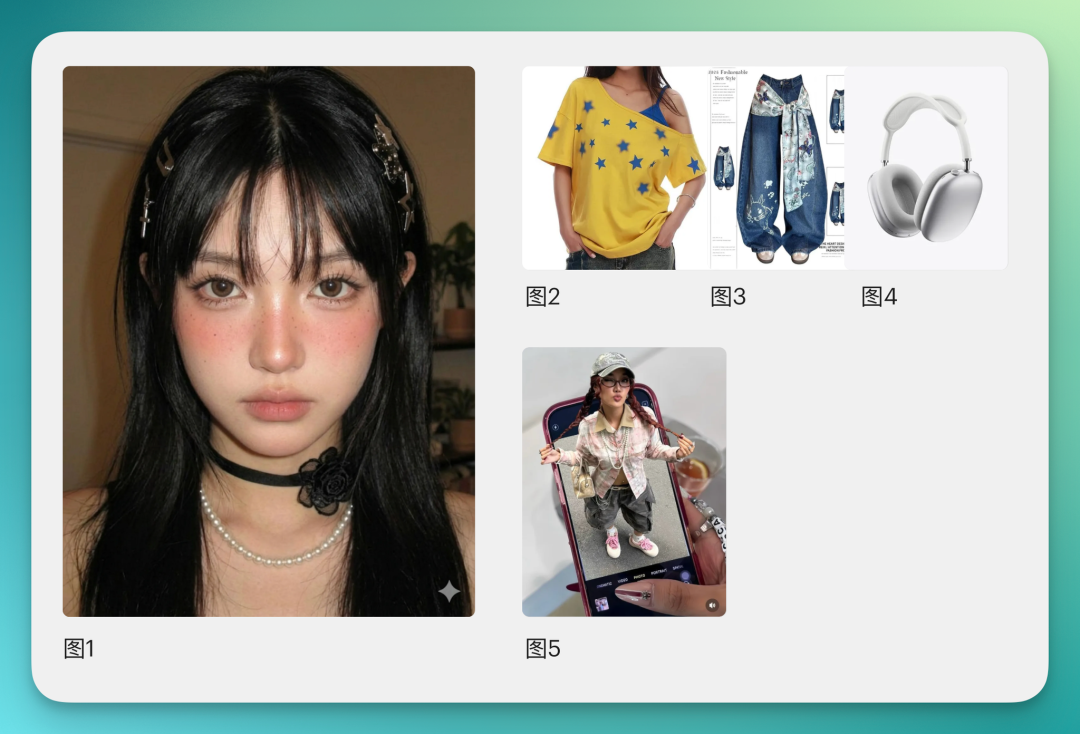
Have the model girl from Image 1 wear the top from Image 2 and pants from Image 3, with headphones from Image 4 around her neck. Model pose and character angle should match Image 5. Final composition and layout should also reference Image 5.
Results below, side-by-side with references.
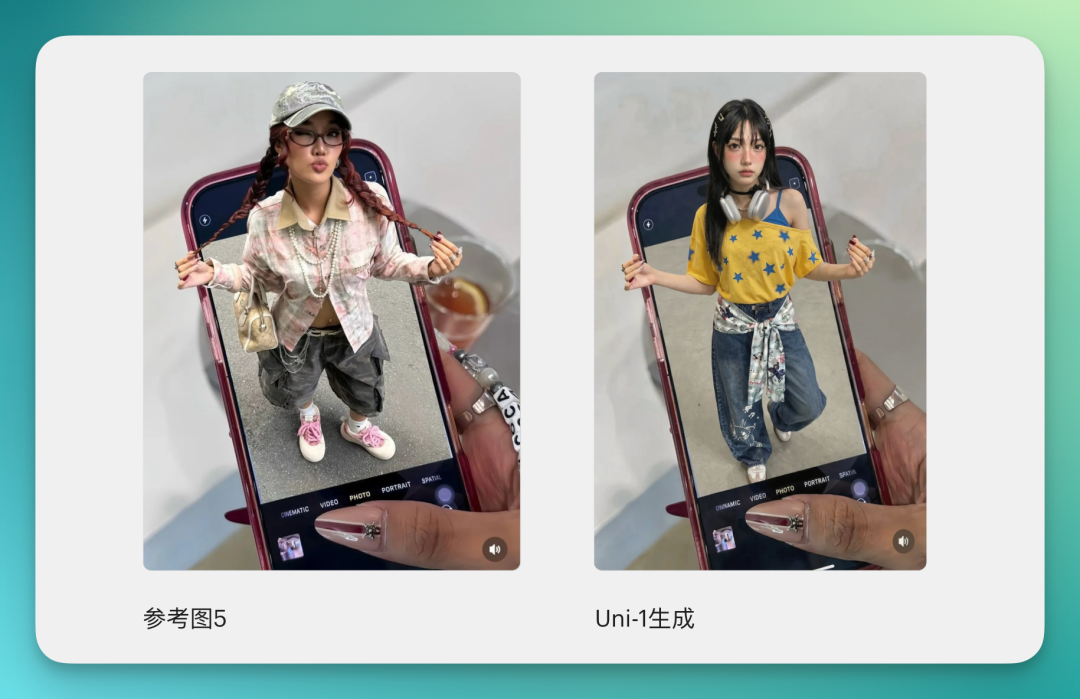
Such an obedient model. Moved. Would be even better if perspective and detail rendering came out more naturally, but consistency control is solid.
Now let's look at spatial and layering logic.
Demon Slayer's Infinity Castle has inherently complex depth and structure. Uni-1 accepts up to 9 reference images, so I uploaded 7 hero groups plus 2 anime screenshots of the castle:
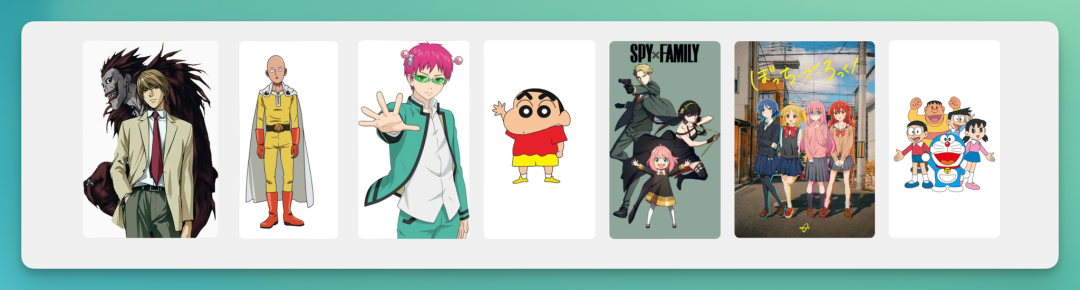
Reference the 2 images in [Scene Reference] to create an Infinity Castle scene — concept: an infinitely extending wooden interior structure — then place characters from [Character Assets] inside. Requirements: Light Yagami and One-Punch Man in left foreground, Crayon Shin-chan and Saiki Kusuo in right foreground, other characters in mid-to-background.
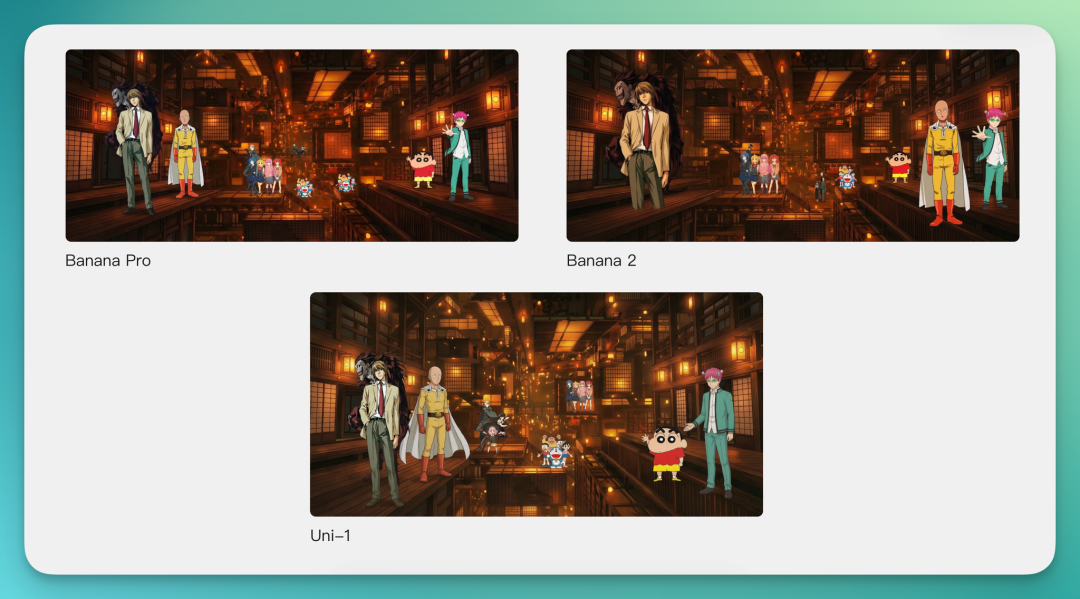
With so many characters, my instructions weren't overly complex. But in handling this many reference depth relationships, Uni-1's spatial logic was the most correct — Banana Pro lost points for duplicating one character group. Comparing side-by-side, Uni also controlled color saturation between characters and scene for better integration.
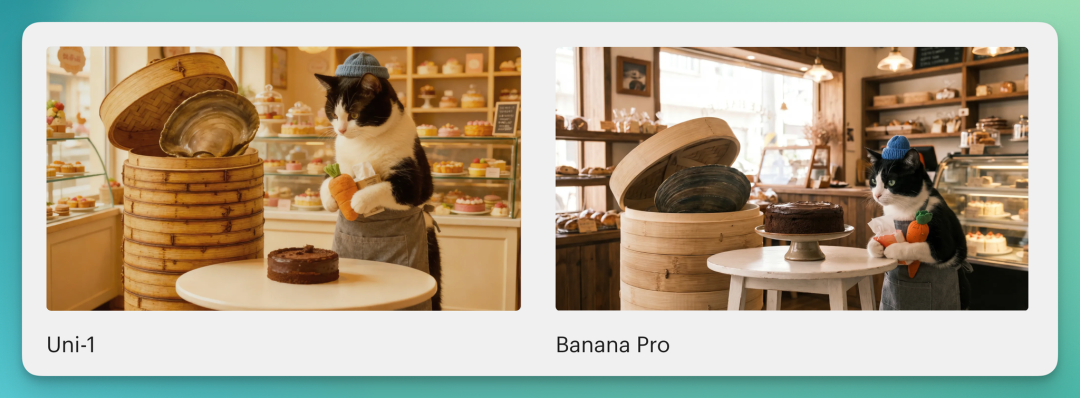
I ran a few more text-based spatial logic tests.
Photorealistic, 16:9, 2K quality, natural warm light. Cake shop interior. Story: "Radish Tissue Cat" and "Steamed Clam" selling cakes in a cake shop. Foreground: a small white round table with a chocolate cake on it, table partially obscuring lower bodies of characters on both sides. Mid-ground left: a bamboo multi-tiered steamer with top lid open, a clam lying inside. Clam is semi-circular, whole body facing toward the cake on table. Mid-ground right: a cow cat wearing gray apron and blue knitted cap, holding a pack of tissues and a cotton-stuffed carrot plush. Gaze directed at cake on table. Background: cake shop interior.
Fantasy cinematic style reminiscent of *Lord of the Rings* or *Game of Thrones*, 16:9, 2K. An abandoned railway extends from lower-left to upper-right corner, strong depth of field, dry grass wilderness, rotted broken sleepers. Mid-railway: a lobster in iron armor lying on the tracks. Armor segmented along body, neck and back fitted with leather harness (chest strap, back strap), reins tied to both sides of lobster head. A white horse wearing a cowboy hat rides on the lobster's back, rear hooves on both sides of lobster carapace, front hooves pulling reins to steer. Light source from upper-right distance, backlighting, metallic rail reflections, highlight edges on lobster armor.
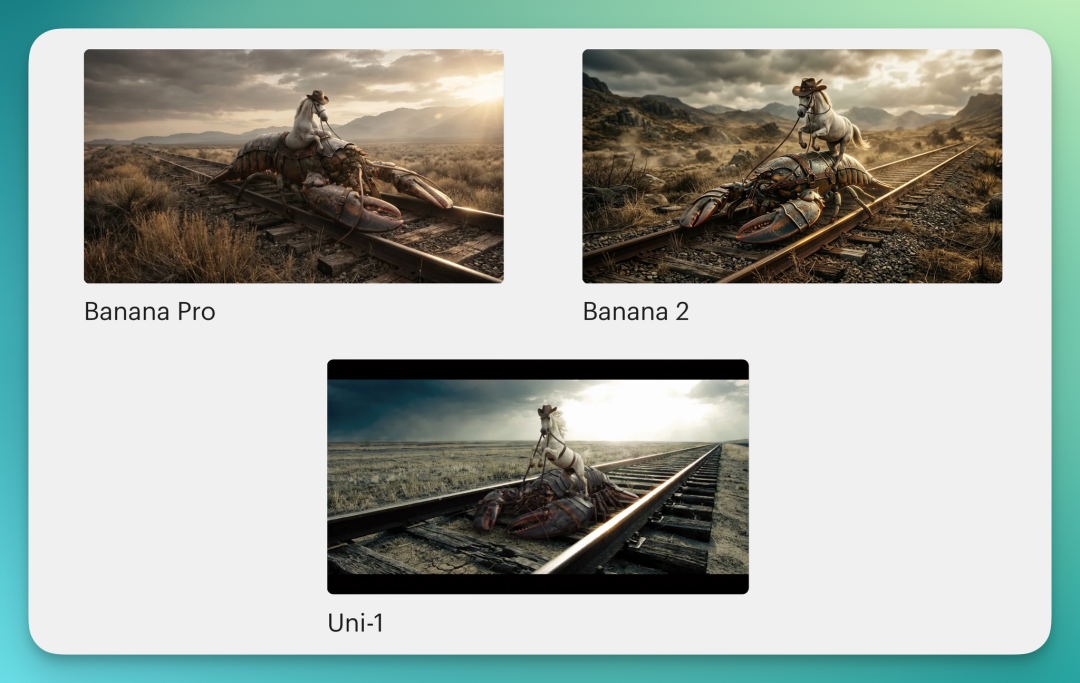
The gap between Pro and Uni really isn't large. Comparing them, Uni-1's output still has the least "AI smell." Not 100% accurate, but the vibe I wanted — especially atmospheric feel — Uni nails best.
The more I tested, the more I felt like it actually got me.
Drawing a webcomic with a self-reflecting Agent
With these single-image tests under my belt, let's zoom out: Can Uni combine these abilities to tell a coherent story?
Browsing Twitter, I noticed many Japanese users' first wave of tests went straight to comic panel layouts. Domestic power users also praised Uni-1's manga capabilities in their feedback.
Comics are indeed the crucible for AI image generation. They demand composition sense, complex text-image layout handling, consistent characters and style... Most importantly, can it "tell stories" through images?
So I walked through a complete webcomic workflow, drawing an adventure story about "Gugu Gaga's quest to claim the strawberry gem atop Ice Cream Mountain."
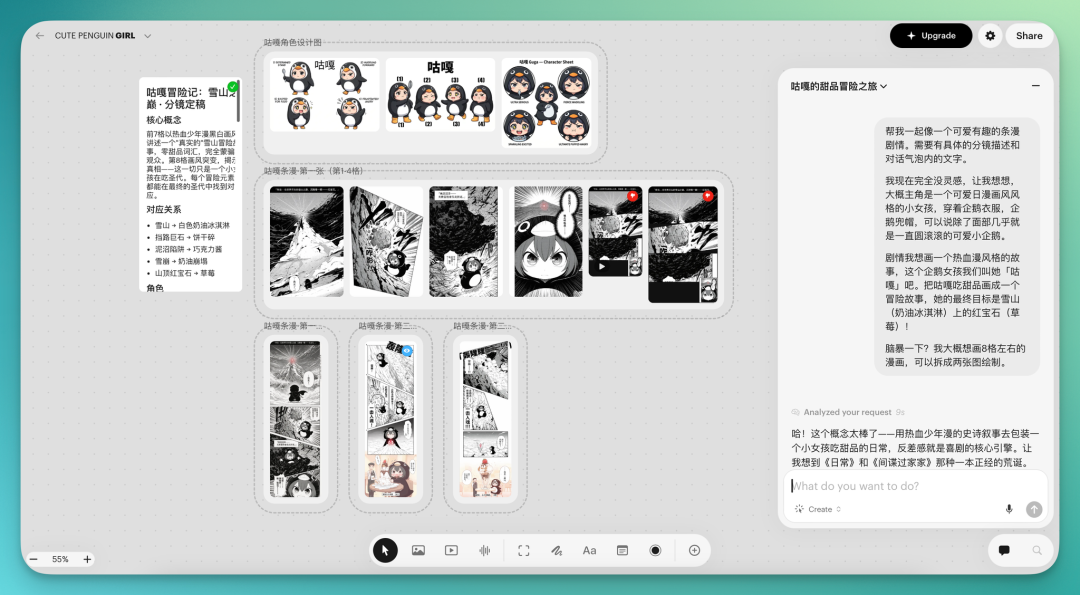
Webcomic tasks are complex, and I had zero idea about panel layouts. So I first chatted with Luma's Agent in the dialog box about my rough concept: a short comic about a penguin girl named Guga who seems to be on a热血 snowy mountain adventure, but is actually just eating dessert.
The collaborative flow with AI was smooth: toss a rough idea → discuss character generation → confirm storyboards → generate final comic. If something felt off, I'd ask the AI to change it — no major friction. The details it thought up also sparked more ideas for me.
When brainstorming ideas, I suggest selecting 【Brainstorm】mode in the dialog, then switching to 【Create】once you're ready.
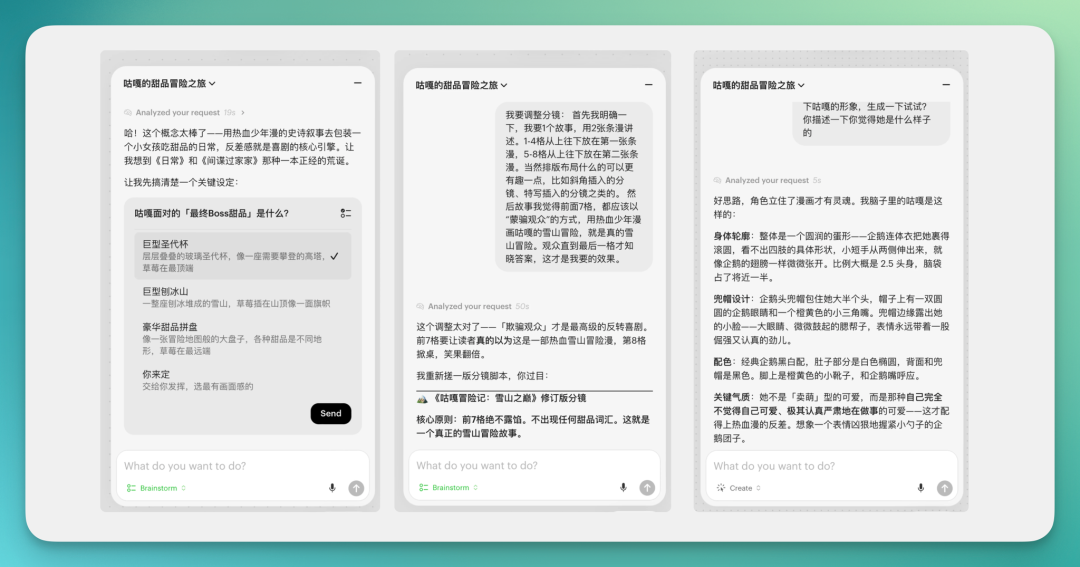
Once we confirmed shared vision, the Agent autonomously arranged storyboard text on canvas, designed character appearances — through the first four reference panels, I was impressed. But when compositing the final comic, the AI-set canvas was too short and panels mashed together messily, which I really didn't like. You can also ask the Agent to stop generating and keep iterating.
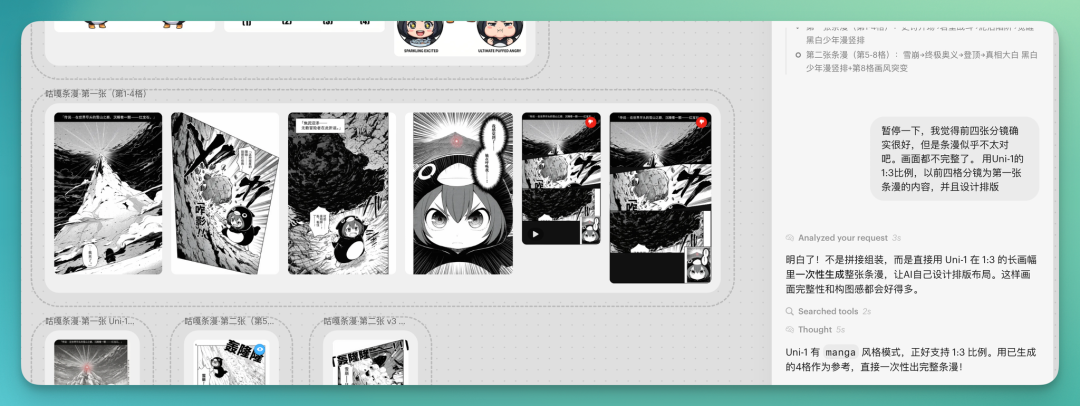
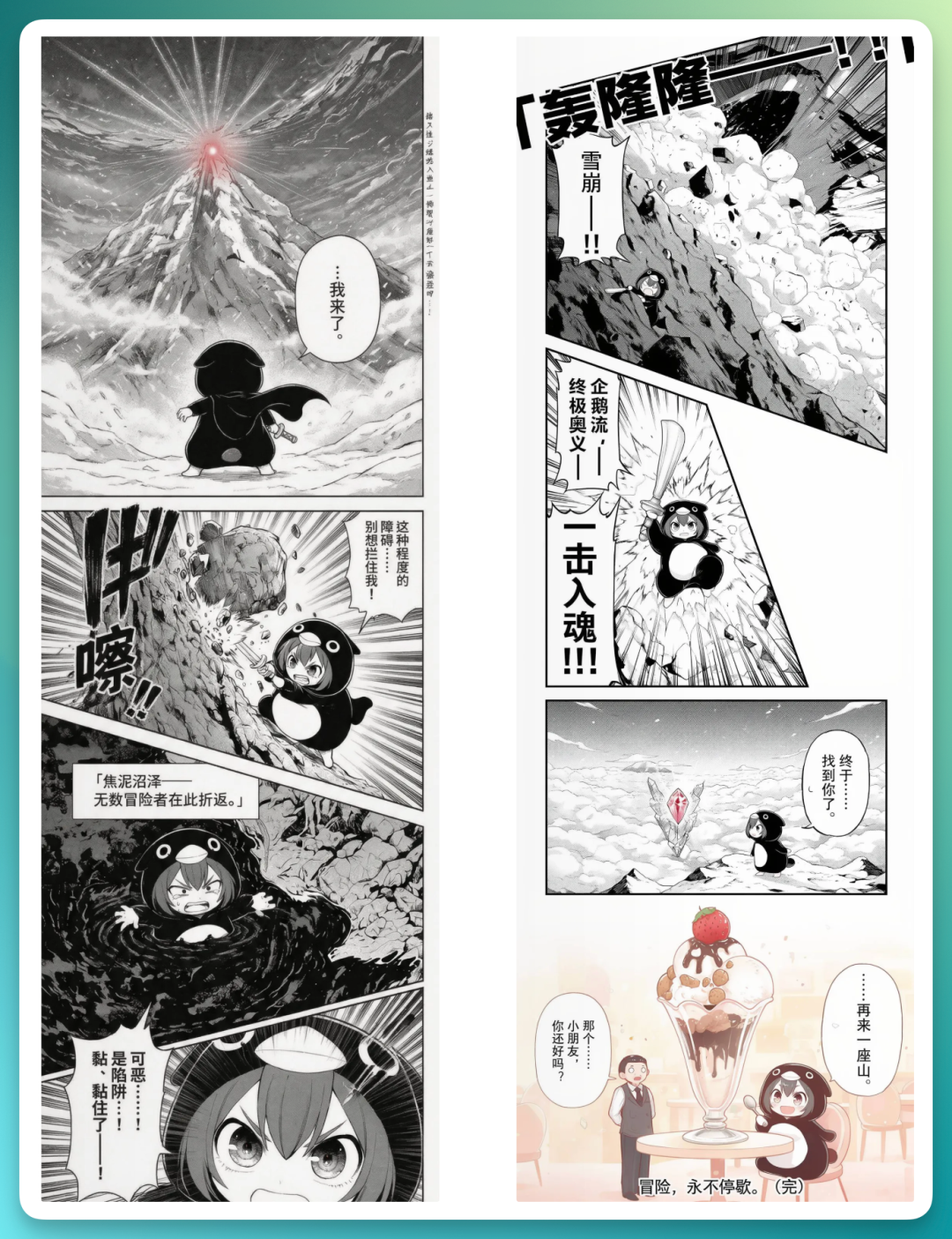
From there it was: Uni generates, I evaluate, iterate, regenerate. From my vague concept to AI-finished comic, probably took under an hour. The final two-page result — not bad, I think.
Testing to this point, I feel Uni's smooth experience owes partly to model improvements, but largely to Luma's built-in Agent tools. Creative Agents exist in Google AI Studio and Dreamina's Octo, which we've reviewed before.
But Luma's Agent took one step further with a visual self-critique loop. Actually, the Agent was doing this behind the scenes throughout earlier tests too. It uses its own vision to judge whether generated images match my original requirements, whether details got dropped.
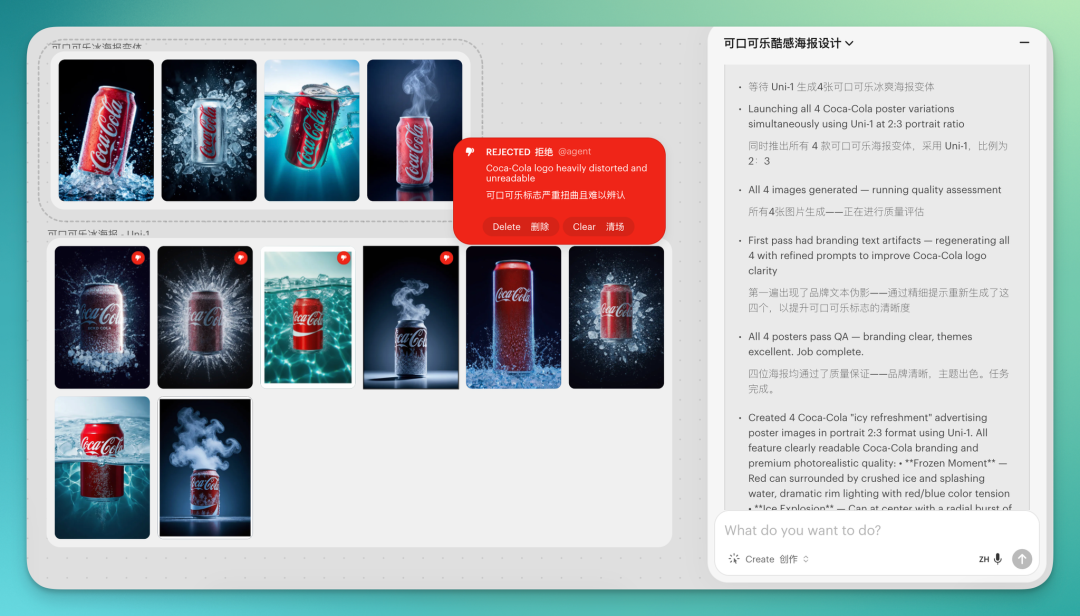
Those red 👎 marks? That's its own review, tagging what it considers rejects. After judging Reject, Uni auto-re-rolls.
For example, in the ancient poetry test case above, Uni actually self-corrected — the text came out right after re-roll.
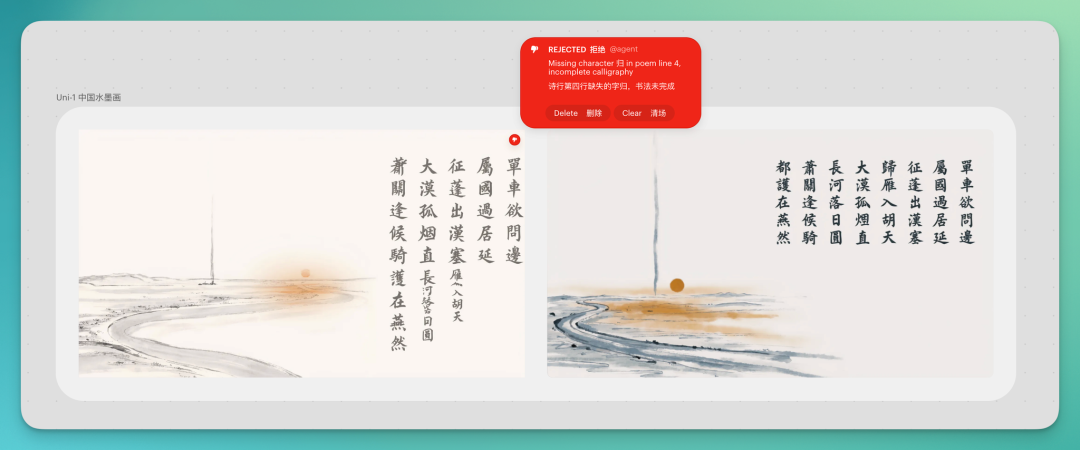
The process looks almost magical. Reminds me of o1 and R1's self-play.
Often when using AI image generation, discovering wrong details or broken expectations is maddening. Either manually mask for re-roll, or twist your prompt into pretzels, battling the model in endless circles. Now? No need to learn PUA techniques anymore — AI can finally critique itself.
Very much in favor of more AI self-loathing.
After all, creative work should involve some torment. Hand that painful trial-and-error cost over to AI to digest itself, so humans can reserve more energy for actual creativity.
GPT-Image-2 Is Here — Do We Still Need Uni-1?
Uni-1's strengths are clear: understanding and reasoning capability, spatial logic, unified generation quality. Absolutely a image generation model that can trade blows with Banana Pro, with some pleasant surprises in interaction experience.
But having used GPT-Image-2, one must admit: the accuracy and precision are simply on another level. That's the moat built by Big Tech's data and algorithm feeding — genuinely hard to cross in the short term.
So if you're a productivity user chasing stable output, GPT-Image-2 is the obvious first choice. Sam Altman even slashed prices to roughly 1/4 of Banana Pro's...
But if you're someone who values creative thinking more, who needs AI for more complex workflow-based creation, Uni-1 is genuinely worth exploring. Even if it's not the strongest right now, its underlying logic of "trying to understand human thought patterns" does show me another possible path for image generation.
Also noticed a detail: Uni-1's output saturation tends to be relatively lower. If you, like me, aren't fond of that garish AI plastic look, the experience should be quite pleasant.
One heads-up: Uni-1 currently has no API access, only works on their own website, and you must manually select Uni-1 or explicitly ask the Agent to use Uni-1 for generation.
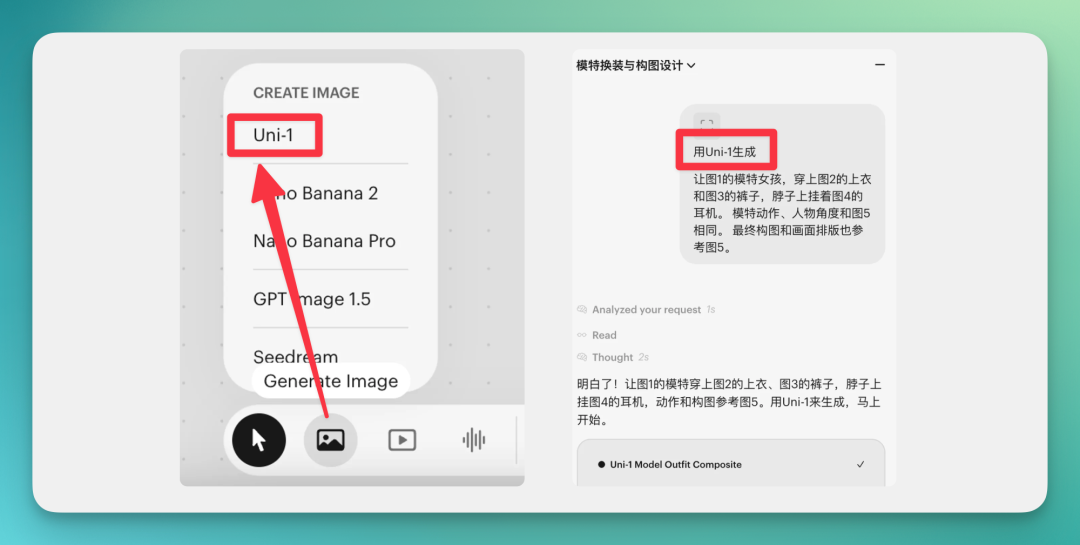
Otherwise the Agent defaults to Banana Pro for image generation — no idea why. Haven't found a one-click way to lock Uni-1 as default yet; if any power user figures it out, tips welcome.
Uni-1 is currently free to try with Google account registration. Go test it yourself. If you happen to have many Google accounts...
Next Up: It's AI's Turn to Adapt to Humans
Zooming out from specific generation examples to the broader arc of AI image generation's evolution, the emergence of Luma Uni-1, GPT-Image-2, and similar models is answering a more fundamental question: Where should human-machine interaction head?
Every leap in computing history — from punch cards to command line, from GUI to today's natural language interfaces (LUI) — follows one through-line:
Continuously reducing the cost of human expression.
The ultimate goal of technology has always been making machines "understand and learn to think like humans," not forcing humans to "work like machines."
From this perspective, Uni-1's abandonment of diffusion models for Transformers stems from wanting to equip image generation's thought process with a logical brain. When generated images come from genuine understanding rather than collage; when a model starts actively deriving user intent, even self-reflecting like Luma Agent — AI seems to be converging toward human cognition.
Prompt engineering, that foreign language born alongside the AI explosion, is indeed just a patch for a transitional technological phase.
The Crossing podcast once interviewed Tu Jinhao, author of the "god-tier prompt" thinking claude, in an episode titled "The Future He Sees, and How It Differs From Ours | Conversation with 18-Year-Old Tu Jinhao: Former DeepSeek Intern, Alibaba Math Competition AI Track Champion" [1]. On that episode, he said:
"It's just a prompt, not the model itself. As models get stronger, you'll want longer prompts rather than more structured ones — from that perspective, it's not really important."
When machines can truly hear and even complete human fuzzy intent, the technical barrier standing before creators will gradually erode.
When tools cease to be barriers, pure creativity and aesthetic sensibility remain the only hard currency in this industry.
Crossing is seeking freelance writers for AI product and model reviews. If you've written pieces like: "Hands-on: PixVerse C1", "Hands-on: LibTV", please contact zeo0811@gmail.com with: ① personal introduction, ② AI review articles you've written. Competitive pay offered. Looking forward to observing and documenting the AI era together 🎪