In the first week of the new year, AgiBot's latest release revealed serious ambition.
The real world isn't a demo. How should humanoid robots enter it?
The Real World Is Not a Demo. How Should Humanoid Robots Enter It?

👦🏻 Author: Jingshan
🥷 Editor: Koji
🧑🎨 Layout: NCon

In 2025, the pace of progress in embodied intelligence has been nothing short of hitting the accelerator. Humanoid robots of various forms and sizes have flooded the market, all sprinting toward the goal of "commercial closed loops."
More and more people are turning their attention to this field, and everyone is trying to answer a critical question:
When humanoid robots are no longer constrained by size and cost, and truly enter the real world, what happens?
Against this backdrop, AgiBot's Embodied Intelligence Research Center officially released a framework called SOP (Scalable Online Post-training) for robot online learning at the beginning of the year.
This echoes a prediction Yusen Dai made on Crossing's podcast 2026 AI Kickoff Conversation: beyond pre-training and post-training, the "third pocket" that will truly determine the ceiling of the next phase is likely Online Learning — the ability of a system to continuously consume feedback and calibrate its own behavior in real time during actual operation.
As Dai put it at the time, the real question isn't whether models can get even bigger, but whether there exists a "third pocket" — Online Learning — that keeps the system learning after deployment.
In this sense, what AgiBot's SOP attempts to address is a more fundamental, longer-term question: after robots are deployed, how do they remain reliable in complex, uncontrollable real-world environments and actually get smarter with use?
Going forward, we don't plan to rehash the technical details from the paper.
Compared to parameters, we want to share our understanding of this SOP release from a broader perspective.
But the Real World Is Not a Demo
The past year has been one of explosive growth for humanoid robots.
We saw them standing in rows at NVIDIA's GTC conference, folding laundry in Tesla's videos, and doing backflips and even brewing coffee in countless startup demos.
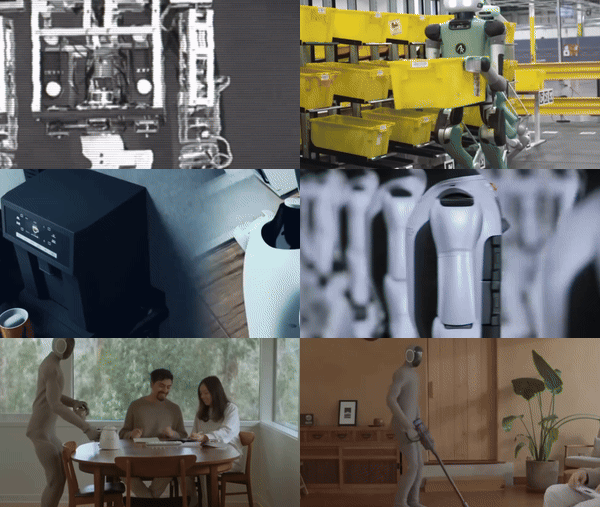
Visually, they certainly look increasingly convincing. It seems like just a few more months and they'll be walking into our kitchens, taking over real-world tasks.
But one easily overlooked fact is this: these demonstrations, "99%" of them, happen in "controlled environments."
Lighting, flooring, props, workflows — all potentially designed. Failed takes may be edited out. Accidents may be preemptively avoided.
But the real world has never been a demo floor.
For instance, the Coke can in your living room might be dented. The rug might have curled edges. Even indoor lighting changes constantly — lights on or off, curtains blocking or admitting sunlight. And then there's the biggest variable of all: people.
A child might suddenly run up. A worker might change where parts are placed. Someone might accidentally block the robot's path.
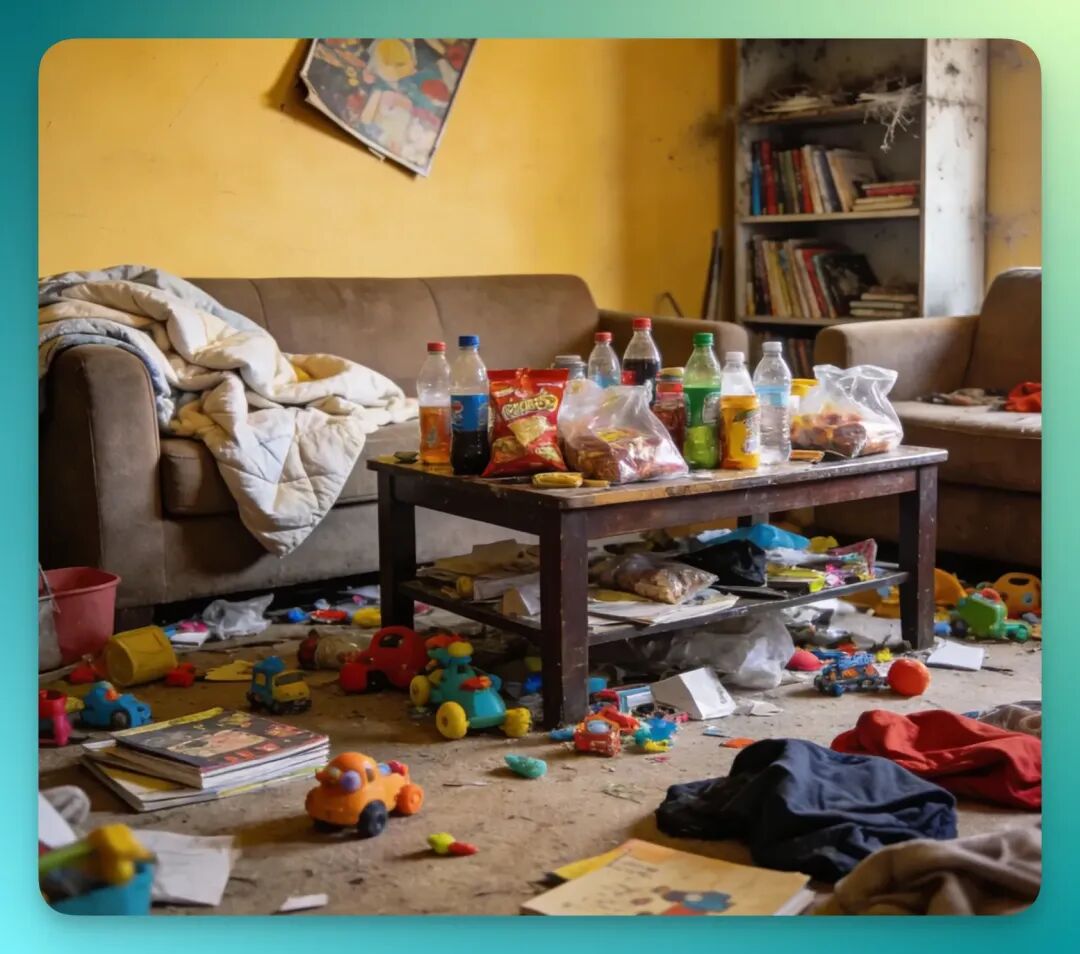
In such environments, robots that performed stably in labs often fail集中地、重复地 when deployed in real scenarios.
And if the problem isn't limited to "one machine"? That's when things get truly troublesome.
When you're deploying not one, but dozens, hundreds, or even thousands of robots, every low-probability failure gets amplified.
For C-end users, or even B-end users, the verdict is straightforward: it's simply "unusable."
So the question is obvious, and it's fundamentally a paradigm question:
When should robots actually "learn" real-world scenarios?
Should they learn everything in one go inside a lab, or should they run, correct, and grow while operating in the real world?
This question determines whether humanoid robots can "truly exist in the real world over the long term."
So, How Have Robots Learned Over the Past Two Years?
The mainstream path is actually quite clear: offline imitation learning.
Humans first demonstrate tasks in ideal environments, collecting high-quality data through various methods, then use this data to train Vision-Language-Action (VLA) Models.
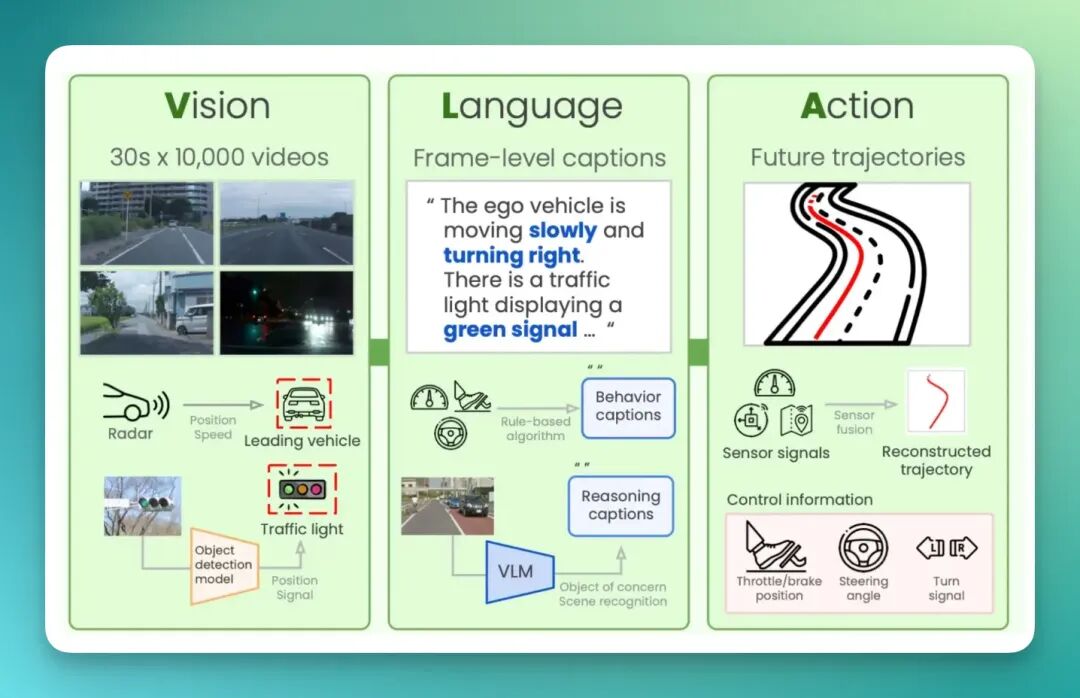
Once training is complete, the data is "frozen," and the model is deployed.
This approach worked well early on. But the problems are equally obvious — roughly three of them:
[1] Offline data only covers "ideal, standard behaviors."
Put simply, human demonstrations are essentially a form of "prior filtering." They struggle to cover the vast amount of inelegant, non-standard, off-script situations in the real world.
A simple example: human operators typically wear motion-capture suits or use teleoperation handles to demonstrate a task in an ideal environment (say, grasping an apple).
But when the apple isn't so "ideal" — say, half-eaten — the data is effectively "half a failure."
[2] The stronger the model, the more frequent "long-tail failures" become, with rising marginal costs.
In short, when model accuracy goes from 0% to 90%, generic offline data works well. But when you're trying to get from 99% to 99.99%, the remaining errors tend to cluster in rare, hard-to-reproduce "long-tail scenarios."
To fix that last 0.01%, you may need to collect data specifically for that scenario.
The meme "wrapping dumplings just for the vinegar" applies perfectly here.
Fixing one new failure scenario may require multiples of manual effort.
[3] Static models cannot handle a dynamic world.
This points to a core contradiction: offline learning is essentially using "the past world" to guess "the future world."
The moment a model is deployed with "frozen" data, it begins to go stale. The real world doesn't run on a demo script — lighting changes, layouts change, objects change.
If every new problem requires pulling the humanoid robot back to the lab, recollecting data, retraining the model, and redeploying via OTA...
That iteration cycle is too long — far too long to support commercial deployment.
So, people concluded that a new approach is needed.
What Exactly Is SOP, Which AgiBot Just Released?
Against this backdrop, AgiBot proposed SOP (Scalable Online Post-training).
Simply put, in the traditional humanoid robot lifecycle: develop → train → deploy → end.
In SOP: develop → pre-train → deploy → real learning begins.
The core idea of SOP is straightforward:
Robots can go online with an imperfect, 60-point model. Deployment no longer means the end of development; instead of "frozen data," it marks the beginning of large-scale data acquisition.
The real world itself becomes the largest training ground.
Based on currently available technical materials, here's how we've organized it.
SOP's specific operational logic builds a closed loop of "real world → cloud learning → instant feedback":
[1] Parallel Execution
Multiple robots execute tasks in the real world.
[2] Data Upload
All execution trajectories (not just successes, but more importantly failures, stalls, and human-takeover corrections) are uploaded to the cloud in real time.
[3] Online Update
Cloud compute uses this "real, real-time data" to fine-tune the model or perform reinforcement learning.
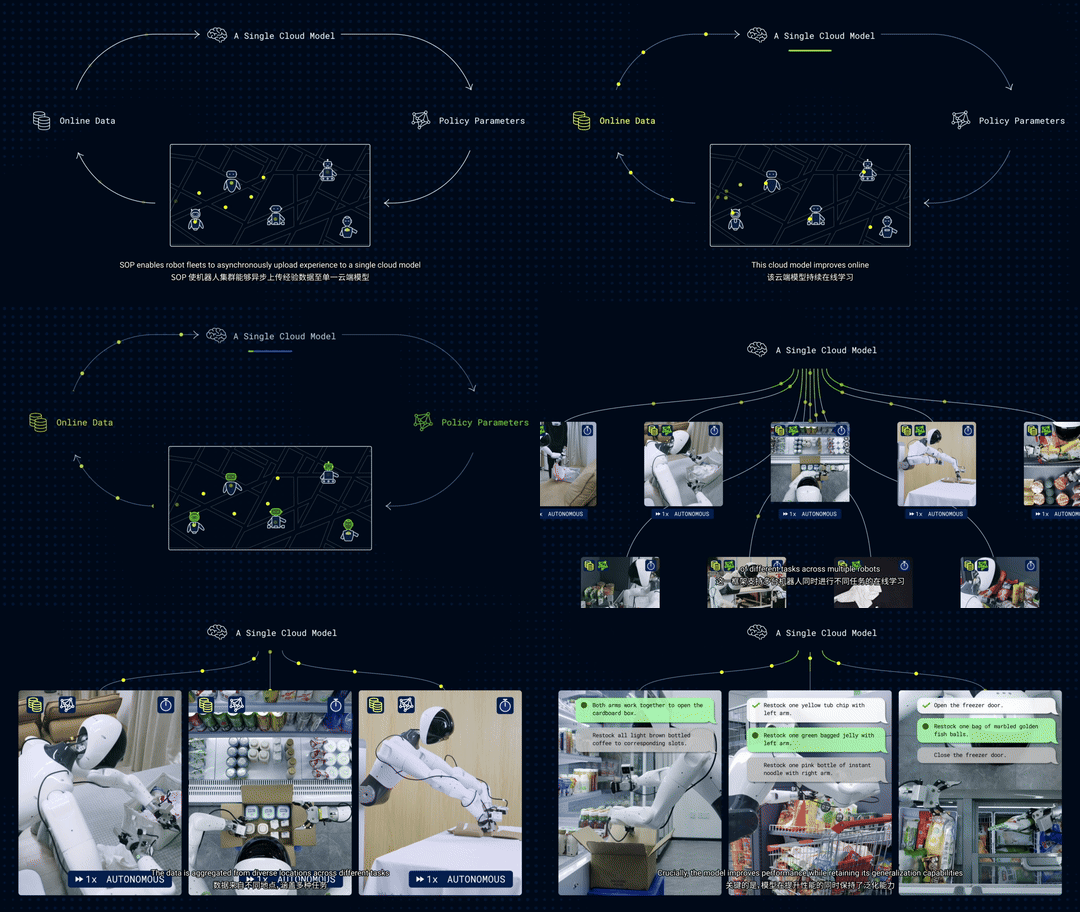
[4] Parameter Sync
Newly learned capability parameters are synchronized back to all robot endpoints within minutes or even seconds.
Several points are critical in this process: scalability and parallelism.
Here's a SOP process diagram I found from AgiBot:
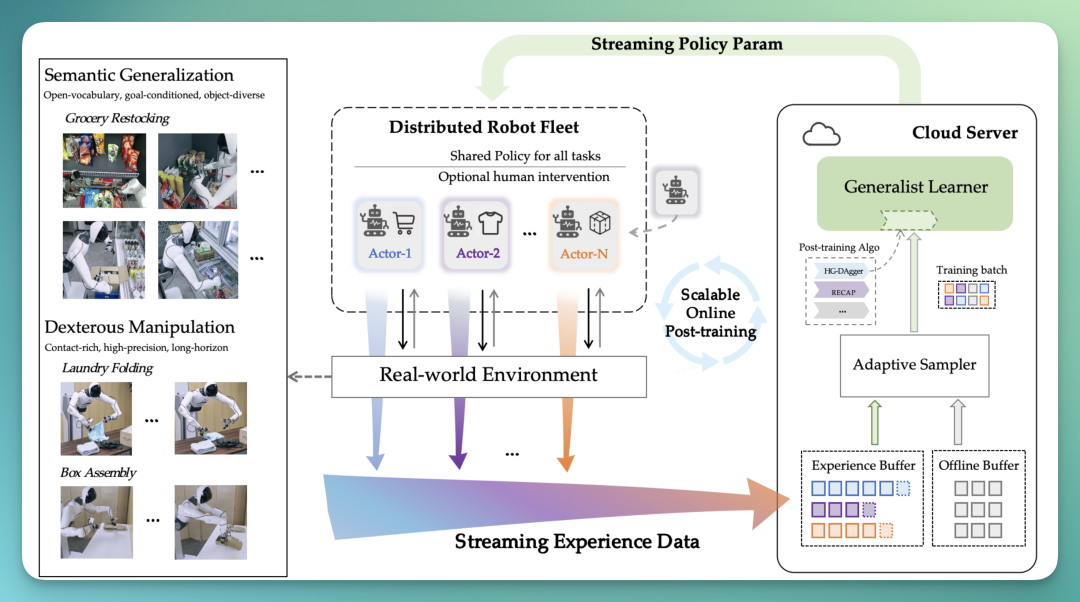
Simply put, this is how a robot team works.
Each robot has its own tasks — some are "restocking" or "item picking" tasks.
In retail scenarios, "restocking" or "item picking" actually tests the model's semantic generalization capabilities. You need to distinguish hundreds of product types and different shelf types, and crucially, understand human instructions to find the right item from piles of stuff and complete the task.
Other tasks, like folding clothes or assembling things, require finer skills and longer operation times.
In "clothes-folding with disturbance" scenarios, SOP's advantages become more apparent:
Moreover, through SOP, humanoid robots can continuously execute clothes-folding and box-folding tasks for 36 hours.
Clothes-folding task:
Box-folding task:
These robots don't just work alone — they operate in a distributed team, all sharing the same policy.
They execute tasks in real environments, then send all experiential data back to cloud servers, which analyze the data and help the robots optimize their operations.
Then, based on what they've newly learned, the robots become increasingly capable of handling more diverse tasks.
So, Why Must Parallelism and Distribution Be Emphasized?
If only one robot is learning online, it often encounters a problem: it focuses narrowly on learning and solving just this one problem.
This process is slow, and it easily falls into "local optima."
Because it has seen too few scenarios. It might mistakenly conclude that "all red things are off-limits" because yesterday it touched a fragile red cup.
But when you have 100, 1,000 robots online simultaneously, the situation changes completely.
First, the cloud model can, in a short time, see the states and problems encountered by various robots in various scenarios.
Second, when Robot A makes a mistake and the cloud corrects it, Robot B immediately learns to avoid that same mistake. To reach the same success rate, a single machine might need 1,000 hours of operation, while a cluster of 100 robots in parallel might need only 10 hours.
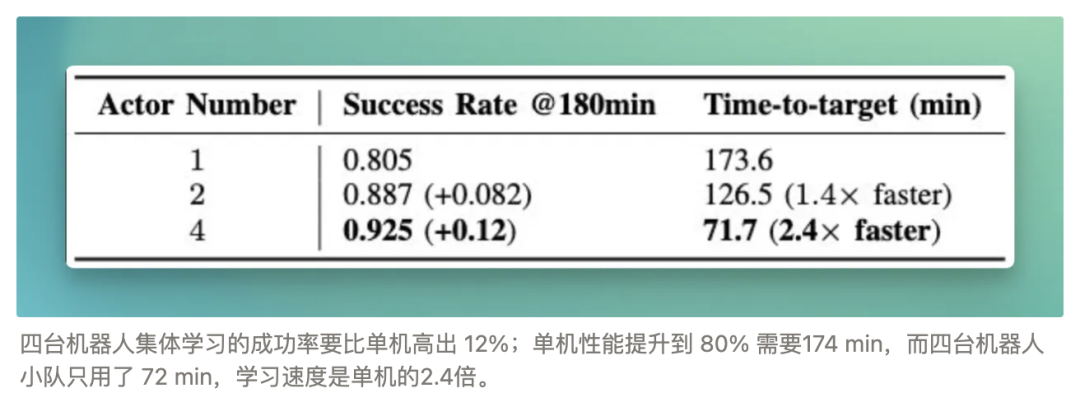
Scale, here, is no longer a burden but a capability in itself.
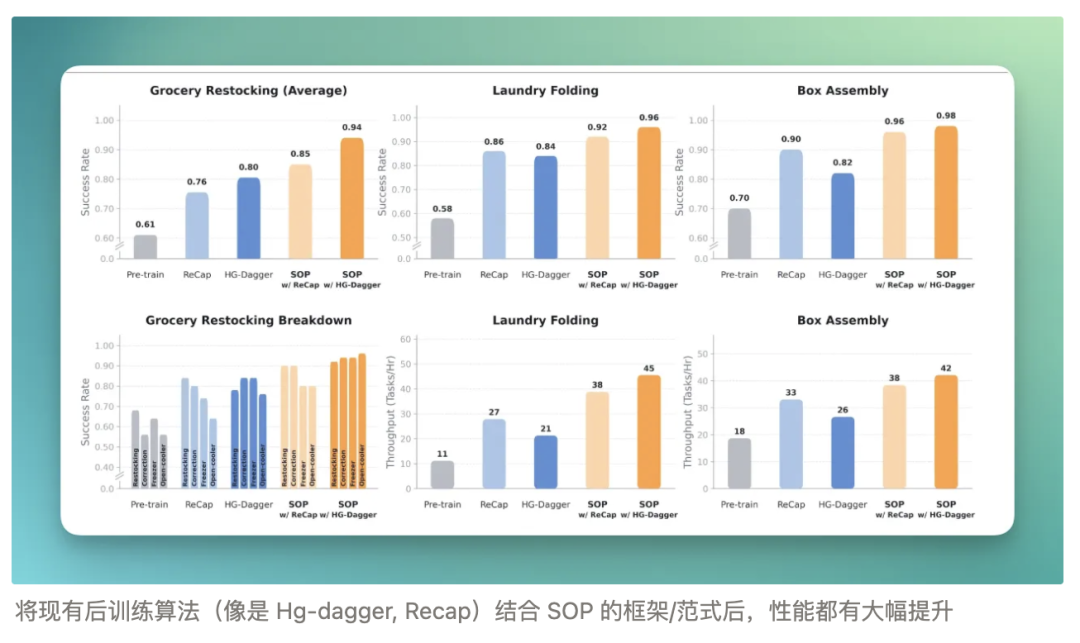
Overall, one of SOP's key values is that it changes how "robots" define "data."
In the past, only cleaned, specially collected data counted as "training data." Real-world data was often treated as noise, as interference.
Under the SOP architecture, real-world experience becomes an asset-izable training resource.
This actually parallels LLM development. After GPT-3, much of LLM progress was driven by RLHF (Reinforcement Learning from Human Feedback). Models weren't just "reading books" (pre-training); they were also observing how humans evaluated their responses (feedback).
At this point in time, the view that "pre-training is dead" has already been disproven by the Gemini 3 series, and OpenAI has also publicly acknowledged that pre-training remains important — but the importance of reinforcement learning is still a top priority.
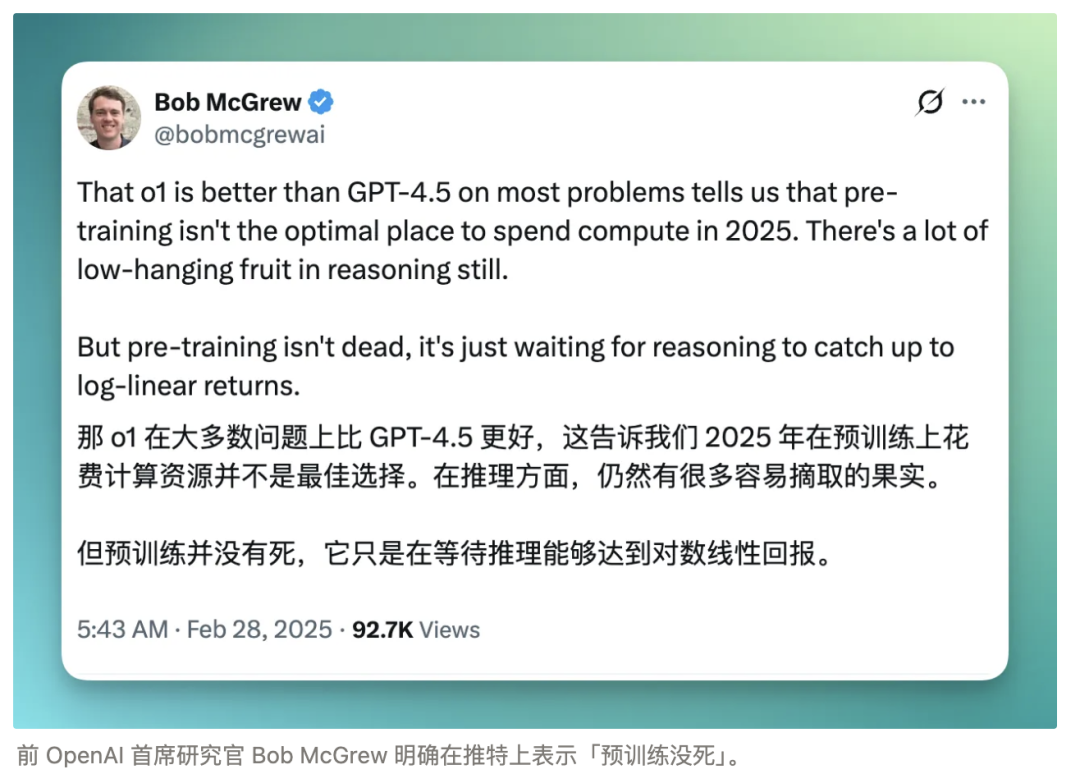
From a certain angle, SOP may be RLHF for robotics — RLHF based on physical-world feedback.
And something quite interesting emerges: negative feedback is no longer a bad thing.
Once the technology matures, every time a robot reaches and grasps at empty air, that may be a piece of negative feedback. Every time a robot completes a task but takes too long, that's an opportunity for optimization.
External "noise" may now become the "reinforcement learning fuel" for humanoid robots.
So, looking back at SOP now, things get quite interesting.
SOP will, to some extent, lower the barrier for humanoid robots to enter real environments (homes, offices, malls), because it supports "continuous evolution" on top of the "distribution foundation" of "specific robots."
Perhaps the true era of humanoid robots doesn't begin the moment they "stand up."
Rather, it begins the day they learn to keep learning in the real world.
For more technical details on SOP, we encourage you to click "Read Original" to check out the paper and blog.