MiniMax Puts Up $150,000 Bounty for a "Child"

Remix Marketplace is far ahead of the competition
Remix Marketplace Is Miles Ahead
👦🏻 Author: Jingshan
🥷 Editor: Koji
🧑🎨 Layout: NCon

In the AI Agent space, we've heard an interesting phrase floating around:
"Willing to Pay Top Dollar for 'Offspring'"
Here, "offspring" refers to templates that creative users have built with AI Agents, made available for others to copy and adapt.
The Crossing team recently took another deep dive into the Remix Marketplace module of the newly launched MiniMax Agent (released August 11).
This "Agent Market" operates on two core principles:
【1】When you remix someone else's work, you spend fewer credits to get your project off the ground;
【2】When your work gets remixed by others, you earn 100 credits in return.
Those credits represent real money — creators have a direct path to monetizing their output.
Twenty days ago, MiniMax Agent rolled out a major update enabling full-stack development, with integrated Stripe payments, Supabase databases, and more. Crossing published a detailed tutorial at the time — Seriously, This Actually Crushes OpenAI! | MiniMax Agent's First Major Update, 30 Days After Launch
MiniMax is now actively accelerating the shift "from features to tradeable productivity." They're hosting a global AI Agent challenge with $150,000 in total prizes, centered on the idea of "turning your Idea + Agent into productivity, into hard currency in the market." Remix is one of the officially recommended entry points. Event details at the end of this article.
🚥
Next, let's walk through 3 concrete examples of what Remix can actually do, break down MiniMax's ongoing $150,000 grand prize competition, and show how you can participate through original builds + remixing.
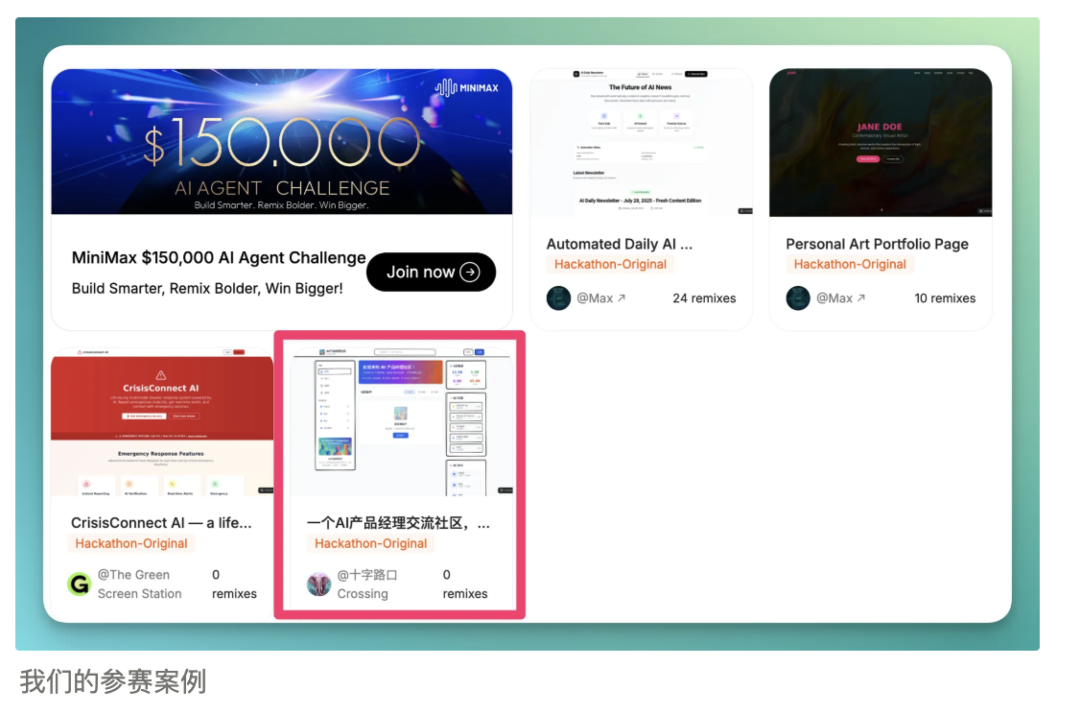
The article also includes our own "AI Product Manager Community" project, already published to the Gallery for anyone to remix!
How to Approach Agents: Remix Marketplace
Why Do I Need Remix Marketplace?
In this 2025 Year of the Agent, we've already stress-tested a huge number of excellent AI Agent products. Through that process, I've personally run into two recurring pain points in daily use:
【1】The cold-start chain is too long:
We're constantly seeing impressive, polished builds on X from people using tools like Bolt.new, but we can't "replicate" them. Same with MiniMax Agent earlier — you had to build your Agent from scratch, and when time was short, you could only cobble together something barely "functional."
【2】Cost constraints:
Practical Agents like MiniMax Agent burn through credits at a non-trivial rate. Lots of ideas, limited credits, need to "fail cheap" — and finished work had no way to circulate.
That's why the Remix Marketplace feature hit so different for me:
You can take someone else's finished product and "remix it cheap, ship it quality" instead of reinventing the wheel every single time.
Below, we remixed 3 real-world cases to show just how good Remix is.
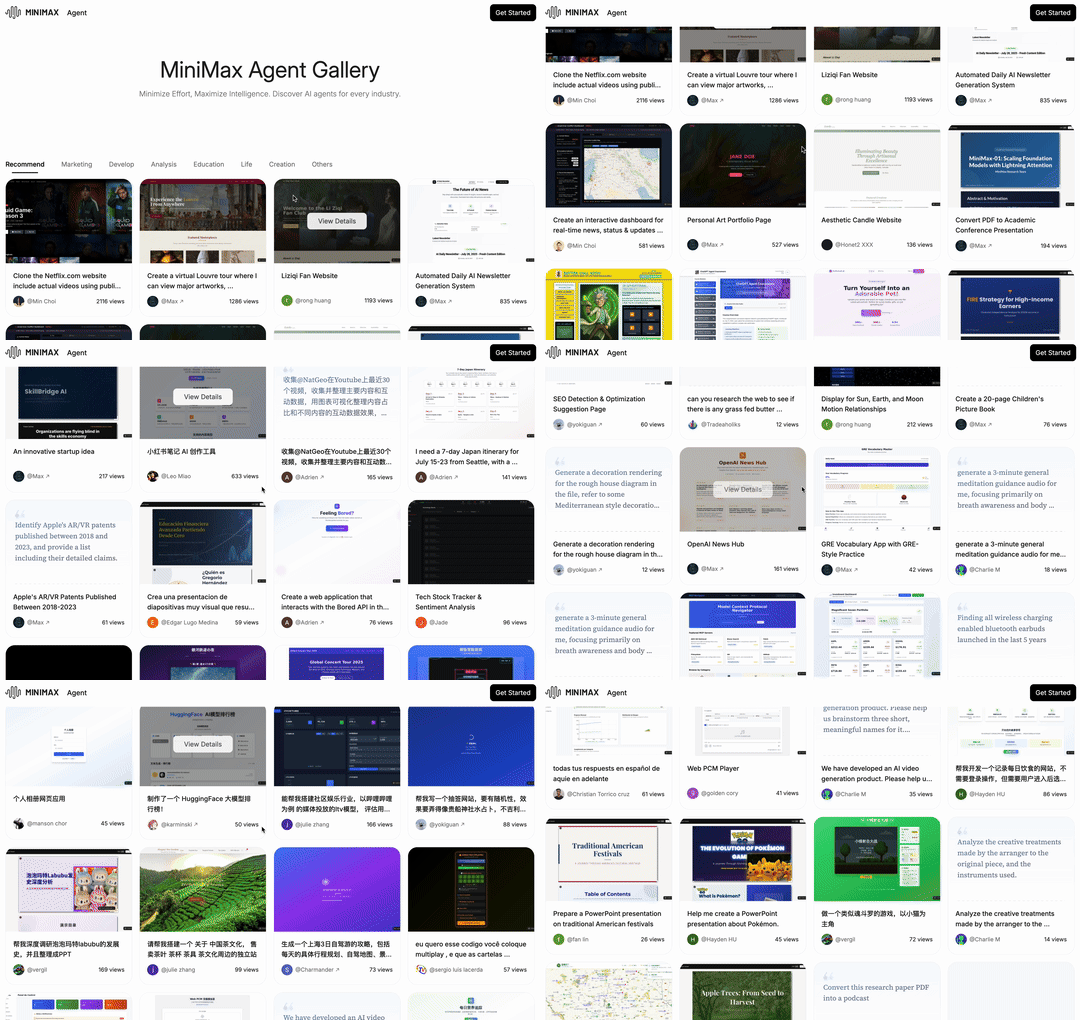
Using Remix is simple: on any project cover in the "Agent Market," you'll find the Remix button. You can also browse the Gallery for more polished projects from published builders:
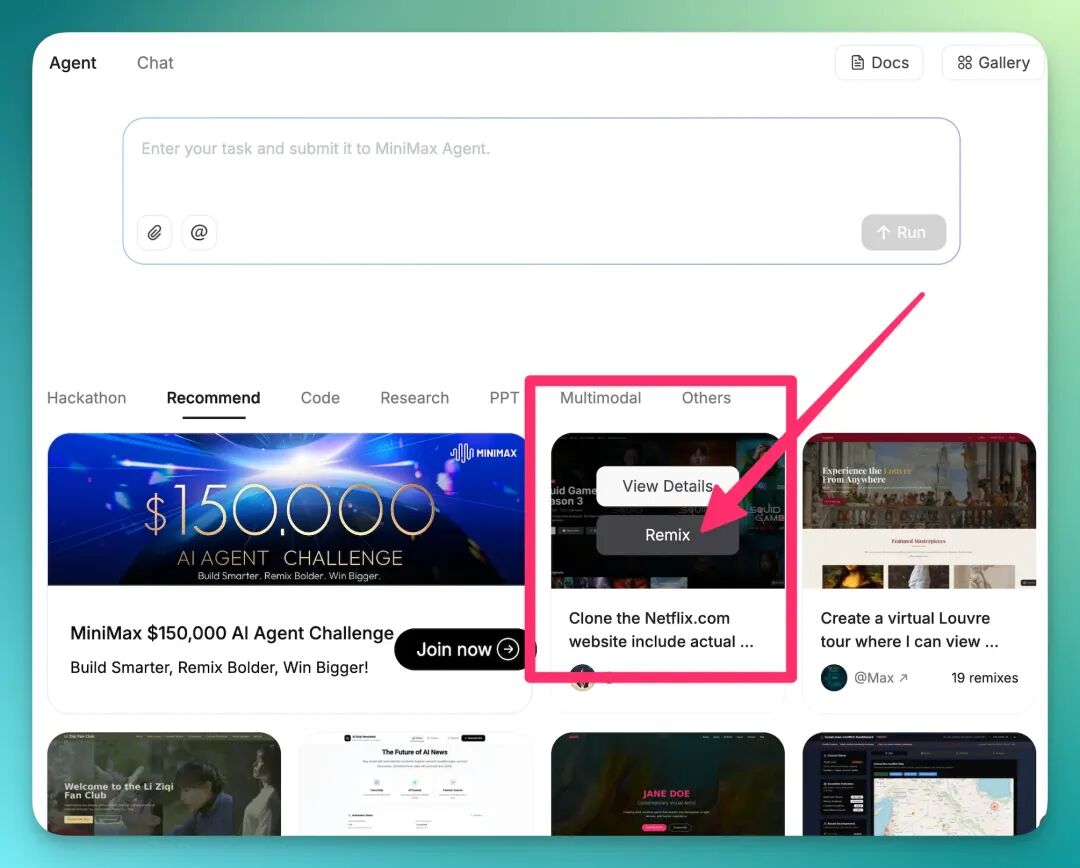
And it's only been a few months — the Gallery is already packed with creative work. You can really see people's imagination at play:
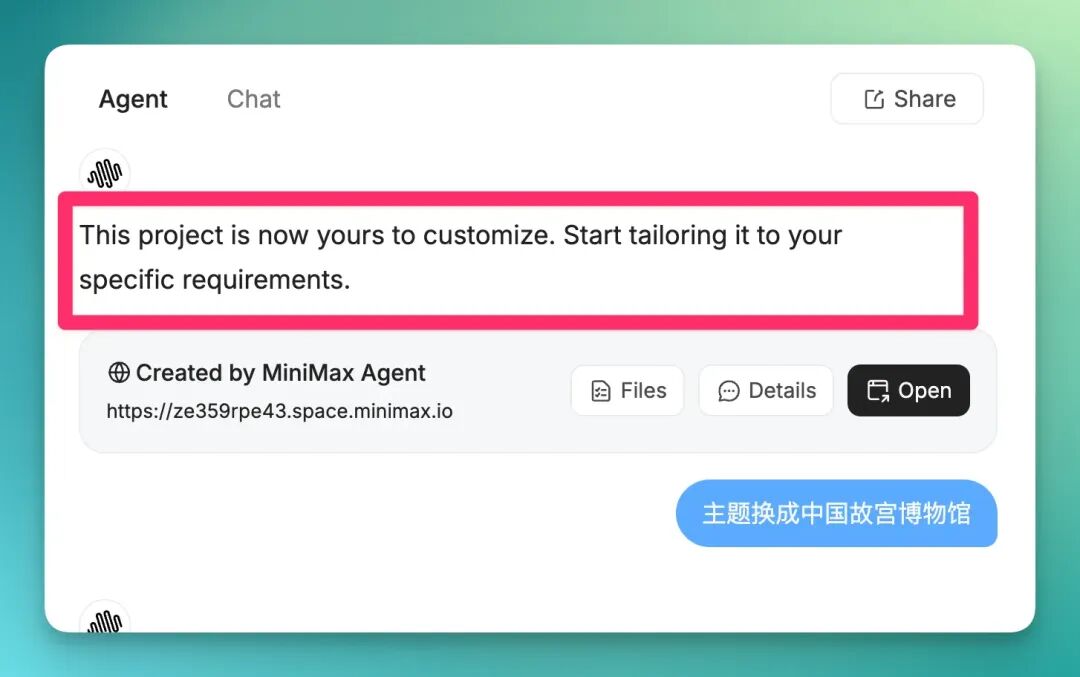
When you click Remix, MiniMax Agent helpfully tells you: "This project is yours now — change whatever you want!"
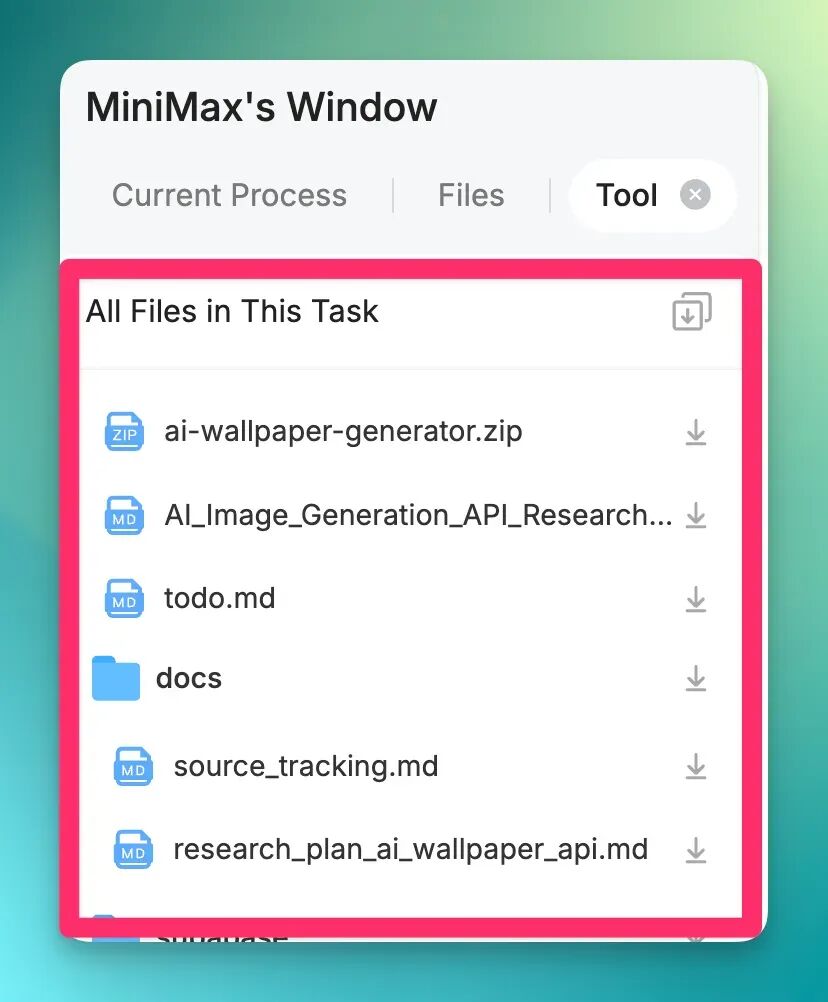
Plus, all files, code, and configurations from the original project are viewable and editable. But when I checked the files, I noticed sensitive data like API Keys had already been scrubbed.
This transparency makes the whole "renovation" process clear and controllable:
1) Productivity: AI Wallpaper Generator → Ghibli-Style AI Video Generator
Browsing the Gallery, I got drawn to an AI wallpaper generator made by @shengli chang.
The app's standout feature was its rich creative inspiration options, with AI generating images in specific styles:
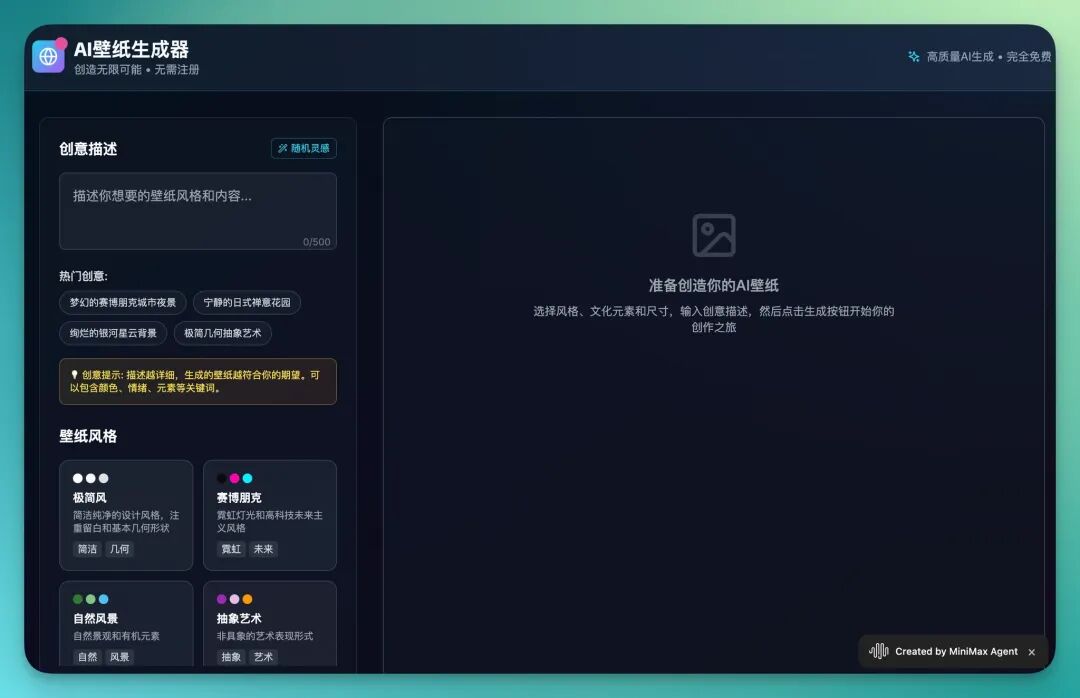
The whole project was polished, user-friendly, and feature-complete:
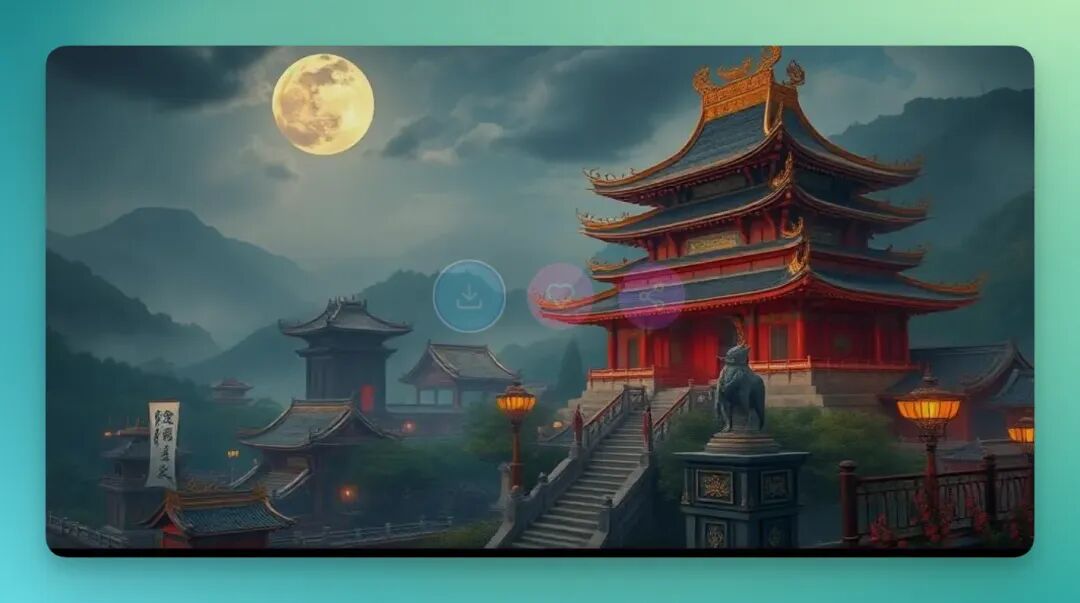
But what I wanted wasn't a wallpaper generator — it was a short video generation tool, with a completely different aesthetic.
Building from zero, just designing the interface and functional logic would eat up serious time.
Remixing directly on top of the original author's work, the prompt can be dead simple:
Change the overall style to Ghibli, switch from AI wallpaper generator to AI video generator, full-stack front-to-back, with the backend model plugged into XX's API.
API docs:
API ID:
API Key:
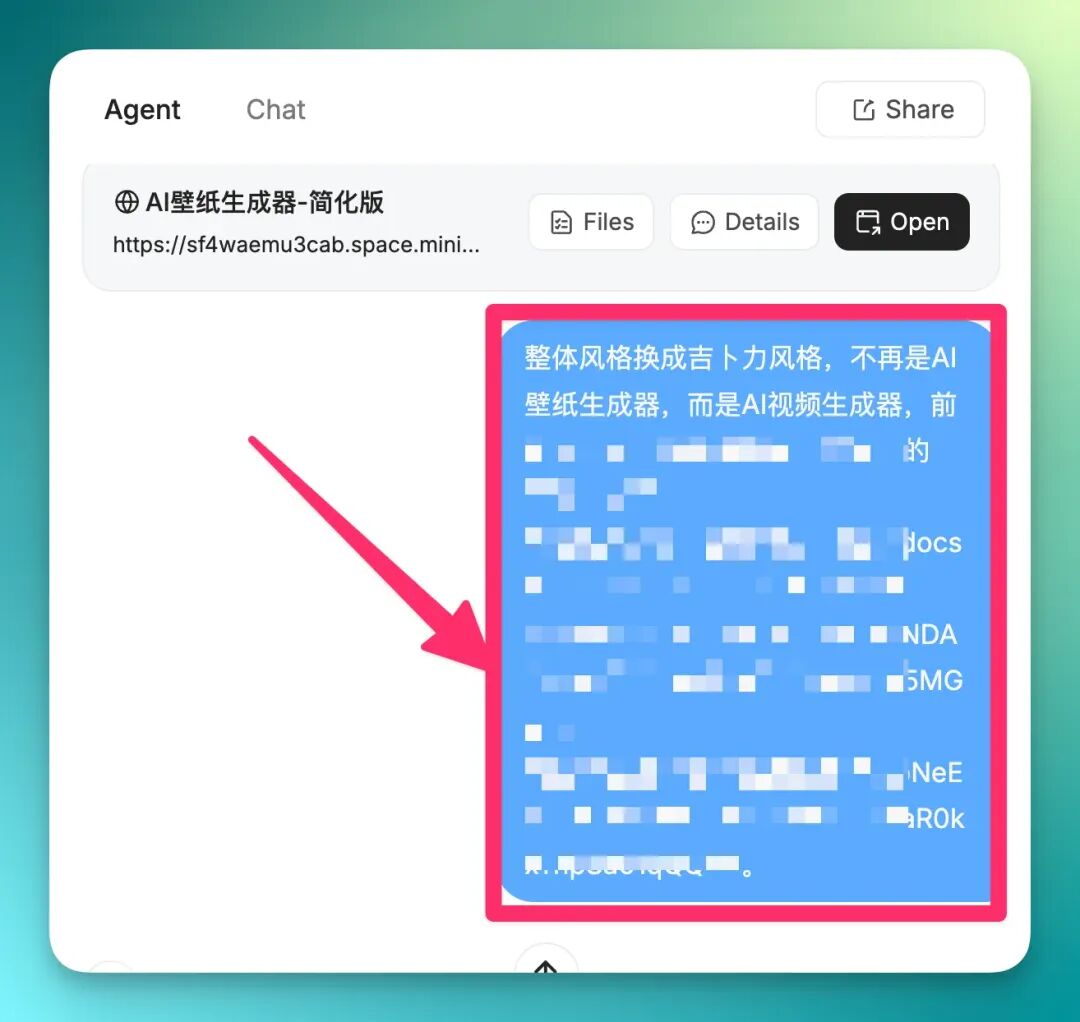
This time, using Remix, MiniMax Agent's reuse flow proved noticeably more streamlined than "hand-crafting from 0 to 1."
First, it identifies and preserves the original project's core design logic (like the inspiration prompt feature), then swaps out images, generates relevant code, wires up the video generation model's API, and finally redesigns the frontend interface.
Most importantly, it doesn't "accidentally" delete the original author's key functional design concepts:
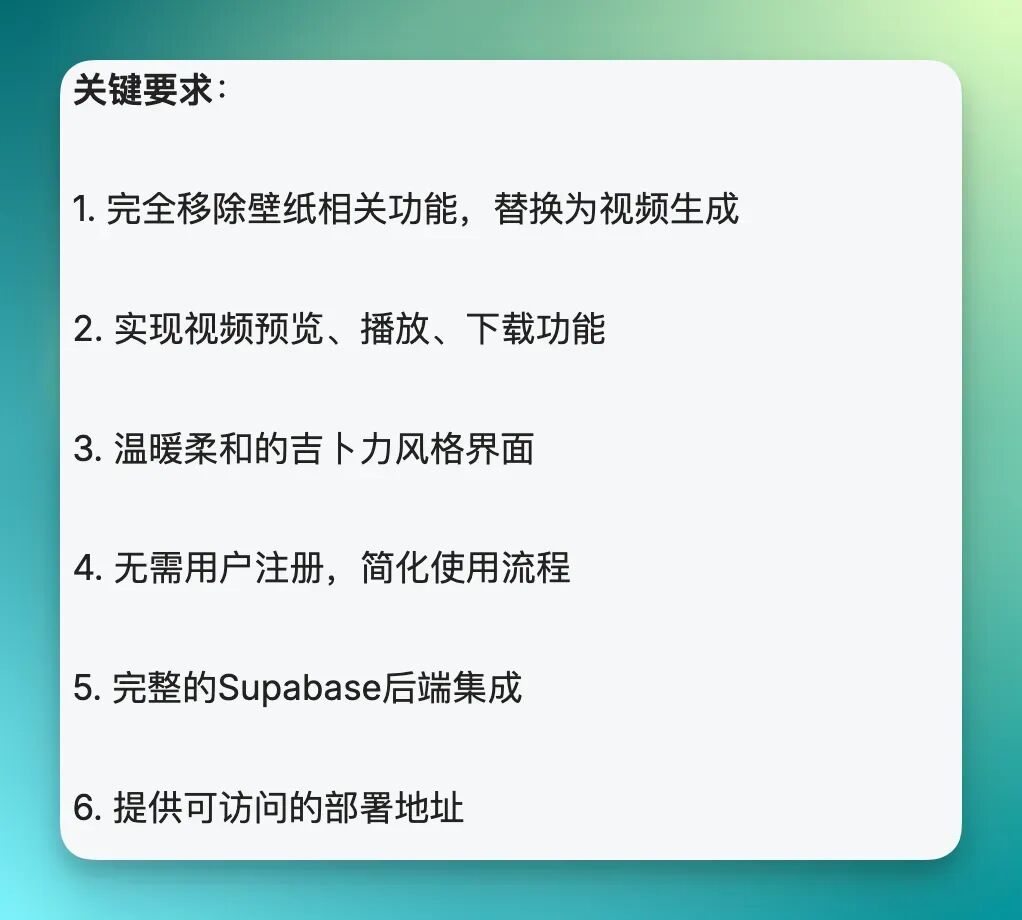
In basically no time, the entire project's theme, functionality, frontend UI, and even some database elements were completely swapped out.
And this time, MiniMax Agent burned through remarkably few credits!
Building a complete project like this from scratch would cost 3,000–5,000 credits — anyone who's used it knows that's not cheap. Through Remix, checking my dashboard, I spent roughly 500–1,000 credits.
Here's how the remixed version turned out:
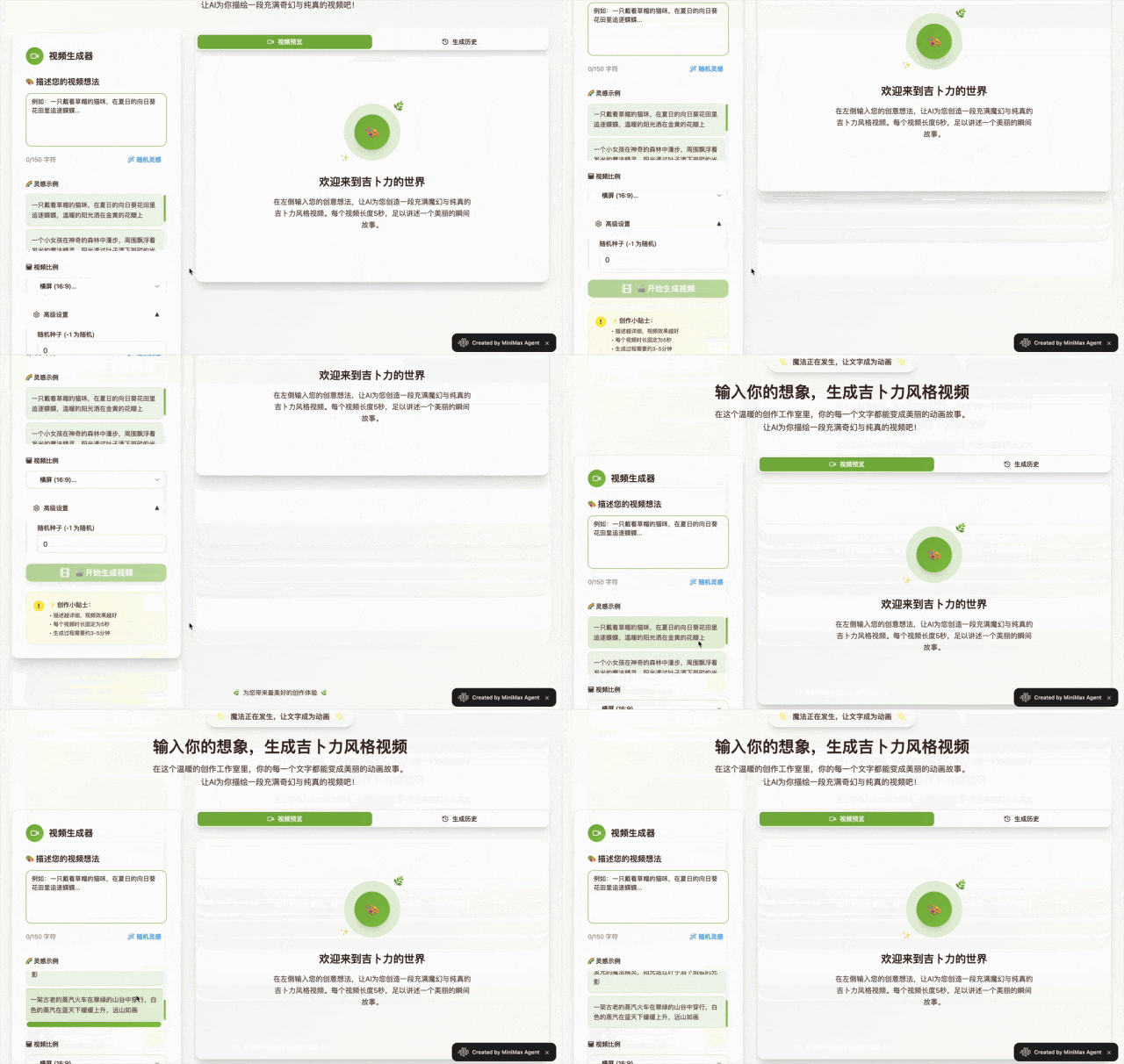
As you can see, the core features of the original "AI Wallpaper Generator" were all inherited by the new "Ghibli AI Video Generator."
The entire interface also shifted from a modern, minimalist aesthetic to a warm, healing Ghibli style:
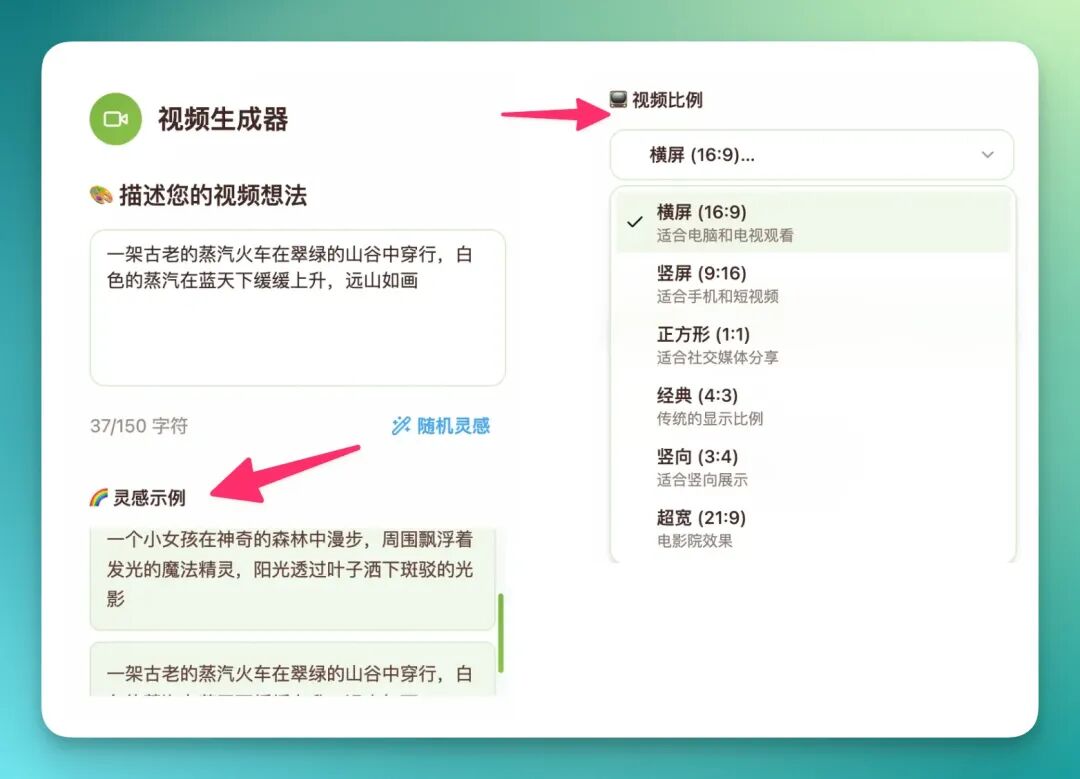
Let's use the auto-generated inspiration to see how the full workflow performs in practice:

2) Full E-commerce Site: Chinese Tea Store → Chanel, Dior, HR Website
By comparison, I think the biggest change in the Ghibli AI Video Generator was its functionality and theme. The Remix wasn't particularly complex, and it didn't fully stretch MiniMax Agent's full-stack development capabilities.
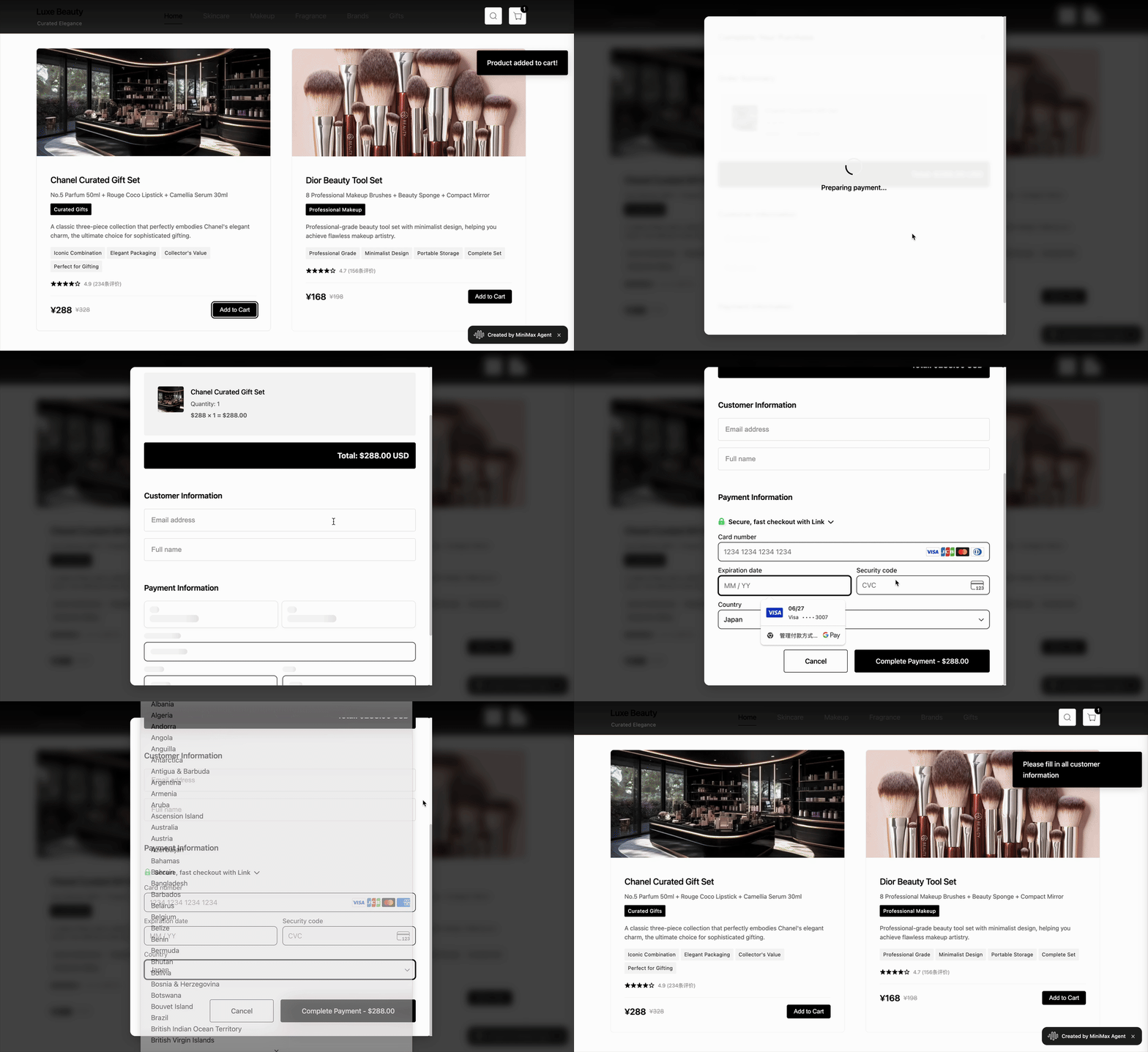
Next, let's try a more complex case: a "Chanel, Dior, HR online shopping website" with a complete backend and Stripe payment integration.
This cosmetics site was built using full-stack development, and the Remix process involved more complex brand database retrieval and research.
The original work was a "Chinese tea culture independent store" by @julie zhang, selling tea leaves, teacups, tea sets, and tea culture accessories. The overall layout was minimalist, but the functionality was already quite complete:
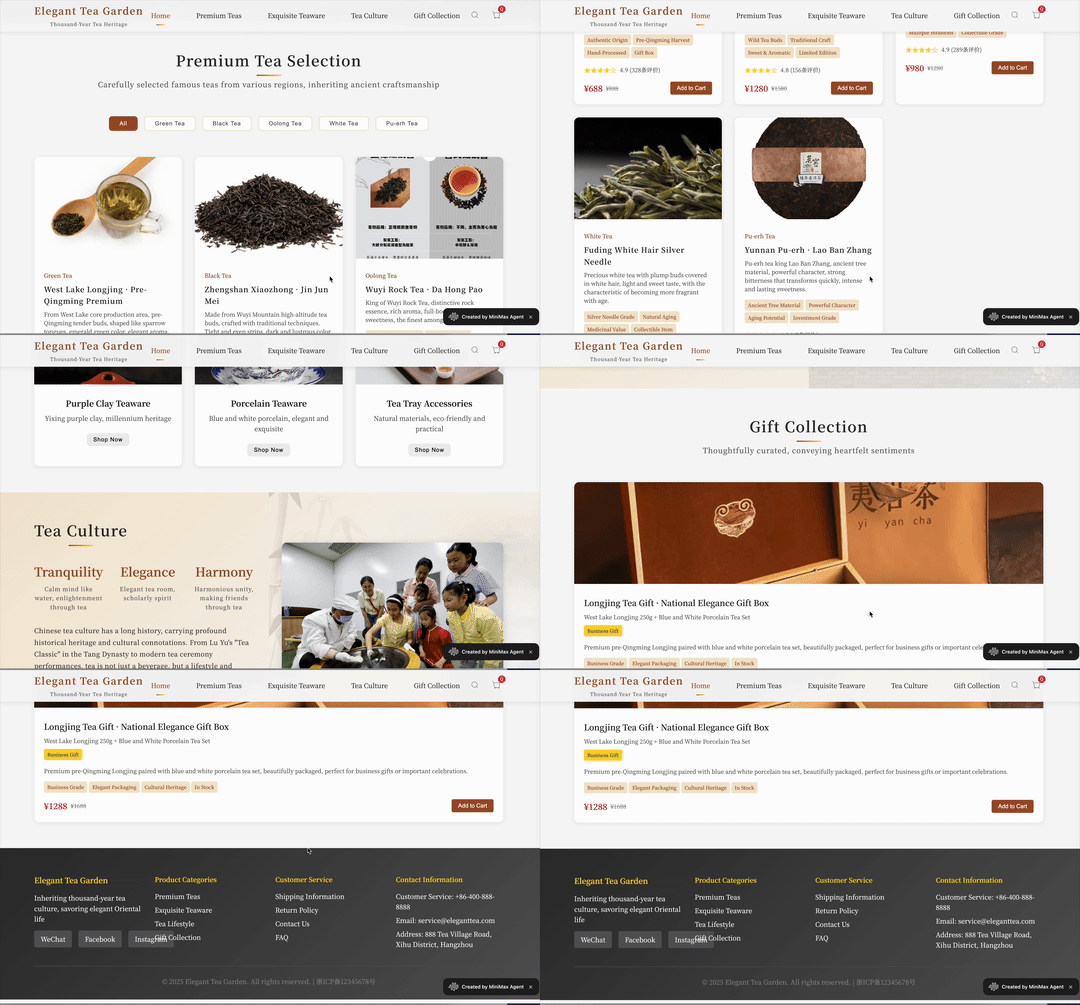
This project's complexity exceeds the previous case. It includes data display, category filtering, detail pages, and other functional modules.
At this point, because MiniMax Agent combines deep research capabilities with its own planning abilities so effectively, the Remix feature's power to repurpose complex works really shines.
For example, I told it:
Change the theme (selling tea) to theme (selling Chanel, Dior, HR cosmetics)
The prompt really was just this short:
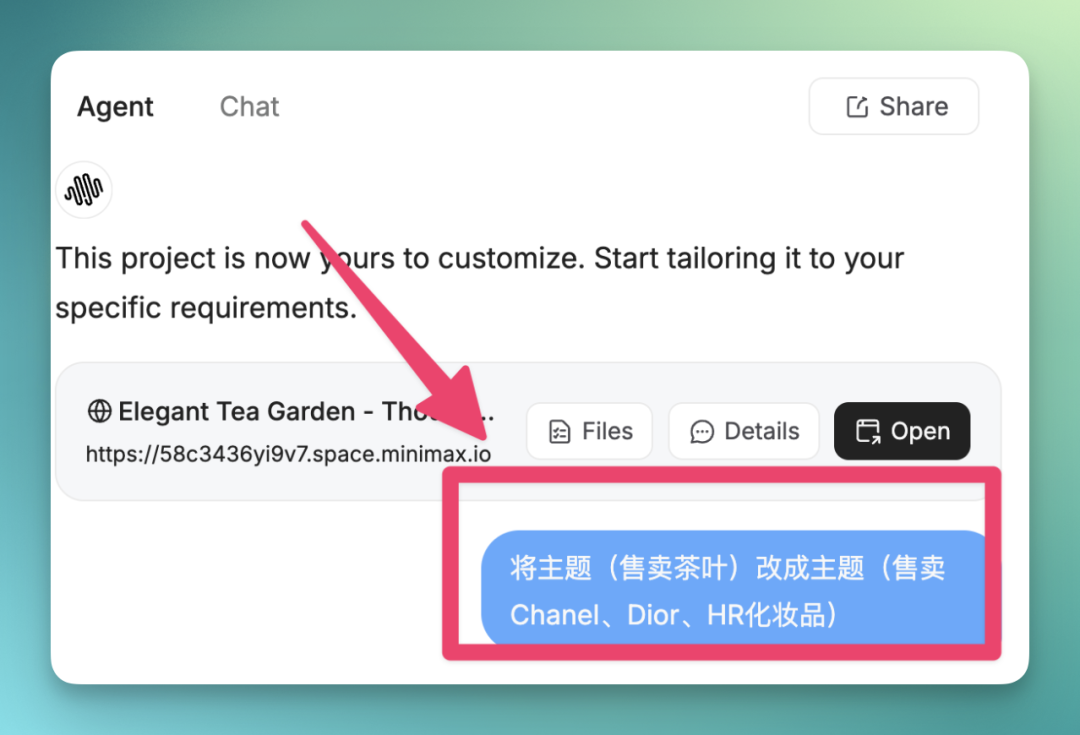
First it deeply searched for "information on the three cosmetics brands," then went back to query the relevant files for the "Chinese tea" project, then autonomously planned multiple steps and modified them one by one.
The workflow flowed seamlessly:
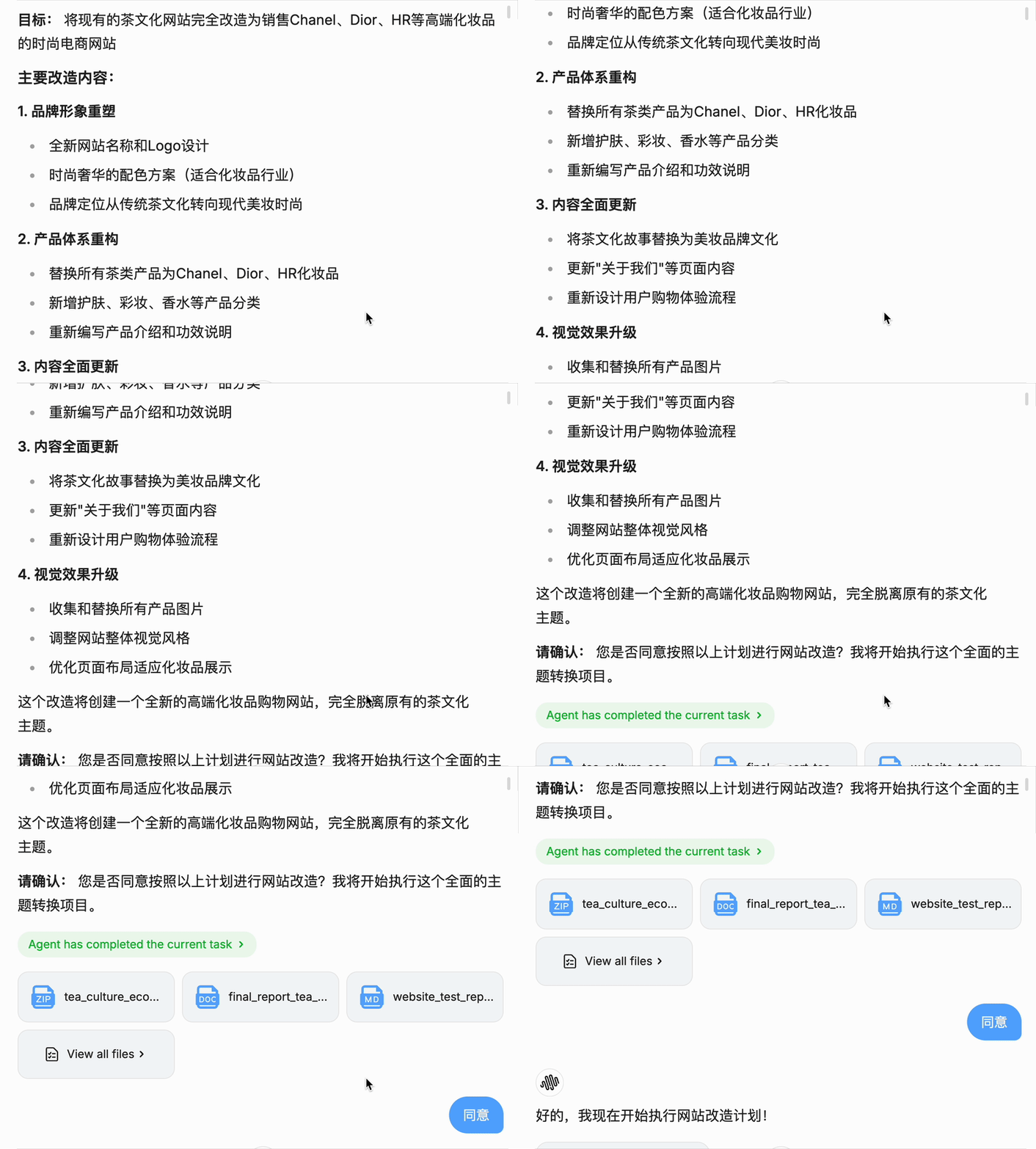
Let's look directly at the results. Where Chinese tea accessories were originally displayed, cosmetics now appear. All layouts and interaction logic are preserved, but the content has been completely transformed into a minimalist cosmetics theme:
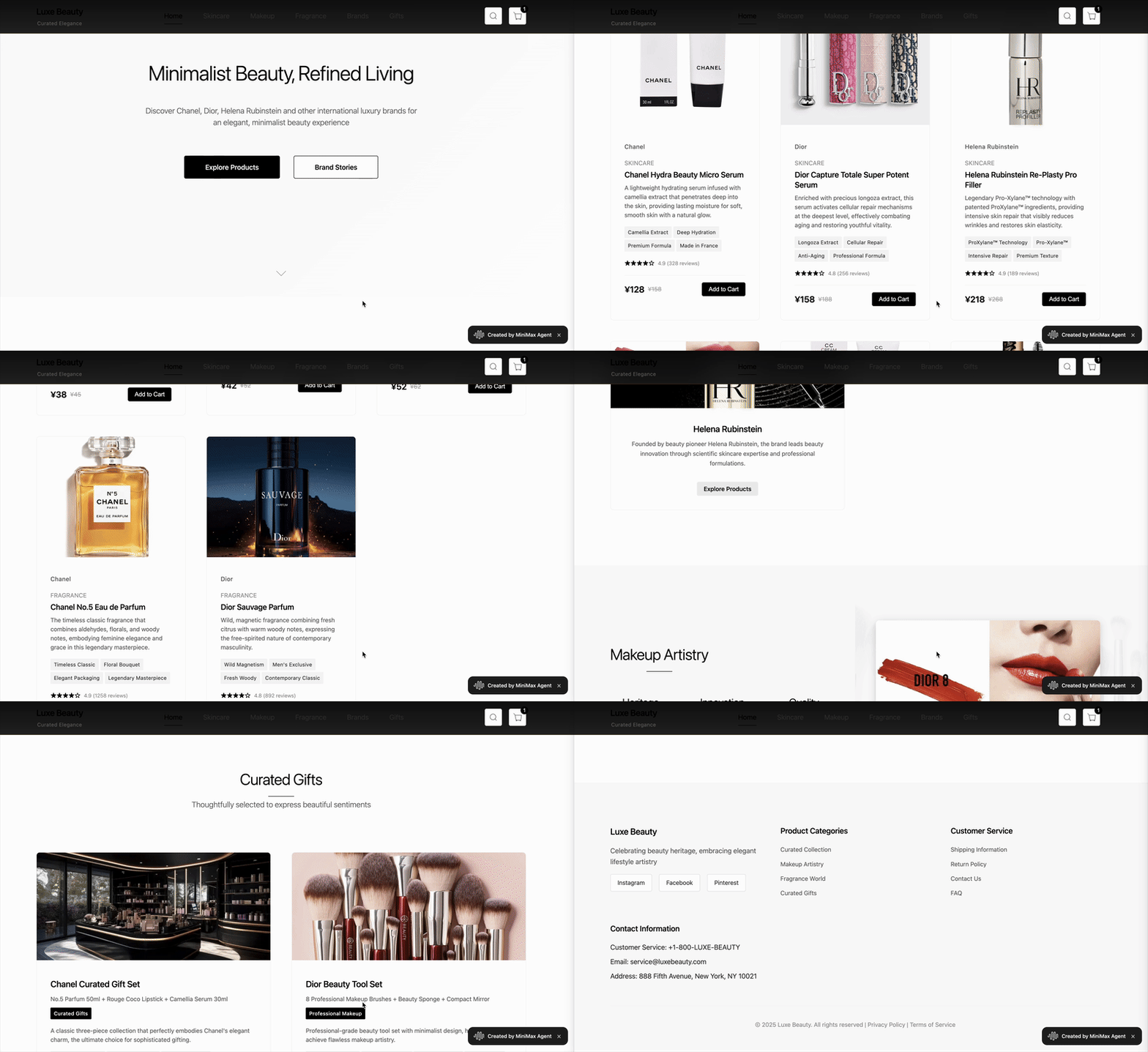
The useful thing about MiniMax Agent's Remix is that it doesn't simply replace text. It truly understands what data, code, and files need to be precisely swapped or modified between the two themes.
Afterward, we can have it integrate frontend and backend, adding real Stripe payment capabilities. Let me demonstrate:
3) Content Replacement: Virtual Louvre → Virtual Forbidden City
Finally, let's look at a classic project in MiniMax Agent: the "Virtual Louvre Tour" created by @Max. The entire design is classic and refined, providing an online museum experience with 3D displays, audio guides, and more.
Honestly, I had previously tried to recreate this project using almost identical prompts, but could barely achieve such good design sense. The original project's design quality and attention to detail simply can't be matched through simple imitation.
But this Remix feature largely reduces that hassle and time consumption.
I converted the entire project to a "Chinese Palace Museum" theme with just a few words in the prompt:
Change theme to Chinese Palace Museum
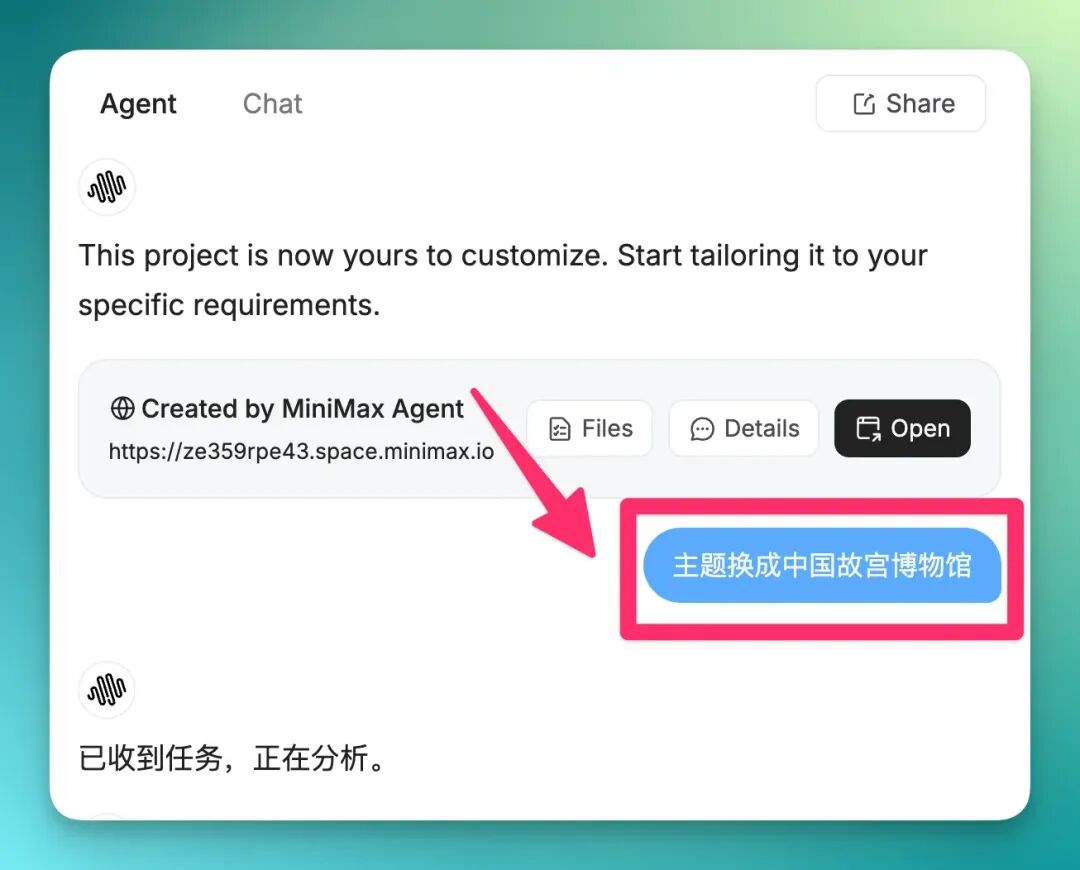
MiniMax Agent automatically began searching for the Palace Museum's treasured collection: bronze ware, porcelain, and masterpieces of calligraphy and painting.
It not only replaced the exhibit information but also adjusted the overall visual style. The original European classical style was transformed into traditional Chinese aesthetics: deep red hero images, typography, layout, and more.
Here's the finished result:
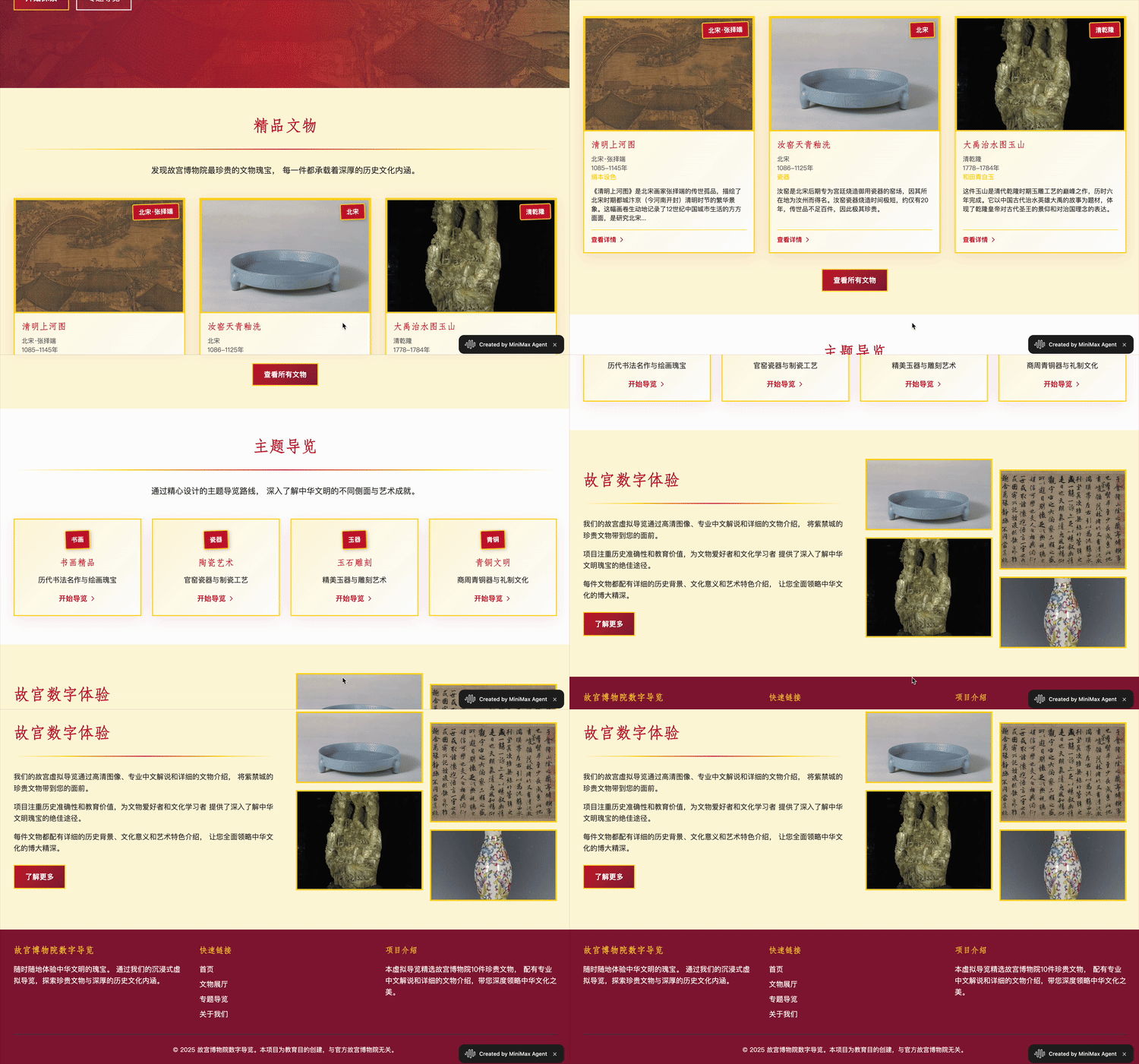
The original "Virtual Louvre" project was quite feature-complete. For example, each artwork had corresponding audio commentary and various informational guides.
Similarly, in the new "Virtual Forbidden City" project, all the original features are preserved. I recorded a video so you can see the project's overall completeness — every artifact comes with professional Chinese audio narration.
For pieces like the "Jade Mountain Illustrating the Great Yu Controlling the Waters" and "Along the River During the Qingming Festival," the audio guides, artifact details, and collection locations are all accurately inserted with multimodal information:
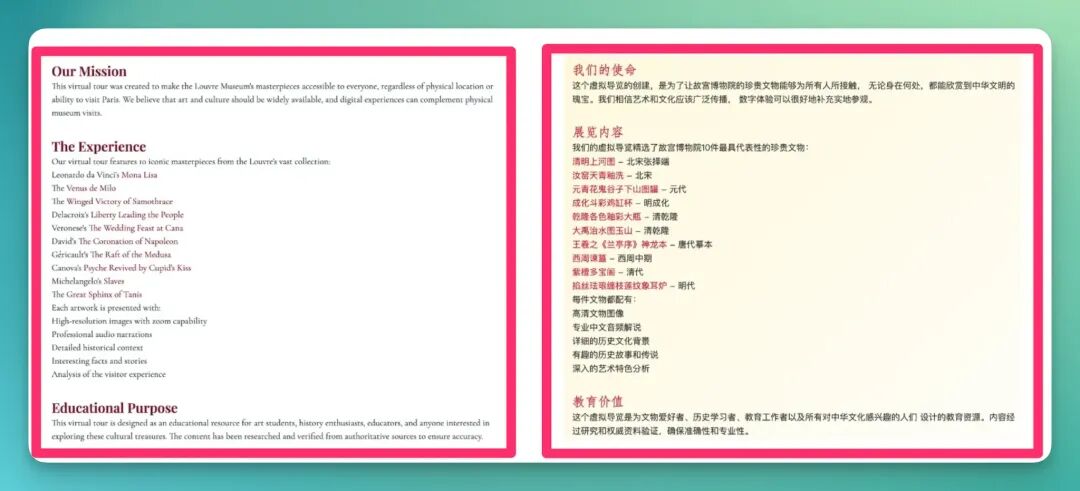
Finally, let's compare the "About Us" modules between "Virtual Louvre" and "Virtual Forbidden City."
Compared to the original, the "Virtual Forbidden City" CSS rendering is actually even better:
How to Pick Good Remix Candidates
Through these three Remix examples, it's clear that Remix isn't "zero cost," but it clearly drives down the "starting barrier" and "trial-and-error cost."
From this experience, we've summarized several "clues" for judging whether something is "worth Remixing, and easy to Remix."
Works worth Remixing:
[1] Clear, complete functional modules (easy to understand and modify, letting you change things with a brief prompt)
[2] Highly distinctive design style (saves massive amounts of frontend UI rework time)
[3] Clear application scenario (easy to migrate to other domains, with low probability of Agent hallucination during the process)
This way, MiniMax Agent can use its "highly precise" capabilities to change the entire work's theme without disrupting the original's "functional logic."
But overly simple single-function apps are better built from scratch.
For people with customized project needs who lack good prompts, Remix is genuinely useful.
How to Create Remixable Cases That Others Will Use
The Remix Marketplace is actually a win-win ecosystem.
Those who Remix others' works can build "good" Agents more efficiently;
And authors who get Remixed also receive "credit rewards" of 100 credits each time. Every well-made work can become someone else's starting point, bringing you a steady stream of credit income. We calculated MiniMax Agent's subscription fees — if you were to "buy additional credits," 100 credits is worth approximately $0.78 USD.
This mechanism does seem genuinely "creative and sincere" compared to traditional Agents.
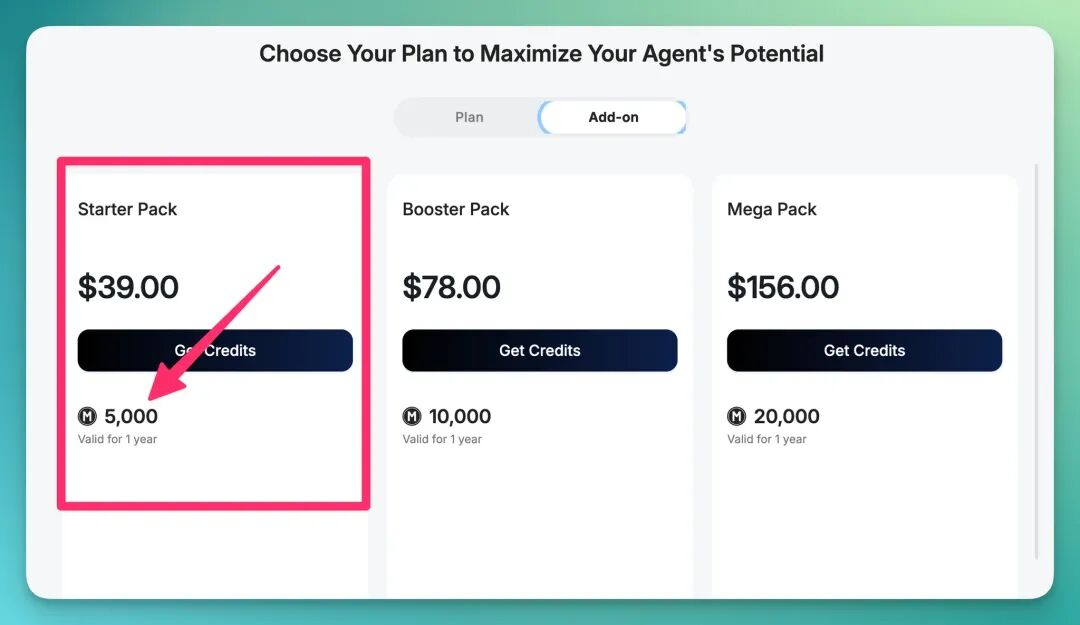
We've Remixed multiple beautiful, fun works, sending our credits to many original creators.
So, how do you create good cases that others will easily Remix?
We've summarized two points:
[1] Treat the Agent as a real "product" — it needs to create real value for "consumers";
[2] Stronger generality and broader generalizability — finding the classic scenarios in the Agent market.
The underlying logic of the Remix Marketplace is to multiply "useful" productivity. With social media traffic and points-based rewards adding transactional muscle, it treats Agents as products to be "sold."
So points function more like a "technical currency." Only Agents that have been refined through multiple rounds of Vibe Coding and can meet vertical-scenario demands qualify as "good Agents."
We Joined This Global Agent Challenge Too
For this Remix launch, MiniMax Agent put up a "$150K Global Challenge" specifically to drum up momentum for their Agent platform — and we signed up.
One distinctive thing about this competition — it encourages original works built from scratch, while also supporting direct replication and adaptation of usable projects into other scenarios, enabling productivity to multiply.

The core philosophy:
Build Smarter, Remix Bolder, Win Bigger
Here's what we gathered about the event. The timeline is tight — just two weeks: starts August 11, submissions due August 25, results on September 1. The barrier to entry is low: as long as you use MiniMax Agent to build something, whether original or Remix, you're in.
We visualized the prize breakdown:
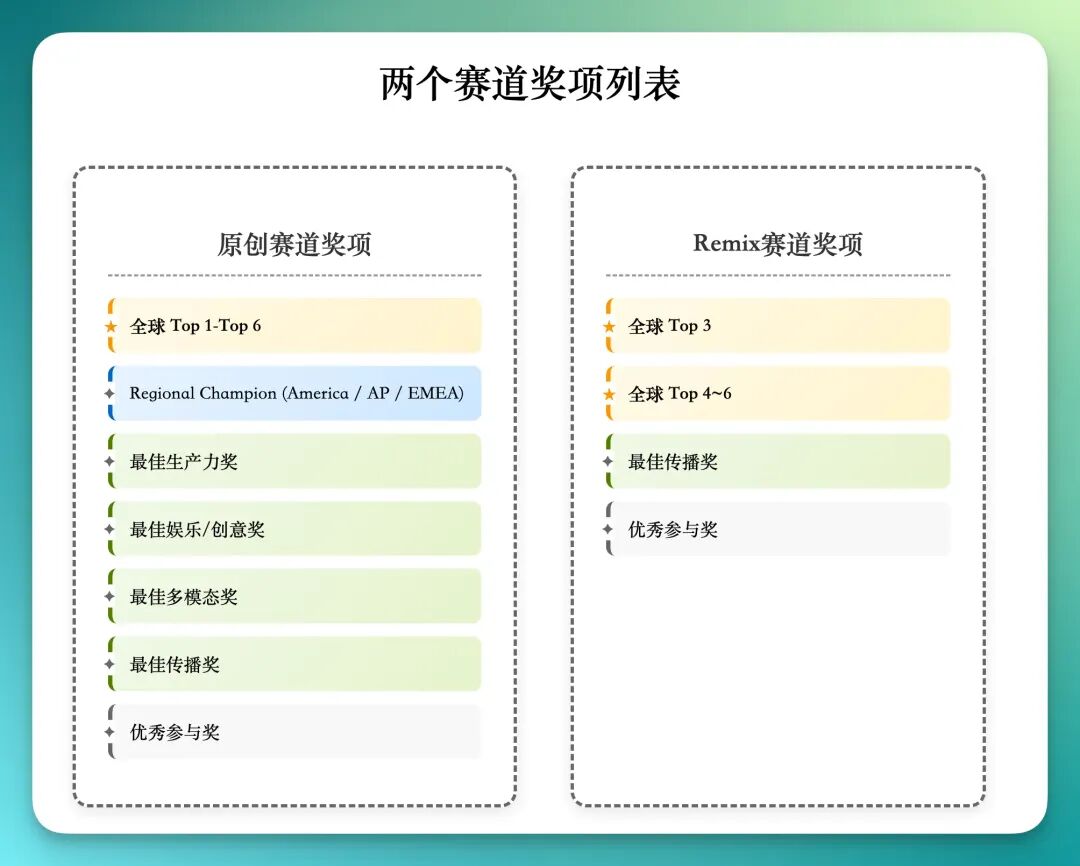
The prize pool for original works is larger than for Remix works. In the original track, the global #1 takes home $30,000, with runner-up and third place getting $20,000 and $10,000 respectively. Even 4th through 6th place receive $3,000 to $5,000. The total $150,000 pool is genuinely substantial.
And the odds are fairly generous across the board — we did some quick math, and there are over 180 winning slots total. Alongside the headline $30,000 prize, there are "inclusive awards" and various "innovation breakthrough" categories. The "Excellence Participation Award" alone has 80 slots across both tracks.
For full details, check the MiniMax Agent hackathon page (PS: this event page was itself built with MiniMax Agent in one day):
https://minimax-agent-hackathon.space.minimax.io
The competition will end, but making "reuse + fine-tuning" a habit will make every Agent project you tackle afterward lighter.
Our Entry — An AI Product Manager Community
We hand-built another "rough but fun project" with MiniMax Agent — an AI product manager community.
Our prompt:
Build me an AI product manager community with sections covering (AI hardware, foundation models, AI products, etc.); use a unified low-poly modeling style for all cover images — flat folded angles, color blocks suggesting volume, game-like visual feel. AI-generated. Overall layout reference: https://www.reddit.com/
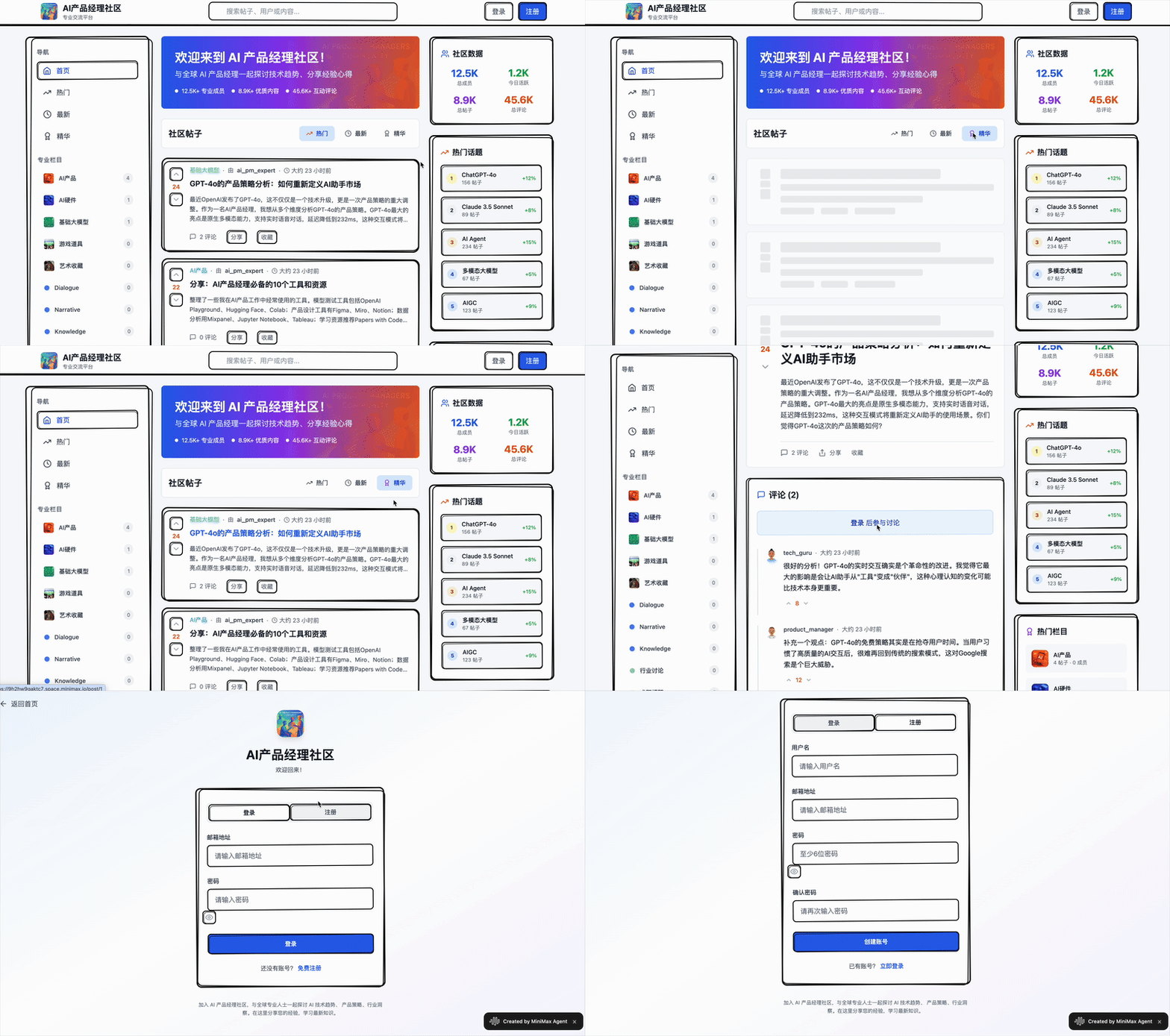
What can this community do?
Let me walk through the features.
The whole thing connects to Supabase with a complete user system: registration, login, profile center; user data management (avatar, bio, location, etc.); an experience points (karma) system.
The community requires login, and only logged-in users can post.
The nav bar is still pretty barebones, but covers the basics: "Hot," "New," "Top":
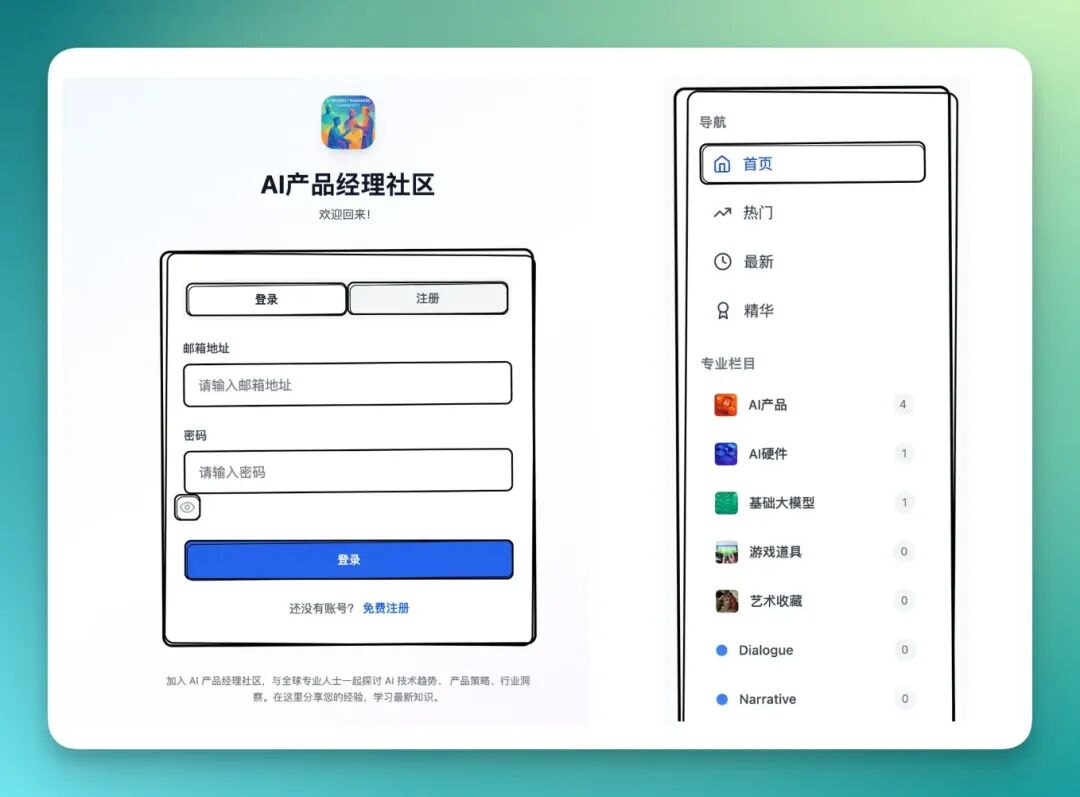
Once inside, you see trending topics, community stats, popular sections, community activity, and more:
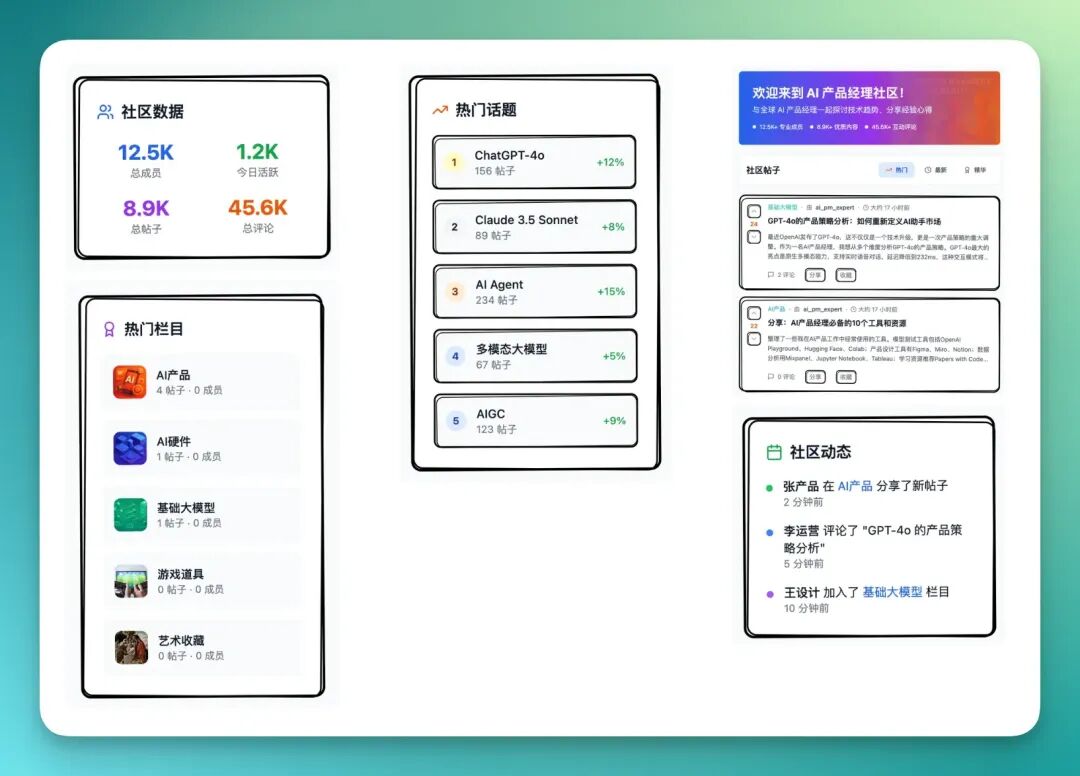
Visual Style The overall aesthetic:
[1] All functional modules use black-and-white wireframe borders, doodle-like hand-drawn effects, and simple bold-line design.
[2] All cover images use: low-poly modeling style, flat folded angles, color blocks suggesting volume, game-like visual feel.
How to Share? How to Enter the Challenge?
Once your project is complete, to enter the MiniMax Agent Global Challenge: first publish it to Gallery, then submit via the official site.
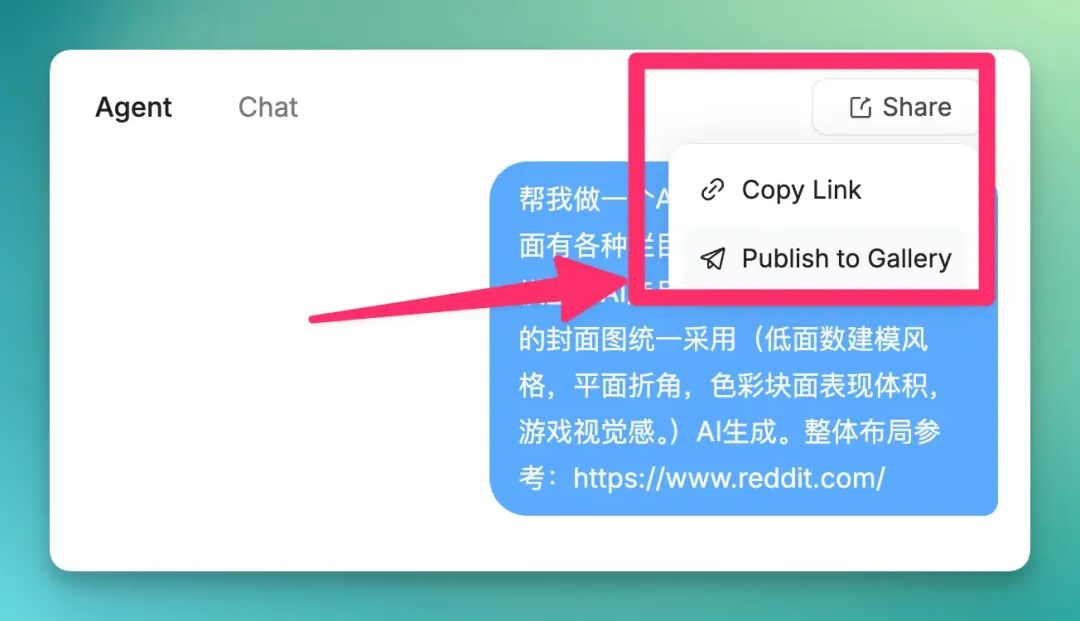
Click "Share" in the upper right to push it to Gallery:
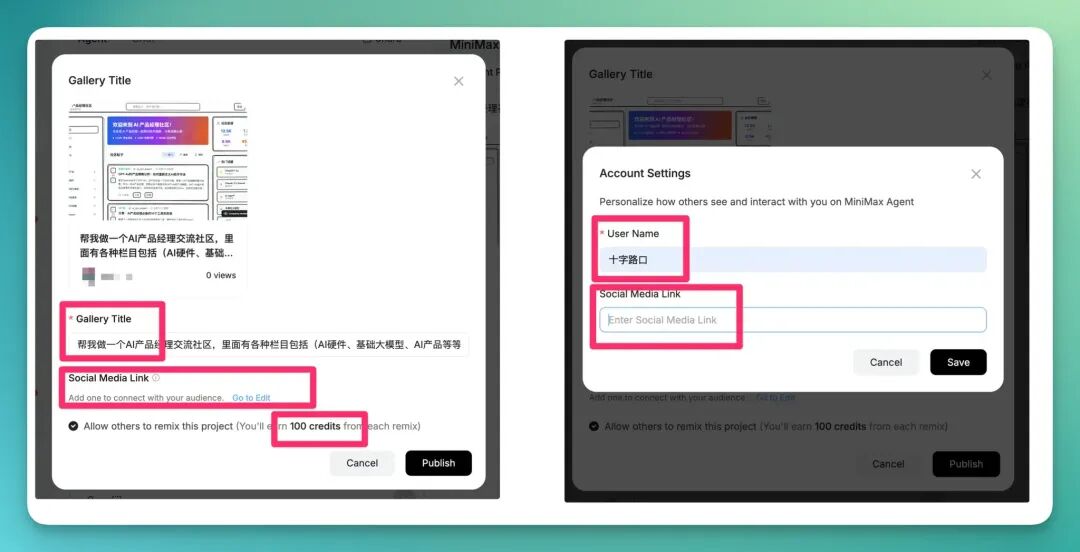
There's a thoughtful touch during publishing: you can add your social media handles (like X/Twitter), so other users can follow you directly from your work.
This gives every creator a platform to showcase themselves.
Plus, every time a user Remixes your work, you earn 100 points (so please, Remix ours generously~):
We call this "AI Product Manager Community" a "rough work" because there's still plenty of room for improvement. But that's exactly the magic of Remix — it doesn't need to be perfect, just a good starting point.
Once published, head to the official site to submit.
Click "Submit" in the upper right:
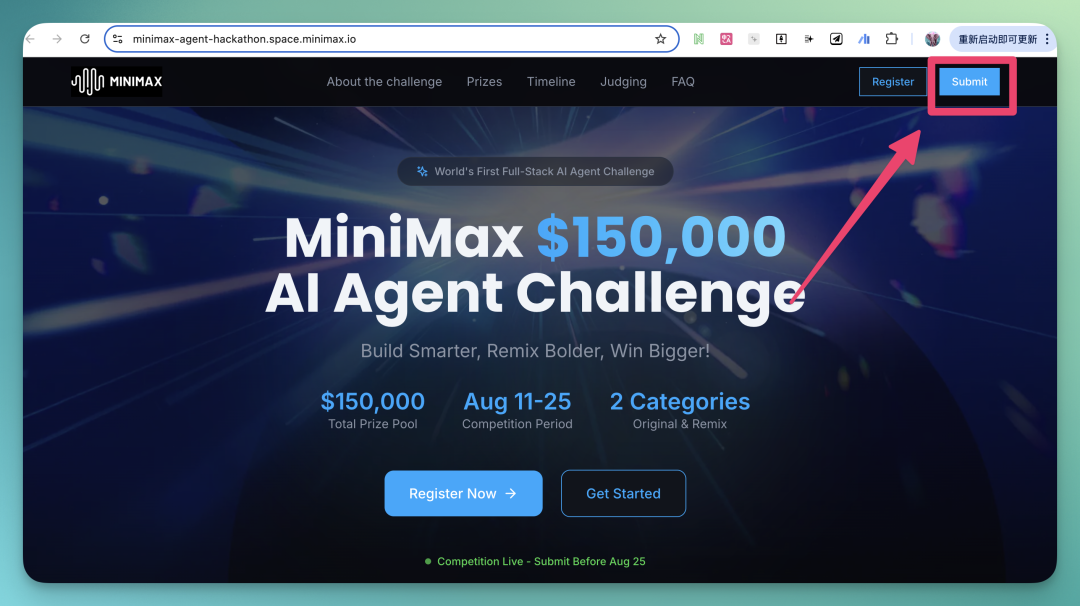
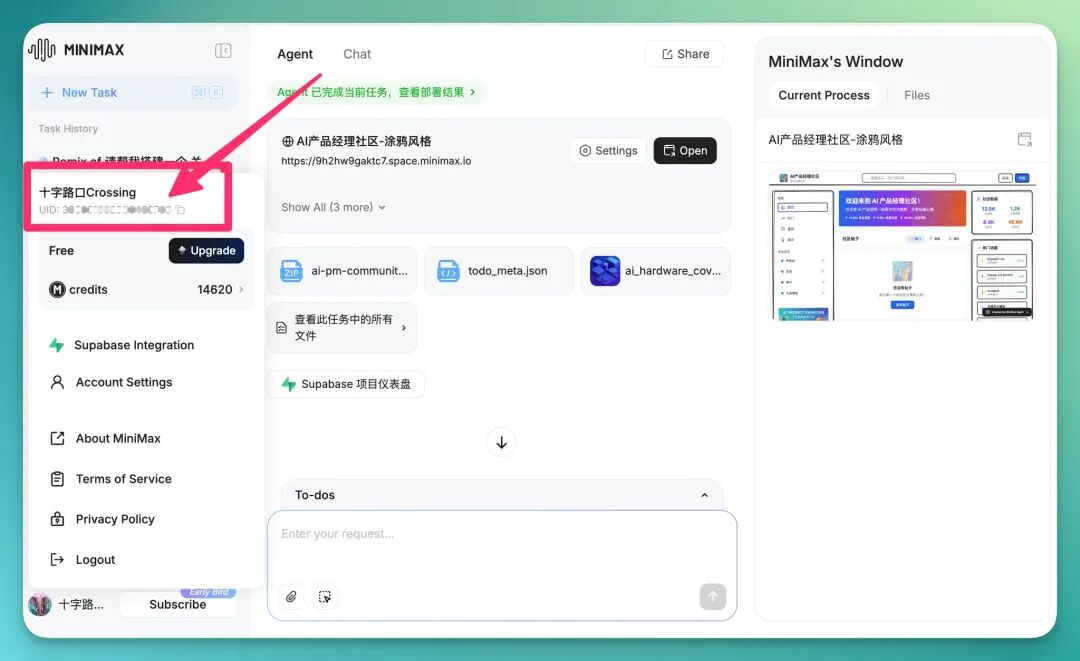
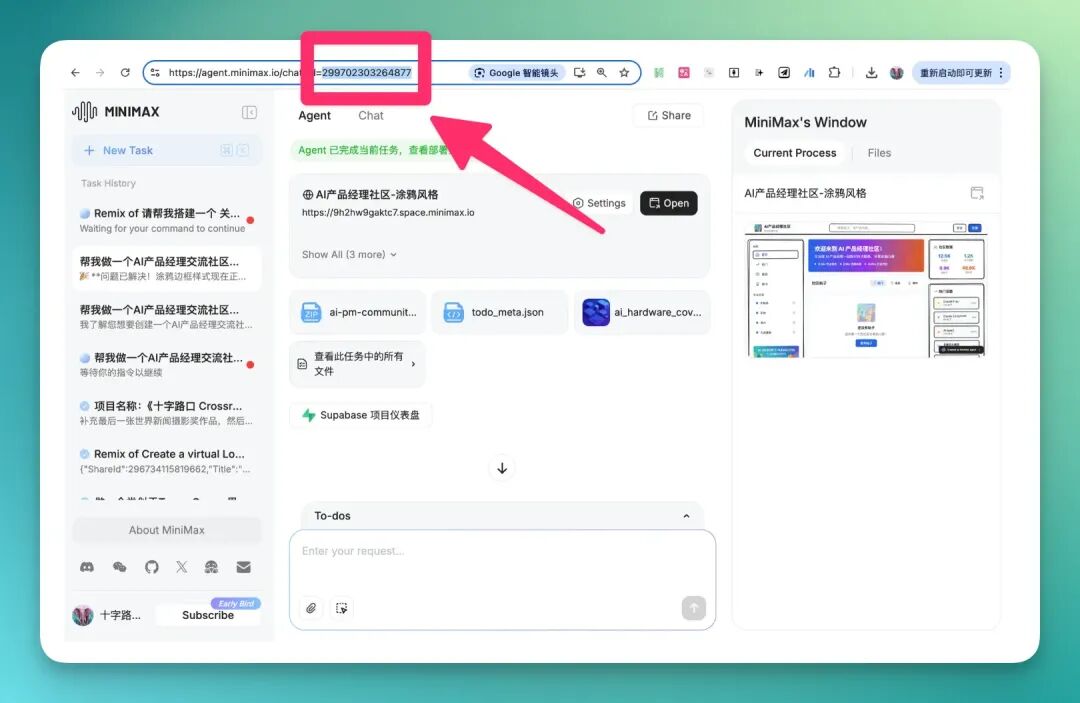
Note: when submitting, many people get confused about UID and Chat ID. Let us clarify.
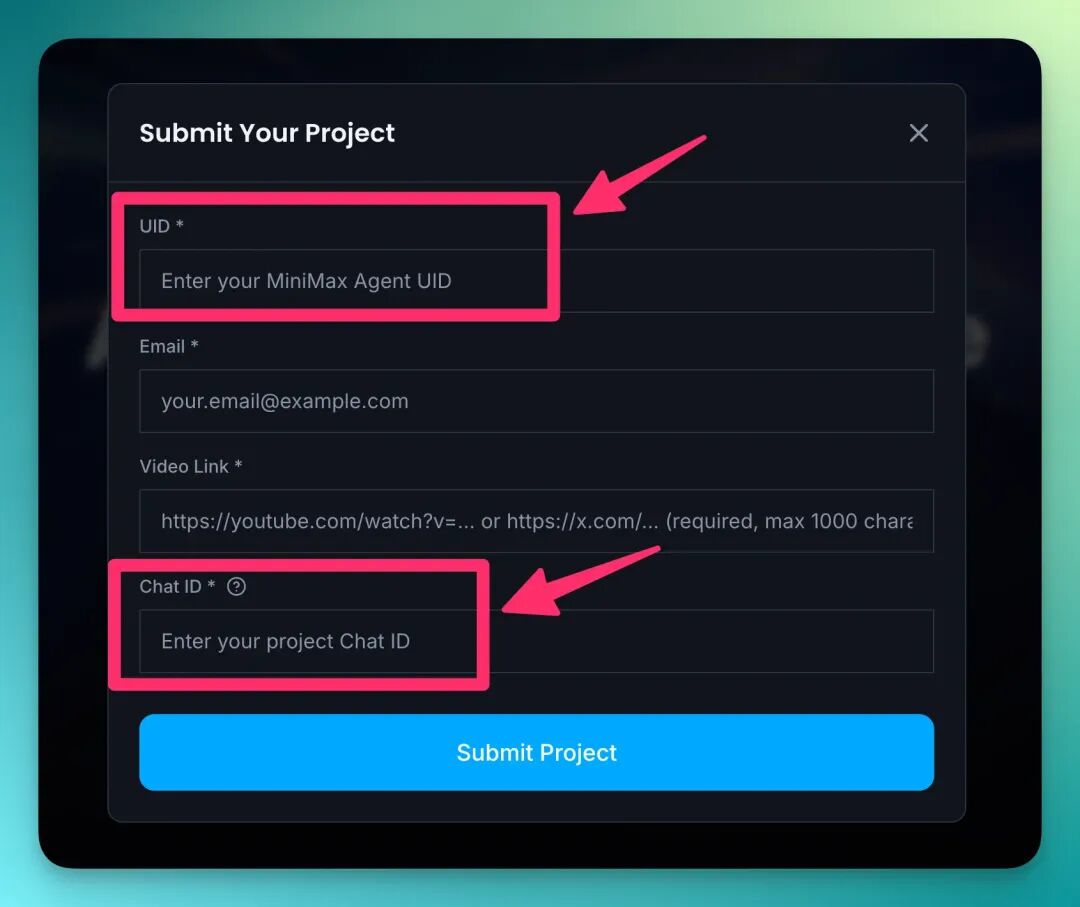
UID is the unique ID number for your account, found by clicking your avatar in the lower right:
Chat ID is that short string of numbers at the end of your work's URL:
Once all this is filled in, the MiniMax Agent hackathon site can pull up your work — and who knows, someone might come Remix it.
The value of Remix Marketplace is clear: with less cost and less time, take a proven work and reshape it for your own scenario. This points-based trading system is what sets it apart from traditional Agent platforms.
In an "inspiration economy," productivity becomes a circulating "technical currency."
Through this experience, across three cases we saved over 70% in points consumption, achieved full functionality with refreshed themes and styles, and sent points to multiple original creators.
So if the goal is to move fast, fail cheap, and get Agents into circulation, Remix is one of the most effective paths available. Go to the Marketplace, find a piece that fits, remix it, and ship it — it becomes someone else's starting point too.