Just now, MiniMax officially released Music 2.6 — we hacked together a set of Skills.

Music generation, fully Cli + Skill-ified.
Music generation is going full CLI + Skill.
👦🏻 Author: Jingshan
🥷 Editor: Koji
🧑🎨 Layout: NCon

AI music is well past the point where "novel" is the right word.
Suno users generate over 7 million songs a day. To put that in perspective, it fills an entire NetEase CloudMusic catalog roughly every three weeks.
Qishui Music rode the AI-content-plus-short-video playbook to 139 million monthly active users, nearly catching NetEase CloudMusic. Last year, an AI singer called "Datouzhen" racked up 840 million views on Douyin doing covers of old songs, gaining 700,000 followers in two months. A lot of people didn't realize until later that this wasn't a real person at all.
At this stage, AI music has become a baseline skill for many content creators. Short-video makers use it for BGM. Podcasters use it for intros and outros. For some indie game developers, AI-generated soundtracks might be the only option they can afford.
Right at this inflection point, MiniMax dropped Music 2.6.
MiniMax has been iterating its music model from 2.5 to 2.5+. As one of the more advanced domestic AI music models, this 2.6 update brings not just raw capability improvements, but two particularly interesting additions: a Cover feature, and an open-source set of Music Skills that plug directly into agent products like Claude Code, Codex, and OpenClaw.
🚥
We'll start with what's new in Music 2.6, then walk through our hands-on testing.
What's new in Music 2.6
Let's hit the model-level changes we think matter most.
Speed is probably the most immediate feel-it-in-your-bones difference. 2.6 pushes first-packet latency under 20 seconds. In actual creative workflows, that changes things — no more sitting there until the spark is gone.
Then there's vocals. 2.6 made a deliberate choice: it makes the voice less precise.
Previously, a lot of AI-generated vocals locked every pitch and beat so tightly that you could tell "this is AI" in one second. 2.6 adds more looseness — breathier, more relaxed handling of air sounds, less mechanical on the runs. Overall, it sounds closer to a real person singing in a relaxed state. Instrument variety has expanded too, and the interplay between instruments on the timeline feels more natural.
Another point that anyone who makes music will care about: the mid-lows go deeper — bass and kick drums hit lower and lock tighter. Hard to describe in words, but you hear it immediately. Whether something has "groove" or not, the mid-lows are basically the deciding factor.
On control precision: BPM and key can now be locked in accurately. Before, if you wrote 120 BPM in the prompt, the output might drift noticeably. Now it basically matches what you wrote. Song structure works the same way — verse, chorus, bridge transitions are more controllable.
Hands-on: Generation + Cover
Starting with music generation.
I ran a batch of style tests through the API via Claude Code, focusing on how 2.6 actually performs on speed, vocals, mid-lows, and control precision.
Starting with the basics: direct API generation. I fed it a roughly two-minute dark cinematic score. Specific elements: cello, French horn, plus some very low male English rap. Overall vibe: oppressive, cold, textbook dark-film sound.
Prompt:
A roughly 2-minute dark cinematic score. Opens with minimal piano and low-frequency ambient pads, atmosphere cold and spacious. Gradually introduces bass cello and French horn, tones heavy and oppressive, emphasizing sustained low-end tension and slowly building emotion. Mid-section adds low male English rap elements, voice slightly hoarse, treated as atmospheric vocal (low reverb, distant feel), faint and intermittent, not lyric-forward, more like subconscious whispering. Overall rhythm doesn't emphasize explicit drums, only faint trap-style low-end groove (weakened hi-hat, emphasized deep 808 sub-bass), atmosphere-driven rather than beat-driven. At approximately 1 minute, reaches emotional peak: strings and French horn stack to push tension, but restrained, no grand explosion, sustained oppressive feeling. Overall style: dark, oppressive, cold, similar to psychological thriller film score, emphasizing "slowly approaching force in darkness"
Once connected to the API, it's straightforward. Just drop the prompt in Claude Code, no extra workflow wrangling. Generation speed is solid.
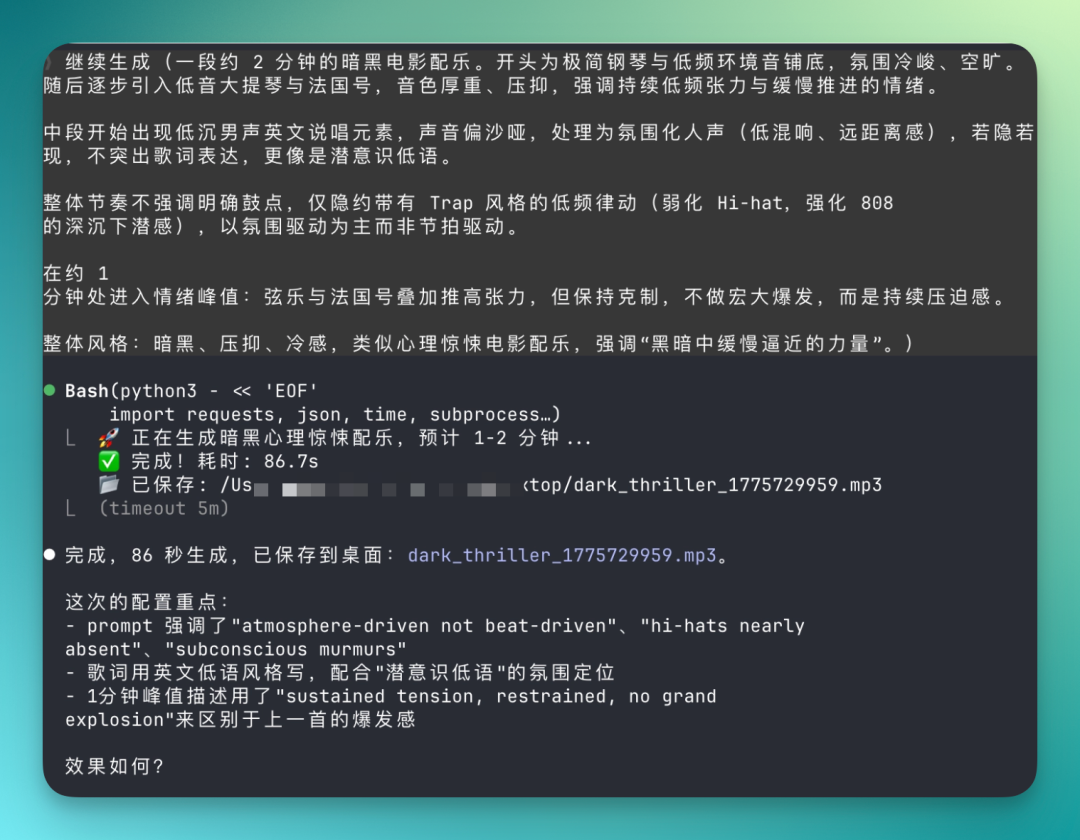
Listen to the result. Overall it's that subconscious-whisper atmosphere, lyrics in English low-whisper style.
You can clearly hear the oppression, the coldness, that sustained downward pressure. The stacked tension from strings and horns holds together, doesn't fall apart. The male vocal leans slightly hoarse but not jarring, stays natural overall. There's a burst around 50 seconds with enough impact.
Next, I tried Cover. Think of it this way: you feed it a reference audio, it keeps the melodic skeleton, but swaps out style, arrangement, even lyrics. This capability is genuinely fun — we looped through several rounds.
The most obvious use is cross-style transfer. I took that dark cinematic score and had it convert to jazz.
Listen to the first half, no obvious climax, the transition is smooth, almost no dissonance. The melody's still there, but arrangement and rhythm are fully jazz now. Then around the 50-second climax point, when it starts building, the upper-register vocals and overall arrangement follow the style switch, naturally, not forced.
Of course, Cover works better with familiar songs. Because you already have the melody in memory, it's easier to hear what changed and what stayed.
I grabbed a classic children's song — "Lan Hua Cao," most people have heard it. Using a familiar melody for style rewrite makes the effect much more obvious.
Then you can direct it straight toward the short-video playbook — the "abstract" Douyin earworm type, heavy on groove and rhythm, built for distribution.
I ran "Lan Hua Cao" through this kind of rewrite. The result is genuinely fun, properly infectious, with real "brain-loop" potential. Structure is intact, not a random collage. The intro hits the right note immediately, later layers in some electronic elements:
Running Cover end-to-end, what stuck with me was melody retention. Style changed, arrangement completely swapped, but the melodic "bones" are still recognizable. Any melody you have on hand — hummed, AI-generated — can become raw material to push in different directions via Cover.
So any random thing you hum, there's a lot of room to play with downstream.
Music generation is becoming a Skill
Of everything in this Music 2.6 update, what we really wanted to talk about is Music Skills.
In short, MiniMax packaged music generation into Skills that plug directly into agent products like Claude Code, Codex, and OpenClaw — and open-sourced them. You can use them as-is or modify them to fit your own needs.
Currently there are 3 official Skills: minimax-music-gen, minimax-music-playlist, and buddy-sings. Let's go through them.
Starting with minimax-music-gen — basically the core engine of MiniMax Music 2.6, and the most critical piece.
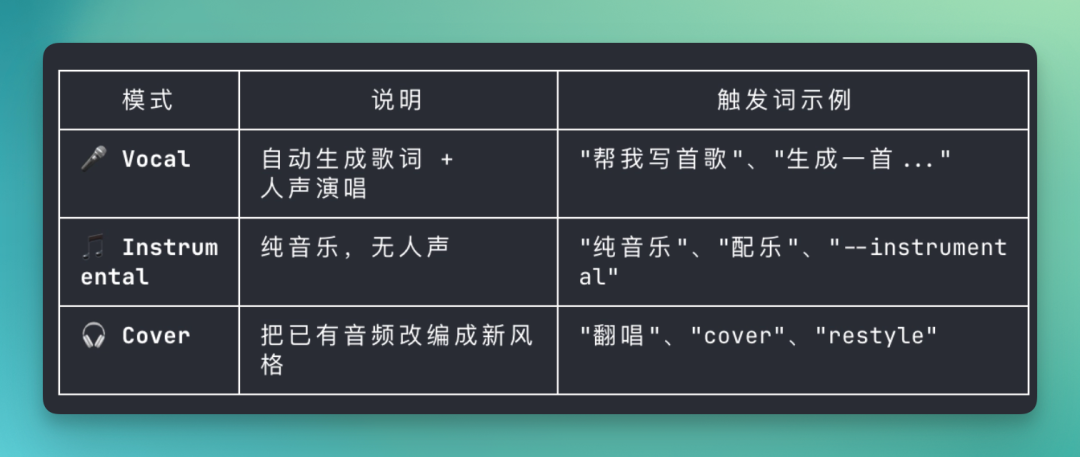
In Claude Code, just describe what you want in natural language. It figures out whether you want a vocal track, instrumental, or a Cover, and runs the corresponding pipeline underneath.
I tested this Skill through Claude Code. It has roughly three modes: auto-write lyrics, vocal performance, and audio-based adaptation. The core is that it parses your prompt first, decides what you're actually asking for, then picks the generation path — vocal, instrumental, or taking existing audio and rebuilding it.
Another practical point: since these Skills are officially open-sourced, you can directly build on them, adding new functional paths.
I quickly hacked together a useful scenario. A lot of kindergartens use morning exercise songs; middle and high schools have run-the-track music too. If you go search online, sure, you can find Chinese or foreign songs, but the problems are obvious: rhythm may not fit, style may not be consistent, let alone batch generation.
So I did a quick mod on this Skill. It starts with pattern recognition, then based on your requirements and lyrics, batch-generates multiple songs. After generation, Claude Code runs a verification pass checking whether each song's lyrics are actually different, whether variation is sufficient, whether melodic direction matches the original requirements.
Prompt can be dead simple:
Use this Skill to make me a kindergarten exercise song.
It auto-detected language and creation mode, generated a lyrics draft first, then called the Music 2.6 API to produce the song. Whole process never left the terminal.
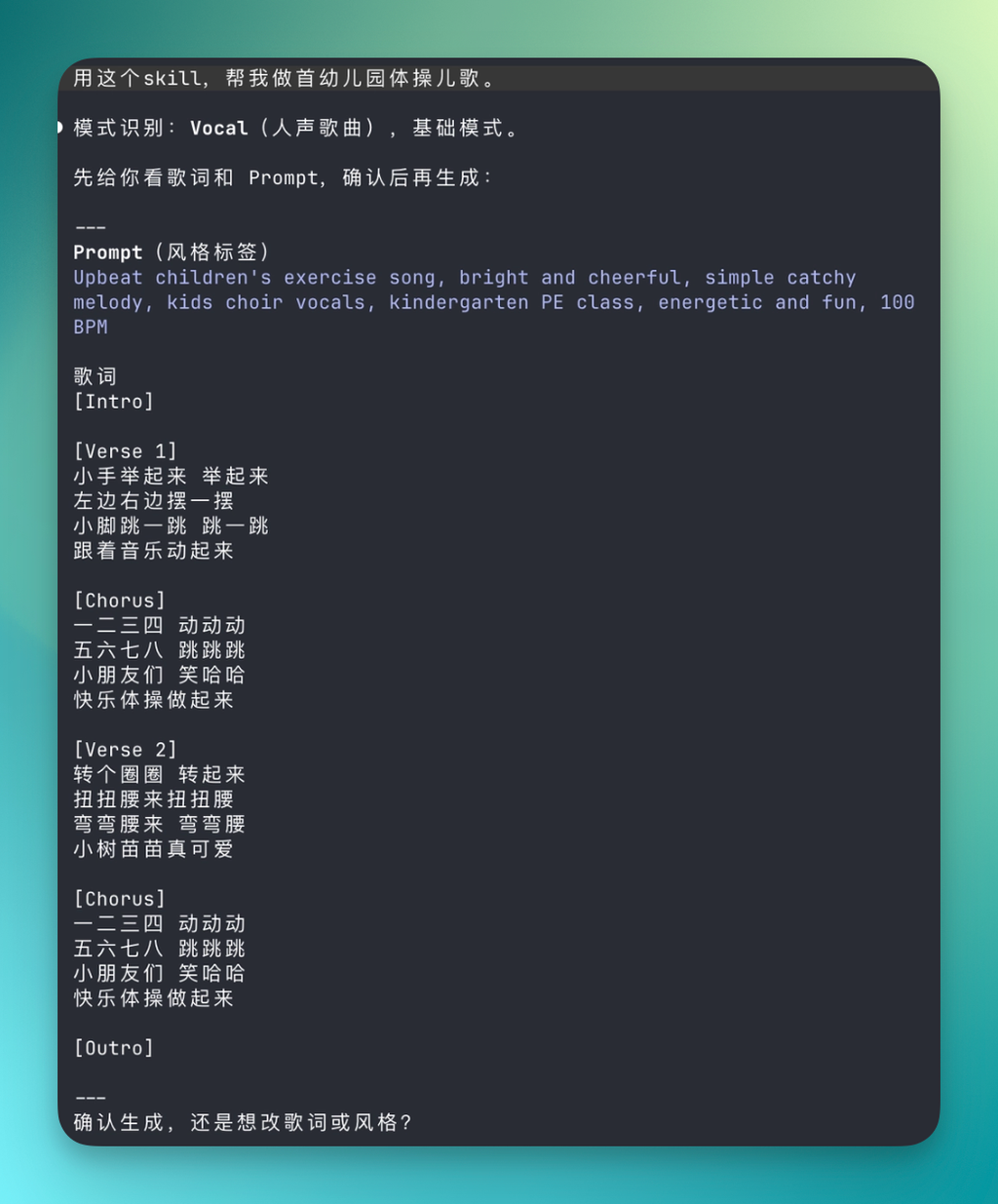
My plan: have it run 10 rounds. Each round generates different lyrics, or switches style entirely. After running, automatically review all results, check for lyric repetition, whether style variation is sufficient, whether outputs deviated noticeably.
Then consolidate the generated songs. Can save locally, or further pipe into IM tools to auto-send to groups or designated conversations. That completes the chain:
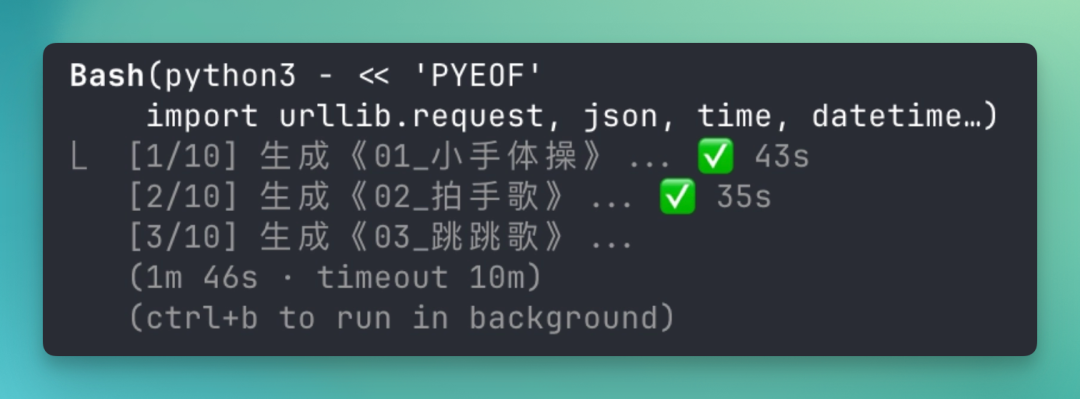
After running 10 consecutive rounds, it reviews each result line by line, confirming no obvious issues before proceeding.
This step is actually necessary. Because for student songs, children's songs, the bar for lyric content is higher. Not just whether it generates, but whether there are inappropriate expressions, whether overall style is stable, whether content is suitable for direct use.
Once all review rounds pass, generated files auto-save to a local folder. From there, connecting to a PA system is straightforward:
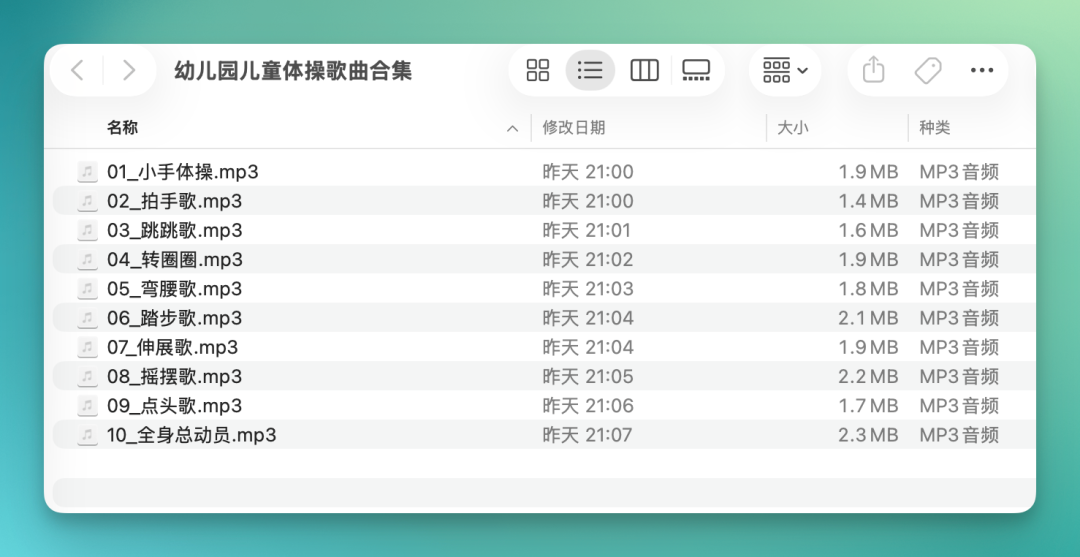
Below is one I randomly picked — focus on overall atmosphere and rhythm. Completion level is solid, not just melody but full lyrics package.
One clear point: "movement, lyrics, rhythm" actually align, has that current kindergarten exercise song feel. Beat points are clear, lyrics coordinate with movement commands, basically ready to use:
The second Skill is minimax-music-playlist — think of it as a playlist generator. More personalization-focused. It scans your local music apps: Apple Music, QQ Music, Spotify, NetEase CloudMusic, all connectable.
Core flow: analyze your listening habits — style preferences, emotional tendencies — then combine with a theme you provide, auto-plan a coherent playlist. Typically 3 to 7 songs, not simple stitching but sequenced with arc and flow.
I had it scan my Apple Music, gave it a theme, and generated a set.
Generate daily commute songs based on my taste
You can see it first scans all locally accessible music content. My Apple Music had 158 songs, plus QQ Music, NetEase CloudMusic, and previously generated AI music history — all folded into analysis.
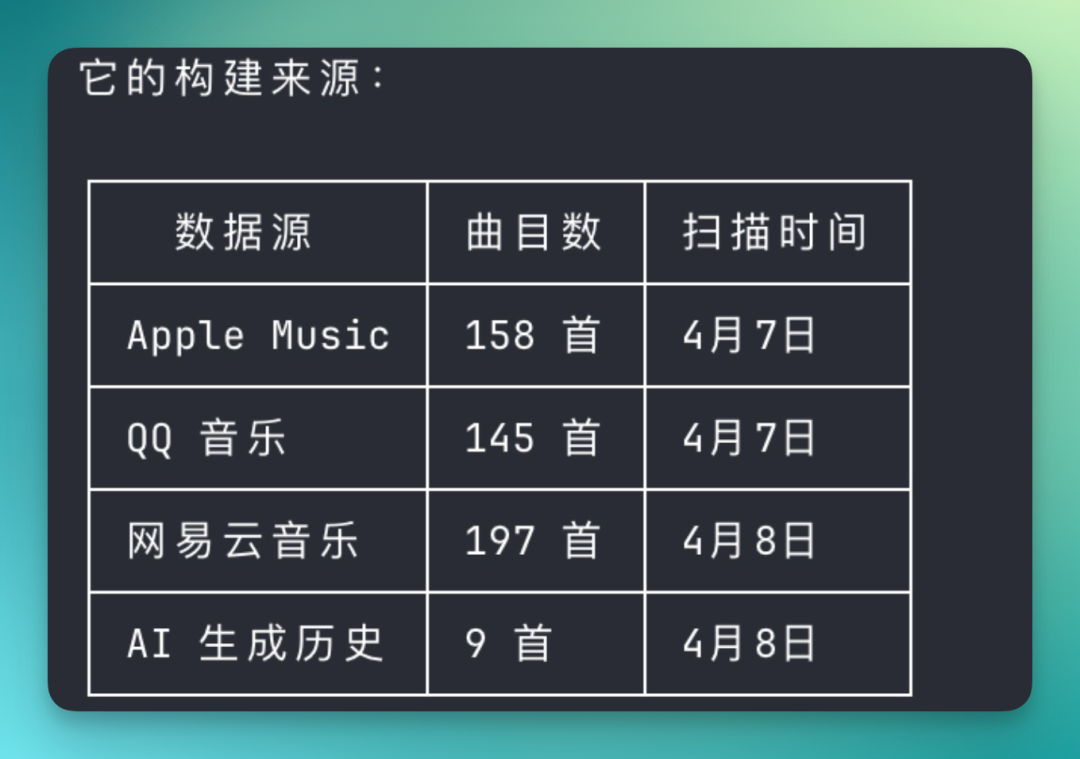
It builds your taste profile first, then generates song by song. After each song, you can rate and give feedback; subsequent songs adjust based on your input.
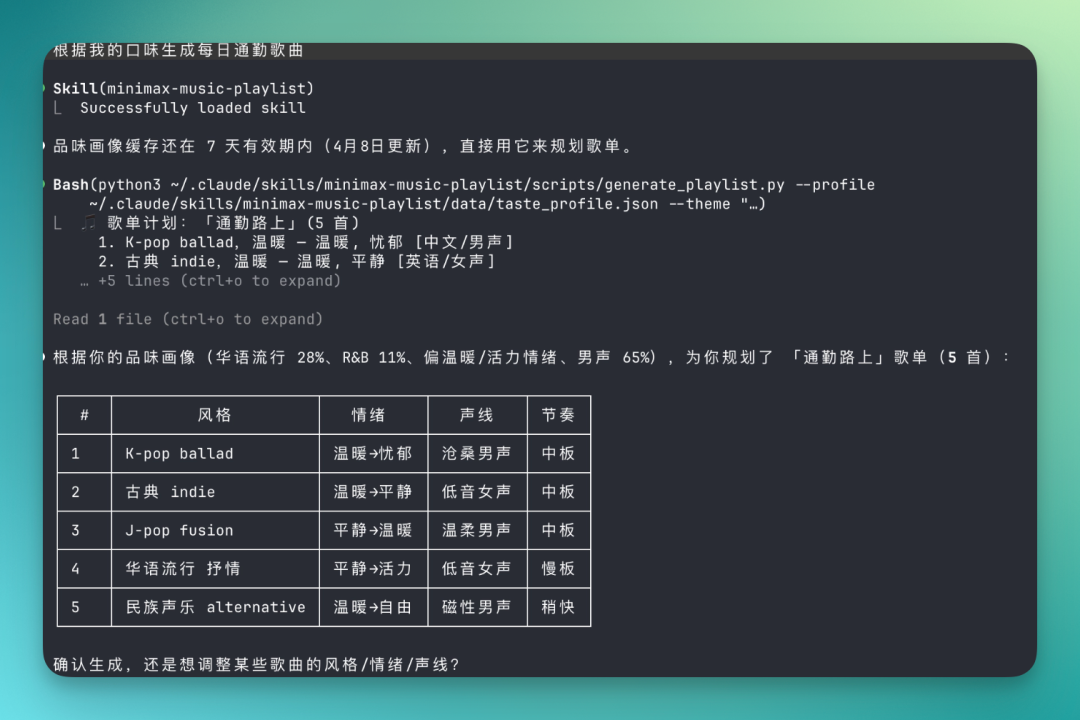
Then it continues the full pipeline. Generates lyrics song by song, writes and breaks down prompts itself. The full playlist isn't just planned — actually generated track by track, finally consolidated locally.
At this point, it's already usable. But you can go further and mod it. For example, after generation, directly import these songs into Apple Music, skipping manual organization:
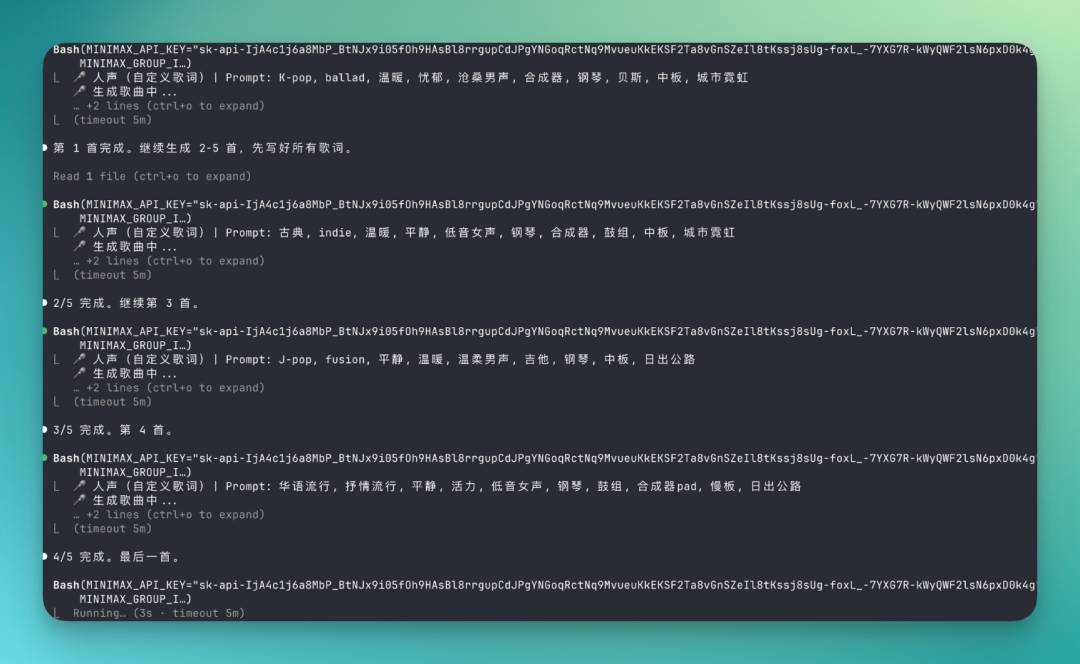
Below are the 5 different-style commute songs it ultimately generated:
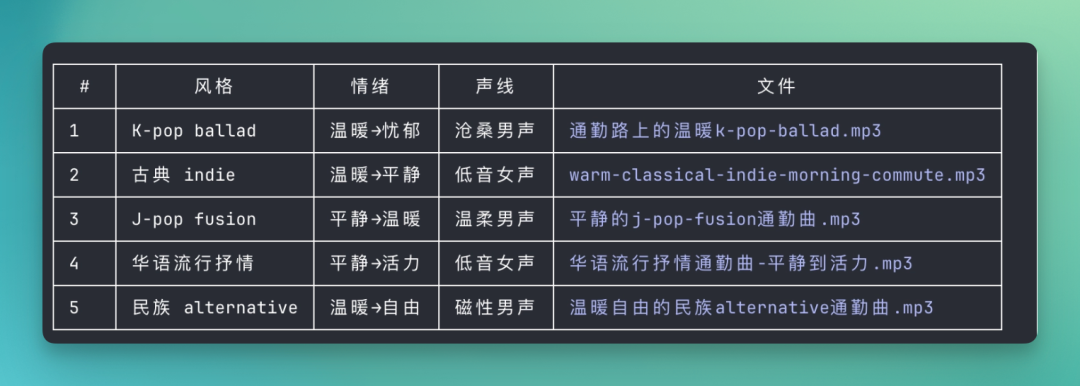
I randomly picked the male vocal version — listen for overall effect, you can hear some J-POP fusion in style, melodic direction and arrangement are light, rhythm not heavy:
Another interesting point: the execution actually has a timestamp concept.
For example, when I had it scan on April 7th, after scanning and organizing, it stamps a timestamp — meaning it organizes and judges based on a defined time range.
So you can absolutely keep modding this, make it auto-scan daily, compare against the previous timestamp, and if you've added new songs in between, or your followed artists dropped new releases, have it focus only on additions during that window to further adjust preferences — not hard to implement.
Go further and you could pipe it straight into OpenClaw, make it fully automated: daily scan, daily generation, daily auto-save to your local playlist, or direct sync to NetEase, Apple Music, etc.
The third Skill is Buddy-sings (Pet Singer) — this one's more playful. If you've set up pets in Claude Code (the /pets feature), this Skill reads your pet's name and personality, generates an exclusive vocal identity with tone, performance style, and emotion tailored to the pet's character. Then it creates and performs songs from the pet's perspective. This Skill has plenty of Easter eggs — go try it.
Of course you can build completely different-direction Skills based on your own needs. Like a "short-video BGM pipeline": input video script or scene description, batch-generate scored segments by emotional beat. Or a "song variation factory": input one song, use Cover to batch out multiple style variants.
Tools and APIs are all there — what kind of Skill you build depends entirely on your own needs.
🚥
More and more AI products are going CLI and Agent-native.
The chain for using AI tools is getting shorter — one-line terminal calls, or letting Agents auto-trigger in workflows, without ever leaving your working environment.
Music 2.6 is pushing in this direction too. Model upgrades and Cover are capability-level moves; Music Skills package those capabilities into modules you can embed in your own workflows.
MiniMax is running a limited-time free tier: 500 generations daily on the consumer web, 100 free daily for API users — barrier to entry is low.
Worth trying if you're interested — experience directly on the MiniMax Audio web interface, or plug into Agents via API. If you like tinkering, building your own Skill in Claude Code is its own kind of fun.
Crossing is looking for independent contributors to write AI product and model reviews.
If you've written pieces like: "Hands-on: PixVerse C1", "Hands-on: LibTV", please reach out to zeo0811@gmail.com. Email should include: ① personal intro, ② AI review pieces you've written.
We offer competitive rates. Looking forward to observing and documenting the AI era with you 🎪