MIT Grads Are "Quantifying Aesthetics," Building an AI-Era Xiaohongshu

An "AI bestie" who gets aesthetics — and gets you.
An "AI Bestie" Who Gets Aesthetics — and Gets You.
👧🏻 Author: Ms. Yi
🥷 Editor: Koji
🧑🎨 Layout: NCon

Open Xiaohongshu or Pinterest, and you see "someone else's life." Open Viba, and you see "yourself in the next scene."
That's how Qianhui Liang, founder of N7 Interactive, defines her latest product in the simplest terms. At a moment when AI shopping tools are piling into price comparison, virtual try-on, and helping you "buy faster," Viba has chosen to solve a more fundamental problem: Before the user even opens the search box, how do you help them figure out who they want to become?
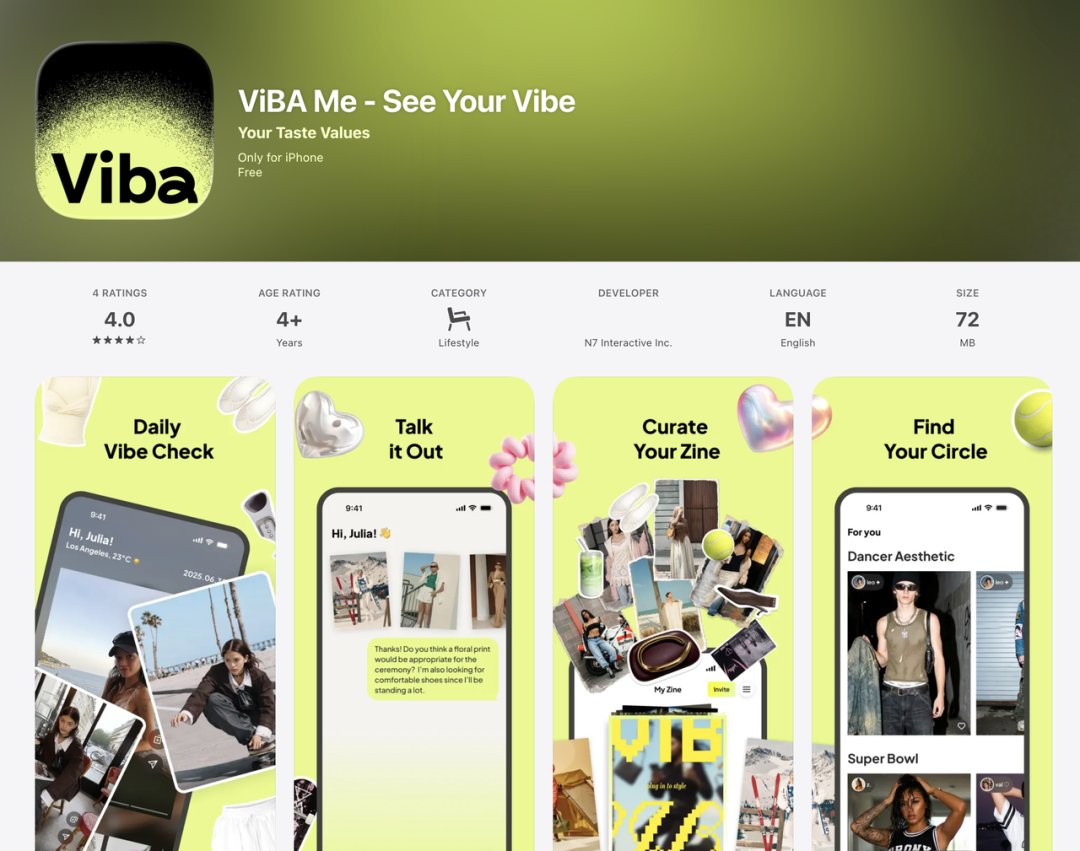
Founded by an MIT dual master's graduate in architecture and computer science, and former head of social product at Huawei's Cyberverse, the company has already posted MVP numbers that excite the team: users save an average of 13.79 inspirations per week, with peaks near 30; week-two retention hits 53%; and a single organic Instagram post from a user broke 100,000 views. Behind these figures lies an emerging "new entry point for AI-era consumer decision-making." Viba defines itself as "Xiaohongshu meets Daydream for North America," but a more apt description might be: an "AI bestie" who understands aesthetics, understands context, and understands you.
As we approach the 2026 window, what shifts are happening in the AI-driven consumer decision-making track? And what gives the Viba team a shot at breaking out? With these questions in mind, we sat down with founder Qianhui Liang.
Below is the full interview, edited by Crossing.
Rapid-Fire Round
Let's start with a quick Q&A to get to know you.
🚥 Crossing
Age?
👩💻 Qianhui Liang
🚥 Crossing
Alma mater?
👩💻 Qianhui Liang
Undergrad in architecture at Tongji University, master's at MIT — dual degree in computer science and design.
🚥 Crossing
MBTI and zodiac sign?
👩💻 Qianhui Liang
Gemini. Used to be ENFP, now ENTJ.
🚥 Crossing
One sentence to describe your company and product?
👩💻 Qianhui Liang
Viba is an AI bestie that gets your lifestyle. We're building the lifestyle consumption entry point for the AI era.
🚥 Crossing
Team size?
👩💻 Qianhui Liang
Seven total (five full-time, two part-time).
🚥 Crossing
What were you doing before starting up?
👩💻 Qianhui Liang
Making abstract aesthetics computable.
An "AI Bestie" Who Gets You
🚥 Crossing
You say Viba wants to be "the lifestyle consumption entry point for the AI era" — that's a broad claim. Simply put, how should we understand what you're building?
👩💻 Qianhui Liang
Simply put, we're building a truly understanding, aesthetically attuned AI bestie — a lifestyle Bestie.
What makes a real bestie in life? First, she's got taste. Ask her what to wear before heading out, and she'll flood you with ideas. Second, she actually knows you — who you're dating today, what kind of relationship it is, whether you want to come off sexy or cute, even what mood you're in.
Viba is that bestie, turned into AI. Our core positioning is to build a new consumer decision-making entry point for the AI era. Users don't start from product search; they start from "what kind of person do I want to be" and "what scene do I want to enter."
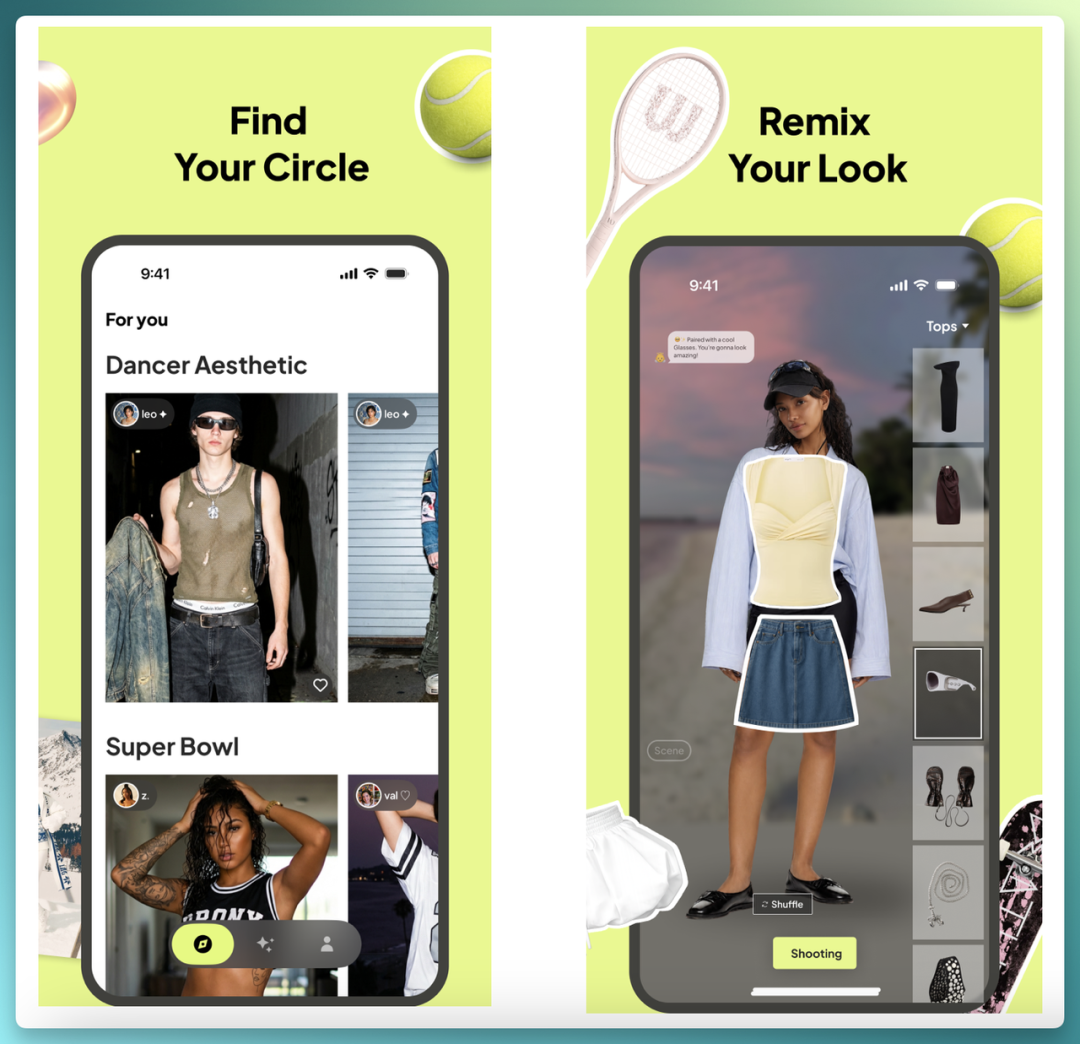
Viba is a Lifestyle Agent. It's a bit like Xiaohongshu for North America plus Daydream, but what we're doing is the full closed loop from "inspiration generation" to "real-world lifestyle consumption."
🚥 Crossing
In what scenario do you want users to think of Viba first?
👩💻 Qianhui Liang
"Big plan, no fit? Try Viba." — Big occasion, no outfit inspiration? Give Viba a shot!
"We help you dress for the plan, check the fit, and feel ready before you step out."
Viba designs your look for that next big date. You just confirm every detail, and the moment you walk out, you're the center of attention.
🚥 Crossing
You'd been working on Sceno, a Vision Pro-based visual community, before pivoting to Viba. What opportunity did you see?
👩💻 Qianhui Liang
We've never changed direction. We've always been building AI products in the "visual context" space.
N7 Interactive was founded in 2024. Sceno was our first product, built on the idea that "one photo takes you back to where it was taken." We discovered that users' synced photo albums contained massive amounts of lifestyle data. Viba — our second product — uses AI to dig deeper into the "user services" behind that data.
The inflection point came in September 2025. That was when a key industry variable emerged — the maturation of the Nano Banana model. The opportunity in visual AIGC had truly arrived. Large models could now understand you more dynamically and contextually, and costs had dropped dramatically.
But beyond the technical variable, what matters more is landing that technology in contextual applications.
AIGC can express different selves and life scenarios in digital, visual ways. But what it ultimately connects to is still real-world assets, products, and consumption behavior. In the AI era, individual personalization gets pushed to the extreme. A person is no longer a single unified user profile, but multiple social personas: who she wants to present as on a date, traveling, at a party, at work, hanging with friends — each is different.
Against this backdrop, we found a stronger, higher-frequency, more commercially proximate entry point: outfit styling. That's how Viba was born.
You could say that on Sceno, users were "revisiting the past." On Viba, they're "rehearsing the future."
🚥 Crossing
There are already players in this space. What's the fundamental difference between you and AI shopping assistants like Doji or Phia, or established platforms like Pinterest?
👩💻 Qianhui Liang
The difference is that we've chosen to deeply intervene in the pre-purchase phase.
Doji and Phia solve efficiency problems during and after purchase — AI try-on, cross-platform price comparison, helping users buy what they already want faster and cheaper. Viba solves the stage before the user has even clearly articulated "I want this."
We divide consumer decision-making into three phases: pre-purchase (inspiration/intent generation), mid-purchase (search/comparison/decision), and post-purchase (fulfillment/sharing). Most AI shopping tools cluster in mid- and post-purchase because data is easier to get and commercial paths are shorter. But our core conviction is: The biggest opportunity in the AI era isn't optimizing efficiency by 10%, but creating 10x new demand at the intent level.
Beyond that, we can better capture user mindshare through three layers of design:
-
Bringing inspiration back to real life: We use AIGC content creation to connect with real physical-world assets — clothing, events, locations.
-
Scenario-driven consumer decisions: On Viba, users don't start by searching "sneakers." They start by thinking: "This weekend in Santa Monica, I want to look more chill, more natural."
-
All-in-one consumption chain: From seeing an inspiration, inserting yourself into it, saving it, to finding the outfit, brand, location, and event — the full chain happens in one product.
We Do "One Person, Thousand Faces"
🚥 Crossing
Viba emphasizes "expressing individuality, expressing self," but that sounds like every "thousand faces for thousand people" social media platform. What's actually different in the product?
👩💻 Qianhui Liang
Our logic is completely inverted.
Others do "thousand faces for thousand people" — push the same content to different people and see who likes it. We do "one person, thousand faces" — around the same person, help her manage her different sides in different scenarios.
For example, you're dating today, traveling tomorrow, at a music festival the day after — you want to present completely differently. Viba doesn't push you "viral hits." It models based on your real-life scenarios.
What city you're in, what you usually like to do, what you've got coming up — this context is what grounds our inspiration recommendations.
In terms of product feel, the differences you'll notice:
First, our goal isn't to have you scrolling content, killing time. What we care about is whether you've entrusted us with your real-life plans, whether you've told us your intent.
Second, our recommendations are "you-centered," designed around your real consumption scenarios.
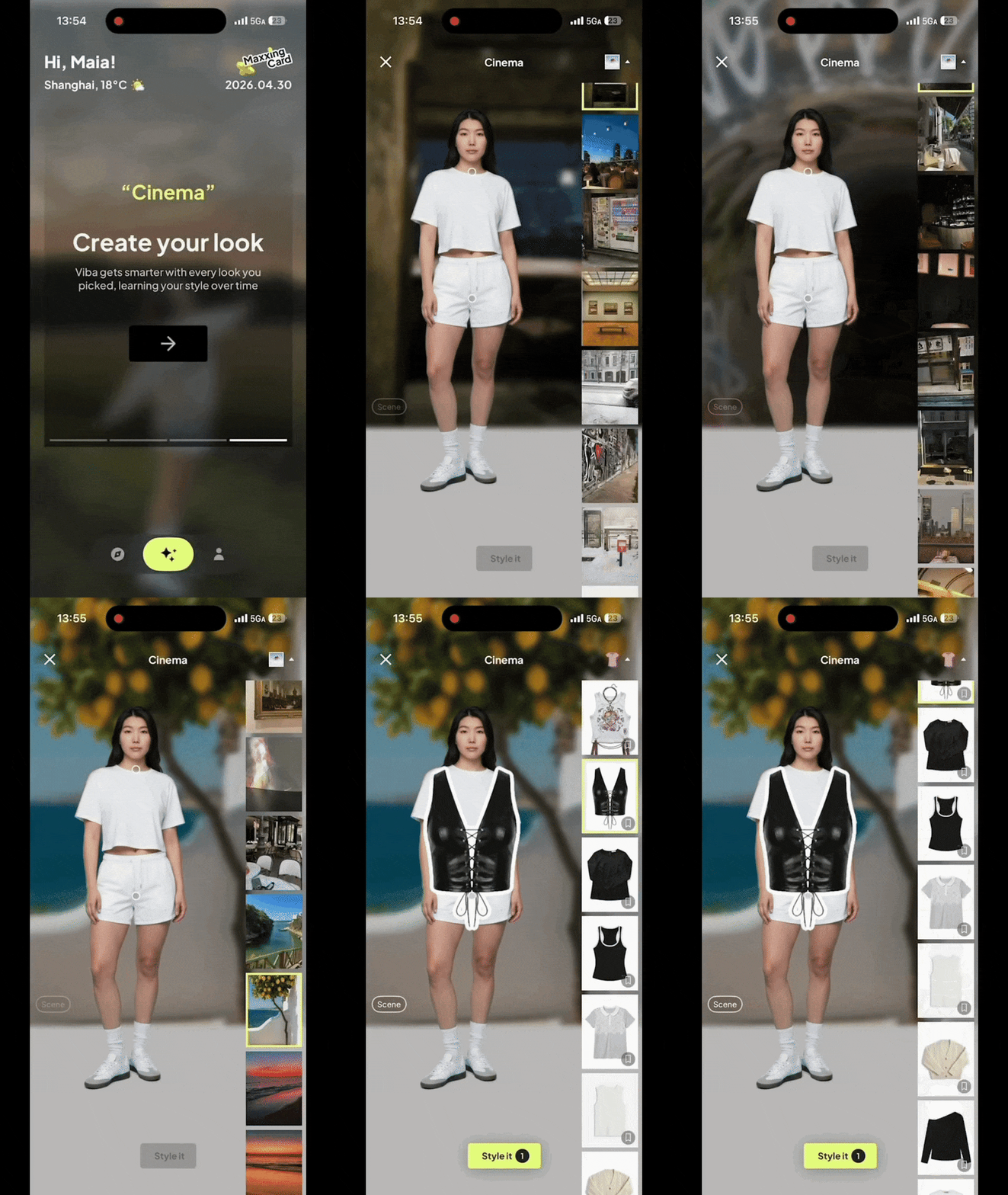
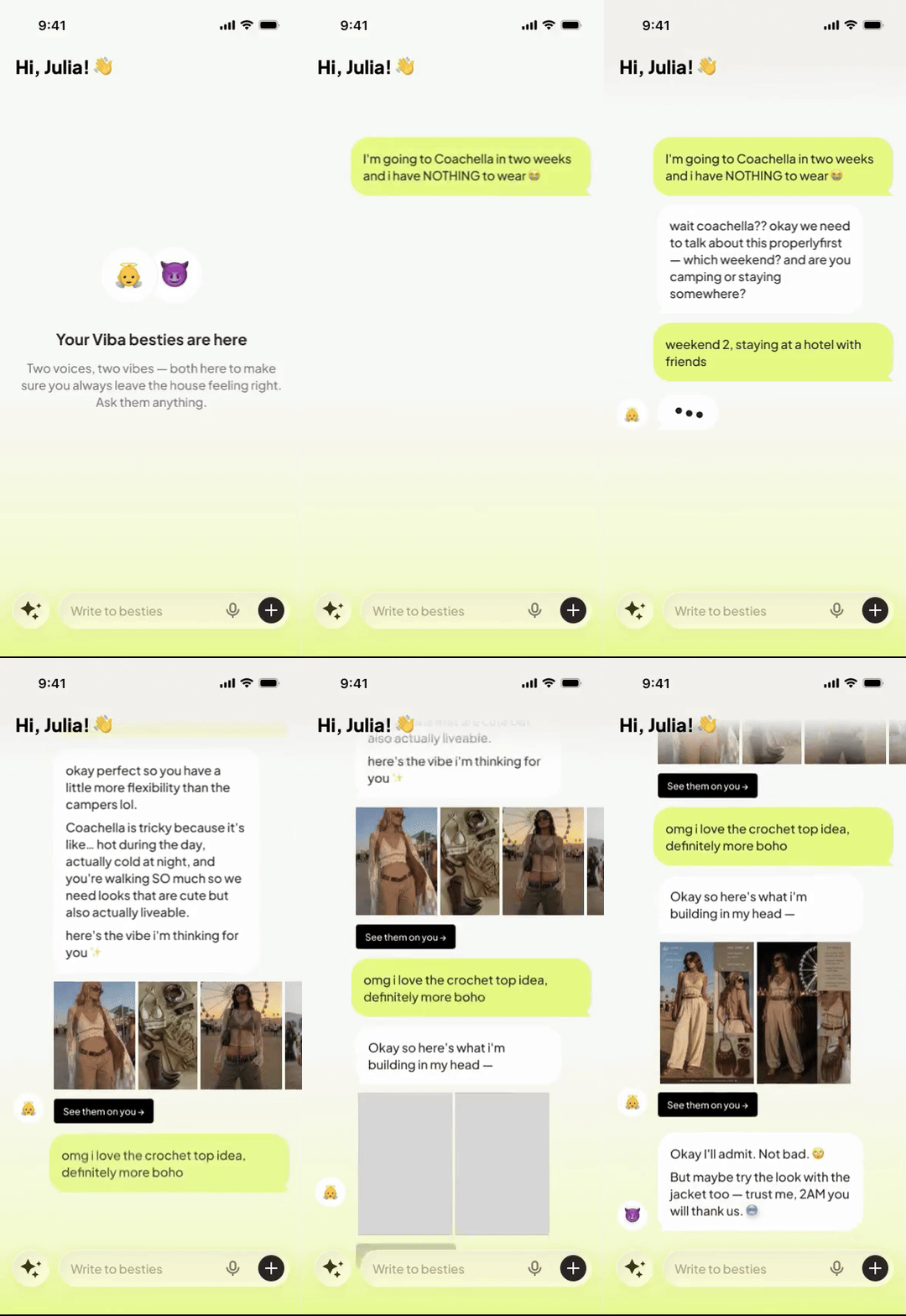
For example: Open Viba in the morning, and based on your city, your style, your upcoming plans, it generates several outfit inspirations right away. We also have a Styling Room where users can remix existing inspirations like playing Love Nikki — swap pieces, adjust pairings, add mood tags. Finally, you can upload your own scene photos, like "I'm going to Coachella next week, the venue looks like this," and try different looks against that backdrop.
When a user saves or downloads a look, they're telling Viba "I want to show up like this at the beach / on this date / at this festival." Then Viba proactively asks about your plans and continues serving you around your schedule, rather than waiting for you to search.
🚥 Crossing
You recently launched MVP testing. What key feedback did you get?
👩💻 Qianhui Liang
During MVP, we cold-started through offline events at 15 core universities in SF, NYC, and other cities, inviting 300 core users into testing and completing roughly 1,000 user visual data entries.
We saw several clear signals:
First, user saving behavior is extremely active.
In MVP, users averaged 13.79 weekly saves per person, with peak weekly saves hitting 28.52. This is our North Star metric — different from the DAU, GMV, and time-spent metrics traditional internet companies track. But we believe that in the AI era, the core asset in consumer decision-making is no longer "traffic," but "intent." No longer "post-planting audience assets," but "high-intent assets with clear life scenarios and consumption intent."
Second, retention exceeded expectations.
Over four weeks of testing, two weeks hit 100% week-two retention, with an average of 70%.
Third, organic sharing is already working.
Organic Instagram posts from users hit single-day natural views of 100,000+. KOLs also created content spontaneously — accounts like @dakyta (275K followers) and @azevedormn (252K followers) actively used and shared Viba-generated party and date looks.
🚥 Crossing
Any specific user stories to share?
👩💻 Qianhui Liang
So many. One strong feeling: On Viba, users aren't looking at other people's lives. They're genuinely rehearsing, pre-enacting their next entrance look.
During MVP testing, one user spent a month preparing a party outfit. She received nine images daily, making choices and trying things on. She wasn't "being planted with desire" — she was actively constructing an image of who she wanted to become, even something that broke from her previous self. Later, she actually went out in a bold look and got real-world positive feedback.
Others prepared looks for birthday parties weeks in advance, rehearsed repeatedly before spring break trips, or bought an expensive blazer and then tested it across different occasions on Viba to see how it paired and whether it was worth keeping.
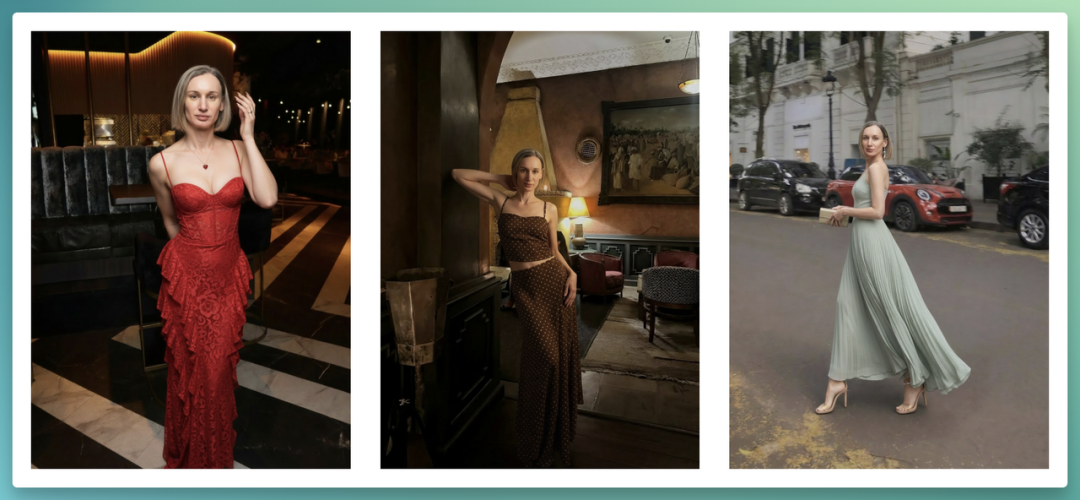
We also saw some surprises. For instance, one girl uploaded her boyfriend's photo and daily got "perfect boyfriend version" outfit inspiration — then actually rebuilt his wardrobe based on Viba's suggestions.
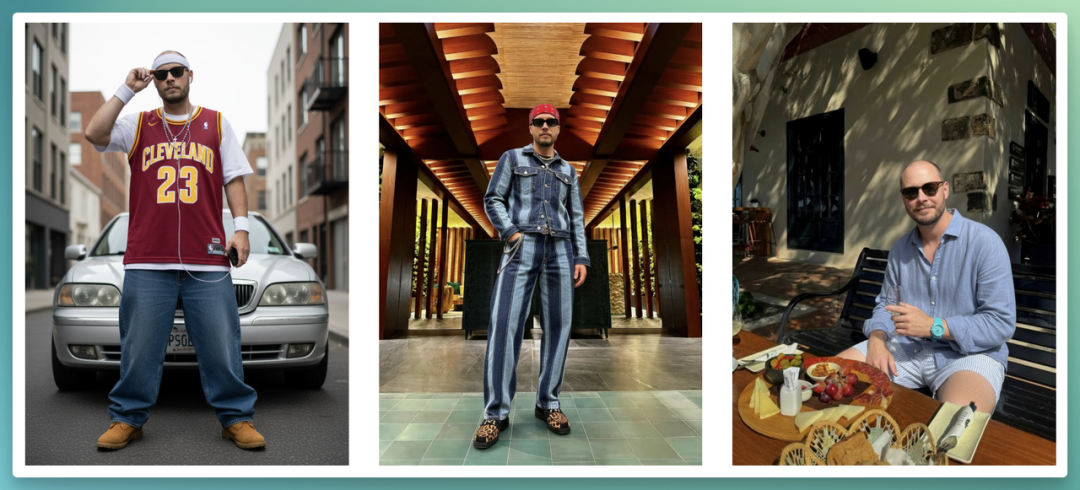
Of course, our core users are primarily women. They may not be influencers, they may not have stylists — they just want to shine on dates, trips, at festivals, or birthdays. Viba is for them. That said, we've also found some high-potential male users who particularly love Viba and are extremely sticky.
They're well-educated with a certain social status. But in real life, most men don't spend time on outfits, and no one takes good photos of them. On Viba, they suddenly got their "DOTA moment" — an exclusive "celebrity photo."
Men, especially high-income men, may be an underestimated paying demographic.
🚥 Crossing
On which specific scenarios are you focusing more energy to design dress codes and close the consumption decision loop?
👩💻 Qianhui Liang
We're mining "Big plan" scenarios that require sustained user interaction, discussion, and image updates. In these scenarios, users typically bring multi-round, continuous context input, and connect to real life and social relationships.
From backend data, we see users paying attention to many formal occasion looks — mostly scenario-based on user-specific interests or lifestyle preferences, like outdoor activities such as rock climbing, hiking, and so on.
MVP user feedback also convinces us: People genuinely accept and are willing to entrust Viba with their real-life plans and aesthetic preferences, and willing to invest time cultivating them.
In today's attention-scarce environment, this is the most exciting signal for us.
🚥 Crossing
What new features is Viba developing?
👩💻 Qianhui Liang
We're about to launch "Bestie Circle," expected to go live in May.
Once Bestie Circle is live, users can access friends' avatars and collections. For example, a guy buying his girlfriend a gift can see what looks she's saved and directly put together something to buy her. Girlfriends can also copy each other's homework.
We've designed two persona versions — an Angel Bestie and a Devil Bestie. Like your real besties: one always says "you look amazing in this," the other says "you already have ten things like this, don't buy it!"
We're creating a real, human, connected-feeling "AI bestie."
Aesthetic Engine + Scenario Agent, Prying Open a Trillion-Dollar Market
🚥 Crossing
Historically, many vertical outfit platforms have ultimately been swallowed by Xiaohongshu and Instagram. What's different this time?
👩💻 Qianhui Liang
The core differences are two-fold: a transformation in business model, and a reconstruction of user experience.
First, AI is reshaping the commercial ecosystem of consumer decision-making.
From shelf e-commerce to content e-commerce, consumer decision-making has continuously shifted earlier. AI lets us go further — not waiting for users to generate demand before satisfying it, but proactively modeling and even mining needs they haven't yet recognized, embedding consumption decisions into the earlier "intent stage."
This means future commercial logic will change: Traditional affiliate models use fixed commissions, but in 2-3 years, brands may move to dynamic commissions based on how much "high-quality intent" a platform generates and its conversion rate.
Further out, when we sufficiently understand users' real needs across life scenarios, we may even be able to influence supply-side反向.
Second, Viba offers a "me-centered" experience, not "matching content to people."
Past content platforms were essentially about matching content, products, and users — pushing the right content to the right people. But Viba is completely different: we're user-"me"-centered, with users exploring themselves around their own life scenarios.
Moreover, driven by the desire to "become more beautiful" and "become more confident," users will generate consumption desire across more scenarios. Because they want to try more different versions of themselves. This driving force is far stronger than passive "being planted with desire."
You could say Viba isn't "another vertical outfit platform." We're redefining "where consumer decision-making begins in the AI era."
🚥 Crossing
Where does your technical moat show?
👩💻 Qianhui Liang
Our technical moat rests on two core pillars:
First, the Aesthetic Engine: we don't do black-box recommendations.
Traditional recommendation algorithms are based on behavioral statistics. Our aesthetic engine uses curated high-quality fashion data to build an interpretable aesthetic expression space, breaking down a garment into dozens of aesthetic feature dimensions.
When a user says "I like this image," the engine understands the underlying combination of aesthetic features, so recommendations can cross specific categories. So Viba isn't selling individual items, but a unified aesthetic worldview.
Second, the Scenario-Aware Agent: we've redesigned the memory "workflow."
Most agent memory processing is a separated pipeline. Viba puts Context (scenario), memory retrieval, and memory usage into the same training loop, letting the system learn which memories are most worth using to generate next actions in specific scenarios. It first sells you a "dream," then helps you realize it.
🚥 Crossing
What unique design choices has Viba made on the aesthetic front?
👩💻 Qianhui Liang
"Relatable realism" is the highest principle across all our design, with three layers:
Layer one: interpretability of the aesthetic engine.
Traditional AI generation easily "drifts" — face doesn't look like you, fabric texture is wrong, lighting is off. Our aesthetic engine doesn't directly generate a "perfect but not you" image. It first learns your facial features, body proportions, daily color preferences, then uses these as hard constraints during generation.
The experience this gives users is: "This actually looks like me, not a model with my face swapped on."
Layer two: relatable scenarios.
We don't generate "a beautiful woman at the beach" generic scenes. We generate "you, on Third Street in Santa Monica, in 4pm sunlight, wearing that linen shirt you saved last week."
So on Viba, what users see isn't just "inspiration," but "their own future photo."
Layer three: actionability from inspiration to execution.
Next to every generated image is an entry for "how to achieve this look."
Click in, and you'll see: this shirt is available at a nearby store, these jeans are on Poshmark secondhand, these shoes are similar in style to a pair you already own so you don't need new ones.
We don't want users stuck at "so pretty but irrelevant to me." We directly tell them: "You can become this, and here's step one."
🚥 Crossing
How have you sized the market opportunity behind this?
👩💻 Qianhui Liang
This isn't a battle for an app, but a battle for an operating system. We've done detailed calculations:
- TAM (Total Addressable Market): Global fashion and lifestyle consumption market, projected at roughly $3 trillion by 2029.
- SAM (Serviceable Addressable Market): The "pre-purchase inspiration and decision" segment for young users (15-35) in North America and Western Europe. Over the next 5 years, roughly 30% of consumption decisions will gradually be taken over by AI Agents — about $900 billion.
- SOM (Serviceable Obtainable Market): Over the next 3-5 years, Viba has the opportunity to reach 5-10% of that — $45-90 billion in market value.
Cross-Border + Global Team, Breaking Out from LA
🚥 Crossing
What kind of team is behind Viba? What unique advantages do you have in local operations?
👩💻 Qianhui Liang
The question of "how to make AI truly understand who a person wants to become in different scenarios" can't be answered by a pure tech team, or a pure fashion team. It requires a genuinely cross-border team.
Our core team of three comes from wildly different fields: gaming, autonomous driving, luxury, content communities, and spatial computing. Each person brings their own slice, turning "aesthetics" and "scenarios" into something computable, recommendable, and productizable.
CMO Nissa did luxury operations at LVMH and user growth at Douyin and Xiaohongshu, building precise judgment about "the social culture and crowd psychology of every era." CTO Syler comes from a game engine background, using his experience in ByteDance's traditional search and recommendation scenarios to build Viba's scenario-aware agent and "dynamic memory modeling" technical innovations.
Plus, our operations team members come from different countries — Korean, Russian, Latinx — and they're all young.
They don't just execute; they bring first-hand insights that help us understand what users from different cultural backgrounds actually want. For example, what Latina girls care about, who they want to become.
Also, we based the company on Shanghai's Wujiaochang University Road — Fudan, SUFE, and Tongji are all nearby. It's closer to young people, and the energy of the area is different. University Road is lined with restaurants, bars, coffee shops; studios above, residential buildings behind — very diverse.
Startups, too — diversity is what I value most. You need people from different backgrounds and profiles for good collision. If everyone's too similar, mindset converges, but users are diverse.
🚥 Crossing
What's Viba's market strategy?
👩💻 Qianhui Liang
Break through LA and Miami, then use these two cities to cover California and Florida.
In the first week of opening Viba Summer Fun Fund applications, we received hundreds of submissions, mostly organic. We've completed city ambassador matrices of 100 KOCs each in LA, SF, and Miami (#VibaCityNPC), with market coverage gradually extending across California and Florida.
We've chosen LA as the first stop for Viba's official summer launch.
Currently, Viba has reached summer cooperation agreements with student associations at over ten North American universities, covering the full cycle from US summer through Back to School.
This summer, we'll simultaneously roll out 100+ summer IRL scenarios across Los Angeles, San Francisco, and Miami, covering date spots, rooftop bars, beach clubs, music festival venues, and more.
We're collaborating with well-known LA fashion brands, with over ten brands already through initial screening and entering the partnership pipeline. Among them are clients who've served multiple Grammy winners including Justin Bieber and Lady Gaga.
On June 6, Viba will land at the LA Diversity Community Fashion Show, which will be Viba's launch starting point in LA. At that time, runway looks will also be unlocked for the community — users can not only virtually attend the show on Viba, but directly place orders.
🚥 Crossing
Where is the product in terms of iteration progress?
👩💻 Qianhui Liang
Our roadmap is very clear, in three phases:
Phase 1 (March 2026 - June 2026, MVP): Validate user relatability. The core question to solve: Are users willing to insert themselves into inspirations, and save, share, and remix them? Current data gives us strong confidence.
Phase 2 (June 2026 - December 2026, AI Bestie upgrade): From tool to agent. Current AI generation tools are upgrading to a "Lifestyle Intention Agent." It will continuously understand your aesthetics, scenarios, and future behavioral intent.
Phase 3 (December 2026 - June 2027, Local IRL closed loop): Connect to the real world. We'll connect high-intent assets to real outfit items, local brands, events, locations, and friend co-creation in real scenarios.
🚥 Crossing
Current funding status?
👩💻 Qianhui Liang
Viba's last round was invested by Wanqiang Li's family office (Xiaomi) and MiraclePlus. We're currently launching a new funding round.
🚥 Crossing
What's the expected business model for Viba?
👩💻 Qianhui Liang
Mainly four ways: transaction commissions; brand partnerships; subscription services, with AI Bestie Premium offering deeper stylist-level services; and data insights services, where we'll provide de-identified trend insight reports.
By end of 2027, transaction commissions and brand partnerships are each expected to account for over 40% of Viba's total revenue.
We Don't Fear Copying — We Fear Our Flywheel Not Spinning Fast Enough
🚥 Crossing
If TikTok or Instagram embedded an AI stylist tomorrow, would Viba be replaced? What's your hardest-to-copy asset?
👩💻 Qianhui Liang
If TikTok or Instagram embedded an AI stylist tomorrow, we wouldn't see it as bad — it would validate that this direction is platform-level demand.
But when big platforms do this, they'll likely fit it into their content and ad logic: get users to generate better-looking content, post to Stories, boost engagement, then connect to product conversion.
Viba works backwards from scenarios to decisions. We don't start from "post a piece of content," but from "how does your next real-life moment happen." For example, a user planning a date night doesn't just need an outfit — she needs a whole set of consumption decisions: what to wear, where to get her makeup done, which restaurant to book, what to order, where to grab a drink after, how to take photos, how to share with friends...
What we fear isn't copying, but our own flywheel not spinning fast enough. Viba's moat comes from a positive flywheel formed by the trinity of "data-scenario-ecosystem":
-
Data moat: High-intent assets can't be bought. When a user tells Viba "I'm going to my ex's wedding next weekend and want to look like I'm doing great" — this kind of intent, loaded with strong emotion and scenario, is something no API can purchase.
-
Scenario moat: Mindshare is a friend of time. When users need to "prepare for a date," they won't first Google search "is there an app that can help me." They'll directly open the app that's already helped them three times. Viba is becoming young users' "last stop before heading out."
-
Ecosystem moat: Local IRL requires dirty offline work. Once we've built fulfillment relationships with local merchants and event organizers across 100 North American cities, Viba becomes lifestyle infrastructure.
We don't compete with TikTok/Instagram on distribution efficiency. We accumulate advantage in deeper aesthetic context, more specific Local IRL scenarios, and higher-intent consumption assets.
🚥 Crossing
What's Viba's ultimate form, say three years out?
👩💻 Qianhui Liang
I want it to be young people's first stop to "check my fit" — opening Viba every morning is instinctive.
It doesn't just do outfit looks, but serves all your "want to go out and do something" scenarios. For example: helping you find places that fit your mood today, reminding you of upcoming local events worth attending, telling you what to wear, what to eat, who to go with, how to make the best memories...
In the future, it will also move beyond the phone, into more modalities like AI glasses.
For example, you're walking around shopping with glasses on, glance at a jacket, and directly ask Viba: "Is this me?" It can answer in real time, give advice, remember your preferences.
I want Viba to let all girls — and of course boys too — be confident and comfortable with all of you. Be confident and comfortable being every version of yourself. It's the bestie who knows you best.
AI is changing everything. But some changes aren't about "more efficient" — they're about "more yourself."


Crossing is looking for freelance writers to cover AI product and model reviews. If you've written articles like "Hands-on with PixVerse C1" or "Hands-on with LibTV", please contact zeo0811@gmail.com. Your email should include: ① personal introduction, ② AI review articles you've written. We offer competitive compensation. Looking forward to observing and documenting the AI era with you 🎪