The Voice AI space is heating up, and a startup called Hojo has emerged.

Voice AI is another storyline entirely, separate from general-purpose large language models.
Voice AI is the other narrative arc beyond general-purpose large models.

👦🏻 Author: GaKi
🥷 Editor: Koji
🧑🎨 Layout: NCon

While everyone has their eyes on general-purpose large models, some noteworthy new models have begun emerging in the relatively quiet Voice AI track.
The keyboard is losing its "dominance."
Over the past two years, OpenAI launched the Realtime API, Google built Gemini Live, and nearly every major domestic model company has started laying out Voice AI. More and more people are coming to believe that when Agents truly enter workflows, voice will become a more natural context entry point than typing.
If Agents are going to genuinely integrate into workflows, they first need to learn how to understand these sounds. And the foundational capability behind this is ASR — Automatic Speech Recognition.
To measure ASR performance, the industry most commonly cites Hugging Face's Open ASR Leaderboard, with the core metric being Word Error Rate (WER): lower numbers mean more accurate recognition. For a long time, this leaderboard has basically been the domain of big tech and star labs — training data, compute, engineering accumulation, each presenting significant barriers. Few small teams dared to compete head-on in this dimension.
Recently, a startup team called Hojo publicly disclosed a set of speech recognition test results that seem to show "dark horse" potential.
According to officially released data, Hojo-ASR-V1 achieved solid results on multiple public English speech recognition datasets. Notably, its Word Error Rate on LibriSpeech Clean was just 1.74%, and on datasets closer to real-world scenarios like GigaSpeech and VoxPopuli, it compressed WER to under 8% as well. They didn't submit to the leaderboard, but if you placed their data into the Open ASR Leaderboard for comparison, it would rank very near the top.
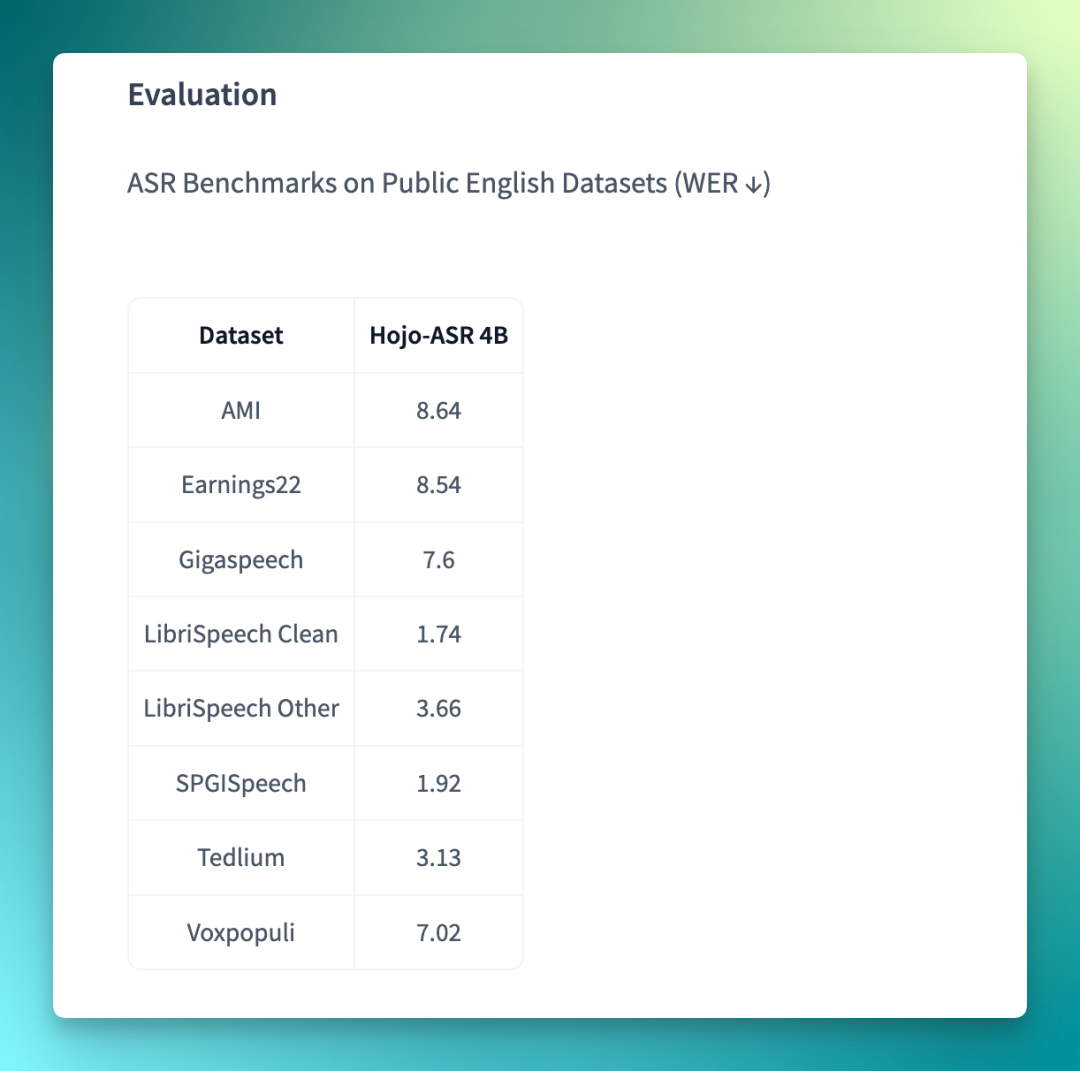
Overall, this is an ASR model that demonstrates competitive performance on public benchmarks. And it is genuinely open-sourced on GitHub and Hugging Face under an Apache-2.0 license, with minimal restrictions on secondary use.
🚥
So we deployed Hojo-ASR-V1 ourselves to see what level this low-profile startup team has actually reached with their speech model, and to use it as a lens for discussing a rapidly heating new narrative in the Agent era: Voice AI.
What exactly is Hojo-ASR? We tested it ourselves
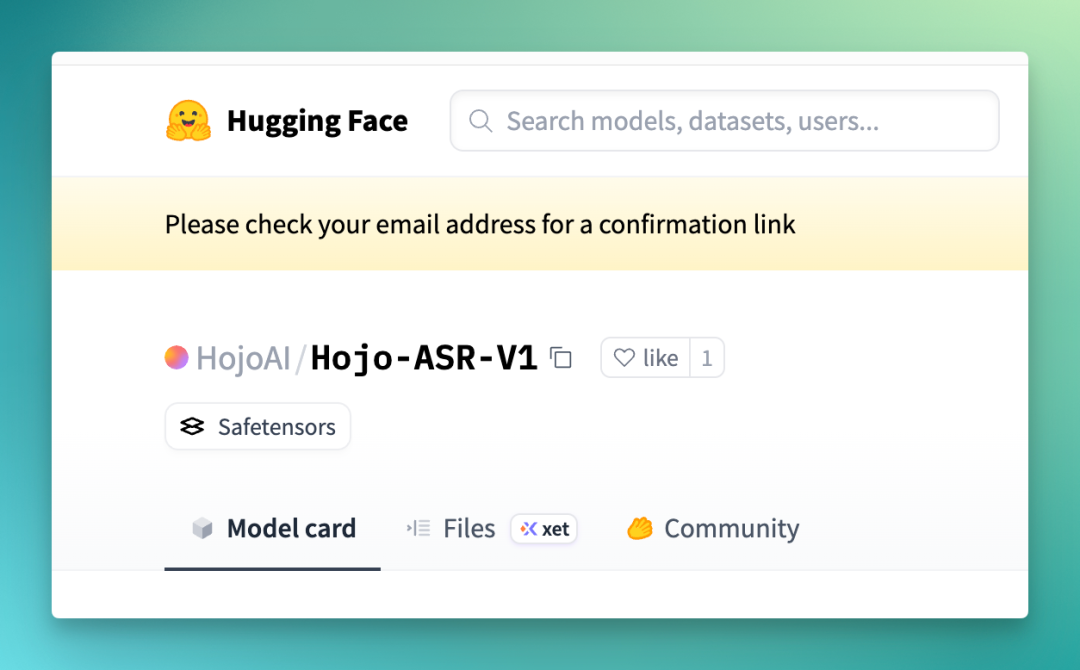
First, Hojo-ASR-V1 is open-sourced on Hugging Face and GitHub:
Hugging Face link:
https://huggingface.co/HojoAI/Hojo-ASR-V1[1]
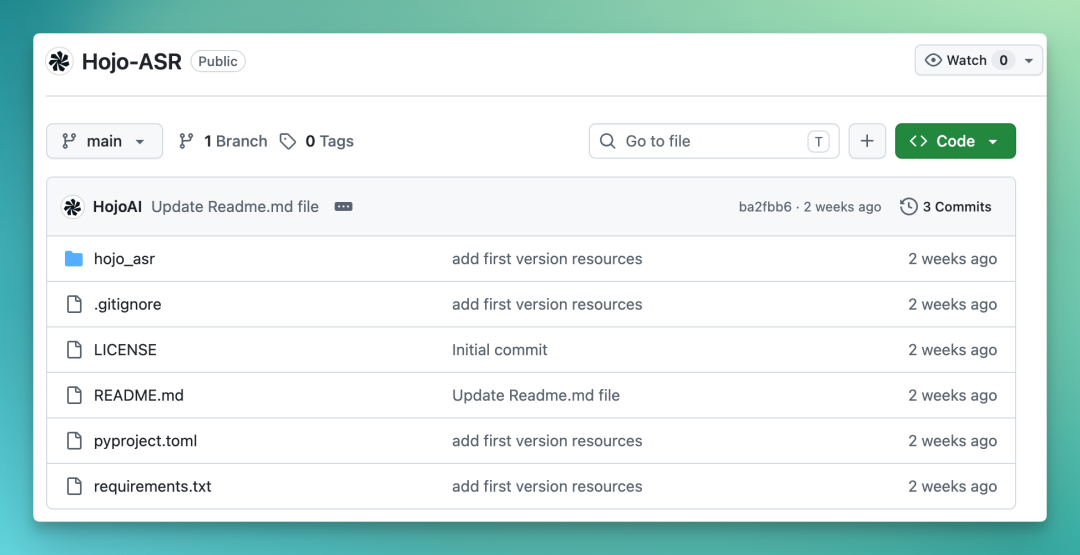
GitHub link:
https://github.com/HojoAI/Hojo-ASR[2]
To be clear about what kind of model Hojo-ASR-V1 is, after actually reviewing its code and configuration, we found its architecture differs from traditional speech recognition models.
Audio is first processed by Whisper's feature extractor to convert it into acoustic features the model can use, then fed into Qwen3-Omni's audio encoder, with a Conformer structure in between for adaptation and compression; finally, it's handed off to a Qwen3-4B language model, which writes out the final text.
In other words:
Hojo-ASR-V1 is an "encoder + adapter + large language model" combination.
The approach of using a large language model for ASR decoding isn't unique to Hojo. This is precisely the mainstream direction at the top of the current OpenASR leaderboard. Several highly-ranked models on the leaderboard right now — NVIDIA's Canary-Qwen-2.5B, IBM's Granite-Speech-3.3-8B, Microsoft's Phi-4-Multimodal — all integrate language model capabilities into speech recognition, pushing average WER down to the 5.6% to 5.9% range.
The benefit of bringing in a language model is that recognition isn't just "hear a sound, write a character" — the model can also use semantics to make judgments. When encountering noise, colloquial expressions, mixed Chinese-English speech, or domain-specific terminology, a model that understands meaning is better equipped to determine what the speaker intended.
Here's the hands-on testing section. We deployed the model locally and ran multiple rounds.
The test cases fall into two categories:
[1] The ASR capabilities of the Hojo-ASR-V1 model.
[2] Hojo-TTS.
ASR
ASR stands for Automatic Speech Recognition.
It's responsible for converting sound into text — the first step in the entire Voice AI pipeline. Whether it's phone voice input methods, meeting transcripts, real-time subtitles, or today's increasingly popular AI Agents, ASR underlies all of them.
I've long been a user of AI voice input tools like Wispr Flow and Typeless.
These products offer a decent experience, but occasionally lag when network conditions are unstable, and there's still room for improvement in Chinese-language scenarios. I gradually shifted toward local deployment solutions, with OpenAI's open-source Whisper being my most frequently used option.
This time, after Hojo-ASR-V1's release, I swapped out Whisper for Hojo-ASR-V1 to see how it actually performed.
Overall, recognition speed and accuracy were both solid — smooth enough for daily voice input. The tradeoff, of course, is that it demands certain local hardware resources and has non-trivial memory requirements.
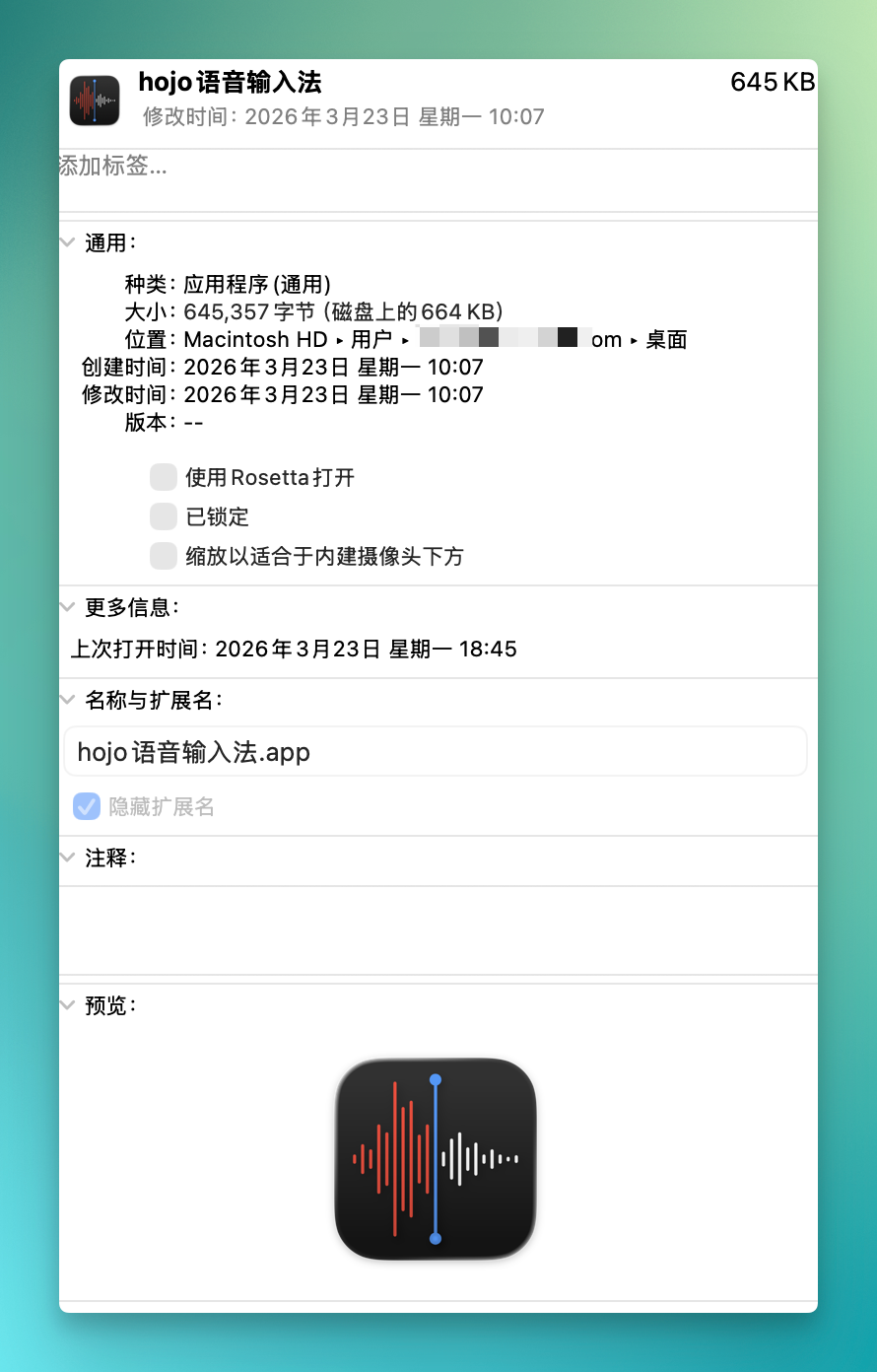
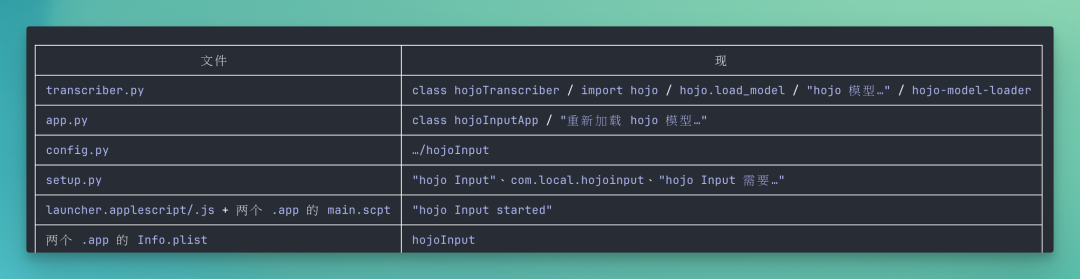
The whole setup isn't particularly complex. At its core, it uses Hojo-ASR-V1 as the underlying recognition engine, then takes over voice input through system-level permissions. Once configured, it works across nearly all text input scenarios — browsers, ChatGPT, Claude, Notion, and more.
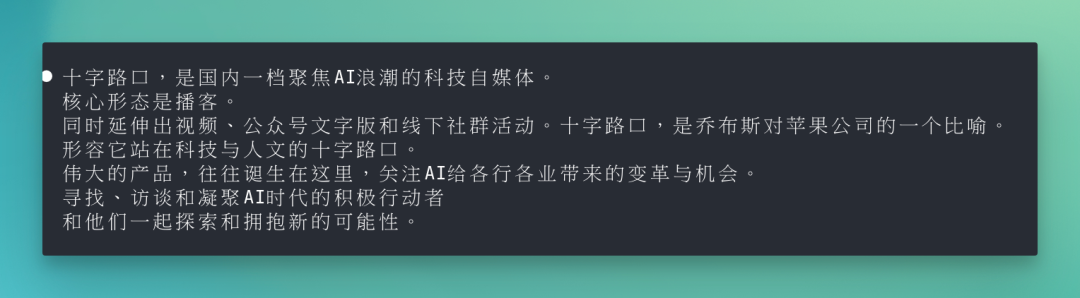
For testing, I directly dictated an introduction to "Crossing," covering the column's positioning, content direction, and the origin of its name. No advance text preparation, no deliberately slowed speech:
What I personally found interesting is that this kind of workflow can be extended further. After recognition completes, you can pipe the text into DeepSeek, GPT, or other models for polishing, formatting, typo correction, and structural optimization.
The overall flow looks something like this:
Voice input → ASR transcription → Large model optimization → Directly into workflow.
For people who write frequently, attend meetings, or collaborate with Agents, this experience feels more comfortable than traditional input methods.
Beyond Hojo-ASR-V1, we also noticed Hojo has invested in the TTS direction. We tested its TTS speech synthesis model this time around, and the team has additionally open-sourced a lighter-weight version called Hojo-TTS-Light. Together these constitute Hojo's answer for Agent workflows.
The other piece of the Voice AI puzzle: TTS
The path we took to experience the TTS model capabilities was through their official website:
hojoai.com

Multilingual speech synthesis — Light, upbeat female voice
First we tested multilingual speech synthesis, a fairly standard TTS feature.
With the World Cup approaching, I had it read a commentary script introducing Japan's national team players in a light, upbeat female voice:
This roughly 30-second Chinese clip sounded quite smooth — articulation and certain details were handled reasonably well, with not much obvious AI feel. The female voice's tone and light, brisk delivery were both discernible. Honestly, when we judge whether a voice sounds natural, we usually listen to its articulation and the tone at the end of each word — this segment basically aligned with the initially set style.
Testing showed Hojo supports quite a few languages: Japanese, French, Cantonese, and others.
Below is the same Japan team introduction script, switched to Japanese. The results were decent too — it genuinely sounded a bit like an NHK broadcast, quite evocative:
Multilingual speech synthesis — Magnetic, steady male voice
This TTS model can also switch between different character voices, and the male voice sounded fine too.
Below is still the 2026 World Cup introduction script, but I set the voice to magnetic and steady male.
This clip aligned pretty well with what I specified in the prompt.
Multi-voice speech synthesis — Audiobook
The TTS model has quite a few usable voices. This time I had it read a passage in audiobook voice. The text was a thematic introduction to Naruto, synthesized in an audiobook male voice.
It sounded quite natural. When reading words like "shōnen," the tail tone was handled in a way that made the前后衔接 very smooth. And with connective words like "and" that we use in everyday speech, the pauses were also well-placed — one reason the whole passage flowed well.
Multi-voice speech synthesis — Whisper
There's one voice I want to call out specifically from testing: whisper.
Below I used a female whisper voice to read a film introduction for The Silence of the Lambs:
You can make out what's being said, while it also simulates the light airflow, subtle breathing sounds, and soft tones of someone speaking right next to your ear. The TTS model's whisper isn't simply turning down the volume — the intonation, rhythm, and emotion are all reasonably well done. This kind of voice works well for suspense commentary, story narration, ASMR, and similar applications.
Beyond standard broadcast voices, I also tested some more distinctive character voices.
Kang Hui
Recently being college entrance exam season, you can hear plenty of blessings and news broadcasts on TV, radio, and short video. CCTV anchors' voices are fairly representative in Chinese broadcasting — standard pronunciation, clear articulation.
So this time I selected a clip of Kang Hui's audio as reference. Below is the original Kang Hui audio.
Voice cloning — Kang Hui
I sent this original audio clip to the TTS model and had it replicate the voice to read a roughly 40-second script wishing college entrance exam students well.
In terms of results, the TTS model preserved the original vocal characteristics quite well, especially Kang Hui's intonation, pauses, and broadcast rhythm. From the very first sentence, you can tell it sounds quite like Kang Hui himself. When reading lines like "live up to your youth, head toward the future," the familiar news broadcast cadence and large-event hosting feel are both present.
Nezha
Voice cloning is a fairly representative capability of TTS models. I used it to replicate several IP character voices, starting with Nezha from Ne Zha.
It sounded quite close to Nezha's unruly, languid feel, with pauses roughly matching that state.
Peppa Pig
Cartoon character voices were also handled reasonably well by the TTS model. Cartoon voices differ from real people and film characters, and present their own processing challenges.
Below is the Peppa Pig voice I synthesized with the TTS model:
MacArthur
I even specifically recorded a clip of the viral "MacArthur" commentary voice from Douyin and had it read through:
"Crossing" is a domestic tech media property focused on the AI wave, with podcast as its core format, extending into video, WeChat public account text versions, and offline community events. "Crossing" is Steve Jobs' metaphor for Apple — describing it as standing at the intersection of technology and liberal arts, where great products are often born. It focuses on the transformation and opportunities AI brings to various industries, seeking out, interviewing, and uniting "active actors" in the AI era, exploring and embracing new possibilities together with them.
Who is the Hojo team
Returning to the Hojo team itself, it's not a company that only does speech large models. Hojo has been around for roughly two years, and before this information disclosure, the outside world knew very little about it. Because of this, we contacted the team to obtain some firsthand information.

According to Hojo's own positioning, what it wants to build more is a Personal Agent OS for knowledge workers. Simply put, it's about getting Agents to truly enter daily workflows for office work, communication, creation, and collaboration — with ASR and TTS being two key puzzle pieces in this system.
This is also the key to understanding Hojo. ASR is merely the first foundational layer for Agents to understand real work scenarios. Only by stably receiving information from meetings, calls, voice memos, and multi-person discussions can the subsequent understanding, planning, and execution possibly work.
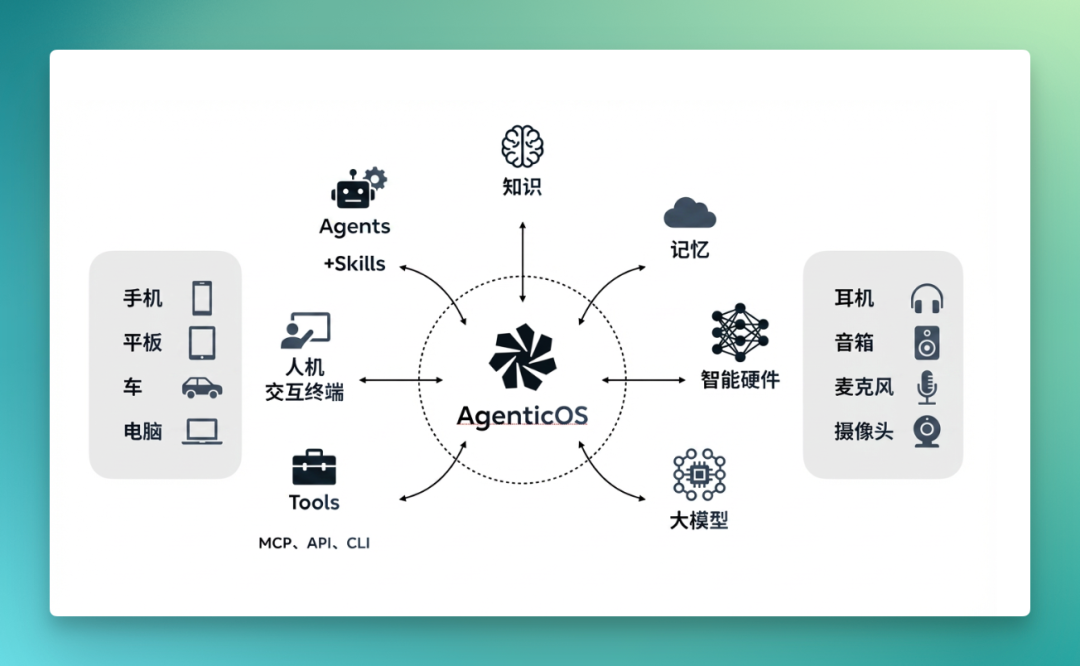
From a team background perspective, one special thing about Hojo is that its core members have long dealt with "real speech scenarios." Team members largely come from in-car voice, smart cockpit, and voice interaction teams, including Xpeng Motors, NIO Nomi, and SenseTime.
To be specific, founder Zhao Hengyi previously worked at LeEco, Xpeng, NIO, and SenseTime, leading voice interaction, smart cockpit, and AgentOS-related work — building in-car voice, smart cockpits, multilingual interaction, AI autonomous app operation, and cross-device services.
Chief Product Officer Li Ou previously worked at SenseTime, NIO, and other teams on AgentOS, smart cockpits, and digital product planning, focusing on how voice capabilities are organized into complete product experiences rather than remaining at single-point model capabilities. COO Sun Xiaogang has experience in Agent solutions, voice interaction commercialization, and industry deployment, having participated in voice interaction solutions for automotive, dining, and mobility scenarios.
Putting these resumes together, the Hojo team's collective experience carries credentials for long-term handling of real-scenario speech problems.
This is mainly because these team members have basically all focused on ASR in relatively realistic environments — scenarios quite different from clean lab audio. In cars there's noise, dialects, multiple people speaking, temporary interruptions, and large amounts of incomplete, colloquial expression. Users don't speak according to standard prompts, nor do they wait for the system to slowly respond. People who've worked these kinds of scenarios more easily understand where speech models actually get difficult — ASR needs to stably understand human intent in complex environments.
Hojo Chief Scientist Su Dan's background also makes more sense placed in this context. He worked on speech recognition R&D at Baidu in his early years, experiencing the phase when deep learning pushed ASR toward commercial deployment; later he led speech-related directions at Tencent AI Lab, catching the phase when large models rewrote voice interaction.
The value of this resume lies in his having continuously experienced several shifts in speech technology: from recognition accuracy competition, to real-scenario deployment, to the large model era's reconstruction of voice interaction. For a company wanting to build a Personal Agent OS, this kind of experience means it won't treat voice merely as an input component — redesigning it within real workflows is what matters.
On the capital front, Hojo has completed nearly 100 million RMB across four funding rounds since founding, even before its product has officially launched at scale, and is currently in its Pre-A round. This information can't directly prove product success, but it does indicate that primary markets have begun paying attention to this company's technical accumulation in the Voice AI and Agent OS directions.
On commercialization, according to Hojo's introduction, its self-developed "large model + Agentic OS" combination already provides underlying voice capabilities for tens of millions of AI voice devices. If this figure is accurate, it means the company isn't just staying at papers, demos, or leaderboards — it has already entered real devices and real user scenarios.
From Hojo's own planning perspective, ASR is only the first step. It's simultaneously working on TTS, and plans to launch a full-duplex speech model by late June. The real story it wants to tell is about building a complete voice interaction foundation around Personal Agent OS: letting Agents hear, understand, respond, and ultimately enter knowledge workers' real workflows.
Whether these plans can be delivered remains to be verified by subsequent products. But at least from Hojo-ASR-V1's performance this time, it has already delivered a sufficiently eye-catching result on the first link of the Voice AI workflow.
So, why did this set of disclosed data from Hojo-ASR attract attention? Or, what kind of context does Hojo-ASR exist within?
Voice AI is the other narrative arc beyond general-purpose large models
As Agents begin entering real workflows, the context they need to receive grows increasingly complex: discussions in meetings, demands in phone calls, sounds in on-site environments, a sentence the user temporarily adds, even constantly shifting instructions during multi-person collaboration.
In the past this information mainly came through typing, but in many work scenarios, the information that actually gets generated isn't written — it's spoken.
This is also why big tech has been加码 Voice AI these past two years. OpenAI launched Realtime API, Google built Gemini Live, and domestically iFlytek, Doubao, MiniMax, and StepFun have all invested in the voice direction.
The heat in this track these past two years can be measured in waves of hot money. According to AssemblyAI statistics, speech AI startups raised approximately $2.1 billion in venture capital in 2025; and in the one-year period from June 2025 to May 2026, there were 36 publicly disclosed funding rounds in conversational AI, totaling roughly $2.58 billion.
One word to sum it up: very hot.
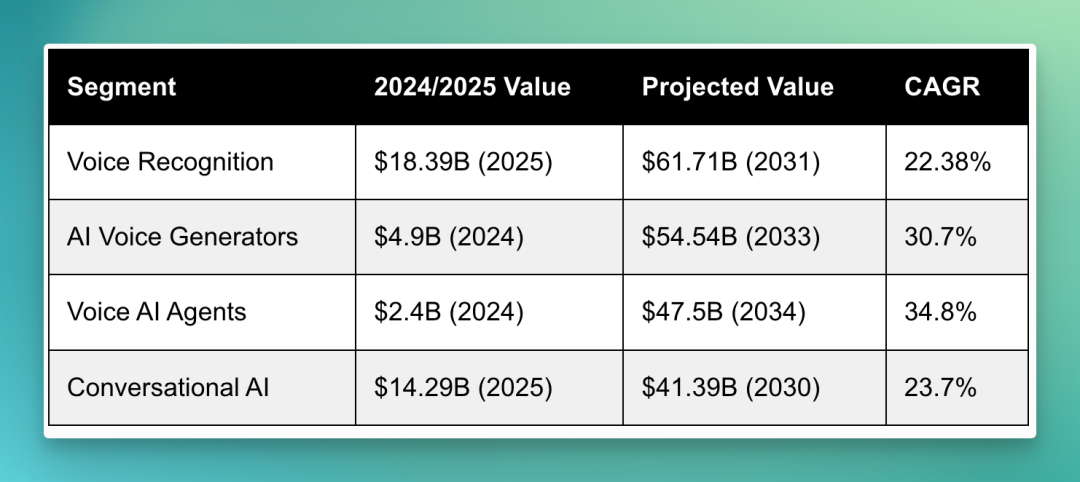
Looking at specific companies: voice synthesis company ElevenLabs raised $500 million in its Series D at an $11 billion valuation; phone customer service voice company PolyAI raised $86 million in its Series D; real-time calling-focused Retell AI processes over 40 million AI calls monthly, with quarter-over-quarter growth exceeding 300%. And teams like Cartesia specifically work to push voice latency under 100 milliseconds, making conversations sound less choppy.
Big tech has also been very active. OpenAI launched Realtime API, making voice an end-to-end solution — voice in, voice out, no longer splitting into "transcribe text, run through model, then synthesize" three stages, but completing the full flow in one pass.
Google's Gemini Live follows a similar approach, able to be interrupted mid-sentence and then continue responding, and also recently launched Voice AI powered by Gamma4:
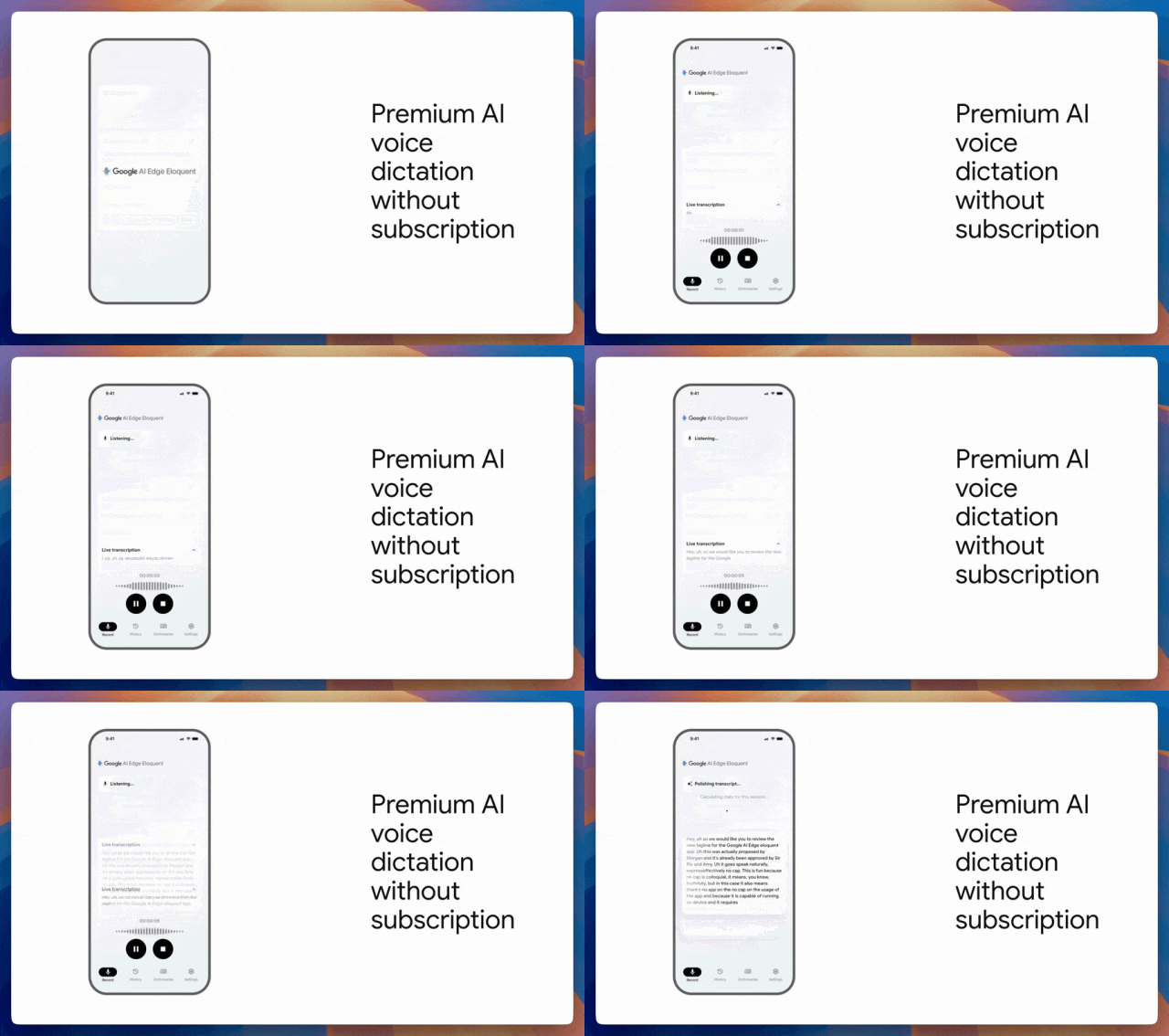
As you can see, voice is transforming from "a more natural interaction method" into an entry point for Agents to acquire context.
Placed within the recently popular concept of Vibe Working, this trend becomes even more apparent. People don't necessarily need to organize every step of demand into complete prompts. They can think, speak, and adjust on the fly, letting Agents catch intent, fill in context, and push tasks forward in conversation — this possibility feels more natural.
In this pipeline, ASR is the first-layer capability. It determines whether an Agent can first understand the real world. If it doesn't hear accurately, subsequent understanding, planning, and execution all become distorted; if it hears accurately, voice can truly become part of the workflow.
To sum up:
As Agents begin entering daily life, voice — that is, Voice AI — will likely be their first point of contact with people. There are many ways for humans and AI to connect: typing, clicking interfaces, writing code to call APIs, but the closest to everyday human conversation is still opening your mouth and speaking.
This is also why more and more people are calling voice the Agent's context entry — the entry point for context. If large models are responsible for understanding the world, then voice is the channel through which the world continuously flows into models.
And in this channel, ASR plays the role of the perception layer. It determines whether an Agent can accurately capture information from the external environment, whether it can transform sounds from the real world into context that models can understand and utilize.
From this perspective, the competitive stakes for ASR have already been elevated:
Contending for the entry point connecting next-generation Agents to the real world.
This is also why Hojo-ASR-V1's disclosed data deserves more attention. What it reflects isn't simply a change in a single model's performance.
Voice AI is moving from auxiliary capability toward infrastructure, becoming an increasingly important foundational layer in the Agent era.
Returning to Voice AI. While most manufacturers' attention is concentrated on general-purpose large models, the voice track — relatively quiet by comparison — has actually been evolving rapidly. Right in ASR, a domain long dominated by OpenAI, Microsoft, NVIDIA, IBM and other big tech, startup teams have begun delivering genuinely competitive results.
The emergence of Hojo-ASR-V1 doesn't necessarily mean the landscape has already changed, but it does demonstrate that Voice AI is moving from marginal capability toward a more important position, attracting more and more people to refocus on this track.
Speech recognition is only the first step of Voice AI. After machines hear accurately, whether they can understand and respond in ways close to human — that's the longer, more valuable, higher-potential story.
Crossing is looking for independent contributors to write AI product and model reviews.
If you've written articles like: "Hands-on with PixVerse C1", "Hands-on with LibTV", please contact zeo0811@gmail.com. Email should include: ① personal introduction, ② AI review articles you've written.
We offer competitive compensation. Looking forward to observing and documenting the AI era together with you 🎪

References