What if a Personal Agent didn't belong to just one person?

Put AI between two ordinary people.
@Chen Zhiyan
In the comments section of last week's Personal Agent article, many readers kept asking: "Do ordinary people actually need a Personal Agent?"
It's a fair question. Nearly all the AI products in this wave are built for so-called knowledge workers: coders, PowerPoint makers, researchers, schedule jugglers. Before the Personal Agent concept was singled out for discussion, the first thing that came to mind for most people looking for an everyday AI product was still Doubao.
In the second half of this year, I noticed an AI app called Twoo. It resembles a Personal Agent in some ways, but differs in others — a product that's hard to explain in a few sentences.
Two people enter the same conversation, where an AI agent named "Little Octopus" resides. It can interject, take notes, look things up, pass along messages for those who find it hard to speak up, or simply stay quiet. Unlike AI companions designed to be friends or lovers, Twoo is built to participate in the relationship between two real people.
"AI + social" is hardly a novel pitch. But most products on the market approach it through AI avatars or AI-as-social-object. Twoo's angle is using AI to serve the social relationship between people.
This is partly what I found difficult to grasp about Twoo: it looks like an IM with AI features added in. But why do people talking to each other need AI at all? And IM is a domain the tech giants have dominated for a decade without much innovation.
According to data the Twoo team shared with me, the product has been live for roughly three months with over 60,000 DAU. New user next-day retention is 68%, and 30-day retention is 23%. Among AI apps that generally struggle to keep users around, these numbers seem decent.
Between July and October this year, I spoke with Twoo founder Xi Chen several times, always circling back to the same question: why do two people need an AI between them?
1
When Twoo first launched in July, one of its most active user pairs was a married couple who wrote novels together.
Previously, they each wrote with GPT separately, sending their sections to each other for feedback, then pasting that feedback back into GPT. When they did this in Twoo, the AI would generate a plot segment, one person would say "take it in this direction," the other would share their thoughts and update the setting, and the creation would continue.
But when they weren't discussing their writing, they talked about daily life in Twoo: what kind of school to choose for their child and what documents they'd need, what to handle for next month's move, what couldn't be forgotten that day. In Twoo, Little Octopus handled memory, reminders, and picking up conversational threads.
Chen calls this kind of need "ordinary people's chore coordination."
The stuff of ordinary life tends to be fragmented, ongoing, and intertwined with different people. Chen says people rarely realize how much collaboration their lives contain: the person buying groceries has to balance everyone's dietary needs; it's usually children who remind elderly parents to take their medicine; before picking up a child from school, spouses need to coordinate schedules; a child's study plan typically comes from parental arrangement.
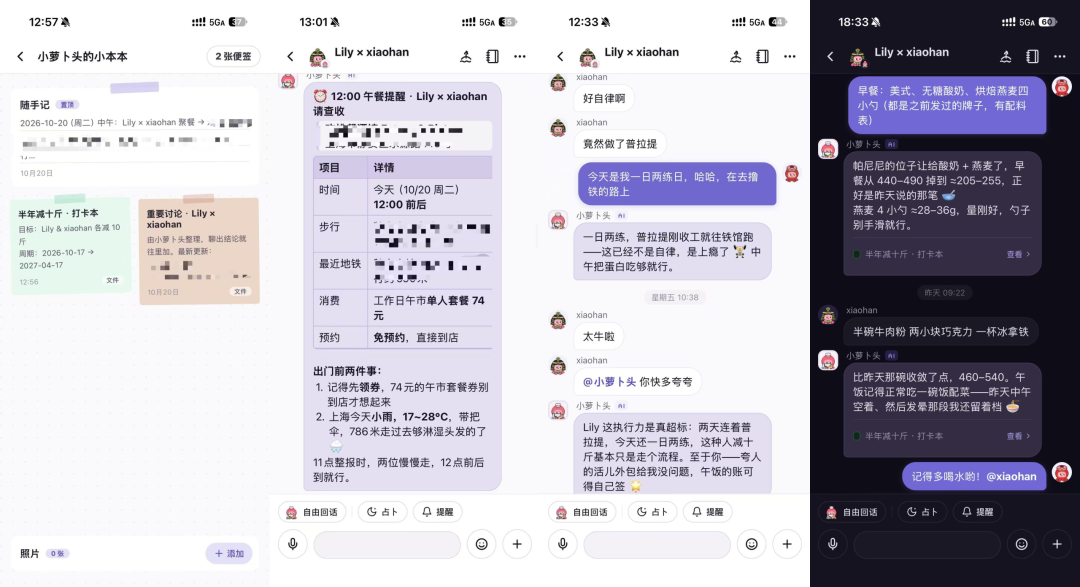
My weight-loss island with Xiaohan
The most typical example is trip planning.
Unless you're traveling alone, the person making plans needs to collect companions' budgets and preferences, find recommendations, consult AI, make trade-offs, then send the results back to the group. New requirements mean revising everything all over again. Twoo tries to let this process happen directly in chat: two people discuss, Little Octopus chimes in with supplements, and once a plan forms, it gets recorded in their shared "little notebook."
At the airport, forgetting which terminal or gate? Just ask. Last-minute itinerary change? Have it modify the plan, both people can see it — no need to hunt for which file is the final version.
Twoo itself was born from chores.
Initially, Chen built himself an AI bot in Lark to manage life minutiae. But he immediately ran into a problem: many things didn't affect him alone. Grabbing a meal with friends, for instance, meant balancing his own nutrition plan with others' tastes. He found himself constantly screenshotting messages back and forth between the AI and friends.
It was too much trouble, so he simply created several "two people + bot" groups in Lark. When he needed to discuss something with these people, he'd pull the bot into the conversation directly. He gave the bot high freedom to interject at will, but with strict instructions never to leak information from other groups.
Gradually, Chen noticed that conversations originally happening on WeChat began migrating to these groups. This showed him a possibility: AI didn't need to build a relationship from scratch — it could participate in an existing one.
2
There's no standard way to use Twoo. People in different relationships have turned Little Octopus into different things. The core insight is that with another person present, using AI takes on different meaning.
One user once told Chen that Twoo's value lay in "using AI to look things up while the other person is right there." Searching for "what's good to eat nearby" or "what exhibitions are on this weekend" was really expressing: "I want to go with you."
Setting a "remember to take your medicine" reminder with a Personal Agent is schedule management. Setting the same reminder for your mother in Twoo carries an additional layer of expressing care.
This isn't to assume users come to Twoo already equipped with "emotional expression." Often, they simply find a feature convenient, and later discover that things buried in their hearts become easier to say in this conversation, in this alternative way.
In some conversations, Little Octopus serves another function. When the other person sends a message and you're busy, the conversation might otherwise stall. But in Twoo, Little Octopus responds first. Sometimes you've seen the message but don't know how to reply — it offers a stepping stone.
What exactly is an AI situated within a relationship?
Assistant, pet, messenger, conversation starter, buffer zone — all apply, yet none fully captures it. Chen's definition for Little Octopus: seventy percent functional value, thirty percent emotional value.
"Without that thirty percent emotional value, people wouldn't use it."
According to Twoo's latest statistics, within a new user's first 24 hours, 52% set a reminder and 36% open the little notebook. Users who complete either of these actions have roughly triple the 30-day retention of those who don't.
3
However, the biggest problem Twoo faced after launch wasn't whether Little Octopus was working — it was finding someone to use Twoo with. Partners, best friends come to mind easily, but extending to ordinary friends is harder.
Chen told me that friend requests sent via Twoo ID and invitation links have an acceptance rate above 95%. But this only describes requests already sent. The hard part is before sending: users must guess whether the other person would be willing.
Some users found their own solutions. They posted on Xiaohongshu looking for strangers to use Twoo with, to raise Little Octopus together. Not necessarily because they were interested in a specific person — sometimes they simply wanted to try the product and needed another person to cooperate.
These behaviors pushed the team to build "the Dock," where users can find fellow travelers to "board an island" together in Twoo.
Close relationships are Twoo's most natural starting point, but close relationships don't always share the same interests. Partners may not play the same games; best friends may not be preparing for the same exam. No single relationship can carry all of a person's companionship needs.
So in the Dock, requests appeared for CET-4/6 study buddies, weight-loss partners, quit-smoking partners, even "drink 8 glasses of water daily" partners. Two people motivate each other, Little Octopus helps make plans and sends timed reminders. Neither has to constantly bear the burden of pushing the other, nor decide at the outset how far this relationship will go.
An AI app born from intimate relationships now includes stranger socializing — is this appropriate?
In Chen's view, younger generations don't start by defining "what kind of relationship are we" and then decide what to do together. Often it's the reverse: there's something you want to do first, then you find a person.
He believes that when AI can provide sufficient knowledge and capability, human relationships will actually return to something more purely about the relationship itself.
When I first heard Chen say in July that Twoo would serve managing a relationship, I asked him: "Isn't this the kind of awareness and need that only 'good students' have?" When I saw him again two months later, Twoo already had numerous user-created Docks for different interests and tasks. This was quite different from the AI-participating couple's group of the beginning.
The next question: is any of this enough to make two people leave WeChat for a different chat window?
4
"Users' time on Twoo doesn't eat into their WeChat time — it eats into their Doubao time."
The first time I heard Chen say this, I thought he was being arrogant. But as he explained further, I realized it wasn't about benchmarking.
"What triggers us to ask Doubao is usually conversation with someone else. You only look up restaurants after making plans with someone; you only check weather when planning to go out with someone; you only look things up when you've discussed a topic together." He believes needs grow out of relationships. "It's just that in the past, we had to cut away from the human conversation, then turn around to ask AI alone." Twoo wants to put that step inside the conversation.
I later realized that beyond this convenience and subtlety, an important part of what Twoo addresses is how AI products acquire context.
Personal Agents build understanding and memory of an individual by connecting calendars, email, and so on. Work Agents complete job context by accessing documents and knowledge bases. Twoo's source of context comes from placing Little Octopus inside an ongoing conversation between two people.
In Twoo's chat interface, users can tap a mute button to silence Little Octopus.
According to Chen's observation, some users with multiple islands first turn off Little Octopus's free interjection, yet continue chatting there. His interpretation: users may not need AI to constantly respond, but they want the information to stay here, accessible when needed without re-explaining everything.
This also explains a somewhat stubborn limitation: from intimate relationships to stranger partners, Twoo's uses keep expanding, yet an island always allows only two people.
Why not more? Chen has calculated: two people means one relationship edge, three people means three edges, six people means fifteen edges. "Today's models cannot clearly define goals in multi-person groups, nor can they easily satisfy multiple people simultaneously."
More troublesome is the attention problem. Two people talking have naturally aligned goals — the AI serves this one goal. Add more people, and whoever the AI responds to, the rest become outsiders. The AI immediately shifts from helper to noise. This clearly undermines effective context accumulation.
Of course, AI agents will have value in multi-person groups too — Twoo simply chooses to handle a smaller unit first.
Then the question: what if WeChat embeds an AI assistant into conversations one day?
Chen also thinks WeChat, Xiaohongshu, and ByteDance might all do this. But he sees Twoo's opportunity in the distinction between "having chat history" and "users being willing to hand that to AI."
Some users have explicitly told him they wouldn't want AI to directly read their existing conversations. But starting from a new window, users know from day one that AI participates in chats here.
5
Chen studied mathematics in college. After graduating from University of Chicago in 2010, his first job was quantitative trading on Wall Street.
In 2015, he returned to China and founded Chuiyi, a men's clothing subscription platform: users submitted preferences, the platform sent curated outfits, customers kept what they liked and returned the rest. Chuiyi raised through Series B but ultimately didn't survive. Afterward, he worked at Alibaba and ByteDance before starting this venture earlier this year.
Compared to his quantitative training, his previous startup may have influenced him more directly.
The Chuiyi team once reached over 400 people. Chen recalls that as the team suddenly expanded, many lacked trust foundations. He began trying to maintain the image of a "capable CEO." When the company hit difficulties, others still willing to follow him made him feel he couldn't let them down. But guilt, people-pleasing, and pretense are poor foundations for lasting collaborative relationships.
This time, he hopes the team can speak directly to each other. With Twoo, the goal is "both the process and results have to be enjoyable."
Chen says he's deeply influenced by Netflix's culture of "Context, not control." The Twoo team keeps full transcripts of meetings, feeds collective discussions to AI, and advances work from shared background.
"Things the team doesn't know that only partners know — that's maybe 1%."
Behind this lies his own epistemology. Chen told me he believes humans approach truth through only two methods: either repeated experimentation, or tools of higher dimensionality — just as without a magnet, humans cannot perceive magnetic fields. In his view, large language models belong to the latter. "Human conversation is a low-dimensional shadow cast by a high-dimensional relationship, and models can see connections invisible to people."
By this account, Little Octopus is the magnet he places inside a relationship.
This doesn't fully explain Twoo's origin, but it helped me better understand why Chen built it. "Most relationships don't die from conflict — they die from maintenance costs becoming too high." He's said this to me several times.
However, Chen's product philosophy isn't easily understood by many; some investors have pressed him with challenging questions.
When I met Chen again in September, he no longer wanted to prove that "everyone needs Twoo." He said people who choose this product are precisely those who recognize AI participating in relationships this way. Just as different people choose different collaboration tools, there's no need to first argue out the one correct answer.
In recent months, Twoo hasn't been the only one moving in this direction.
On October 19, Wabi — the new product from Replika founder Eugenia Kuyda — opened to users. After a decade in AI companionship, this entrepreneur's new product takes the form of a chat app where several people share a conversation, and AI can help track school forms, household schedules, and other chores. This "multi-person shared AI assistant" concept overlaps considerably with Twoo's approach.
Near the end of one conversation, Chen mentioned a detail. He noticed some users open Twoo daily not saying "you there?" but "come collect shells." Shells are the in-app virtual currency; after collecting, the two people often continue chatting.
No response to "you there?" hurts the sender a little. No response to "come collect shells" allows self-consolation — the other person just isn't interested in shells. Little Octopus and shells leave some room for hesitation.
This may still not fully answer why two people need an AI between them. But it may suggest that the individual needs Personal Agent points toward aren't necessarily about just one person.
Cover image: Jean-Antoine Watteau, The Embarkation for Cythera, 1717, Musée du Louvre
Powered by @Twoo