o1
OpenAI o1
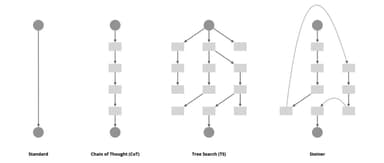
OpenAI o1 is a reasoning-focused large language model released in September 2024, distinguished by its deliberate "system 2" approach to complex problems. Unlike earlier GPT models optimized for rapid response, o1 uses reinforcement learning to perform extended internal chain-of-thought reasoning before answering, enabling it to self-correct and explore multiple solution paths. In benchmark tests, it solved 83% of International Mathematical Olympiad qualification problems against GPT-4o's 13%, and ranked in the top 500 nationally in North American math competitions, with performance in physics, chemistry, and biology comparable to PhD-level expertise .
The model introduced a new scaling paradigm: rather than relying solely on pre-training compute, o1's capabilities improve with both increased reinforcement learning during training and longer "thinking time" during inference, a shift that rebalanced GPU allocation across the model lifecycle . However, it launched as a deliberately narrow tool—lacking ChatGPT's browsing, file upload, and image processing features, and weaker on factual knowledge—reflecting what Yunqi Capital described as OpenAI's move toward "not pursuing everything at once, but closer to real-world scenarios" . By April 2025, OpenAI had begun phasing out the o1 series in favor of o3 and o4-mini, which added image reasoning and tool-use capabilities at substantially lower cost .
AI-generated — may contain errors, please verify.
Coverage
Moonshot AI Releases Visual Reasoning Model k1, Outperforming OpenAI o1 in STEM Benchmarks | Z News
Every pixel deserves deep thought.
30,000-Word Transcript: A Google DeepMind Researcher on Deconstructing OpenAI o1 and the LLM+RL Paradigm | Z Talk
The most hardcore, no-fluff technical breakdown of o1.
Yichao Ji, Peak: A Small Step Toward Replicating OpenAI o1 — Steiner Open-Source Model Progress Report | Z Talk
Since OpenAI released o1, I've been working on reproducing it as a side project in my spare time.
Moonshot AI Founder Zhilin Yang's Latest Take: Deep Reflections on OpenAI's o1 Paradigm Shift | Z Talk
The Next Phase of Foundation Models: A New Paradigm?
A Quick Guide to the Pros and Cons of OpenAI’s New o1 Model | Yunqi Tech Pi
Where's the ceiling for large language models?