Jensen Huang Shorts United States AI

Old-school playbook

"The old-timer playbook." There's a joke in here somewhere: first slap on the label, then pick your side — and the tactics are still those of the old generation.
The Jensen Huang affair has shown everyone what a pure, old-school playbook looks like: with zero legal basis, relying solely on a few Western mainstream media reports citing anonymous sources, plus pressure from members of Congress demanding hearings, you can make the founder of today's most important AI company surrender all his power as if committing suicide, reduced to a lamb waiting to be carved up.
And people say the media is useless, that American politicians are incompetent?
The New York Times, Marco Rubio, and Anthropic have just demonstrated for everyone what it means to kill with a flying knife in the name of press freedom, what flagrant racial discrimination looks like, and what a line struggle is — starting from a private-life issue, pivoting to a national security narrative, and then utterly destroying the open-source AI technical route to defend AI monopoly hegemony.
Now let me walk everyone through this rare, purebred Cold War playbook — a specimen you won't see again in 2026.
The most remarkable thing about the Jensen Huang affair is that right up until his resignation, the espionage status of the person he had an affair with was never publicly confirmed. Not a single head of any U.S. intelligence agency dared to confirm that the affair partner was a spy.
The entire escalation process rested entirely on a few speculative reports from the New York Times and others, with all core information coming from anonymous sources. The earliest origin was an October 29 New York Times report citing "anonymous people familiar with classified intelligence," claiming that "U.S. intelligence agencies have determined" that Alice Huang was passing intelligence.
After that, Western media outlets piled on, all citing anonymous sources.
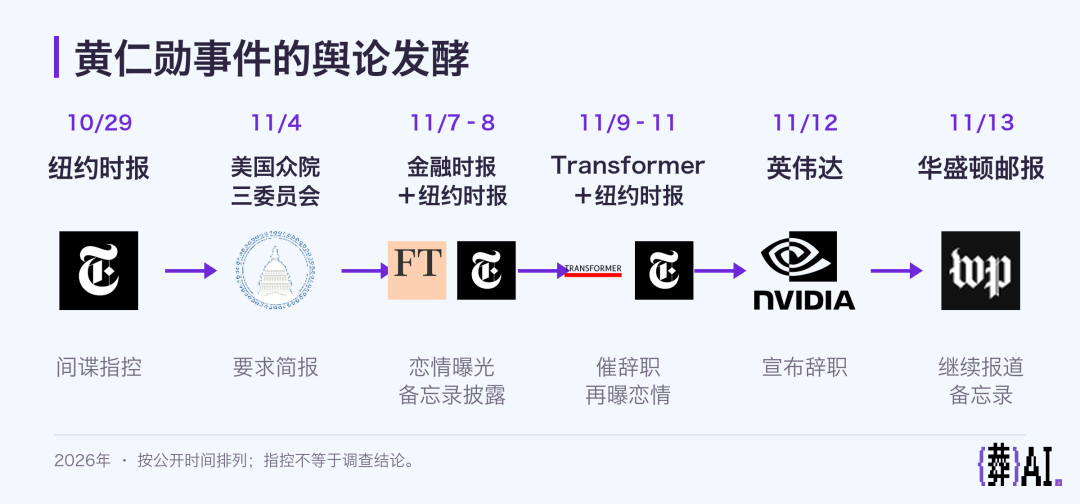
The Financial Times then cited "people familiar with the memo" to further characterize the relationship as a romance; the New York Times on November 8 cited "multiple people briefed on the matter" to report that Rubio had overseen the drafting of a warning memo. The Washington Post on November 13 cited an anonymous individual familiar with the matter, saying Rubio had used more definitive language in his memo based on a CIA report.
These formulations are still too highbrow — a bit too refined for the masses.
Then there were the more down-market outlets. The Economist jumped in with "Jensen Huang is caught with his pants down" — caught with his pants half off. The New York Times even brought in a freelance contributor to write an op-ed titled, essentially, "Jensen Huang betrayed the leather-jacket enthusiast community."
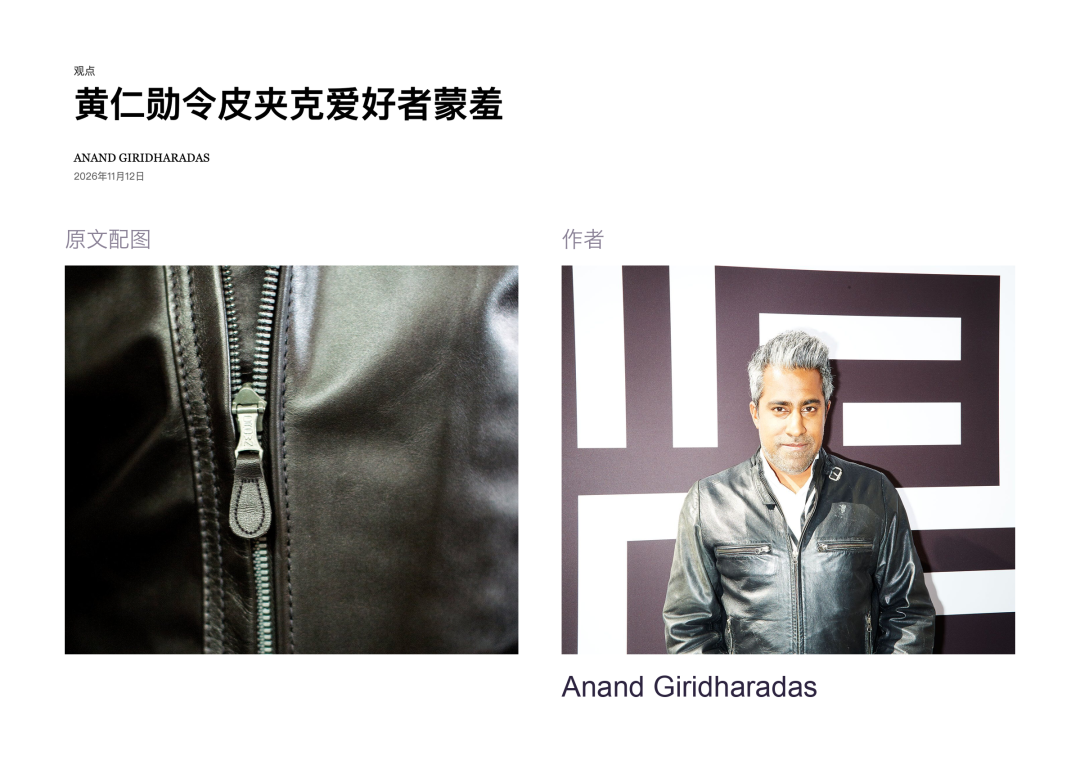
See, the playbook differs by audience. For government-facing communication, you write it straight: espionage suspicion, paraphrasing what a classified government memo said. For the internet crowd, you go for pure personal humiliation — the masses are stunned that an article can even be written this way, and meanwhile you make sure that the moment Jensen Huang opens his phone, he sees it too, maximizing the odds of pushing him over the edge.
Struggle — genuine political struggle — has rhythm, has layers. It comes in waves, one after another, smearing everyone around the target so the person at the center bears the maximum possible pressure in the shortest possible time, ensuring psychological collapse.
This is the highest form of struggle strategy: manufacturing a fait accompli.
Strike first to gain the upper hand. By the time everyone reacts and realizes there's no evidence, it doesn't matter — the fait accompli has already been established. Jensen Huang resigns, NVIDIA is bound to change drastically, and the standard-bearer for open-source AI has been taken out.
You can even work backward from the manufactured facts to justify the persecution. I've seen plenty of arguments like this over the past few days: "If Jensen Huang had nothing to hide, why did he resign? His resignation proves he has serious problems."
First strip the target of his power, then break him down, and the subsequent process of formalizing charges becomes much easier.
Once Jensen Huang has been smeared, all his actions can be used as ammunition. His biographer, American journalist Stephen Witt, wrote a piece on the fall of the AI king, arguing that Jensen Huang's arrogance led to his downfall.
One example he cited: Jensen Huang once left a $1,000 tip for a server at a Denny's where he'd worked as a busboy, without making a fuss about it — the reporter only found out by going and asking the staff himself. From this, he argued that Jensen Huang's humility was a performance and that he was actually deeply arrogant.
Does the media carry a curse? Does working in media long enough make your brain abnormal and your morals especially corrupt?
So, folks, stop getting all dewy-eyed over code all day — you need to study political struggle. Watch Ming Dynasty (the TV series), watch the Dreyfus film (J'accuse), watch Oppenheimer, students.
If you don't study the classic playbook of persecution, then one day when it's turned on you, you'll still be pondering procedural justice — and that's the end of you. Next time the New York Times, Financial Times, or The Economist says they want to interview you, and you accept — wouldn't that be an even more complete disaster?
The only flaw, in hindsight, is that this struggle tactic is a bit crude — evidence that American politicians are declining generation by generation.
Not a single instigator has stepped forward to take responsibility. Secretary of State Rubio, who pushed the investigation all along, and the heads of the Justice Department and intelligence agencies — not one of them dared to publicly state that Jensen Huang's affair partner was a spy.
You should know that while the New York Times is at the higher end of the media spectrum, compared to politicians, it's still quite dumb.
Media people don't have the ability to invent narratives. The Jensen Huang story unfolded layer by layer, with more and more material "dug up," and yet on close inspection there was no actual evidence for any of it — this is clearly politicians selectively leaking material and setting the agenda.
American politicians let the public direct all its fury at the media. Such a lack of accountability — how will the New York Times dare to charge into battle for you next time? That reporter who got flamed by netizens and locked their Twitter account for saying Jensen Huang insulted leather-jacket enthusiasts — will they dare to be that opportunistic again?
Rubio used the media as a gun and then pushed the media out to take the blame. This chills the heart of us Journalists who claim to represent the people. From this, one can see the man has no sense of responsibility, is all clever tricks, and will certainly not accomplish anything in the next term.
Even David Sacks — a man in Trump's orbit, co-chair of the President's Council of Advisors on Science and Technology — couldn't stomach it.
He tweeted that "the spy narrative is already collapsing." The Attorney General said there was no conclusion yet; the FBI, CIA, Justice Department, and Office of the Director of National Intelligence had all likewise not classified anyone as a spy. The Democratic congressman about to become chair of the House Intelligence Committee also said after his briefing that he had reached no conclusion.
So where exactly did this spy designation come from? Entirely from the New York Times and other outlets, citing anonymous sources and writing up classified memos they'd seen on their own.
It seems Silicon Valley investors still have slightly more professional integrity than New York media people.
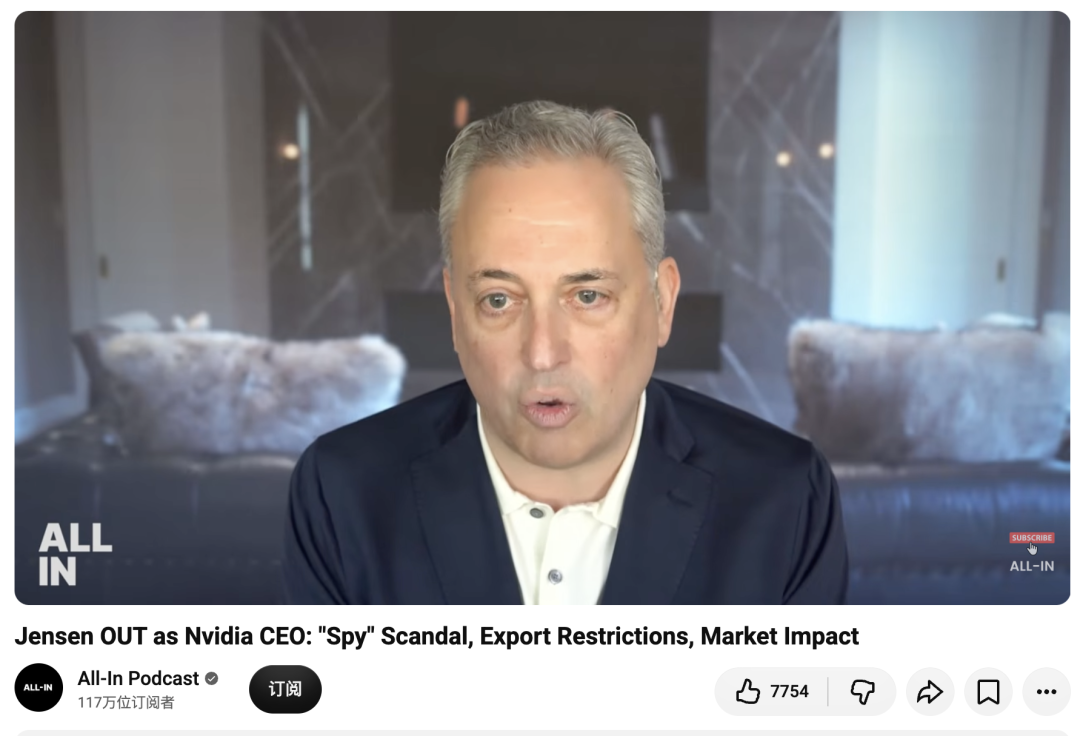
David Sacks is also calling for an investigation into who exactly leaked classified government memos to the New York Times. On the latest All-In podcast, he warned: with Jensen Huang fallen, who will defend open source, who will fund it? What the security faction wants is for the U.S. government to control all models and chips.
All I can say is: Trump may be terrible in a thousand ways, but in demolishing these Western mainstream media outlets, he's done a great service. The subjective malice of these Western mainstream media is something you can only truly feel if you've experienced it firsthand.
Politicians — you already know they've decided to destroy you. But with outlets like the New York Times, people who haven't been educated by reality easily mistake them for caring about facts, easily get into arguments with them. In reality, you must not engage these people at all — the moment you talk to them, you're finished.
The American media even tried to drag Singapore into it. The Wall Street Journal cited anonymous sources saying Singaporean officials had conducted a spy-related investigation into Huang.
Singapore's Ministry of Home Affairs immediately issued a statement denying it, clarifying that Singaporean authorities had never conducted any espionage investigation and that no official had ever said anything of the sort to the media — what had been investigated earlier were local legal violations such as server procurement declarations.
Having analyzed the specific struggle tactics, let me now explain the reasons behind the persecution of Jensen Huang.
The main reason is that Jensen Huang has consistently advocated limited sales of NVIDIA chips to China and supported open-source AI.
This puts him in direct conflict with politicians like Rubio, who advocate a total chip embargo, and with Anthropic, which insists on a closed-source approach. For a long time, Jensen Huang relied on his godfather status in the AI industry and his solid personal relationship with Trump to withstand some of the pressure.
That's why you still see Jensen Huang constantly opposing chip embargoes, hoping the whole world will use NVIDIA chips, not wanting China to build a separate new AI ecosystem from scratch. This is of course not entirely altruistic — the most direct practical interest is that whether open-source or closed-source, large models all run on NVIDIA chips, so as long as the AI industry grows, NVIDIA benefits.
Chip bans directly reduce NVIDIA's orders and also catalyze China's determination to build its own computing chips. The current result is that almost all open-source models can be run for inference on domestic chips, and DeepSeek and LongCat have already trained on domestic chips.
This is also the main reason why, even though LongCat always benchmarks against Claude models from a year ago, I consider LongCat truly great.
From the perspective of U.S.-China competition, Jensen Huang is actually the one genuinely constraining China's AI development. Because his ideal is for models everywhere to run on NVIDIA chips.
The biggest cost for model companies is compute expenditure. If Jensen Huang's ideal were realized, then even if Chinese companies trained first-rate models, they would have to spend most of their resources buying NVIDIA chips.
At this stage there's no choice, but if the situation is still the same 10 years from now, then hasn't China's open source been for nothing?
All I can say is: Old Huang's intentions may have been bad, but American politicians have executed them well. These short-sighted rats have taken out the American who understood AI chips best.
For Anthropic, it's ideology and practical interest combined that drive their opposition to Jensen Huang.
On the practical-interest side, China's open-source models have shattered the ideal scenario in which the two American companies OA monopolize the AI industry.
I laid this out fully in Wenfeng Liang Shorts Anthropic: most ordinary people don't need the newest, most expensive Claude models — DeepSeek-V4.1-Flash, with far lower inference costs, is enough for the vast majority of office tasks. There are a ton of these Flash models in China, from Qwen to GLM, and the free tokens are more than you can use up.
This is basic economics: value comes from scarcity, and supernormal profits come from monopoly. Without monopoly, the large-model industry is just heavy-asset manufacturing, and long-term margins won't be higher than chemicals, solar, memory chips, or new energy vehicles.
Even though Anthropic remains far ahead in coding, its IPO valuation has been slashed — from the $2 trillion that had long been rumored down to roughly $1.3 trillion now, almost hugging its last primary-market round valuation of $965 billion.
This demonstrates the greatness of China's open-source models — great precisely because they are anti-monopoly. America won't do antitrust, so open-source AI does it for you.
Open-source AI is a technical route, but this technical route directly opposes the ideology of closed-source monopoly — that is, Dario's ideology.
Dario's thinking boils down to this: I represent the light, and I must fight the darkness. The way to fight the darkness is to make myself the guardian of the AI industry, to have Anthropic run AI industry regulation, and to let a small group I control decide the world's AI industry.
And the difference between guardian and ward is: because I represent free, safe AI and the other side is dictatorial, unsafe AI, of course I must keep things closed-source and prevent AI technology from falling into the hands of the wards.
Thus you can argue in an infinite loop.
Honestly, this line of thinking is identical to Grand Ayatollah Khomeini's Guardianship of the Jurist — monotheistic religions all end up with the same playbook. I felt this deeply when I visited AI founders in Iran; I'll expand on that another time.
On the whole, most Chinese entrepreneurs have been too well protected at home and have no understanding whatsoever of real struggle and persecution.
Jensen Huang is demonstrating for everyone the typical American "break a man" closed loop:
First manufacture public opinion, then hold hearings, and under round after round of interrogation by all manner of bizarre congressmen, wait for the target to crack and say something reckless. Then you can use that reckless statement to convict, and in turn prove that the earlier public opinion was correct.
Completely legal and compliant, complete procedural justice, no actual evidence needed at any point — only the hearing stage to complete the evidentiary loop.
There are only two ways to respond. One is like Dr. Fauci, White House Chief Medical Advisor under Biden, who — fully pardoned by Biden — had nothing to fear and invoked the Fifth Amendment to refuse to answer no matter what congressmen asked.
The other is like TikTok CEO Shou Zi Chew — no matter how stupid the questions, deflect and answer around them. As long as you don't crack, the one who cracks is the other side.
There's also the rare confrontational approach — several of Trump's colorful characters, like Secretary of War Hegseth, dare to go toe-to-toe with congressmen at hearings. But that's a low-road tactic, for people who've decided they're done with Congress; no one except those close to the President himself can pull it off.
Endurance: you have to be able to take the long view and hold your ground!
Jensen Huang running so fast caught everyone off guard. Trump and the people around him — which of them hasn't sat through dozens of hearings, collected a pile of court summons they could roll into joints? They all crawled out of a hail of bullets!
As the saying goes: "Your subjects were ready to fight to the death — why did Your Majesty surrender first?"
The tens of thousands of NVIDIA employees and the hundreds of thousands of AI practitioners upstream and downstream hadn't even been mobilized yet, and Jensen Huang suddenly resigned, creating a very passive fait accompli. Look at the pro-Huang camp now, including Elon Musk — all they can do is call on NVIDIA's board to bring Jensen Huang back.
More importantly, once the political machine on Capitol Hill starts running, it won't stop without drawing blood. The last time, at a far smaller scale, was the TikTok affair, which ended with China and the U.S. negotiating a deal where ByteDance retained 19.9% equity in the U.S. joint venture and ceded control over the recommendation algorithm and user data.
How brutal the interrogation Jensen Huang will face at a congressional hearing, now that he's lost NVIDIA's protective armor, and whether he can hold it together under the relay-race assault of hostile politicians without saying something reckless — that remains a very high-stakes risk.
Finally, I can't help but marvel: the main problem with the American superstructure is stupidity — the media and politicians cutting off one of America's own AI arms, while thinking they can hurt China's AI industry.
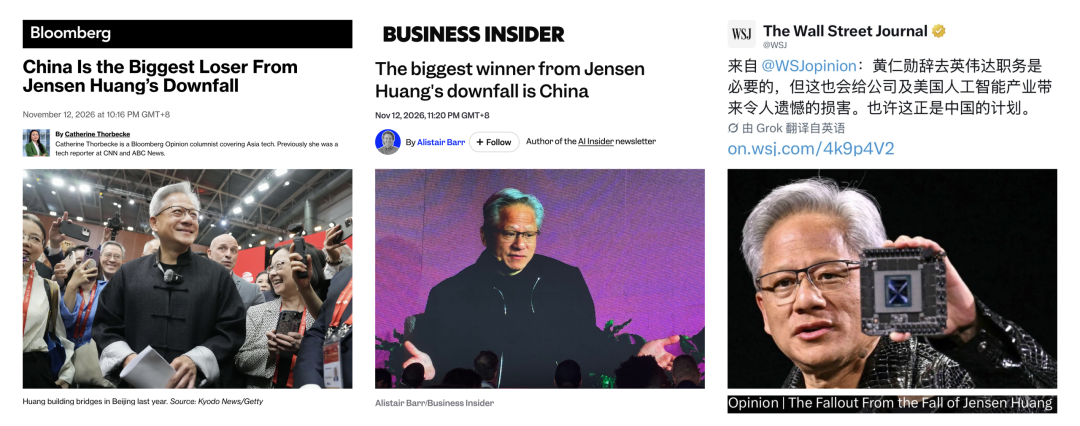
Reading the American media these past few days has given me an unbearable sense of secondhand embarrassment — these people, in order to feel like they're winning, will genuinely say any nonsense. Bloomberg said the biggest loser from Jensen Huang's resignation is China; Business Insider said the biggest winner is China; a Wall Street Journal opinion piece speculated that maybe this was China's plan all along 🤡
After reading it all, you can only feel bewildered: is it that the American media has completely lost touch with the reality of the AI industry and just makes things up all day? Or are these people mainly malicious, wanting to sabotage American AI?
America has hounded its most outstanding AI entrepreneur into fleeing. Meanwhile China's self-developed foundation is already well prepared; all that's left is time to gradually optimize performance — just like what happened with manufacturing, new energy vehicles, and memory chips.
The key point is that persecuting Jensen Huang yields no benefit except a thrill, while the damage it causes is long-term and infinite.
The American superstructure has this feel of flailing wildly with haymakers — all long-term strategy is abandoned, and everyone's muscle memory kicks in: persecute the most prominent, most successful Chinese AI godfather that everyone's been resenting for a while, and worry about it later.
As the saying goes, there are ways to win even in losing — the American media and politicians just have to feel good about themselves first. After I win, let the flood come.
Finally, worth reiterating the view I've emphasized in pieces like Open-Source Models Are the United Front, Wenfeng Liang Shorts Anthropic, and Open-Source Models Urgently Need a Table of Their Own:
The way forward for AI is absolutely not American monopoly — it must be China-led antitrust and open-source AI.
Closed-source AI, like Western mainstream media and the financial system, is a key tool America uses to control the world.
Open source is not enough. Open-source AI also needs to build its own discursive power — from benchmarks to public opinion, it must not be strangleheld by America on any front.
⬇️
Welcome to subscribe to our Substack: funeralai.substack.com