WAIC 2026 Highlights | Gaorong Ventures' Hardcore AI Alliance, Charging Toward the Era of Real-World Deployment

Let AI understand the world, and let the world understand AI.
This July, artificial intelligence became the most frequently uttered keyword in Shanghai. The 2026 World Artificial Intelligence Conference (WAIC), which officially concluded yesterday, drew unprecedented attention as the "largest AI event in history."
At this year's WAIC, multiple portfolio companies of Gaorong Ventures made concentrated appearances, covering large language models, AI applications, embodied intelligence, physical AI, chips, quantum computing, and other directions.
From the major announcements made by this "hardcore AI corps" at the conference, we can observe an irreversible trend in the industry: AI is moving from capability demonstration to result delivery.
Models are no longer merely pursuing "better answers" but continuously improving performance on real-world tasks; AI applications are no longer confined to single-point features but entering complete workflows for content creation, learning, and scientific research, actually delivering outcomes; embodied brains and robot bodies are also moving from one-off demos to more complex, longer-duration real-world operations; the massive computational demands driven by these industry developments are also pushing domestic computing power to build critical underlying infrastructure without reservation.
Below, we've compiled highlights from select representative companies.
AI: From Models to Applications, Exploring the New Frontier of Intelligence

Moonshot AI: World's First Open-Source 3-Trillion-Parameter Model Released
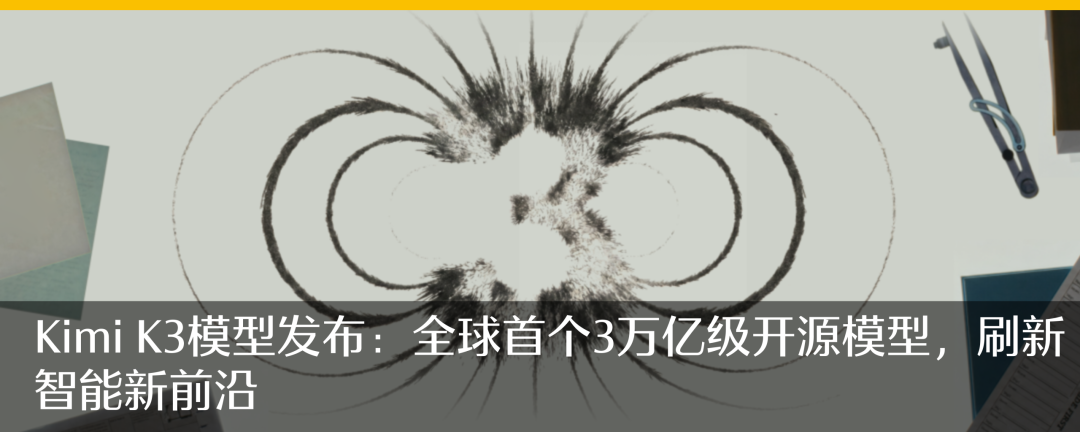
On the eve of WAIC's opening, Moonshot AI released its next-generation flagship model Kimi K3, which became the most discussed model at the WAIC venue. Kimi K3 is a 2.8-trillion-parameter model built on the KDA hybrid linear attention mechanism (Kimi Delta Attention) and Attention Residuals technology, with native visual understanding support and a 1-million-token context window. It is the world's first open-source model at the 3-trillion level, designed for frontier intelligence scenarios including long-horizon programming, knowledge work, and reasoning.
Moonshot AI also stated that the Kimi K3 release is just the beginning, and Kimi will continue to unlock the model's potential, steadily improving its performance on real-world tasks.
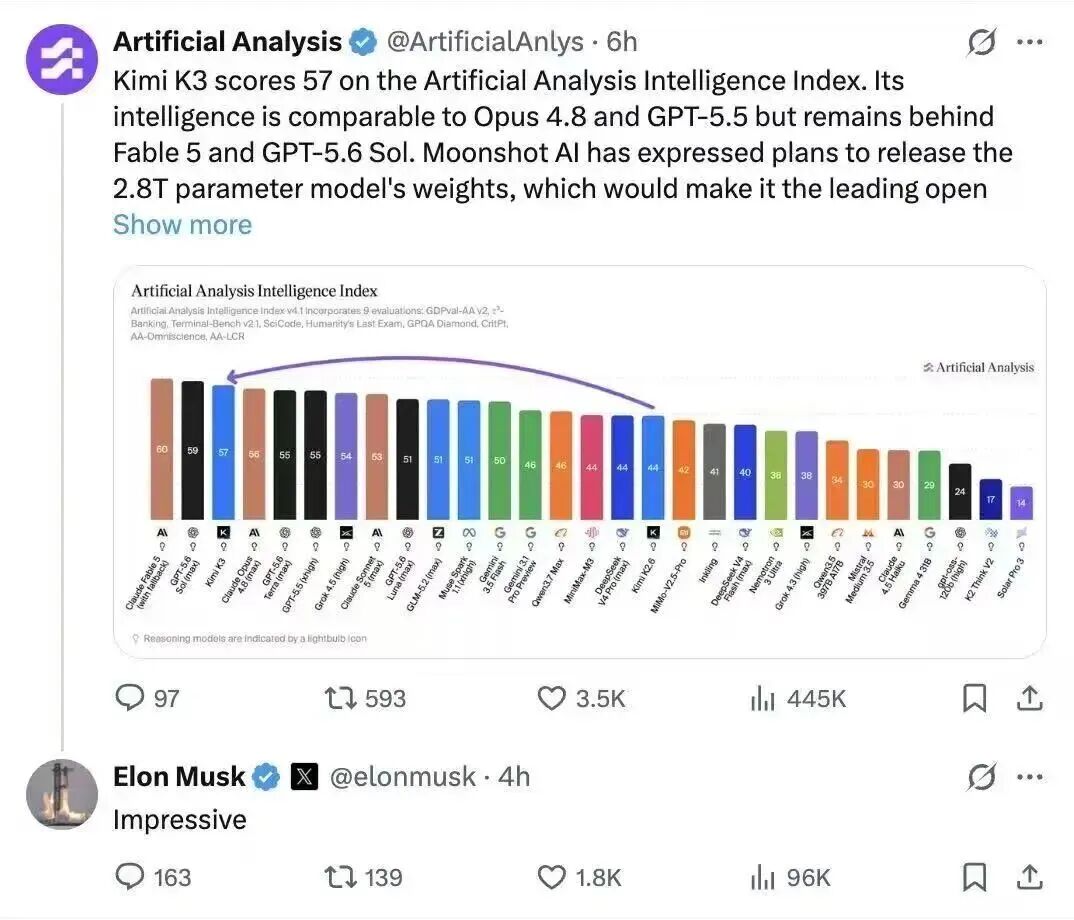
Elon Musk liked Kimi K3

Yanyu Technology: LibTV Agent Officially Launched, Building the World's Largest Professional Video Skill Hub
Also on the eve of WAIC's opening, Yanyu Technology officially released LibTV Agent. Centered on professional video creation, LibTV Agent brings four core advancements: 1) a high-baseline all-capable video agent; 2) the world's largest professional video Skill Hub, with over 100 director-level Video Skills in its initial release; 3) dual-view creation, simultaneously outputting both Storyboard and Node Workflow results; 4) agent-driven editing.
LibTV Agent builds a unified capability baseline around finished video production, autonomously completing creative understanding, shot planning, video generation, and finished product optimization, maintaining stable output in professional scenarios including commercial advertising, short dramas, film and television, and self-media. For video creation tasks under 3 minutes, its single-generation success rate for deliverable-standard output exceeds 80%, truly achieving production-ready direct output.

Yuaiweiwu: Building an "AI Learning Lab"
This year marked Yuaiweiwu's first appearance at WAIC, where the company built an "Aixue AI Learning Lab" on-site,集中展示AI学习智能体、数字人、声纹降噪、多模态生成等全栈自研成果。
On the product side, Yuaiweiwu showcased its core product matrix including Aixue AI Thinking, Aixue AI Humanities, Xiabao AI, and Aixue Paijiang Agent. Aixue is also gradually evolving toward an AI learning agent that covers all ages and subjects, capable of accompanying learners through long-term growth.
Yuaiweiwu also brought a complete set of multimodal perception and generation capabilities to the WAIC venue, including "Zhiyin," an AI teaching agent that can be generated in minutes, leading digital human technology, and AI voiceprint noise reduction technology, among others.

Mindverse: Personal Agent Model Macaron-V1 Released
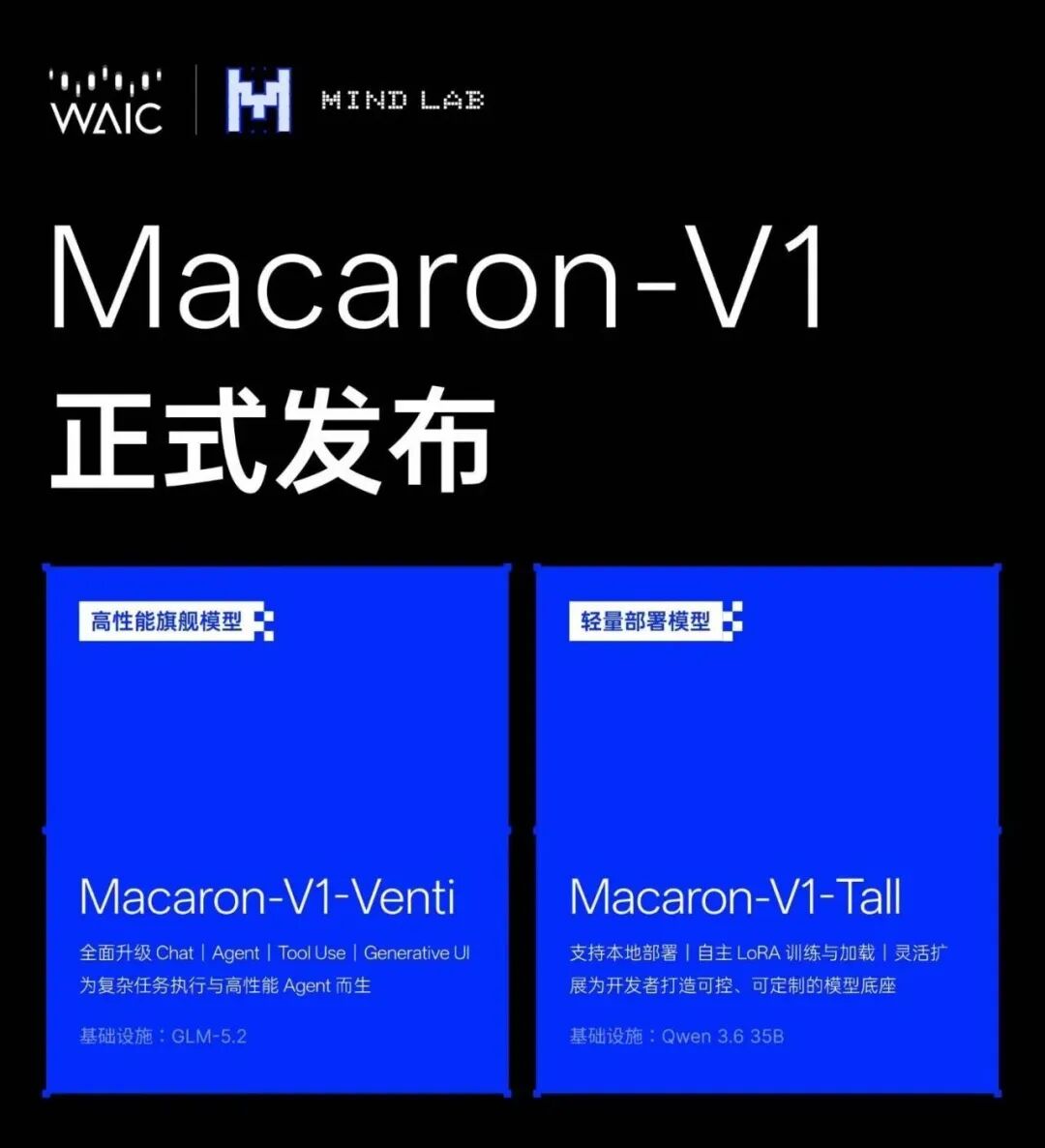
Mindverse officially released the "Personal Agent Model Macaron-V1." Macaron-V1 is the world's first full-size personal agent model based on the MoE-LoRA architecture, covering multiple parameter specifications, with debut support for the A2UI universal graphics protocol, deep compatibility with the Pi kernel, and integration of growable personality with efficient tool calling.
Macaron-V1 is backed by the self-developed MinT reinforcement learning platform, achieving efficient trillion-parameter MoE model LoRA-RL training with computational overhead reduced to 10% of traditional approaches. With lossless LoRA technology, MinT supports massive-scale parallel efficient training of large models, building foundational infrastructure for personal agent innovation.

MemVerge: New Consumer Product MemoryBox, Exploring New Possibilities for AI Memory
MemVerge has long focused on exploring intelligent infrastructure for the AI era, and at this year's WAIC officially showcased its new consumer product MemoryBox. MemoryBox centers on personal memory, allowing users' knowledge, experience, preferences, and creativity to continuously accumulate, while connecting different AI models to bring AI closer to users' working methods and creative habits.
MemoryBox supports importing multi-platform AI conversation history, transforming personal experience and knowledge into long-term memory assets; regardless of which AI model users switch to, MemoryBox helps them maintain accumulated knowledge and usage experience; through AI personas and memory spaces, it creates tailored AI experiences for different scenarios including work, creation, learning, and life.

Physical AI: Bringing Intelligence from the Digital World to the Physical World
Geekplus: Debut of Embodied Intelligence Gravity "Dual-Brain" Framework
At this year's WAIC, Geekplus released Gravity, a unified embodied intelligence framework for long-horizon complex tasks, and率先推出其核心模块Gravity 4D具身模型,这是一次从"预测画面"到"预判物理"的范式级跃迁。On the same day, Geekplus formally unveiled its "one core, dual engines" general embodied intelligence architecture: "one intelligence core + data engine & ecosystem engine."
To address the industry pain point of language brain and physical brain operating in isolation, Gravity constructed a "dual-brain synergy (Mixture-of-Transformers, MoT)" architecture, giving robots a complete mind capable of "thinking clearly first, then acting." As the core module of the Gravity framework, the Gravity 4D embodied model extends the 2D video prediction paradigm, using 4D latent extracted by Gravity 4D-VAE as teacher supervision, simultaneously learning future RGB appearance, 3D structure, and 3D motion in latent space.
Flexiv: Multiple Joint Applications Debut, Completing Real Tasks
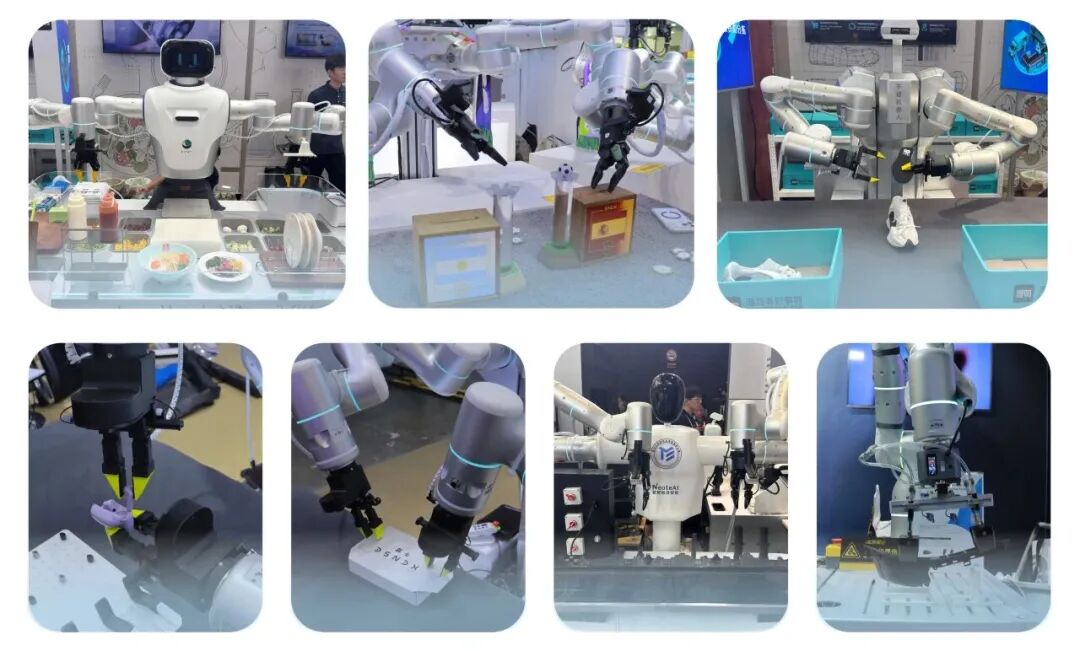
At this year's WAIC, Flexiv's adaptive robots appeared in different forms across multiple exhibition zones and scenarios, within multiple embodied intelligence systems. This also marks a notable phenomenon at this year's WAIC: robot platforms are gradually evolving from single execution carriers into general intelligent robot bases connecting models, perception, tools, and industry applications.
For example, in the headlight assembly and inspection application demonstrated by Fudan University's Trustworthy Embodied Intelligence Research Institute and Xinzhi Embodied Intelligence Technology, two Flexiv force-controlled grippers Grav on Rizon Dawn robots collaborated to sequentially complete headlight positioning, fixing, assembly, and power-on inspection; at the SoftTouch Technology booth, Flexiv adaptive robots cooperated with flexible gripper tools to demonstrate automotive air conditioning vent injection molding unloading.
Lingdi Technology: Self-Developed Simulation Engine Continues Expanding Physical AI Boundaries
Lingdi Technology brought SynReal World, StyleWork, and store robots to WAIC,集中展示自研仿真引擎在具身智能训练与产业应用中的最新进展。From textile and apparel to gaming and film (CG) to embodied intelligence, Lingdi Technology continues advancing along the same technical path: transforming physical laws into computable, trainable, and verifiable digital capabilities.
The highlight of this exhibition, SynReal World, is Lingdi Technology's full-stack data engine for embodied intelligence. The platform connects 3D assets, environments, tasks, and evaluation, covering data generation, virtual training, simulation evaluation, and real-world deployment, providing robots with digital environments for repeated training and verification.
StyleWork,面向服装等轻工业场景,融合AI Agent能力,可参与设计、选品、营销和运营等环节,完成流程协同、工具调用与结果反馈,并通过持续学习和记忆不断完善角色能力。
GravityXR: Spatial Computing Chips, From Understanding Information to Understanding Space
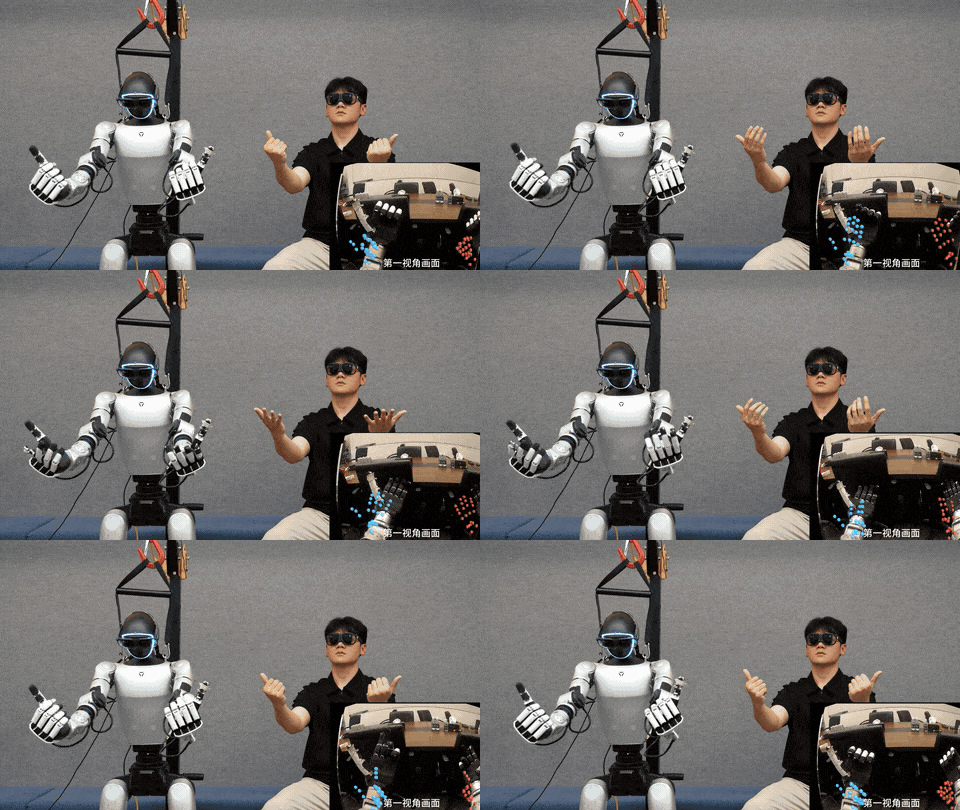
Spatial computing chip company GravityXR made its first public demonstration at this year's conference of its technology and product layout for spatial intelligence, covering applications from high-performance MR devices to lightweight AI glasses and hardware, to embodied intelligence.
Among these, GravityXR's self-developed spatial computing chip X100 attracted considerable attention. X100 adopts advanced process technology and is China's first full-function spatial computing chip, supporting up to 8K/120Hz ultra-high-definition MR display output, covering full functions including spatial positioning, eye tracking, and gesture recognition, while supporting on-device small model deployment; combined with self-developed spatial perception algorithms for real-time understanding of 3D environments, every spatial computing terminal equipped with X100 becomes a natural vehicle for spatial intelligence.
Taking embodied intelligence as an example, users wearing X100 professional reference designs can achieve first-person perspective data collection and immersive teleoperation, thereby providing high-quality real-scenario data for robot skill learning, truly打通从数据采集、模型训练到远程操控的完整链路。
Domestic Computing Power: Targeting Industry-Wide Challenges, Building Next-Generation Computing Infrastructure
Biren Technology: First Introduction of NPO Optical Interconnect, Distributed Decoupled Architecture, and Maximum 1024-Card Supernode Solution
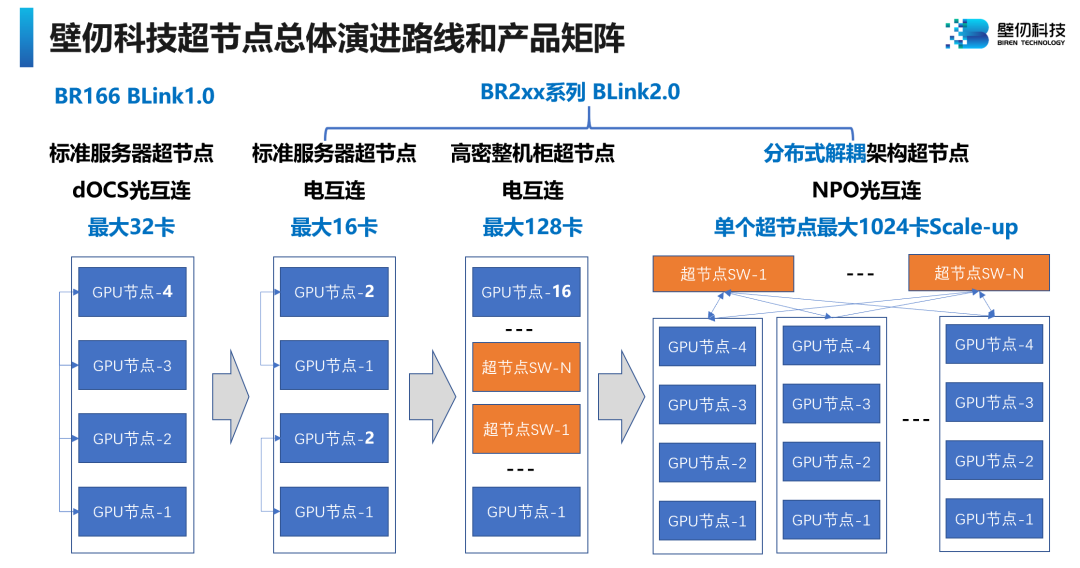
At this year's WAIC, Biren Technology formally introduced its next-generation NPO optical interconnect and distributed decoupled architecture supernode solution, supporting single supernode scale-up expansion to 1024 cards, and received SAIL Award series honors from the World Artificial Intelligence Conference.
Current AI development faces three core challenges: model parameters moving from hundreds of billions to trillions (ultra-large parameters), Agent and other application scenarios requiring million-level context lengths (ultra-long text), and inference and training both requiring thousands of GPUs working in concert (ultra-large clusters). Facing these industry-wide challenges, Biren Technology presented an end-to-end supernode solution covering chips, protocols, systems, and applications.
Chips: Biren Technology's industry-first Chiplet architecture high-computing-power chips, with the new-generation BR2xx series GPU continuing this technical path; Protocols: Biren Technology's self-developed BLink™ 2.0 supernode interconnect protocol; Product Matrix: Based on BR2xx and BLink™ 2.0, Biren Technology has constructed a three-tier supernode product matrix, namely 16-card standard server supernode (electrical interconnect), 128-card high-density rack supernode (electrical interconnect), and 1024-card distributed decoupled architecture supernode (NPO optical interconnect); Application Solutions: Biren Technology's "Token Factory" solution.
Xi Wang Sunrise: Building Computing Infrastructure for the Agent Era
AI is moving from model capabilities to application deployment, and inference computing power has become the key infrastructure for agent proliferation. As China's first "All-in Inference" GPU company, Xi Wang Sunrise appeared at WAIC with a native computing base for the Agent era, demonstrating on-site system-level capabilities from chips, computing infrastructure to software ecosystem and industry solutions.
In AI inference hardware, Xi Wang centered on its Qiwang series GPUs, demonstrating on-site a complete product chain including compute cards/modules, servers, and supernodes; the Huanwang supernode prototype also made its first appearance,直观呈现下一代AI推理基础设施形态。
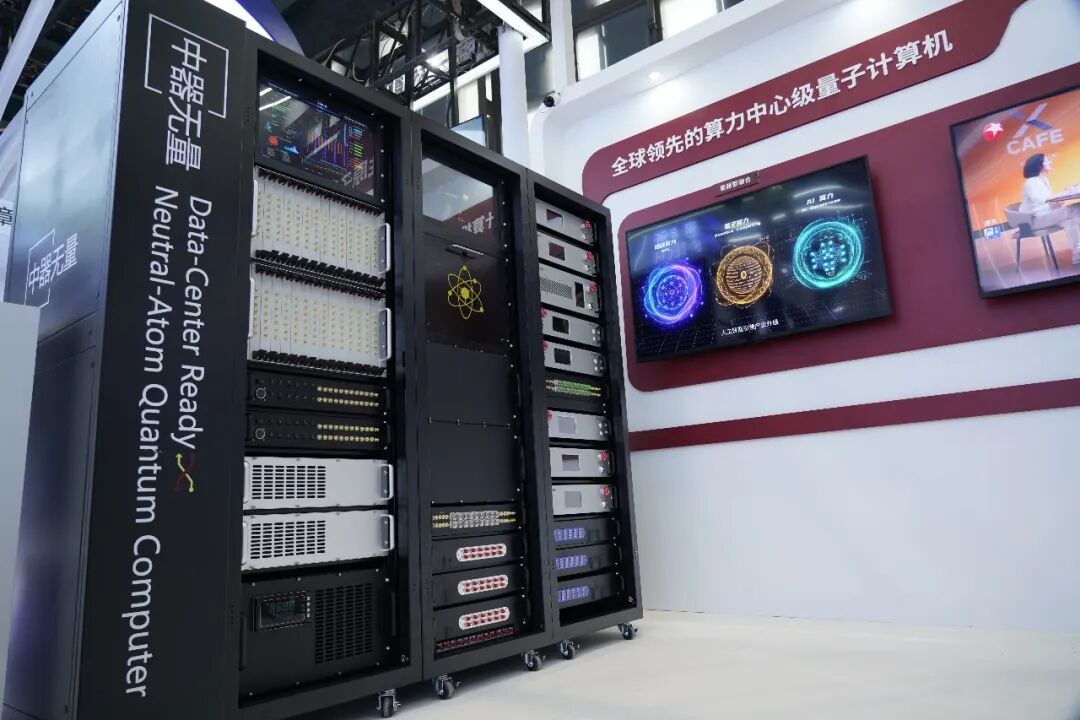
Zhongqi Wuliang: Datacenter-Scale Neutral Atom Quantum Computer "Qinghe No. 1"
On July 18, Zhongqi Wuliang officially released the datacenter-scale neutral atom quantum computer "Qinghe No. 1" at this year's WAIC, and simultaneously exhibited large-scale fault-tolerant quantum computing system architecture at the Zhongqi Wuliang booth in the main exhibition hall of the World Expo Exhibition and Convention Center, the Shanghai Ecology Exhibition, the Future Industry Cultivation Exhibition, and the MetaX Zhangjiang booth. This is a world-leading deployable quantum computer designed for datacenters, marking a key step for quantum computing from laboratories to datacenters.
"Qinghe No. 1" achieves world-class levels in metrics including qubit count, readout fidelity, and gate fidelity. The product enables quantum-classical hybrid computing operating systems, real-time atomic image processing, high-speed AI error correction decoding, and other functions. In application scenarios, it provides callable, verifiable, and sustainably iterative quantum computing services for tasks including materials combinatorial optimization and artificial intelligence. Zhongqi Wuliang is advancing toward large-scale fault-tolerant quantum computing.
From models to AI applications, from embodied intelligence to domestic computing power, what Gaorong's "Hardcore AI Alliance" presents is not merely an investment map, but also an exemplary sample of accelerating AI's journey from the digital world to the real world. We also believe that the ultimate goal of AI is to complete real tasks and make the real world a better place.