BlueRun Ventures' Jui Chan on Data, Value, and Long-Term Judgment: What Will Actually Survive the AI Hype?

Reflection and Perseverance in Practice

When the market gets hotter, it's even more important to return to real value.
BlueRun Ventures has long focused on foundation models, AI applications, and Physical AI, with investments in Moonshot AI, Genspark, Galaxy Universal, and AgiBot. Behind these bets lies a consistent framework: companies truly worth long-term commitment must not only stand at the starting point of technological change, but also penetrate real scenarios, identify demand, accumulate data, and build capabilities that can continuously evolve.
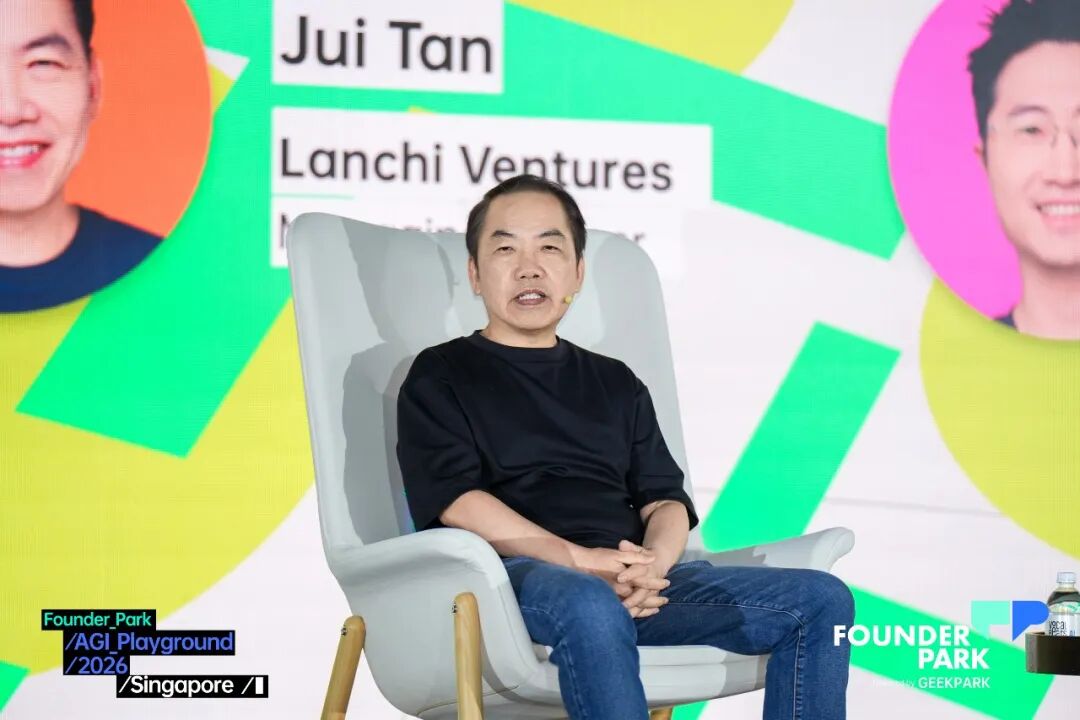
On August 3, at AGI Playground 2026 in Singapore — organized by Founder Park, a subsidiary of GeekPark — Jui Chan, Managing Partner at BlueRun Ventures, drew on the firm's long-term investment practice in AI to share his thinking on market shifts in AI, valuation logic for AI companies, and how Physical AI moves from technology into the real world.
In his view, as model capabilities converge, startups increasingly need to build distinctive scenario understanding and data moats; the value of Physical AI lies in entering real production and solving existing problems. Chan also addressed recent discussions around open-weight models — a market trend driven by cost, data, and deployment needs. Whatever the technical path, he argued, the ultimate destination remains cost, delivery, and user value.
The full conversation below, edited and compiled by BlueRun Ventures. Enjoy:

Peter: What notable changes have you seen in the AI industry over the past 12 months?
Jui Chan: I've observed several fairly obvious shifts, especially for Chinese entrepreneurs — whether they're based in China or overseas.
First, the market has clearly heated up. Even very early-stage AI projects are now being priced at very high valuations.
Second, we're seeing large numbers of excellent engineers starting companies. Some come from major AI firms, others from startups. This is tied to the reactivation of capital markets: more money is flowing in, and not just in VC — the secondary markets too. There will still be fluctuations, but overall, capital is entering in significant volume.
Third, people are converging on similar directions. This has its pros and cons. The upside is that investors can concentrate their research on these tracks; the downside is that many are now rushing toward the same ideas. When there's more money in the market, competition intensifies, and mistakes inevitably multiply.
Peter: With markets and technology both changing rapidly, do you still encounter opportunities that make you want to move quickly? What qualities do you particularly look for in companies?
Jui Chan: Two or three years ago, investment decisions were relatively easier. Back then, everyone was looking at large language models, semiconductors, GPUs, and some application-layer opportunities — the directions were fairly clear. But now competition is fiercer and capital markets are heating up. In this environment, we need to find things with clear differentiation.
Over the past six months, we've looked at many opportunities in Physical AI. Though substantial capital has already entered this market, it's still missing something very fundamental: high-quality physical interaction data. So we've been searching for companies that can genuinely solve this problem. Earlier this year, BlueRun invested in OriginFlow.
This company doesn't rely solely on first-person visual data. Instead, through new algorithmic capabilities, it redefines the value of electromyographic data in robot training. A simple example: when we reach out to pick up a bottle, a series of subtle muscle contractions occur in our arm and hand. They can capture the electrical signals produced by these muscle contractions and feed that signal data to robots for training, making robot behavior more human-like and capable of finer tasks. This is the type of opportunity we're watching: how to fill in what's missing from the actual experience of Physical AI.
The Agent space I just mentioned follows the same logic. We try to avoid investing in Agents that could easily be replaced by large language models, or in any single Agent capability in isolation.
You've probably seen similar stories in the news: a startup is building some Agent, and before long, Anthropic or another foundation model company releases a comparable capability.
So over the past six months, we've preferred companies with unique scenarios, unique data, and unique context. What they truly need to solve is the gap between today's most advanced models and users' real needs.
Many assume that once models reach state-of-the-art performance, user problems naturally get solved. But that's not how it works. Most users aren't as familiar with models as developers are — there's often a layer between what users actually want and what large language models can directly provide. To bridge that gap, you must genuinely understand the product's usage environment and specific context, and you need proprietary data.

Peter: A question many entrepreneurs currently care about: as foundation models keep advancing and extending into the application layer, does building applications today still make sense?
Jui Chan: This is still evolving rapidly, so what I share today may not be 100% representative of reality. I can share from an intuitive level:
From an investor's perspective, we, like entrepreneurs, ultimately need to understand customer and user needs. Today's market roughly divides into two categories: enterprise users and consumers. These two are very different.
In the enterprise market, executives certainly want their companies to build AI capabilities quickly. At first, many companies will allocate a budget for teams to spend, subscribing to various large language models. But they'll soon discover the costs are very high. And the "scary" part is that those who truly know how to use AI can consume enormous amounts of quota. So budget remains a constraint for enterprises. If they only use closed-source models, costs become prohibitive. And in China today, open-weight models are quite popular.
Another issue: data and intellectual property are increasingly important to enterprise customers. Companies worry whether their data might be accessed by model providers when using closed-source models. Another concern is that foundation model companies may enter the application layer at any time. For example, Cursor's product uses Anthropic's models — originally Anthropic's customer — but when Anthropic launched Claude Code, the two became direct competitors. For many application companies dependent on closed-source models, this relationship itself represents risk.
On the other hand, for consumers paying out of their own pocket for AI, willingness to pay tends to be weaker than enterprises. So products need to be not only useful but also cheap enough.
I mention these two user types first because as a startup, you must clearly decide which you're serving. The products required are completely different.
For example, companion AI leans more toward consumers. So the questions to focus on are: do you have the relevant data? Is your understanding of this usage scenario deep enough? Does your Agent truly make users feel understood? In the enterprise market, the questions are whether you can help clients protect their data while giving them access to AI at reasonable cost.
These questions must be thought through from the start. Entrepreneurs need to know who they're serving to build real value. For startups, what you should seek isn't "can I build a better, smarter model," but which specific scenarios can form unique value. Recently, quite a few startups have entered science and math directions. What entrepreneurs really need to think about is how to establish unique value in specific scenarios that foundation model companies can't easily displace through mere model capability upgrades.
Returning to the opening question: what changes have occurred over the past six months? Compared to a year ago, we're seeing fewer AI application companies now, and noticeably more Physical AI companies. Because founding teams must first think through two things: how will continued progress in large language models create competition for me? And facing that competition, what unique capabilities and moats can I build?
From this perspective, the market has actually become somewhat more rational over the past six months. A year ago, massive capital flooded into the application layer; now, capital attention is shifting toward foundation models and Physical AI.
Of course, this trend is still evolving. Some foundation model companies have already entered capital markets; others are preparing for IPOs and have achieved very high market valuations. This is gradually forming a market consensus: compared to foundation model companies, application companies may not offer as much growth potential or investment opportunity. But whether this consensus is correct — it's still too early to conclude.
Perhaps in six months or a year, when a batch of application companies have built genuine core capabilities and competitive moats, and proven their commercial value through sustained revenue growth, market assessments of the application layer will shift accordingly.


Peter: How should investors value an AI or Agent company? What factors matter most?
Jui Chan: At this stage, early-stage AI company valuations are still mainly determined by market supply and demand. It's difficult to calculate purely based on revenue, profit, or actual capital needs.
Many teams now starting companies have very strong backgrounds, so they demand higher valuations. Meanwhile, increasingly more capital is entering the AI market. For early-stage projects, especially companies around Series A, valuation depends heavily on two factors: the quality of the founding team itself, and how many funds are willing to compete. This logic applies more to application companies and Agent companies that don't need to do their own pre-training. Their capital requirements are relatively limited, and valuations more reflect investors' judgment of the team and market opportunity.
But for Physical AI companies, or teams training next-generation foundation models, the situation is different. They need to do pre-training, which requires substantial spending on GPU rentals. Thus, these companies may need to raise $50 million to $100 million at Series A. For such capital-intensive companies, valuation is often reverse-engineered from financing needs and equity dilution tolerance. If a company needs to raise a large sum while not giving up too much equity in a single round, its pre-money valuation naturally gets pushed up. For some projects we've seen, Series A pre-money valuations may already reach $200 million to $300 million.
So application companies and model/Physical AI companies differ not only in financing scale but in underlying valuation logic: the former is more determined by team quality and market competition, while the latter must also factor in training costs, capital needs, and acceptable dilution ratios.

Peter: Over the past 12 months, investment enthusiasm for AI hardware and Physical AI has risen significantly. How do you view this wave of enthusiasm? What's driving it?
Jui Chan: In my view, this Physical AI wave is driven by both macro factors and micro-level industry reasons.
At the macro level, China is entering its 15th Five-Year Plan period, and embodied intelligence has become a national priority direction. Capital markets have formed relatively strong investment consensus around it.
At the micro level, first, China hasn't yet developed a mature enterprise AI payment market. In the past, many investment institutions including ourselves invested in Chinese SaaS, but few projects achieved ideal returns. One important reason is that Chinese enterprises have relatively limited willingness to pay high prices for software solutions.
Therefore, when Chinese entrepreneurs enter AI, the available directions are relatively concentrated: consumer applications on one hand, and Physical AI on the other. Because China lacks a sufficiently mature enterprise AI market, entrepreneurs and investors naturally direct more energy and capital toward consumer applications and Physical AI.
The second micro-level factor is China's massive manufacturing base. China has a large-scale, complete-chain manufacturing ecosystem. For Physical AI, real production scenarios matter enormously. Only when robots enter actual environments, continuously collecting data and receiving feedback with human involvement, can models keep improving.
China's vast manufacturing system happens to provide such a training ground. The rich tasks, processes, and interaction data in factories allow robots to continuously accumulate real-world data. These factors together have driven up investment enthusiasm for Physical AI.
This is also characteristic of early-stage investment markets: a direction can heat up rapidly within months, and cool just as quickly in the following months. The long-term value of Physical AI and the short-term heat of capital markets are two things that need to be judged separately.
Peter: When facing different types of Physical AI companies, what are investors' evaluation criteria?
Jui Chan: Ask different people this question, and you'll often get completely different answers.
For example, Professor Fei-Fei Li has noted that Physical AI still lacks sufficient data, and true maturity may take 10 or even 15 years. But if you ask the most passionate entrepreneurs in this field, they might tell you that within five years, we'll see large numbers of robots in factories and even homes.
Who's right? I think it's still hard to conclude. But one thing is certain: technology keeps advancing.
We've invested in several relatively large-scale robotics companies, including Galaxy Universal, AgiBot, and Tashi Zhihang. From these companies' actual data, we're already beginning to see certain scaling effects: as training data increases, robot capabilities improve correspondingly. This process has similarities with large language models. Five years ago, robots were still quite "dumb" — even learning a simple task might require extensive time and repeated training. But today, as AI capabilities improve and data volume grows, robot capability improvement is also accelerating. However, Physical AI scaling won't be as fast as large language models, because it faces a far more complex physical world.
Text, images, and other data on the internet can be relatively directly used to train large language models. The same is true for coding AI — GitHub has accumulated years of code and software data that models can learn from directly. But the real-world interaction data Physical AI needs is difficult to obtain at scale in the same way.
Even so, we remain relatively optimistic. In the future, some companies will be the first to deploy embodied intelligence robots in factories and manufacturing, performing genuinely valuable work in specific scenarios.
Tashi Zhihang is one example. Automotive wiring harnesses consist of numerous circuits connecting speakers, communications equipment, and other components. In the past, this work required large numbers of skilled workers to complete by hand, with extremely high accuracy requirements. If even one wire is connected incorrectly, the entire component may become unusable. Now, robots are beginning to enter this production环节, with surprisingly effective results.
So simply put, technology is advancing and commercial deployment has already begun; but when market enthusiasm runs too high, mistaken investments and market corrections are equally inevitable. So ultimately, what we look forward to is robots entering factories and homes, completing work of real value.
I'm cautiously optimistic about Physical AI's long-term development — it still needs time to continue evolving.

Jui Chan: There are many entrepreneurs here today, and I'd like to take this opportunity to share one observation.
When we talk about robots, it's easy to ask from the outcome: can your robot really enter homes and care for the elderly? If it can't do that today, does that mean the company isn't worth starting?
But from the startups we've engaged with, excellent entrepreneurs don't simply choose between "can I achieve the endgame now." They certainly have long-term visions and believe they can ultimately get there; but at the same time, they seriously consider: with technology not yet fully mature today, which scenarios already have real and urgent demand? What problems can I solve now? And what milestone stages should I pursue to acquire customers, accumulate data, and sustain the company's continued fundraising and growth?
Automotive wiring harness assembly is a good example. This work involves numerous circuits that must be connected according to strict requirements by skilled workers. It requires certain knowledge and skills, is highly repetitive, and has very low error tolerance. If just one connection is wrong among many circuits, the entire component may need rework or even scrapping. In manufacturing, fewer young people are willing to do such work long-term — it requires professional training but is repetitive. And this production环节 is precisely where robots can first create value.
So for startups, a realistic path is to first enter such niche scenarios and solve problems that already exist today. In this process, the company can continuously accumulate data, customers, and technical capabilities, then gradually extend toward more general-purpose robot abilities.
Perhaps one day, when robot costs are low enough and capabilities strong enough, they really can enter homes and care for the elderly. But before reaching that endgame, startups must first find a scenario that works today.

Peter: Final question. Looking ahead three years, what relatively certain judgments do you have? What consensus today might be overturned, and what underappreciated changes might become reality?
Jui Chan: I have three relatively clear judgments.
First, open-weight models and open-source models will become more widespread.
We're in Singapore today, and many Singaporean enterprises are here too. I'd encourage everyone to try open-weight and open-source models. As enterprise AI usage scales up, cost becomes an increasingly important issue. At the same time, enterprises need to protect their proprietary data and choose more flexible deployment options according to business needs. So the future market won't have only one solution. Closed-source and open-source models will coexist long-term, serving different scenarios respectively. This is a market trend driven by cost, data, and deployment needs together.
Second, Physical AI will enter more real scenarios.
Its development speed may not match that of large language models, but in the next three years, we'll certainly see it more in factories and niche applications. Robots will gradually move from demonstrating capabilities to solving specific problems, completing genuinely valuable work in manufacturing and other professional scenarios.
Third, AI will reshape some portion of work.
Whether large language models or Physical AI, as they spread, some repetitive work will be displaced. Governments, enterprises, and society all need to consider how to respond to resulting employment and economic structural changes. But there's also a positive side. People who truly understand how to use AI can accomplish more work and create higher output. Future gaps may lie not only in what capabilities a person originally had, but also in whether they can effectively leverage AI.
What I'm less certain about is capital markets. Today, massive capital is entering AI, which on one hand drives technology and industry development, and on the other raises market expectations. In the end, some will achieve excellent returns, and others will lose substantial funds. If AI doesn't create enough real value within expected timeframes, will the market see significant correction? How large would such correction be? These questions are still hard to answer.
So I'm relatively optimistic about AI and Physical AI's long-term development, but remain cautious about how short-term capital markets may evolve.

BlueRun Ventures' Jui Chan in Conversation with BAAI's Wang Zhongyuan, Galaxy Universal's He Wang, and ModelBest's Li Dahai: Long-Term Value in the Foundation Model Era and the Next Curve
Kimi K3 Release: A Sleepless Night, Witnessing the Realization of Long-Termism

I'm Not the Pianist on the Ocean, I Choose to Walk Toward Land | Terry Zhu in Conversation with OriginFlow's Shentao Qin