MaHui Entrepreneurs | AI4S Industrialization Roundtable: With So Many Application Scenarios, "AI Tools" Will Deliver Greater Value

#MaHui Entrepreneurs — Resilient and Bold, Exploring Without End
The 2022 Zhongguancun Forum series event — "AI for Science: Co-creating the Future" Scientific Intelligence Summit was held recently. Source Code Capital joined several MaHui members, industry entrepreneurs, and Source Code Capital investors to discuss the opportunities and challenges of AI4S industrialization.
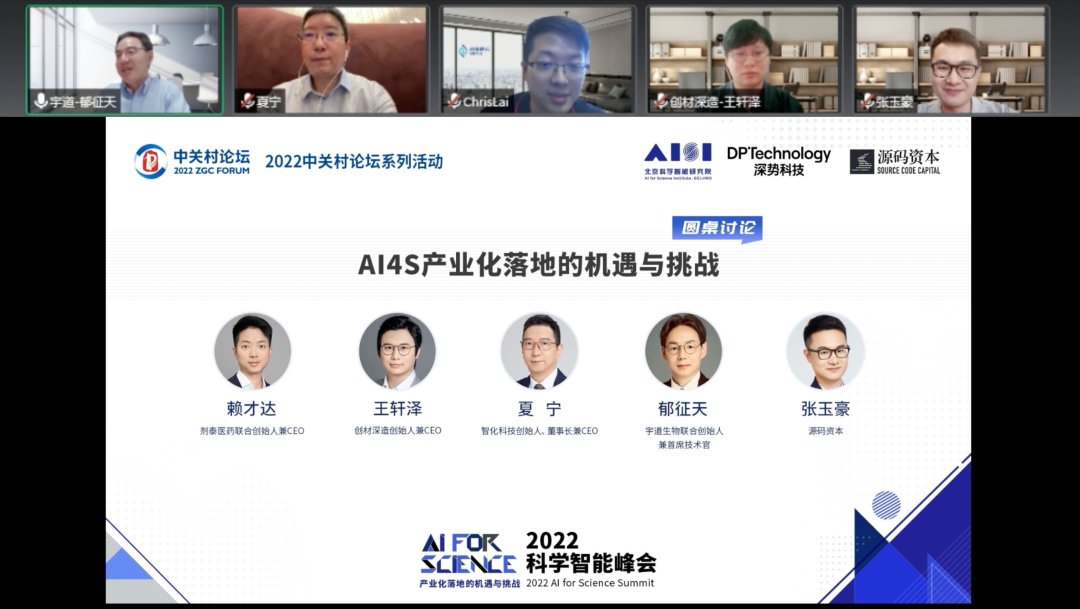
Below is the roundtable discussion:
Source Code Capital Yuhao Zhang: First, I'd like to ask Dr. Zhengtian Yu, Co-founder and Chief Technology Officer of Nutshell Therapeutics, about drug design in the pharmaceutical industry. Where do you see the best application scenarios for AI? Where does the data input and information generally come from?
Nutshell Therapeutics Zhengtian Yu: AI has several major application scenarios. First, preliminary screening for exploring various possibilities. Initial screening is one of the best application scenarios for AI, especially for possibility calculations at extremely high scales that humans simply cannot complete. Second, solving unbounded problems within general problem sets. Using the Go example shared by a previous guest — Go has bounded board space, so all possibilities can be calculated within those boundaries. But imagine if the board became unbounded; theoretically, the scenarios would be innumerable. This is where breakthroughs require combining first principles with AI. Small-molecule drug development, for instance, encounters exactly this type of problem.
As for data input and information sources, Nutshell Therapeutics works on allosteric drug discovery, an emerging field in small-molecule drug discovery, and is continuously exploring the integration of artificial intelligence-assisted drug design (AIDD) technologies. The information mainly involves proteins, small molecules, or more broadly DNA vectors — using AI to establish different representations for these.
From different dimensions, there are generally over a dozen methods for small-molecule representation, though there could be more; the same applies to proteins and DNA. Using AI, we can comprehensively interpret these features from high-dimensional, multi-dimensional perspectives, enabling deeper exploration of related problems. The subsequent application involves feeding this interpreted information into models to solve for unknowns. This process resembles reading — initially you read extensively, accumulating thousands or tens of thousands of pages, but ultimately you must extract and absorb the essence, achieving the effect of "reading thin."
From a data perspective, the largest data volume lies in small-molecule representation. Many methods already exist for interpreting small-molecule representation — can we represent these small molecules from even higher and more dimensions? For proteins, the consideration is what representations can better express their dynamic structures.
Both sides involve massive data volumes. Once data reaches a certain scale, dimensionality reduction begins, and models emerge from that reduction. Nutshell Therapeutics' application of AI demonstrates how it both accelerates problem-solving speed and transforms previously impossible tasks into possibilities.
Source Code Capital Yuhao Zhang: Thank you, Dr. Yu. We can see that applying AI's abstract feature extraction capabilities to the complex, multi-dimensional data at various stages of drug design can efficiently aggregate data from different sources, distill effective information, and thereby accelerate the drug design process. Nutshell's drug design platform provides excellent allosteric tools.
For my second question, I'd like to explore with Dr. Ning Xia, Founder, Chairman, and CEO of Chemical.AI. Chemical.AI's product software has received considerable acclaim from major pharmaceutical companies and industry players. You've likely seen many products in China offering algorithm-accelerated software for industry. From your overall perspective, how effective are these products currently? What is the attitude of large pharmaceutical companies regarding internally developed versus externally provided tools?
Chemical.AI Ning Xia: Chemical.AI has deeply explored solving key problems in intelligent synthesis. From retrosynthesis prediction to automated synthesis, our products are already in use at numerous large pharmaceutical companies both domestically and internationally. Before adopting our products, these pharmaceutical companies evaluated many similar products on the market. After extended trial periods and repeated assessments, they ultimately selected us. Overall, we've gained industry recognition in a relatively new field.
From an industry development perspective, we're currently in an excellent window of opportunity. Five to ten years earlier, this opportunity likely wouldn't have existed. In recent years, as costs in the pharmaceutical sector have risen and competition intensified, pharmaceutical companies have placed increasing emphasis on R&D and are very willing to adopt external new technologies to enhance internal R&D efficiency.
Early on, the industry may not have considered AI essential technology, but recently attention to AI applications has grown significantly. While some large pharmaceutical companies are internally experimenting with algorithms and AI to solve problems, they're also actively looking outward at AI pharmaceutical companies to see if they can find different problem-solving approaches or more effective products.
Chemical.AI was previously an algorithm software R&D company and is now gradually moving into synthesis automation. True AI implementation requires both computational high-throughput and larger chemical space. Computational high-throughput alone, without corresponding physical-world high-throughput, has limited impact. For example, calculating ten thousand molecules is one thing, but to truly know which ones are effective and potent, you need to actually synthesize them for biological testing.
So we believe that in the future, AI must not only improve computational speed but also integrate with real experimental scenarios. Only then can physical-world experimental throughput be increased. This is the most valuable direction, and it's what Chemical.AI is currently working hard to achieve.
Source Code Capital Yuhao Zhang: Thank you, Dr. Xia. From your sharing, we can understand that for traditional pharmaceutical companies, given R&D pressures and innovation demands, there's strong appetite for external tools — particularly effective tools and scenarios combining dry and wet experiments — which presents many new development opportunities for AI4S entrepreneurs.
My next question is for Dr. Caida Lai, Co-founder and CEO of METiS Pharmaceuticals. Globally, what AI4S industrialization implementations would you consider recognized "best practice" cases?
METiS Pharmaceuticals Caida Lai: I can speak to the innovative drug-related portion. The threshold for "best practice" in AI4S industrialization within innovative drugs has generally risen.
First, you need a high-throughput data platform to drive algorithms and continuously generate core drug development advantages. Second, through collaborations with large pharmaceutical companies and biotech firms, you need to demonstrate the ability to advance drugs, quickly moving to Phase II clinical trials to prove viability.
Based on these requirements, innovative drug companies must possess both dry and wet experimental capabilities in their infrastructure, with leading advantages and distinctive features in certain niche areas, while ideally also having end-to-end pharmaceutical capabilities.
AI4S industrialization in innovative drugs divides into two parts: service models and pipelines.
On the service model side, CRO and CDMO models represent directions where AI drug discovery companies have performed relatively well. Companies like Chemical.AI and XtalPi, for instance, can collaborate with over a hundred pharmaceutical companies to accelerate specific R&D segments. I've always felt that the retrosynthesis work Dr. Ning Xia is doing at Chemical.AI is tremendously significant. If done well and integrated with experiments, it can greatly improve efficiency and reduce costs.
The larger challenge is how to truly advance pipelines. The pipeline chain is exceptionally long with lengthy iteration feedback loops. You need to start with smaller iterations, beginning with delivery iterations, then moving to animal disease trials, and finally human trials — each stage progressively more difficult, with each block requiring extremely solid execution. Currently, the entire industry, including international companies, hasn't yet established strong best practices. We can ensure rapid execution from project initiation to drug development within one to two years, but actually proving drug efficacy still faces numerous limitations.
The first AI-designed drug to emerge was actually a COVID vaccine, developed in just 50 days — but that was driven by pandemic pressure. The actual drug development chain is extremely long. The difficulty lies in identifying good biological targets, completing molecular sequence design, and building out the entire drug delivery system.
My intuition is that this field will likely remain primarily collaboration-based, leveraging others' existing clinical capabilities and good targets, ideally utilizing proteins and cells already present in the human body — meaning the proteins produced are ones the body already makes, and the cells used for delivery are ones the body already has. This approach can significantly reduce biological risk, making technical risk the true determinant of success or failure, thereby demonstrating AI's value.
Source Code Capital Yuhao Zhang: Thank you, Lai. The innovative drug industry has long industrial chains and cycles. Influenced by the pandemic in recent years, traditional industries have increased demand for innovation, while innovative drugs have raised ever-higher requirements for data and AI tools regarding emerging diseases, complex systemic diseases, and oncology.
My final question goes to Xuanze Wang, Founder and CEO of DeepMaterial. From the materials industry perspective, what kind of industrial support will the materials sector need in the future to make China's overall AI4S industrialization more effective?
DeepMaterial Xuanze Wang: AI4S represents a shift from serial to parallel processing. Financial investment, quality-assured data support, and openness to new metal materials are what I consider the three most important factors, along with policy support, talent support, and others.
AI4S application in the materials industry requires substantial financial backing. From an investment perspective, equipment and materials involve significant costs, and financial support ensures continuity of investment.
Additionally, the industry needs quality-assured data support. Fragmented data distribution significantly impacts rapid industry development. Much data is currently scattered across universities and research institutes; more centralized data would benefit industry development. Currently, local governments and certain institutions are forming data alliances — the industry needs quality-assured data support.
For "AI + metal materials," regarding what material features, characteristics, and properties AI actually needs, data collection requires specifically designed experiments targeting these properties, ideally with standardized experimental protocols and data generation workflows — this would be excellent for both algorithms and data.
Domestic companies' acceptance of new materials needs improvement, but as practitioners, we're sensing accelerating acceptance, with many companies increasingly quick to adopt new materials.


- MaHui Entrepreneurs | Exploring Known Unknowns and Unknown Unknowns
- MaHui Entrepreneurs | The Shenzhen "New Farmer" Featured in CCTV's In-Depth Interview: Taking an AI Photo of Every Fruit
- MaHui Entrepreneurs | Biren Technology's Wen Zhang: The Story of Chinese Chip Companies Has Just Begun
- MaHui Entrepreneurs | Post-90s Entrepreneur Junbin Zhang: Building Transformational Products, Pursuing Value from Zero to One
- MaHui Entrepreneurs | Two 29-Year-Old Genius Scientists' "Moon and Sixpence"
- MaHui Entrepreneurs | Mech-Mind's Tianlan Shao: Some of My "Grassroots" Experience
- MaHui Entrepreneurs | Exploration Never "Extinguished," Saluting the Spirit of Aerospace
For more MaHui members, click "Read Original" to view