What do CEOs of smart manufacturing companies talk about when they get together?

Stande, XYZ Robotics, Keenon, Chuxin... All the robotics companies you care about are right here.
In 2020, robotics became the absolute center of attention across China's venture capital and startup ecosystem.
As the demographic dividend steadily faded, Chinese manufacturing accelerated its transformation toward intelligent manufacturing. The COVID-19 pandemic further catalyzed this shift, making wider robot deployment an inevitability. China's complex and diverse manufacturing landscape had already prepared domestic companies for years of intense competition, while critical upstream component supply chains achieved systemic breakthroughs. Leveraging technological advantages in 3D vision, SLAM navigation, and deep learning to achieve more coordinated integration of "eyes, hands, brain, and feet" would become the "China path" for the next wave of intelligent robot upgrades.
Following the "intelligence +" direction within its "three horizontals, nine verticals" framework, Source Code Capital had already begun positioning early, partnering with Chuxin as far back as 2016. Over the past year, Keenon, Cloud Whale, Standard Robots, XYZ Robotics, HAI ROBOTICS, Mech-Mind Robotics, and Dingna Automation had also joined the Source Code Capital family.
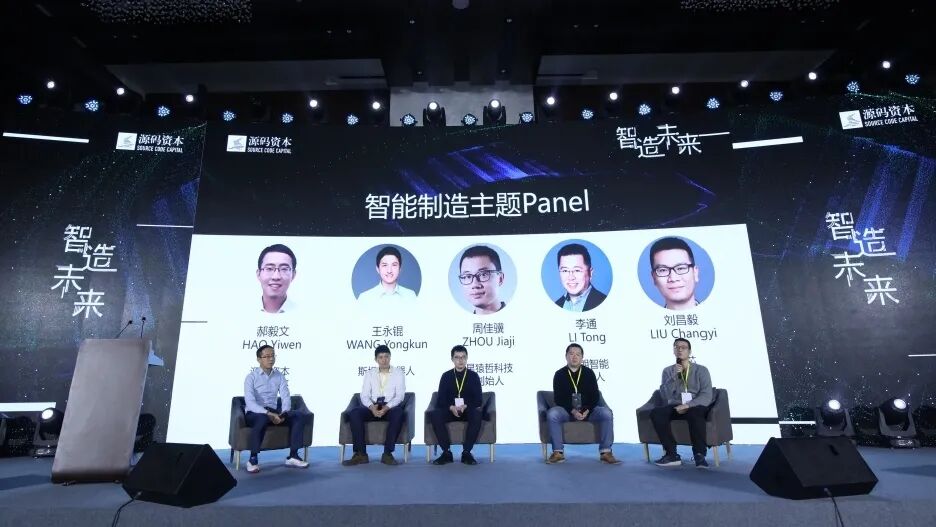
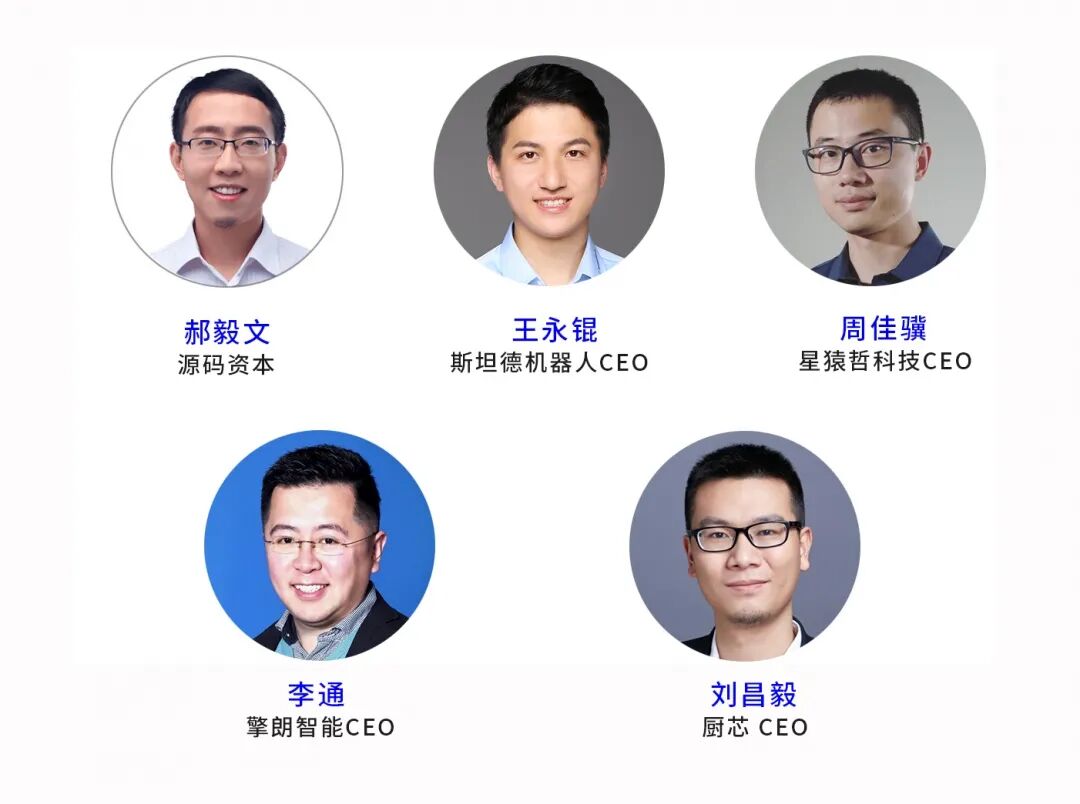
At the 2020 Code Society Investor Conference and Intelligent Manufacturing Summit, Standard Robots CEO Yongkun Wang, XYZ Robotics CEO Jiaji Zhou, Keenon CEO Tong Li, Chuxin CEO Changyi Liu, and Source Code Capital's Yiwen Hao sat down for a roundtable. They shared war stories from their entrepreneurial journeys — the pitfalls they'd encountered — and offered their deep reflections on where the industry was headed.
I. Lessons from the Trenches
Yiwen Hao (Source Code Capital): Let's start with introductions — your businesses and your entrepreneurial journeys so far.
Changyi Liu: Hi everyone, I'm Changyi Liu, CEO of Chuxin. Our mission is to drive intelligence and automation in the food service industry. We aim to become a globally leading provider of restaurant equipment and services.
Tong Li: Hello, I'm Tong Li from Shanghai-based Keenon. Keenon builds unmanned delivery robots for local life services. We're both a manufacturer and an operator.
Jiaji Zhou: Hi there! I'm Jiaji Zhou from XYZ Robotics. Our goal is flexible manufacturing — giving robotic arms dexterous manipulation capabilities. Through 3D vision, motion planning, and end-effector design, we enable hand-eye coordination so arms can pick up and place all kinds of objects, helping solve warehousing and logistics challenges.
Yongkun Wang: Hello, I'm Yongkun Wang from Standard Robots. We're an industrial logistics robotics company focused on manufacturing — specifically the logistics segments of 3C products, electronics manufacturing, semiconductors, display panels, and sensor production.
Yiwen Hao: What kinds of pitfalls do you hit during manufacturing and project implementation? Any lessons to share?
Changyi Liu: I joined Tencent back in 2006 and worked in pure internet the whole time. For me, hardware and internet products are completely different animals. With hardware, once something actually goes wrong, recall costs are devastating. You have to front-load the work — make it more solid, more thorough. Second point: in hardware, actually achieving both high quality and low cost is incredibly difficult.
Tong Li: Many industries have complete supply chain ecosystems, but ours doesn't. So Keenon isn't just a robot manufacturer — we've had to extend upstream and become a supply chain company ourselves. Sensors, controllers, drivers, electromechanical systems — we develop and manufacture all of it in-house.
Jiaji Zhou: Our company is software-focused. Hardware can reduce software complexity, but balancing the two is an art. We could make the end-effector extremely complex, but once you do that, software control requirements and boundary conditions escalate. Our approach is to continuously make software more sophisticated, which lets us reduce hardware demands and run on existing standard products.
Yongkun Wang: I believe a robotics company's core technology isn't hardware — it's software and your understanding of the industry. So whether to build something yourself depends on assessing your own capabilities and whether that thing is a core competency. If it's a core moat, you must build it. If not, don't. That's one of the bigger traps in hardware manufacturing.
The second "pit" in production is cost versus quality. There are no standards in our industry, so you need to find balance between standard and custom. For the 70% that's standardized product, your manufacturing has competitive advantage — build that yourself. The other 30% that's custom? Don't do it yourself.
II. Core Moats
Yiwen Hao: What would you say is your company's core moat right now?
Yongkun Wang: The real moat is your ability to define product standards and your depth of understanding of customer needs. Standard-definition capability is core. When others discover this industry is profitable and manufacturing-strong companies start copying your products — that's when real competition begins. What you're competing on is core capability.
Jiaji Zhou: First, you need to choose a domain with certain technological barriers. Once you've selected that barrier, you absolutely cannot get it wrong. As your technology evolves and you can manufacture that moat, and the scenario is large enough — then you have a shot.
Tong Li: Moats vary by industry. In relatively mature industries, cost is a moat. But in emerging industries like Keenon's, I think the biggest moat is sustained innovation capability. Meeting real customer demands requires constant ideation, constant innovation, constant self-negation.
Changyi Liu: What is a moat? If someone better than you in every dimension entered this business, how long would it take them? That duration is the moat. I think moats are fundamentally a function of time.
Moats have many layers. Our company's ultimate defined moat is corporate culture. Because changing someone's philosophy and culture is the hardest thing. Ultimately, you need to grind a team into one that genuinely believes in your values and culture from the heart — and that takes the longest.
III. Organizational Upgrades
Yiwen Hao: First, do any of you have plans for second growth curves? Second, how do you align organizational structure and capability with your product lines and headcount expansion?
Changyi Liu: Previously the company had one business, and I was the business lead making direct decisions — efficient across the board. But now we're actively developing second and even third product lines. The challenge becomes needing more business leaders. How do you transform from a single-business company into a multi-business company?
In 2020 we went through a significant organizational transformation, promoting managers from within. We hoped they'd take ownership of metrics from both regional and product perspectives. The process was painful. Everyone had to face change: people below needed to grow, needed to learn delegation — ensuring empowerment without chaos.
Tong Li: Our solution is "digital-driven" — making all organizational behavior online and digital. Every sales visit, every conversion, shipping, logistics, after-sales service, operations management — everything goes online. Think of it as taking what's invisible offline and making it visible online, understanding what's actually happening in the organization. Which team has issues at which stage — the data makes it obvious. This turns managing an organization into managing a mathematical formula; you adjust parameters directly. Too few customer acquisitions? Maybe visit volume is insufficient. Conversion rate problems? Increase training. Our experience is using digital methods to elevate overall organizational operations and management capability.
Yongkun Wang: Our company went from 80 to 200 people very fast — many joined within six months. We were quite internet-style and flat, so people didn't really know each other or how to collaborate. This month, we're undergoing a full organizational transformation, with Huawei and ByteDance as reference models. Next year we'll implement OKR management, making the entire company as transparent as possible with aligned goals. I report my schedule to the whole company weekly. Maximum transparency on objectives, unified goals.
Jiaji Zhou: At this stage we're designing various software for dexterous robotic manipulation. Some hardware lacks suppliers or isn't cost-effective, so we'll build that ourselves too.
IV. Business Models
Yiwen Hao: How do you choose your monetization model — selling versus renting? I'd like to hear your thinking.
Jiaji Zhou: We do offer leasing now. Some customers feel upfront investment is too large, but overall it's not mainstream — we primarily sell products.
Changyi Liu: Currently we're rental-only, not sales. But fundamentally we don't decide the business model — customers do. Previously, customers bought commercial dishwashers but without training, chemicals, or maintenance support, they'd end up abandoned in storage. When Chuxin entered the market, customer demand was clear: they needed clean dishes as a service.
Tong Li: Traditional robotics companies sell. Keenon does both. Keenon wants aligned interests with customers — in restaurants, hotels, we want robots actually being used.
Our customers in these scenarios don't understand technology. A restaurant isn't going to hire someone just to maintain a robot. So in local life services, leasing is an increasingly prevalent and mainstream direction. Keenon is a manufacturer, but even more so an operator.
Jiaji Zhou: My feeling is if a product leases well, it should sell well too. That depends on the supplier's product strength and capabilities. By that logic, leasing isn't viable for us at this stage. Most customers with volume just purchase directly — it's cheaper.
Yongkun Wang: We're currently sales-only, no rentals. At customer sites, we're defined as equipment vendors serving equipment. Leasing would require heavy asset investment, and we want to stay asset-light, so we haven't entered that model.
It's also customer-determined. First, we can't provide leasing services. Second, customers haven't requested it — they can accept our pricing.
V. Ten Years From Now
Yiwen Hao: Finally, please envision where your companies will be in ten years — what changes will you bring to human society?
Changyi Liu: I hope that when any restaurant brand opens in the future, we can provide a complete unmanned back-of-house solution.
Tong Li: I feel robots are slowly entering human life — this is the first time in history. I believe in three, five, ten years, such scenes will be everywhere in daily life.
Jiaji Zhou: Robotic arms can do far too little right now because software capabilities aren't good enough. We hope that in three to five years, machines will substantially replace human labor.
Yongkun Wang: Standard Robots hopes robots can automatically move materials in factories.

- Source Code Capital portfolio companies Mech-Mind Robotics, HAI ROBOTICS, and Haochezhu Huzhu named to The Information's 2020 "TI50" list
- Source Code Capital makes major moves into robotics
- Visual inspection technology company "Dingna Automation" announces completion of RMB 100 million Series B round, led by Source Code Capital