Code View | Source Code Capital's Di Wang: When AI Factories and Robotics Reshape the Globe, the Next "Interstellar" Moment for Going Global

Focus is the core competitive advantage for Chinese companies expanding overseas today.

The "Hong Kong FinTech Week × StartmeupHK Festival 2025," co-hosted by the Financial Services and the Treasury Bureau of Hong Kong, InvestHK, the Hong Kong Monetary Authority, the Securities and Futures Commission, and the Insurance Authority, recently concluded successfully in Hong Kong. Di Wang, Managing Director at Source Code Capital, was invited to speak at the Caixin Media panel on "New Logic and New Paradigms for Going Global Amid Global Supply Chain Restructuring," where he joined Chen Xi, CFO and Board Secretary of Sunwoda Electronic Co.,Ltd. — a MaHui portfolio company — and Professor Chen Jianwei of the National Academy of Opening-up and Development at the University of International Business and Economics to discuss the opportunities and challenges facing Chinese enterprises expanding overseas in the current landscape.
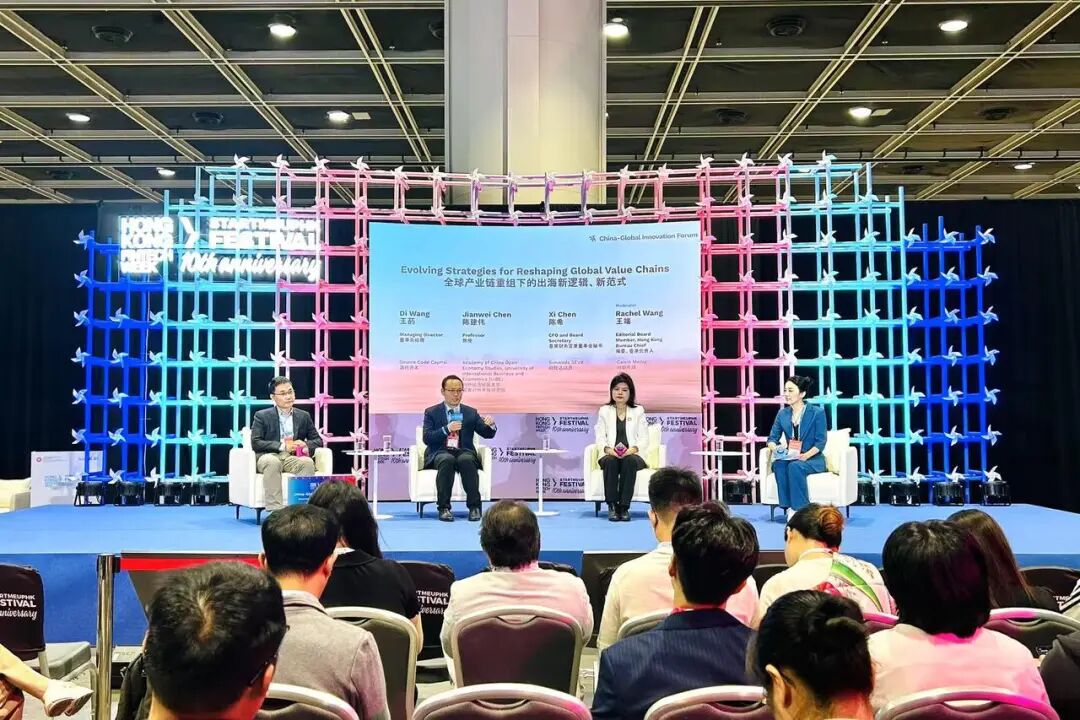
From left: Di Wang, Managing Director at Source Code Capital; Professor Chen Jianwei, National Academy of Opening-up and Development, University of International Business and Economics; Chen Xi, CFO and Board Secretary of Sunwoda Electronic Co.,Ltd.; Wang Duan, moderator from Caixin Media
Source Code Capital has maintained a sustained focus on the going-global trend, with early investments across robotics, AI, intelligent manufacturing, internet, and consumer sectors, backing companies such as Beatbot Starmax, Woan Robotics, Yangteng Innovation, Keeway, Hesheng Innovation, Poweroak, OPay, and Stori.
Against the backdrop of ongoing supply chain restructuring, Wang offered an investor's perspective on high-growth overseas sectors, sharing insights on how Chinese companies can navigate geopolitical risks, build global capabilities, and the disruptive trends that will shape the next five to ten years.
Below are the edited highlights, presented in their original spirit:
1
Three Directions with Growth Potential
Wang Duan, Caixin Media (moderator): Welcome to the Caixin panel. From an investment perspective, which going-global sectors hold the most growth potential amid supply chain restructuring?
Di Wang, Source Code Capital: China's industrial competitiveness internationally is progressing well overall. We focus on three main directions:
First, the "new energy trio": electric vehicles, lithium batteries, and solar modules. These represent China's new wave of going-global. Though these industries have experienced cyclical volatility, competitive turbulence, and deflationary pressure in recent years, we're now seeing them move from a deflationary logic back toward reflation — a favorable inflection point starting this year.
Second, AI infrastructure. AI represents a massive paradigm shift. At the hardware and infrastructure level, there remains room for cooperation between China and the United States. Breaking down data centers, they primarily comprise compute chips, interconnect, power, and thermal management. While China lacks clear advantages in core compute chips, it holds significant strengths in the other three modules:
- Interconnect: Primarily optical communications and emerging communication methods.
- Power: The United States faces acute shortages in power infrastructure for large-scale AIDC construction. Power architectures have evolved from primary to secondary to tertiary stages, and China stands as the global high ground for power electronics technology.
- Thermal management: This is another domain where China has substantial room to grow.
In these three foundational areas of AI infrastructure — interconnect, power, and thermal management — China maintains deep cooperation with European and American markets.
Third, pan-intelligent hardware driven by the spillover of Chinese industrial capability.
As I noted in Turning Foreign Lands into Home: Investment Reflections on Industrial Basics and Manufacturing Going Global, Chinese manufacturing and Chinese-made products are globally competitive. Looking at developed markets in Europe and America, there remains enormous latent growth potential.
- First, products serving American household or commercial energy independence, built on China's new energy advantages — such as residential energy storage systems.
- Second, the DIY market, a distinctive market form in Europe and America. 3D printing, for instance, is widely adopted by professionals.
- Third, automotive DIY. Unlike China, where car repair habits differ, Europe and America have large user bases accustomed to fixing their own vehicles. In dimensions like automotive DIY and intelligent hardware, Chinese companies have vast room to participate in global supply chains.
2
The Core Competitiveness of Chinese Companies Going Global Is "Focus"
Wang Duan, Caixin Media (moderator): The Wingtech-Nexperia acquisition case has drawn considerable attention recently and become a required study for Chinese companies going global. From an investor's perspective, what lessons does this case offer? How should Chinese companies respond to uncertainty in their overseas expansion?
Di Wang, Source Code Capital: The comprehensive uncertainty facing Chinese companies going global is real, and ultimately much depends on the entrepreneur's or team's ability to respond. When we evaluate companies, we pay close attention to their capacity for focus.
Individual country markets differ enormously. Spreading efforts across a dozen-plus countries like "scattering beans" usually leads to failure. Focus reflects a company's discipline around product strength and strategic resolve. The United States, Europe, and Japan are fundamentally different markets; Southeast Asia and Africa operate more on a "time machine" concept, where lessons from China's past decades can be replicated.
By contrast, the United States currently presents the highest barriers, most complex regulations, and greatest uncertainty for Chinese companies going global. Recent U.S. legislation has been voluminous and vaguely worded, requiring extensive collaboration with local counsel to understand compliance requirements. Hence, focus is critical.
Second, Chinese companies going global are no longer "following" — they are "leading." Many successful companies no longer content themselves with imitating established local players. Instead, they position themselves as premium from the outset, seeking differentiation. In robotics, home energy, and other sectors, we've seen Chinese companies over the past two to three years identifying pain points that local overseas brands have failed to address — offering better functionality and software experiences, with higher pricing and brand positioning than local competitors, yet successfully capturing market share.
Overall, Chinese companies going global remain in an early exploratory phase. American companies, after half a century of development, have built mature global service systems and can often deploy minimal staff to expand overseas smoothly. Chinese companies today are still laying the groundwork through continuous exploration — building policy responses, understanding market structures, and establishing distribution channels. In another generation's time, Chinese corporate globalization should become equally seamless, with tremendous potential.
3
Four Fruits on China's "Tech Tree"
Wang Duan, Caixin Media (moderator): Looking ahead five to ten years, which industries or disruptive areas are you most optimistic about?
Di Wang, Source Code Capital: I focus on pan-manufacturing and hardware long-term, and observe several major trends:
First, the premiumization of domestic industrial technology. China's "tech tree" keeps climbing upward — this is the through-line. The core challenge yet to be cracked is advanced-process semiconductors. Within roughly five years, this field could see meaningful breakthroughs, which would be a massive variable for Chinese industry and an initially very fast-growing sector.
Second, the "factory-ization" of AI infrastructure. The United States currently plans to build 10–15 gigawatts of AIDC annually, still using traditional engineering construction methods. But as human demand for intelligence explodes, if annual needs eventually reach hundreds of gigawatts, traditional engineering approaches will prove unworkable. AIDC delivery may ultimately evolve toward "AI factories," with more standardized production lines and process decomposition.
Third, AI-native interactive hardware. Beyond computers and phones, the industry anticipates a third commonly used device on users' desks. Phones are built around touchscreens and visual interaction; new intelligent interaction may rely more on new paradigms like voice, attempting to simplify screens and displays to better serve personal productivity and scenario efficiency. Behind this lies extensive software engineering to streamline and productize personal agents, supporting new hardware form factors.
Fourth, intelligent robotics. This is a shared aspiration. Though robotic degrees of freedom and complexity far exceed autonomous driving, likely requiring longer evolution, the accumulation of data, algorithms, and models provides a path toward approximating what people imagine. Picture the next 50 years: when the marginal cost of intelligence and robotic execution both drop to near zero, humans can define goals and robots can build and explore at low cost. This technological prospect offers enormous imaginative space.
4
Fintech Still Holds Opportunity
Wang Duan (moderator): You mentioned that Chinese companies' overseas service systems — financial, legal, and so forth — still seem to have gaps. Could this become a new investment opportunity?
Di Wang, Source Code Capital: This is an excellent question. Beyond following the macro trend of RMB internationalization, fintech holds exceptionally high value in this context — it's also a domain where China possesses technological strengths. We've already invested in portfolio companies operating fintech in Southeast Asia or Latin America, such as OPay and Stori. They don't necessarily rely entirely on RMB settlement; rather, they use technological means and innovative financial service models to effectively drive local business落地. This contains substantial investment opportunity.