How Can Effective Equity Incentives Achieve "Fairness, Value, and Participation"? | ESOP Research

Value, sense of value, values
Preface: Source Code Capital surveyed entrepreneurs on ESOP topics and found that CEOs face many common dilemmas. How large should the option pool be at different stages of a company? How should ESOP be granted? To whom? How much? How can you communicate with employees to create real incentive effects? As the company grows, how does ESOP connect with capital markets? When liquidity opportunities arise, how are ESOPs taxed and how can taxes be minimized? When employees leave, how should ESOP be handled?
ESOP is not a purely commercial, legal, or tax issue. An expert in one field may struggle to propose a comprehensive solution. To fully address the concerns of our CEOs, Source Code Capital screened service providers in the market offering ESOP-related services and invited four expert teams. Each has handled multiple TMT industry equity incentive cases in their respective fields. This is the first time they have appeared together on one platform. They will analyze ESOP from four dimensions — management, legal, tax, and dispute resolution — covering the entire process from multiple angles, to help everyone use this tool effectively.
Incentivize without falling into traps.
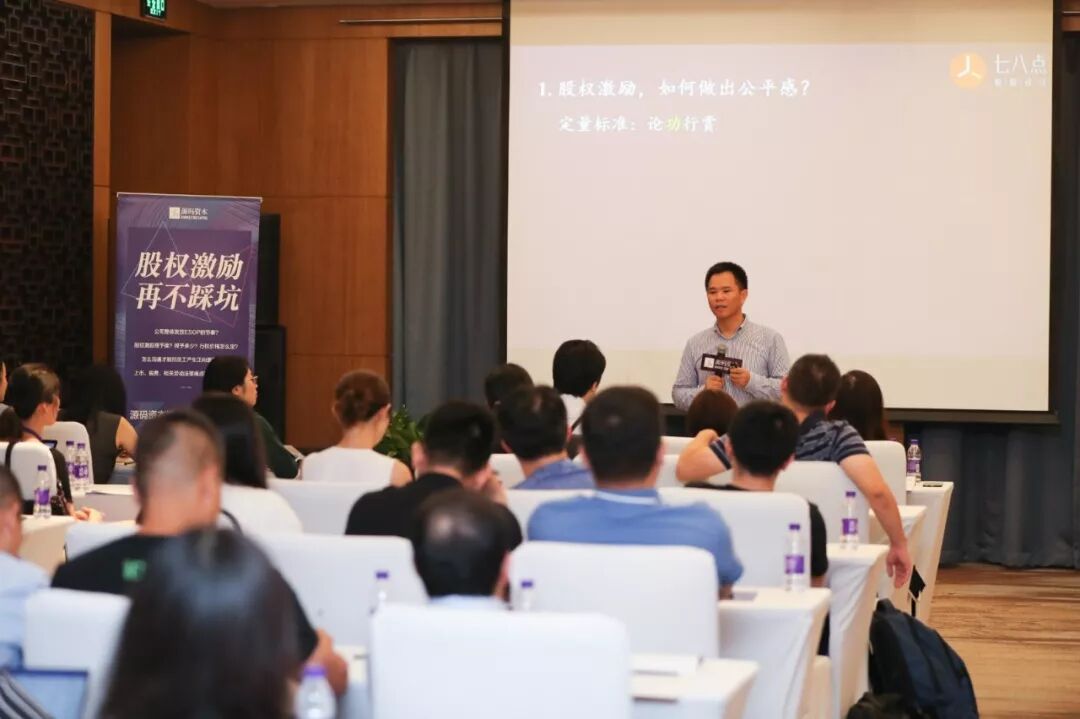
Dewen He
Founder, Beijing 7:30 Equity Design Studio; Equity Designer
Has provided equity design services for numerous internet companies including Xiaomi
[The following is the original speech]
Why did I choose the topic "How to Design Effective Equity Incentives: Fairness, Value, and Participation"? I believe that for every company doing equity incentives, granting stock itself is not the goal. The real goal is making it effective — achieving actual incentive effects after the stock is granted.
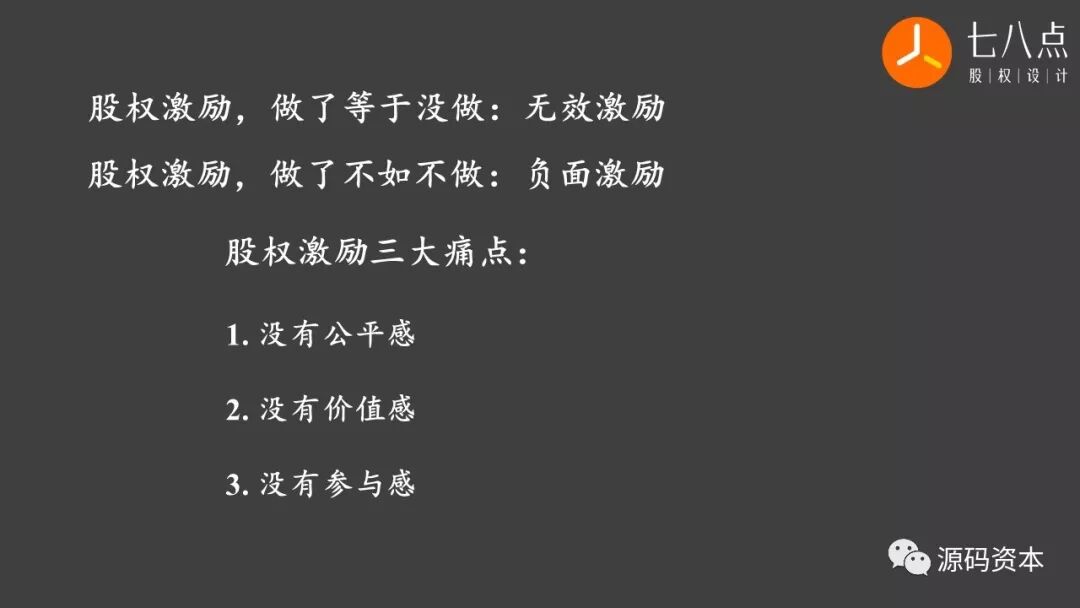
Equity incentives have three major pain points: lack of fairness, lack of value, and lack of participation. How to solve these three pain points and achieve effective equity incentives? It relates to the company's business value and prospects, the founder's leadership and personal charisma, and professional equity design services. My topic today focuses on how to create fairness, value, and participation in equity incentives through professional equity design services.
Regarding equity incentives, I'd like to first share three perspectives:
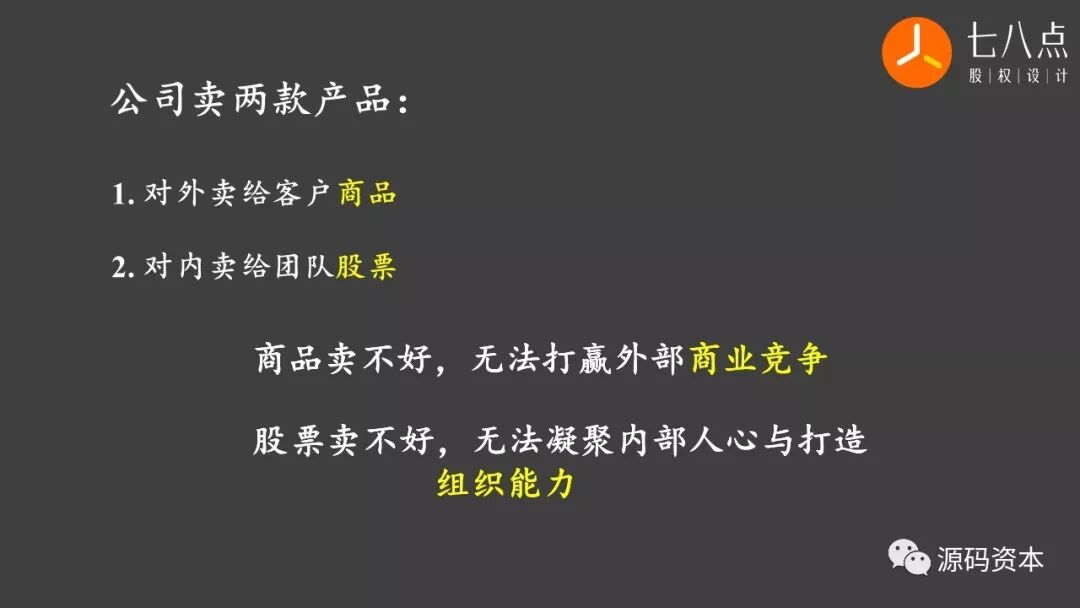
First, every company sells two products: one is the goods sold to external customers, the other is the stock sold to internal teams. If goods don't sell well, the company's cash flow dries up and it's hard to win external commercial competition. If stock doesn't sell well, it's hard to unite internal morale and build true organizational capability — especially in the knowledge economy era we inhabit, where partnership-based co-creation and sharing organizations have increasingly become the standard for modern commercial organizations.
Second, companies have two types of money to spend: one is currency issued by the central bank, the other is stock issued by the company itself. Any commercial competition is fundamentally a war for talent, capital, and resources — all requiring money. Currency is the company's present wallet, available now. Stock is the company's future wallet, also available now. Of course, issuing stock is harder than issuing cash, because cash has clear pricing and high credibility — it's backed by the central bank's credit. Issuing stock requires solving stock pricing and stock credibility issues, which is precisely where investment institutions and professional service providers add value.
Third, many companies have implemented equity incentives, but either they had no effect — ineffective incentives — or they were worse than nothing — negative incentives. I've heard many entrepreneurs and incentivized executives and employees feedback that after equity incentives, employees discovered "three no-changes": First, "identity didn't change" — they were employees before and still didn't feel like shareholders or partners; second, "rights didn't change" — they still didn't know what they didn't know before, still couldn't participate in discussions they weren't part of before, still didn't share in profits; third, "responsibility didn't change" — since they didn't pay for the options anyway, except for possibly three seconds of excitement at some distant, unpredictable IPO bell-ringing, they felt no connection to the company for eight or ten years before listing. Why does this happen? We believe most companies' equity incentives have three major pain points: no fairness, no value, and no participation.
How to solve these three pain points of "no fairness, no value, and no participation"? This requires the joint efforts of many experts from different fields here today. Based on our service experience, I'll offer some preliminary thoughts for discussion.
1 How to Create Fairness?
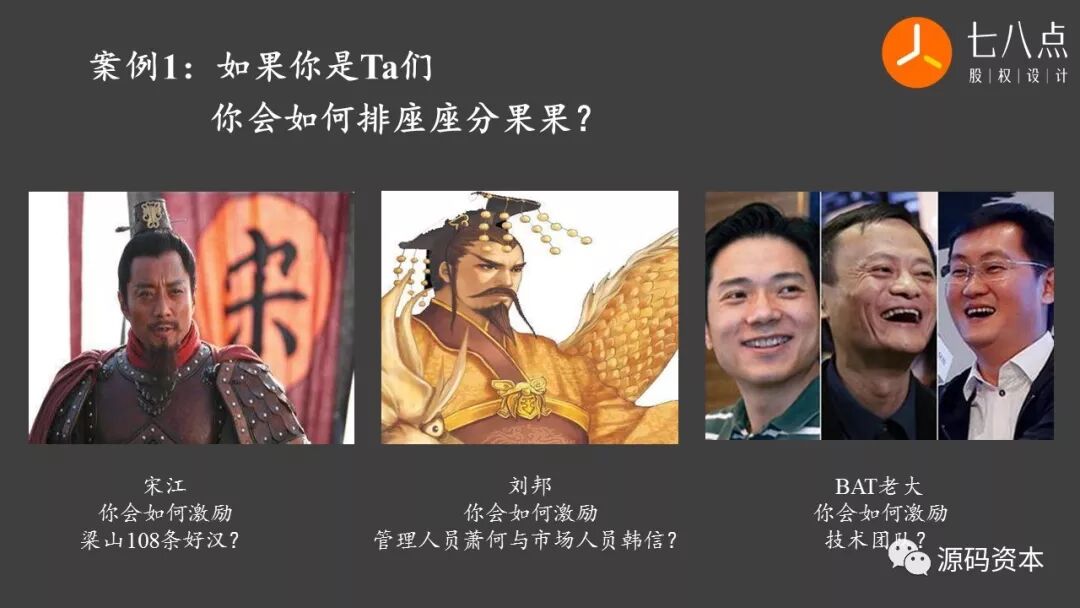
If you were Song Jiang, how would you arrange seats and distribute rewards among the 108 heroes of Liangshan?
If you were Liu Bang, how would you arrange seats and distribute rewards between your administrator Xiao He and your market-expanding general Han Xin?
If you were the leader of BAT, how would you arrange seats and distribute rewards for your technical team? Baidu was technology-driven for a long time, Alibaba was operations-driven for a long time, Tencent was product-driven for a long time — do these companies have the same standards for granting stock to technical teams?
If you were Cheng Wei, in DiDi's early days when territory grabbing relied mainly on iron-fist operations, but after grabbing territory the importance of ground troops declined and later it was mainly product and technology-driven — how would you arrange seats and distribute rewards for employees with different developmental stages and historical missions?
"Why do they have stock when I don't?" "Why do they get more stock than me?" These are employees' real inner thoughts when equity incentives are implemented, and this is the same incentive dilemma all organization operators face. "Not worried about scarcity but worried about inequality" — overestimating one's own contribution and underestimating others' is simply human nature.
How should incentive equity be granted to win public acceptance and feel fair and reasonable? I believe it should be "reward according to contribution" — distributing equity based on contribution size. But what exactly is "contribution"? How to evaluate and quantify it? These are the difficult points. Companies can reference four metrics: position value, rank value, performance value, and tenure value. For example, regarding position value contribution, Baidu's technical positions get a larger slice of the pie, Tencent's product positions get a larger slice, Alibaba's operations positions get a larger slice. Tenure is not a primary consideration for "pie" distribution in many companies, but one Fortune 500 HR company, Egon Zehnder (EZI), highly values tenure, believing that longer company service means better client relationships and greater value contribution. Different companies have different business models and core competencies, so they emphasize different metrics for "pie" distribution.
Therefore, regarding "fairness" in equity incentives: first, there must be rules; second, the rules must be relatively fair and reasonable, able to win public acceptance; third, the rules can be made public. Everyone is equal before the rules, but we don't pursue equality of outcomes. The ideal result is that those who receive stock feel incentivized, while those who don't also feel the rules are fair and reasonable before them, with clear goals and expectations.
2 How to Create Value?
Company A has a Series A valuation of 300 million. It plans to recruit an executive with "30,000 RMB monthly salary + 1% options."
The executive thinks the salary is too low (another company offers 50,000/month) and the stock is too little (another company offers 2% options). The dual value perception and user experience for both compensation and equity are poor, and negotiations reach an impasse.
If you were this company's founder, how would you negotiate the executive's equity?
For most middle-level and employee equity incentive quantification, the four metric value coefficients discussed earlier can resolve this. However, for core executive equity incentive quantification, beyond the quantitative methods mentioned, much needs to be resolved through one-on-one negotiation. In our client services, we've found that core executive equity negotiations are often quite difficult processes, with both sides having vastly different expectations. The problem the founder in the earlier case encountered is one many founders will eventually face. Behind this problem is the question of how to create value perception in equity incentives.
1. Value ≠ Value Perception
A company grants incentive equity to an executive. One way to say it: the company grants them 1% equity — their value perception may not be high. But if phrased differently: the company grants them 1 million shares — their value perception will be higher. Another example: the company's fair market value is 1 RMB/share. One way to say it: the company grants incentive equity at 20% of fair market value — their value perception may not be high.
But if phrased differently: for every share they buy, the company gives them 4 shares — their value perception will be higher.
Product managers often discuss "user thinking," focusing on the "value perception" of products. When granting incentive equity to employees, the employees who hold company stock are also "users" of the company stock. Since company equity is a complex financial product, and employees have professional asymmetry, information asymmetry, and negotiating position asymmetry regarding stock — they are "novice users" of company stock — we even more need user thinking and value perception thinking.
In the first two tests, the quantity and pricing of stock granted by the company are exactly the same. The only difference is communication method. Why does communication method difference lead to value perception difference? Is this communication meant to trick employees? Actually no. Because equity is a complex financial product, we need to treat people as people. Many founders themselves can hardly explain what their company is worth — we certainly can't expect employees to understand.
2. Value Expectation Management
(1) Equity value matters more than equity percentage
A 10 billion market cap company: 1% equity is worth 100 million. A 1 billion market cap company: 1% equity is worth 10 million. A 10 million market cap company: 1% equity is worth 100,000. Why is the value represented by the same "1%" equity so different? Equity value = equity percentage × company value. Different companies have different market caps/values. But for most employees, they easily understand equity percentage size. However, as novice users, they don't easily judge company market cap size. Therefore, when doing employee incentives and recruiting executives, guide them to focus more on equity value size, not just stare at equity percentage and share quantity.
(2) Future equity value matters more than present equity value
Three companies, all valued at 100 million, all willing to give 1% equity to attract an executive — this 1% equity has present market value of 1 million. Identical starting points. But after 5 years, one may have stagnated, still valued at 100 million. One may have reached 10 billion market cap, with 1% equity appreciating to 100 million. One may have lost money or gone bankrupt, with equity becoming worthless paper or even a liability.
3. Exercise Cost Communication
Question: Company A has Series A valuation of 500 million; investors enter at 5 RMB/share. The company plans to list on domestic A-shares. After financing, the company plans to grant incentive equity to employees. How should incentive equity be priced?
Employees can obtain company stock through three methods:
- First, equity investment model: employees use real money to purchase company stock at fair market value.
- Second, equity incentive model: employees obtain company stock at a discounted price to fair market value plus human capital investment.
- Third, equity reward model: based on employees' outstanding historical contributions, stock is granted for free. We are now discussing the "equity incentive model."
For companies that have already completed financing and have future listing plans, two equity structures are available: offshore equity structure and onshore equity structure. Under these two different structures, the room for pricing flexibility differs greatly. Under offshore structures, overseas capital markets focus more on future growth potential; profit itself is not a listing obstacle, so tech companies like BAT with little net profit can still list. Therefore, employee incentive equity pricing has considerable flexibility — discounts like buy 1 get 5, buy 1 get 10 are all possible.
However, under onshore structures, if pricing is too high — say at fair market value of 5 RMB/share — the incentive effect on employees is limited. If discounted 80%, say to 1 RMB/share, there is a 4 RMB per share difference. As company valuation grows higher, this difference grows larger. This difference, not paid by employees, is ultimately paid by the company, eating into company profits.
If pricing is handled poorly, it's possible that before listing, after finally generating tens of millions in net profit, the company sees large profits consumed by the difference between employee incentive equity pricing and fair market value (share-based payments), even turning profits negative. For A-share listing, there are still profitability requirements, which would affect listing. As company valuation grows higher, if employee incentive equity pricing is too low, share-based payments will consume more and more company profits. Therefore, discount ratios for employee incentive equity pricing will become smaller and smaller, increasingly approaching investor pricing.
The value perception of incentive equity relates on one hand to future returns discussed earlier, and on the other hand to employee exercise costs. When employee exercise costs approach stock fair market value, with little or no discount, how should we communicate with employees to avoid misunderstanding or misinterpreting incentive equity pricing, which would affect value perception?
- Controllable investment risk. In post-financing equity incentives, the main incentive tool is options. Options are a right, not an obligation, for employees. In the future, employees can choose to exercise or not. At exercise time, if company stock market price far exceeds exercise price and the employee is optimistic about company future development, they can exercise. If stock market price is below exercise price and the employee is not optimistic, they can abandon exercise. Compared to investors, employees are following investment behavior, and can abandon follow-on investment based on risk judgment — employee investment risk is not high.
- Expectable appreciation space. Even if employees follow in at the same price as investors, professional investors certainly made professional judgments, believing the company still has growth space and stock still has appreciation space — employee stock still has appreciation potential.
- Employee interest maximization. If employee incentive equity pricing is too low, affecting company listing, employee stock cannot be liquidated through capital markets, which is also not the best outcome for employees themselves.
4 Special Notes
For key talent, use equity vesting mechanisms and exit mechanisms to control risk, with getting it done as the goal.
For startups, the company's business development prospects and the leader's ability to "paint visions" are the core competitiveness for creating stock value perception and getting talent on board.
If a company can neither give employees present value nor paint a picture of future value, it's only natural that they can't recruit talent and end up alone. For truly outstanding talent, the future big picture is more attractive than present returns.

Dewen He
Founder, Beijing 7:30 Equity Design Studio; Equity Designer
Has provided equity design services for numerous internet companies including Xiaomi
3. How to Create Participation?
For employees, options mean: (1) they don't need to spend real money to buy company stock now, (2) before spending real money to exercise, they are not company shareholders, enjoying no shareholder rights and bearing no shareholder obligations, (3) they correspond to company future, long-term, and uncertain returns. Therefore, after receiving options, many employees feel their identity hasn't changed, rights haven't changed, obligations haven't changed. Some equity incentives, done equals not done. Some equity incentives, create piles of conflicts and disputes — worse than not doing them.
How can employees have participation in equity incentives?
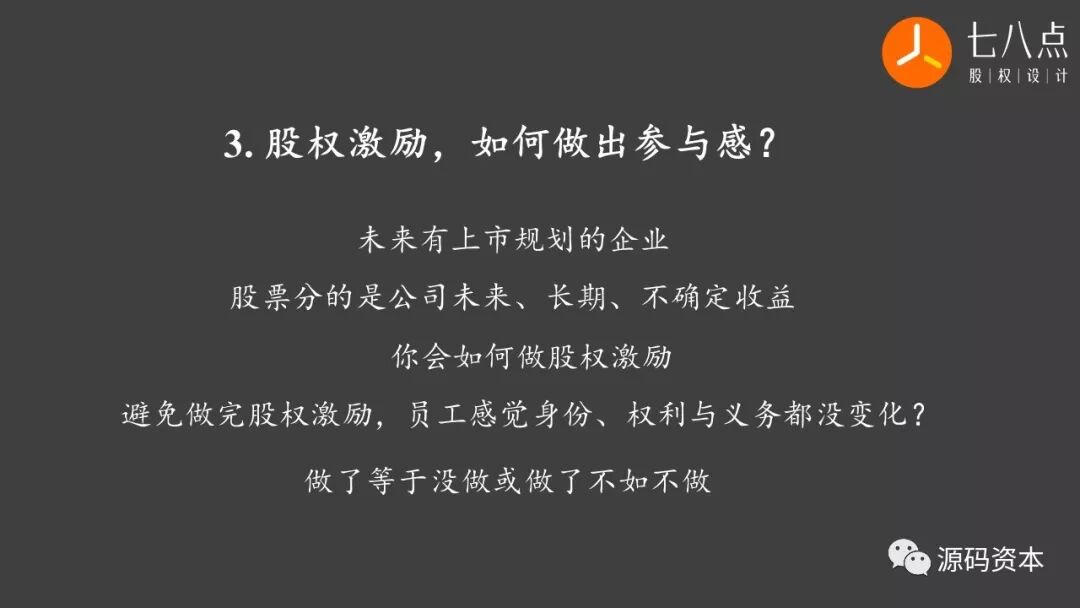
There are two major models for equity incentives: the Huawei and Vivo/Oppo model, and the BAT model.
In the Huawei and Vivo/Oppo model, the company doesn't list, but has decent cash flow; when performance is good, the company can distribute profits annually — this is a model of distributing present company value. In the BAT model, before listing, companies typically need large capital investment; cash flow is usually not good, often with no money to distribute. Even if some profits are made before listing, they usually don't tend toward large pre-listing dividends. Dividending 1 RMB before listing likely divides away 30-50 RMB of post-listing market cap. Therefore, the BAT model is one of distributing future company value. This also means that except for those three seconds of excitement at some distant, ever-shifting IPO bell-ringing, employees may feel the company has no connection to them whatsoever — no participation.
How to create participation in equity incentives? Drawing from Xiaomi's approach that we previously served, here are some ideas for reference:
(1) Partner + Angel Employee: AB Identity
A identity: operating team identity. B identity: financial investor identity.
Xiaomi's 8 partners all had AB identities. On one hand, they were all company founders who obtained Xiaomi common stock at low prices in the early startup stage. On the other hand, they were all company financial investors — at Xiaomi's Series A financing, they all invested real money in Xiaomi at company valuation, with investment amounts ranging from tens of millions to one or two million. At Xiaomi's founding, Lei Jun told co-founder Bin Lin: "If you truly love something and truly think it through, there's no better investment than investing in yourself." To solve the source of stock purchase funds, he sold all his stock from former employers Microsoft and Google and converted it all to Xiaomi stock.
Xiaomi's early 50+ angel employees also invested real money in Xiaomi, with total investment exceeding 14 million. One early Xiaomi angel employee, Xiao Guan, even converted the dowry money her parents gave her into Xiaomi stock. 5Y Capital's Qin Liu, Xiaomi's earliest institutional investor, said she was "a truly faithful investor, she's my idol."
As a serial entrepreneur, Lei Jun didn't lack the money from partners and angel employees. But what he needed was the sense of responsibility and business participation behind that money. Therefore, Lei Jun created trouble for himself, finding himself 50+ employee "bosses" — everyone invested real money and became company shareholders. Partners and angel employees all bet their personal fortunes on Xiaomi; if Xiaomi failed, many people's half-life of struggle and assets would be wiped out. This partly explains Xiaomi's early-stage all-hands 6×12 hour work schedule.
If employees have limited investment capacity, entrepreneurs can also learn from Yongping Duan and Ren Zhengfei's approach: (1) employees must spend real money to buy company stock, (2) lower the employee investment threshold, solving employee funding difficulties through high salaries, major shareholder loans, shareholder dividends returned to investment, bank loans, and various other methods.
(2) Combined Compensation Model
When recruiting, Xiaomi gives some employees different compensation choices:
- First, normal market-rate cash salary
- Second, 2/3 salary plus some stock
- Third, 1/3 salary plus more stock
Results: 10% chose the first and third forms; 80% chose the second. This combined choice approach: first, understands whether each employee is optimistic or pessimistic about the company's uncertain future, and understands different living costs and pressures from housing, cars, and children; second, gives employees voluntary choice, not mandatory stock allocation; third, those who bet accept the outcome — profits bring shared joy, losses bring no regrets.
Everyone is responsible for their own voluntary choice. This two-way selection model also better ensures that those ultimately incentivized are exactly those you need to incentivize. If someone was already unstable, wanting to jump ship after half a year, they certainly wouldn't choose your stock. Their choice of your stock indicates at least a relatively long-term investment mentality. Voting with money is true love.
(3) Mid-Route Stock Liquidation Mechanism
No matter how high the company valuation, before cashing out, company stock is only paper wealth. Only when stock truly becomes money do people feel greater value perception. Startup executives and employees generally have relatively low salaries, and universally face real living pressures from housing, cars, and children. Therefore, after passing company milestone developments — for example, after completing Series C financing — consider allowing executives and employees to liquidate small amounts of stock within certain limits to improve their lives. Give investors discounted prices for buying some employee secondary shares, say 20% off; investors are also willing to buy some employee secondary shares. This makes everyone happy.
(4) Phased Implementation
Jack Ma said: some people believe because they see; some people see because they believe.
In early startup stages, stock has no clear pricing, stock credibility is not high, and stock value only becomes visible through belief. Most people only believe because they see; only a minority see because they believe. In early startup stages, only those few partners will foolishly believe that the stock in their hands — which can neither buy breakfast nor make a down payment — might be worth something in the future. Therefore, we recommend that stock grants be directionally and rhythmically phased. For core partners, stock always needs to be granted. For most executives or employees, when company stock has some value perception — either the company has attractive present profitability or an attractive valuation — then implement phased, step-by-step equity incentives.
How to do company equity incentives well? I'll leave you with three words. First word: "Value." Only when a company is valuable can its stock be valuable; everyone should build a truly valuable company — either valuable now or valuable in the future. Second word: "Value perception." Equity is a financial product; employees are novice users of company stock. Have user thinking; make company value more visible; let novice employee users recognize and perceive the present and future value of equity. Third word: "Values." Equity design is not about designing for any one person, not one-sidedly promoting "equity conquers all," and certainly not fabricating facts to trick, deceive, or scam employees. Rather, it's based on principles of long-term company stability, dynamic fairness, and reasonableness, guiding everyone to jointly grow the company pie.
Only by dividing the "pie" well can you grow the "pie." May you all divide the pie well, grow the pie, and build your company into a valuable company — this is the greatest incentive for all shareholders.

More ESOP Research

How to Avoid the Pitfalls of "Equity Incentives"? | ESOP Research
Source Code Capital
Creating Lasting Real Value

WeChat ID: sourcecodecapital
More Professional Content
Follow our official WeChat