MaHui Entrepreneurs | Two 29-Year-Old Genius Scientists and Their "Moon and Sixpence"

MaHui Entrepreneurs Resilient, Bold, and Ever-Exploring
On June 15, VBData released its 2022 Future Healthcare 100 list. DeepWise made the Innovative Digital Healthcare Top 100, recognized for its next-generation "AI + molecular simulation" algorithms and its drug computational design platform Hermite, which effectively broke through the "small data" and even "no data" bottlenecks in pharmaceuticals.
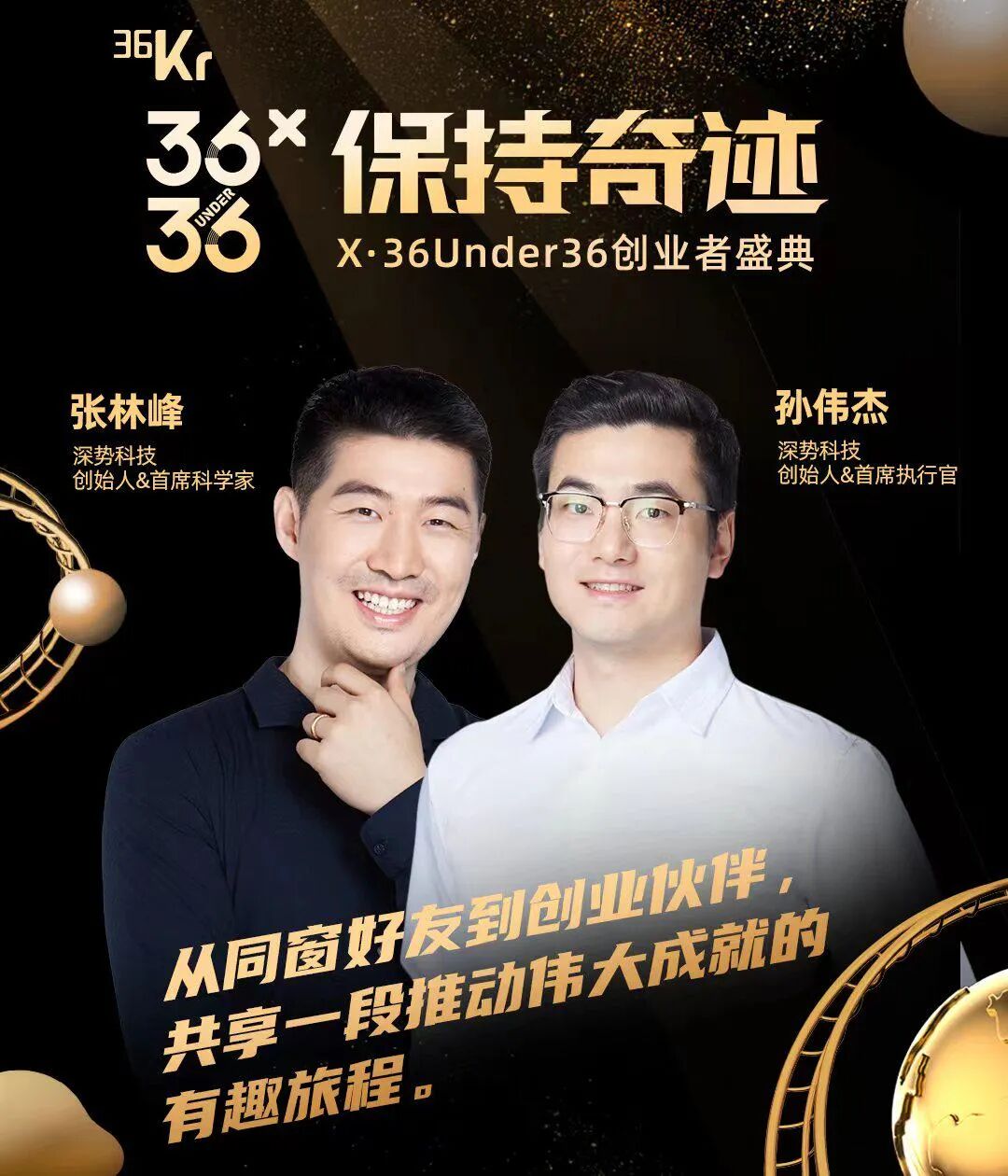
In a remote photography studio on the outskirts of Beijing, Weijie Sun, one of DeepWise's co-founders, was "getting a haircut" in the makeup room. "Working from home is way more exhausting than going to the office. I don't even have time to keep myself presentable." Fresh out of COVID lockdown, he had been invited to 36Kr's "Keeping the Miracle Alive" X·36Under36 entrepreneur gala. At the event, he caught up with many founder friends and thought about his other partner, Linfeng Zhang, still in Shanghai.
Sun and Zhang were classmates at Peking University's Yuanpei College. Zhang majored in physics, math, and computer science; Sun studied politics, economics, and philosophy. Together, they made 36Kr's 2022 S-Class founder roster, recognized as China's most representative young innovators and "new-era Chinese partners."
01 The Beginning
This is a story about two "prodigy types" who could have taken the shortcut to conventional success but instead chose to level up in the business world.
Zhang was admitted to Peking University early in his first semester of senior year after making the provincial physics olympics team. During his time at Yuanpei, he racked up substantial research achievements. Upon graduation, he received offers from Princeton, MIT, and Cornell — ultimately choosing Princeton.
Yuanpei is an intensely liberal arts-focused college. Though Sun and Zhang were schoolmates, they didn't share a single class as undergraduates. But in their very first week, they kept running into each other across different contexts — playing sports together, collaborating in various student organizations. Sun joked, "We wore ourselves out for Yuanpei's athletics program, and that opened the door to our friendship."
After graduation, while Sun was working in investment in China searching for his direction, Zhang stayed on the academic track in the United States, studying under the highly respected applied mathematician Weinan E and Roberto Car, a member of the U.S. National Academy of Sciences and a founding figure in molecular simulation.
By then, Zhang had already developed a series of algorithms combining machine learning with molecular simulation, built the open-source community DeepModeling, and was gaining traction. During his doctoral studies, he even translated a book on quantum computing on his own.
By the time he finished his PhD, he had what looked like a solid path ahead — perhaps a postdoc, then a faculty position at a top U.S. university. There were bolder possibilities too: graduating early, going straight to a professorship.
He turned them all down. It was the moment when AI was first colliding violently with scientific computing, and computational simulation stood at a historical inflection point. Zhang once laid out two convictions in a personal note: First, multiscale physical models are the foundation, high-performance simulation is the engine, and machine learning is the bridge that integrates data and connects different physical scales — the simultaneous advancement of all three was bringing people from different disciplines together and putting models and data from electronic structure to molecular dynamics to mesoscopic and even macroscopic scales within a single framework. Second, the pipeline from fundamental innovation to rapid commercialization was being connected.
In this chain of platform innovation moving toward industrial application, the two were hungry to be the "grafting point" — one end reaching deep into the most fundamental disciplinary innovation, the other connecting to concrete industrial problems. This was undeniably a bold, even risky decision. Not just in China — you couldn't find a direct comparable anywhere abroad. In other words, what they were setting out to do would be a global first.
Sun had long dreamed of "building a tech company born in China that impacts the world." Every summer when Zhang returned to China, they would meet and imagine together: What would AI and scientific computing solutions look like when mapped onto real, specific industrial needs? How could they actually solve problems people cared about? They shared a vision — that research and technology could make human life better.
To build such a system, entrepreneurship was necessary, almost inevitable. In 2018, having reached deep consensus on both business thinking and scientific exploration, they co-founded DeepWise. Sun became CEO, responsible for strategy; Zhang became Chief Scientist, leading R&D. The cross-disciplinary pairing turned the two from schoolmates into real business partners.
Source Code Capital investor Yuhao Zhang was their senior at school. In early 2020, when DeepWise began fundraising, experience and instinct both told him "this deal cannot be missed" — sure enough, months later he became DeepWise's first investor, and later helped Source Code Capital lead the Series B.
02 The Immense Energy of the Microscopic
Life is long, yet passes in an instant. Some see dust; some see stars. "Solving problems" may be the mission of truth-seeking, pragmatic "genius scientists." In over an hour of conversation with the author, contrary to expectations of two young founders going on about AI, they mentioned "solving problems" 26 times. "Without solving fundamental problems, there's no value." "The meaning of our existence is to solve problems." "Where exactly are the industry's problems, and how do we actually use computation to solve them?"
Put simply, DeepWise's mission is to use the "AI for Science" paradigm to solve molecular simulation problems at microscopic scales, delivering revolutionary solutions in drug discovery, new materials R&D, and beyond.
2020 was a milestone year. Zhang and collaborators achieved, for the first time, first-principles-precision molecular dynamics simulation of over 100 million atoms on Summit, then the world's largest supercomputer — winning the "Gordon Bell Prize," the highest honor in high-performance computing. This put them on a small peak of using classical computation to solve the quantum world. Notably, seven of the team members were Chinese, five from Peking University.
What did this award mean? Before this, typical physics simulations in drug and materials design operated at scales of tens of thousands to hundreds of thousands of atoms, a million at most. They had boosted efficiency by 1,000 times over previous human baselines while maintaining high precision, ushering ultra-large-scale molecular dynamics simulation into a new era.
"We never did this for the award. Our endgame is solving problems." What's rare is that DeepWise's entrepreneurial path actually walks this talk. The "innovation to application" chain first took force in innovative drug design, launching the cloud-based preclinical computer-aided drug design platform Hermite, along with joint drug R&D services for small molecules, peptides, and antibodies.
On the currently hot topic of AI pharma, Sun prefers the term "computational pharma." Even though DeepWise has already partnered with top domestic drugmakers like Hengrui Medicine and Hansoh, he emphasizes that computation's role goes far beyond assisting drug development — it can partially replace experiments. By building a new-generation microscale industrial design platform, it can continuously solve a series of problems across real industrial scenarios.
This is the unique scientific aesthetics of the microscopic world — and a purely original path that no one in China had walked before.
"When you truly want something, the whole universe conspires to help you." The Alchemist is a book Sun and Zhang return to often, and the "company book" DeepWise gives every new hire in their onboarding package. That line from the book encourages them constantly.
In 2021, CATL, as a global leader in new energy technology, needed systematic construction of foundational data models for battery research. By chance, a CATL executive drew inspiration from a DeepWise educational lecture and began experimenting with their methods in R&D. Hillhouse, which had invested in DeepWise's Series A, along with university scholars, also recommended DeepWise to CATL. Leveraging its influence in computational chemistry through open-source algorithms and software, DeepWise found CATL coming to them.
Sun admitted frankly that CATL engaged with the early-stage startup at a very high level. After multiple face-to-face exchanges with senior leadership, their ideas were validated one by one and turned into collaboration — which especially energized the team. "We hadn't anticipated opening up in battery materials and new energy this quickly." For DeepWise, this collaboration opened the possibility of landing its microscale industrial design platform in another major industry. Yet landing such a massive deal, the two athletes simply celebrated with a exhilarating game of basketball.
On the entrepreneurial journey, Sun and Zhang particularly savor moments of sudden insight. In DeepWise's Zhongguancun office, the backdrop is covered with physics and math formulas, as if in a university classroom.
"At any moment in the day, ideas strike you. The most effective thing is to write them down quickly, talk to people. If it's a really big idea, it should be rapidly spread out, with the team pushing it forward together. I love environments full of blackboards where people can quickly jump into discussion — if you find it works, it's pure joy," Zhang said.
03 The "Alms-Seeking" Journey
Unlike today, when they're sought after by industry and investors, three years ago Sun and Zhang were just two young men crammed into a part-time office at Peking University's data research institute, calculating how much money it would take to pull this off — and even now, they're still under 30.
Sun laughed that without even counting human costs, just computing power alone would require at least 1 to 1.5 billion RMB, while they had 200,000 in the bank. Initially, DeepWise collaborated with a Guangdong lab, but the 10 million-plus in research funding barely sustained early development.
Facing this massive capital gap, they embarked on a grueling fundraising journey. But team-building and product iteration kept the two founders tied down. To avoid spreading themselves too thin, they took a counterintuitive "shortcut" — sending every investor who came knocking the same pitch deck, but one that was highly technical and specialized. This screening mechanism sounded a bit arrogant, but it worked: only those who understood the deck and could ask valuable questions would continue; investors who didn't get it automatically filtered themselves out.
Aligned values make decision-making exceptionally efficient. Across three funding rounds, through this selective, deep-dive approach, investments were closed within one to two weeks each. DeepWise needed investors who understood it. Yuhao Zhang, who joined Source Code Capital in 2021, was one of those rare investors.
A biophysics PhD from Yuanpei with years of frontier biotech investment experience, Zhang was immediately struck by DeepWise's revolutionary "AI for Science" paradigm. He was also deeply curious, later systematically understanding how this new paradigm applied to complex cross-scale modeling tasks — how precise physical modeling was brought into materials simulation on molecular dynamics problems, and what more practical applications it could have in chemistry, biology, pharmaceuticals, and beyond.
Over several months, Source Code Capital partner Yungang Huang joined Yuhao Zhang on multiple visits to DeepWise's founding team, often talking for hours, with whiteboards full of discussions on how "deep potential" could better land in applications. This enabled Yuhao Zhang to lead Source Code Capital, which had missed the Series A for various reasons, to successfully lead the Series B.
Zhang told the author that beyond regular meetings, they communicated frequently with the two investors in WeChat groups. He even joked, "Source Code investors are night owls who reply to messages instantly." For DeepWise, each investor brings different nutrients — some know their way around open-source strategy, others have resources in IT R&D. But whenever business development or technical issues arose, Source Code was among their first choices to turn to.
Deeper, more systematic entrepreneurial support capabilities are a distinctive strength of Source Code Capital — deep industry insight, rapid mutual growth, solving real pain points. This intense entrepreneurial spirit is perhaps the secret to why DeepWise is so willing to engage with them frequently. Helping at critical junctures without getting in the way, bringing both intellectual and practical assistance — super-experts providing intelligent organizational empowerment, and MaHui and Code Brain connecting resources and ecosystem.
Outside of work, the four friends often play basketball together. On a team, the goal is to win. You have to figure out how to coordinate best. But the problem is, winning individually and winning as a team are different experiences. Usually only one person can be the center who scores, but then you can't win together. It's an analogy that reflects organizational thinking in collaboration. "We started discussing these things early on, from both technical and philosophical angles," Zhang said.
Confucius once said, "How dare we despise the young?" What started as a two-person operation has grown into a team of over 100, with an average age under 30. They carry less of the entrepreneurial anxiety that's so common, and more of a buzz of excitement.
Maugham wrote in The Moon and Sixpence, "On a street full of sixpences, he looked up and saw the moon." In the founders' words, the author saw something of Strickland's drive — relative to working for money, they more enjoy the value of solving problems, with money being merely a byproduct. Yet with investors' backing, the end of dreaming-big entrepreneurship may be: the moon is there, and the sixpences happen to be there too.


- MaHui Entrepreneurs | Mech-Mind's Tianlan Shao: Some of My "Grassroots" Experience
- MaHui | Nearly 40 MaHui Members Make the "X·36Under36" S-Class Young Entrepreneur Roster
- MaHui Entrepreneurs | Nreal's Shunhao Fan: What Kind of Operating System Does the XR Era Need?
- MaHui Entrepreneurs | When a "Software-Defined Storage" Company's Founder Is Also a Race Car Driver
- MaHui Entrepreneurs | Academician Weinan E Proposes a "New Dawn" for Applied Mathematics: AI for Science Deeply Integrates AI with Fundamental Science
- MaHui Entrepreneurs | From 0 to 1 to 23.4 Reading Week: "Happy Reading Day"
- MaHui Entrepreneurs | From 0 to 1 to 23.4 Reading Week: "The Beauty of Reading"
- MaHui Entrepreneurs | From 0 to 1 to 23.4 Reading Week: "General Knowledge and Big-Picture Thinking"
- MaHui Entrepreneurs | From 0 to 1 to 23.4 Reading Week: "Organization and Talent"
- MaHui Entrepreneurs | From 0 to 1 to 23.4 Reading Week: "Strategy and Operations"
- MaHui Entrepreneurs | From 0 to 1 to 23.4 Reading Week: "Entrepreneurial Mindset"
- MaHui Entrepreneurs | Exploration Never "Extinguished": Saluting the Spirit of Aerospace
For more MaHui members, click "Read More"