The Growth Logic of New Brands on Douyin E-Commerce

Good content, good products, good service.
On November 19, Douyin E-Commerce and Source Code Capital co-hosted a "New Brand Development Trends Seminar," where they jointly released the New Brand Growth Trends White Paper (hereafter referred to as "the White Paper"). The White Paper summarizes Douyin E-Commerce's observations on consumer brand development trends around "new brands, new business, new growth" — how brands can use content to connect users with a better life and reshape the consumer journey. Drawing on case studies from Source Code Capital portfolio companies across the consumer sector — including Wang Xiaolu, Blank ME, Cloud Whale, PMPM, WonderLab, WANGBAOBAO, and usmile — the report distills growth strategies for new brands on Douyin E-Commerce. Source Code Capital, from an investor's perspective, analyzed the growth trajectory of new brands, the fertile ground that digital transformation provides, and how new brands can build a "product strength" moat.
At the seminar, Zhang Hao, Head of Douyin E-Commerce Service Providers, and Huang Tingfu, Head of Douyin E-Commerce Merchant Strategy, shared their insights on the growth logic for new brands on the platform.
Below are their presentations:
Long-Term Operations on Douyin E-Commerce
Speaker: Zhang Hao, Head of Douyin E-Commerce Service Providers
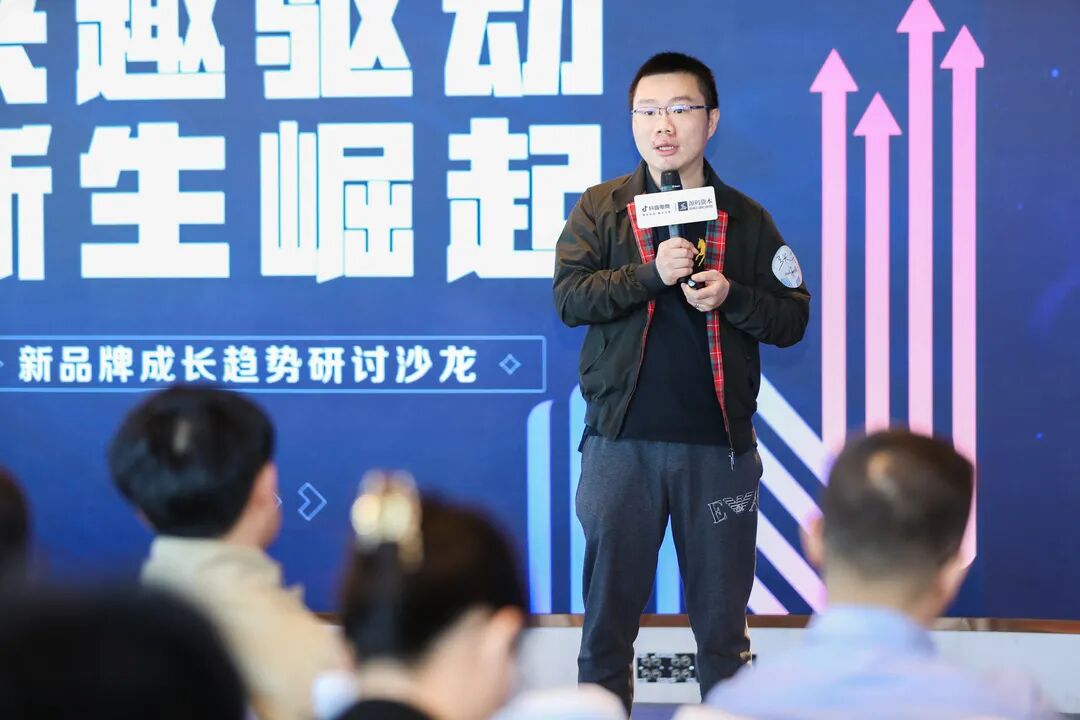
First, let's talk about what "interest-based e-commerce" means. Compared with traditional shelf e-commerce, on Douyin users satisfy their interests through content while simultaneously making purchases. For example, we've talked with many brands and advised them not to compete on price.
From a business perspective, today we're very focused on how to build sustainable, long-term operations within Douyin E-Commerce. We want merchants to make money, and we want the platform to develop well.
Good Content, Good Products, Good Service
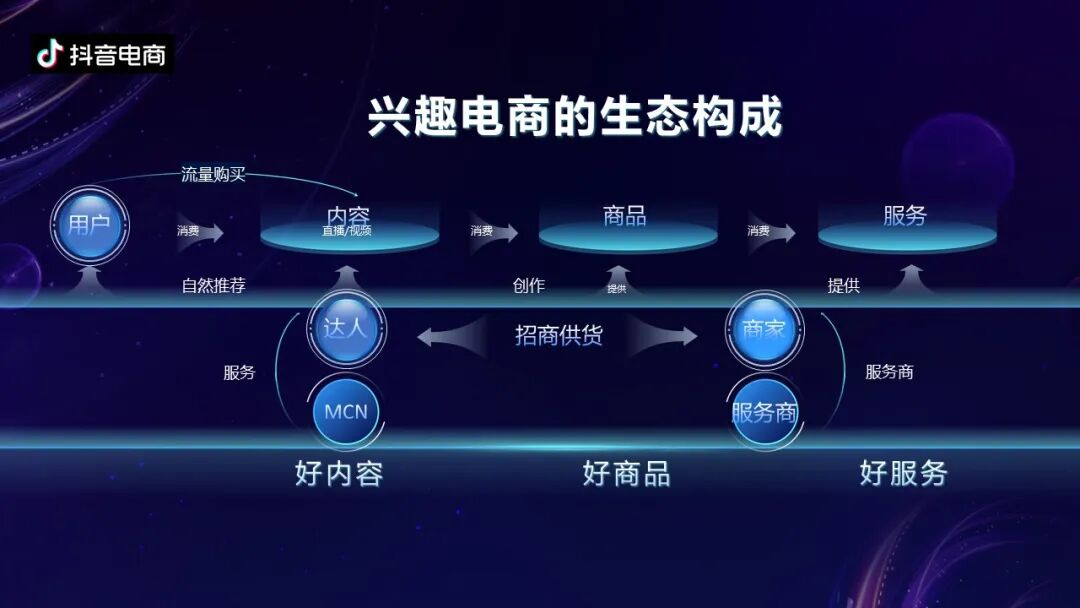
First, good content. We put good content first because the barrier to entry for content is high. When the medium evolved from text and images to video and livestreaming, the difficulty increased significantly. Many startup brands think that making a good product and finding distribution channels is enough, but today you must understand content. Without content literacy and the ability to judge quality, you might not even be able to select a good service provider.
Second, good products. A new brand's core competitiveness must come from refining great products, because good products determine how far you go and how much premium you can command.
Third, good service. E-commerce itself is a full-chain service. Every brand needs to review its internal efficiency — how to close the loop from customer service to supply chain and elevate service to high performance. Poor service may seem like just a reputation hit in the short term, but over time it severely impacts user experience. For example, there was an apparel and footwear brand that started with decent sales but suffered from bad service and damaged reputation. Later, they moved their service team from Guangzhou to Hangzhou, which dramatically improved efficiency.
How Can Brands Capture Growth Opportunities in This New Marketplace?
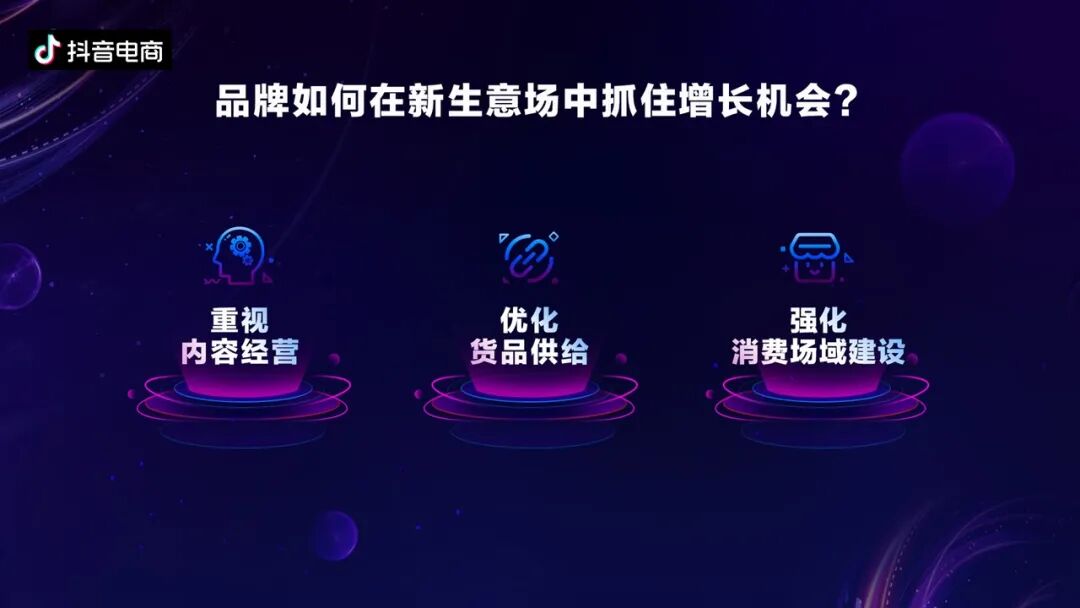
First, prioritize content operations. Why? Because consumers need to see what's behind the product. Content enhances user experience and lets people see what's happening on the production line. For instance, an interesting case: a clothing factory used comparison videos to show they used the same fabrics and craftsmanship as international luxury brands, helping more people recognize China's supply chain advantages — and they sold very well. Users want quality; merchants demonstrate quality through content, letting users experience it through video. That's the core of content. Also, don't overlook the power of KOLs. Compared with traditional ad placements, vertical KOLs offer impressive CPM rates and matrix scale — this resource is worth tapping.
Second, optimize product assortment. The key is whether your selection is interesting and useful enough. For users, Douyin E-Commerce offers quality goods; only something sufficiently interesting and useful becomes a brand that can monetize.
Third, strengthen domain construction. Building a strong consumption domain means using multi-domain operations to fully cover the user consumption journey.
Finally, some advice based on questions you've raised.
Question 1: How should brands match with Douyin E-Commerce resources?
You need a solid product lineup, a content team, a refined operations system, and a good service provider. A solid product lineup means not just good products, but also inventory reserved for Douyin — because sometimes you finally start selling and then run out of stock. Second, we strongly recommend having a content team, even just three to five people. Going forward, whether new brands originate from China or globally, the product team and content team will be the CEO's two most critical functions.
Question 2: Where are the opportunities for standardized products?
Seed planting, KOL livestreaming, and self-broadcasting — and don't forget the high efficiency of short video. You've seen that many of our partners today focus on standardized products, and for these, short video efficiency remains very high. Personally, we hope to cultivate more short video service providers from a creative angle, to reduce marketing costs for standardized products.
Question 3: How to build the team? (Livestreaming, KOL selection, content, paid promotion, customer service)
True heroes climb out of pits — the boss/operator needs to jump in first. Because Douyin E-Commerce has too many roles that need to be reconstructed from scratch; it's hard to reuse experience from other platforms. But we've found that brands that succeed usually have the boss or core operator deeply involved. Being in the right place at the right time means the boss works hard — you must be willing to get your hands dirty.
Question 4: Where is the growth opportunity for Douyin E-Commerce in 2022?
Master "product finds people," capture "person finds product" (search), and watch the mall closely. First, you still need to nail "product finds people" — this is the biggest opportunity to get started on Douyin E-Commerce. Then there's the mall, whose biggest benefit is for large standardized products, marketing moments, or repurchase scenarios — we'll be paying very close attention to this next year.
Question 5: What matters most, most, most of all?
Upgrade from "TA + frequency capping" to LTV-based brand user data accumulation (do the math). In the past, you'd select target audiences on the platform, control quality, and when a precise user was covered three or more times, they became your target user. But today, looking at the entire information feed product format, you need to revisit user LTV — how much value this user brings over the next one to two years. This determines your investment. Everyone must calculate this; it's not about being profitable immediately, but about seeing clearly how many potential users you have. Whether through self-funding or financing structures, if you want to deeply penetrate those 5 million people over the next two to three years, you need to know how much to invest per account.
Finally, I hope everyone can become a winner in long-term operations. On every platform, you must drive high conversion — at least achieve the highest conversion rate in your category. Maintain reasonable premium; supply chains are already very strong now, making it hard to further drive down costs through scale effects. Third, survive long. We believe the next 10 years will truly be a golden decade for Chinese consumers.
Thank you all!

The Underlying Logic of Multi-Speed Growth for Douyin Brands
Speaker: Huang Tingfu, Head of Douyin E-Commerce Merchant Strategy
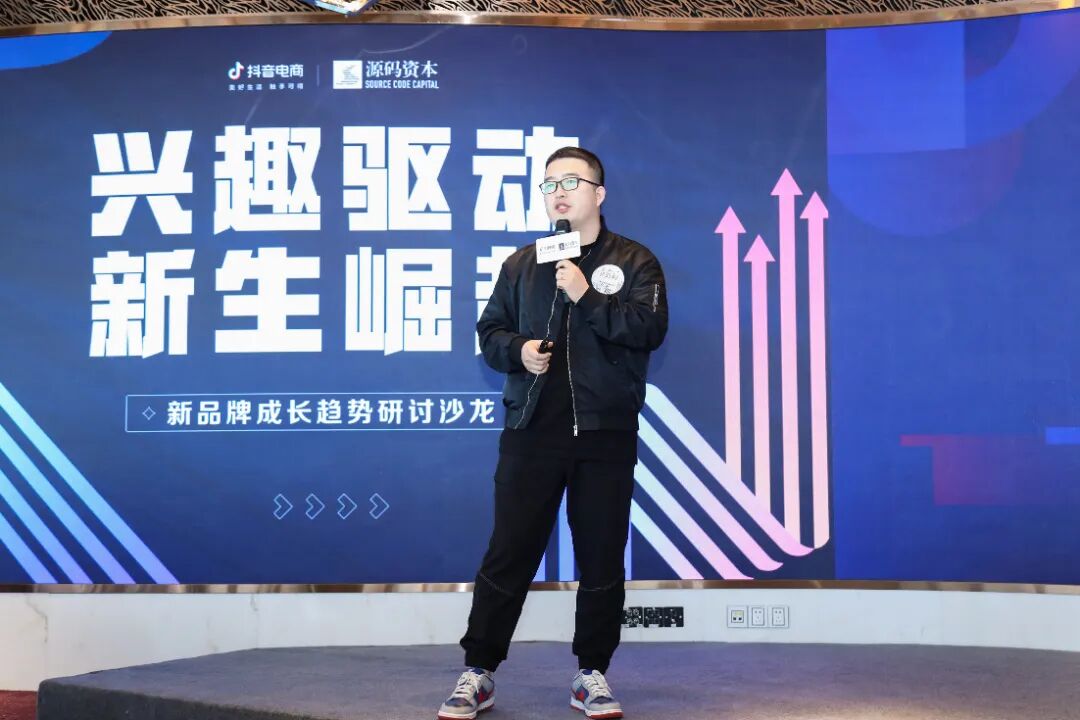
Let me share some of Douyin E-Commerce's key advantages:
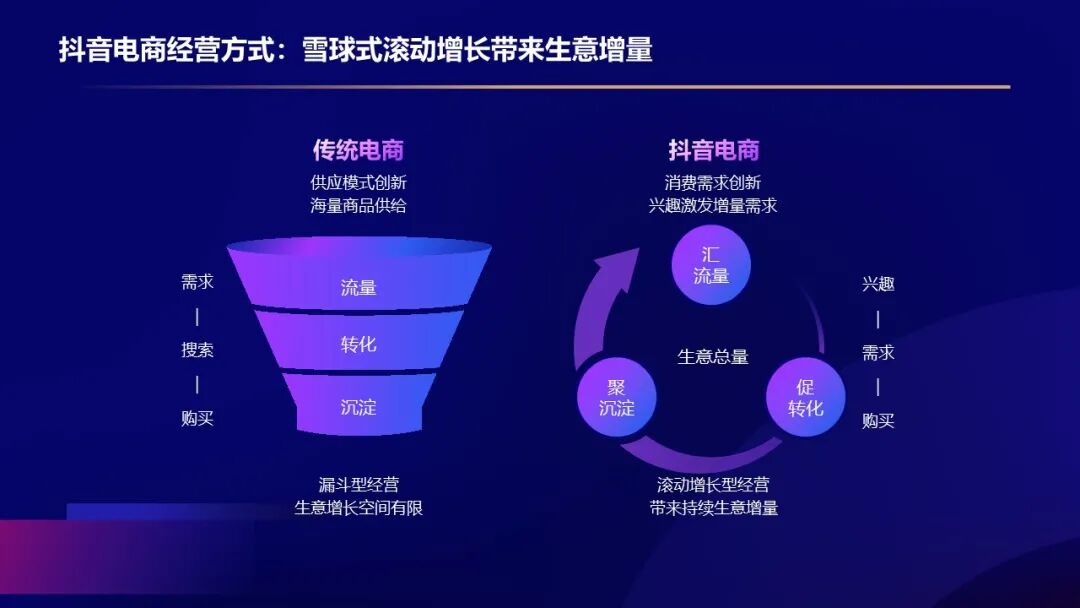
Traffic advantage. Businesses on Douyin E-Commerce have four core operating domains: livestreaming, short video, search, and Douyin Mall.
Trending products. We have a strong platform for building trending products, which you can think of as hit products. New products combined with strong content get noticed and purchased by target audiences.
New categories. At a conference in Guangzhou, there was a projector brand — projectors are a very niche category on Douyin E-Commerce. With relatively high price points (the cheapest being 999 RMB), they set a goal to become the leader in a new, underdeveloped category on Douyin. They achieved TOP1 in three months and were thrilled. So new categories represent a major opportunity.
Short-chain operations. Through brand self-broadcasting on Douyin E-Commerce, brands can face consumers directly, who can immediately perceive product texture, packaging, service, etc. Companies can quickly gather consumer feedback and make corresponding adjustments to products and content, enabling rapid iteration and more efficient business operations.
Traditional shelf e-commerce follows demand, then search, then purchase — "intent → search → purchase." With Douyin's interest-based e-commerce, it's interest first, then inspiration, then purchase — "discovery → inspiration → purchase." Traditional e-commerce sits downstream of precise traffic for things users already want to buy, while interest sits upstream of traffic.
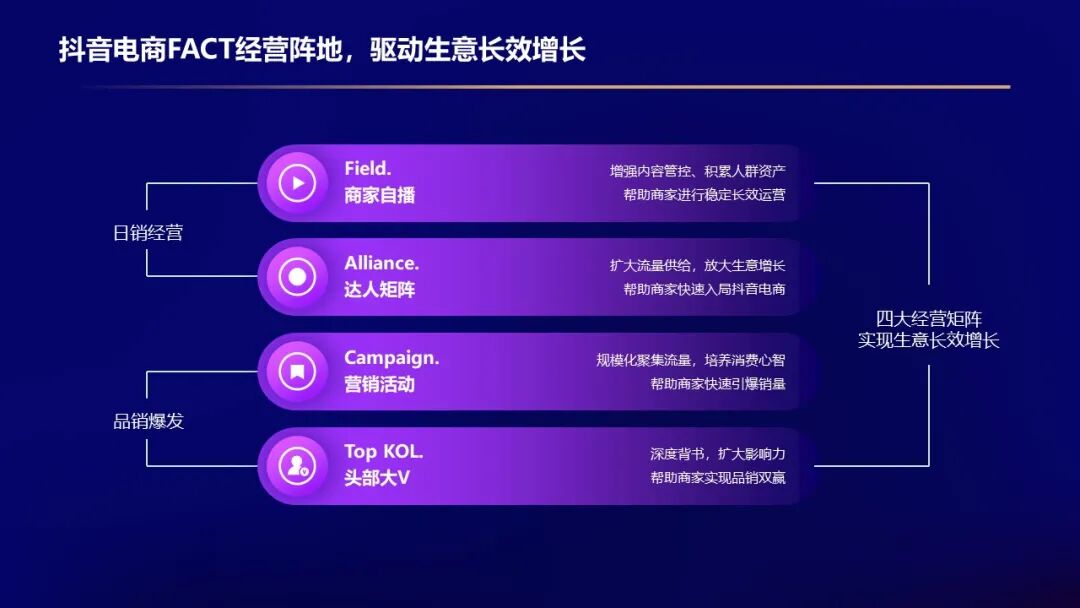
The Four Horse-Drawn Carriages: The FACT methodology for interest-based e-commerce operations — Field (merchant self-broadcasting), Alliance (KOL matrix), Campaign (marketing events), and Top KOL (headline influencers) — known as the four horse-drawn carriages of Douyin E-Commerce platform operations. For each of these, the Douyin Brand project team provides the following support to brands:
First, Field (merchant self-broadcasting). The platform has developed practical methodologies covering livestream scripts, hosts, product mix recommendations, etc., while also providing service provider matchmaking support.
Second, Alliance (KOL matrix). The platform facilitates matchmaking with KOLs willing to promote Douyin brands, using Douyin Brand special events to increase sales volume and visibility within the platform.
Third, Campaign (marketing events). Qualifying Douyin brands receive resource support. Unlike current events mainly targeting established large brands, we've built an event system specifically for Douyin brands. Typically structured in 7-day cycles, the platform provides high-intensity traffic support and unified visual materials during this period to boost brand visibility and help brands make their debut.
Fourth, Top KOL (headline influencers). We've launched the Douyin Brand Star Promoter project, using deep collaboration with top KOLs to help new brands explode both on and off the platform.
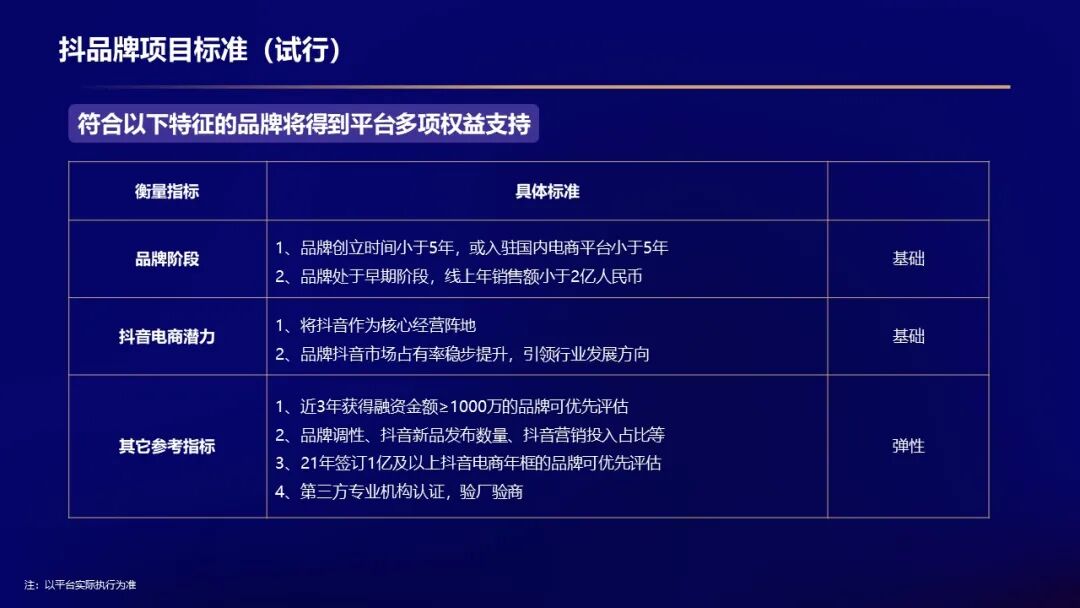
In July this year, we launched the Douyin Brand project, with an annual goal of building 100 new consumer brands exceeding 100 million RMB in GMV, making Douyin E-Commerce the premier launchpad for new consumer brands.
Criteria for entering the Douyin Brand incubation pool: founded less than 5 years, online sales not yet reaching 200 million RMB, and a desire to make Douyin E-Commerce the core online operations platform. Other reference indicators include funding raised, brand positioning, new product launches, and product quality. To date, the number of Douyin Brands in incubation has exceeded 100, growing at a rate of 10-15 per week.
Douyin Brand benefits include event amplification, dedicated service, traffic support, brand promotion, product privileges, and investor networking — mainly manifested across the four domains and four horse-drawn carriages.
In the process of incubating 100 new consumer brands exceeding 100 million RMB in GMV, Douyin E-Commerce will adhere to the "Three Goods" principles — good content, good products, good service — hoping to ultimately fulfill Douyin E-Commerce's mission: no good products at fair prices should be hard to sell, making a better life within reach.
Thank you all!


Douyin E-Commerce & Source Code Capital Joint Release
New Brand Growth Trends White Paper

600 Million DAU: How New Consumer Brands Can Master Douyin and Prepare for Double 11

Source Code Capital Consumer Portfolio Companies Visit Xiaohongshu: Three Steps to Building Brand Moats
197 Million MAU: How Can Brands Build Stickiness with Bilibili Users?