Source Code Capital's Wu Jian: Discovering Value in Robots Through the Lens of Industrial Internet

The "last mile" of industrial internet is seeing a convergence of favorable timing, positioning, and human capital in the robotics sector.
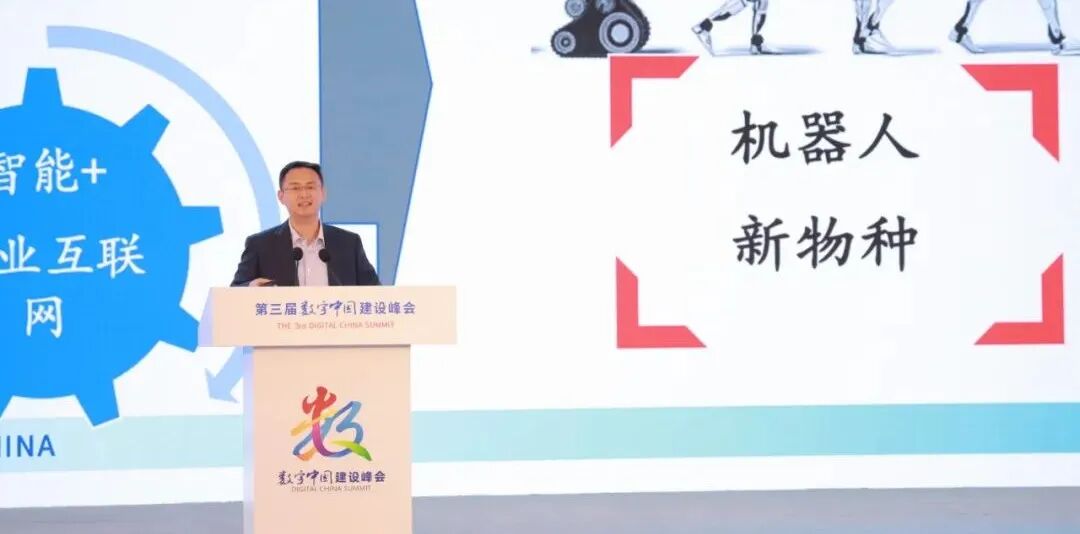
On October 13, 2020, Jian Wu, Partner at Source Code Capital, was invited to speak at the 3rd Digital China Summit, delivering a keynote titled "Value Discovery in Robotics Through the Lens of Industrial Internet."
This year's summit focused on the theme "Innovation-Driven Digital Transformation, Intelligence-Led High-Quality Development." It brought together academicians from both Chinese academies of sciences and engineering, leaders from national ministries and commissions, relevant provinces and municipalities, major state-owned enterprises, and well-known companies. Attendees exchanged views on cutting-edge fields including artificial intelligence, 5G, industrial internet, and blockchain. Through its "Cloud Summit" platform and hybrid online-offline format, the event created a "permanent, never-ending" showcase and exchange platform for policy announcements, technology demonstrations, industrial innovation exploration, and in-depth cooperation between government and enterprises, as well as among enterprises themselves.
The following is the full transcript of the speech:
Distinguished leaders and colleagues, I am Jian Wu from Source Code Capital. First, I would like to thank the organizers for giving us the opportunity to be the sole investor representative at this session, sharing some perspectives from an investment standpoint.
At last year's Digital China Summit, Yi Cao, Founding Partner of Source Code Capital, shared our investment framework in the industrial internet space. Today, I will follow that thread and discuss our new investments over the past 12 months — what we see as the "last mile" of industrial internet.
The "Last Mile" of Industrial Internet
The concept of the "last mile" stems from our broader "Three Horizontals, Nine Verticals" investment logic, which Source Code Capital has followed since its founding. We have observed that the "Internet Plus" transformation of traditional industries has gradually extended from consumer internet to industrial internet and industrial internet proper. At the same time, "Intelligence Plus" is playing a role in the industrial domain. The collision between "Internet Plus" and "Intelligence Plus" in industry is continuously generating new business models.
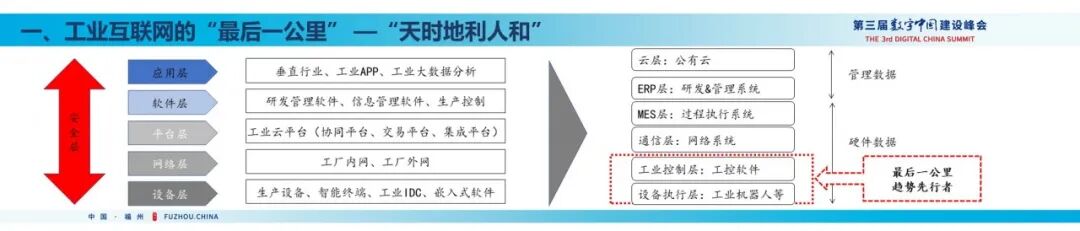
The "last mile" of industrial internet — the robotics sector we focus on — is facing a convergence of favorable timing, advantageous geography, and harmonious people.
By "favorable timing," national support provides major development opportunities. The Ministry of Industry and Information Technology and its newly established Industrial Internet Research Institute serve as strong policy drivers. External pressure provides external motivation: while it may cause some short-term constraints, in the long run it acts as a powerful stimulus for development. Additionally, the post-pandemic era has sparked new reflections. For instance, under what circumstances are critical links in industry stable? In the face of viruses, humans may no longer be the most stable factor, making the deployment of robots in certain key positions an inevitable trend.
By "advantageous geography," China is the world's largest manufacturing center, with rich application scenarios and technology accumulation — this is our greatest geographic advantage. Autonomous driving is a typical case: with substantial government and capital investment, the technology储备 and industrial chain cultivation for autonomous driving are relatively mature, though large-scale commercial application remains some distance away. But if we slightly narrow the open-road, passenger-carrying scenarios that autonomous driving faces, and instead apply them in relatively enclosed, limited spaces and unmanned scenarios — such as factories and warehouses — we can directly achieve a dimensional reduction strike. Technology spillovers like autonomous driving provide substantial tailwinds for robotics development.
Finally, on "harmonious people," our Investment Partner at Source Code, Dr. Hongjiang Zhang, a top scholar in China's AI academic community, has provided comprehensive analysis noting that China's AI talent supply already exceeds that of all other countries combined. Meanwhile, as many of you here well know, China's engineer supply similarly leads the world — and the list goes on.
Driven by the combined forces of favorable timing, advantageous geography, and harmonious people, Source Code has already observed China's robotics market maturing in our recent investment practice.
Value Creation in Robotics
Robotics creates value in two main ways.
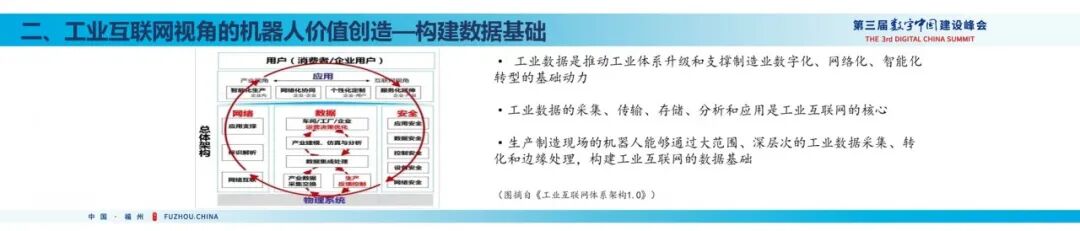
First, data. While many industrial internet applications currently enable data connectivity, robots equipped with various sensors can serve as the "five senses," better capturing diverse data from production scenarios and building a foundation for extensive, deep-level industrial data.
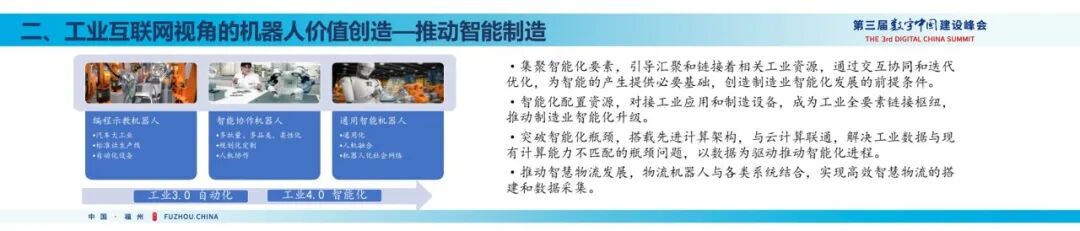
Second, intelligent manufacturing. Robots also serve as the "hands and feet," enabling production and manufacturing functions such as sorting, handling, and fabrication. Industry 1.0 through 4.0 represents a progression from mechanization to electrification to automation, and then to intelligence. However, we observe that many of China's manufacturing industries have not yet fully achieved 3.0 — automation. This means we have the opportunity to simultaneously achieve both automation and intelligence in manufacturing, enabling a "corner overtaking" in intelligent manufacturing. In this process, as a key intersection of automation and intelligence, robots will play an important role.
Investment Expectations:
New Species of Robots and Flexible Manufacturing
As an investment institution, we hope to see more enduring and transformative innovation. For example, we have invested in numerous robotics companies in warehousing scenarios, including AGVs and robots for lifting, sorting, and palletizing. At the Industry 3.0 stage, many robots operated in relative isolation. Now, as these robots become more intelligent and more interconnected, we sense that unexpected chemical reactions may occur.
Drawing from our experience investing in consumer-facing businesses: the 3G era gave rise to Meituan and Toutiao, though many people hadn't anticipated this when 3G was first commercialized. The 4G era was even more telling — while people predicted video would flourish in 4G applications, most didn't initially foresee that the biggest winner would be the short-video format of Douyin, which emerged relatively late. We now judge that new species will emerge in robotics, though we cannot yet describe them in detail; combining this with our perspective from consumer internet, we believe they may appear in the flexible manufacturing domain.
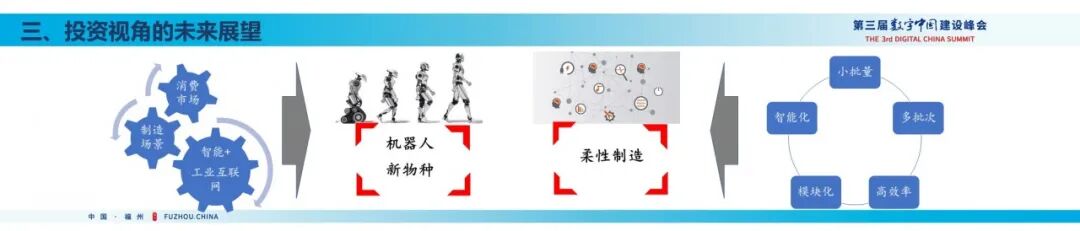
We observe that the "new consumption" trend is increasingly characterized by small-batch, high-frequency orders. These changes on the consumer end will in turn stimulate the manufacturing end, forcing manufacturing to adapt to these new demands. Therefore, we anticipate that new species of robots may emerge to better serve the need for flexible manufacturing. They will feature the following characteristics: on one hand, meeting the flexible demands of small-batch, high-frequency production; on the other, they will necessarily be intelligent and modular, enabling efficient production and transformation.
As an investment institution focused on cultivating the new economy, we pay close attention to these new species, and we look forward to exchanging ideas and exploring together, jointly anticipating new investment opportunities in the industrial internet space.