Yi Cao: Value Discovery and Creation in Industrial Internet

We believe the nascent industrial internet will also see its boom.
On May 7, 2019, Yi Cao, founding partner of Source Code Capital, was invited to speak at the "Second Digital China Summit," where he delivered a keynote titled "Value Discovery and Creation in Industrial Internet."
The summit's theme was "Foster new drivers through informatization, promote new development with new drivers, and create new glory through new development." It was positioned as China's platform for releasing informatization development policies, showcasing e-government and digital economy achievements, exchanging theoretical and practical experiences in Digital China construction, and gathering global forces to advance Digital China cooperation.
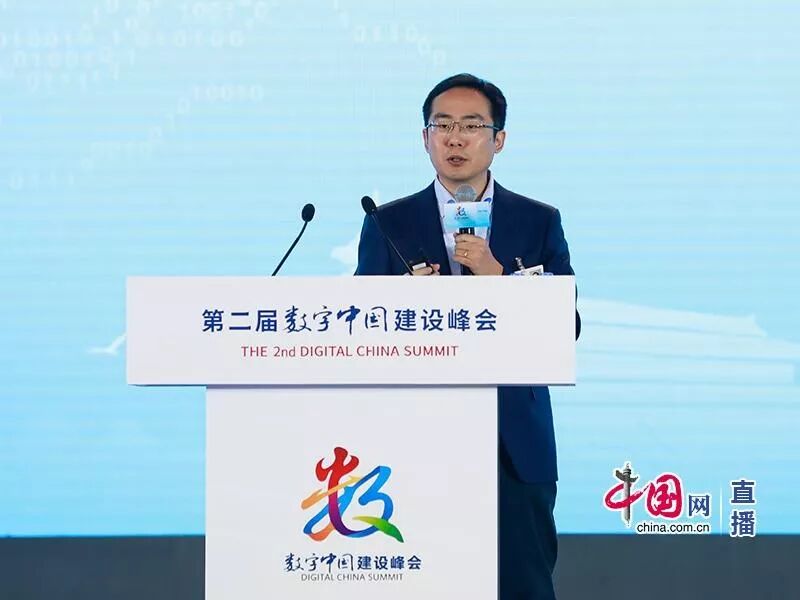
Image source: Second Digital China Summit, photo by China.org.cn
The full text of the speech follows:
I'm delighted to have this opportunity to exchange ideas at the Second Digital China Summit. From this morning until now, I've gained much inspiration — from Academician Wu Hequan and Director Li Ying's sweeping yet deeply informed perspectives, to the industrial reflections and practices of the leaders from Haier, XCMG, Inspur, and Foxconn, four pioneering companies in industrial internet. I'd like to share some observations from a venture capital perspective on entrepreneurship, innovation, and investment in industrial internet, hoping these might offer some useful insights. Is industrial internet truly attractive? How should we understand and discover its value creation?
The "Inverted Pyramid" and "Three Horizontals, Nine Verticals"
Over the past 15 years, I've been investing in early and growth-stage companies throughout the information revolution. My investment logic during this period can be summarized in two diagrams. The first is this "inverted pyramid" industry perspective, with Moore's Law as its core driving force, progressively pushing the entire economic world toward commercial innovation and transformation through digitalization, online connectivity, and intelligence — giving birth to a digital twin world. It is like the sun of this digital world, contributing immense energy ceaselessly every moment, enabling photosynthesis, metabolism, species evolution, socialization, and more.
The second diagram is this "Three Horizontals, Nine Verticals" investment map, situated at the application layer of the pyramid. It shows how three forces — "Internet+," "Intelligence+," and "Global+" — are driving transformation across nine domains in both 2C (consumer) and 2B (industrial) sectors, creating value by "optimizing existing stock and activating new growth." For the first ten of these 15 years, the vast majority of my energy went to consumer internet; in the past five years, consumer internet and industrial internet have gradually reached equal weight. I mention my experience mainly as a reference point that broadly reflects an industry shift — from 2C-centric to a balance of 2C and 2B. I believe this also represents a microcosm of how capital accurately and timely adjusts, from which we can see the second half of the internet, the second half of the new economy, and indeed the new normal of the entire national economy — signs of an economy maturing and developing.
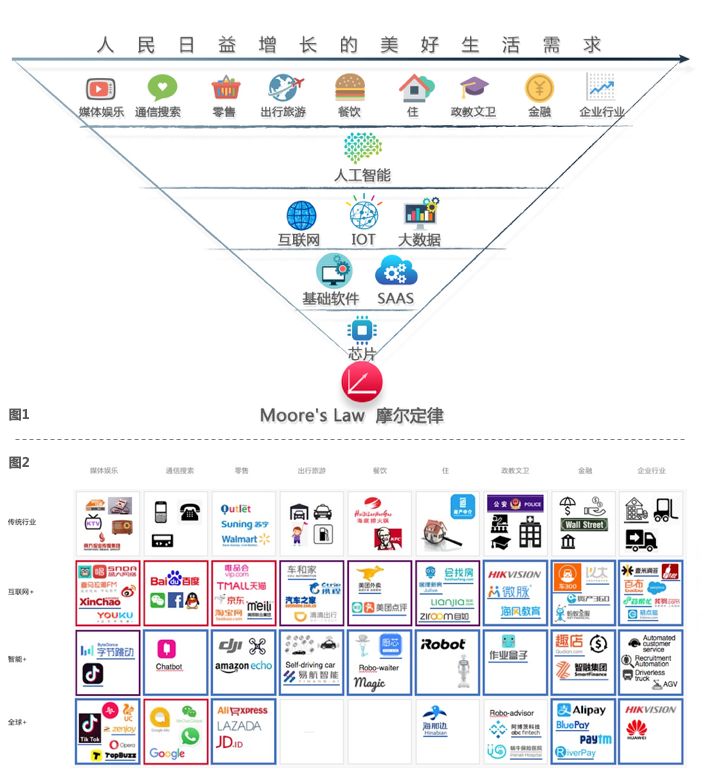
Figure 1 (top): "Inverted Pyramid" Industry Perspective
Figure 2 (bottom): "Three Horizontals, Nine Verticals" Investment Map
The Second Half of the Internet: From Consumption to Distribution to Production
I roughly divide industrial internet into distribution internet and industrial internet proper. I see distribution internet as having opened the prelude to industrial internet. The circulation links between industry and consumers, and between industry and industry — let's call this "distribution internet" for now — encompasses the digitalization, online connectivity, and intelligence of commercial flow, logistics, capital flow, and data flow. This segment has accelerated over the past five years, with leading enterprises emerging across various industries including fast-moving consumer goods, agricultural products, pharmaceuticals, textiles and apparel, building materials, auto parts, industrial MRO, construction machinery, 2B logistics, and 2B finance. These companies leverage information technology to achieve scale and high efficiency, transforming many "large, fragmented, chaotic" distribution landscapes into increasingly concentrated, scaled, and efficient operations. We believe no fewer than ten companies worth several billion to over ten billion dollars will emerge from this space.
With highly developed consumer internet and rapidly maturing distribution internet as foundation and driving force, we believe industrial internet in its nascent stage will also flourish.
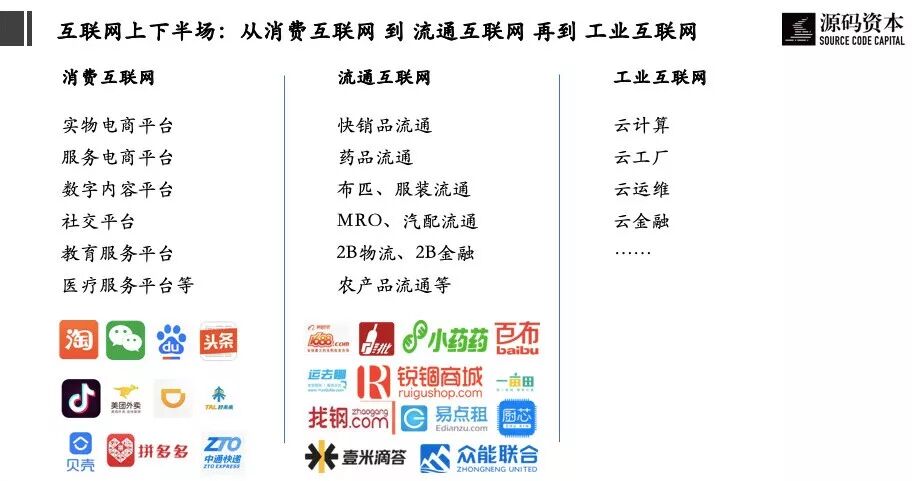
Image source: Source Code Capital
Distribution-Driven Industrial Internet Packs Greater Punch
Whether a concept or technology can industrialize and sustain itself depends critically on business model quality, directly affecting whether it can achieve product-market fit from zero to one. So at this early stage of industrial internet, we as investors constantly examine, question, and consider: what value does industrial internet create for enterprises of different scales? Why would enterprises push production and manufacturing processes online? If we open the three financial statements that every enterprise cares about daily, we may find answers.
In the income statement: how to help them increase revenue (sales reach, sales efficiency, intelligent pricing, etc.), reduce costs (procurement reach, procurement efficiency, etc.), and lower expenses (improving human efficiency, cloud services, reducing financing costs, etc.)? In the balance sheet: how to help them optimize inventory (inventory turnover, virtual inventory, dead stock risk, etc.), optimize liabilities (financing methods, amounts, and costs, etc.), optimize fixed assets (achieving asset-light operations through cloud assets, etc.), and optimize receivables and payables? Based on these enterprise needs, we see models like "cloud computing," "cloud factories," "cloud procurement," and "cloud O&M" emerging. And the most powerful model among these is one driven by distribution/commercial flow (increasing revenue, reducing costs, cutting expenses) to push industrial digitalization and online connectivity. Moreover, with commercial flow support, the cost of digitalization and online connectivity can be very low.
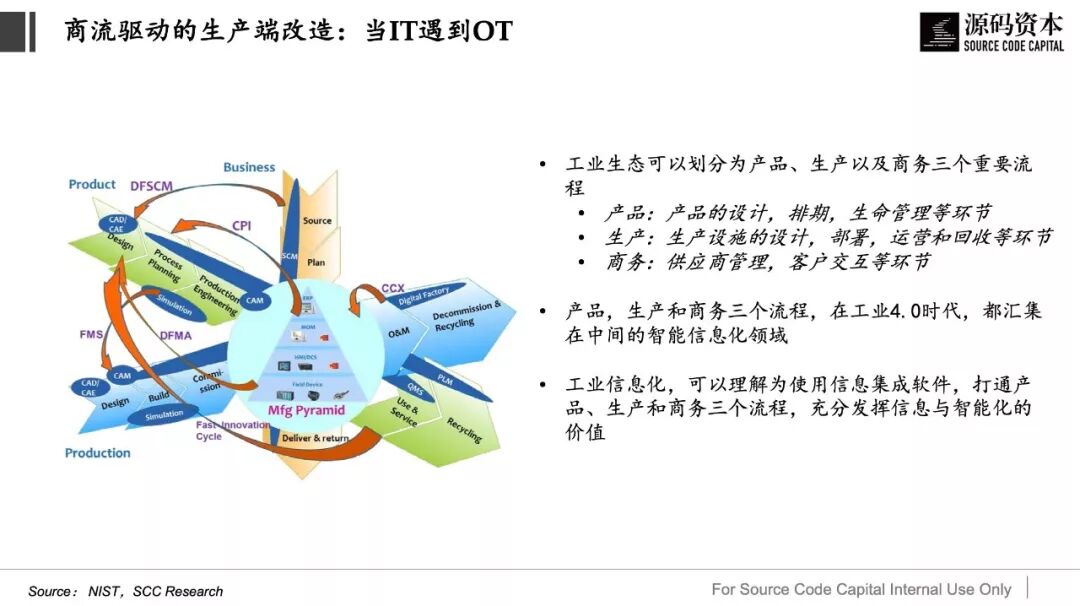
Image source: Source Code Capital
Let me give an example: Baibu, an industrial internet company in the textile industry that we invested in. They are leveraging their dominant position in distribution internet to drive industrial internet construction. Five years ago, we made an angel investment in this company, which was dedicated to e-commerce-enabling fabric distribution between garment factories and textile mills. From merely million-level GMV back then, it has rapidly grown to ten-billion-level this year, becoming the largest e-commerce channel for fabric distribution — and still growing fast.
Last year, they began trying something quite interesting: undertaking capacity托管改造 of upstream textile mills, using orders to open doors, and using IoT software and hardware systems to further improve efficiency, raising textile machine utilization rates from the original 60% to over 90%. Now tens of thousands of textile machines have achieved online capacity托管, realizing highly efficient, robust, and scalable "cloud factories" that enable higher utilization rates for quality capacity, generating good profits, while gradually eliminating inferior excess capacity. Beyond connecting various looms through IoT to create "cloud factories," they are currently also experimenting with "cloud O&M" — based on monitoring machine failure data, building regional maintenance centers to help weaving mills repair equipment at lower cost and with greater timeliness, replacing the previous model where each factory had to固定请运维技术员工 and purchase spare parts.
There's also "cloud finance" — using equipment GPS and operational data to provide factories with white-label procurement of raw materials, and based on factories' order capacity utilization to offer financing leases for machinery and equipment. The essence of business remains the same; it's just that with machines connected, the entire transaction data chain is打通, enabling financial services, orders, procurement, and maintenance that were either too risky or impossible without data.
Image source: Source Code Capital
Approaching industrial internet through application-driven, value-creation-driven thinking is our angle. Going online for the sake of going online, building industrial internet platforms for the sake of building platforms — these approaches won't last in the end. Conversely, truly focusing on needs and value creation offers enormous space. Industrial internet is the most important yet earliest-stage part of Digital China construction. With government support, if our business community works together, we believe we can drive industrial internet penetration from the current 1% to 10% to 50%, just as consumer internet did over the past 20 years. Perseverance and bold action — the task is weighty and the road is long, but the vision is grand! Thank you all!

More Partner Perspectives
- Hongjiang Zhang: AI's Long-Term Development Requires People Willing to Do Unheralded Work
- Dialogue with Future Entrepreneurs: You Can Practice Deliberately Like This
- Dr. Hongjiang Zhang: AI Talent Shortage Is a Global Problem — Dialogue with Yang Rui
- 【Alumni Interview】Yi Cao: Computer Science Inspires My Decision-Making
- Source Code Capital Investment Partner Dr. Hongjiang Zhang: AI Is the Next Big Opportunity for Chinese Startups
- Source Code Capital's Yi Cao: The Nine Faces of Technological Innovation
- Yi Cao: Inclusive Finance Enters an Era Where "Internet+" and "Intelligence+" Simultaneously Gain Traction
- Source Code Capital's Yi Cao Named Cyzone "2016 China Angel Investor of the Year"
- Yi Cao: VCs Must Keep Learning and Embrace a Far-Reaching Sense of Mission
- Yi Cao: Source Code Capital's "Three Horizontals, Nine Verticals" Investment Map
- Yi Cao: "Internet Plus" Has Run Its Course; the Next Wave Is "Intelligence Plus" and "Global Plus"
- Yi Cao: The More Cross-Disciplinary the Startup, the Higher Its Odds of Success