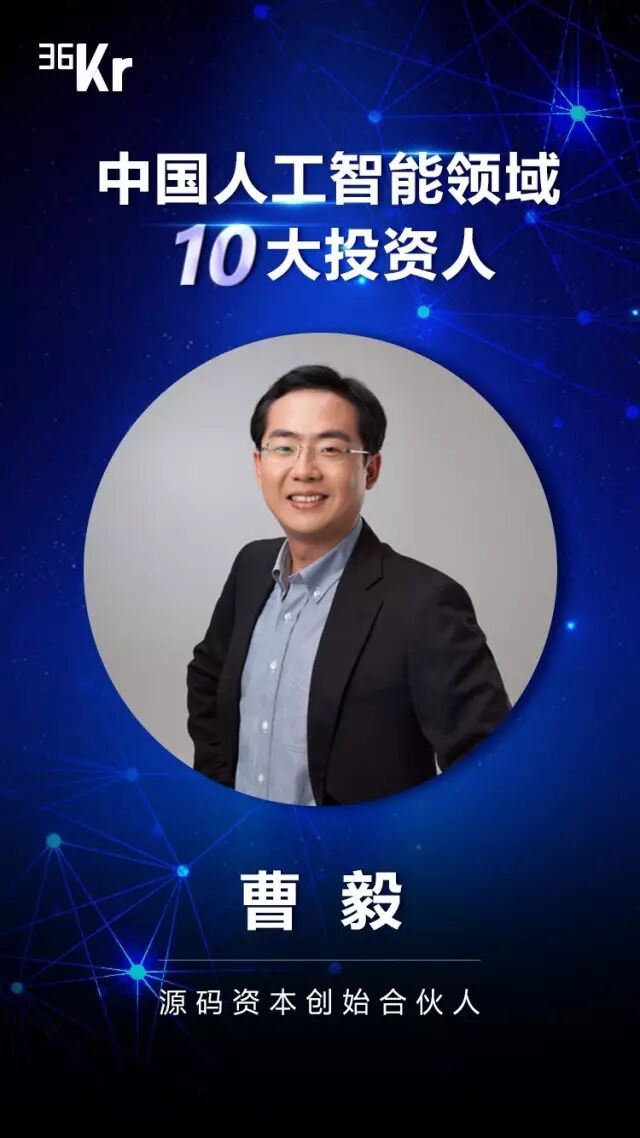
Yi Cao, founding partner of Source Code Capital, was named one of "China's Top 10 AI Investors."

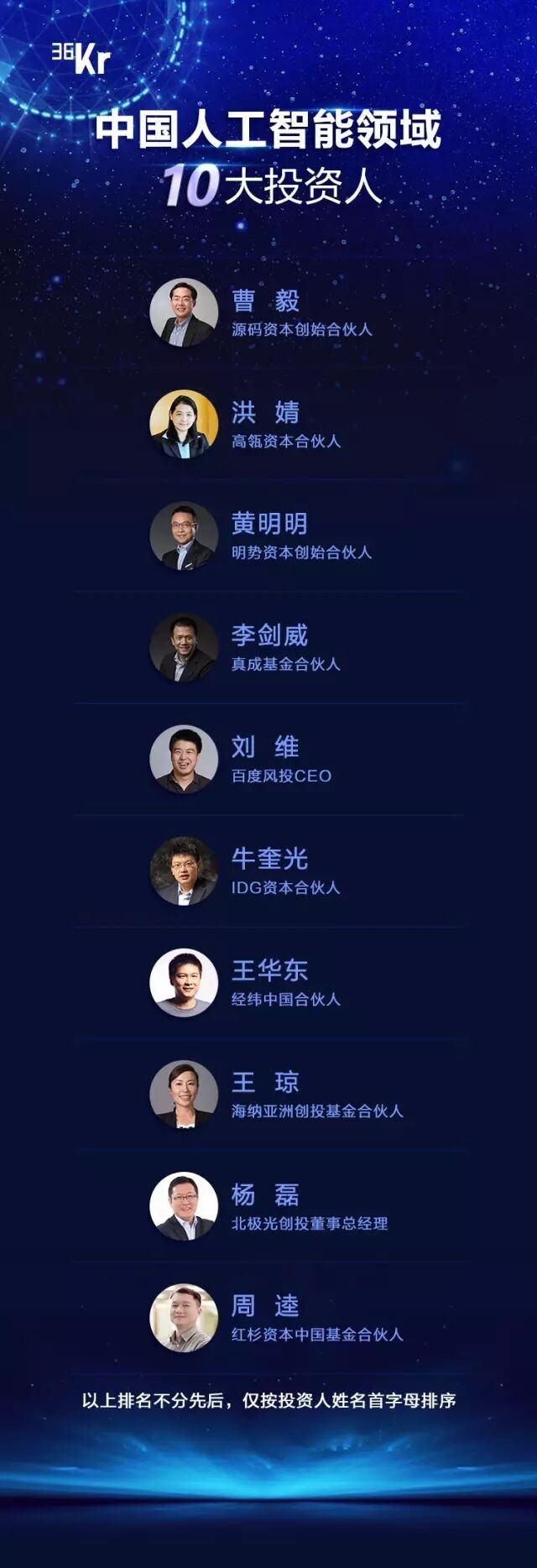
On June 28, at the "Wisdom·Transformation·Achievement — 2017 Business New Ecology Summit," 36Kr released its "Top 10 Investors in China's AI Sector" and "Most Influential Investors in China's AI Sector" lists.
On June 28, at the "Intelligence·Transformation·Achievement — 2017 Business New Ecology Summit," 36Kr released its "Top 10 AI Investors in China" and "Most Influential AI Investors in China" lists.
As an emerging industry, artificial intelligence has become a focal point across sectors. In 2016, four national ministries jointly issued the "Internet Plus" AI Three-Year Action Implementation Plan, explicitly calling for the cultivation of AI industries. This spring, AI made its first appearance in the government work report. In May, at the Wuzhen Go Summit, AlphaGo defeated player Ke Jie and announced its retirement. This man-machine battle once again made people feel the power of AI algorithms. Globally, an increasing number of major companies are entering the field as active players. The concept of "artificial intelligence" was formally proposed at an academic conference at Dartmouth in the summer of 1956, and after 60 years of development, the third wave of AI has now arrived.
In the investment world, Jim Breyer, known as the world's top VC, predicted long ago that AI would bring considerable returns to investors, particularly in healthcare and entertainment. As the second-largest market for AI financing events after the United States, China saw 173 investment events in Q4 2016 alone. In 2016, financing in China's AI sector reached approximately $2.6 billion. Whether companies developing underlying technologies or those building application scenarios, AI companies have become darlings of the investment world.
In underlying technologies, the most closely watched companies span computer vision, machine learning/deep learning, and natural language processing. In application scenarios, intelligent driving is a major area where investors are placing bets and where internet giants are heavily deploying resources. Intelligent security and smart home are the fields with the highest average investment per company. The frequency of completed financing rounds for intelligent medical and intelligent finance companies is gradually increasing.
There's no doubt that the rapid development of AI in recent years owes much to the dedicated and professional efforts of AI investors. As an industry with high technical barriers, large capital requirements, and long return cycles, AI demands more from investors' expertise, decisiveness, patience, and foresight than perhaps any other sector. At the same time, competition among AI startups has already become extremely fierce — algorithms are no longer the core moat, and helping application scenarios land and driving industrial upgrading have become important parts of investors' work.
Against this backdrop, 36Kr and VC Assistant jointly released the "Top 10 AI Investors in China" and "Most Influential AI Investors in China" lists.
Initially, from 102 investors nominated by institutions or through public application, 57 were selected as eligible for the ranking. The selection referenced public online voting and investors' track records, calculating across dimensions including number of investments, participation level (lead/co-investment), equity stake, board seats, and paper returns (paper return information was only considered when multiple investors tied). For the "Top 10 AI Investors" ranking, online voting accounted for 40% of the composite score and investment performance for 60%; for the "Most Influential AI Investors" ranking, online voting and investment performance each carried 50% weight.
36Kr is committed to identifying the most professional and dedicated investors in AI. They have long cultivated deep expertise in the industry, possess profound understanding of AI's current state and development trajectory, and have their own distinctive methodologies for the opportunities and risks within it. They are not followers of the AI hype — they recognized AI's value earlier than the bandwagoners, and they more deeply believe in the disruption and transformation AI may bring.
"Although artificial intelligence itself has not yet been realized, its attempts and trial-and-error research have created countless byproducts, bringing us all kinds of new things," said Yutaka Matsuo, AI expert at the University of Tokyo and author of The AI Rage. Through continuous trial and error, technologies such as speech recognition, text recognition, natural language processing, game playing, and search engines have already had enormous impact on the development of real society and are widely applied in our daily work and lives. It is these investors and entrepreneurs on the lists who together witness and create the grand vision of humanity and machines' shared future.
Related Content
Hongjiang Zhang: The Nature and Opportunities of AI | 2017 Ma Hui
Profiling "Reliable" AI Startup Characteristics | Source Code Capital Internal Reference