Stanford University 2025 AI Index Report Released: Key Findings on China's AI Rise and Narrowing Gap Between Top Models

A Comprehensive Breakdown of the 2025 AI Index
Stanford University HAI (Human-Centered Artificial Intelligence) recently released the 2025 AI Index report, offering a systematic overview of developments across the AI field. The report notes that the 2025 AI Index is HAI's most comprehensive index to date, published at a critical moment when AI's impact on society, the economy, and global governance continues to intensify.
This 400-plus-page report covers R&D, technical performance, responsible AI, economic impact, science and medicine, policy, education, and public opinion — an information explosion. Here are the highlights we've pulled for you.
The report shows that over the past year, China has caught up in the large model race, Chinese respondents rank highest globally in AI awareness, trust, and enthusiasm, and the rise of Chinese tech is unstoppable.

The Gap Between Top-Tier Large Models Has Narrowed Significantly
Across multiple dimensions — open-source vs. closed-source, China vs. the United States, and performance metrics — the gaps between leading large models are shrinking. As model capabilities improve and inference costs drop, AI agents are beginning to show their potential.
1. AI Benchmark Scores Are Surging, Performance Approaching Human Levels
AI is mastering new benchmarks at an accelerating pace. In 2023, AI researchers introduced several challenging new benchmarks, including MMMU, GPQA, and SWE-bench, to test the upper limits of AI systems. In 2024, AI performance on these benchmarks improved dramatically — MMMU and GPQA saw gains of 18.8 and 48.9 percentage points respectively. On SWE-bench, AI jumped from solving just 4.4% of programming problems in 2023 to 71.7% in 2024.
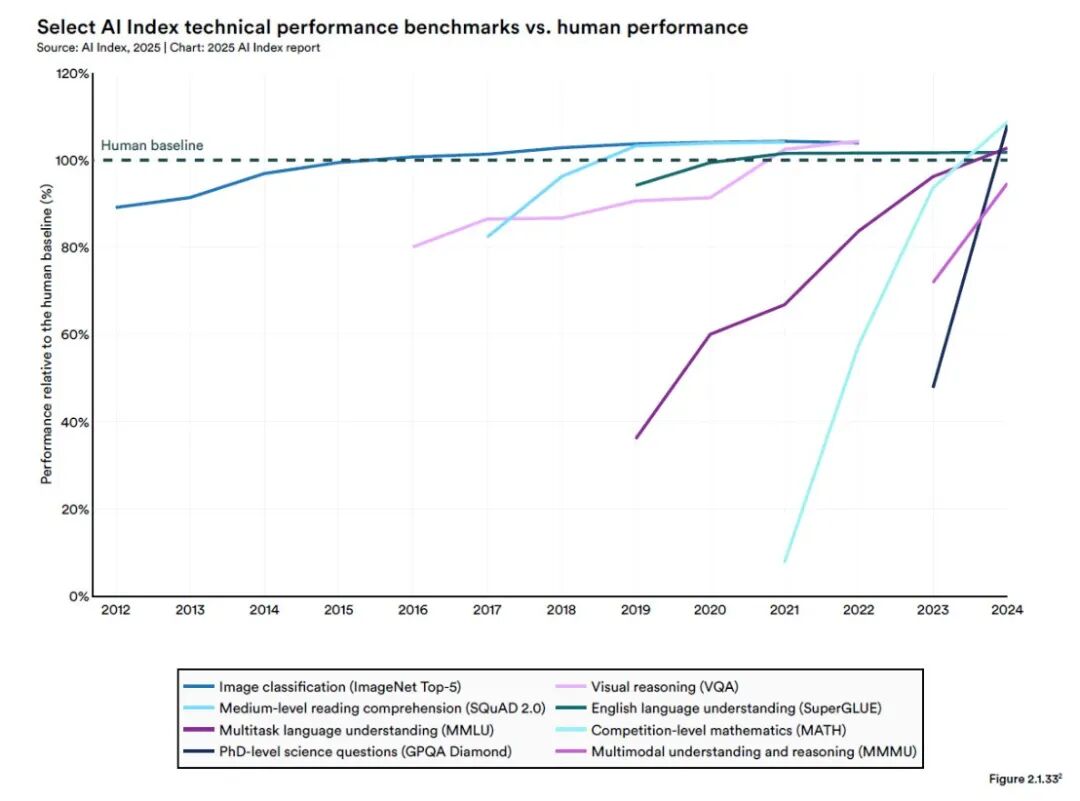
Beyond benchmarks, large models have also made major strides in generating high-quality video. In some cases, AI agents have even outperformed humans on time-constrained programming tasks.
2. Open-Weight Models Are Catching Up
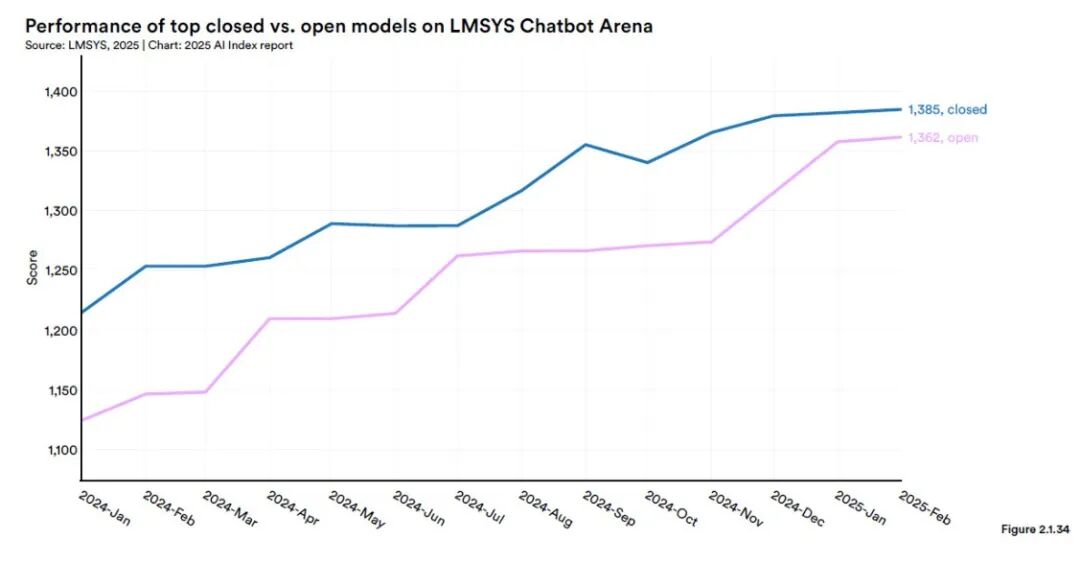
Last year's AI Index showed that leading open-weight models lagged significantly behind their closed-weight counterparts. By 2024, that gap has nearly disappeared. In early January 2024, the top closed-weight model outperformed the leading open-weight model by 8.0% on the Chatbot Arena leaderboard. By February 2025, that margin had shrunk to 1.7%.
3. The Gap Between Chinese and American Models Has Narrowed Dramatically
In 2023, American large models significantly outperformed Chinese ones. That trend no longer holds. At the end of 2023, the performance gaps between Chinese and American large models on benchmarks like MMLU, MMMU, MATH, and HumanEval were 17.5, 13.5, 24.3, and 31.6 percentage points respectively. By the end of 2024, these had narrowed to 0.3, 8.1, 1.6, and 3.7 percentage points.
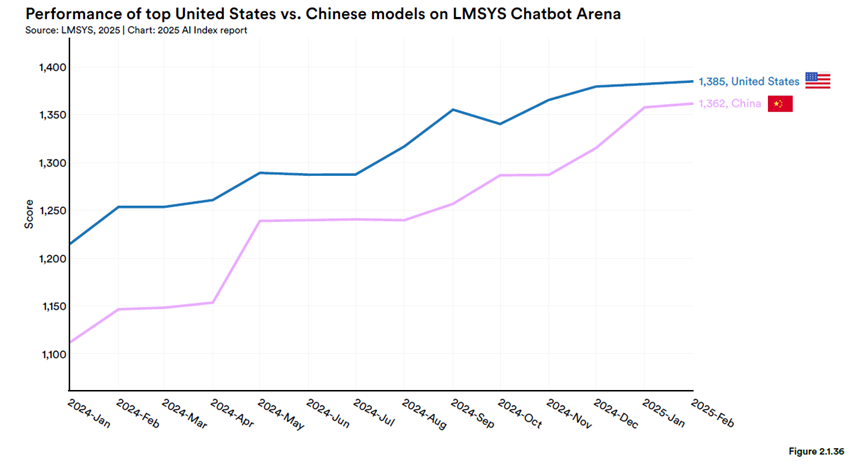
4. Performance Gaps Among Top Models Are Shrinking
In last year's AI Index report, the Elo score difference between the #1 and #10 models on the Chatbot Arena leaderboard was 11.9%. By early 2025, that gap had narrowed to 5.4%. The margin between the top two models also shrank from 4.9% in 2023 to 0.7% in 2024. Competition in AI is intensifying, with an increasing number of high-quality models entering the field.
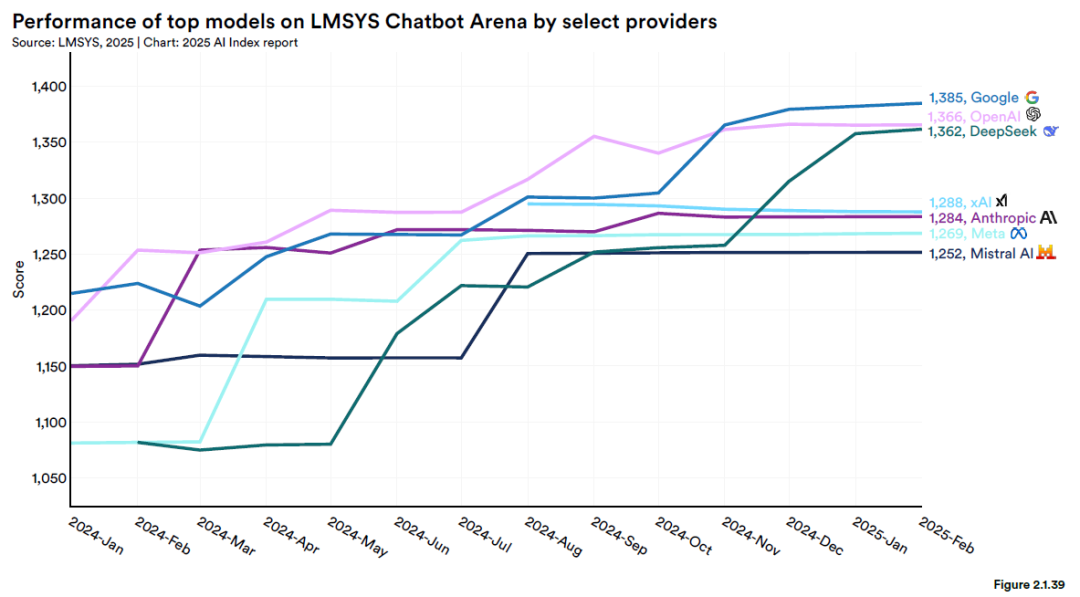
5. Inference Costs for Large Models Have Dropped Sharply
AI model inference is getting cheaper. A model scoring equivalently to GPT-3.5 on MMLU saw its query cost drop from $20.00 per million tokens in November 2022 to $0.07 per million tokens in October 2024 (Gemini-1.5-Flash-8B). Depending on the task, inference prices are falling by anywhere from 9x to 900x annually.
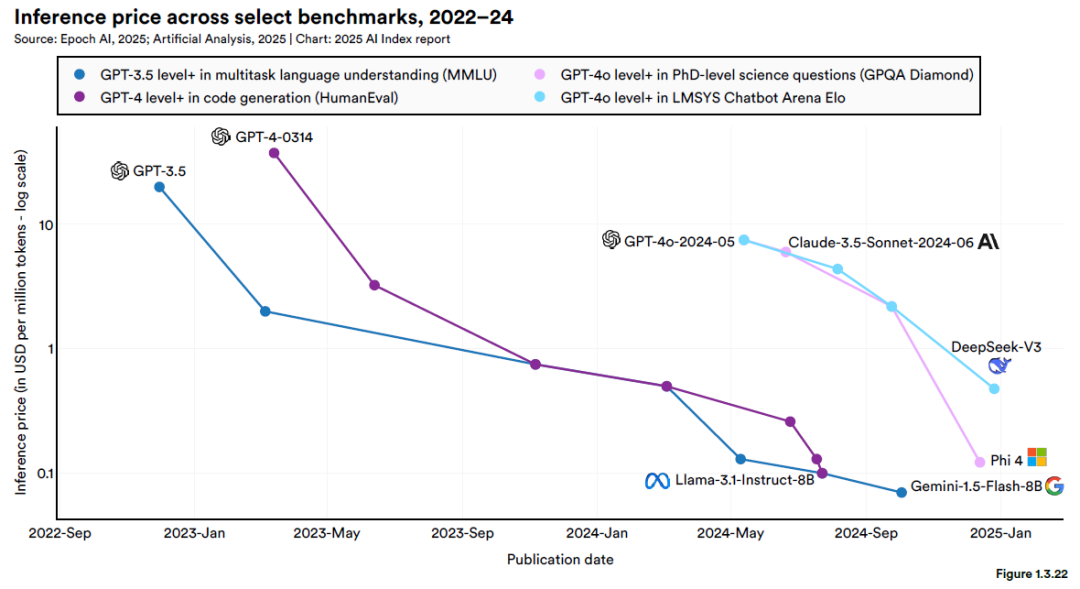
6. AI Agents Are Beginning to Show Their Potential
RE-Bench, launched in 2024, introduced a rigorous benchmark for evaluating AI agents on complex tasks. In shorter time windows (two hours), top AI systems scored four times higher than human experts. But as time increased, human performance surpassed AI. On specific tasks like writing Triton kernels, agents now match human expertise and can deliver results faster and at lower cost.
AI Investment Fever Spreads, China Maintains Dominance in Industrial Robots
Global AI investment and adoption have hit record highs. AI is boosting productivity, but there's still significant room for companies to improve cost reduction and efficiency. On the hardware front, China's industrial robot installations exceed all other countries combined, while there's growing emphasis on deploying robots in human-interactive scenarios.
1. Global AI Investment Hits Record Highs
Global artificial intelligence investment reached an all-time high, growing 26%. In 2024, corporate investment in AI hit $252.3 billion. The AI industry has undergone explosive expansion over the past decade, with total AI investment growing more than 13x since 2014.
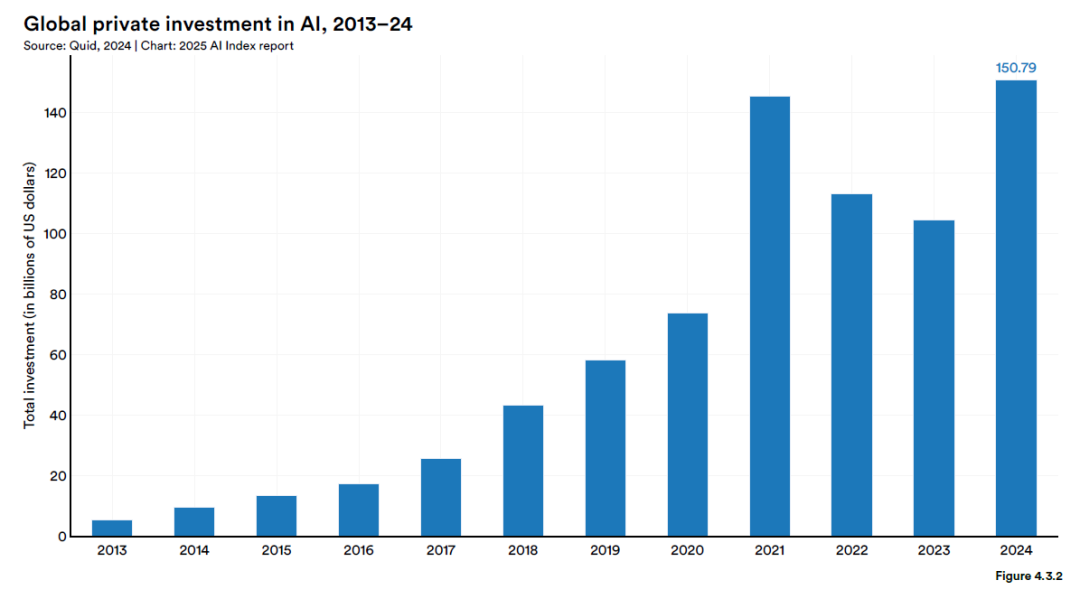
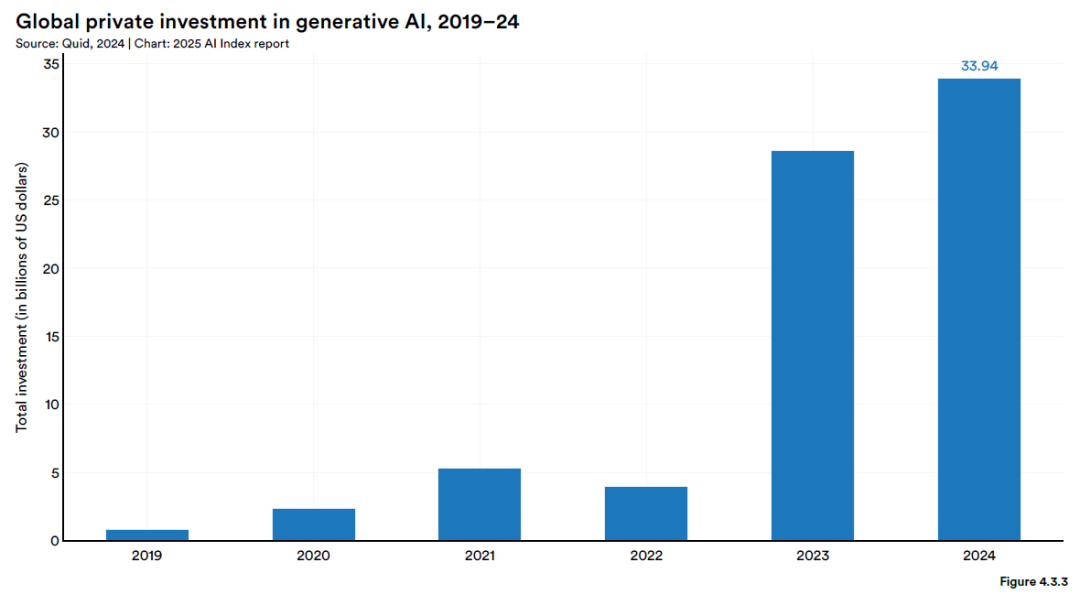
Investment in generative AI has surged, now accounting for over 20% of all AI-related investment. In 2024, generative AI investment reached $33.9 billion, up 18.7% from 2023 and more than 8.5x above 2022 levels.
The United States leads in AI investment. In 2024, U.S. AI investment reached $109.1 billion, with China second at $9.3 billion and the United Kingdom third at $4.5 billion. In generative AI specifically, U.S. investment exceeded the combined total of China, the European Union, and the United Kingdom by $25.4 billion — up from a $21.8 billion differential in 2023.
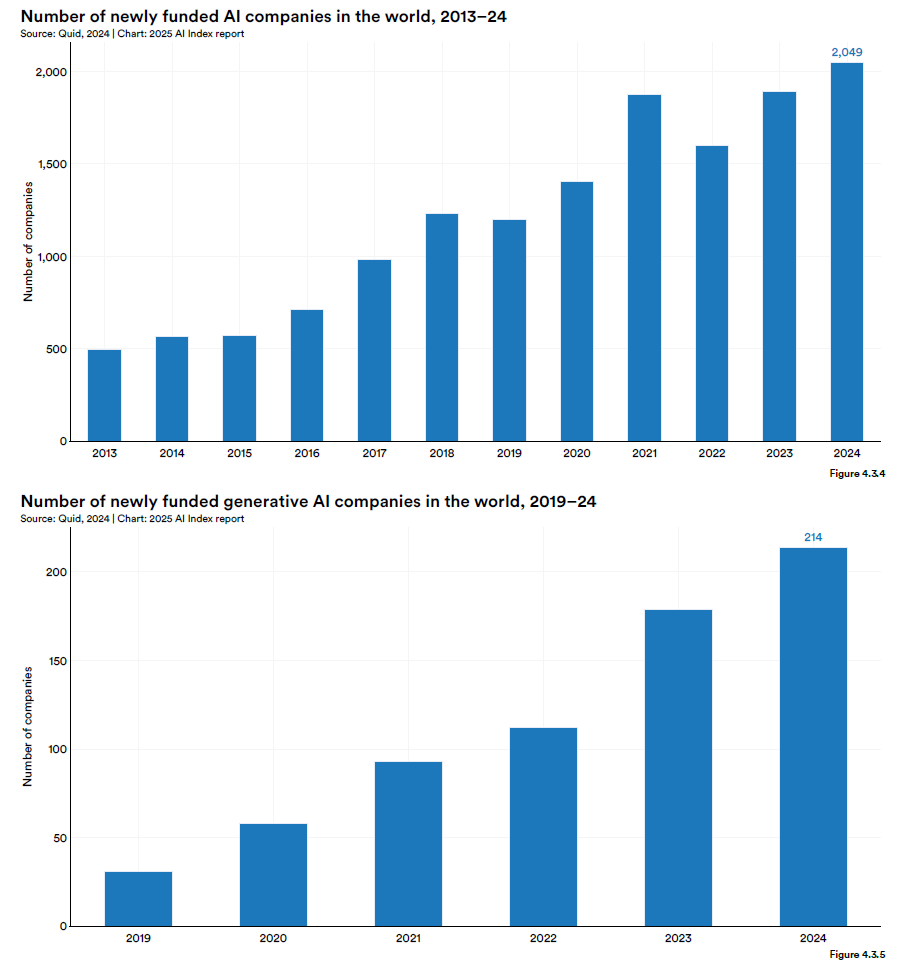
The number of AI companies receiving funding rose to 2,049 in 2024, up 8.4% year-over-year. Notably, generative AI saw a significant increase in funded companies, with 214 startups receiving investment in 2024, compared to 179 in 2023 and just 31 in 2019.
2. AI Adoption Is Rising, But Most Companies Are Still in Early Stages
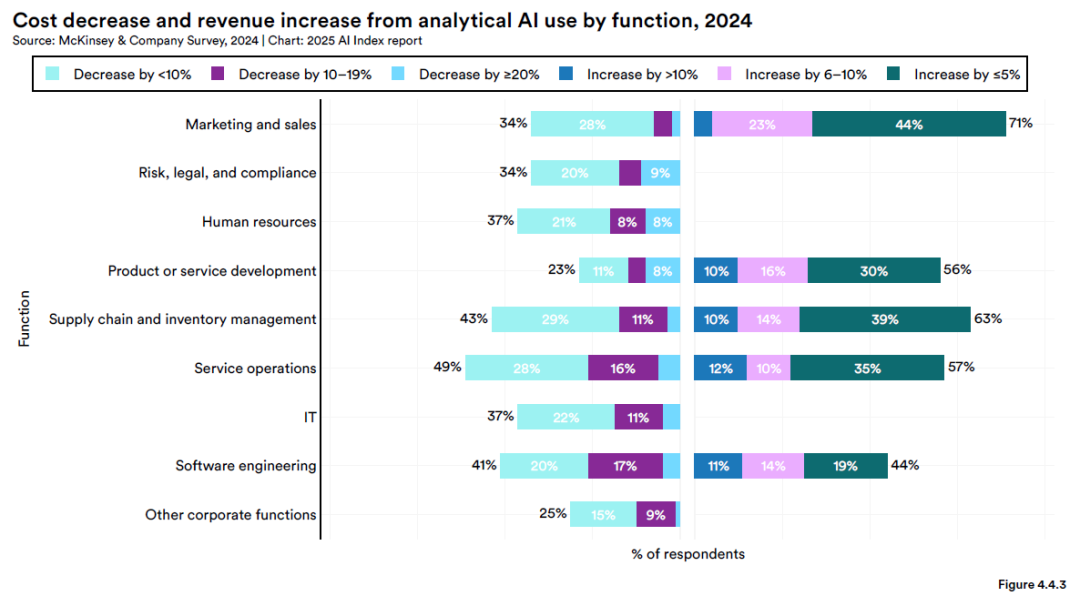
In 2024, the share of surveyed organizations using AI jumped from 55% in 2023 to 78%, but cost savings and efficiency gains remain modest. Most respondents reported AI-driven cost savings of less than 10%. On revenue growth, 71% saw gains in sales, 63% in supply chain management, and 57% in service operations — but the most common revenue improvement was below 5%.
By region, AI adoption patterns shifted noticeably. North America leads at 82% adoption. China's AI usage rose to 75%, a 27-percentage-point increase representing the highest annual growth rate globally.
3. Collaborative and Interactive Robot Installations Become More Common, China Maintains Industrial Robot Dominance
In 2017, collaborative robots accounted for just 2.8% of all new industrial robot installations; by 2023, that share had risen to 10.5%. Excluding medical robots, service robot installations increased across all application categories in 2023. This trend reflects growing emphasis on deploying robots in human-interactive settings.
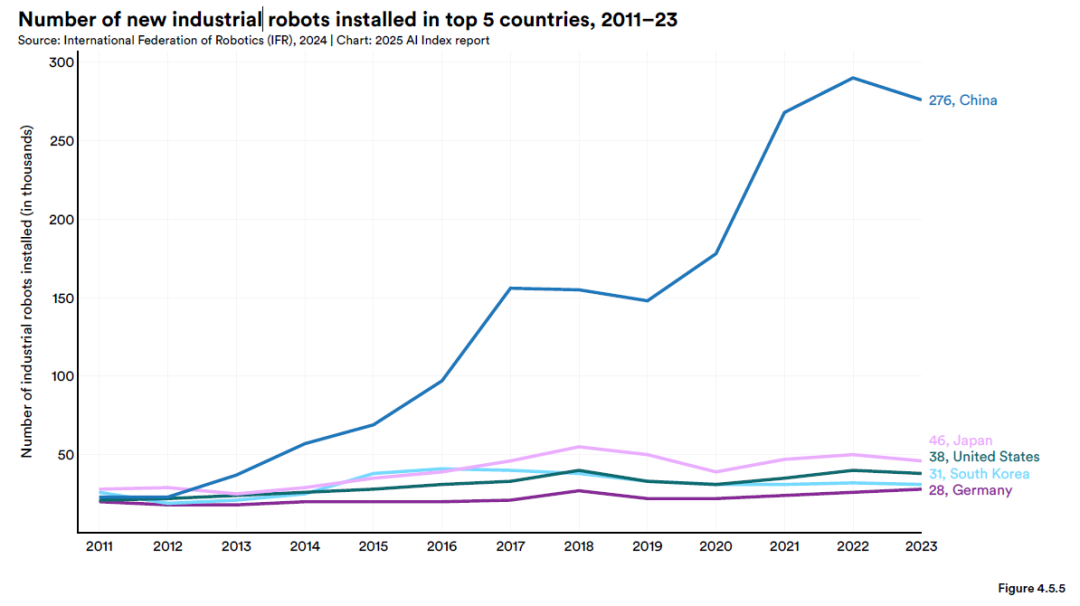
In 2023, China installed 276,300 industrial robots — six times Japan's total and 7.3x that of the United States. Since surpassing Japan in 2013 (when China accounted for 20.8% of global installations), China's share of worldwide industrial robot installations has risen to 51.1%, exceeding the rest of the world combined.
AI Is Accelerating Medical and Scientific Progress
AI is becoming a critical force driving scientific advancement and transforming medical practice.
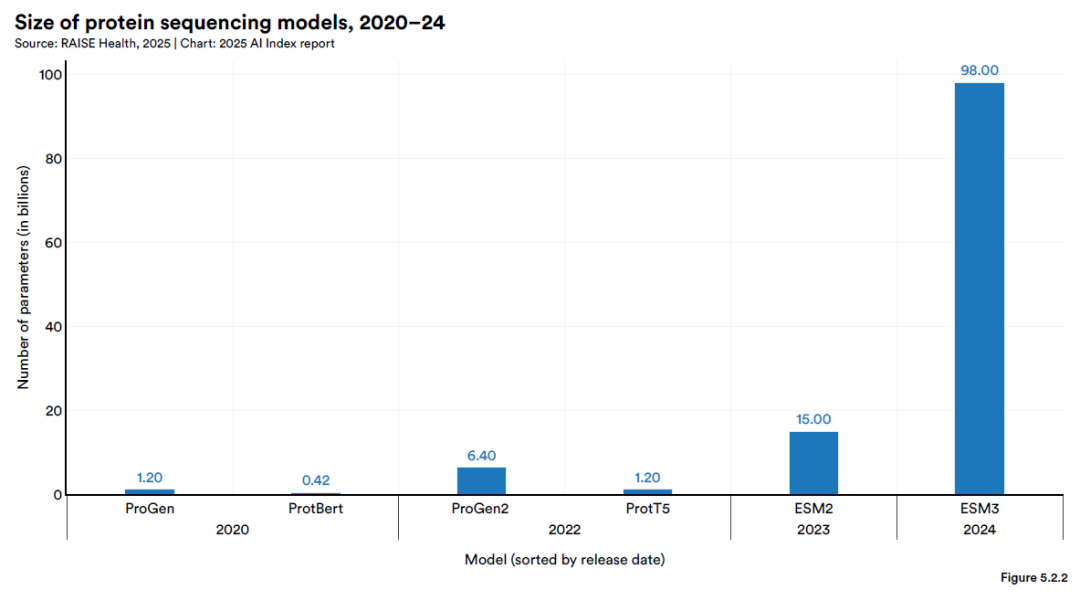
More Powerful Protein Sequencing Models: In 2024, a new generation of protein sequence models emerged, including AlphaFold 3 and ESM3 — larger in scale and stronger in performance, dramatically improving protein prediction accuracy. These models are advancing not only fundamental biological research but also opening new pathways for drug design and synthetic biology.
Clinical Task Performance and Applications: One new study found that GPT-4 outperforms physicians in diagnosing certain complex clinical cases. Other research shows AI surpassing doctors in cancer detection and identifying high-risk patients. Additionally, FDA-approved AI-enabled medical devices have exploded in number, from 6 in 2015 to 223 in 2023.
The Promise of Synthetic Data in Medicine: Research published in 2024 indicates that AI-generated data can help models better identify social determinants of health, predict clinical risks more effectively while preserving privacy, and facilitate the discovery of new drug compounds.
Public Attitudes Toward AI's Transformative Impact Are Growing More Positive
Globally, public sentiment toward AI is becoming more positive, though significant regional differences remain. Chinese respondents rank highest in AI awareness, trust, and enthusiasm.
In 2024, 67% of global respondents reported "having a good understanding of AI," and 66% believed "AI will profoundly change daily life in the near future." The share of the global population viewing AI-driven products and services as "more beneficial than harmful" ticked up slightly, from 52% in 2022 to 55% in 2024. The biggest gains came from previously more skeptical countries including the United Kingdom, Germany, the United States, Canada, and France.
In surveys about AI products and services, Chinese respondents showed the highest levels of awareness, trust, and enthusiasm. 80% reported "feeling excited about these products and services." By comparison, only 58% of American respondents believed "AI will profoundly change life in the next 3 to 5 years."
Consistent with 2023 findings, significant differences in AI optimism persist across Asia-Pacific, European, and American regions. In China (83%), Indonesia (80%), and Thailand (77%), large majorities believe AI products and services bring more benefits than harms. In Canada (40%), the United States (39%), and the Netherlands (36%), only minorities hold this view.
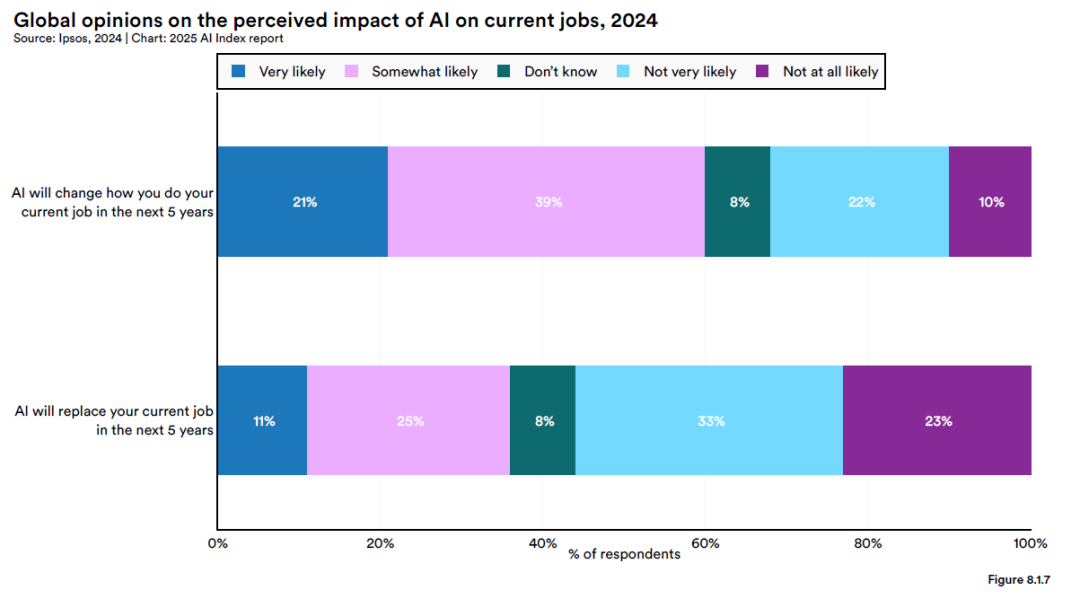
Respondents expect AI to reshape work, but concerns about being replaced remain relatively muted. Globally, 60% agree AI will change how people work within five years, while 36% believe AI will replace their jobs within that timeframe.
Full report: https://hai.stanford.edu/ai-index/2025-ai-index-report


- Architecture Revolution, Act Two: China's RISC-V Army Fights for Ecosystem Ascension | Unity Ventures
- Technological Waves Surge: A Cambrian Explosion in AI's Deep Waters | Unity Ventures Spring Notes
- DeepSeek Disrupts the Industry Landscape, Unity Ventures Portfolio Embraces a New AI Era | Unity Ventures Portfolio