AutoGame's Zhang Haoyang: Beyond 'Content Feeding,' How AI Games Become the Ultimate Vessel for Next-Gen Media | Founders Talk

In the Age of "Data Is King," Reclaiming Control of Our Digital Lives
As GenAI ignites a revolution in content production, the changes on the supply side extend far beyond new generation tools and new forms of content. AI is redefining the relationship between humans and information, humans and each other, and even humans and the digital world. Entirely new media platforms will emerge in the future.
Unity Ventures portfolio company AutoGame founder Haoyang Zhang recently published an essay sharing his views on the ultimate form of media in the GenAI era. He argues that the vehicle capable of carrying this new media form may not be video platforms, but rather "Baseplate Games" featuring "full-factor generation" by AI.
Core arguments:
- AIGC video streams and "Baseplate Games" represent two fundamentally different paths of media evolution, essentially concerning the distribution of "control." In the former, control rests with platform algorithms; in the latter, it is dispersed among rules set by creators and the actions of every participant.
- The gaming industry has passed through "channel-centric" and "content-centric" eras, neither of which can now satisfy players' demand for massive, high-quality, personalized content. AI will drive the industry's third leap into a "data-centric" era.
- The fusion of AI and gaming, after progressing through three stages — AI Novel, AI NPC, and AI UGC — will ultimately reach the "infinite game" stage, where AI generation capabilities transform the game world into a continuously evolving, never-ending living organism.
- "Infinite games" can be realized as sustainable products through the "Data-Product-Model" golden triangle theory, building commercial moats via a flywheel of "Product (World OS) -> Data (Player Co-creation) -> Model (World Soul) -> More Intelligent World OS."
The demonstration of Google's next-generation video generation model Veo3, with its visually irrefutable power, has pushed discussions of AIGC (AI-Generated Content) to new heights. When a model can stably generate high-definition video over a minute long with high physical consistency and logical coherence, a clear industry roadmap seems to unfold: streaming media represented by short-video platforms will most likely become the first vehicle for AIGC mass media. Platform algorithms, no longer content with "recommending" from vast content pools, will directly invoke powerful generation engines to real-time create exclusive, infinitely supplied personalized content streams for each individual user profile.
This is undoubtedly a tremendous leap in the sense of communication studies, bringing Nicholas Negroponte's prophecy of "The Daily Me" in Being Digital [1] to billions of people's daily lives in a more immersive and engaging video form. Yet a deeper question follows: Is this "feed"-centric, one-way consumption model the ultimate form of mass media in the AI era?
The answer is likely no. Media historian Harold Innis, in his work The Bias of Communication, pointed out that every dominant medium has an inherent "bias" that shapes the form of knowledge and the structure of society [2]. A medium's revolutionary character lies not only in its efficiency of information distribution, but more critically in how it defines the relationship between humans and information, humans and each other, and even humans and the world.
AIGC video streams, despite achieving revolution on the production side, still perpetuate the traditional "finished product" logic on the consumption side — merely driving the cost of producing "finished products" to near zero. Between medium and audience, the relationship remains one of presentation and viewing.
The core characteristic of truly next-generation mass media must necessarily be the deep fusion of "interactivity" and "generativity." What it transmits should no longer be fixed information packages, but a dynamic "world" available for exploration and change. In such media, the audience's identity will shift from "consumer" to "participant" and even "co-builder" — their every action becoming part of the media content, real-time and irreversibly altering the medium's own form and narrative.
This leads us to a conclusion: the ultimate vehicle capable of carrying this new media form is not video platforms, but games — specifically, "Baseplate Games" featuring "full-factor generation" by AI. To understand this claim, we must deeply analyze the intrinsic logic of the gaming industry's own evolution, the four-layer role AI plays within it from surface to core, and the commercial and technical methodology for building this ultimate form.
01 The Predicament of "Content Is King" — The Gaming Industry's Internal Crisis
Before exploring the future, we must clearly examine the present. Over the past three decades, the video game industry's development has followed a clear and brutal evolutionary path, passing through two major eras and now anxiously standing at the threshold of a third.

The Channel-Centric Era
From Nintendo's strict control of the cartridge market through its "licensing system" in the 1980s [3] to the early 21st century, the gaming industry's lifeblood was firmly gripped by "channels." In China, this phenomenon was particularly pronounced. In the early days of smartphone proliferation, the "Hardcore Alliance" formed by mainstream phone manufacturers wielded absolute dominance over game distribution through their control of hardware entry points, determining the life or death of numerous games [4]. In this era, games were more like industrial products, their value realization highly dependent on distribution pipelines.

The Content-Centric Era
In recent years, however, digital distribution channels have become unprecedentedly flattened, and the competitive focus has naturally shifted from "how to be seen by players" to "how to be chosen by players." Premium content, or excellent products themselves, became the only way to stand out among countless games.
Especially in the Chinese market, the "license freeze" that began in 2018 objectively accelerated this process. When obtaining publishing licenses became difficult, shoddily made, reskinned profit-seeking games could no longer survive, and the industry was forced toward a premiumization path. A batch of high-quality games represented by Arknights and Genshin Impact, through their exceptional product strength, achieved great success not only in the domestic market but also globally validated the logic of "product is king." They bypassed the strong constraints of traditional channels, directly establishing connections with players through community operations and content marketing, proving that top-tier content itself is the best channel.

Yet beneath the glory of "content is king," a profound and unsustainable crisis is lurking.
First, economic unsustainability: the exponential rise of costs. For instance, AAA game development costs are ballooning at an alarming rate. According to the latest industry reports and leaked documents, such as internal materials from Sony Interactive Entertainment, The Last of Us Part II cost $220 million to develop, while Horizon Forbidden West cost $212 million [5]. This doesn't even include global marketing expenses that frequently exceed $100 million. Development cycles have stretched from two or three years to five, seven, or even longer. This heavy-asset, long-cycle investment model means that a single failure can deal a devastating blow to even a top-tier company.

Second, creative unsustainability: talent-driven inspiration depletion. The essence of "content is king" is "talent is king." It relies on the flash of genius from star producers and the painstaking craftsmanship of hundred-person development teams working day and night. Yet human creativity is not an inexhaustible assembly-line product. Under highly industrialized processes, game design increasingly trends toward "formulaic" — Ubisoft-style open-world "canned goods," service games' "season" models, these validated-success frameworks are repeatedly applied, to the point where the term "open-world fatigue" has emerged among veteran player communities [6].

Meanwhile, development teams themselves face enormous creative pressure and burnout, with talent depletion and turnover becoming normalized — something repeatedly reflected in annual reports from the Game Developers Conference (GDC) [7].
Finally, consumer-side unsustainability: content locusts and experience involution. The evolution of the player base is the last straw breaking the "content is king" model. In the era of information explosion, players' tastes have grown increasingly discerning and their patience increasingly limited. Like "content locusts," they can consume a world built over years with hundreds of millions of dollars in mere dozens of hours, then swiftly move to the next target. This traps game content design in a vicious cycle of "experience involution," where developers must deploy stronger audiovisual stimulation, denser reward feedback, and vaster content volumes just to elicit a flicker of response from players' increasingly numb sensory thresholds.

When an industry's production relations can no longer accommodate the demands of its productive forces — when human-driven workshop-style production fails to satisfy players' appetite for massive, high-quality, personalized content — the conditions for a paradigm revolution are ripe. This profound internal crisis has created a historic window for gaming's third great leap: Data is King. And the engine driving this revolution is AI technology, gradually permeating every fiber of the game industry.
02 The Stairway to a New Reality — Four Stages of AI-Game Convergence
The fusion of AI and gaming is a gradual, deepening process that progressively reconstructs the essence of games itself. It can be clearly divided into four sequential, ascending eras.
Stage 1.0: AI Novel
Pure text adventure games represented by AI Dungeon inaugurated the era of "semantic generation." For the first time, a large language model (LLM) served as the core engine of a game, validating that AI could do more than mathematical interpolation — it could comprehend and generate content with logical coherence and narrative value. This was a qualitative leap from "formal" generation to "meaningful" generation, the original, primordial spark of AI capability in gaming. Yet its limitations were equally apparent: single modality, weak world consistency.

Stage 2.0: AI NPC
This is the current focal point of industry exploration, aimed at shattering NPCs' rigid "dialogue tree" patterns and endowing them with "souls." Stanford University's "Generative Agents" project stands as a landmark exemplar. In this project, researchers created 25 AI agents in a virtual town, each equipped with a unique memory module (Memory Stream), capable of reflection (Reflection), and able to formulate long-term plans (Planning) accordingly. Based on this information, they could autonomously schedule their days, work, socialize, and even spontaneously organize and spread word of a party [8]. This academically proved the possibility of granting NPCs intrinsic motivations, enabling autonomous social behavior, and thereby generating "emergent behavior" in the world.
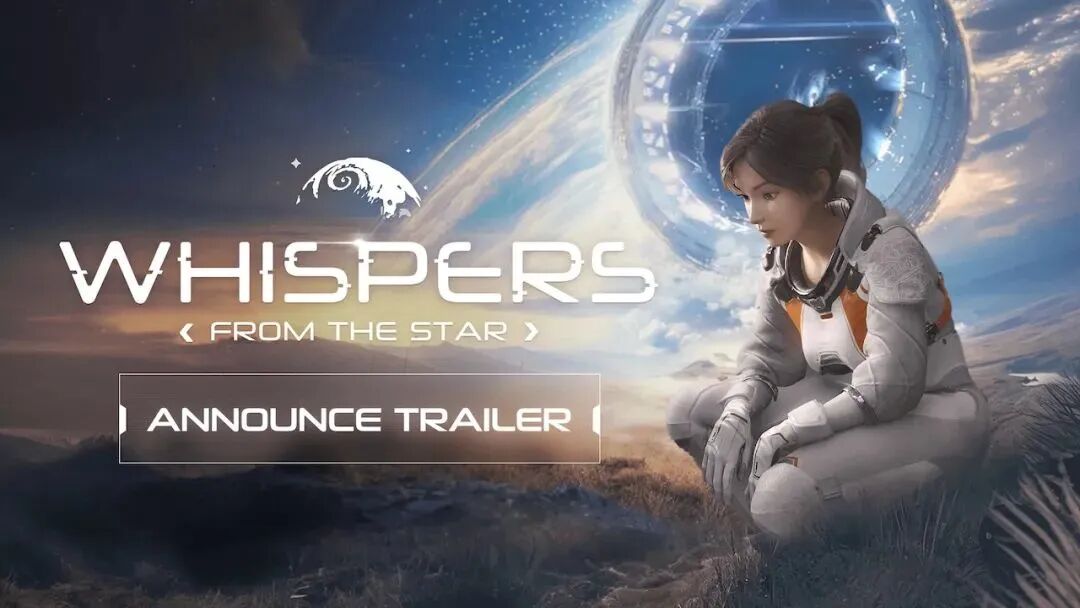
In commercial exploration, products like Whispers from the Star attempt to combine AI-driven real-time voice generation with dynamic storytelling, making player-NPC interactions more immediate and emotionally immersive — an important step in bringing laboratory technology to market and validating user experience.
Stage 3.0: AI UGC
The energy of UGC (User-Generated Content) has already been proven in Minecraft and Roblox. The AI UGC era aims to drive the barrier to creation to its absolute minimum: natural language. The core driver of this transformation is the evolution of Coding Agents.

In the past, AI programming tools like GitHub Copilot largely played the role of "assistant," offering code completion and suggestions to developers. But with Anthropic's release of the Claude 3.7 Sonnet model, we see a clear inflection point: AI is evolving from "Copilot" to "Vibe Coder" — an intent encoder that comprehends high-level intentions and directly generates usable finished products. Users need only describe their needs in natural language ("I want a UI script where the character's health bar turns red when it decreases"), and the AI can generate, test, and display usable code snippets or components in a workspace right beside them.
AI UGC harnesses precisely this powerful Agent capability. It translates complex programming, numerical design, level layout, and other game creation tasks into natural language interactions that ordinary players can understand. This brings three profound transformations: dramatically lowering the creation barrier — enabling hundreds of millions of players who know nothing about programming to become creators of game worlds; significantly elevating average content quality — AI can follow optimal design paradigms, avoiding common novice mistakes and ensuring baseline quality of generated content; radically compressing content creation cycles — reducing development work that previously took days or even weeks to mere minutes.
Stage 4.0: "The Infinite Game"
This is the logical terminus of the first three eras' development, a grand vision often dubbed the "Infinite Game" by industry observers. In this stage, AI-driven generative capability is no longer confined to a single component (NPCs) or tool (UGC), but permeates every corner of the entire world. The game world itself becomes an ever-evolving, never-ending living organism.
This concept dovetails with the "World Models" actively being explored in AI academia. As advocated by Turing Award laureate Yann LeCun and others, building AI models capable of understanding and predicting how the physical world operates is a critical step toward artificial general intelligence [9]. And games are the ideal "sandbox" for training and validating world models. The "World-Labs" concept proposed by Fei-Fei Li's team at Stanford University also emphasizes the importance of training Embodied Artificial Intelligence agents in realistic, interactive simulated environments [10].
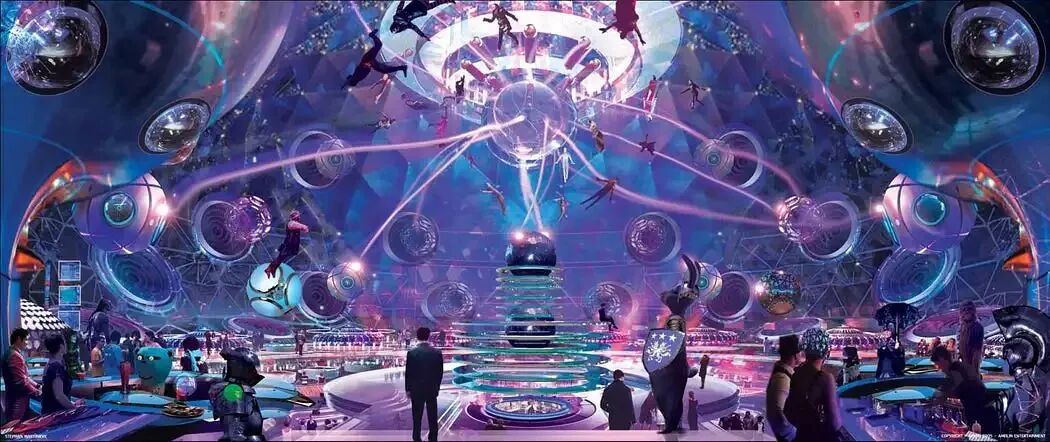
When powerful world models are embedded in games, the entire world gains "emergent" capability. Plotlines are no longer pre-scripted, but naturally surface from the interactions of countless AI agents and the evolution of social events. Culturally, this parallels the "OASIS" depicted in the film Ready Player One — a vast virtual universe, co-shaped by users, with its own economy, society, and history, running parallel to the real world [11].
The Golden Triangle and the Data Flywheel — Commercial Moats in the AI Era
"The Infinite Game" is a grand vision. But to ground this vision in sustainable products and business models requires a clear implementation path. At the core of this path, I believe, is a "Data-Product-Model" Golden Triangle theory of business — one that explains how to build insurmountable moats in the AI era.

In the AI era, traditional business moats are being rapidly eroded. In the past, software's defensibility lay in code complexity and functional uniqueness. But in the large model era, many functions can be implemented through MCP tool API calls, diminishing the value of code itself. First-mover advantage has also become unreliable — a hit application can be overtaken by a more feature-complete competitor within weeks. The true, sustainable moat lies in a self-reinforcing, virtuous-cycle system.
This system must be formed through tight coupling and co-evolution of "Product," "Data,"" and "Model" — the absence of any corner renders its defensibility fragile.
Failure Mode 1: Model + Data only (missing effective product). This is the trap many traditional enterprises fall into during AI transformation. They hold massive troves of industry data and have invested heavily in training or fine-tuning so-called "private domain large models." Yet these models often sit idle on the shelf, lacking a sufficiently excellent "product" vehicle that enables high-frequency user engagement and generates new value. The model's capabilities cannot effectively reach users, and users cannot produce new, high-quality data to feed back into the model. It's like building an ultra-high-power engine with no chassis, wheels, or steering wheel.
Failure Mode 2: Model + Product Only (Missing the Data Flywheel)
This describes the vast majority of "AI tool applications" on the market today. They cleverly harness the capabilities of general-purpose large models like GPT-4 and package them inside a polished "product" shell. In the short term, they can acquire users through first-mover advantage and excellent product design. Yet their moat is a castle built on sand. Their value is entirely dependent on the underlying general-purpose model; they possess no core, continuously generated proprietary data of their own. When the base model improves, the value of these "thin applications" is rapidly diluted.
The true moat lies in using "product" as the vehicle to drive a self-reinforcing data flywheel. Its mechanism works as follows:
-
A well-designed product attracts users into high-frequency, deep interactions.
-
These interactions produce massive amounts of unique, proprietary interaction data unavailable in the public domain.
-
This high-quality data serves as fuel to train and optimize an AI model customized for that specific product.
-
This more powerful customized model, in turn, dramatically enhances the core product experience — making it smarter, more personalized, and more compelling.
-
Better product experience attracts more users, generating more data, and the flywheel begins to accelerate.
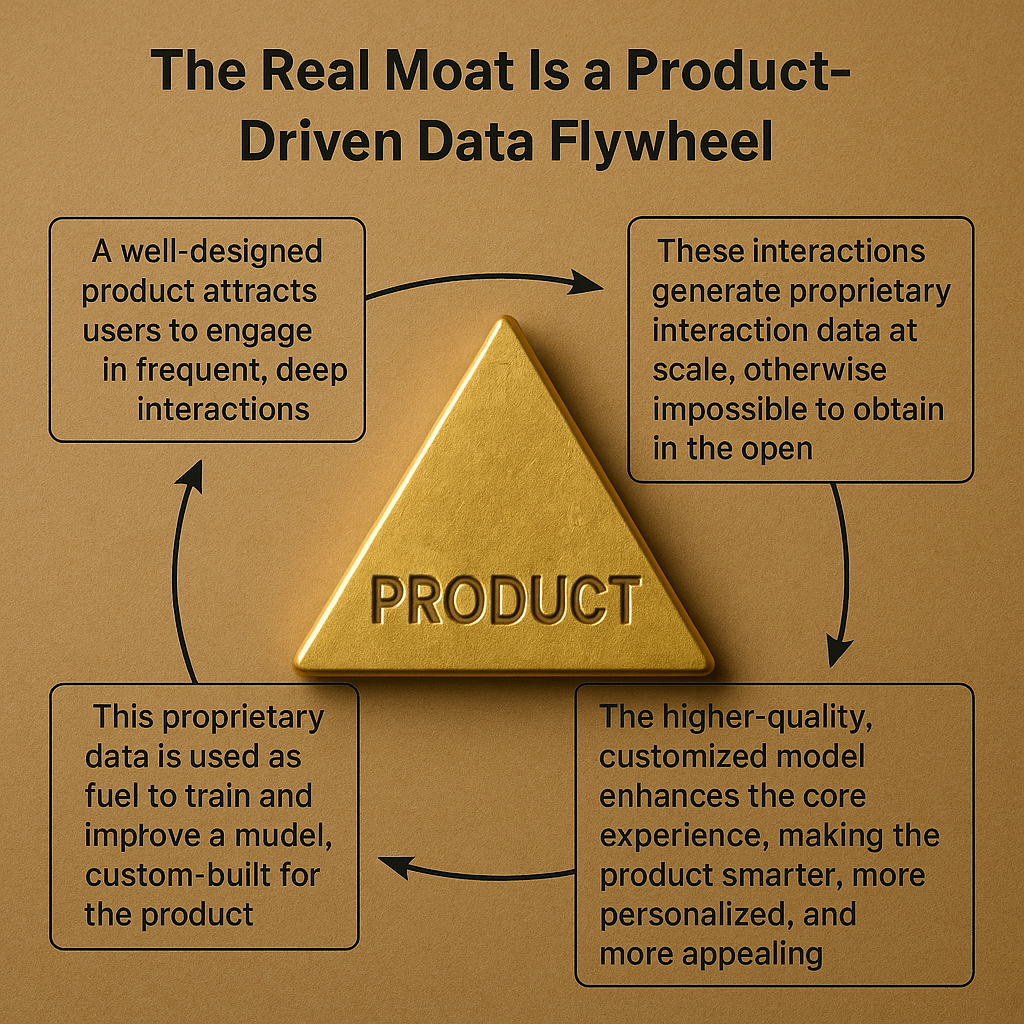
This product-driven data flywheel builds a barrier that grows taller and wider with time — one that becomes virtually insurmountable.
Building "Base Games" — The Ultimate Practice of the Golden Triangle
"Base games" represent the most perfect, almost innate, application of the Golden Triangle theory in gaming. Traditional games are like "sculptures" — fixed in form, entirely determined by their creators. Base games, by contrast, are like "gardens" — developers provide only the soil (rules) and seeds (initial content), while the game's content grows organically through AI evolution systems and player interaction, producing unique and unpredictable experiences. So how does one build a "base game"?

Defining the Product — Building a "World OS"
Developers must first transform their role, shifting from "film director" to "urban planner" and "lawgiver of physics." What they build is no longer a linear story, but a "World OS." The kernel of this operating system includes:
1. Foundational Rule Set: Defines the immutable axioms of the world — its laws of physics, economic models, magic systems, social ethics. This is the world's "constitution."
2. AI Model Cluster: A suite of AI models customized and initialized for this world, including NPC cognition models, world event evolution models, UGC content generation models, and more. This is the world's "administrative apparatus" and "natural law."
This "World OS" is the core product — an open "canvas" waiting to be filled and evolved. Its design goal is not to present content, but to maximize the capture of high-quality interaction data.
Interaction as Co-Creation — Making Players "Developers" of the World and Contributors of Data
On top of this "World OS," every player interaction carries dual significance. It is simultaneously the player's own experience, and a "write" operation to the world — the most valuable training data contributed to the AI model.
- Explicit Co-Creation: Players use AI UGC tools to create new quests, items, characters, and buildings through natural language, directly adding content to the world. This is structured, intention-driven creative data.
- Implicit Co-Creation: Players' everyday behaviors — exploration, combat, trading, dialogue — all provide feedback to the AI model. The system observes which quests are popular, which NPC dialogues prove more engaging, which spontaneously formed settlements grow more vibrant, and uses these as "positive reinforcement" to guide future content generation. This is massive behavioral data reflecting genuine preferences.
Through this mechanism, the entire player community becomes a distributed, 24/7 "data labeling team" and "content creation team." They are simultaneously consumers and, most importantly, data producers.

Model as Moat — Forging the Irreplicable "World Soul"
The AI model cluster, continuously iterated and optimized through massive proprietary interaction data, becomes the unique, irreplicable "World Soul" of the base game.
Over time, this AI "World Soul" learns the unique "culture" and "history" of this particular world. It knows which regions' players prefer high-difficulty challenges. It knows all the lore and anecdotes of a legendary NPC. It can even predict the next "world event" likely to erupt based on player collective behavior. It is no longer a generic AI, but the crystallization of this specific digital civilization's collective unconscious.
Competitors can copy the game's UI, foundational rules, even its art style. But they cannot copy this "World Soul" that has engaged in hundreds of millions of deep interactions with millions of players and co-evolved over years. This closed-loop flywheel of "Product (World OS) -> Data (Player Co-Creation) -> Model (World Soul) -> Smarter World OS" constructs the most formidable commercial moat in AI gaming.
The Ultimate Vessel — Consumer Illusion, or Co-Created Reality?
AIGC video streaming and "base games" represent two radically divergent futures for media. The former strives to create a perfect, passive sensory illusion. Through algorithms, it infinitely satisfies your preferences, immersing you comfortably in a tailor-made filter bubble. This is a future of consumer illusion.

The latter strives to construct an imperfect but perpetually evolving dynamic reality. It presets no endpoint; instead it provides a set of rules and tools, inviting you to participate in shaping the world. Every choice you make adds a new stroke to this world's history. This is a future of co-created reality.

These two paths are, at their core, about the distribution of "control." In the former, control rests with platform algorithms; in the latter, control is dispersed among creators who set the rules and every participant's actions.
Which form ultimately dominates our digital life is not merely a technological and commercial question, but a cultural and philosophical one about what role humans choose to play in our future digital world. This may be among the most important choices we face since the birth of artificial intelligence technology.
References
[1] Negroponte, N. (1995). Being Digital. New York: Alfred A. Knopf.
[2] Innis, H. A. (1951). The Bias of Communication. Toronto: University of Toronto Press.
[3] Sheff, D. (1993). Game Over: How Nintendo Zapped an American Industry, Captured Your Dollars, and Enslaved Your Children. New York: Random House.
[4] 手游那点事. (2021). 存在7年,"硬核联盟"给中国手游市场带来了什么?. [Online]. Available at: https://www.36kr.com/p/1284050731475718 (Accessed: 26 May 2024).
[5] Tassi, P. (2023). 'Horizon Forbidden West' And 'The Last Of Us Part 2' Budgets And Sales Leak Via Insomniac. Forbes. [Online]. 19 December. Available at: https://www.forbes.com/sites/paultassi/2023/12/19/horizon-forbidden-west-and-the-last-of-us-part-2-budgets-and-sales-leak-via-insomniac/ (Accessed: 26 May 2024).
[6] Macgregor, J. (2021). The analyst who coined 'open world fatigue' says the genre's been improving. PC Gamer. [Online]. 29 August. Available at: https://www.pcgamer.com/the-analyst-who-coined-open-world-fatigue-says-the-genres-been-improving/ (Accessed: 26 May 2024).
[7] Game Developers Conference. (2024). State of the Game Industry 2024. [Online]. Available at: https://www.gdconf.com/news/state-game-industry-2024-layoffs-and-ai-top-mind-developers (Accessed: 26 May 2024).
[8] Park, J. S., O'Brien, J. C., Cai, C. J., Morris, M. R., Liang, P., & Bernstein, M. S. (2023). Generative Agents: Interactive Simulacra of Human Behavior. arXiv preprint arXiv:2304.03442.
[9] LeCun, Y. (2022). A Path Towards Autonomous Machine Intelligence. OpenReview.net. [Online]. Available at: https://openreview.net/pdf?id=bz5a1r-kVsf (Accessed: 26 May 2024).
[10] Fei-Fei Li, et al. (Stanford Vision and Learning Lab). Research direction towards interactive agents and embodied AI. (Note: This refers to the general research thrust of the lab, as exemplified by projects like BEHAVIOR-1K).
[11] Cline, E. (2011). Ready Player One. New York: Crown Publishers.