Jingying Technology Raises Tens of Millions of Dollars, Former AWS Chief Applied Scientist Joins to Build Agent-Native Company for Content Industry | Unity Ventures Portfolio News

Building a Reinforcement Learning Environment That Agents Can Plug Into and Self-Improve
Unity Ventures' early-stage portfolio company Jingying Technology (CreativeFitting) has announced the completion of a new round of tens of millions of dollars in Series A and A+ funding. Investors include Lollapalooza Capital (Huiwen Wang's family office), Ant Group, and Yin Yu, former Tencent corporate vice president.
At the same time, the company officially announced that Minjie Wang, former principal applied scientist at AWS Shanghai AI Lab and current dean of the Shanghai Institute of Intelligent Computing and Innovation at The University of Hong Kong, has joined as chief scientist.
These moves all point to one clear signal: Jingying Technology is redefining its technical boundaries, transforming production methods in the content industry, and providing an "accessible, self-evolving" reinforcement learning environment for Agents — becoming an Agent-native company for the content industry.

Over the past year, Agents have undeniably produced the clearest "template" first in the coding industry.
Various Coding Agents, represented by Codex and Claude Code, no longer remain at the "code completion assistant" stage. They can execute complete workflows and even sustain software tasks over extended periods, genuinely solving problems.
Recently, data released by OpenAI showed that Codex's weekly active users have surpassed 5 million, with desktop users growing more than 6x since its February launch... In a sense, Agents are profoundly restructuring the coding industry.
After recognizing the enormous potential of Coding Agents, the industry has been asking: beyond software, what's the next industry that could soon be restructured?
Jingying Technology's (CreativeFitting's) answer: the content industry.
Founded in 2021, Jingying Technology has been known to outsiders primarily for AI short dramas. But the company sees AI short drama as merely the first scenario for an Agent-native company to transform the content industry. An Agent-native company represents an entirely new paradigm: everyone creates their own Agent to join the company — organizational friction disappears, and the company operates at Agent speed.

What Jingying Technology is betting on is becoming the first such company in the content industry. Its technical core is building an accessible, self-evolving reinforcement learning environment for Agents.
The reasoning behind this judgment is straightforward: the content industry is increasingly resembling the software industry.
In Jingying Technology's view, the software industry has operated entirely in the virtual world since day one — code writing, compilation, testing, and deployment all complete in a closed loop on machines, with no dependency on physical processes. This is precisely why it was the first to be restructured by Agents: without physical friction, Agent capabilities can be fully unleashed.
The content industry, meanwhile, as multimodal model foundations grow stronger, is moving away from its past heavy reliance on physical-world interaction. Art design, filming, editing, dubbing — more and more links that once required physical-world collaboration are gradually being virtualized. When content production increasingly approaches completion entirely in the virtual world, it gains the prerequisite conditions for Agent-driven restructuring.
What Jingying aims to do now is validate whether the content entertainment industry can form a new production, evaluation, and feedback environment oriented toward Agents, just as the coding industry has.
The latest news: Jingying Technology has just completed a new round of tens of millions of dollars in Series A and A+ funding, with investors including Lollapalooza Capital (Huiwen Wang's family office), Ant Group, and Yin Yu, former Tencent corporate vice president. Simultaneously, the company officially announced that Minjie Wang, former principal applied scientist at AWS Shanghai AI Lab and current dean of the Shanghai Institute of Intelligent Computing and Innovation at The University of Hong Kong, has joined as chief scientist.
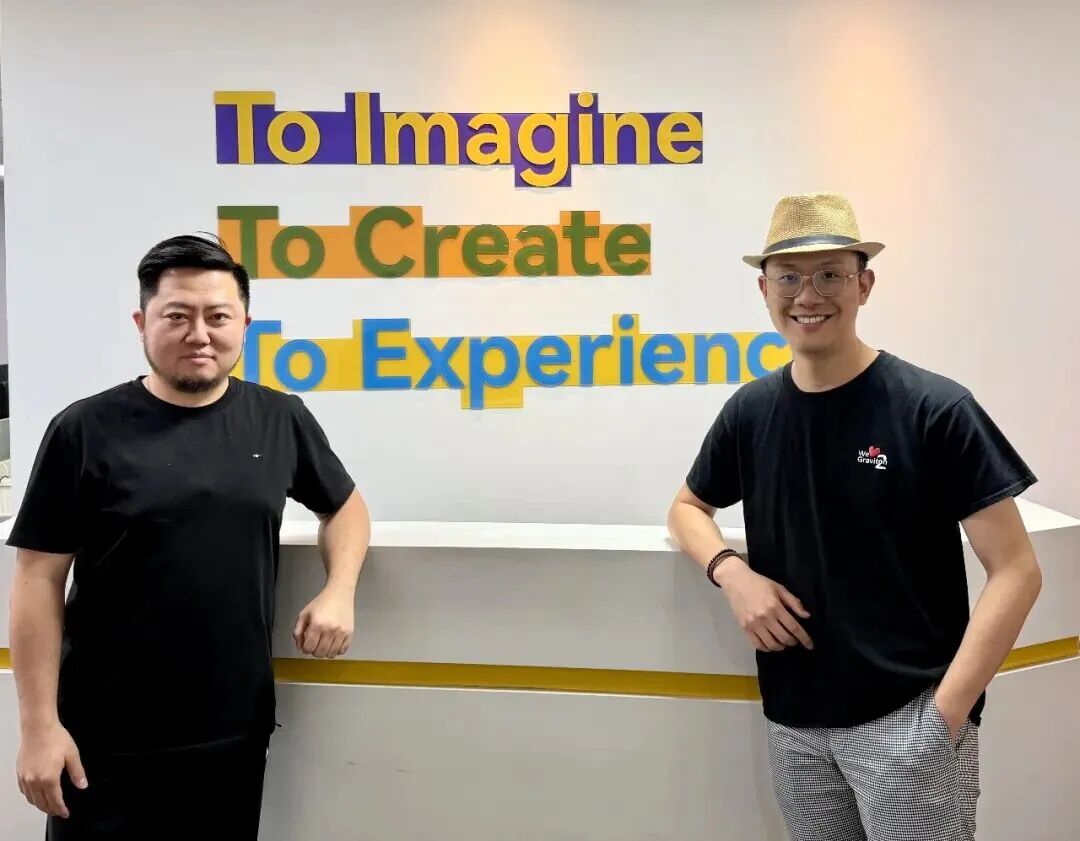
Left: Jiang Zhu, CEO of Jingying Technology; Right: Minjie Wang, Chief Scientist of Jingying Technology
Minjie Wang completed his undergraduate and master's studies in the Department of Computer Science and Engineering at Shanghai Jiao Tong University, where he was a member of the renowned ACM Class, and later earned his Ph.D. in Computer Science from New York University. He served as principal applied scientist at AWS, the youngest person in the Asia-Pacific region to hold this title. He is also a significant contributor in the deep learning framework space — one of the main initiators and core maintainers of the well-known open-source graph deep learning framework Deep Graph Library (DGL), and an early core developer of the deep learning framework MXNet.
And these heavyweight moves are all sending a clear signal to the industry: Jingying Technology is redefining its technical boundaries and accelerating its transformation into an Agent-native company.

AI video models are in a fierce arms race, so why still no good content?
Over the past year-plus, AI video generation models have improved noticeably. Image quality is more stable, motion more natural, character consistency better, and audio-video synchronization capabilities steadily advancing. For many people, calling up a powerful video generation model, inputting a prompt, and generating a video clip — this is the "new narrative for AI entertainment" in the "large models restructuring everything" discourse.
This is, clearly, a "misjudgment."
For genuine entertainment consumption, generating an impressive video clip is only the first step. When technology truly enters the harsh context of commercialization, problems follow in rapid succession: what stories are worth making? Will users watch? Who evaluates content quality, and by what standards? How does consumer feedback flow back smoothly? Can the entire system sustain cross-cycle self-driven iteration?
No matter how strong a large model's single-point capabilities, it cannot spontaneously answer these system-level questions.
Jingying Technology Chief Scientist Minjie Wang summarizes it this way: in the content industry, "models raise the floor, not the ceiling."
At the underlying logic level, large models are essentially compression of massive data, adept at generating stable, safe, average answers from large samples — "regression to the mean." But good content, or creativity, is non-mean: it is "spiky", with something sharp and unexpected protruding above average performance. In short dramas, an anti-trope character design, a setup that precisely hits mass emotions, an unexpected twist... these are expressions of individual creator inspiration that models cannot "grow" on their own.
If models can only output the average of training data, they are merely copying formulas, struggling to continuously generate things that truly dazzle users.
More complex still, user content preferences themselves keep changing. Again taking short dramas as an example: urban romance may be popular today, sci-fi suspense tomorrow; users may want light content during commutes, stronger plots in the evening; the same genre may receive completely different feedback across platforms, regions, and demographics.
In summary, what the content industry faces is not a static correct answer, but a dynamic, highly personalized, continuously fragmenting preference system. This far exceeds general models' iteration speed — it's impossible to retrain a hundred-billion-parameter model every two weeks to chase shifting user tastes.
Wang believes these two problems together lead to one conclusion: good models alone are far from enough — models cannot solve where creativity comes from or how feedback flows back. Coding Agents matured first not just because models were strong enough, but because the coding industry naturally has a complete environment: documentation systems provide knowledge accumulation, compilers and testing frameworks provide instant feedback. Agents in this environment can learn, trial-and-error, and iterate.
What the content industry lacks is precisely this environment. Everyone creates their own Agent to plug into it, focusing on creativity and taste while Agents handle tedious processes — and continuously evolve. Drawing on Coding Agent experience, a truly functional content reinforcement learning environment needs at least two things:

Good creative priors: Corresponding to documentation systems in coding environments that store knowledge and experience (like READMEs, API specifications), creation is never building castles in the air. Agents plugged into the environment need accumulated genre understanding, audience profiles, style references, and industry experience to stand on higher ground — to deeply understand "what kind of plot twist users of this type truly expect," rather than mechanically calculating "what content gets the highest click-through rate."
Accurate, authentic content preference signals: Corresponding to compilers and testing frameworks that provide real feedback in coding environments, code has clear black-and-white objective correctness — compilation passes or fails, tests pass or fail. But entertainment content carries strong personal subjectivity. If Agents in the loop cannot access accurate, dense preference signals, they cannot achieve true self-driven iteration, only repeatedly producing "safe but mediocre" mean-regressed content.
These two things are what models cannot provide but Agents truly need — with them, Agents have prior knowledge to draw upon and real feedback to align with, and self-driven iteration can truly run.
Paradigm upgrade: Building an Agent-native company for the content industry
What Jingying is doing, in essence, is a paradigm upgrade for the content entertainment industry — building an Agent-native company for this domain, that is, providing a content environment where Agents can "plug in and self-evolve."
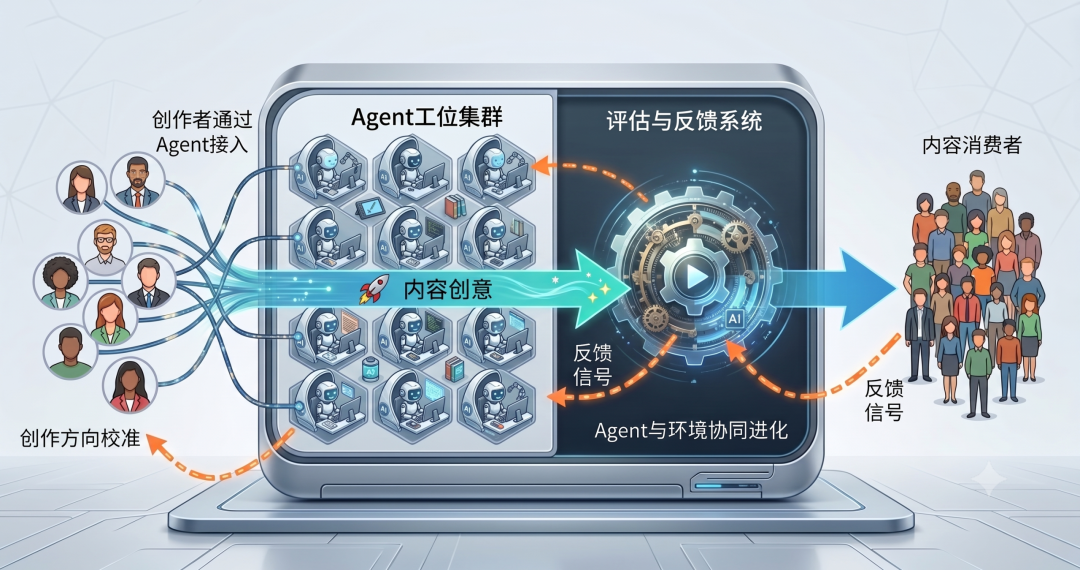
Agent-native company operating model
Breaking this down, the core dimensions of this technical system can be dissected as follows:
Accessible: Jingying Technology has built an open Agent-native creative toolchain. People with different creative specialties — scriptwriting, filming, editing, visuals — can all build their own Agents to complete the full creative chain from idea to finished piece, and plug into the evaluation environment.
Self-evolving: Unlike coding environments, evaluation standards in the content industry are themselves dynamic — user preferences shift at any moment. Thus the entire system needs continuous evolution: creator Agents constantly inject creativity, market feedback flows back in real time, driving dynamic updates to evaluation standards, and creator Agents calibrate direction with each outcome, both jointly converging on authentic market signals.
And in this process, Agent-driven execution reduces friction, accelerates market validation and feedback loops, freeing creators from process coordination to truly focus on creativity itself.
How to understand this?
Jingying Technology CEO Jiang Zhu told Synced that traditional content entertainment has long been constrained by three core frictions:
Creation-side friction: Complex, high-quality content requires multi-person collaboration, with high organizational and communication costs;
Consumption-side friction: A natural gap exists between creators' subjective output and user preferences. The traditional approach uses recommendation algorithms to fish for the best match in existing pools, but because individual preferences are so personalized, even at the limit of recommendation algorithms, user needs cannot be fully met — the content matching their preferences may not even exist yet;
Content genre iteration friction: Organizational friction in the physical world is too heavy, trial-and-error costs too high, stretching the industry's exploration and emergence cycle for entirely new content types extremely long — from anime to short video to short drama, all followed this pattern.
Jingying Technology's content environment dramatically compresses the organizational and collaboration friction inherent in traditional content production by moving humans from "synchronous loops" to "asynchronous loops."
In the new "asynchronous loop" mode, humans no longer need to perform tedious, synchronous AI tool operations. They simply continuously provide inspiration and creativity in the "asynchronous loop," while multi-role Agents remain in efficient "synchronous loops" 24/7, self-driving production, evaluation, iteration, and distribution tasks, ultimately delivering produced content precisely to consumers.
Why AI short drama is the preferred scenario for Agent-native companies to transform the content industry
Why start with AI short drama? Jingying Technology told Synced this is not merely because AI short drama is hot or because of their own experience — it reflects dual considerations of technology and business.
First, short drama's feedback density is naturally suited to drive system iteration. Entertainment content inherently has rapid, high-frequency characteristics, and short drama is one of the content forms that has been market-validated and is currently in explosive growth. Data shows that in Q1 this year, short drama monthly active users (MAU) have surpassed 700 million — nearly 7 out of every 10 internet users watch short dramas. Some institutions estimate that by 2026, China's micro-short drama and manga-drama market will conservatively exceed 120 billion RMB...
This growth environment can flow back massive, high-density authentic positive feedback in a short time, providing continuous signals for Agent evolution and iteration.
This is also something Wang particularly values. He told Synced that when previously at AWS responsible for Deep Research product evaluation, writing research reports was typical informational content where quality was highly subjective, and the chain for collecting authentic user feedback was extremely long. You'd make an improvement and wait ages to know if it was good, and by the time feedback finally arrived, requirements might have already changed — the product could barely iterate quickly during R&D. But this dilemma virtually doesn't exist with short drama: whether users like it, whether they keep watching, produces clear behavioral feedback within minutes.
Second, short drama tests narrative ability — it is a "touchstone" for testing the upper limits of content quality. Short drama may be short, but it's not just a meme or a single image. It still depends on character, conflict, twist, pacing, and emotional progression. This makes short drama a special content form: consumption duration is short enough for rapid feedback acquisition; yet weighty enough to test whether a system truly possesses storytelling capability.
Additionally, there's another important reason why AI short drama serves as the preferred entry point for Agent-native companies transforming the content industry. Zhu believes that for this entirely new Agent content environment to truly operate, it absolutely cannot rely on fabricated simulated data. The system must cross the "cold start" survival threshold — and this is precisely the core moat that Jingying Technology has built through years of deep cultivation in AI short drama.
Through genuine success in short drama operations, the company has already accumulated massive numbers of authentic creators and high-frequency consuming authentic users. Creators' online contributions represent high-dimensional signals of human quality, while consumers' real subscriptions, payments, interactions, and feedback data at the terminal provide content preference signals.
The bidirectional signals formed by both constitute the "cold start" soil for the Agent content environment. This means Jingying Technology doesn't need to build a theoretical system from scratch like other players — it can directly upgrade its existing environment to an Agent-native environment.
According to Jingying Technology, this system has now officially entered internal testing and will launch publicly soon.
But this is only the beginning; short drama is merely the first entry point. As more people create their own Agents and dispatch them into this environment, content industry production methods will be completely rewritten — not just short drama, but the entire content industry.
What Jingying Technology aims to do is become the first Agent-native company for the content industry in this era. What comes next is seeing how fast it can run.


Generation and Judgment: My Notes on "Sparring" with AI | Unity Ventures Perspective