Neutral-Atom Quantum Computing Company MatriQ Secures Hundreds of Millions of Yuan in Series B, Completing Five Funding Rounds in One Year | Unity Ventures Funding News
Cumulative funding has surpassed 1 billion yuan.
Neutral-atom quantum computing company MatriQ recently announced the close of a Series B round in the hundreds of millions of yuan.
The round was backed by a group of investors including Hangzhou Industrial Investment Group, Hangzhou High-tech Jintou, Chengdu Technology Innovation Investment Group, Hongruida Investment, Bosch Ventures, Guangzhou Haizhu Chengfa, and Chuanchuang Investment — a mix of local state-owned platforms, industrial capital, and market-driven funds. The funding will support the company in linking up regional resources, launching pilot quantum-classical hybrid computing projects, and deepening industrial ecosystem partnerships.
Within a single year, MatriQ has closed five consecutive equity rounds, bringing its cumulative fundraising to over 1 billion yuan.

Founded in 2025, MatriQ is a frontier tech company focused on full-stack neutral-atom quantum computing solutions. It is driven by engineering, productization, and commercialization, with the goal of building a practical quantum computer.
Founder Xiayuan Xia holds a bachelor's and master's degree from Imperial College London and a PhD from Heidelberg University and the Max Planck Institute of Quantum Optics (MPQ), where he studied under Anton Zeilinger, winner of the 2022 Nobel Prize in Physics. MPQ is one of the birthplaces of global neutral-atom quantum computing — it was the first to achieve independent control of single atoms in optical lattices and single-site resolved readout, and is a key contributor to the global strategic white paper on this approach.
The company has also assembled R&D talent from MPQ, Imperial College London, the University of Cambridge, Carnegie Mellon University, Columbia University, Zhejiang University, Shanghai Jiao Tong University, Sun Yat-sen University, and other universities and research institutions, spanning quantum physics, optical engineering, precision manufacturing, and quantum algorithms.
Among the various technical routes in quantum computing — superconducting, ion trap, and neutral atom — each has its trade-offs. MatriQ chose the neutral-atom route primarily because of its inherent advantage in scaling to large numbers of qubits.
Neutral-atom quantum computing has drawn growing attention in recent years. Xia says that over the past three or four years, the number of physical qubits on the neutral-atom route has grown dramatically, leading overseas teams have notched breakthrough after breakthrough on milestones such as logical qubit encoding and continuous atom loading, and core metrics like single-qubit and two-qubit gate fidelity have improved rapidly.
MatriQ has now built full-chain technical capabilities from in-house development of core components to full-system integration, achieving the construction and stable operation of defect-free arrays of up to 2,310 physical qubits — making it one of the few neutral-atom quantum computing companies in China capable of delivering thousand-qubit-scale full systems.
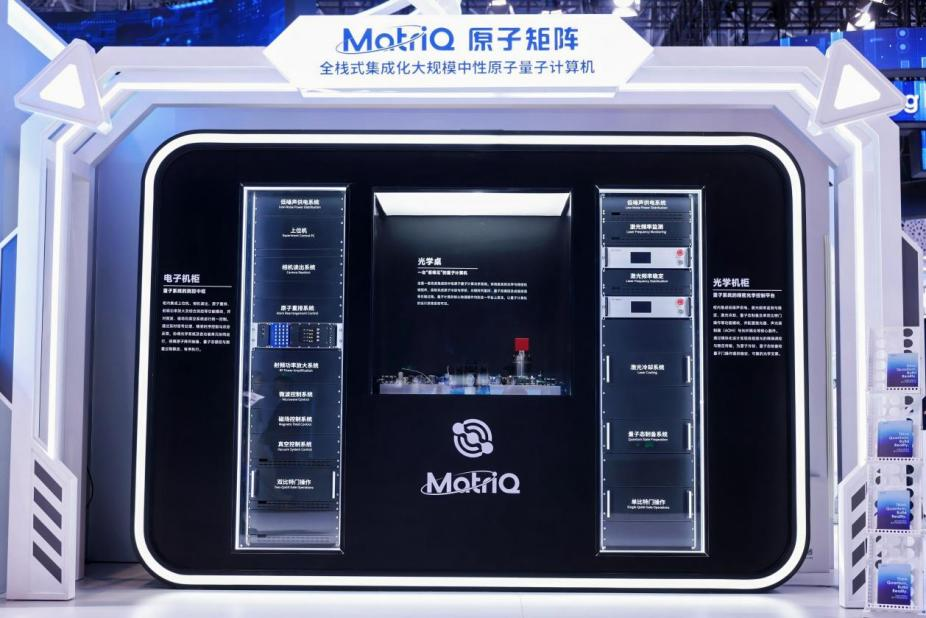
Photo of the full system (Image credit: the company)
In terms of product architecture, MatriQ uses a design that separates storage and entanglement zones. Xia explains that a core challenge with neutral atoms is that laser operations on a specific qubit tend to interfere with neighboring qubits that don't need to be operated on. The zoned architecture moves atoms out of the storage zone into the entanglement zone before performing gate operations, which both avoids affecting other qubits and enables parallel operations on multiple pairs of atoms at once, boosting computational efficiency.
The zoned architecture is itself one solution to the errors introduced by off-target light exposure — atoms in the storage zone are unaffected when light hits. In addition, the team uses lasers of other wavelengths to "throw a blanket over" atoms that shouldn't be operated on, further reducing errors.
On commercialization, MatriQ pursues a dual-engine strategy of "full system + cloud platform." On the system side, the company offers on-site deployable neutral-atom quantum computers to data centers and other computing infrastructure customers, and has already signed its first batch of commercial full-system orders with domestic data centers.
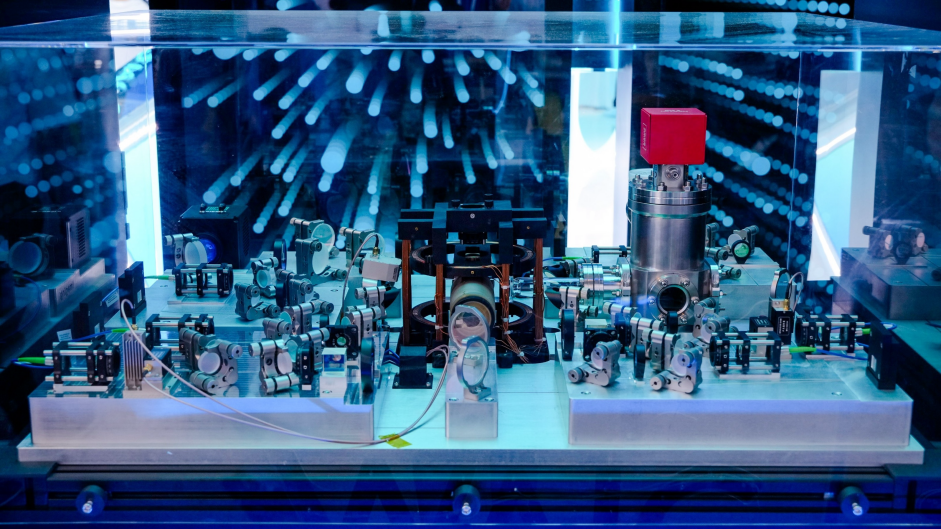
Close-up detail of the full system
On the cloud side, the MatriQ quantum cloud platform connects directly to the company's own system compute, with standardized programming interfaces and intelligent task scheduling. It mainly serves research institutions at home and abroad, quantum software and algorithm startups, and R&D departments at large enterprises in fields like biopharma and materials.
Xia says the cloud platform is currently in final internal testing and internal customer testing, will open to more customers soon, and has already discussed commercial orders with some customers. He expects the full system and cloud platform to carry equal weight in the short to medium term, while over the long term the cloud platform could become the larger business, "because it places lower demands on customers than a full system and is more convenient."
On the technical roadmap, MatriQ's goal for next year is to convert several thousand physical qubits into dozens of logical qubits through logical encoding, achieve 99.99% single-qubit gate fidelity and consistently above 99.5% for two-qubit gates; the year after, it aims for nearly 10,000 physical qubits and nearly 100 logical qubits.
Xia says both the team and investors take a long view of quantum computing. "We'll treat this as a 10-year endeavor."
In his view, the challenges ahead fall into two categories. On the technical side, accelerating gains in qubit count and operating precision, and converting fewer physical qubits into logical qubits with lower error rates, will require multi-dimensional iteration across R&D, hardware, software algorithms, and error-correction algorithms. On the ecosystem side, building a developer community and identifying genuinely viable niche use cases for quantum computing will be as hard as hardware iteration.
Below is an edited excerpt from Hard Kr's interview with Xia:
Q: The neutral-atom route has gained noticeably more attention over the past two years. As an industry insider, how do you see it differing from other routes?
Xia: Over the past three or four years, the neutral-atom route has stood out for a few reasons. First, the number of physical qubits has grown enormously. Second, leading overseas teams at Harvard and MIT have achieved technical milestones in converting physical qubits into logical qubits through error-correcting codes. These advances have energized the industry. But quantum computing is an extremely long-cycle endeavor, the technical paths haven't converged yet, and there's still a very long road ahead.
Q: Very few players in the industry have built cloud platforms. What's technically difficult about this, and will it become a larger source of cash flow over the long term?
Xia: First, you need a complete system. Without one, a cloud platform is mostly castles in the air — it requires a system with stable performance metrics. Second, you need the full capability to build a cloud platform, spanning multiple software layers from low-level hardware control and the intermediate compilation layer to the upper-level cloud platform and even the application layer. That demands full-stack capability and a deep combination of hardware R&D and delivery with software understanding. Beyond that, finding more customers, lowering the barrier to use, and bringing ecosystem partners in is a longer and relatively harder task.
Over the long term, as quantum computing takes off in specific niche industries, the cloud platform will indeed become a sizable business, because it places lower demands on customers than a full system and is more convenient. In the short to medium term we'll weight the full system and cloud platform equally; over the long term we'll explore the cloud platform's business model more — including partnerships with ecosystem players and cloud providers — to open up system compute to more users.
Q: What are the company's competitive advantages?
Xia: Our advantage isn't any single patent — it's engineering and full-stack capability. From day one the company has been anchored in engineering, productization, and commercialization, spending a lot of time and resources turning lab instruments into products that are repeatable, mass-producible, and deliverable. Our team has the complete ability to build a full system from scratch, we can design core components in-house, and we leverage the strengths of China's supply chain for a major edge in cost and iteration speed.
On top of that, we started early — our first-round investors invested after seeing our full system. Quantum computing is a globally competitive field, and over the long run Chinese companies' advantages in cost and lead times will only grow. We need to compete not just on frontier innovation but on the commercialization path as well.
Source: Hard Kr
Author: Xue Ou