'Atomatrix' neutral-atom quantum computer debuts, co-launches Shanghai Cube Pro hybrid training system | Unity Ventures Portfolio

China's First Fully Integrated, Full-Stack Engineered System for Neutral-Atom Quantum Computing
During the World Artificial Intelligence Conference (WAIC 2026), AtomMatrix, a Unity Ventures portfolio company, unveiled its independently developed full-stack integrated large-scale neutral-atom quantum computer in a public offline debut.
The system can construct and stably operate defect-free physical qubit arrays of up to 2,310 qubits, featuring a "storage-entanglement" partitioned architecture. Key metrics including qubit scale, gate operation fidelity, and system stability all reach internationally advanced levels.
This marks China's first full-stack integrated engineering system in the neutral-atom quantum computing domain, representing an important step forward in the industrialization of this technical approach.

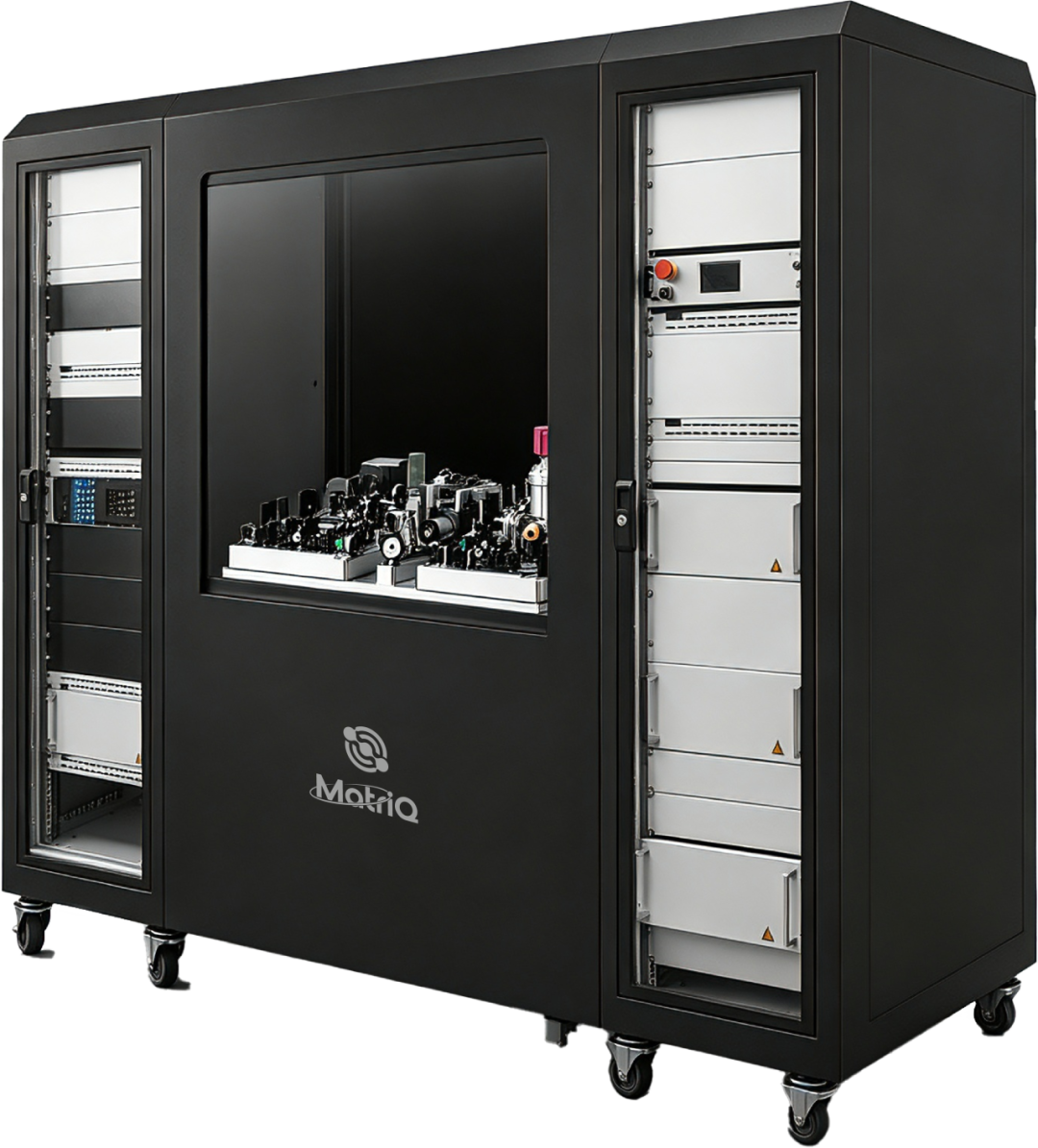
AtomMatrix Full-Stack Integrated Large-Scale Neutral-Atom Quantum Computer
01
High-Performance Large-Scale Arrays Become Reality
Core Technologies Lay the Foundation for Computational Power
Neutral atoms represent one of the leading technical approaches in international quantum computing, offering distinctive advantages in scalability, coherence time, full connectivity, and environmental deployability. In recent years, the approach has been widely regarded as one of the most commercially promising routes.
A core breakthrough of AtomMatrix's exhibited system lies in its large-scale programmable atomic array rearrangement capability. In neutral-atom systems, due to collisional blockade mechanisms, atomic loading in optical tweezer arrays exhibits inherent randomness — initially trapped atoms typically appear in non-uniform, defect-containing distributions. Therefore, before executing quantum simulation, quantum gate operations, or logical qubit preparation, the system must relocate randomly loaded atoms to target positions via programmable paths, transforming them into ordered, defect-free atomic arrays. The efficiency and precision of this rearrangement process directly determine the usable scale and computational quality of the quantum processor.
The system has currently achieved construction and stable operation of defect-free physical qubit arrays of up to 2,310 qubits. Under actual operational conditions, it completes a fully automated workflow from random atomic loading identification, to programmable path planning, to target array generation — a critical step from random loading toward a programmable quantum processor. On this foundation, the system supports Hamiltonian simulation computing and quantum gate circuit computing, providing the underlying physical basis for large-scale quantum circuit execution.
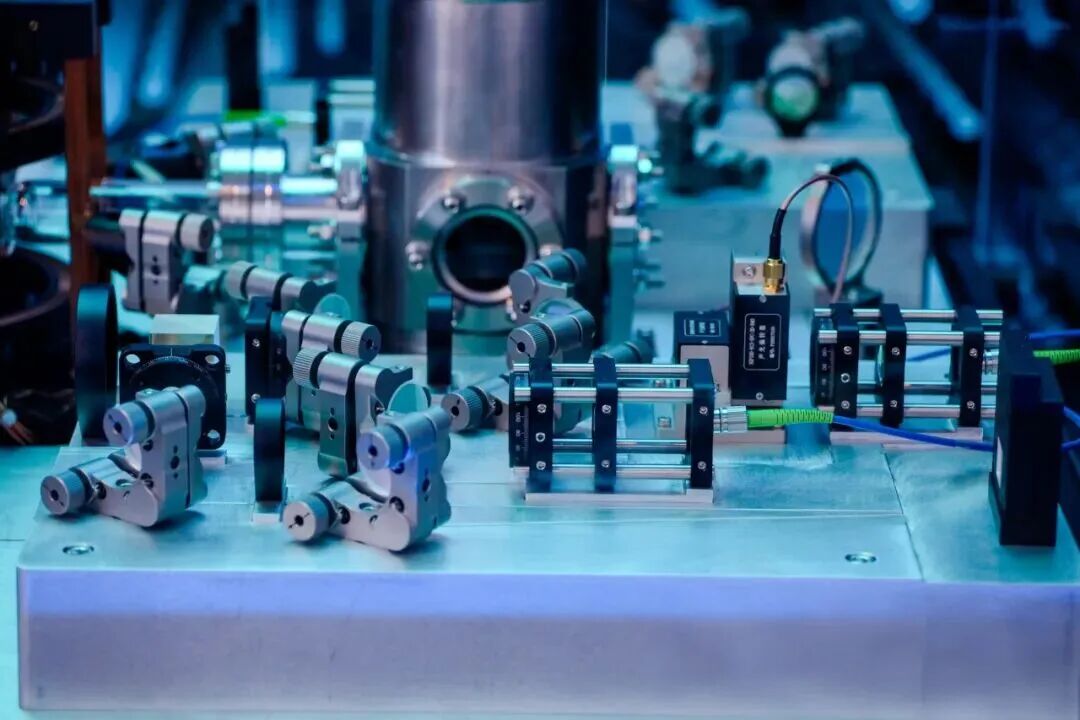
Close-up of Full-Stack Integrated Large-Scale Neutral-Atom Quantum Computer
Another key technology is the programmable atomic movement capability based on the "storage-entanglement" partitioned architecture. As quantum computing systems continue to scale, traditional single-region static array architectures increasingly struggle to meet complex computational demands. The AtomMatrix team spatially divides the system into two functional zones: the upper portion serves as a storage region for long-term preservation of qubit array quantum coherence; the lower portion serves as an entanglement region for executing local two-qubit gate operations.
Under this architecture, the system can selectively transfer target atoms from the storage region to the entanglement region via movable auxiliary atom arrays according to computational task requirements, complete local interactions within the controlled region, then return atoms to the storage region or continue participating in subsequent operations. This partitioned design helps reduce crosstalk effects on non-target qubits while enhancing scalability for qubit rearrangement, local gate operations, and error correction workflows, providing underlying motional capability support for mainstream fault-tolerance schemes such as surface codes. This work represents one of the frontier directions in current international neutral-atom quantum computing.
02
Engineering System Adapts to Deployment Requirements
Full-Stack Capabilities Expand Industrial Boundaries
Unlike laboratory proof-of-concept prototypes designed for single demonstrations, the neutral-atom quantum computing system unveiled here represents a complete engineering system oriented toward delivery, with product form, technology stack coverage, and computational architecture all designed for practical deployment. In terms of system form, the equipment adopts fully modular, highly integrated engineering design, consolidating vacuum systems, control and measurement modules, cooling units, and other components into a standardized system form — breaking free from the deployment constraints of dispersed laboratory equipment and taking a critical step toward deployable installation.
AtomMatrix founder Xiyuan Xia interviewed by CCTV News
The industrialization of quantum computing faces core challenges not at the theoretical level, but at the systems engineering level. The significance of this system lies in its being a complete, operable, and iterable engineering system rather than an isolated laboratory demonstration of metrics. Our team's goal is to deliver a genuinely usable full-stack quantum computer. The path to industrialization has only just begun, but the first step has been taken solidly.
— Xiyuan Xia, Founder of AtomMatrix
Notably, during WAIC, the Shanghai Cube Pro hybrid quantum-classical training system, which AtomMatrix participated in developing, was also officially released.
The system was jointly developed by Suanfeng Information, Shanghai Mohe Information Technology, Hangzhou AtomMatrix Computing, a domestic high-speed switch chip enterprise, and Shanghai Jiao Tong University. The quantum hardware component was developed by AtomMatrix, marking a major engineering breakthrough in the integration of quantum computing and AI computational power in China, providing an autonomous and controllable next-generation intelligent computational foundation for critical domains such as biomedicine and new materials.

Shanghai Cube Pro Hybrid Quantum-Classical Training System