BCI startup Junrou Technology announces angel funding, letting electrodes "crawl" to multiple brain regions | Unity Ventures portfolio

Completed three consecutive funding rounds within a year
Brain-computer interface startup Junrou Technology announced the completion of its angel round and angel+ round. The angel round was led by Unity Ventures, while the angel+ round saw investments from Shunwei Capital, Hillhouse, AgiBot, and others. Within a year of its founding, the company completed three consecutive funding rounds, with total proceeds reaching the hundreds of millions of RMB.
Junrou's "NeuroWorm" technology is an ultra-soft, stretchable fiber electrode rolled from a planar electrode array, with a magnetically controlled unit at its "head." A small hole is drilled in the skull, and multiple fiber electrodes are guided by magnetic fields to "crawl" toward multiple brain regions. This dynamic electrode technology comes from the team of Zhihui Liu at the Shenzhen Institute of Advanced Technology, Chinese Academy of Sciences, and was published in Nature in September 2025.
We believe that electrodes, as the core foundational component of brain-computer interfaces, will fundamentally determine the pace at which BCI technology becomes widespread. That's why we invested early in this next-generation ultra-flexible electrode platform, led by Zhihui Liu and Qianbi Peng.
Over the past several months, we've been thrilled to see the company's products find real-world applications in embodied tactile sensing — a powerful validation of the platform's remarkable extensibility. We look forward to the team continuing to push boundaries, providing hard-tech support for the advancement of brain-computer interfaces and embodied artificial intelligence.

A small hole in the skull, multiple fiber electrodes guided by magnetic fields to "crawl" toward multiple brain regions. This dynamic electrode technology, dubbed "NeuroWorm," was published in Nature in September 2025. It comes from the team of Zhihui Liu at the Shenzhen Institute of Advanced Technology, Chinese Academy of Sciences.
That same year, Zhihui Liu founded Junrou Technology. Within a year, the company completed three funding rounds totaling hundreds of millions of RMB. Its previous round was led by Unity Ventures, with the National Innovation Center for High-Performance Medical Devices as a co-investor. The latest angel+ round was joined by Shunwei Capital, Hillhouse, and AgiBot, with LightSource Capital serving as exclusive financial advisor.
In September, Neuralink enabled a paralyzed ALS patient who had lost the ability to speak to tell his wife "I love you" again — using only his thoughts. Brain-computer interfaces are advancing step by step from decoding movement and language toward "mind reading," making the need to collect signals across brain regions and the whole brain ever more pressing. Yet most existing invasive electrodes remain confined to a single brain region.
Junrou's technical approach aims to let electrodes cover more brain areas while minimizing implantation trauma.
Invasive electrodes can hear the "whispers" of brain neurons, but once implanted, their position is fixed and their signal collection range limited. As Zhihui Liu explains it, traditional approaches to covering more brain regions might require increasing the number of skull openings. "Imagine 30 holes in the skull — you'd end up looking like a Mafengwo." The extent of implantation trauma directly affects how many people will be willing to accept an implanted BCI.
The "NeuroWorm" technology from Liu's team is an ultra-soft, stretchable fiber electrode rolled from a planar electrode array, with a magnetically controlled unit at its "head."
During implantation, a bundle of neural fiber electrodes passes through a skull opening roughly 1 cm in diameter. Under the surgeon's manipulation of an external magnetic field device, the electrodes are guided to advance and turn within the brain, reaching multiple target brain region sites. The electrode heads then pierce brain tissue to collect deep signals, while electrode points remaining above the dura mater monitor cortical signals.
This is the core of Junrou Technology's first-generation BCI technology. Its first-generation BCI system has completed partial animal experiments and is expected to initiate IIT (investigator-initiated clinical trials) in 2027.
From static to dynamic — electrodes are given the ability to move inside the skull. The immediate question is: where to? Active response represents the more imaginative technical leap for subsequent generations of "NeuroWorm."
Zhihui Liu notes that Junrou's first-generation product focuses on dynamic delivery: after the head-end electrode is implanted in brain tissue, the delivery system is removed during surgery and linked with medical imaging to achieve automated, closed-loop multi-brain-region targeting. Second-generation and later "NeuroWorms" will autonomously "pathfind" based on real-time neural signal collection.
"Begin with the end in mind" is a phrase Zhihui Liu repeatedly emphasized in interviews.
He believes that complex human activities like cognition, memory, and emotion all depend on coordinated multi-brain-region function. For brain-computer interfaces to eventually achieve human-machine fusion, they must move toward multi-brain-region and whole-brain signal collection. Thus, Junrou has made multi-brain-region signal collection a priority from the start, with plans to first enter medical scenarios such as epilepsy and depression.
This path is connected to Liu's 14 years of research experience. In 2012, after completing his master's degree, he joined the Shenzhen Institute of Advanced Technology to begin researching flexible electrodes for brain-computer interfaces. He then pursued a PhD in materials science and engineering at Nanyang Technological University. Returning to China in 2019, he continued advancing dynamic electrode research. He currently serves as a researcher at the Shenzhen Institute of Advanced Technology, Chinese Academy of Sciences, and as Executive Dean of the Artificial Intelligence Research Institute at Shenzhen University of Advanced Technology.
When asked about his personal entrepreneurial goals, Zhihui Liu spoke of the crops in his hometown in Northeast China. The land reminds him that his parents fulfilled their duty as farmers; as a researcher, he asks himself whether he has fulfilled his own duty — to pursue academic innovation from zero to one, and then bring those results to industry.
The following is a conversation between Zhihui Liu and Anyong, edited for publication.
The Time Is Right
Q: You've been researching neural electrodes since 2012. Your work also has early connections to Charles Lieber?
Zhihui Liu: Fourteen years ago, after completing my master's, I joined the Shenzhen Institute of Advanced Technology, Chinese Academy of Sciences, where I worked under Professor Zhe Yu. Professor Yu was a postdoc in Charles Lieber's lab. Charles Lieber is a very pioneering figure in neural electrodes, so I was exposed to flexible electrodes quite early on.
During that period, I developed one of China's early soft, stretchable gold conductive films and published papers using such electrodes to record cortical EEG. Later, during my PhD at Nanyang Technological University in Singapore, I worked with two mentors in chemistry and materials science — Academician Xiaodong Chen at Nanyang Technological University and Academician Zhenan Bao at Stanford University. My thinking gradually broadened, and I began considering from a materials perspective how to give electrodes more possibilities.
It was the combination of accumulated knowledge in neural electrodes and new materials that later gave rise to Junrou's "NeuroWorm" — our pioneering dynamic electrode technology.
Q: Why choose to start a company at the end of 2025?
Zhihui Liu: After returning from my PhD in 2019, I continued advancing dynamic neural electrode research while validating prototypes and biocompatibility — preparing for industrialization. Last year, after five years of research, our team's dynamic electrode results were published in Nature. The technology, team, and capital environment had all matured, so we began formal company operations.
Technical accumulation was one factor; finding good entrepreneurial partners was equally rare. In 2024, my jointly supervised PhD student Qianbi Peng also expressed interest in co-founding the company. She has both technical ideals and a practical spirit.
Q: Was the surge in BCI investment in 2025 also a contributing factor?
Zhihui Liu: Actually, capital had already heated up in the second half of 2024, but we weren't in a rush to start the company then. Because the Nature research hadn't been published yet, we couldn't prove we held pioneering technology.
Coincidentally, 2025 saw even greater market enthusiasm. Our research also gained recognition from top international experts. We were confident, and the timing was truly right.
Q: Some invasive BCI companies have already entered clinical trials and are seeking regulatory approval, while Junrou is still in animal experiments. Are you worried about being late to the game?
Zhihui Liu: We've been planning for a long time, and we're pursuing a completely pioneering technical route. Right now, everyone wants to solve the problem of signal collection covering whole brain regions, but no solution has emerged that leads ours. In that sense, we're actually ahead.
Making Electrodes "Move"
Q: Your electrode technology is called "NeuroWorm." What key problem is the dynamic electrode trying to solve?
Zhihui Liu: We want to achieve both minimal invasiveness and whole-brain coverage. Minimal invasiveness determines whether BCIs can be accepted by more healthy people; whole-brain coverage determines the volume of human-machine information exchange and ultimately the functional "ceiling."
With traditional approaches, one skull opening only allows electrodes to be implanted in relatively limited, fixed brain regions. To have electrodes cover multiple brain regions simultaneously, you might need multiple openings. Six dots on the head makes a monk; imagine 30 holes — your skull would become a Mafengwo. No matter how powerful the product, it could never become widespread.
Our solution is "dynamic delivery": only a single small skull opening, using magnetic control delivery technology to send multiple fiber electrodes to different brain regions respectively, penetrating brain tissue to collect neural signals.
Q: What does the "NeuroWorm" dynamic electrode look like?
Zhihui Liu: Our electrodes are "one-dimensional" fibers "rolled" from two-dimensional planar electrode arrays, with a diameter of about 196 microns and multiple independent channels integrated along their length. The circular cross-section reduces potential tissue cutting during electrode movement while preserving multi-point signal collection capability.
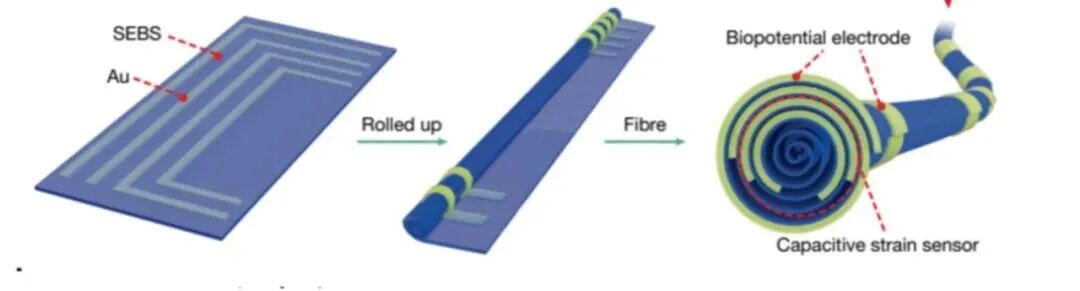
NeuroWorm fabrication process schematic
Q: How do you make the electrodes move and reach where they need to go?
Zhihui Liu: We added magnetic components to the electrode head. Based on magnetic control techniques like attraction and repulsion between magnetic fields, we apply force to the electrodes, pulling them to designated brain region sites. The advantage of magnetic control is that skull and brain tissue don't significantly attenuate magnetic fields.
In operation, we combine medical imaging to determine delivery sites, then use automated mechanical equipment to encode the external spatial magnetic field and electrode magnetic field. By changing magnetic field direction, intensity, and other parameters, we guide the fiber electrodes to move along above the dura mater. After reaching target brain regions, the electrode head penetrates brain tissue to collect deep signals; electrode points remaining above the dura mater can monitor cortical signals.
Q: Will moving electrodes within the skull damage brain tissue?
Zhihui Liu: Any invasive electrode entering brain tissue causes some implantation trauma. Our dynamic electrode technology pursues minimal invasiveness in multi-brain-region implantation. The electrodes' wriggling time in actual brain tissue is very short and speed-controllable, minimizing brain damage to the greatest extent possible.
Q: Most implantable BCI companies working on flexible electrodes choose PI (polyimide) materials. Why did you choose SEBS (styrene-ethylene/butylene-styrene block copolymer) and SIBS (styrene-isobutylene-styrene block copolymer)? Won't new materials take longer to get approved for human implantation?
Zhihui Liu: "Flexible" and "soft" aren't entirely equivalent. We want electrodes that are both flexible and soft.
Take tissue paper and sponge as examples. Both are "flexible" — they can bend. But tissue paper tears when pulled hard, while sponge returns to shape after being stretched or compressed, because sponge is relatively "softer." Softness corresponds to a materials science metric: elastic modulus. Generally, SEBS and SIBS have elastic moduli three to four orders of magnitude lower than PI; lower values mean "softer."
Brain tissue pulsates slightly with breathing and blood flow. If implanted electrodes lack sufficient stretch and recovery capability, there may be mechanical mismatch between them, increasing risks like electrode displacement and signal attenuation.
SEBS and SIBS, as soft, stretchable electrode substrates, have special micro-nano structures in their surface-processed hundred-nanometer-scale gold conductive films that don't easily fracture during stretching, maintaining stable signal conduction. SEBS and SIBS also have good biocompatibility — the foundation for long-term electrode implantation.
Map Unclear, Signals Show the Way
Q: Is Junrou's entrepreneurial goal also to achieve human-machine fusion?
Zhihui Liu: Without question. We have confidence, and we have conviction. When electrode channel counts are sufficient, brain region coverage broad enough, and two-way information communication achieved, at some node brain-machine fusion will give rise to emergent new intelligence — this is the "ChatGPT moment" of human-machine fusion we envision. Pursuing invasive, whole-brain-region routes serves this goal.
My assessment is that in roughly another ten years, some signs of human-machine fusion will begin to emerge.
Of course, for now we must enter through medical scenarios. Based on the strict regulatory standards for medical devices, we continuously validate and improve product safety, building a solid foundation. On the other hand, to achieve the goal of human-machine fusion, we need to collect as much whole-brain data as possible, and medical scenarios provide a practical entry point for data acquisition.
So we will prioritize diseases involving multiple brain regions, such as epilepsy and depression. Currently, our BCI system has completed partial animal experiments and is expected to initiate IIT (investigator-initiated clinical trials) next year.
Q: Human understanding of various brain regions is still very limited, and many disease mechanisms remain unclear. How do you know which brain region to send electrodes to?
Zhihui Liu: Even many current brain implantation and modulation technologies find it difficult to completely determine implantation sites before surgery. DBS (deep brain stimulation), for example, has been applied for years, yet many diseases are still in the stage of exploring specific mechanisms and optimal stimulation locations.
Rather, dynamic electrode technology offers a new possibility. We first implant electrodes in preliminarily identified target brain regions, then use real-time signals collected by the electrodes as a basis, pathfinding and gradually wriggling toward more valuable sites as we go.
We hope to ultimately achieve "one person, one electrode," with delivery locations, channel counts, and other parameters matched to individual circumstances.
Brain-computer interface technology is becoming a "vanguard" for exploring the brain. Breakthroughs in neuroscience mechanism research and BCI development reinforce each other, advancing together.
Q: If flexible electrodes can move within brain tissue, does that mean electrodes could potentially find suitable positions on their own based on signals?
Zhihui Liu: This is precisely what Junrou's subsequent generations of products aim to achieve.
In the future, with assistance from AI decoding, medical imaging, sensing technology, and more, we hope to let electrodes autonomously control and actively respond based on collected neural signals. While avoiding risk areas like blood vessels, they would seek more suitable sites.
To achieve the "ChatGPT moment" of human-machine fusion, the intelligence of the "machine" side is necessary. Of course, exactly which generation of product will finally achieve active response with both good safety and efficacy depends on factors like the speed of channel count improvement and the richness of information exchange.
Q: Invasive BCIs currently only serve small numbers of patients. How will Junrou accumulate sufficient data volume?
Zhihui Liu: I've discussed this with some doctors. Take epilepsy as an example: currently mainly severe, drug-resistant epilepsy patients accept invasive treatment, while mild-to-moderate patients often don't think it's worth the risk. Even when drug resistance appears, they tend to prefer continuing medication or "toughing it out."
In the future, as BCIs become more minimally invasive and treatment safety and clinical benefits become clearer, the efficacy-risk cost-benefit ratio will improve substantially, and patients will recalculate this equation. As more patients become willing to accept implants, our collected data volume will increase accordingly.
This is a non-linear accumulation process.
The US Doesn't Have It, and Domestic Investors Dare to Bet
Q: From returning to China in 2019 to prepare for industrialization, to Junrou completing three funding rounds — what changes have you noticed in investors over these years?
Zhihui Liu: The domestic investment community is becoming increasingly willing to take on challenges.
When I returned in 2019, I discussed this project with some investors, but their attitude was relatively cautious, saying "What you're describing doesn't exist in the US yet." The subtext: can this be reliable? Back then, investors were mainly operating on a domestic substitution logic.
But in recent years, companies like Unitree, CATL, DJI, and Huawei have made capital markets realize that Chinese teams have the capability to create pioneering, disruptive products. Investors are increasingly willing to bet against consensus.
In our first two rounds, we worked with a post-95 investor who was optimistic about the disruptive potential of "NeuroWorm" technology. Initially we worried whether he could persuade the decision-makers at his firm. It turned out the institution was willing to bet at a stage before market consensus had formed.
This also shows that investors now believe Chinese teams can create things that didn't previously exist in the world.
Q: What are your personal entrepreneurial goals?
Zhihui Liu: I'm from Northeast China, from a rural background. Over the years, during New Year and summer vacations, I also take my daughter from Shenzhen back to my Northeast hometown. Looking at the crops in the fields, I can't help asking myself, "What are you doing?"
Grain and vegetables can grow harvest after harvest, year after year, because farmers have fulfilled their duty of farming. For a researcher, my duty is to do good scholarship, to do the zero-to-one innovation this era needs, and then translate results to industry. If I don't accomplish this, I actually feel I can't even match up to farmers, because I haven't fulfilled my own duty.
My personal goal is: since the times have provided the conditions, then go with the flow, do things well, and consider it not having lived in vain.
Source: Anyong
Author: Ruojing Hai