Jinjian Zhang: In the Age of AI, Live as Yourself

"Long Action, Short Thinking"

On January 9, Oasis Capital portfolio company MiniMax successfully listed in Hong Kong.
We were invited onto 42 Chapters for a conversation with Kai Qu, reflecting on the market shifts of the past three years of the AI wave — what we've thought, what we've believed, and what we've done.
Three years ago, AI was still the conviction of a minority. Three years later, it has completed its phase shift from technological faith to path validation. One small cycle has run its course; the final answers remain unconfirmed, but for many, a new starting point is gradually emerging and the direction is becoming clearer.
Six months ago, the first episode of our podcast Signal and Noise went live. We chose to redirect our attention back to specific individuals, documenting their judgments, choices, actions, and reflections as they faced external change.
Looking back from today, technology is accelerating and paths are still being explored. At the individual level, living authentically and finding one's own vitality remains that unchanging through-line — and it has become even more critical in the AI era.
We're republishing this conversation as our opening to 2026.
In the new year, may we continue to meet heart-to-heart, and participate in enlivening each other.
If you have any reflections you'd like to share, we welcome your comments below.
The original podcast transcript was roughly 28,000 Chinese characters; this edited version is approximately 11,000 words.
Enjoy

Kai Qu: Over the past three years, what were the best and worst decisions you've made?
Jinjian: The best decision was definitely going all in on AI.
We've made plenty of small mistakes, had our moments of纠结 and internal friction, but our big-picture direction has basically been right.
Kai Qu: The title of our first podcast in 2023 was "The People Betting Hardest on AI," because back then the market hadn't really formed a strong consensus on AI, yet Oasis was already investing heavily in AI projects early on — for instance, you had already invested in MiniMax by then.
But looking back, 2023 was an excellent entry point. You actually could have gone even more all in, because the value for money on projects back then was so much better than it is now.
Jinjian: Absolutely. And it wasn't just AI — embodied intelligence was also incredibly cheap back then. When we met with projects like Qianxun, Xinghai Tu, Unitree, and Zhuji, they were all valued at 100 or 200 million RMB, with the expensive ones topping out around 1 billion.
So even though we were already investing aggressively, it wasn't enough. Aggressiveness is a mindset: there's no "most aggressive," only "more aggressive" (laughs).
Also, we should have been more open back then.
Let me tell you a story.
As early as 2023, we realized that embodied intelligence was also a path to AGI. We'll expand on this later.
What I want to say is: once we recognized this, we were very proactive about investing in this direction. Some US-based firms we had good relationships with saw us making moves and invited us to come check out their portfolio companies. One project was valued at roughly $800 million at the time, was struggling to raise, so if we were willing to invest, we could have even gotten a discount.
But we had some hesitations. For example, we believed the future of this direction definitely belonged to China, and this was an American project. You could call that a judgment, or you could call it a bias — either way, we ended up not investing.
That company's latest round valuation is now $40 billion.
Its name is Figure AI.
Around the same period, there were actually many companies being undervalued.
Kai Qu: That story leads perfectly into my next question: if you could do it all over again, what would you want to change?
Jinjian: Exactly what I just said: be more open.
Because AI is fascinating. I believe it's one of two technologies — along with blockchain — that can transform human civilization at a civilizational level, connecting all of humanity together.
That's incredibly beautiful, especially in today's geopolitical landscape.
And precisely because of this connection, we should be more open about making friends, less calculating about different asset classes, different countries, different cultures, different people. Even if we don't end up working together, we can still discuss the future of this world together.
Kai Qu: So if you could go back three years, how would you invest with that kind of dimensional dominance?
Jinjian: Convert all the money into compute, then use compute to invest in people.
Because think about it: what is money?
Money essentially represents, post-industrial age, people's claim over goods. With money, you can purchase commodities.
The next era will definitely belong to intelligence. And this intelligence will be provided by AI.
So to seize the future, you should ask: what can command intelligence?
The answer is actually compute.
I believe compute will become increasingly scarce, and may even be further brought under regulation. Because as intelligence grows more powerful, rationing compute is essentially rationing intelligence.
In the future, not everyone may have the right to access compute; future charity might no longer mean giving money to a person, but donating free compute.
So if I could go back three years, I would want to convert all money into compute, even build out our own compute centers or clusters.

Kai Qu: That's quite interesting. So what's the biggest difference between how you see AI today versus three years ago?
Jinjian: Our big-picture direction was basically all correct.
For example, we chose to invest in foundation models, not vertical models. That was actually non-consensus at the time, because people didn't believe there would really be a general-purpose foundation model. Or take how we believed what truly mattered was Agent, not applications or mobile software. We also successfully predicted the era of super-individuals.
But one variable exceeded our expectations: the reaction of big companies.
We didn't expect these global giants to be this capable.
Whether Google, Microsoft, or even Meta — each encountered their own problems, but their conviction in this, their investment, their ability to attract talent, their strategic formulation, including their resolve, has been genuinely strong.
But it's precisely these big tech firms' rapid response that has, in turn, lowered the ceiling for many startups.
Kai Qu: So do you still believe in AGI?
Jinjian: Yes.
Though we may need to align on definitions here:
If you think AGI means an omniscient, omnipresent being, then I don't think we'll get there.
But if you think AGI means AI can surpass humans in any environment with verifiable outcomes, then I believe it will arrive very soon.
Kai Qu: What are your expectations for the next three years?
Jinjian: I think the next three years will be a great era of science, perhaps even an era belonging to scientists, because AI will enormously empower every genius.
Our civilization is like a sphere. Every scientist tears open a crack on this sphere, constantly expanding our civilization through that crack. And the main force of this scientific explosion may be a group of young scientists who understand AI. In the past they might have been too young to even qualify for seniority-based hierarchies, but I believe the future belongs to them.
Kai Qu: If you had one thing to say to people already working in AI, what would it be?
Jinjian: Live out yourself.
Because AI will enormously amplify every point of every individual, whether strengths or weaknesses.
For example. You might have an aesthetic sensibility about something very niche, something only the people around you could recognize before, or that even they couldn't use. But today, with AI, you can amplify that tiny aesthetic out to serve all of humanity.
So in the future, as long as you live out yourself, you can discover the most beautiful, most special point that life has gifted you. And once you find that point, you can create the greatest value in the AI era.
Kai Qu: And for people still on the sidelines of AI? What would you say?
Jinjian: Also live out yourself. Though this is somewhat different from what I just said.
In the future we'll enter an era of coexistence between AI and humans, but most people won't actually be able to participate in the AI transformation. And AI's rapid changes, even its intellectual superiority, may leave many people at a loss.
When you're at a loss, if you still use industrial-era standards to examine yourself, it will be excruciating.
At that point, you even more need to know yourself, to live out your own flavor of life.
Like the sushi master. If you can do something you truly love, rather than living for others' approval, perhaps then you can find your life's value.
So the future will be quite interesting:
Some people will live out themselves, find the most beautiful point in their lives, and use AI to amplify it, creating value for everyone;
Some people may not want to use AI to amplify themselves, or may not even be interested in AI, yet can still live out themselves and become irreplaceable in the AI era.
The former serve everyone by living out themselves; the latter serve themselves by living out themselves. But serving oneself ultimately serves everyone too.
In the end, everyone coexists with AI through living out themselves.
Kai Qu: I'm thinking, people who don't use AI in the future might all become intangible cultural heritage inheritors? Like ten years from now, there might be hand-crafted PowerPoint intangible heritage inheritors (laughs).
And over the past month or two, many people have been discussing the AI bubble. That wave of discussion has somewhat passed, but plenty of people are still expecting the AI bubble might burst in 2026. How big do you think the bubble is now? Are you worried about it bursting?
Jinjian: First off, I really dislike the word "bubble." I can't call it a geezer, but it's at least very pedantic.
Industrial transitions basically all go through this process:
In phase one, people say this thing definitely won't work. In this wave, those opposing and bearish on AI and LLMs are basically older and quite accomplished (laughs).
In phase two, once something's feasibility is validated, people say the ceiling is low, that people tried this before and it didn't work.
In phase three, once people realize the ceiling may be higher than imagined, they say: I admit it has some value, but the bubble is huge.
This entire sequence of statements is noise.
What is a bubble?
A bubble is about the relationship between value and price. As we move in a certain direction, sometimes price gets ahead, sometimes value gets ahead. It's hard for the two to stay perfectly aligned forever — otherwise the game wouldn't have any charm.
In this process, the relative position of value and price doesn't matter. What matters is whether the direction is right.
And I believe AGI is, without question, the most valuable proposition facing humanity right now. Since everyone is moving in this direction, whether there's a bubble or not doesn't really matter. I even hope there's a bit of a bubble — that way more brilliant minds are incentivized to join the game and push AGI forward.
From another angle, what in this world doesn't have a bubble? Even personal brands and marriage have bubbles.
Kai Qu: When I heard your opening, it reminded me of a story.
Back in 2023, when almost no one was paying attention to embodied AI, we noticed it early and quickly reached out to some top professors in the United States. But the more prestigious the professor, the more bearish they were on embodied AI. So we stopped looking into it — and missed that entire wave.
Recently I checked what that very professor is up to now, and found out they've started an embodied AI company themselves (laughs).
Jinjian Zhang: Hahaha, that's history for you.
Reform is always driven by outsiders. Innovation always happens at the margins.
Those in the mainstream are already at the table with the best chips in hand — why would they innovate? Why would they disrupt themselves?
This echoes what I said earlier: I didn't expect that many large companies would be so impressive — they have the best resources, they're in the most mainstream positions, and yet they can still embrace innovation so resolutely.
But most people in that position are probably like the professor you mentioned. I wouldn't call it resting on their laurels, but there's certainly some complacency.

Kai Qu: Yes. I've had another feeling recently. In the past two years, we could basically cover all the information and people in the AI market.
But starting from 2025, especially recently, that's become nearly impossible. The market feels like it's returning to the early days of mobile internet — more and more people and companies, more and more noise.
How do you deal with this?
Jinjian Zhang: You make trade-offs.
At this stage of industry development, companies will inevitably multiply. You have to decide which directions to watch and which to ignore, then focus on the primary contradiction.
Kai Qu: Has your investment methodology, your judgment of people and things, changed over these three years?
Jinjian Zhang: I think people matter even more now.
Because AI is changing too fast. It's hard to accurately predict how things will develop, and that's compounded by competition, geopolitics, and other issues.
In infinite change, the only relatively constant factor is the founder. Can this person solve problems dynamically? Can they seek truth from facts? That's the core.
Kai Qu: So has your judgment of people changed compared to three years ago?
Jinjian Zhang: We value execution more now.
Because AI is already extremely capable — so what do humans still have, compared to AI?
For entrepreneurs, it's defining problems, maintaining original intention, and executing quickly. Because AI can't get the embodied feedback from execution.
But if you tell different founders something, some might give you results in a week, while others will think for a year and then tell you they need to think more.
I think in the AI era, "thinking" isn't that valuable anymore — "doing" has become especially valuable.
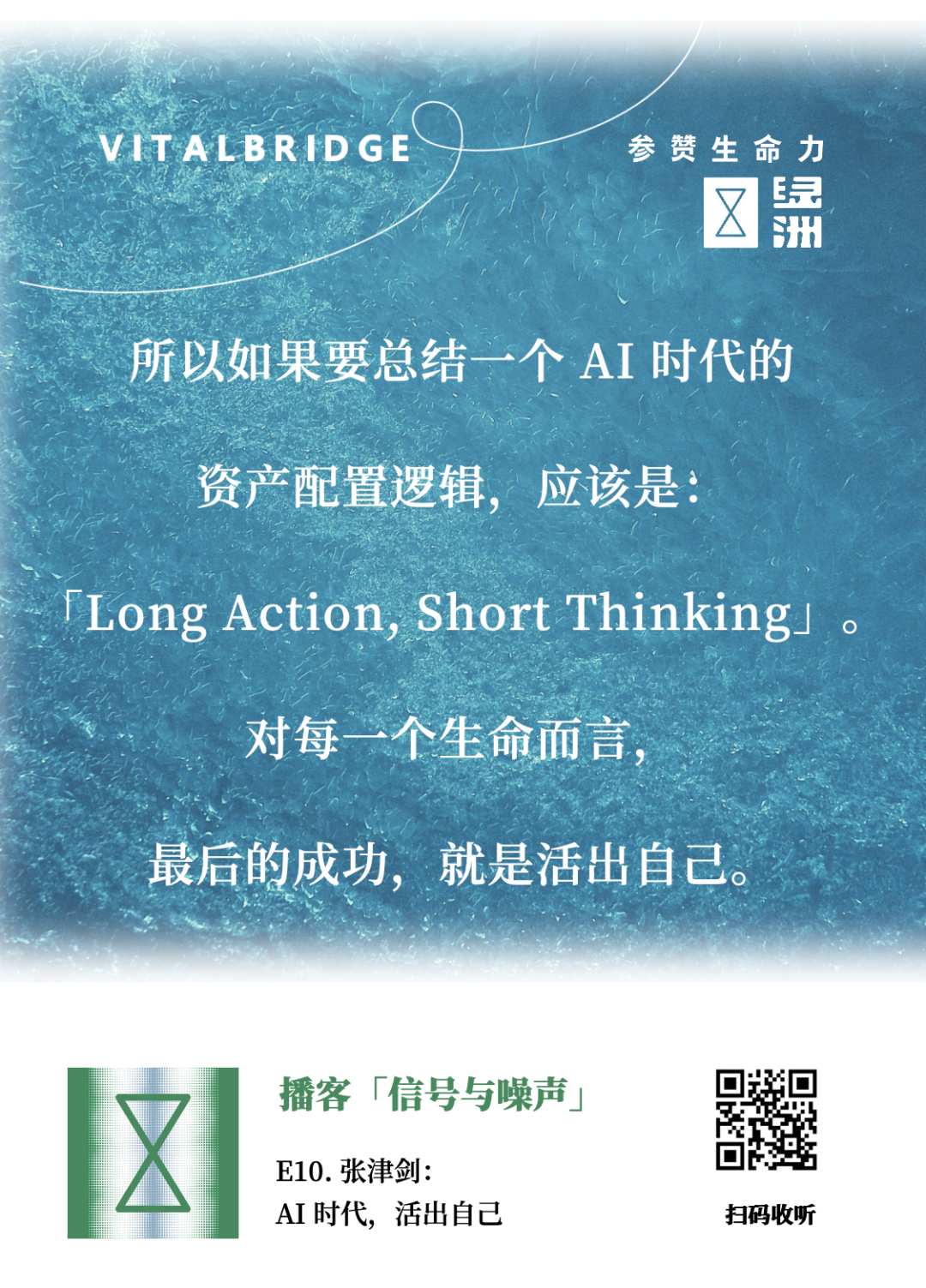
So if I had to summarize an asset allocation logic for the AI era, it would be:
"Long Action, Short Thinking."
Kai Qu: Interesting. If you had to score your past three years, what would you give yourself?
Jinjian Zhang: I don't want to score it. That's too industrial-age.
The good and bad of the past — it's past. Enjoy the present, live authentically, and focus on the future.
Kai Qu: Fair enough. Looking back, a lot of what we discussed in our 2023 podcast has played out. When I asked you what you were thinking about most then, your answer was "what does a world built by Bots look like." The Bots we talked about then are essentially what we now call Agents. Do you have more answers to that question now?
Jinjian Zhang: I've been thinking about this constantly. I believe the next decade will have two important participants: Agents and humans. In this era, the most important thing is:
Finding subjectivity for these two participants, constructing subjectivity.
Constructing Agent subjectivity means giving Agents their own society and networks. This has already begun, though it's still in its infancy.
For example, much of the RL work companies are doing today resembles building an education system for Agents. Training general-purpose large models is like nine years of compulsory education — it solves common-sense problems. The specialized education that follows, giving people specific knowledge, isn't that just RL?
Beyond education, when Agents become powerful enough, they'll face a series of subjectivity issues: how to pay? How to prove "it is it"? How to confirm "it represents you"? How to recognize if it's being defrauded?
There are enormous opportunities here.
And when AI can replace humans, what then makes us human?
This is the subjectivity of humans we need to consider.
For much of our past, we haven't truly established our own subjectivity — we've relied more on external judgment, on others' approval to confirm ourselves.
But in this era, everyone should find subjectivity through "living authentically." Because the biggest difference between us and AI is that we "live." If AI could also "come alive," then we should be afraid (laughs).
So I believe the next decade will revolve around this word "subjectivity."
Kai Qu: Then what's the question you're thinking about most lately?
Jinjian Zhang: How to construct subjectivity, and what role Oasis Capital can play in it.
Over the past year we've tried many things — for example, our podcast Signal and Noise came from this intention.
Because as mentioned earlier, many people lack their own subjectivity. They mostly live in others' expectations and approval, while simultaneously believing that excellent people are flawless: no pain, never discouraged, naturally gifted, life a smooth upward trajectory.
But life isn't like that.
Everyone is ordinary.
Even the most accomplished people don't know what the future holds or how to live in the present.
Perhaps the only difference is that they're more willing to live authentically and more honest about the present moment — and so they achieve a better state of being. This state then propels them to become better versions of themselves.
So if listeners, while hearing our show, have a thought like "oh, so so-and-so is just like this," I find that incredibly valuable.
Kai Qu: I see. In our second podcast episode (review: "High Frequency and Low Frequency in Investing"), you mentioned the concepts of low-frequency and high-frequency signals. What are the low-frequency and high-frequency signals in today's market?
Jinjian Zhang: The high-frequency signal right now is undoubtedly fundraising. At peak, the market sees over forty term sheets in a week now. Three years ago, it was maybe a few per week.
But I think this is mostly noise. Many projects have high valuations and smooth fundraising, but aren't necessarily solving the right problem.
The truly valuable low-frequency signal is: what problem is the founder actually solving, what problem is the industry actually solving, and what is truly the important problem.
Kai Qu: Yes. It feels like certain moments this year resemble the mobile internet wave: founders' reward became fundraising rather than finding PMF or solving problems. And with all the fundraising news, many founders start thinking: why did so-and-so raise so much? Or I'm clearly doing better, why is my valuation lower than theirs?
Jinjian Zhang: Haha yes, that's human nature.
I have a particularly vivid memory. I know a very accomplished investor who also works in primary markets, often comforting founders that valuation doesn't matter, solving the right problem does.
Until one day, they incubated a project themselves, came to talk to me, and said: Jinjian, why is so-and-so at this valuation while I'm only at this one?
I said, calm down first (laughs). Put your investor hat back on, and I'll repeat what you just said back to you. They laughed after hearing it.
That's "easier said than done."
So why "Long Action, Short Thinking"? Because the hardest thing for humans is still managing themselves.

Kai Qu: Yes. Let's return to MiniMax's IPO. Many domestic AI and embodied AI companies are lining up to go public this year, and some expect OpenAI to IPO within the year too. What's your view on market development these past few years and the evolution of exit paths?
Jinjian Zhang: The biggest change is that Hong Kong has become a new exit channel, especially against the backdrop of US-China competition. At the same time, Hong Kong is experiencing an unprecedented bull market, and the government wants it to sustain that, with much active guidance.
Another change is the shifting structure of market participants. People might assume that companies like Zhipu AI and MiniMax would be entirely dollar-funded.
But that's not the case.
Zhipu AI is almost entirely RMB institutions; MiniMax also has significant government funds and RMB institutions. Unitree, Galaxy General Intelligence, Qianxun Spatial Intelligence, and LimX Dynamics — most have similar ownership structures.
Both changes are positive. It means we're building our own tech company valuation system and capital growth system. There will certainly be problems along the way, because our exit market is still young. But I believe we're heading in the right direction, and problems will get resolved eventually.
Kai Qu: From when you invested in MiniMax until now, has your view on large models themselves changed?
Jinjian Zhang: The biggest change in my understanding of large models came through MiniMax:
Multimodality will become increasingly important.
Actually we discussed this in our last podcast (review: "Frequency and Spectrum in Investing") — humans themselves are multimodal large models. Our judgments about many things aren't based solely on language as a single modality, nor just logical reasoning, but on perception across multiple modalities: the five senses, magnetic fields, frequencies, and so on.
Over the past few years, MiniMax — one of the earliest companies in Asia to go all-in on MoE and multimodal large models — has received genuinely positive feedback from developers worldwide. This has only strengthened my conviction about the importance of multimodality.
So this ties back to what I mentioned earlier: why did we start positioning ourselves in embodied intelligence so early?
Because as AI develops, it needs more and more modalities for training, and some modalities simply require embodiment to provide.
Imagine a robot that can perceive data across all modalities. The AI trained through it would possess intelligence beyond our imagination.
But conversely, as embodied intelligence continuously interacts with the world, it also needs to be infused with more and more AI.
So AI and embodied intelligence are like the south face and north face of AGI.
These two directions appear completely different; essentially, they just start from different modalities. But they will grow closer and closer during development, eventually converging at the summit of AGI.
Kai Qu: Oasis has actually invested in quite a few good embodied intelligence projects over the past two years, and the space has been very hot. So how do you see its evolution and changes?
Jinjian: The development of embodied intelligence can be divided into three stages.
In the first stage, people's understanding of embodied intelligence was mostly "robots that can work." Starting around 2017–2018, many began purchasing commercial cleaning robots, warehouse robots, unmanned construction equipment, and so on — many of which also used AI technology. Some of these companies are still doing very well today.
The second stage was around 2023. After suho proposed the term "Embodied AI," the market became more aware: oh, so-called Robotics isn't just machines, but also a vehicle for AI that can help AI execute tasks better.
Market perception has largely remained at this stage.
When we invested in embodied intelligence in early 2023, this was also our logic: we believed new-generation software would need new-generation hardware. And what might that next-generation hardware be? Probably embodied intelligence.
So we became the first investor in both Hypershell Tech and Qianxun, and invested in many other companies as well.
So what's the third stage?
Through our journey with Qianxun, Professor Gao Yang told us something. The market may not have fully digested this yet, but it probably will soon:
Robotics is not Embodied AI.
Robotics is AI.
As I said earlier, AI and Embodied AI are the south face and north face of AGI. What may ultimately be most valuable isn't a machine that carries AI, but the AI trained through that machine.
When Professor Gao Yang first told us this, we found it quite difficult to understand. But later, through learning and discussing with them, we gradually realized he was right.
So cognition itself is quite interesting. There's always a process of continuous alignment between entrepreneurs' cognition and market cognition.
I remember when we invested in Qianxun, their valuation was RMB 250 million. By early 2024, when they raised their second round, the valuation reached RMB 300–400 million. Looking back now, that was a bargain price, but at the time it was actually quite difficult to raise funding. Because what people cared about was: can the robot run? Can it jump? Can it do boxing? (laughs) They simply didn't understand why they were working on AI.
Later, as market perception caught up, Qianxun's valuation rose very rapidly.
Kai Qu: So what directions are you thinking about and looking at recently?
Jinjian: First, the combination of AI and science. As I mentioned earlier, we believe we'll enter an era of big science. So how does AI truly integrate with science? People talk about AI for science now, but I think that understanding is still rather one-sided.
Second is Agent Infra. Because to build AI's agency, there are still some underlying technical problems that need solving.
We're also continuing to look at and invest in embodied intelligence. We're actually putting more money into embodied intelligence than into AI now. This market has just begun, and China has enormous opportunities. Besides Qianxun that I mentioned earlier, suho's team is also excellent. These teams are doing some truly stunning things and may soon spark new transformations. If the south face is led by the United States, then I believe the north face will definitely be led by China.
Kai Qu: OK. Many founders are very eager to know what the funding market will look like in 2026. What's your view?
Jinjian: I'm quite optimistic.
The world's frontier technology basically only looks at China and the United States, because frontier technology essentially comes down to three elements:
Talent, energy, and supply chain systems.
On these three dimensions, only China and the United States can compete. So you either allocate to China or to the United States.
But over the past few years, the world's money has been more allocated to the United States, and now it's clearly being reduced. Where does that reduced allocation go?
Most likely, it can only come to China.
Additionally, over the past year, companies and products like DeepSeek, MiniMax, Unitree, and Black Myth: Wukong have shown people more excellent — even globally leading — Chinese-style innovation. Against this backdrop, I believe more people will be willing to put money into China.
So as long as capital is flowing toward China overall, and innovation can continue pushing forward, the market will continue to improve.
Kai Qu: Understood. We've talked a lot about the market and AI. Let's move to some relatively more personal topics.
You've been emphasizing the concept of "vitality" these past few years. Has your understanding of vitality changed at all over the past three years?
Jinjian: I think vitality is something you live out (laughs).
Vitality can't just be a concept, and even less should it become a value standard or a constraint.
Vitality is actually the manifestation of a person's state of "living as oneself."
If someone has 8 points of vitality, translated, it means they've lived out 8 points of themselves. And if someone has no vitality, they may be constrained by various things and unable to live as themselves.
But more people actually don't dare to live as themselves, so they can only perform.
This is actually quite sad. Because once you start performing, your body keeps increasing in entropy. Analogous to large models, it starts consuming data it shouldn't consume, doing reasoning it shouldn't do, outputting tokens it shouldn't output — and eventually becomes increasingly chaotic, even collapsing.
But conversely, if you can live as yourself, you may become increasingly better.
But this, as the saying goes, is easier said than done. Especially given the education we've received, we may subconsciously have many reservations.
Kai Qu: So how do you live as yourself?
Jinjian: I'm still on the journey (laughs).
If I had to summarize, an important point is doing subtraction.
Something that had a big impact on me: starting around June or July last year, I happened to stop eating dinner.
Kai Qu: Huh? You mean up to now?
Jinjian: Yes. Unless occasionally for special circumstances, I generally don't eat dinner.
Because I don't eat dinner, I have much more free time in the evenings, and finally had the chance to do things I was interested in but never had time to explore.
Also, because I don't eat dinner and keep breakfast very simple, I cherish lunch immensely and plan it very carefully. Then I discovered that when I started having expectations for lunch, I also started having ideas about many other things, and life seemed to gradually get moving.
I later thought about why I didn't cherish lunch before.
Because it didn't matter if lunch was casual — there was always dinner, and if dinner wasn't good, there was always late-night snack.
Often, too many choices make you not cherish what's in front of you.
But what if there were no next time?
For example, if you could only invest in one project this year, or only do one thing in your entire life, what would you do?
If you could do ten things in your lifetime, you'd have many choices. But if you could only do one, there might only be one or two options left.
So doing a bit of subtraction in life has helped me tremendously.
Now I also deliberately practice: don't attend meetings I don't need to attend, don't do things I don't need to do. Often we do things not because we truly like them, but out of habit, subconsciously. Like a program where a piece of code has run too many times and been written into rigidity.
But life isn't rigid.
Discard these subconscious patterns and only do what you truly want to do — even if it seems quite unserious — and it may actually be more valuable.
Kai Qu: Understood. Has researching AI brought you any reflections or insights about human beings themselves?
Jinjian: Many. For example, a core problem AI has been constantly solving is Attention. Too narrow attention loses information; too broad attention easily produces hallucinations. The process of improving model quality is essentially getting it to focus attention on the right places.
And this mechanism applies equally to humans.
Where each person deploys their attention differs, and the resulting token distribution differs, and so does life.
So to improve the quality of human life is similarly about getting people to place attention on the right things.
What counts as "right"?
Don't focus on noise, don't focus on short-term high-frequency signals. Look more at long-term, low-frequency signals. Over time, good changes will happen in your life.
This process is actually quite similar to "mindful awareness" in Buddhism.
Though nowadays when we train AI, we hope it has long enough attention to remember enough context; yet our own attention is being fragmented by things like short videos. Many people's attention span may now be only a dozen seconds or so.
So we shouldn't only pay attention to AI, but should also find our own path of learning in this process. While optimizing AI's attention mechanisms, also optimize our own attention.
Kai Qu: Understood. We previously did an episode about reinforcement learning (review: A "Reinforcement Learning" Masterclass), where the guest said a classic line:
Life is a reinforcement learning process.
Nowadays many people also use the concept of reward functions when summarizing things. So what's your reward function in life?
Jinjian: "Authenticity." This is my North Star metric.
Capability can be cultivated later, but wrong intentions easily cause problems. So-called intention is whether personal goals align with organizational goals. I believe the universe's intention is authenticity, so my only standard for self-judgment is also authenticity.
Kai Qu: After these years of investing, do you understand luck any better?
Jinjian: Isn't investing mostly luck?
Kai Qu: Hahaha, that means you're more successful than before — the more successful someone is, the more they attribute things to luck.
Jinjian: I genuinely think it's overwhelmingly luck, because too many unpredictable things happen in the venture capital process. Projects that couldn't raise funding before may suddenly become hot commodities; people who weren't favored before may suddenly have breakthroughs and keep getting better.
But your question also makes me think of something: when we discuss "the proportion of luck," we usually assume this person is doing reasonably well. If someone isn't doing well, you generally wouldn't ask them this question (laughs).
Kai Qu: That person might also be a big loser, constantly telling people they just have bad luck (laughs).
Jinjian: (laughs) Right. So "luck" is actually a lot like "bubble" — both are post-hoc summaries of random events. When things go well, you can call it good luck; when they don't, you can call it bad luck.
But that doesn't really matter.
What's truly valuable is recognizing how random the world is, and how little we can actually control — almost nothing, really.
All we can do is make certain choices.
For Oasis Capital, the two most important choices are what directions to invest in, and who to partner with. As for what happens after that — the growth process — there are too many random variables. We can only stay humble and let things unfold.

Kai Qu: Got it. Let's wrap up with podcasts. Time really flies — AI's had its first three years, and our podcast has been going for three years too.
You were our first guest. You've basically come on at least once a year for the past three years, and this year you started your own show, Signal and Noise. I'm curious — what has podcasting brought you?
Jinjian: One practical benefit of coming on 42 Chapters is that we need less preamble when meeting founders. Many of them have heard those episodes and already have a good first impression of us. Also, talking with you helps me organize my thoughts.
But the biggest personal benefit has been doing our own podcast. A lot of the time we don't have enough self-awareness — we need some external force, and podcasting is that force. Sometimes the questions I instinctively want to ask reveal my personality and what I care about. Both when I'm asking in the moment and when I listen back afterward, it helps me understand myself better.
What about you? What's changed the most for you these three years of podcasting and working with projects?
Kai Qu: From a podcasting perspective, I've become more comfortable — more accustomed — to playing the supporting role.
Though sometimes I do think: if I were the guest, I might answer better, might seize certain opportunities better (laughs). Because in the early days, a lot of 42 Chapters content was written by me. I was originally the one producing content, then I became the one asking questions. You have to master that balance: don't steal the spotlight, but still set things up for the other person.
There have been practical changes too. Going from newsletter to podcast was, in a sense, a lifeline. That was pretty unexpected. Looking back, podcasting isn't really a great channel for distribution or building an audience from scratch. But at the time, it was really a case of fools rushing in where angels fear to tread — plus a huge dose of luck — and it took off quickly. There were many factors involved, but all in all, it's been a pretty magical journey.
Beyond podcasting, the biggest change these past few years is understanding myself better — knowing what I'm good at and what I'm not. It's really what you were saying about subtraction, or about being more authentic, more truly yourself.
Being yourself doesn't necessarily mean success in the conventional sense. It's more about knowing clearly what suits me better, what brings me more fulfillment.
Jinjian: So after understanding yourself better, how have you changed?
Kai Qu: I think I've become less competitive. I don't compete as much with external standards of judgment or with peers over certain things.
Jinjian: That means you have more inner confidence. A lot of the time, "competing" is about proving yourself.
Kai Qu: I've always had confidence. But I think most excellent people I've seen have a gap between their self-expectations and positioning, and what society recognizes.
So you see a lot of people who are both confident and insecure.
They're confident in their own substance, but insecure because that substance hasn't translated into actual output or socially recognized results.
I'm not saying I'm that excellent (laughs), but I feel like I've become more integrated and coherent.
Jinjian: That's great. That's incredibly valuable.
Kai Qu: Yeah. One last question: looking ahead three years, what advice would you give yourself and everyone else?
Jinjian: At the individual level: be more resolute about living as yourself.
Because in the past era, you could still perform. But going forward, you won't even have space to perform.
At the current pace of AI development, maybe by next year when we have meetings, everyone will have a camera-equipped Agent that can capture, understand, query in real-time, analyze, and remember everything about you. Whether you respect facts, whether you're consistent — it's all completely transparent.
In this situation, unless you can perform so well that you believe your own act, that's fine. But the moment you don't believe it, the moment you know you're performing, AI will know you're performing too.
So in the AI era, there may only be two survival strategies for people:
First, perform to the extreme — "Fake it until you make it."
Second, express yourself truthfully, live as yourself truthfully. Because as long as you truly live as yourself, there will definitely be people who like you, who choose you. And you'll influence each other, making each other more authentic.
I was just talking with a founder today: what makes a good partner?
A good partner is someone who makes you more authentic. You're aligned in direction, and in the process of working together, you can both express your genuine views without reservation. No layers of calculation — just one layer of authenticity. That's a good partner.
Conversely, if you find a partner where you have to perform all the time in front of them, how painful would life be?
So in the next three years, every individual needs to recognize: living as yourself isn't optional, it's mandatory — it's almost the only strategy in the AI era.
Since that's the case, we might as well start living as ourselves now, participating in and celebrating vitality.
I think many great founders, like Junjie, are very authentic people.
I used to often ask him: so-and-so company just raised a lot of money, what do you think?
He said I don't look at that. I only look at what AGI is, how far I am from it, and what I should do.
Another time, an executive came asking for budget, with the reasoning that competitors had several times more budget, and if they could get this money, they could definitely do better than the competition.
Junjie thought about it overnight and said: I can't give you this budget. Because the product is technology-driven, the technology hasn't converged yet, and we still don't know what the future product form will be. We should pour all our money into technology and R&D. Otherwise this budget has no value.
He had so much money in the bank. He could have easily performed for that executive, for investors, for the market.
But Junjie doesn't perform.
A good founder should be like this: live as yourself, let your actions match your words.
That's advice at the individual level. From a broader perspective, it's about believing in the global vision and determination to innovate globally among China's new generation of founders.
This generation of founders is truly going global, truly participating in — even leading — global innovation. Especially in smart hardware.
Before, others might have defined the category, and we'd compete on cost advantages and engineering capabilities. Now we're defining the categories. Hypershell Tech is defining the next generation of exoskeletons; DJI is defining drones; Bambu Lab is defining desktop 3D printing...
Since there are so many excellent Chinese entrepreneurs driving global innovation, each of us should also think and act from this perspective. This is also what I find so admirable about MiniMax: global vision, global innovation, global product, global users from Day One.
In this process, there will of course be many problems. But so what?
Not everyone will end up building a household-name, hundred-billion-dollar company. But for every life, ultimate success is living as yourself.
I believe that very soon, our founders will occupy better positions globally, and then push every individual to better understand themselves and live as themselves.