LatePost Interview with Sun Kuan: The Geek Who Failed Other Subjects, Death Anxiety, and the Birth of the First Consumer Exoskeleton | Oasis Vitality

"Starting a Company Cured My Fear of Death"

Oasis Capital portfolio company Hypershell Tech (Hypershell) has pioneered the launch of the first consumer-grade exoskeleton product, bringing the technology from science fiction — the "superhero" fantasy of films like Iron Man — into everyday usable reality.
This December, Hypershell made its Middle East debut at BRIDGE Summit, drawing widespread international attention. The company is also heading to the United States to participate in CES 2026, continuing to showcase its latest product and technology developments to a global audience.
A conversation between Chinese business media outlet LatePost and Hypershell founder Kuan Sun further reveals how a frontier Chinese tech entrepreneur redefines problems at the boundary of engineering and product, constantly pushing the limits of innovation.
The full interview follows. Enjoy.
Kuan Sun, the 1991-born founder of Hypershell exoskeletons, shares something with Unitree founder Xingxing Wang: neither are the stereotypical star-student entrepreneurs with dazzling resumes. Their hardware field is filled with prodigies from Tsinghua and Peking University or those with degrees from elite overseas institutions. Xingxing Wang failed his Zhejiang University graduate school entrance exam because his English was too weak. Sun's English wasn't good either — most investors can't recall where he graduated.
Sun has been obsessed with building and dismantling things since childhood. His family ran a mobile phone store; by middle school, he could assemble and disassemble phones and write programs.
In college, he built a stereolithography 3D printer by himself. Over six months, he wrote tens of thousands of lines of code, completing a complex hardware project that would normally require a team. Two insights emerged from this: nothing is conceivable but unmakeable, if you're willing; and he seemed unusually capable of solving problems.
This conviction led him to pursue product categories that most people considered "impossible." That experience made him realize that so-called impossibilities were simply things most people hadn't seen — and that these unseen possibilities often contained world-changing opportunities.
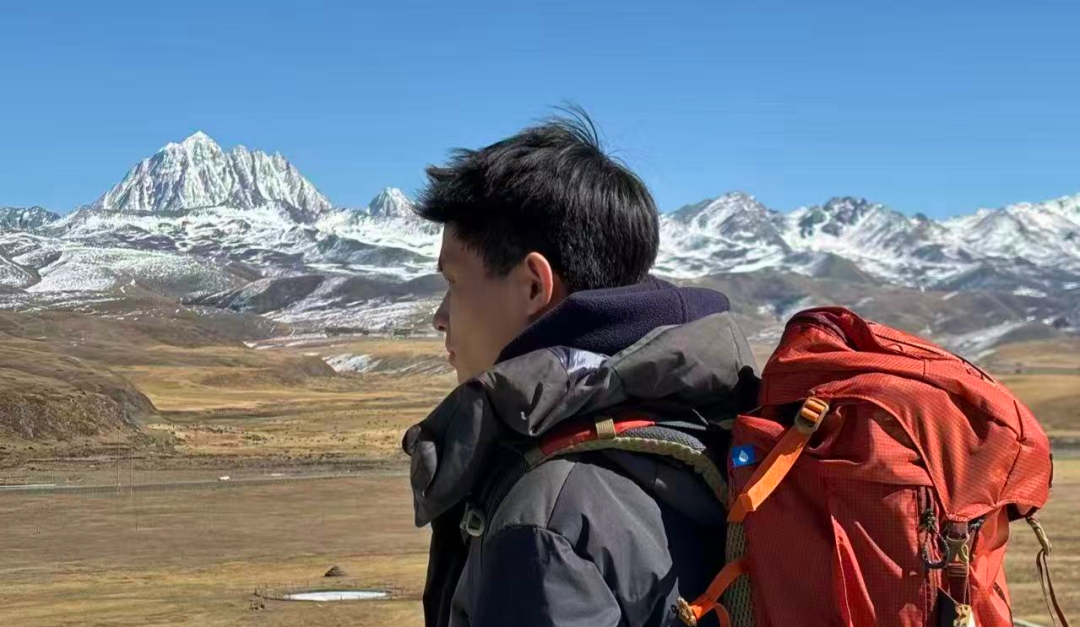
Sun is also an outdoor sports enthusiast himself
Amid breakthroughs in motors, motion control algorithms, and AI, most brilliant engineers with polished resumes chased the same narrative: building smarter, stronger machines to replace humans. Sun took the opposite path — building exoskeletons to enhance humans, not replace them.
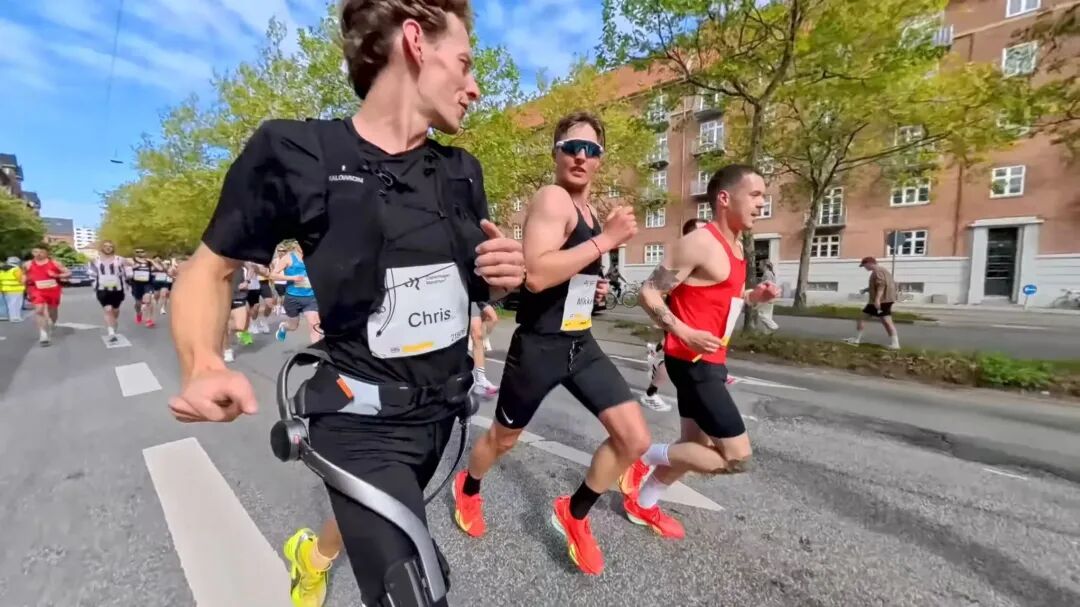
A user running a marathon in an exoskeleton (Source: Hypershell)
The problem: exoskeletons had long been considered science fiction — perpetually out of reach.
Hollywood shaped first impressions of exoskeletons, giving most people naturally high expectations. The industry itself lacked systematic foundations and had virtually no successful consumer-grade precedents. Sun hadn't chosen a tailwind path, but one requiring complete rebuilding from theory, configuration, control, design, to manufacturing.
What follows is an "anti-success-story" entrepreneurial journey: starting as a one-person company, repeatedly rejected; with only 200,000 yuan in the bank before crowdfunding, unable to pay salaries; a co-founder mortgaging their home; self-assessing the first-generation product as "only 50 or 60 out of 100," with direct delivery potentially killing the company; the founder himself spending six months on the factory floor tightening screws just to complete reliability testing. Hypershell's first truly delivered product came 40 months after the company's founding.
But in those 40 months, Sun gradually found his path. When exoskeletons were no longer defined as "devices for people with physical problems," but became something cool and aspirational — a capability people desired — their ceiling truly opened up.
This year, Hypershell raised $70 million in funding, shipped tens of thousands of units, capturing over 90% of the entire consumer-grade exoskeleton category, and has become the concrete representation of exoskeletons for many users.
This is only a beginning, far from success. Sun repeatedly told us that consumer-grade exoskeletons remain in a very early stage; he relishes the joy of defining a new category, while deeply understanding the challenge of crossing the chasm and breaking out of niche markets.

Technology is magic
Opportunity hides in the subconscious "impossible"
LatePost: Many people call you the next Xingxing Wang — meaning, among founders in robotics-related fields, neither of you have elite school credentials, yet you're both passionate and certain about what you're doing, even when many initially didn't understand. Going back to the beginning, how did your interest in machinery and robots develop?
Sun: That's a long story. I was born in 1991. My parents ran a mobile phone store, so we always had various devices at home. I was constantly making fun things — using a four-wheel-drive chassis with an iron shell folded into a small car, building helicopters, sawing door frames for fuselages. By middle school, I started learning programming. My first program wasn't even written on a computer, but on a phone — I had my first smartphone and was terrified of losing it, so I wrote a program where if someone inserted their SIM card, it would immediately message my other phone with the location and the new number. That sense of "making something" was etched in my bones from childhood.
LatePost: Were your grades good?
Sun: Pretty lopsided. Science and engineering were fine; English and humanities were terrible. Actually, about my English — not sure my mom wants to hear this — once I was doing an English test at home and got everything right, but she thought I cheated and slapped me twice. After that, I resisted English even more.
LatePost: Positive feedback, negative feedback, reinforcement learning.
Sun: (Laughs) That matters — it largely shapes a person's self-concept.
LatePost: Hypershell's name comes from Ghost in the Shell. What influence did the sci-fi works you loved as a teenager have?
Sun: I think every generation's entrepreneurial dreams are largely shaped by the cultural works of their childhood. I believe Elon Musk grew up on The Hitchhiker's Guide to the Galaxy, which is why he later wanted to get everyone to Mars. Our generation grew up on Neon Genesis Evangelion, and watched Iron Man in middle school.
Our company is called Hypershell. The "Shell" does come from Ghost in the Shell — Ghost in the Shell. It's a seminal cyberpunk work that explored much deeper themes: the "shell" as the vessel for soul and free will, that beyond will itself, everything is this "shell" — whether prosthetic (note: in Ghost in the Shell, mechanical bodies; some people are partially prosthetic, others entirely) or flesh. Our goal is to amplify human free will: to build a better shell, one that doesn't limit the will, to make people's worlds larger — that's where the Hypershell name comes from.
LatePost: You never considered humanoid robots? Isn't that more sci-fi?
Sun: Different mission. Humanoids are cool, but they're independent from us — like the four-wheel-drive cars I built as a child: one day they go faster and faster, but I'm still standing in place. Humanoid robots replace humans in various scenarios; our goal is to enhance humans.
LatePost: After entering university, you participated in many robotics competitions. What did these sustained practices bring you?
Sun: I basically lived in the lab during college, doing twenty or thirty projects. Several key ones strongly shaped my character and self-concept.
I remember the most complex project: in 2010, my freshman year, I built a stereolithography 3D printer that used laser照射振镜 (laser照射振镜), scanning liquid resin to solidify it, layer by layer forming 3D contours. Its complexity exceeded many people's imagination because no open-source solutions existed then. You had to solve: how to convert a 3D model into code controlling the laser; how to design mechanical structures to make the galvanometer mirrors rotate; how to easily lift cured resin from the base plate to continue printing the next layer.
Every step, every problem, I had to learn from scratch. To generate G-code suitable for laser成型 (laser成型) from models, I even wrote my own slicer algorithm of over ten thousand lines — my first major program. Learning as I went, relying on ingenuity and sudden insights, I ultimately built alone what might have required a team, spending half a year.
This gave me two feelings: first, technology is magic — nothing is conceivable but unmakeable, if you're willing to think; second, I discovered my problem-solving ability was quite strong. From then on, I formed an impression: no problem is unsolvable.
So why was I later willing to pursue categories people considered "impossible"? Because that experience gave me a belief: so-called impossibilities are simply things most people haven't seen; many world-changing opportunities hide in the subconscious "impossible."
LatePost: Why didn't you start a company directly, but instead joined a robotics industry chain company after graduation?
Sun: Actually, I tried entrepreneurial projects in college. One was "Waterdrop Subtitles" — controlling falling water droplets to form patterns in mid-air. We wanted to install it in shop windows. Today, for example, Osaka Airport has a clock made of water droplets.
We tried door-to-door sales, going store by store. But I'm very introverted — it was hard to walk into a store and ask "do you have any needs?" Looking back, from lab prototype to product, then to a 0-to-1 business闭环 (closed loop), there was a huge chasm. I had a touch of youthful foolishness.
LatePost: So you chose to work first and accumulate more experience?
Sun: Actually, at graduation, I shared one of my college projects in a domestic maker community. It happened to be a direction that company was interested in, and they invited me to chat. The conversation revealed interesting people, so I joined.
Initially, I hadn't clearly thought through what I specifically wanted to do, but I knew I loved the process of creating things and solving problems. So the boss had me rotate through departments, with each leader mentoring me for six months. During that time, I made many things — mobile apps, wearable smart hardware, bicycle smart rearview mirrors, mechanical structure design, server backends — rotating for two or three years like this.
By 2016, I started working as a project manager, organizing a team to define and develop an intelligent 3D printer from scratch. The timeline was tight, with many users waiting for delivery, and this time I seriously experienced the commercialization process. After that, I wanted to start my own business again, making smart devices related to people. Later, my boss had a long conversation with me for several hours and gave me a new direction: let me and a few partners build a new brand.
LatePost: So it was essentially an internal startup. What was the direction?
Sun Kuan: A modular PC, somewhat like Raspberry Pi: a development tool for geeks to experiment with various IoT DIY projects. The opportunities we saw at the time were: first, Raspberry Pi, which served Linux developers, could sell a lot annually, while more mainstream Windows developers didn't have a good development platform. Second, Intel had released very low-power chips that could plug into the back of a TV like a USB drive, turning the TV into a PC.
Combining unmet demand with new technical solutions, we wanted to make a Windows development board using x86 chips. This was our earliest crowdfunded product. Relying basically on organic spread, we achieved revenue of four to five million RMB on the Kickstarter crowdfunding platform. After that came sales: building an independent site, cultivating a community, pushing distribution channels, running various trade shows. The project ran for nearly two years, with close to 100 million RMB in revenue.
For me, this was excellent practice in commercialization from 0 to 1: an idea, an opportunity, how it step by step became a category, and then how it was followed by competitors and became an existing category — I ran through a complete category cycle.
LatePost: Why didn't you continue with this?
Sun Kuan: The fundamental reason was that it wasn't the direction I most wanted to pursue.
During this period, I also experienced a misdiagnosis, which plunged me into intense fear and anxiety about death. This time it was false; next time it might be real. Life is short, so you should do what you most want to do, and do it as soon as possible.
LatePost: But you went to study in the UK first, and only started your business two years later. Is that "as soon as possible"?
Sun Kuan: At that time, I already wanted to work on exoskeletons, because I felt they could address human physical vulnerability. But back then, exoskeleton products were more like industrial equipment, often hydraulically or pneumatically driven, with a large box on your back — heavy and rigid. The harsher reality was: for every 1,000 grams of added weight, human metabolism increases by roughly 2%. A 10-kilogram device worn on the body is already very tiring for the person, equivalent to increasing metabolic consumption by 20% to 30%. On top of that, AI was also quite dumb back then — press a switch once and it only does one action, or can only execute some fixed movement pattern. People were more "led along" by the device rather than the device following them. These limitations made it difficult for exoskeletons to be helpful in daily scenarios. And exoskeletons are complex systems engineering, simultaneously involving robotics, sports science, and ergonomics.
I realized that I couldn't rely on a pure maker approach, using "wild methods" to build exoskeletons — I still needed solid academic background.
So the best approach at the time was: first, systematically analyze from an energy perspective whether exoskeletons are feasible; second, use scientific methods to research this direction and truly see the industry's progress and bottlenecks. So I chose to study abroad, to research theories related to exoskeletons.
LatePost: So you already wanted to work on exoskeletons before going to the UK in 2019, rather than determining your startup direction after returning from studying abroad.
Sun Kuan: My interest in this category goes way back. In middle school, my first hardware DIY project was an EMG sensor. When I was very young, I had a dream: in the dream, I had a red cloak that could take me flying to all sorts of places. Looking back today, it's more about the feeling in that dream — a sense of freedom beyond the constraints of the physical world. In a sense, this cloak is also the direction we're working on today: making people freer.
At that time, there was another thought: to work on something that even if one day I "dropped dead" while doing it, I wouldn't regret. Then return to original intention, do what I've always most wanted to do.
LatePost: You did two years of theoretical research in the UK. What were the core insights?
Sun Kuan: First, exoskeletons are definitely theoretically feasible. Second, we found many very interesting and counterintuitive configurations. Later, we made the world's first single-motor exoskeleton: using one motor to assist both legs simultaneously. This wasn't dreamed up out of thin air, but calculated through simulation, and we could explain its principles at the energy level.
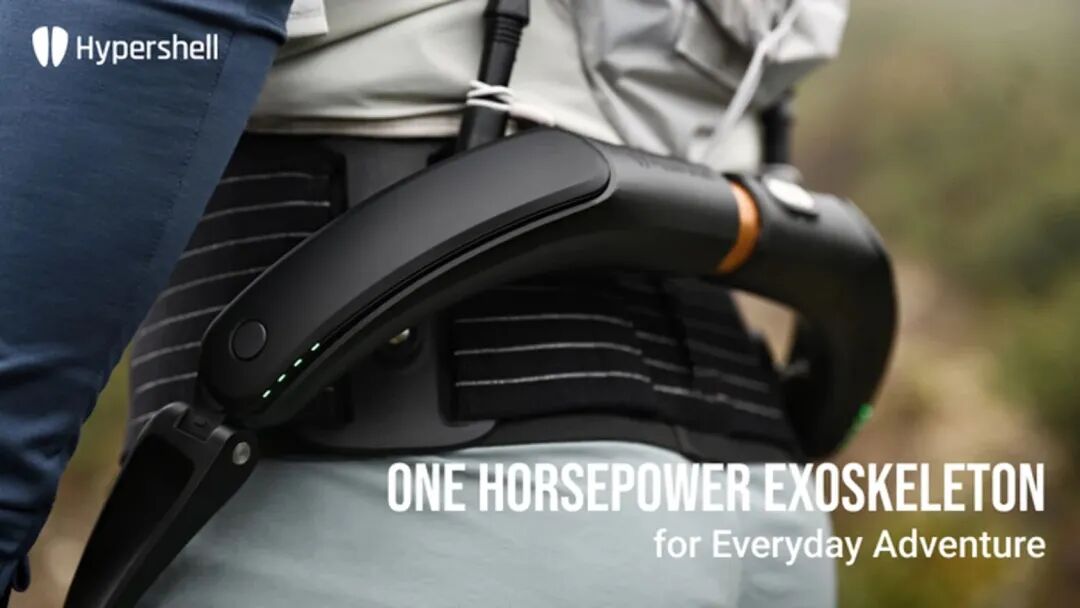
First-generation exoskeleton crowdfunding prototype (Source: Hypershell)
LatePost: Why did you choose to found Hypershell in 2021? Exoskeletons were still quite niche at that time.
Sun Kuan: I had already started another graduate program in innovative product design, a systematic product innovation methodology. But several strong feelings at the time prompted me to return to China early to start my business.
First, after 2019, changes in robotics hardware and control technology, including a series of open-source developments in quadruped robots, new drive technologies and control technologies emerged. This made it possible to create an extremely lightweight and usable exoskeleton product.
Second, during the prolonged isolation of the pandemic, I increasingly felt that human happiness largely stems from connection with the real world. A product that can enhance people's mobility and make their world larger has great value.
So from both the supply of technology and demand sides, I strongly felt the call of the times.

From a One-Person Company
To the First Consumer-Grade Exoskeleton
LatePost: When you officially started the business in 2021, how did you get started? Where did the initial team and resources come from?
Sun Kuan: At the very beginning, there was no so-called team — just me alone, freeloading a desk at a friend's co-working space, using a few months to quickly build a prototype.
That period was almost entirely negative feedback. During that time, I also met quite a few investors. People would ask: in such a revolutionary new track, no one overseas has been able to make it work, why could it work in China? I was also extremely poor at that time — honestly, I'm still quite poor now.
LatePost: How poor?
Sun Kuan: So poor that when MiraclePlus gave me the first check, I thought maybe I should just forget it and go get a job. I actually had a job offer at the time.
LatePost: How long did you agonize between working and starting a business? How did you finally make up your mind?
Sun Kuan: One or two weeks. On the last day of the offer deadline, I turned it down. At the time, I asked my girlfriend what she thought of this choice. She said: even if you don't go start a business today, once you've recovered your energy, you'll still go start a business. I thought about it and strongly agreed.
LatePost: What did Qi Lu say when he met you, and why was he willing to invest?
Sun Kuan: I think MiraclePlus's logic is quite different from many typical VCs — they don't look much at the specific direction, but more at the person. What they like most are people who see opportunities where everyone instinctively says no, and who are also industry experts. They tend to believe that you've seen something others haven't. They also highly value a person's growth, looking at whether you have key life changes every few years.
LatePost: After getting this first investment from MiraclePlus, what did you do?
Sun Kuan: After this came the first co-founder. It was spring 2022, when the pandemic was at its worst. I was in Shanghai when I got the funding, and couldn't even go to the bank to collect the money. Inviting the first co-founder to join was also entirely online communication — he was the algorithm lead at my former company, and we had deep bonds from fighting together.
He only asked me one thing: how do you prove this is feasible? The method I came up with was to take him through a simulation step by step online, explaining why the exoskeleton structure works from an energy perspective. He decided to join that same evening.
LatePost: Next, what was the process from prototype to starting development of the first product?
Sun Kuan: By then we already had a very rough prototype. The next step was rapid prototype validation. But before that, we did one very important thing: thinking about category positioning. The essential question was: who exactly would need a consumer-grade exoskeleton?
We brainstormed one to two hundred different user personas and many different product forms, then used rendered images to run placement tests on platforms like Facebook one by one, seeing which demographics had the highest click-through rates. The results showed that outdoor enthusiasts, photographers, mountaineering hobbyists, aging populations, and others all had demand.
We decided to start from the outdoor angle, rather than the aging population that many people might think of. This was because exoskeletons had historically been tied to healthcare — "whoever uses it has something wrong with their body" — which not only young people couldn't accept, but elderly people couldn't accept either. Outdoor, on the other hand, is about exploration of the real world.
A negative category perception limits the ceiling. Conversely, when people's first impression of exoskeletons is "cool, aspirational," that's when the category's ceiling opens up.
LatePost: Before Hypershell, everything you did was B2B or B2D (developer) business. How did you develop these product instincts?
Sun Kuan: Maybe partly talent, but more from long-term thinking and constant observation. Category strategy itself has many reference cases. For example, many professional outdoor sports brands may have originally positioned themselves in alpine sports, then gradually became more lifestyle-oriented, but consumers still felt they were buying professional gear.
LatePost: In 2023, you built prototypes and ran crowdfunding, gradually getting positive feedback. But your investor told me that year you also had a very difficult period — even you and your co-founder had to mortgage assets. What happened?
Sun Kuan: The hardest time was around the crowdfunding period, with only about 200,000 RMB left in the account. Crowdfunding itself is very expensive, requiring continuous ad spend. But we really had no money then — there was even one month when we couldn't pay salaries, and could only硬着头皮 launch.
After launching, user feedback was extremely good. Many people told us this product would change their lives. This made us believe this was worth continuing to invest heavily in. But the reality was we had no money, so the co-founder mortgaged his house.
LatePost: And you yourself didn't even have assets to mortgage?
Sun Kuan: (laughs) Right, I don't have a house. It was the co-founder who mortgaged his.
LatePost: For the first-generation product's design, what was your core consideration at the time?
Sun Kuan: It had to be a product that was "truly useful" and "truly easy to use." "Useful" is easy to understand. Many past exoskeletons were useless because after putting them on, people's metabolism actually increased — they got more tired. We wanted users to clearly feel lighter after wearing it.
This required solving many problems. First was configuration: it had to conform to biomechanical principles. Second was the power system: performance had to be good enough to provide several hundred watts of peak power. Professional athletes' instantaneous power during sprints is roughly around 1,000 watts — we needed to at least approach this magnitude to be helpful in extreme scenarios like mountaineering or cycling. At the same time, there needed to be sufficient battery life, otherwise after running out of power it would become a burden. Ideally, it could also have energy recovery, such as recovering kinetic energy when going downhill.
Most importantly, AI. Previous generations of this kind of device were extremely complex, with lots of buttons and mode switches. You'd press one to start moving, then press another to stop. I often use the iPhone and Nokia comparison: both had touchscreens, but iPhone went with capacitive touch and just one home button, pushing the experience to its limit. In our early days, engineers would ask me: can we keep a few extra buttons as backup? I said no. Because having only one button forces the team to make the AI good enough. The user only needs to power on and off; everything else is handled by the system. This strategy worked. Now the AI can recognize all kinds of terrain and states.
Finally, it had to "look cool." As a wearable device, it couldn't look like sci-fi villain gear, nor like medical equipment; neither "fancy but too much," nor completely ignoring the human form like medical devices do, only emphasizing function.
Our design philosophy is that exoskeletons should naturally merge with the human body. How users see themselves wearing it, how they think others see them — this deep empathy must be woven into the product design. When you put it on, it feels like it follows the body's natural curves. These curves have already been validated in yoga wear and athletic apparel. An exoskeleton isn't an independent device; it's meant to accentuate human beauty.
LatePost: Besides keeping only one power button, what other design decisions were you particularly insistent on, unwilling to compromise?
Sun Kuan: For example, we wanted it to last a full day of use, not die halfway. In hardcore hiking scenarios, that's roughly 20 kilometers. Our first-generation product managed 17.5 kilometers; our latest, the Hypershell X Ultra, has reached 30 kilometers. Second is size — it had to fold up and fit in a backpack, like a "portable superpower." Weight matters too; we got the exoskeleton under 2 kg.
LatePost: Exoskeletons are complex products with numerous conflicting parameters that need balancing. If you make it lighter, you might sacrifice power and battery life. What was your overarching design principle?
Sun Kuan: An exoskeleton has only one core function: making people move more easily, providing support and protection for joints. Every other feature — battery life, intelligence, portability — exists to reduce the burden the exoskeleton itself creates, to lower its presence.
So the first-principles approach is: assistive power must be strong enough, while minimizing other negative impacts. We first ensure the exoskeleton delivers sufficient assistance, then use AI and engineering optimization to solve the negative impacts of battery anxiety, portability concerns, and operational complexity.
I've always used this ratio of "positive impact" to "negative impact" to evaluate wearable products. The higher the ratio, the better the product. When capability is weak, you have to push negative impacts to the absolute minimum; when capability is stronger, users' tolerance for negative impacts increases.
The First Generation Scored Only 50 or 60 Points
Shipping It Directly Might Have Killed the Company
LatePost: We understand your first developed product, HyperShell Go, never officially launched, and what you actually delivered later was the HyperShell X1. What specific problems did you encounter?
Sun Kuan: After crowdfunding, we ran a user gray-box test with a small batch of engineering prototypes, taking users to real outdoor scenarios.
The reality was that users moved completely differently than we'd imagined. They'd step onto high rocks in a single stride, with large movement amplitude, carrying extremely heavy gear — high load, high flexibility, very demanding on assistance. Many user scores didn't exceed 50; basically in the low 40s. The problems: users found it uncomfortable, and there were clear compatibility issues — with backpacks, with other equipment, and with different body types.
LatePost: Seeing these problems, what choices lay before you?
Sun Kuan: We went through: whether to abandon the first-generation approach. Internally, we were already experimenting with a new configuration; we knew the second-generation design could solve the first generation's problems. But the original design was already close to mass production. Switching to a new approach would definitely cost more and take longer.
Looking back, we were indeed too optimistic. We thought the second generation would just be minor tweaks, finished in half a year. In reality, it took nearly a year and a half, essentially starting from scratch.
LatePost: Which side were you on? Prioritize delivery, or redo the second-generation design?
Sun Kuan: I was very firm on one point: we had to deliver a product with at least a 70 or 80-point experience. If the first batch of users got the product and all complained, it wouldn't just damage the company — it could destroy the entire category.
LatePost: "The boy who cried wolf."
Sun Kuan: Exactly. You can't disappoint users again and again.
LatePost: What were the core improvements from first to second generation? How did you go from 40-50 points to 70-80?
Sun Kuan: The first generation used a single-motor configuration. One motor, behind the back, assisting both legs simultaneously. This configuration came from simulation modeling; energetically it was very efficient, but wearability was poor.
The first generation's biggest problem was that the motor's output shaft axis didn't align with the human joint axis, creating pressure and increased wear risk on the joints. The second generation was redesigned with dual motors, with the exoskeleton axis closely matching the human joint axis. Cost-wise, the second generation was nearly double the first — literally double — because of the additional motor module.
LatePost: That year, what difficulties did you completely fail to anticipate?
Sun Kuan: Something like "user didn't fasten the buckle properly" — we spent two or three months solving this through algorithms that continuously detect whether the device is worn correctly. The hardest designs weren't actually the "robot parts" like motors, but everything that directly contacts the human body.
Those contact points that look simplest, if not handled well, become real pain points over long durations and thousands of force cycles, even causing skin abrasion and bleeding.
And these had no mature solutions in the industry.
LatePost: You'd think there would be professional testing systems for this.
Sun Kuan: Yes, but they don't exist in the robotics industry. So we had to learn from other industries.
Take bicycle saddles. Why that odd shape? Because what's actually suitable for long-duration force is bony support points, not where there's more muscle.
For example, the most suitable place on the waist to bear force is actually the posterior lumbar dimples, because that's bony structure with less soft tissue covering it — pressure there is actually more comfortable over long periods. That's also the origin of our waist unit design today.
LatePost: That's counterintuitive for most people.
Sun Kuan: Right, everyone assumes fixing to fleshier areas would be more comfortable, but the opposite is true.
LatePost: So this long year of revision was another low point, and getting through it meant actually making the product?
Sun Kuan: Yes, I spent half a year at the factory basically screwing in screws myself, to work through all the reliability issues. Mass production is completely different from small batch. We're extremely sensitive about safety, setting test standards far above industry norms: approximately 2 million impact cycles under extreme conditions.
During testing, nearly every part broke at some point. Solving each problem required long verification cycles. Actual delivery didn't happen until 2024.
LatePost: What was the market feedback and sales after delivery?
Sun Kuan: The second half of 2024 was basically fulfilling crowdfunding orders — four to five thousand units. It took four months to deliver, then we started formal sales.
We have a Facebook community of nearly 10,000 people. During that period, the first thing I did every day was check user feedback. We formed an emergency response team internally, with meetings every two days to rapidly resolve user issues.
The positive feedback was overwhelming. Some users' usage frequency exceeded our imagination. For example, a Walmart cart pusher who walks 70,000 steps a day — the product dramatically reduced his burden, and he later became our "product ambassador." Many users wrote long posts calling it a life-changing product: someone who hadn't hiked with family in ten years; someone with asthma who hadn't climbed mountains in years, now back on snowy peaks; photographers wearing it while carrying Steadicams to shoot events.
Walmart employee wearing exoskeleton while pushing carts (Source: HyperShell)
LatePost: What about negative feedback?
Sun Kuan: Plenty. Strange noises, algorithm instability, assistance suddenly disappearing, insufficient battery life, inability to meet personalized needs.
We later discovered some users had asymmetric leg strength, but the device defaulted to symmetry. We then showed users their data and allowed fine-tuning; some users' walking posture improved noticeably.
LatePost: From founding the company to first delivery took 40 months. Were you ever worried someone would beat you to it, capturing the consumer exoskeleton mindshare first?
Sun Kuan: Yes. I'm actually someone who gets anxious easily. That's why I spent half a year at the factory, personally getting involved in solving problems. You can only do your utmost to make things happen as fast as possible.
But I also feel now that you have to respect time. After all, this is an entirely new category. Some processes that looked like detours actually helped us build crucial understanding. Our first product delivery took 40 months, but that's because we essentially developed two generations of products in between. Our latest product, the Hypershell X Ultra, went from project initiation to launch in just four and a half months.
Making innovative hardware products is like this: if the product you release doesn't make you feel slightly embarrassed at all, you probably shipped too late; but if it makes you deeply ashamed, the company is probably finished.
Use a "Monkey Model" to Get It Running First
The Second Time You Can Do It Ten Times Faster and Better
LatePost: You started with just a few people and have grown to over 200 in less than three years. Now your product iteration efficiency, supply chain, and mass production speed are all very fast. How did you achieve this?
Sun Kuan: My philosophy has always been rapid iteration. Once you get the first pipeline running with a "monkey model," the second time you can do it ten times faster and ten times better.
Team building follows the same logic. After running through the full process a few times, you clearly understand what capabilities each module needs and what kinds of people to attract from which directions. That's how the organization has been able to grow so quickly.
LatePost: What's the composition of your management team now?
Sun Kuan: Besides me, there are three co-founders. I mentioned one earlier. Another joined last year and is responsible for commercialization directions like marketing and sales. The third is a product partner who spent seven years doing robotics startups in Boston — a very "soulful" product person.
The first time I talked with him, he asked more about the psychological experience the product creates for people. For example: How does someone see themselves after putting on this product? How do they think others see them? These very human, straight-to-the-core product questions.
LatePost: What do you personally manage the most of?
Sun Kuan: I focus more on product direction now and will gradually complement him. He's responsible for building product methodology, user research, and also helping us set up the supply chain system.
LatePost: What do you think is your organization's biggest weakness right now?
Sun Kuan: My own personality issues get amplified into organizational problems.
I'm very culture- and values-oriented when hiring. I like people with strong drive toward the category and extreme pursuit of good things. But when everyone is too similar to me, it also amplifies my weaknesses — for example, behind the pursuit of "good" is actually neglect of time and process.
I used to believe more in the high-talent-density model, driven by mission, culture, and values. But as product complexity increased, I started realizing that in certain stages, missing processes can cause very serious problems — even millions in losses in one go.
LatePost: What made you realize the importance of process?
Sun Kuan: When management wasn't refined enough, there would be "capsizing in the gutter" incidents. For example, an entire batch of goods shipped overseas was returned because labels were wrong or certification labels were missing — huge losses.
We even ended up in European courts to explain what category this product belongs to. Things like CE certification labels are completely avoidable, but because of process issues, they became boomerangs.
LatePost: How did you handle this afterwards?
Sun Kuan: First, I reflected on myself — I hadn't emphasized process building enough. After that, we started valuing digitalization and information systems, because people will definitely make mistakes. Second, we began bringing in management experience from manufacturing, supply chain, and R&D processes.
I later understood that process is essentially solidified methodology. For example, the labeling problem can be avoided through barcode verification.
LatePost: When something like this happens, do you explode in anger?
Sun Kuan: No. I'm a relatively emotionally stable person. This kind of problem is more my responsibility, because I didn't establish good mechanisms. I'll analyze with everyone whether the mistake was due to attitude or a blind spot in understanding.
Our culture is very open overall and encourages trial and error. Money lost in a startup's early days is essentially tuition. Only when everyone becomes more efficient and makes fewer mistakes can you move toward profitability.
But if it's an issue of intent, I'll be very unhappy. We're a high-performance, high-incentive, bottom-elimination organization — it's just that my interaction style is relatively gentle.
LatePost: Who do you learn from? What kind of organizations do you admire?
Sun Kuan: Every organization has its own challenges. We're learning from some excellent organizations, like Bambu Lab.
LatePost: What's your observation of Bambu Lab?
Sun Kuan: When you talk to their people, you find their mental state is very full. The work challenges are huge, but many people completely don't consider looking at other opportunities.
This isn't just an incentive mechanism issue — it's a system of high performance, high incentives, and bottom elimination. Good people feel this mechanism is fair and also want good people around them.
When an organization keeps squeezing out the water, it enters a positive cycle.
LatePost: This kind of "comfort" isn't actually no pressure, but rather a very pure environment.
Sun Kuan: Right, very pure. That's also why we value values so much in recruiting. We like pragmatic, clean, youthful people.
LatePost: How do you judge values fit in interviews?
Sun Kuan: The first question I most often ask is: What do you think of the direction we're working in? This is about the underlying drive toward the category.
If someone is just randomly looking for a job, we might not be the best choice. Only people who truly see the possibilities in this category and are interested in it can go the long term. I've hired right and wrong before, and gradually you learn what kind of people don't fit us.
LatePost: So you have written values.
Sun Kuan: Yes, but saying them out loud is a bit embarrassing (laughs). Essentially it's simple: First, love and drive for the thing itself. I often ask candidates: Do you really want to do this? If not, we encourage internal transfers to find a direction they truly have passion for.
Second, extreme pursuit of good results. In this category, not being extreme means unusable.
We also ask candidates about their hardest and most fulfilling past challenges, to see if they're someone who continuously pursues better results.
LatePost: I saw your WeChat signature says "infinite progress."
Sun Kuan: First, this Tim (Tim Pan, founder of Yingshi Hurricane) is my idol, just kidding (laughs). My own understanding of this term, the core is actually "iteration."
I think what I'm relatively good at is drawing inferences from one instance. Back in class, the teacher taught us the movement principle of air cylinders: press this switch and it extends, press that direction and it retracts. About ten minutes after that class, I built a "calculator" with air cylinders that could do addition.
I think this is a kind of ability I have: when I see some underlying rules, I can deduce them into a system. So for me, running through something once is very important. As long as something can run through once, I have ideas to deduce it into a system that's possibly ten times better. The underlying logic is actually continuous iteration, continuous trying.

Entrepreneurship Cured My Death Anxiety
LatePost: There's a widespread concern about exoskeletons as a category: will it remain stuck in a niche market? How do you cross the chasm into a more mass market?
Sun Kuan: The logic of breaking out is: the earliest core audience, first, can produce content, and second, the content they produce happens to be what your desired generalized population aspires to and identifies with.
Hardcore outdoor people inherently have content production attributes. Whether photographers or mountaineering enthusiasts, they're willing to share their experiences of conquering a mountain or completing a challenge. This content gets seen by the broader outdoor population, which further influences more daily-travel-oriented people — this is a top-down diffusion process.
Objectively speaking, this is a very long-cycle thing that may require continuous investment over the next ten or even twenty years.
LatePost: Is price the key to crossing the chasm? Ultra is currently $1,999. Will you make lower-priced versions within the same product generation?
Sun Kuan: We do a lot of price testing, adjusting prices to see user acceptance at different tiers.
Today this category is still in a very early stage. At this stage, you need to find people with higher tolerance — many will have some early adopter characteristics, naturally more interested in new technology.
LatePost: From early adopters to mainstream, roughly what price range? Your current average price is around 10,000 RMB.
Sun Kuan: We've calculated a rough inflection point, somewhat like going from iPhone price range to a "feature phone level" price. But this definitely takes time.
LatePost: Analogous to some emerging categories, like 3D printers — initially also considered niche, but Bambu Lab proved the market is far larger than imagined. How do you see its chasm-crossing process?
Sun Kuan: 3D printers went through roughly several stages.
The earliest users were "playing" — playing while DIYing, they were both users and developers. The real key inflection point was when the product became "usable" — approaching iPhone-level experience, one-click printing, automating all complex operations. Bambu Lab did this very well, turning an extremely complex device into something ordinary people could use.
The second key was content community. In the past, the barrier to 3D printing wasn't just hardware, but 3D modeling. Bambu Lab made MakerWorld into something like an App Store platform, letting users upload models, greatly lowering the barrier to use, creating a flywheel: good product brings users, users bring content, content promotes usage, which in turn drives consumables and ecosystem.
LatePost: So for exoskeletons, will there be similar community or ecosystem space?
Sun Kuan: I think exoskeletons are more like cars — they're a foundational capability, called mobility.
When your legs are like having "infinite health bars," your lifestyle, entertainment, travel methods will all be redefined. On this foundation, new sports, new routes, new lifestyles will definitely emerge.
Just like cars brought road trips and Michelin restaurants. The more foundational and invisible the capability, the greater the possibilities it creates.
LatePost: Right now people still mostly see it as sports equipment. To truly become daily wear, what's still missing?
Sun Kuan: Two factors: scenario and product.
Only in scenarios where the body faces challenges does its value get amplified. Second is the ratio between positive impact and negative burden. This ratio must keep getting higher and more invisible. Today I think it's just past the balance point, but not yet at qualitative change.
LatePost: People's expectations for exoskeletons may come from film and games. How do you see the gap between expectation and reality?
Sun Kuan: I actually think this is a good thing — it shows people have basic recognition of this category.
Many users tell me this was a dream they saw in sci-fi works decades ago, and today it's finally reality, with a price as affordable as a phone.
For example, this Hong Kong rescue. In the official thank-you video released, there's a long section about exoskeletons. A 30-floor building, going up and down dozens of times daily for search and rescue, extremely physically consuming — some of these devices were our donations.
I think this is the value we truly want to push: producing positive effects in extreme environments, in life challenges.

Hong Kong rescue personnel wearing exoskeletons in rescue operations
LatePost: Will you expand into upper-limb exoskeletons in the future?
Sun Kuan: We've built a lot of pretty "weird" prototypes in the lab — things like an assistive rig for holding up cameras.
LatePost: You're getting a lot of heat in the primary market, and you've just closed a $70 million funding round. Are you sensing any competitive pressure yet?
Sun Kuan: The most direct competition comes from traditional companies that make medical and industrial exoskeletons. Some of the tech giants are paying attention too.
I remember back at MiraclePlus, Qibo shared something that really stuck with me: how do you solve for competition? The answer was, once you've found PMF, the whole market sees the opportunity and everyone piles in. The only way to win is to run faster than everyone else.
For me, the more important thing today is to stay focused on myself.
Another reality is that the market looks loud right now, but if you add up the entire year's revenue across the whole space, it's probably just a few hundred million RMB — and maybe 90% of that is ours. Exoskeletons aren't a zero-sum game yet. The bigger opportunity is making the product experience better, continuously breaking into new circles, and creating larger incremental growth down the road.
LatePost: Are you happier since you started this company?
Sun Kuan: I feel like I'm living more solidly.
I used to be someone with an intense fear of death. Before starting the company, I'd often jolt awake in the middle of the night, suddenly realizing: one day you might not wake up at all, your self will just dissolve. But after starting the company, that happens much less often.
LatePost: The headline for this issue could be "Starting a Company Cured My Fear of Death."
Sun Kuan: I think this is what it feels like to be "living right." When you're doing what you truly want to do, giving everything you have to create value and make an impact on the world, you don't have so many regrets.
LatePost: Where this drive in entrepreneurs comes from — it really is kind of magical.
Sun Kuan: I used to ask a lot of people: are you afraid of death? I thought this was something everyone felt, but a lot of people didn't even really understand the question.
For me, this has always been a very fundamental motivator.
LatePost: I have a strong sense that you're on the side of humanity. You're not using robots to replace people — you're augmenting people.
Sun Kuan: I believe that in the future, AI and robots will definitely replace many human jobs, and we might even see systems that completely substitute human physical labor.
But I don't want to see that future. What I want to do is help people break free from the limits of their carbon-based bodies as much as possible, to do things that were impossible before. That's what we're actually doing.