Dialogue | William Hu of Qiming Venture Partners and Zhengtuo Zhao of Jieti Medical: Brain-Computer Interfaces and AI's Mutual Advancement | WAIC 2026

Over the next eight to ten years, as invasive brain-computer interface systems achieve "earring-grade" miniaturization and reduced invasiveness, the technology is expected to enter the lives of ordinary people.

The "Qiming Venture Partners · Entrepreneurship and Investment Forum: From Compute Origins to Application Deployment" at the 2026 World Artificial Intelligence Conference (WAIC), hosted by Qiming Venture Partners, was successfully held on July 19 at the Shanghai World Expo Center. During the session titled "Brain-Computer Interfaces and AI: A Two-Way Journey from Effortless Control to Seamless Cognitive Extension," William Hu, Managing Partner at Qiming Venture Partners, and Zhengtuo Zhao, founder of Jieti Medical, shared the latest developments in brain-computer interfaces.
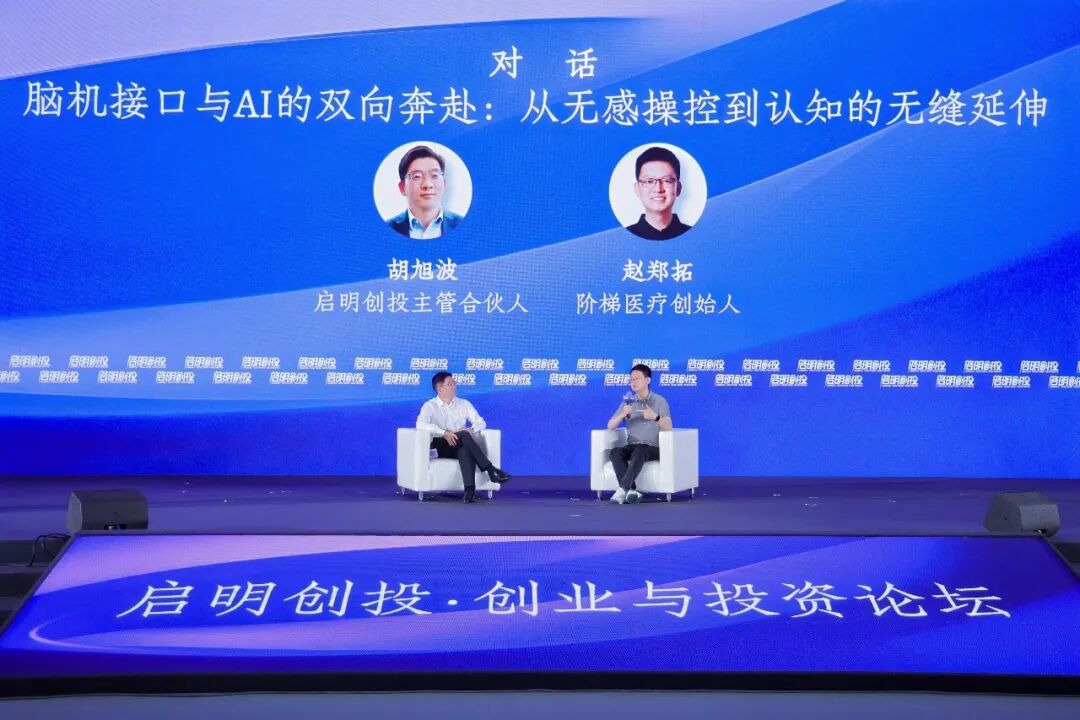
William Hu, Managing Partner at Qiming Venture Partners, and Zhengtuo Zhao, founder of Jieti Medical
Zhao believes that brain-machine interfaces (BMI) represent the "critical hub" for breaking through human biological limits and enabling efficient human-machine connection. He offered a particularly industry-relevant insight: brain-computer interfaces will become a key data source for the evolution of Embodied Artificial Intelligence. Through extreme engineering of invasive approaches, Jieti Medical has enabled subjects to precisely control physical devices through thought alone. This not only restores impaired functions but also positions these users as "brain trainers" for embodied intelligence, efficiently producing scarce, high-precision control data from real-world scenarios. He predicts that within 8-10 years, as invasive brain-computer interface systems achieve "earring-level" miniaturization and reduced invasiveness, the technology could enter ordinary people's daily lives.
Below are edited highlights from the conversation:
01/
The Value of Brain-Computer Interfaces Carries Historical Mission
William Hu: Brain-computers have been quite a buzzword these past few years. My first question: in the current era of artificial intelligence, as one of the world's most seasoned researchers in brain-computers, could you share your perspective on how much value brain-computer interfaces will hold in the future?
Zhengtuo Zhao: Let me briefly introduce myself — I'm a researcher at the Chinese Academy of Sciences' Center for Excellence in Brain Science and Intelligence Technology. I founded a company called Jieti Medical, focused primarily on using brain-computer interface technology to more efficiently connect with the external world, especially as we rapidly enter the intelligent age. That's the brief background.
The reason I work on brain-computers is that I feel the value they carry comes with a sense of historical mission. Looking at the technological revolutions — from steam to electricity to information, and now quickly moving into the intelligent age — there's a pattern, or trend we've observed: machines have become increasingly complex, information connections increasingly tight, and the efficiency, speed, and volume of information exchange have grown explosively. Yet through this process, we find that humans are no different from a thousand years ago. So the bottleneck in human interaction with the external world, or our own inherent limitations, has become a constraint on future productivity gains and social development. That's why we believe that at this juncture, technologies like brain-computer interfaces emerge with a sense of mission — while we may not be able to evolve more complex limbs, they allow us to interact with increasingly sophisticated external devices, such as humanoid robots with dozens of degrees of freedom, at equivalent bandwidth for information exchange, control, and controlled information construction.
Additionally, improving outward interaction efficiency — the speed at which we can transmit and exchange information using our external organs — has already hit significant limits. The physical and digital worlds are rapidly connecting, but because humans are constrained by interaction speed, this connection has become highly inefficient. Brain-computer interfaces are also needed to improve the efficiency and bandwidth of interaction between humans and future software, hardware, and AI systems. That's another dimension.
That was looking outward; looking inward, there's also great mission. Information is exploding, energy is exploding, and the rapid development of various technologies means our living environment is changing at tremendous speed. Perhaps a hundred years ago, the information I encountered in a month equals what I now encounter in a day. Yet the brain's capacity to process information and adapt to the environment hasn't evolved nearly as fast, which we see manifest in rising anxiety, depression, and other issues among young people — a series of social problems stemming from poor adaptation to environmental change. So similarly, I believe brain-computer interfaces also have an inward-facing role in regulating our internal state to help us adapt to external changes — our sleep, metabolism, endocrine function, cognition, and so on. With massive amounts of information coming at us daily, we need the capacity to receive and learn it. So future internal state regulation through brain-computer interfaces is also an important mission of this technological revolution — this is where I see the value of brain-computer interfaces.
Another point: our understanding of the brain is but a drop in the ocean. I find it hard to quantify with a number, but our understanding is truly very limited. The human brain has nearly 100 billion neurons processing all kinds of information, so our current understanding is extremely constrained. But through brain-computer interfaces, we've opened a pathway to understanding and recognizing the brain. As large-scale application and promotion proceed, we'll collect massive amounts of data. Similar to the AI field, understanding the brain will rely purely on collecting task data from various information-gathering activities to decode underlying patterns. So the ultimate frontier of human brain cognition will also be reached through scaled application and popularization of brain-computer interfaces. Once we understand the brain, I think some of humanity's ultimate questions may be answered along the way — though this is admittedly somewhat idealistic, I believe it's also an important mission of brain-computer interfaces.
William Hu: I find this perspective quite illuminating. On one hand, I sense a strong mission orientation that isn't focused on solving one or two problems in the near term. At the same time, I can see that the effort required for our limited brains to understand, analyze, and truly effectively harness future technologies is roughly comparable to what's needed in physical AI.
Zhengtuo Zhao: Yes, the brain has supported all of humanity's achievements throughout history, yet our understanding of the mechanisms behind it remains very limited. Of course, this understanding may not necessarily be essential. Because at this stage, I'm also studying AI, and I found the earlier presentations very informative. The development of AI, especially as it moves from the digital world into the physical world, recapitulates brain patterns to some degree — for instance, encoding information through complex structures. I believe that future understanding of the brain and current development of physical and digital AI will find intersection points to some extent, and perhaps even the brain's intelligent approaches will ultimately feed back into the development of present-day artificial intelligence.
The reason I say this isn't necessarily inevitable is that the brain has modes distinct from current AI development — it has its strengths. Whether they will intersect in the future? I think that's a question mark. But a crucial reason we can never abandon the human brain is its curiosity. This curiosity may not really be about功利地, goal-oriented problem-solving. Perhaps many problems will already be solved through physical or digital AI, but the human brain retains a curiosity to understand and discover the world, providing AI with higher-level objectives. That's a possible future form.
02/
Different Technical Paths, but the Core Goal "Converges to the Same Destination"
William Hu: Professor Zhao, you've done research and also founded Jieti Medical. Returning to Jieti Medical itself — there are many technical paths available in the brain-computer field. Could you share what path Jieti Medical has chosen and why?
Zhengtuo Zhao: Regardless of the various technical paths, the core goal of brain-computers converges to the same destination: enhancing the efficiency of information exchange between the brain and external data. Interaction occurs at multiple levels — perception, decision-making, input and output at both ends, and the intermediate information processing, similar to reasoning and cognition. So at this stage, all brain-computer interfaces are about improving our ability to exchange information with the external world, ultimately achieving fusion between brain and machine, or brain and intelligence. This is where all paths converge.
Currently there are different approaches — for example, external sound, light, electricity, magnetism, ultrasound, and other methods to interact with brain information, extracting and writing brain information. There are also invasive approaches represented by Elon Musk's Neuralink, directly implanting sensors into the brain to achieve single-neuron-level information interaction, using single-neuron discharge as the minimum resolution unit, thereby theoretically enabling higher information throughput and control precision. In my view, current approaches using various other energy forms, including electricity, sound, and ultrasound, are limited by the skull and scalp, causing significant signal attenuation that prevents us from capturing the most refined differences in how the brain processes this information.
So for non-invasive paths, the current challenge lies in fundamental technological breakthroughs or revolutions that would enable non-invasive methods to obtain very fine-grained brain activity information. For invasive approaches, they already have neuron-level signals from the brain's functional units. But being invasive, even minimally invasive surgery is still surgery, so acceptance is lower. The problem to solve is extreme miniaturization and minimal invasiveness, making it acceptable to more people — this is the goal of extreme engineering.
In summary, non-invasive technical paths are pursuing breakthroughs in underlying technology, while invasive approaches are pursuing extreme engineering. We chose the latter because extreme engineering has greater determinism — with sufficient resource investment, the probability of future deliverables is higher, whereas underlying technological breakthroughs carry certain uncertainty, or involve betting on probability.
But regardless of technical path, what we're focused on today is invasive or implantable approaches. In the future, all these brain-computer interface technical paths only solve the first step of information interaction, information collection, and information writing. After collection, much remains to be done — information needs to be processed, decoded, and translated into language machines can understand, then interact with machines, and in the process of interacting with different machines, develop an ecosystem involving software, hardware, AI, and other external elements. So we're currently focused on the determinism of engineering problems, with the hope of monitoring different technical paths' development and, at the appropriate time, grafting the downstream pipeline built through invasive approaches onto different technical front-ends. This is our path selection.
03/
Brain-Computer Interfaces Can Create Substantial Value for Embodied Intelligence Development
William Hu: Assuming embodied intelligence becomes reality in the future, what role do you think brain-computer interfaces will play? What important milestones remain along the way? Where does Jieti Medical currently stand?
Zhengtuo Zhao: We've actually been accumulating understanding through practice. Before we obtained data from the first half of this year, we thought less about this aspect, mostly feeling that future fusion was inevitable, whether with digital AI or physical AI. But after getting some practical data, we discovered that brain-computer interfaces will contribute certain value to the development of embodied intelligence in the future — we believe this value is quite significant.
We're currently conducting clinical trials, with 18 patients (as of July 2026) implanted with brain-computer interface systems, manipulating various electronic devices. Simultaneously, we're having them control physical peripherals — robotic arms, robot dogs, wheelchairs, and such. When controlling robots, we started with a seven-axis robotic arm operation, and we found patients could actually do remarkably well. They could manipulate the robotic arm "as if it were their own finger" through thought alone to complete actions — this was trajectory-level control, not simply decoding end-point X, Y, Z coordinates, but truly decoding angular velocity and angular acceleration at multiple key nodes, ultimately enabling fluid robotic arm manipulation.
Seeing these results was extremely exciting, because we understood that one of the core challenges in the current embodied intelligence field is the lack of high-quality data, or insufficient high-quality data — these robots haven't seen rich enough scenarios, and specific corner cases may not be teachable through hands-on demonstration in real-world application scenarios.
When we saw these structures, we realized our subjects are a population with genuine need. They can, much like Tesla drivers, daily operate these embodied intelligence robots at home, collecting high-precision motion trajectory-level data through thought alone. Seeing this, we realized this could be a major value point, because this is a low-cost or even zero-cost model for collecting high-quality data in general, specific application scenarios, and this model is clearly scalable. This year, China's brain-computer interface field has about 100 patients and subjects using brain-computer interface systems long-term.
This is the eve of brain-computer interface technology planning. Starting next year, as systems gradually receive certification and enter commercialization, this number will expand dramatically. For instance, by one estimate, next year it will be thousands of cases, and thereafter tens of thousands or more. In this process, we can do simple calculations — as mentioned earlier, 2025 was still at the scale of ten-thousand hours of data. Simple calculation: 100 subjects using 6 hours daily, 365 days, yields roughly two to three hundred thousand hours of data. If we multiply that number by ten or a hundred, I believe such high-quality, large-scale data will provide what we might call data support for current embodied intelligence field development.
Additionally, this is real-machine, hands-on operation, and data from specific real application scenarios. In the future, this will conversely provide tremendous help to our patients, or application models will provide very good benefits and assistance to our subjects. For them, a foundation model trained on tens of thousands of hours can help them complete basic operations, but in special scenarios can provide indicative assistance — much like autonomous driving or assisted driving. I believe more patients will achieve quality-of-life improvements through brain-computer interface technology, and this positive cycle will to some extent motivate larger groups to accept this, forming a very good closed loop.
Additionally, for them, our subjects transform from individuals with functional impairments, paralyzed patients, somewhat marginalized roles in society, into embodied intelligence brain trainers, reconnecting with the forefront of the era — this is quite interesting, or carries public welfare value and sense of responsibility. This will form a beneficial model that can inject certain value into the future of embodied intelligence, especially in the development and evolution of the brain.
04/
"Earring-Level" Miniaturization and Reduced Invasiveness Achievable Within 8-10 Years
William Hu: The entire brain-computer interface market is extremely hot, and current valuations for each company are considerably higher than one or two years ago. In your view, what is the next key milestone or breakthrough the industry urgently needs? That is, by achieving this milestone, the market can fully validate the reasonableness of current investment valuations and further open up future growth imagination. Please share your assessment.
Zhengtuo Zhao: This relates somewhat to my previous answer. For us, our three-to-five-year goal remains focused on clinical scenarios for patients with functional loss — motor and language function loss, inability to efficiently output information externally, and sensory loss, inability to obtain information from the external world, such as vision and hearing, for interaction. These are the clinical scenarios and problems to solve within three to five years. At this stage, what remains are largely engineering problems, so I don't think we need to expect a breakthrough-level milestone here — more that we need to steadily do good engineering work, because clinical applications have very stringent regulatory requirements, and we must maximize reliability and safety. So this is the core problem to solve prominently at this three-to-five-year stage.
From this perspective, I personally believe that as a medical device, achieving the kind of significant quality-of-life improvement for disabled groups I just mentioned, while also addressing internal issues like neurological diseases including psychiatric conditions, improving their mental state and daily health through neuromodulation — this also holds tremendous value, and current valuations are entirely commensurate with such a state.
But I believe the current brain-computer field, especially technology-focused investors paying attention to brain-computers, aren't only focused on medical scenario applications. More attention goes to whether future interaction can fundamentally change our interaction methods from the ground up, with corresponding business models and social operation patterns also changing. Additionally, whether it can form a very good mutually reinforcing, mutually promoting dynamic with this wave of artificial intelligence. I believe enormous commercial value lies behind this as well — this is a five-to-ten-year horizon matter.
The motor, language, and other output scenarios we're currently solving are essentially replacing keyboards and mice — we can already do this quite well. Next will be visual reconstruction and auditory reconstruction, replacing screens and microphones. Basically, once these input-output information interaction methods are replaced, all computing can move to the cloud, and the future becomes a transformation in human-computer interaction methods — perhaps phones, tablets, computers won't be needed, we go out carrying nothing, yet high-quality information interaction isn't diminished at all. This is the next milestone worth anticipating. We might have a question: invasive approaches require surgery, but this remains an engineering problem, and we're confident in predicting that within eight to ten years, the entire invasive brain-computer interface system can be compressed to the size of an earring — that is, I get an ear piercing and have all interaction capabilities. At that point, ordinary consumer audiences and scenarios may to some extent consider this personal enhancement or upgrade. So this is what I see as the next milestone worth anticipating.
Simultaneously, running parallel to this is another milestone I mentioned in the previous question: much like Tesla's fleet, building a brain-computer interface subject cohort, where such cohorts continuously feed back the highest quality data to embodied intelligence brains through daily life usage, improving their understanding of various scenarios, especially corner cases, or intelligent understanding, ultimately enabling embodied intelligence to reach its "GPT moment" faster. I think this is another important milestone, and I don't think this is just a story — there are feasible, practical path objectives, and I believe this is also a milestone achievable within five to eight years.
William Hu: So I think whether in entrepreneurship or investment, curiosity is a very important trait. Over the next five to ten years, if brain-computer interfaces and artificial intelligence continue rapid development, they will very likely change many aspects of human lifestyle.
05/
Four Major Advantages for Global Competition on China's Innovation Soil
William Hu: You've conducted research in China and then started a company. Could you share what unique advantages China offers for entrepreneurship, especially in the current context of China's AI industry environment?
Zhengtuo Zhao: Everyone can feel it at this stage — the popularity of WAIC is one reflection. China's frontier technologies and future industries have excellent atmosphere and excellent ecosystem, supporting everyone here to continuously intersect, collide, connect, and generate new value.
Just the other day I was chatting with friends working on controllable nuclear fusion and commercial aerospace. We can see the density, scale, and efficiency at which the most cutting-edge things in Shanghai are interacting — this is extremely important, and of course closely related to policy orientation.
Specifically, there are several core points for global competition through innovation on China's soil:
First, manufacturing advantages. For us, working on brain-computers involves many technologies from semiconductors, consumer electronics, and other sources, including core components from industry. China's advanced manufacturing foundation and advantages globally provide us with tremendous technical support.
Second, ecosystem advantages. Brain-computers are an interface, and interfaces need to connect to something to create value. China's excellent ecosystem in consumer electronics, embodied intelligence, and other AI areas enables us to pursue a good open-source model. I don't like using the word "competition" — I think we should better promote human progress. In the brain-computer field, the United States has something inevitable; Neuralink is very clearly an inevitability. In China, I hope to call for building our own Android system in the future, using open-source methods, using connection to ultimately efficiently generate value.
Third, China's engineering and technical intellectual resources are truly very advantageous. Engineering and technical students, plus currently many top overseas talents returning — I think our team has attracted many who see the momentum of China's development, and this momentum can jointly contribute to this field. Of course, this also离不开 policy support.
Finally, policy can often drive decisions or behaviors that defy commercial logic or that short-term commercial logic wouldn't support. For example, Elon Musk may excel at extreme engineering, cost compression, scaling, and such — he does this beautifully. But in brain-computers, there are many fundamental elements, and how much the brain can be utilized and to what degree — during this process, the basic research stage can't immediately empower commercialization, but will long-term determine how far the ceiling is for this endeavor. So policy guidance that integrates industry, academia, and research will also provide tremendous help for the future development of China's brain-computer field.
Qiming Star | Jieti Medical Raises 350 Million RMB in Series B, Qiming Venture Partners Co-Leads

Qiming Venture Partners was founded in 2006. Currently, Qiming Venture Partners manages 11 USD funds and 7 RMB funds, with total assets under management reaching $9.5 billion. Since its establishment, the firm has focused on investing in outstanding early and growth-stage companies in Technology and Healthcare innovation.
To date, Qiming Venture Partners has invested in over 580 high-growth innovative companies, of which more than 210 have listed on the New York Stock Exchange, NASDAQ, Hong Kong Exchanges and Clearing Limited, Shanghai Stock Exchange, and Shenzhen Stock Exchange, or exited through M&A and other means. Over 80 portfolio companies have become recognized unicorns or super-unicorns in their respective industries.
Many Qiming Venture Partners portfolio companies have grown into the most influential companies in their fields, including Xiaomi (01810.HK), Meituan (03690.HK), Bilibili (NASDAQ:BILI, 09626.HK), Zhihu (NYSE:ZH, 02390.HK), Roborock (688169.SH), Hesai Technology (NASDAQ:HSAI, 02525.HK), UBTECH (09880.HK), WeRide (NASDAQ:WRD, 00800.HK), HyperStrong (688411.SH), Insta360 (688775.SH), Unisound (09678.HK), Biren Technology (06082.HK), Zhipu (02513.HK), Gan & Lee Pharmaceuticals (603087.SH), Tigermed (300347.SZ, 03347.HK), Zai Lab (NASDAQ:ZLAB, 09688.HK), CanSino Biologics (688185.SH, 06185.HK), Schrödinger (NASDAQ:SDGR), APT Medical (688617.SH), Sanyou Medical (688085.SH), AmoyDx (300685.SZ), Sinocelltech (688520.SH), Insilico Medicine (03696.HK), AusperBio, Yuanxin Technology, MediLink Therapeutics, Leads Biolabs, StepFun, and others.