Q&A | Duane Kuang and Qianli Technology's Qi Yin: Closed-Loop Business Models Sustain Tech Progress, AI Era Offers Huge Hardware Opportunities

Because of the changes brought by AI Agent assistants and operating systems, many different hardware form factors will emerge in the future before gradually converging. This is a space where both tech giants and startups will have significant opportunities.

The "Qiming Venture Partners · Entrepreneurship and Investment Forum — Venture Capital Unleashing the Resonance Cycle of AI Technology and Applications," hosted by Qiming Venture Partners as part of the 2025 World Artificial Intelligence Conference (WAIC), was successfully held on July 28 in the Blue Hall of the Shanghai World Expo Center.
In his welcome address, Duane Kuang, Founding Managing Partner of Qiming Venture Partners, noted that as one of China's earliest and most extensively invested institutions in the AI sector, this marked the third consecutive year that Qiming Venture Partners has hosted this forum. Qiming Venture Partners aims to connect the themes of innovation, entrepreneurship, and venture capital through this distinctive sub-forum, and through the candid sharing of distinguished guests, provide valuable and useful insights to the industry and the broader AI ecosystem.
During the dialogue session, Qi Yin, Chairman of Qianli Technology, and Duane Kuang engaged in a focused discussion on "The Evolution of 'AI + Endpoints': How Large Models Empower Terminal Evolution and Industrial Restructuring."
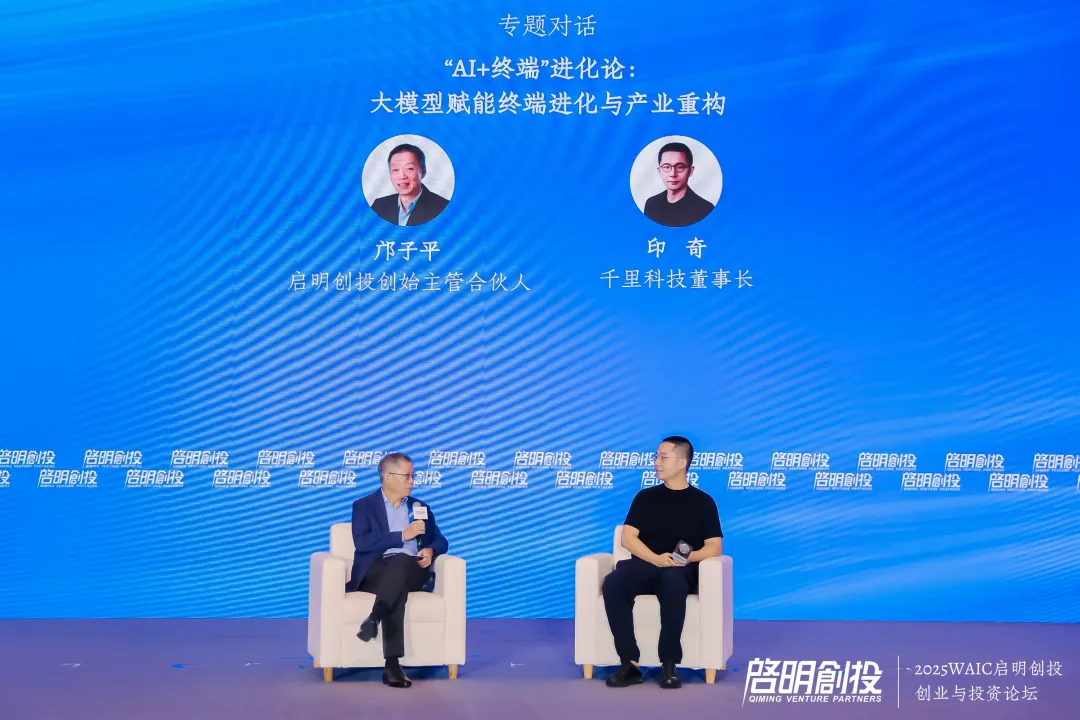
Duane Kuang, Founding Managing Partner of Qiming Venture Partners (left), and Qi Yin, Chairman of Qianli Technology (right)
Qiming Venture Partners was in fact one of Megvii's earliest institutional investors, and Kuang and Yin have known each other for twelve or thirteen years through AI.
In this conversation, Yin shared what he sees as two core trends in the future of AI endpoints, as well as reflections on his two entrepreneurial journeys.
Below is an edited transcript of their dialogue.
01/
The Next 3 Years Will Be a Fascinating Period for AI + Endpoints
Duane Kuang: We met because of AI, and today we're on stage together again because of AI. More than a decade has passed. You're now Chairman of Qianli Technology and involved in many other AI-related endeavors. Why don't you share what you've been busy with lately?
Qi Yin: I've actually known Duane for about twelve or thirteen years. My latest role is Chairman of Qianli Technology. Recently, I've been spending more time on this new platform thinking about the integration of AI and endpoints, particularly focusing on cars and phones — the two most core endpoints. From my first entrepreneurial experience as founder of Megvii, what I consistently pursued was advancing foundational AI technology and the integration of software and hardware. In this new era of AI, with rapid technological iteration, there are many fascinating scenarios emerging in both phones and cars.
Take cars, for example. This year marks roughly the tenth year of intelligent driving in China — since the first wave of intelligent driving companies emerged in 2015. I believe the next three years may be the finals for autonomous driving in China and globally. We'll see fundamental changes in the competitive landscape, technology, and products of autonomous driving.
Inside the car, there are also interesting developments, such as new human-machine interaction scenarios. Perhaps in five years, people will talk more about intelligent cockpits than intelligent driving. The same goes for phones. The integration of phones and AI may be the most non-consensus consensus right now — everyone feels there will be many killer apps on phones, or emerging through software-hardware integration, but no one knows exactly what they are yet. I think the next three years will be a fascinating period for AI + endpoints.
02/
Models Are the Most Important Underlying Force Driving the Evolution of the Entire AI Industry
Duane Kuang: You've been following the AI industry for a long time. How do you assess the current state and level of China's multimodal large model industry? If possible, roughly compare China and the US.
Qi Yin: I believe models remain the most important underlying force driving the evolution of the entire AI industry.
Looking back at the development of large models over roughly the past three years, I see two clear axes:
**The first axis is learning paradigms. If you go to Silicon Valley and talk with people at OpenAI, Anthropic, and Google, there's now fairly clear consensus on dividing the evolution of future learning paradigms into three stages: from the earliest imitation learning (the GPT paradigm), to current reinforcement learning, to future autonomous learning. The prevailing view is that these three paradigm evolutions may lead to AGI — this is the horizontal axis.
The vertical axis is equally clear: the processing of future information and data modalities, from language to multimodality to world models.
This forms a 3×3 grid. My sense is that learning paradigms iterate roughly every 18-24 months. So originally, from GPT-1 to GPT-4 took about two years.
Duane Kuang: So you believe the transitions from 1 to 2 and 2 to 3 may not be paradigm shifts but rather incremental changes?
Qi Yin: Yes, though it's easy to be wise in hindsight. But looking back at the second paradigm, the past 24 months have been quantitative change without a qualitative inflection point. DeepSeek's breakthrough was the first globally to replicate the o1 reinforcement learning paradigm, and it did so with open source and excellent user experience. So my overall feeling is that from early this year to mid-next year, or perhaps late next year, there remains substantial room for development in reinforcement learning.
Recently, people may not have noticed an important figure when Grok 4 was released: Grok 4 showed that its reinforcement learning compute exceeded its pre-training compute. Or put another way, if today you're not a reinforcement learning model — or what we call a reasoning model — you may no longer represent the latest model paradigm. That's one axis.
The other axis is quite interesting. Amid the rapid and intense iteration of learning paradigms, there's often an interwoven technological transformation from language to multimodality to embodied intelligence or world models. We first saw this with Midjourney's text-to-image generation, then SORA — these advancements weave between the two axes as they progress forward.
We predict that in the next 6-9 months, there will be some stunning breakthroughs in core technologies for multimodal models, particularly unified understanding and generation. First, I think this is the broad trend.
Second, regarding your question about China and the US: I felt that two years ago, when many people from industry or government asked about the gap between Chinese and American models, there were many different answers. Today there's more unified recognition that the gap is roughly six months. That's the temporal sense.
But does this mean the gap is narrowing? That conclusion isn't necessarily yes. Because if we look at total compute consumption across China and the US, the gap is actually widening — meaning American tech giants are spending more compute to explore more original technological breakthroughs and discontinuities, while China in the short term remains more follow-oriented and pragmatic. So I think China and the US will each play greater roles in the global AI landscape, and I believe China will play a more important role in the open-source ecosystem.
03/
Business Models That Can't Close the Loop Cannot Sustainably Drive Technological Progress
Duane Kuang: You shared some extended reflections recently. Perhaps you could use this stage to share your insights from experiencing AI 1.0 and now participating in AI 2.0. For the new generation of AI going to market, what should people pay attention to? If you were to lead an AI 2.0 company today, what factors would you focus on more?
Qi Yin: I can share two keywords today.
The first keyword, I would call "closed loop." When I first started my company in 2011, during the wave of college student entrepreneurship, the phrase everyone used most was "entrepreneurship is like jumping off a cliff and assembling the plane on the way down." Looking back today, I think this view is wrong. AI is one of the most resource-intensive and fiercely competitive industries globally. When starting a company, you should at least have a rough design for the basic elements from technology to product to commercialization, because during the actual entrepreneurial process, no one knows what the future holds. But if fundamental elements in your business model are missing or wrong, I think no matter how hard you work, you're sprinting in the wrong direction. I believe business models that cannot form a closed loop cannot sustainably drive technological progress.
Duane Kuang: Closed loops and technological progress are certainly interactive. Both when we started our companies back then and now, many new entrepreneurial opportunities become viable only as technology continuously advances and usage costs decrease. How do these two better align?
Qi Yin: The second concept: when we talk about business closed loops, as a CEO running a company, you need to have a feel for whether you're pushing a flywheel, and this flywheel has many variables. There are at least two types of flywheels. One is when we're building many C-end products close to users — this wheel starts turning with a push, and you can make many assumptions, whether about improving model performance or reducing model costs. But when you face user needs and business models, that sensory experience is very real. If this flywheel is a small wheel that starts moving quickly from the beginning, this model is like what Alex [Alex Zhou, Managing Partner at Qiming Venture Partners] mentioned earlier: go narrow and go deep. You'll have that sensory feel, and such wheels can be pushed.
Then there are companies building foundation models — you'll find this is a massive wheel with many assumptions, requiring enormous energy. But on the other hand, you know that if this wheel can be turned, there can truly be enormous commercial closed loops in the future. So I think you can make many bold assumptions, but ultimately you must return to overall ROI. If you're in foundation models with very large investments, you'll find the ceiling for commercial monetization is only so high. I've always done a calculation that all foundation model companies must answer: if you're paying 200-300 million RMB annually for foundational compute, and you realize that in 5 or 10 years there can't possibly be such profits, your business model doesn't hold. So under bold assumptions, return to common sense — these two need to be well balanced.
04/
Hardware Presents Enormous Opportunities
Not Just Cars and Phones
Duane Kuang: On the topic of closed loops, VC/PE traditionally has some differences from what you mentioned about endpoints. You just noted that the possible opportunities in these two endpoints are quite "hard" [capital-intensive] and quite expensive. Could you expand on your thinking about these two endpoints?
Qi Yin: First, regarding pure application or pure software, I personally believe it's very difficult to compete in China's commercial landscape. There are two exceptionally excellent and great companies here: one is ByteDance, one is Tencent — one plays first-mover advantage, one plays catch-up advantage. So what we've proven over the past period is that if you build a pure app-level AI application, setting aside whether the scenario and user needs are sufficiently rigid, under this competitive landscape, I think this track is extremely difficult.
Duane Kuang: In the mobile internet era, wasn't Toutiao born during that time? Why can't there be enterprises in the AI era that can shake Tencent's position?
Qi Yin: Look at two points. First, Tencent: you'll find Tencent's greatest source of confidence is how well Tencent Video's WeChat Channels has chased Douyin. This shows that from a catch-up perspective, in such massive tracks, late-mover advantage is also significant.
Second, the mobile internet era had many legendary entrepreneurial stories, but those stories often came from breaking through from the flanks in narrow, deep areas that weren't on everyone's radar. Large models are an open-book, heavily bet-on, everyone-is-watching industry. In an industry where everyone is watching, I think it's very difficult to have "sneak attack" opportunities, because everyone has enormous information access.
Including talent — look at Silicon Valley, after the talent flows among OpenAI, Meta, and Anthropic, there's rapid circulation of technology, applications, and ideas. So there's no time window. I think it's very difficult for startups, though I may be somewhat pessimistic — this is on the pure software application side.
On the other hand, **I believe hardware has enormous opportunities, not just cars and phones. I think many domains have significant applications. There are several interesting points.
First, when I look at American hardware like AI Pin, I feel their approach is wrong.** Because in the new AI endpoint domain, future AI services, operating systems, and hardware may be one thing. Ultimately, you'll find that what matters is essentially what AI service you're providing, and hardware becomes very much a vehicle.**
Let me give two examples, both related to my original field. For instance, instant cameras have become very popular recently — cameras that take photos and print them. That's essentially the best AI service; the hardware form factor doesn't matter. What matters most is what end-to-end AI service you're delivering. So when we define an AI hardware, you first need to tell me: what AI service is so much better on this hardware than installing Doubao on a phone? When that service is validated, you might then seek the best hardware form factor.
The second example is also photo-related. Having worked on phones for 15 years, recently with small foldable phones, Xiaomi has done very well because they have an excellent photo printer that can close that loop. So I think in AI endpoints, for example, at an AI endpoint product launch, you should be talking about what Agent you've built, why this Agent is so useful, and then you've paired it with such seamless hardware to make the experience closed-loop. In the future, endpoints may really become like apps today — increasingly scenario-based and service-oriented. That's the first point.
Second, **AI services, operating systems, and hardware — operating systems will undergo fundamental changes, and we may soon see significant ecosystem shifts in Android. For example, something highly likely to happen: future Gemini will be on all Android phones in non-China regions globally. If so, global Gemini Agent DAU will exceed 3 billion, becoming the world's largest Super AI App. So you'll find that the operating system point is extremely critical. Domestically, I know many major companies are also paying close attention to operating systems — there will be fundamental changes in operating systems going forward. Originally, our phones were terminals controlled solely by humans. Future phones will be human-machine co-piloting, with machines doing many things in the background. So operating systems will see major changes in the next 12 months.
Because of changes in AI Agent assistants and operating systems, many different hardware form factors will emerge in the future, then gradually converge. This is a domain where both giants and startups will have significant opportunities.
Duane Kuang: At the forefront of such waves, when we invest in technology platform companies, our dream is never just to invest in the coolest AI printer, but to invest in the most essential AI entry-point hardware platform. That's why Pin existed — Pin didn't just want to do chat interaction or any single item; they wanted everything to flow through them in the future. So you mentioned phones may be a consensus before consensus — are there still opportunities for such singular platform hardware? Are phones or cars such opportunities?
Qi Yin: Looking at China's hardware ecosystem, I think Huawei and Xiaomi's ecosystems are excellent examples. Simply put: person-car-home. "Person" centers around phones, with some wearables including recently hot glasses and other sub-categories. I think these sub-categories will remain in the same ecosystem as phones; whether there's an independent big opportunity here is questionable. "Car" is definitely a massive domain — intelligent driving and intelligent cockpits have just begun, and while Robotaxi has been talked about for many years, it's still on the eve of explosion. So cars are definitely a huge scenario.
The "home" scenario is quite interesting. Will home become the core scenario for embodied intelligence in the future? If so, I think the timeline will be somewhat longer — also a five-year-plus scenario. I think the big opportunities here are relatively apparent. Among smaller opportunities, I previously heard an observation from the investment community: based in Shenzhen, China has many opportunities around roughly 1 million units annual shipment. These are all very good opportunities — I think Qiming Venture Partners has invested very well, with many excellent verticals in the 1-5 million unit range. In this 1-5 million range, there are many independent hardware entrepreneurial opportunities. But if we're really talking about 10 million, 50 million units plus, we return to looking at potential opportunities within the larger "person-car-home" ecosystem.
Duane Kuang: Excellent. Thank you, Qi Yin, for taking the time today, combining your past entrepreneurial experience with many observations on today's market. Thank you!
PAST REVIEWS
Qiming Headlines | 2025 WAIC "Qiming Venture Partners · Entrepreneurship and Investment Forum — Venture Capital Unleashing the Resonance Cycle of AI Technology and Applications" Successfully Held Qiming Perspectives | Technology Growing Upward, Applications Taking Root Downward — AI Resonance Cycle and 2025 Top 10 AI Outlooks Released Qiming Stars | 3 Qiming Venture Partners Portfolio Companies Win WAIC SAIL Award TOP30

Founded in 2006, Qiming Venture Partners currently manages 11 USD funds and 7 RMB funds, with total committed capital reaching $9.5 billion. Since its inception, the firm has focused on investing in outstanding early and growth-stage companies in Technology and Healthcare.
To date, Qiming Venture Partners has invested in over 580 high-growth innovative companies, of which more than 210 have listed on the New York Stock Exchange, NASDAQ, Hong Kong Exchanges and Clearing Limited, Shanghai Stock Exchange, and Shenzhen Stock Exchange, or exited through M&A and other means. Over 80 portfolio companies have become recognized unicorns or super-unicorns.
Many Qiming Venture Partners portfolio companies have grown into the most influential companies in their respective fields, including Xiaomi (01810.HK), Meituan (03690.HK), Bilibili (NASDAQ:BILI, 09626.HK), Zhihu (NYSE:ZH, 02390.HK), Roborock (688169.SH), UBTECH (09880.HK), WeRide (NASDAQ:WRD), Insta360 (688775.SH), Gan & Lee Pharmaceuticals (603087.SH), Tigermed (300347.SZ, 03347.HK), Zai Lab (NASDAQ:ZLAB, 09688.HK), CanSino Biologics (688185.SH, 06185.HK), Schrödinger (NASDAQ:SDGR), MicroPort EP MedTech (688617.SH), Sanyou Medical (688085.SH), Amoy Diagnostics (300685.SZ), Berry Genomics (000710.SZ), Genor Biopharma (688520.SH), Yuanxin Technology, Insilico Medicine, MediLink Therapeutics, LaNova Medicines, Zhipu AI, StepFun, Biren Technology, and others.