Morning Star | Sharpa's David Li: General-Purpose Humanoid Robots Are Either Omnipotent or Useless

"Humanoid robotics will ultimately end up in one of two states: either omnicapable or incapable of anything."

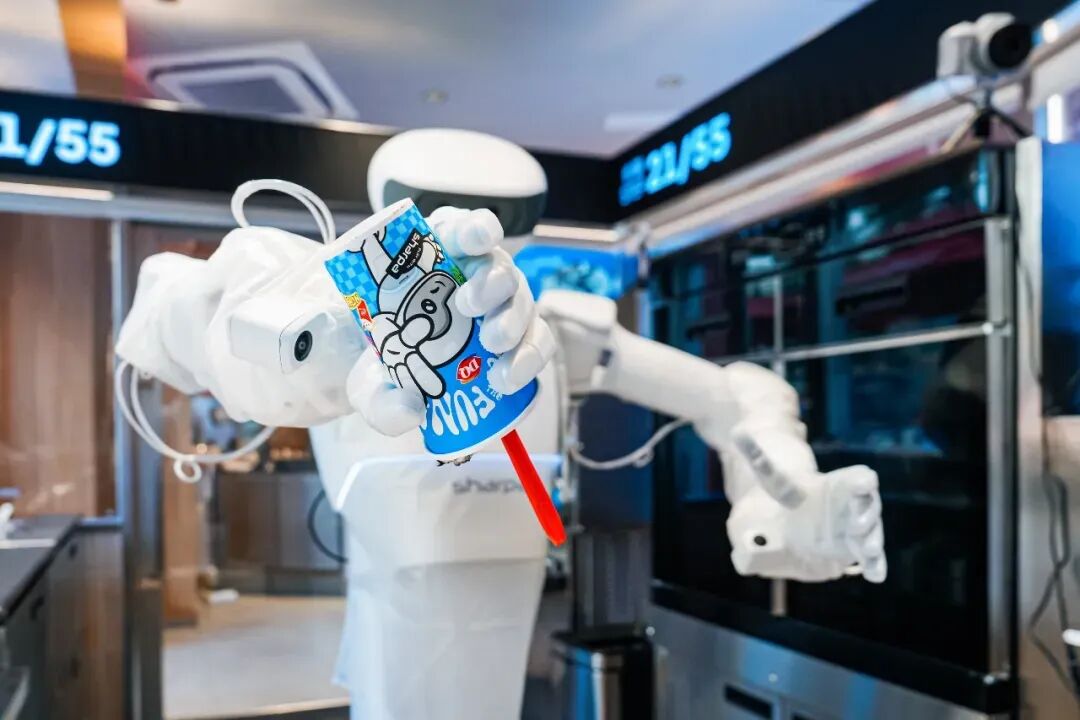
Editor's Note: As Embodied Artificial Intelligence continues to heat up, "deployment" has become the most frequently asked question over the past year. Qiming Venture Partners portfolio company Sharpa recently announced it has raised over 4.5 billion RMB in funding. At a DQ store in Shanghai, the company began pilot operations where its robot completes all 55 steps required to make a Blizzard — without modifying any existing equipment, processes, or ingredients. Starting from this cup of ice cream, Sharpa co-founder David Li sat down with GeekPark to share his systematic views on technical approaches, deployment standards, and commercial value for robotics: why "creating jobs for robots" through partial deployment can never cross the "kill line" drawn by specialized equipment; and why one scene must be fully mastered before skills can migrate to the next. Having personally witnessed the cost-down curve of lidar at Hesai Technology, he put it bluntly: "For general-purpose humanoid robots, there are only two end states: either omnipotent, or impotent."
Below is the original GeekPark In The Loop report, republished with authorization on the Qiming Venture Partners WeChat official account.

Over the past year, one of the questions most frequently asked of the robotics industry has been whether there has been any genuine deployment, any real progress toward commercialization.
By the standards of real stores, real orders, and continuous operations, the DQ project may already be one of the closer attempts at an answer. Yet by the business math of today, it clearly hasn't fully closed: the project is currently piloting at just one store, can only make a limited range of products, still takes longer than a human to make one cup, and the first-generation unit cost far exceeds human labor.
Sharpa co-founder David Li views this DQ pilot as a test whose results must be faced with "sincerity."
He divides the problem into two layers.
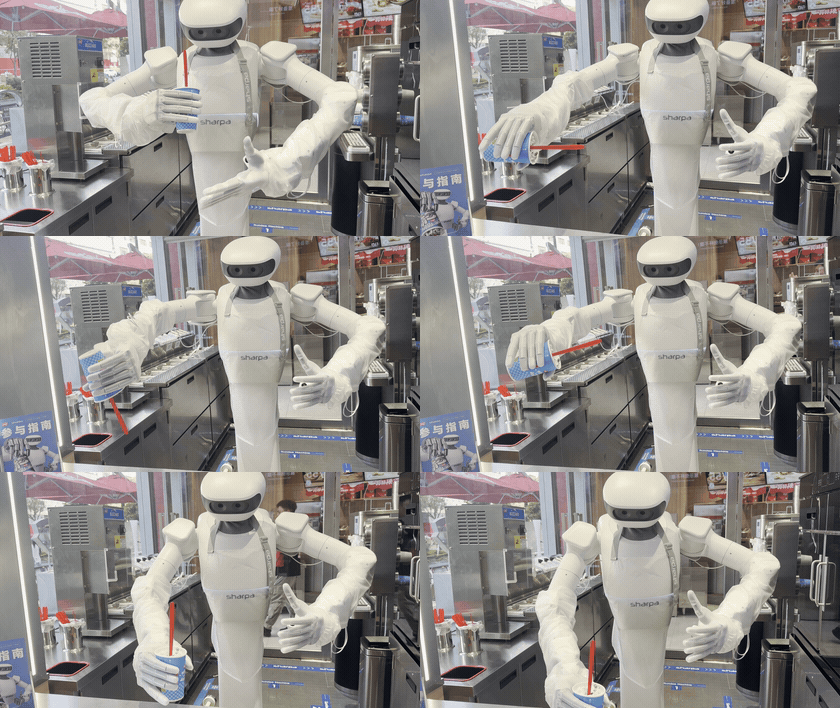
The first is "can it actually be done." No environment modifications, no artificial reduction of task difficulty — just put the robot into real operations and test it: Can it reliably complete 55 steps? Can it work continuously for 12 hours? If every day ends in chaos, then this technical path hasn't worked out, and the only honest response is to admit failure — what Li calls "failing sincerely."
The second layer is "can it be done faster and cheaper." In Li's view, as long as the "can do" capability threshold is crossed first, speed and cost reduction are two things that are "100% certain to happen and 100% certain to succeed." He has reason to say this. Li's previous venture was Hesai Technology — he personally walked the curve that took lidar from hundreds of thousands of yuan per unit down to today's thousand-yuan level.
Here, the word "sincerity" stands out with particular sharpness.
This relates to how the robotics industry currently defines "deployment." People have seen numerous robots claimed to be deployed, yet in many of these projects, the environment, equipment, and even workflows have been specially modified, and the robot may only be completing the final action in an entire automated process.
The project runs, but it's difficult to judge whether the robot learned to work, or whether people redesigned a job better suited to the robot.
Li compares this approach to "building phone booths": just because mobile phones aren't good enough yet, you construct phone booths everywhere in the city. Such projects can certainly run and may solve specific problems; but the capabilities robots learn are hard to leave that customized environment, and may not necessarily support high-value commercialization.
He doesn't deny the value of "building phone booths" itself. Dedicated automation can absolutely be a viable business. But packaging a tailor-made automation system as proof that general-purpose robots have entered the real world — that, in his view, is insincere.
What he wants to do is the opposite: have robots adapt to human environments, tools, and workflows as they exist, taking on jobs originally done by people without modifying the site; then migrating the capabilities learned from that job to the next scenario.
From this cup of ice cream, GeekPark sat down with Li for a conversation.
Sharpa recently announced its funding round — over 4.5 billion RMB. Investors include Qiming Venture Partners and other institutional and strategic investors.
In the past, he rarely spoke systematically as Sharpa co-founder about his views on robotics technical approaches, deployment standards, and commercial value. This time, he laid out the thinking previously scattered across product and technology choices in complete form.
Behind this lies Li's full set of judgments on robotics technical approaches, deployment standards, and commercial value: Why are general-purpose robots "either omnipotent or impotent"? What is the "kill line" drawn by automation? And why is the one thing the robotics industry should never do "creating jobs for robots"?
01/
General-Purpose Hardware Running General-Purpose Software
GeekPark: The outside world has always seen Sharpa as a dexterous hand company, but the DQ project actually demonstrates full robot and AI capabilities. How should we understand this?
David Li: Sharpa was never a company that only made dexterous hands from day one. There's a goal posted in our office: by 2050, use robotics technology to free up 20% of human time.
To achieve this, what we wanted to build from the start was general-purpose hardware and general-purpose software.
We led with the dexterous hand because at the time, there wasn't a good enough hand in the industry. If a robot can't operate human tools, no matter how smart the model above it is, it can't ultimately reach the physical world.
So we first designed the five-finger dexterous hand Sharpa Wave, which is our definition of general-purpose hardware. Hardware products are very intuitive — people can easily judge whether they're good or not — so the outside world remembered the hand first.
AI, by contrast, is invisible. Every company can talk about model architecture, data scale, and GPU count, and everyone thinks their AI is well done, but there's no unified standard in the industry.
So between something visible and easy to judge, and something invisible and rather chaotic, people only remembered the visible one.
In reality, the company's internal energy allocation was never like that — software and hardware are roughly split 50-50, and within hardware there are many products; the hand was just the first one to surface. Full robots are harder to build than you think, and data infrastructure is also harder than you think.
This time, we're presenting our own definition of general-purpose software: can it complete a real job from start to finish without modifying the environment? Can it execute repeatedly in actual operations? And after completing this task, can the learned skills be recombined for use in the next scenario?
GeekPark: When did the DQ project start? Why did you ultimately choose this scenario?
David Li: At this year's CES, we first publicly released our full robot North. After returning from CES, we began searching for real scenarios it could enter, and the DQ project started after that.
We set several conditions: the scenario must be real, a job must be fully completed, the operations can't be too simple; most importantly, we couldn't modify the original equipment, processes, ingredients, or tools.
We found DQ, an international brand with very strict standards, to partner with. DQ's equipment and operating procedures can't be casually changed, and the brand is very familiar to everyone. Only by running the project through under such constraints would it be convincing. When other brands see this system operating within DQ's standard framework, they'll understand what that means.
Food and beverage also has a practical advantage: people can directly see how the robot works and whether it does a good job — almost at a glance.
GeekPark: To human eyes, making a DQ Blizzard isn't complicated. For a robot, what are the real difficulties?
David Li: DQ isn't the hardest scenario, but it can't be called easy either. The difficulty isn't in any single action, but in the robot having to use equipment and tools originally designed for humans, without any site modifications, to complete 55 steps in sequence.
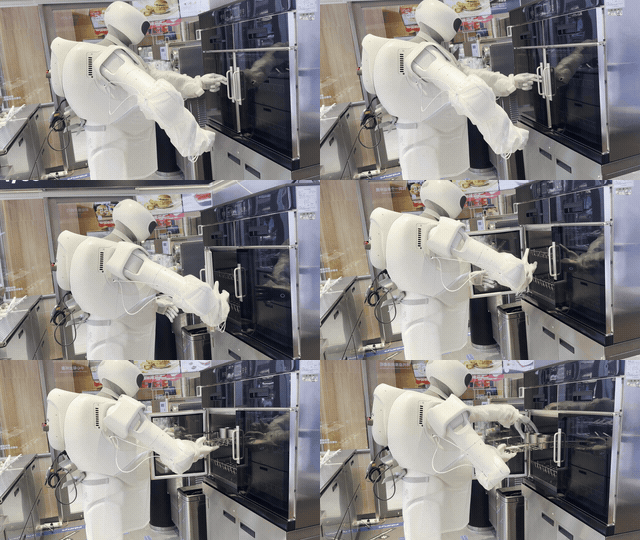
Many things here are naturally designed for human hands. The paper cup must be held steady without being crushed; the cabinet handle is narrow, requiring very precise finger grasping; spoons sit in a large cup and need to be picked out one by one — easy for human hands, but potentially very difficult for grippers.
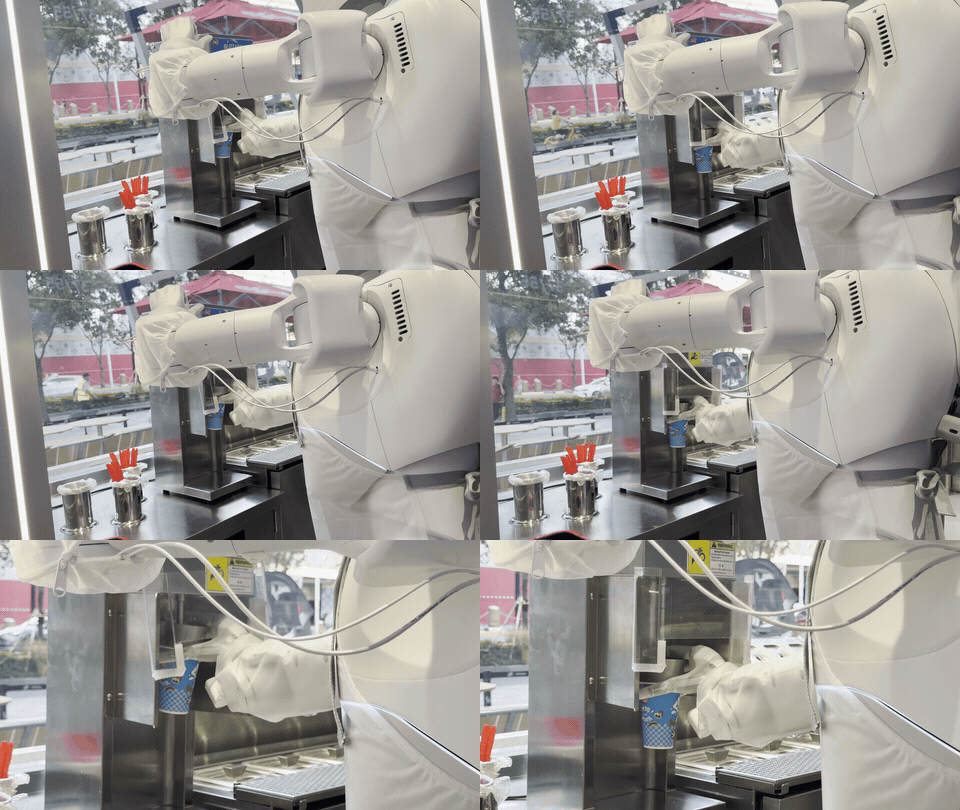
Mixing is another level of difficulty. The cup doesn't contain water, but clumped, highly viscous ice cream mixture. After the mixer starts, the cup experiences constantly changing pull force and torque. The robot must hold the cup steady without crushing it, while adjusting the cup's position, grip strength, and vertical movement amplitude in real time based on visual and tactile feedback — not simply replaying a fixed motion.
Any single action taken alone may not be particularly difficult; but connecting them all, and doing each step well, is hard. If any of the 55 steps fails, you can't deliver a complete ice cream.
If you modify the environment for every difficulty encountered: change it once for grabbing paper cups, again for picking up spoons, and again for flipping switches — it completely falls apart. The robot might make that one cup of ice cream, but the entire system becomes dedicated automation, not the effect we want.
What we care about most is fully completing a scenario without modifications, having the robot use original tools like a human would, and doing an entire job from start to finish.
GeekPark: By the standards of truly entering store operations, where is this project now?
David Li: Step one, and definitely an early step one. But it's not a weak step one.
Next generation we'll update the hardware; in the scenario we'll add different toppings and customized drinks, and work toward more food items — this DQ location also serves hamburgers, for instance.
The reason I emphasized fully completing a scenario is that when you do, what you get isn't just a pile of data, but skills for each sub-task within it. Later when making hamburgers or pizza, many steps can be recombined.
For example, making ice cream requires 55 steps. After the model breaks down these skills, a future 60-step hamburger task might find that 40 steps have already been learned, automatically placing those 40 steps and only needing human demonstration for the remaining 20. Later when making pizza, perhaps 18 needed steps have already been learned in previous tasks, so they can be directly recombined — learning a new task becomes increasingly faster.
I think this is the most straightforward definition of generalization: after doing one thing well, doing another thing takes significantly less time.
GeekPark: During the pilot, do engineers still need to be on-site watching?
David Li: Early on, definitely. On one side there are normal store staff, and on the other hand there are still people there early on because you still need to explain things to customers.
As for whether technical on-site presence is needed, we're still in the pilot phase and I'm not certain. But the standard is clear:
After running another month, if it needs changing at most once a week, I'd consider that not needing on-site presence; once a month would be perfect. If it's three times a day, then it's still on-site.
GeekPark: How will you increase cycle speed next?
David Li: There are two lines for increasing speed.
First is mechanical capability — how fast the hand and arm themselves can move. This is the fundamental physical limit. After the next-generation product launches, mechanical speed will improve significantly.
Second is model stability. Many people think robots are slow now because model inference isn't fast enough, but that's not actually the case. The model's control frequency can be very high. What truly limits speed is:
When actions speed up, can it still stably do things correctly.
This involves learning from non-expert demonstrations, the model's tolerance for out-of-distribution situations, and real-world reinforcement learning capabilities. The model currently isn't quite "skilled enough," so its "courage" can't be too great either. If speed is raised too much, cups may not be held steady and things easily drop. Since the store can't accept frequent errors, it can only go slower for now.
It's like when you first learn to drive. You start slow not because the car can't go fast, but because you aren't skilled enough yet — going fast leads to scrapes. Right now we first guarantee success rate; as training data increases and the model becomes more stable, we can continue accelerating without sacrificing success rate.
So cycle speed doesn't come just from switching to faster hardware, nor simply from increasing model inference speed, but from hardware speed and model stability advancing together.
GeekPark: What about cost? The first-generation full robot costs at least several hundred thousand yuan.
David Li: Sharpa is my second venture. The first was Hesai Technology, where we already fully experienced the process of hardware going from high cost to scaled mass production, with costs continuously declining through scale. To put it exaggeratedly, I reduced costs too much the first time, so I'm not too worried about cost reduction this time.
Many people misunderstand Chinese manufacturing, thinking things sell well because costs are low. But China's automotive supply chain, especially the smart vehicle supply chain, often works the opposite way: first the product is good, more people use it, volume grows, and then it becomes cheap.
The most critical thing is still getting the AI and tasks to work first. Once that works, volume comes up, and costs naturally come down. Speed and cost reduction are things I'm highly confident will improve over time.
02/
Robots: Either Omnipotent or Impotent — 90% Capability Is a Trap
GeekPark: You keep emphasizing fully completing a scenario 100%. But with current robot capabilities, often 90% can be completed and the remaining 10% is left to humans — isn't that also a form of deployment?
David Li: This is precisely a trap that's easy to fall into.
The difference between a 100% real scenario and a 90% real scenario is: as long as that 10% still requires a human, the person in that scenario cannot leave.
And that 10% isn't randomly leftover — it's often precisely the hardest part. You've done everything easy, and what's left are all problems you can't solve today.
So this isn't a state of "just a bit more to reach 100%"; often it's the stretch you can't cross.
A person originally did five things, and the robot replaces one for them — that doesn't mean you've created one-fifth of that person's value. The remaining four things still need to be done by them, so that person still has to be there — for whoever's actually paying, nothing has changed on the books.
90% is sometimes not close to 100%, but closer to 0.
We could make a robot very good at folding towels, but go to a hotel — is there a "towel-folding specialist"? No. The towel volume at any fixed location doesn't support a full-time job, and even centralizing all towels for one person to fold isn't necessarily faster than housekeeping staff folding them as they go.
There's even a more troublesome issue: the one task the robot took over was embedded in the person's original workflow. Their remaining four tasks have to wait for your one task to finish before they can continue — if you're slow, they have to wait beside you.
So the time you thought you saved isn't actually fully saved.
This isn't a case where there was originally a real job and the robot came to replace the person; rather, we first look at what the robot can do today, then carve out one action from the person's work for it, making it appear employed. I call this: creating jobs for robots.
GeekPark: But if you do one link well as a transition, doesn't that also create economic value?
David Li: There's actually no such thing as transition. Doing only one link leads to only two outcomes, and neither is a general-purpose robot.
First, you still want to be a general-purpose robot. Then you have to ask yourself: since you're only doing this one link, why use a humanoid form? What the customer sees isn't a general-purpose robot, but a piece of equipment doing this one thing. They won't pay more because you have two arms and a pair of hands — they'll only compare you against existing dedicated equipment already doing this task.
In that comparison you lose. The other side has three degrees of freedom total, simple structure, stable cycle, with costs already driven extremely low; you have dozens of degrees of freedom, plus tactile sensing and compute — how could you possibly be cheaper? It doesn't make logical sense. And the cost line for automation hasn't basically changed over the past ten or twenty years; it's a stable line with many suppliers and customers already participating.
I call this the kill line. Can a piece of dedicated equipment do what you're doing? If yes, you'll definitely be more expensive.
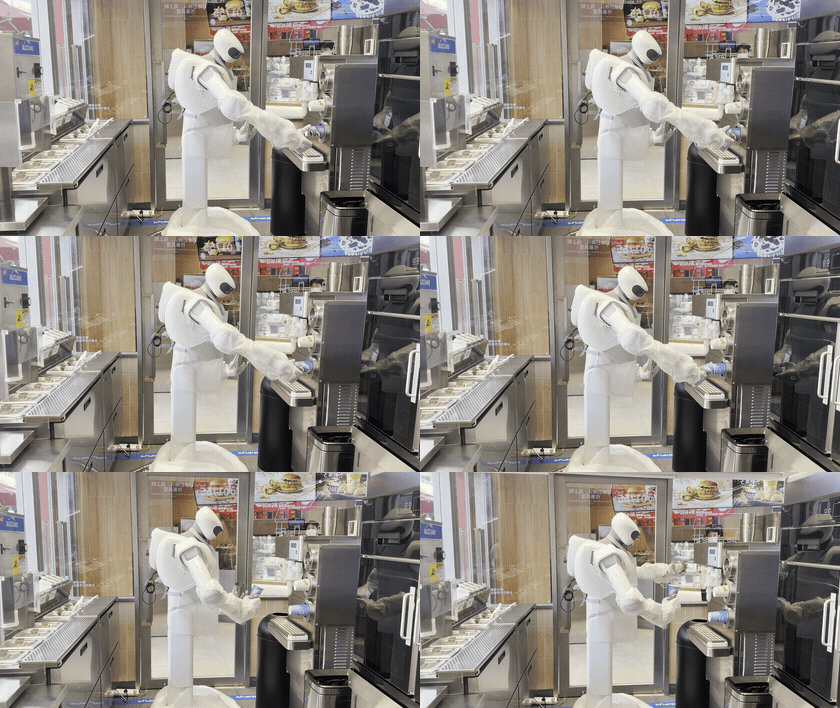
Second, you simply accept it: you're a piece of dedicated equipment, abandon general-purpose hardware, simplify the structure, and drive cost to minimum. This path is viable — I don't deny its value. But that's a different business, and not as valuable as people think.
Suppose there's a position dedicated to cutting onions, and you make an onion cutter to replace this person. This certainly creates value, but the boss won't pay you the saved salary — they'll just pick the cheapest onion cutter among several options and buy it. That profit goes to the boss, not the supplier.
When can the supplier capture it? When the thing is fundamentally complex, requiring special materials, special processes, special data — then there aren't many people who can do it.
So the profit you ultimately earn doesn't depend on how much people originally spent on this thing, but on how much they spent plus whether what you're doing is sufficiently unique and sufficiently difficult.
GeekPark: So you believe intermediate forms don't exist.
David Li: Yes. For general-purpose humanoid robots, there are ultimately only two states: either omnipotent, or impotent — no intermediate form.
When many people pursue intermediate forms, they think as long as they're more efficient than humans it works — faster, more stable, cheaper than a person at this action, so the thing is viable.
Actually no. Beating humans in comparison is useless, because you only took one task and that person still has to stay there, their salary still paid; while what you'll actually be price-compared against is dedicated equipment that can do this task — comparing generality against humans, price against equipment, you get neither advantage. This is the kill line: as long as you're doing one link, you'll always stand below this line.
So if you can't do omnipotence, whether in the AI world or the robotics world, you're actually closer to impotence, because the value you ultimately generate is uncertain. Once you don't do omnipotence, that kill line cuts you down to impotence.
03/
No Matter How Many Phone Booths You Build, You Won't Build a Mobile Phone
GeekPark: When people first started discussing humanoid robots in 2023, many believed in Elon Musk's logic: build a set of general-purpose hardware and have it complete as many tasks as possible. But as work progressed, fewer and fewer people in the industry stuck with this — robotic arms work too, grippers work too, just find a scenario to land in first. Why are you still on the original path?
David Li: I think this is fundamentally a technology stack choice. If because today's AI capabilities are insufficient, you decide to compromise on hardware generality and model generality, I can certainly understand — but then we're not talking about the same thing.
But look, from 2023 to today, even with all these compromises made, that "seemingly compromised and therefore deployable" thing hasn't actually materialized.
GeekPark: Some would suggest we first use human takeover to get things running, first having robots do part of the work — couldn't this be a way to deploy first?
David Li: Takeover isn't as useful as people think.
There are two types of robot failures: one is failing to do what should be done, stopping there while a human comes to complete the step; the other is doing what shouldn't be done. The latter is far more serious — it's not leaving 1% for humans to complete, but having already made a mistake, and the cost of cleaning up this mistake isn't 1%.
So takeover has a strong precondition: every time the robot encounters something it can't do, it must accurately stop before making an error. But real-world failures aren't this ideal. In many scenarios, without forming a 100% closed loop, you don't even know how to take over.
GeekPark: What about modifying the environment to let robots first bypass difficult parts?
David Li: Can't grab the spoon? Fix the spoon in place. Can't open the cabinet door? Redesign the handle. Can't do the full process? Break down the task until only what the robot can do remains. The project might finally run, but every modification bypasses a problem the model should have learned.
Internally we call this approach "building phone booths." The proper thing is to improve the mobile phone's capabilities so it can make calls anywhere; but because the phone isn't good enough today, you build a fixed phone booth everywhere. Phone booths certainly work, and can even be a good business, but no matter how many phone booths you build, the phone itself won't get better because of it.
So modification and generalization are often opposites. The capabilities you bypass to get today's project deployed faster are precisely the hardest things to make up when you later want to return to the general-purpose path. You think you just took a detour, but you may have already switched to a different road.
This is why the two words we most emphasize this time are "no modifications": no modifications to original equipment, no modifications to their production process — that is, recipes — no modifications to ingredients, not even that spoon can be changed.
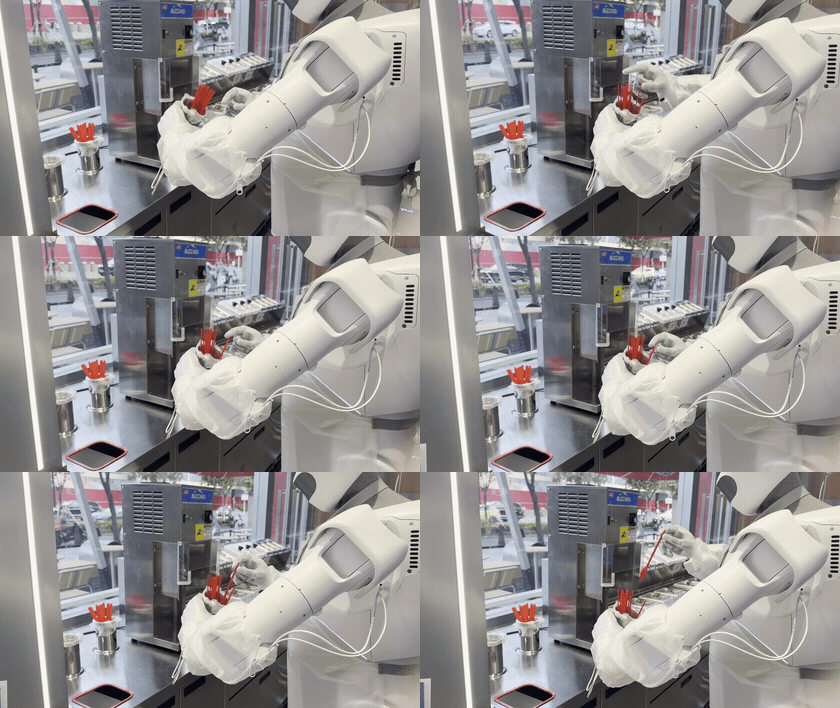
At the end of the day, you built an autonomous vehicle, but want to modify the roads for it — then autonomous driving was achieved long ago, why not just build trains?
GeekPark: I think the purpose of people's compromises is to have a deployable solution first to get robots out there, collecting data and revenue as they run, using such data to improve their general intelligence?
David Li: I think this is the biggest disagreement today.
Taking a general-purpose humanoid to do an extremely dedicated, repetitive scenario — what you essentially get is still dedicated intelligence. Whether this works depends on what you're deploying.
Suppose we learn 10 important operations at DQ, and another company learns 10 in a factory sorting scenario, with equally complex tasks — then the first step isn't fundamentally different; if they deploy faster than us, they did well.
Then comes step two. After we break down ice cream-making skills, next we make hamburgers, and 40 of 60 steps may already be learned, with only 20 remaining to demonstrate. The question for the other side is: can the 10 skills they learned continuously find next scenarios where they're reusable? If yes too, then we're tied, neither more advanced than the other.
But if what they did in the factory was just pick and place, forever moving one thing from here to there, then deploying in a hundred factories versus one factory is only a difference in quantity. The data they collected might just be how to pick up twenty different shaped objects. I find it hard to imagine that a model trained only on such data would naturally gain capabilities to operate other tools and complete other jobs.
So deployment itself doesn't create value; what creates value is whether what you deployed is sufficiently complex. Same factory, same hundreds of robots running — some are moving toward generalization, others are just doing the same thing hundreds of times.
And there's an even earlier judgment: do you actually believe intelligence is data-driven?
If you truly believe, then you should ask the next question: what kind of data grows general intelligence?
Running the same scenario a hundred million times, you get the extreme of that one thing — that's a good product curve, but it won't spontaneously grow a second thing. For generality, you can only tackle complex tasks scenario by scenario — first fully complete them, and after completion what you get isn't data for this one thing, but a set of skills that can be called upon by other tasks.
Beyond this, hardware, data, and models are connected. Using dedicated hardware to complete a dedicated task, you collect dedicated data, and the trained model will likely still be dedicated. It won't naturally become general intelligence just because you deploy more and more.
After our deployment, the data we receive is how five fingers coordinate, how force is applied, how grip strength is adjusted based on tactile feedback — these are what human hands do, so they can migrate to other tools and environments. Human tools and environments were designed for this hand in the first place.
So quantity of data isn't the point; what matters is whether what you collect from deployment is the kind of data that can become intelligence.
This already played out once in the automotive industry. Back then Cruise went straight for San Francisco — challenging the hardest first, because the information density in that data is highest. I can't say they were wrong.
Source | GeekPark Author | Li Yuan
Previous Reviews
Qiming Stars | Hesai Technology's David Li: Focus on Self-Developed High-Performance Products and Continuously Improve Operational Efficiency Qiming Perspectives | Qiming Venture Partners' Alex Zhou: Over the Next Decade, Robotics and Embodied AI Industries Will Develop Upward, with the Supply Chain Continuously Emerging Quality Entrepreneurial Opportunities Qiming Perspectives | Qiming Venture Partners' Alex Zhou: Crossing Technology Waves, Finding Business Inflection Points in the AI Era | WAIC 2026

Qiming Venture Partners was founded in 2006. Currently, Qiming Venture Partners manages 11 USD funds and 7 RMB funds, with total assets under management reaching $9.5 billion. Since its establishment, it has focused on investing in outstanding early and growth-stage companies in Technology and Healthcare Innovation.
To date, Qiming Venture Partners has invested in over 580 high-growth innovative companies, of which more than 210 have been listed on the New York Stock Exchange, NASDAQ, Hong Kong Exchanges and Clearing Limited, Shanghai Stock Exchange, and Shenzhen Stock Exchange, or exited through M&A and other means. Over 80 companies have become recognized unicorns or super-unicorns in their industries.
Among Qiming Venture Partners' portfolio companies, many have grown into the most influential companies in their respective fields, including Xiaomi (01810.HK), Meituan (03690.HK), Bilibili (NASDAQ: BILI, 09626.HK), Zhihu (NYSE: ZH, 02390.HK), Roborock (688169.SH), Hesai Technology (NASDAQ: HSAI, 02525.HK), UBTECH (09880.HK), WeRide (NASDAQ: WRD, 0800.HK), HyperStrong (688411.SH), Insta360 (688775.SH), Unisound (09678.HK), Biren Technology (06082.HK), Zhipu AI (02513.HK), Gan & Lee Pharmaceuticals (603087.SH), Tigermed (300347.SZ, 03347.HK), Zai Lab (NASDAQ: ZLAB, 09688.HK), CanSino Biologics (688185.SH, 06185.HK), Schrödinger (NASDAQ: SDGR), APT Medical (688617.SH), Sanyou Medical (688085.SH), AmoyDx (300685.SZ), Sinocelltech (688520.SH), Insilico Medicine (03696.HK), AusperBio, Yuanxin Technology, MediLink Therapeutics, Leads Biolabs, StepFun, and others.