MaHui Founder | Academician Weinan E Proposes a "New Dawn" for Applied Mathematics: AI for Science Deeply Integrates Artificial Intelligence with Fundamental Science

Looking forward to a thorough and in-depth discussion with everyone on the "AI for Science" trend!
#MaHui Entrepreneurs Resilient and Bold, Exploring Without End
AI4S, or AI for Science, marks a paradigm shift in scientific research driven by the convergence of artificial intelligence and scientific inquiry in recent years. Traditional disciplines from mathematics and physics to chemistry, materials science, and biology are undergoing rapid and profound transformation as a result.
From late June to early July, the inaugural Scientific Intelligence Summit "AI for Science: Co-creating the Future" will make its debut under the guidance of Beijing Municipal Science & Technology Commission. Hosted by the AI for Science Institute, Beijing and organized by MaHui member DeepWise, Source Code Capital will also take part in the forum on Opportunities and Challenges in Industrialization, where we look forward to having comprehensive and in-depth discussions with you on the development trends of "AI for Science." Stay tuned!
*See the invitation at the end of this article.
In 2016, AI and frontier basic science gradually began to merge, opening a new chapter for AI for Science.
Weinan E, academician of the Chinese Academy of Sciences, president of the AI for Science Institute, Beijing, and professor at Peking University's International Center for Machine Learning, together with his students Jiequn Han, Linfeng Zhang, and others, were among the first to recognize systematic opportunities at the intersection of machine learning and scientific computing, providing disruptive AI-based solutions to a range of fundamental scientific problems.
Weinan E is a towering figure in applied mathematics and computational science. His research spans an exceptionally wide range, from electronic structure and molecular dynamics to chemical reactions, fluid mechanics, and solid mechanics. His 2011 book Principles of Multi-scale Modeling stands as an authoritative text in the field of multiscale methods.
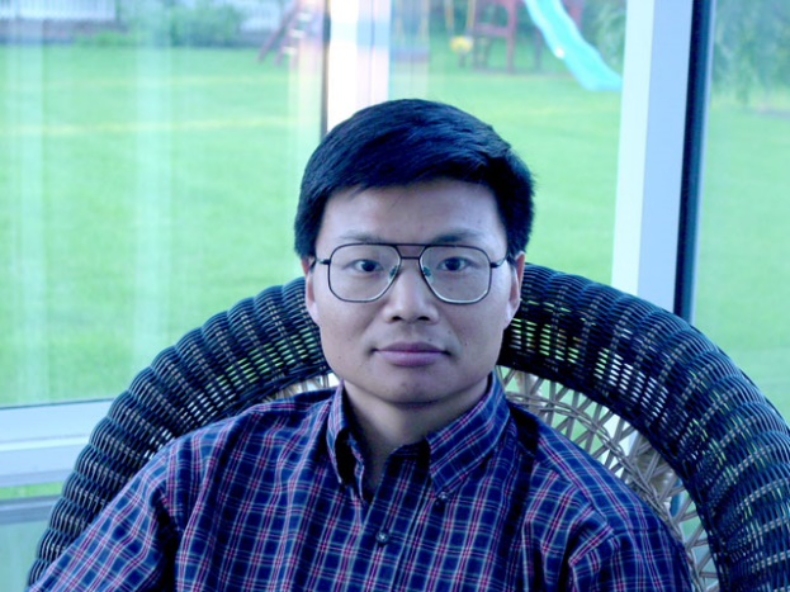
Photo | Weinan E, Source: Personal homepage
Weinan E received his undergraduate degree from the Department of Mathematics at the University of Science and Technology of China and earned his Ph.D. from the University of California, Los Angeles in 1989. He has served as a professor in the Department of Mathematics at Princeton University since 1999. He also became director of the Beijing Big Data Research Institute at Peking University in 2015.
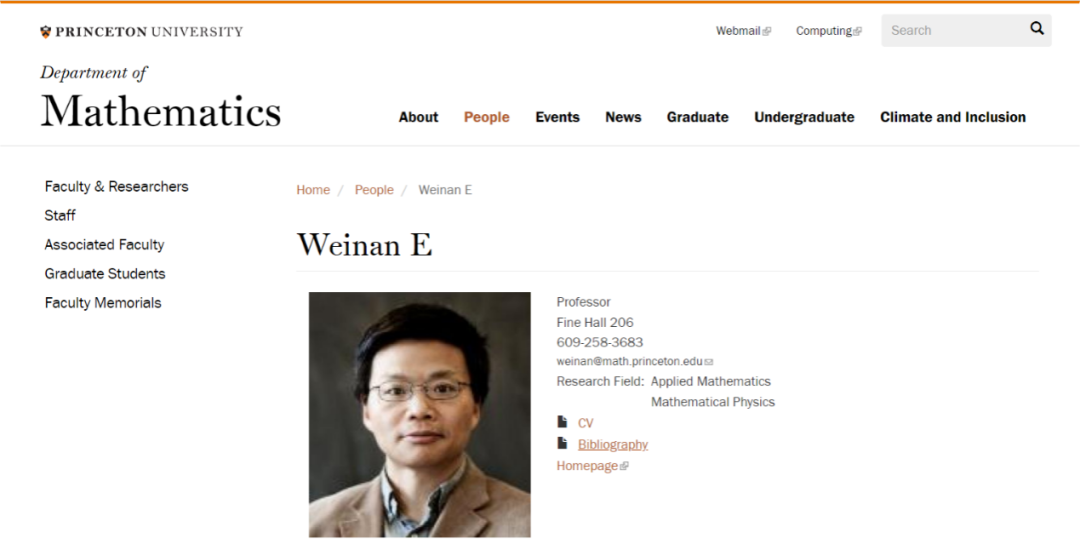
Photo | Weinan E's homepage at Princeton University, Source: Princeton University website
Currently, Weinan E's main research directions are the mathematical theory of machine learning and its applications in scientific computing and physical modeling.
In summarizing his own research, Weinan E wrote: "My work draws inspiration from different branches of science and impacts research in fluid mechanics, chemistry, materials science, and soft condensed matter physics." He seeks to clarify scientific problems through mathematics and has contributed to several long-standing scientific challenges, such as turbulence. He has also devoted himself to establishing mathematical frameworks for analyzing multiscale problems while developing and analyzing general-purpose algorithms. For example, the PEXSI algorithm he developed with collaborators dramatically accelerated computations in density functional theory (DFT).
In April 2021, Notices of the American Mathematical Society, the flagship publication of the American Mathematical Society, published Weinan E's perspective piece titled "The Dawning of a New Era in Applied Mathematics," which garnered widespread attention in the field. In it, he argued that we stand on the eve of a third great wave in applied mathematics — following Newton and John von Neumann — with machine learning bringing entirely new opportunities for studying high-dimensional problems. Applied mathematics, he contended, would become the foundation of interdisciplinary science and stand at the forefront of technological innovation.
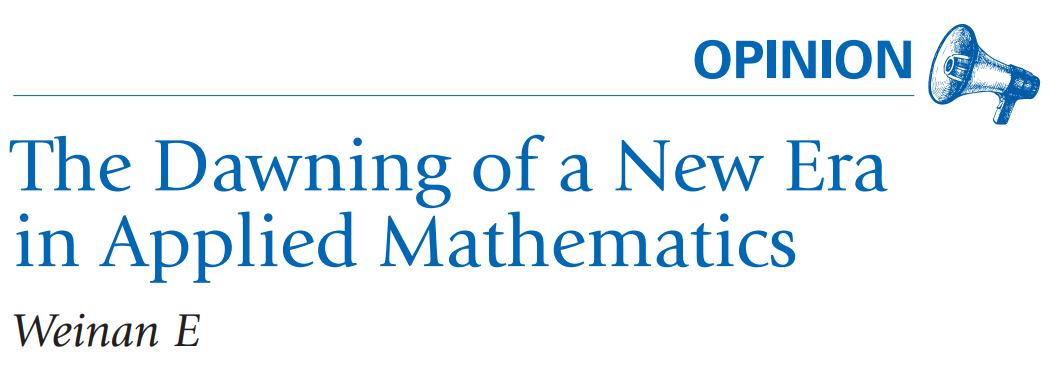
Photo | Cover of the relevant paper, Source: Notices of the American Mathematical Society
Deep Potential Team Wins Gordon Bell Prize,
Open-Source Project DeePMD-kit
Joins AlphaFold2 as a
New Starting Point for AI for Science
"What truly interests me are algorithms, and I hope to solve practical problems in science and engineering through computational methods — in physics, mechanics, chemistry, materials, and other fields," Weinan E said. Earlier generations of scholars developed a series of algorithms that solved many problems in civil and mechanical engineering; now we need to tackle more difficult challenges.
Weinan E began pushing for the use of multiscale models to address difficult problems in chemistry, materials, turbulence, complex fluids, and chemical engineering in the late 1990s. Later, he realized that a data analysis tool bridging lower and higher levels was missing — and machine learning happened to provide exactly that. Machine learning, he said, is indeed an effective tool for solving high-dimensional problems.
Weinan E offered several examples to explain the "curse of dimensionality," a problem that can only be solved through machine learning. The difficulty in computational chemistry lies in so-called high dimensionality. For instance, the most fundamental physical model in computational chemistry, the Schrödinger equation, is a typical high-dimensional differential equation. Its dimension — the number of degrees of freedom — is roughly three times the number of electrons. A physical system with 100 electrons would be considered extremely small, yet it corresponds to a differential equation in 300-dimensional space. Thus, even very simple physical systems involve extraordinarily high-dimensional Schrödinger equations. This gives rise to the "curse of dimensionality": computational cost grows exponentially with dimension, and classical computational methods simply cannot handle such problems.
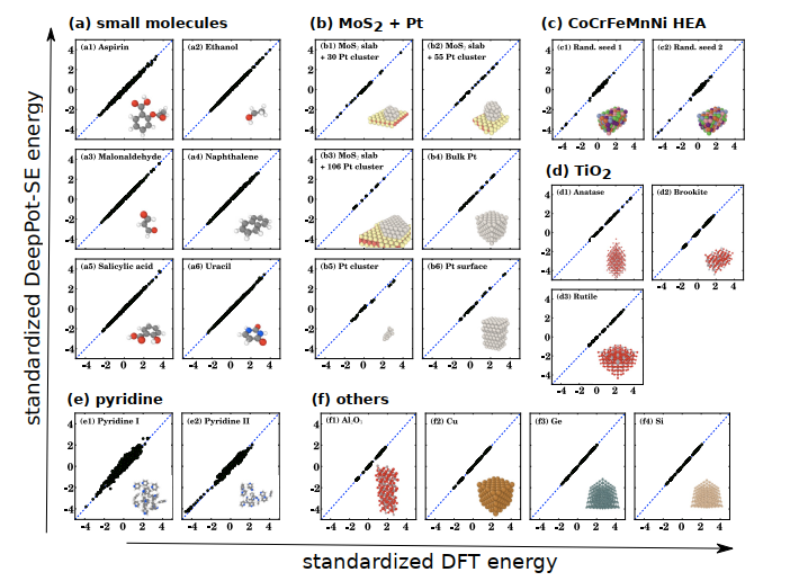
Photo | Related work, Source: NeurIPS-2018
However, machine learning can handle computer vision problems such as image recognition. The dimension of image space is enormous — each pixel represents a degree of freedom. A 32×32 pixel image already reaches 1,024 degrees of freedom, while a color image expands this by a factor of three. So image recognition deals with very high-dimensional functions. Classical methods could not handle such functions, but machine learning achieves excellent results.
"So, in a mathematical sense, deep learning provides a tool for approximating high-dimensional functions. The impact of this is enormous, because we encounter high-dimensional functions in many contexts," Weinan E summarized.
Weinan E has done extensive work in machine learning-based molecular dynamics research. He noted that molecular dynamics remained merely a mathematical tool or "toy" for a long time, initially of interest mainly to statistical physicists. Only when quantum mechanics was incorporated into molecular dynamics could computational accuracy be guaranteed and the attention of chemists and materials scientists be gained. Machine learning-based molecular dynamics follows the same principle.
The difference is that for classical first-principles molecular dynamics, each step requires calling first-principles models for computation, which is extraordinarily expensive. Machine learning-based molecular dynamics models do not require this; by generating a model similar to a classical force field, subsequent calculations can be performed directly using the machine learning model. Weinan E explained that this has two major impacts: first, we can now compute much larger systems with dramatically reduced computational cost; second, scenarios that were difficult for classical first-principles-accurate molecular dynamics methods can now be handled more conveniently. For example, research on thermal conductivity can now treat temperature more rigorously.
In 2020, the "Deep Potential" team, including Weinan E, received the highest honor in international high-performance computing: the ACM Gordon Bell Prize. They used machine learning methods to push the limit of first-principles-accurate molecular dynamics to 100 million atoms.
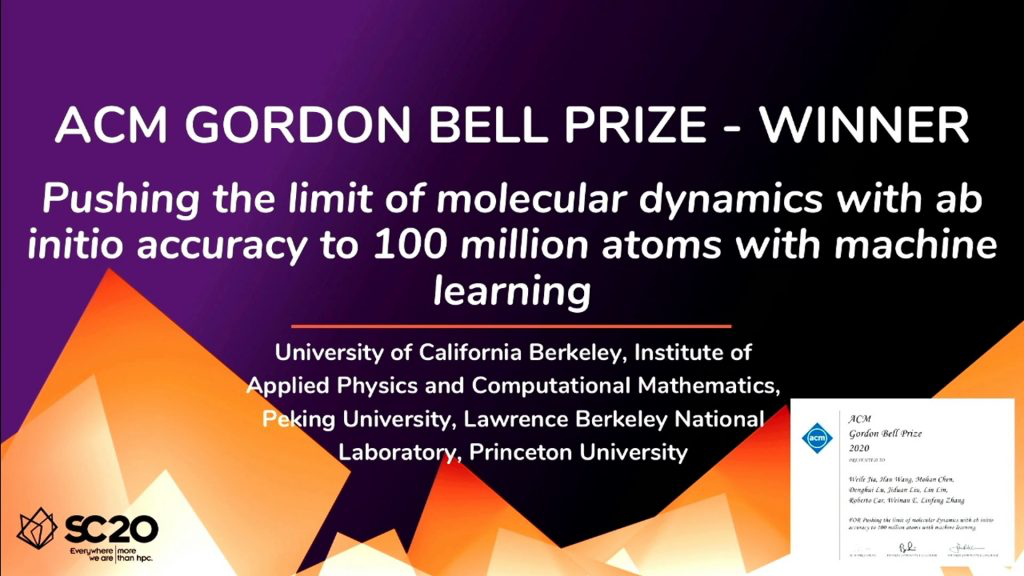
Photo | 2020 ACM Gordon Bell Prize, Source: Oak Ridge National Laboratory website
Weinan E noted that currently, there are two particularly prominent achievements in the AI for Science field. AlphaFold2 solved the protein folding and 3D structure prediction problem, while the "deep potential molecular dynamics" open-source project DeePMD-kit enables us to handle very large-scale first-principles-accurate molecular dynamics problems. DeePMD-kit applies AI to the fundamental principles of science, giving us entirely new tools. It is like a new kind of "electron microscope" — with such tools, we can do many things.
Weinan E said: "AlphaFold2's greatest contribution was making us realize that this could actually succeed. If we all believe it can be done, then I believe many teams can achieve it." Before this, no one realized that machine learning could help nearly completely solve the protein folding problem. However, AlphaFold2 is a purely data-driven achievement that does not involve physical models, whereas DeePMD-kit combines AI with fundamental principles and physical models — making it a tool with broader and more widely applicable value.
Enterprise-Research Institute-University Collaboration
Building an "Android"-Like Platform Model,
AI Will Make Great Strides in Traditional Science
Many believe that AI's real-world applications have not been as successful as imagined, for two main reasons: first, AI is not easy to use — the barrier to entry is too high; second, AI has not yet penetrated deeply into the real economy, where it currently serves as a nice-to-have rather than a must-have for manufacturing. "Traditional science is where AI has greater room for development. I firmly believe this is correct," Weinan E said. "AI for Science not only helps solve numerous scientific problems but is also a crucial part of driving manufacturing transformation and real economic development."
AI for Science requires both breakthroughs in scientific computing theory and full integration with AI. Many feel that from an AI perspective, there haven't been too many breakthroughs in the AI for Science field, but Weinan E disagrees. Compared to traditional AI applications such as computer vision or natural language processing, applying AI to science presents fundamentally different challenges. The organic integration of AI with physical models is absolutely critical.
Weinan E pointed out that insufficient communication between theoretical research, experimental research, and industry is a major obstacle to AI for Science development. For example, in computational chemistry, relatively little communication occurs among theoretical chemists, experimental chemists, and those developing products such as drugs, mainly because their work does not overlap much.
Weinan E explained that in the past, due to tool limitations, teams largely worked independently in a "small workshop" model — a theoretical materials research team would cover everything from first-principles calculations to force field models, molecular dynamics computations, and data analysis. The problem with this model is inefficiency. Since there are relatively few fundamental physical models — mainly quantum mechanics, density functional theory, molecular dynamics, and so on — it is both important and feasible to collaborate on developing a universal, high-precision, and efficient model, thereby creating a platform-based model. This way, different researchers can use this model for various applications. Just like "Android." But building such a platform is not easy; it involves algorithm development, model refinement, software implementation, and many other issues — which is why collaboration is essential.
Weinan E further explained that future scientific development must adopt a platform-based research model, and infrastructure construction is essential — just as industrialization would be impossible without roads and railways. The AI for Science Institute, Beijing that he leads focuses primarily on building platform-based tools. Furthermore, enterprises can provide real-world scenarios and identify pain points and key problems to solve. Meanwhile, university research institutions are the intellectual source for solving these problems. The tripartite collaboration of enterprise-research institute-university is crucial. The Scientific Intelligence Institute serves, in some sense, as a bridge.
Based on this philosophy, Weinan E and others established the International Center for Machine Learning at Peking University, aiming to tackle the most fundamental machine learning problems and aspiring to make it one of the most influential machine learning research centers internationally. This center maintains close ties with the AI for Science Institute, Beijing.
AI for Science Development
Needs Young People Who Want to Do Great Things,
Even More It Needs Rational Voices
Regarding talent cultivation in AI for Science, Weinan E also has considerable insights. First, as the saying goes, "even the cleverest housewife cannot cook without rice." He believes the most important thing is having young people who want to accomplish great things and have a strong desire to contribute to society. Weinan E said: "What I'm relatively good at is bringing such young people to frontier fields and helping them find platforms and room for development."
"I'm somewhat concerned lately. I've had considerable contact with undergraduates recently and found that involution and lying-flat phenomena are quite serious. Students are also generally unwilling to initiate communication," Weinan E said.
For ambitious students, we need to cultivate an open mindset and guide them to hold themselves to high standards, because a person's growth cannot exceed the standards they set for themselves — so don't set your ceiling too low. Additionally, a solid academic style is indispensable.
Regarding his own approach to mentoring students, Weinan E said: "My students typically choose their own broad research areas — mathematics, mechanics, materials, physics, chemistry, or economics — and I generally help them identify specific directions and entry points. I impose few restrictions on students and don't limit their fields; as long as it's truly needed for social development and scientific research, anything goes. Often my learning method is to have students teach me. Relatively speaking, I'm a 'slow' learner. My advantage lies in having seen more and more broadly, allowing me to play a role at critical junctures."
Furthermore, Weinan E noted, "Domestically, I hope to see more solid work rather than various pie-in-the-sky publicity. I worry that various forces, including capital and publicity, will quickly trivialize the AI for Science field."
There is much froth in the broader environment, which is very dangerous. Once foamy voices dominate, resources become difficult to allocate to those who are actually doing the work. "I hope the voices of teams doing serious work can be heard, thereby gaining more resource allocation. I also hope to use my very modest strength to push young people who are truly doing things to the front lines," Weinan E said. "Overall, we need to view and support the development of AI for Science more rationally."
From the "Ivory Tower" of Research to the Front Lines of Entrepreneurship, Accelerating the Industrialization of Basic Science Innovation
Weinan E shared that "before 2014, I was a standard researcher living in an ivory tower, and my students were basically the same. When I started researching big data, I realized that big data must be grounded in reality, and one of the most important means of grounding it is entrepreneurship. From that point, my attitude toward student entrepreneurship began to change."
He cited his student Linfeng Zhang's founding of DP Technology as an example: as a researcher, Zhang was already very mature upon graduation. He received offers from many universities at home and abroad. Had he followed the conventional academic path, he would have had to write numerous grant applications to build a team, which might have taken three to five years to establish. But by choosing entrepreneurship, this process becomes much faster. On one hand, he could quickly build a strong research team; at the same time, he could do both cutting-edge research and practical implementation. This would be difficult to achieve without entrepreneurship. Additionally, another of Weinan E's students, Cheng Tai, together with classmate Linpeng Tang, founded Morq Technology, which has become a leading AI foundational technology and platform company. Using entrepreneurship to pursue the most frontier research is the new path that Morq Technology and DP Technology have forged.
Recently, the inaugural Scientific Intelligence Summit, hosted by the AI for Science Institute, Beijing and organized by DeepWise, will be held in Beijing with the theme "AI for Science: Co-creating the Future."
Weinan E said the summit's main purpose is to establish AI for Science as an important development direction. More importantly, through rational discussion, it will examine how we should proceed in the future to achieve our goals, thereby promoting rational development of AI for Science in China and internationally, while attracting a cohort of young people to participate.
During the interview, Weinan E mentioned that another key research focus for him now is developing next-generation AI algorithms. He said that current deep learning still has certain limitations, and how to develop more effective and more usable AI methods should be a key focus. On another front, Weinan E is also paying considerable attention to control theory research related to industrial scenarios and promoting AI's role in this area.
Weinan E will deliver a speech at the main forum of the inaugural Scientific Intelligence Summit. We look forward to hearing him share his latest research work and his unique and profound reflections on the future of AI for Science.



- MaHui Entrepreneurs | From 0 to 1 to 23.4 Reading Week: "Happy Reading Day"
- MaHui Entrepreneurs | From 0 to 1 to 23.4 Reading Week: "The Beauty of Reading"
- MaHui Entrepreneurs | From 0 to 1 to 23.4 Reading Week: "General Knowledge and Big Picture"
- MaHui Entrepreneurs | From 0 to 1 to 23.4 Reading Week: "Organization and Talent"
- MaHui Entrepreneurs | From 0 to 1 to 23.4 Reading Week: "Strategy and Operations"
- MaHui Entrepreneurs | From 0 to 1 to 23.4 Reading Week: "Entrepreneurial Thinking"
- MaHui Entrepreneurs | Exploration Never "Extinguished," Saluting the Spirit of Aerospace
- MaHui Entrepreneurs | That Moment of Your "Joy, Anger, Sorrow, Happiness" May Awaken 2 Million Children with Autism
- MaHui Entrepreneurs | Sleep Well, Then Go Explore a More Awake Entrepreneurial Life
- MaHui Entrepreneurs | When Entrepreneurship Becomes Their Way of Life