"Code Brain" "Standing Together Against COVID-19" Series Session Four: Reverse Thinking — How Entrepreneurs Should View the Pandemic From a Different Angle

Guest: **Zhou Yahui**, Founder, Chairman, and CEO of OPay
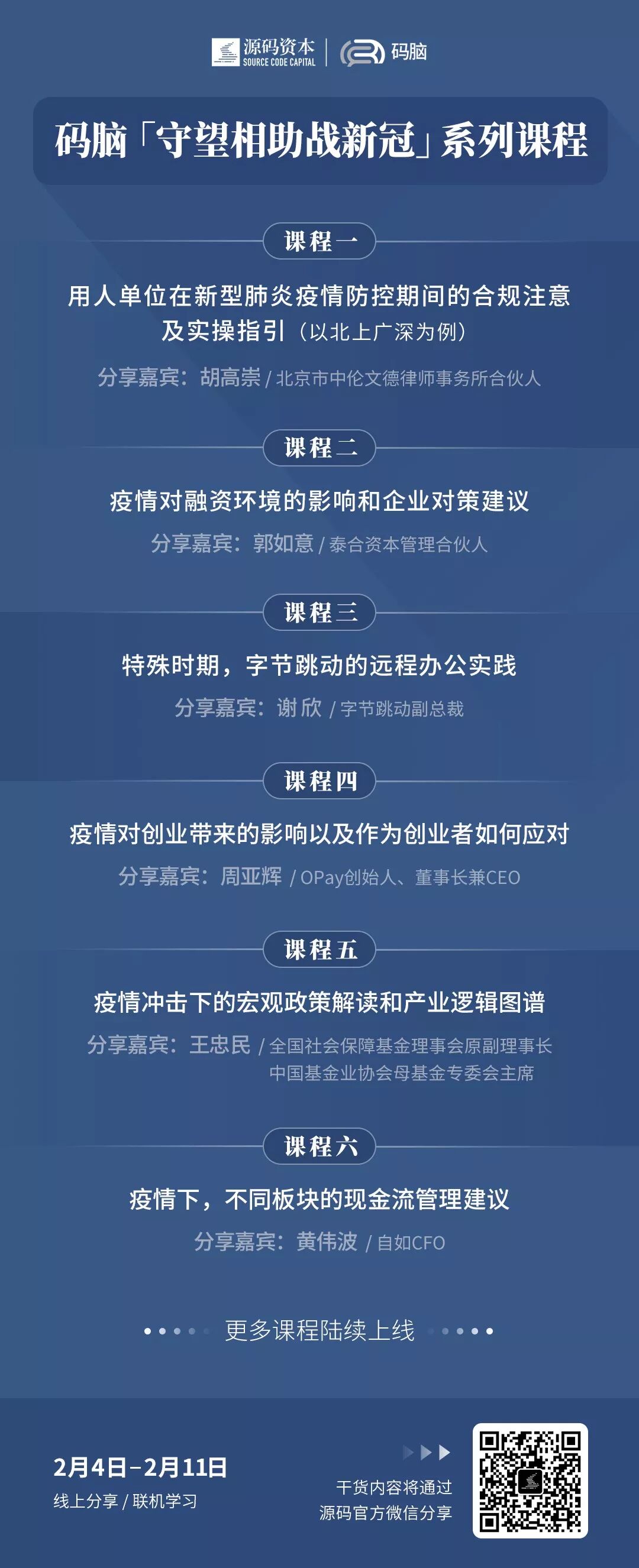
As the pandemic deepened, every sector of the national economy came under enormous pressure. On one hand, healthcare systems and logistics supply chains urgently needed expanded capacity; on the other, online education and remote work became essential needs. Market demand and business models were quietly shifting — new opportunities were emerging from the crisis. To address the new landscape under COVID-19, Source Code Capital's post-investment services team organized the Code Brain "Standing Together Against COVID-19" webinar series. From February 3 to 11, we invited experts and industry leaders to share insights online on topics including employee leave and return-to-work policies, startup financing, remote collaboration, cash flow management, and leveraging government policies — offering intellectual support to Source Code Capital community members from multiple angles, easing anxieties and facing challenges together.
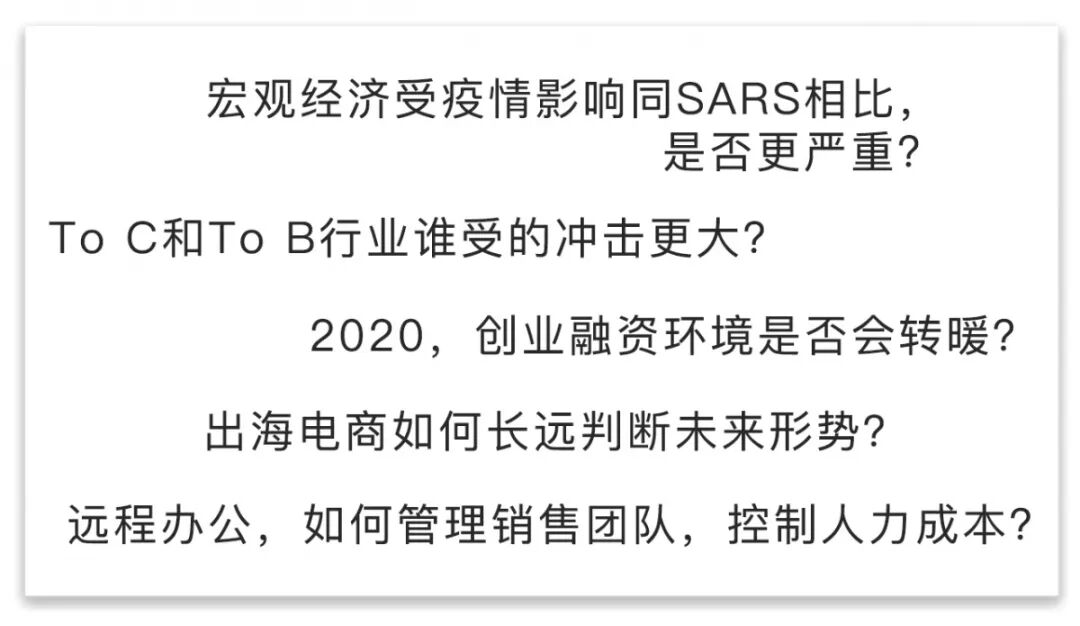
With these questions in mind, Zhou Yahui analyzed the changes happening across specific industries and the financing environment, and how entrepreneurs could better respond. He also shared his personal experiences of going through three major "disasters": the 1996 Lijiang earthquake, the 2003 Beijing SARS outbreak, and the 2020 COVID-19 pandemic.

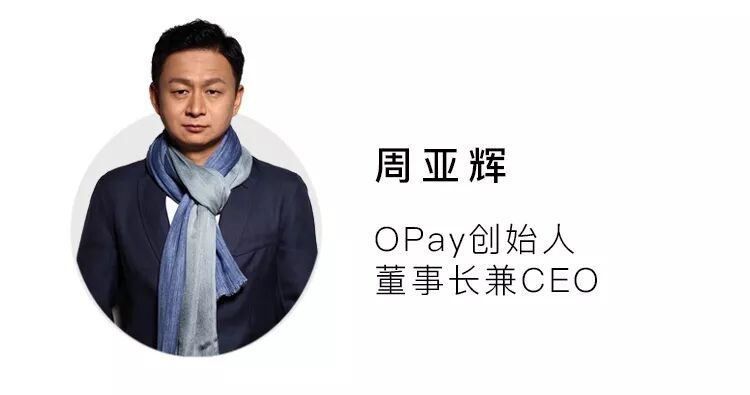
An accomplished entrepreneur and investor, Zhou Yahui founded Kunlun Tech in 2008 after graduating from Tsinghua University and pursuing serial entrepreneurship. Kunlun Tech focuses on "building leading overseas social media and content platforms" and successfully IPO'd on the Shenzhen Stock Exchange in 2015. Its acquired browser company, Opera, listed on the US Nasdaq in July 2018. In 2018, Zhou founded OPay, a one-stop electronic financial services platform dedicated to transforming Africa through technology.

-
Entrepreneurs should learn to use reverse thinking, approaching this pandemic from a different angle.
-
For all entrepreneurs, macro factors will never affect us as much as micro factors do. The micro level is the daily work content and problems that need solving — these matter more to us.
-
Just do what you need to do. When entrepreneurs throw themselves wholeheartedly into work, sometimes you don't even perceive the impact of external events.
-
On financing, I don't think you need to be so nervous. Fundraising will definitely be difficult — at least in the first half of the year. It's common sense for companies to have 12 months of cash reserves, and ideally be able to generate their own cash flow.
-
Looking at the long term, everyone is still looking at China's fundamentals. My biggest concern is whether this will lead to reduced international investment in China.

The Pandemic's Impact on Macroeconomics, Industries, and Financing
The macro environment is definitely more severely affected by this pandemic than SARS. Next week, over 50% of companies in Beijing still won't be in the office — they'll still be working remotely. It'll take at least another two weeks after that to return to normal.
Looking at the long term, everyone is still looking at China's fundamentals. You've probably seen the Ren Zeping team's forecasts for current macroeconomic growth online. I think the pandemic should end by March, and most companies, including government agencies, should return to work around February 17. On the contrary, not many companies will be back next week. Right now it looks like we're in the first scenario — effective containment, relatively short duration, with China's annual GDP growth possibly dropping from around 6% to about 5%.
Under the pandemic, some industries are definitely hit particularly hard, while others benefit significantly. For example, in my gaming business, online data for virtually all games has doubled. Online education, online audio and video, and online fresh grocery are also relatively well-positioned. But other businesses that require salespeople on the road or depend on offline sales will be more severely affected.
I'm both an investor and an entrepreneur — currently spending 90% of my time on OPay. There's been a lot of advice that companies should prioritize cash. In the past two weeks, investors have reached out to me, asking most frequently whether the pandemic has affected me, then sending materials emphasizing the need to guard cash and do down-round financing. It's gotten a bit tiresome.
Right now, consumer-facing businesses are more heavily affected. But whether B2B or B2C, everyone should focus on customer acquisition costs, conversion rates, and ROI, and try to move as much business online as possible. During this period, China's supply chain will be affected — right now many goods can't be shipped out, and neither Shenzhen nor Zhejiang can fulfill orders. Many employees are quite anxious at this time; if not mandated to come into the office, the vast majority won't. How to coordinate at this time — everyone has relatively more experience with this, so I won't elaborate.
On financing, I don't think you need to be so nervous, because fundraising will definitely be difficult — at least in the first half of the year. It's common sense for companies to have 12 months of cash reserves, and ideally be able to generate their own cash flow. Actually, my biggest concern is whether this will lead to reduced international investment in China. In the second half of 2019, I already clearly sensed that international investment in China was decreasing. Whether this trend accelerates in 2020, with money shifting to Southeast Asia and South Asia instead — this is something I haven't fully figured out, and have been thinking about. There are other dimensions too, like advance prediction, adapting to changing circumstances, capturing government policies, and grasping development patterns. The chart below reflects the sharp decline in financing starting from 2019.
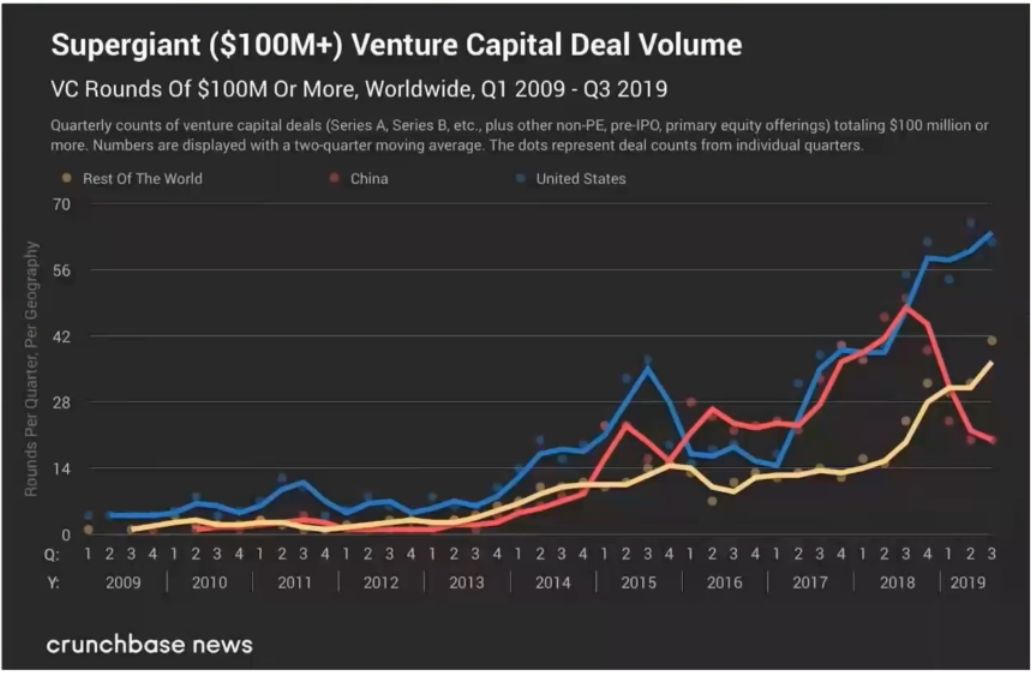
Image source: Crunchbase
Entrepreneurs Should Approach the Pandemic with Reverse Thinking
Let me start with three short stories. Counting this one, I've actually been through three particularly major "disasters."
The first was in 1996, my first year of university. During the winter break for Spring Festival, I returned to my hometown in Lijiang, Yunnan, just as Lijiang was struck by a magnitude 7.0 earthquake. Experiencing an earthquake for the first time was quite frightening — the entire city's population was living in tents pitched outdoors. I found sitting in the tents all day quite boring, and with youthful vigor wanted to do something for society. On the third day, I organized all the university students studying out of province and went to the front lines of earthquake relief in rural areas. For the next two weeks, I was in the countryside building roads, clearing obstacles, and rescuing people. When I returned to the tents two weeks later, you could see that everyone else was essentially doing nothing every day — just panicking, worrying, or feeling at a loss. If at that time you went and found something to do, time actually passed quickly, and you wouldn't even have time to think about how this affected you personally or your business — you simply wouldn't consider it.
The second was SARS. When SARS broke out, I was running a startup called Huoshen Interactive, a social network company based on animation. I remember it very clearly — at the time I didn't realize how serious SARS was, and I was still constantly going out to meet clients. Beijing's subway and buses weren't suspended then. The entire car of Beijing's Line 2 would be completely empty; I'd ride a full loop and come back. That's how I got through it.
This is the third time. Perhaps because I'm older now, I've actually felt quite nervous this time, thinking the pandemic seems quite serious. Now I might not dare to take the subway or train. Later I wondered why? On one hand, I'm older and more cautious; on the other, it has to do with media — public discourse is more developed than before.
To summarize, what do I want to illustrate with these three stories? I think we need reverse thinking, we need to view the pandemic positively. This pandemic has given me the longest stretch of time with my parents in 20 years, and I've quite enjoyed it. My parents are in their 70s and still cook for me every day. It's rare to have enough time to be with them — that's quite nice. Regarding much of the news in public discourse lately, I don't even know the full context. Why is that? Because I'm too busy — where would I find time to look at these things, scroll through news, and so on. I think we should approach the pandemic from a different angle. I think just do what you need to do. When entrepreneurs throw themselves wholeheartedly into work, sometimes you don't even perceive the impact of external events. I'm busy with work every day, in meetings all day, and when I have a little time I spend it with my parents, chatting and eating with them. People really just have a few things: eating, sleeping, working every day — that's life.
For entrepreneurs, because work takes up such a large proportion of time, I think it's hard to pay attention to these macro-level things. Look at the pandemic from a different angle, try to discover what's different from your previous rhythm of life and work, and try to appreciate its positive aspects. For all entrepreneurs, macro factors will never affect us as much as micro factors do. The micro level is the daily work content and problems that need solving — these matter more to us. Macro factors aren't actually that important for us; sometimes just try to "do what you need to do." Eat when you need to eat, sleep when you need to sleep, work when you need to work, live when you need to live — let everything else follow its natural course.

Q1: What impact will the pandemic have on startups' international expansion, such as cross-border e-commerce?
Zhou Yahui: For cross-border businesses, this pandemic will have relatively significant impact. Many good companies have strong predictive capabilities. When we discussed this on January 29, a colleague shared YY's policy: all expatriate employees had to be deployed and on-site in their assigned countries before February 1. Because they predicted that various countries might quickly restrict entry and exit for Chinese nationals. After we learned this, we immediately notified all expatriate employees that they must depart for their assigned countries before February 1. As you can see, starting February 2, various countries began restricting entry and exit for Chinese nationals — this is a matter of predictive capability.
For the e-commerce industry as a whole, I believe domestic e-commerce will far exceed cross-border e-commerce. Because international trade is increasingly affected by tariffs, virtually all major countries hope to use tax, fiscal, and monetary policies to encourage the growth of their domestic manufacturing share, so domestic e-commerce will become increasingly large. For individual merchants, it mainly depends on how to solve logistics problems. In the long term, I think the high-speed growth of cross-border e-commerce will be somewhat affected, and these companies need to think more about how to build brands rather than purely doing trade.
Q2: How should we manage organizations and improve organizational efficiency in the remote work era?
Zhou Yahui: I've been an entrepreneur for 20 years. Sometimes I feel that management gets overly complicated, making it hard to learn good management. Personally, I think management should be explainable in one sentence. I believe remote work means making all your work revolve around video conferencing. As long as you solve this problem and learn to use video conferencing systems better, all other remote work issues will naturally resolve themselves.
Q3: What are the most critical issues entrepreneurs need to pay attention to during the pandemic, and what risks should they guard against?
Zhou Yahui: Entrepreneurs should be a group that's different from the rest. I can't answer what specific issues you need to watch out for. What I want to say to entrepreneurs is: at this time, entrepreneurs should use different angles to think about how to respond to the pandemic, how to perceive its impact on your own company, how to come up with innovative methods to solve these problems, and how to adjust strategy and execute tactics.
Q4: The pandemic will accelerate industry differentiation and consolidation. Should cash-rich companies now consider industry consolidation?
Zhou Yahui: I personally believe that companies with valuations below $1 billion shouldn't consider consolidation. First and foremost, consider how to grow and how to control costs.
Q5: What adjustments can be made for B2B business sales? Should we collect two-year contract payments, or accelerate payment collection cycles? Any good strategies for new sales?
Zhou Yahui: I haven't run a B2B company before; I'm currently working on my first one. At a detailed level, I think collecting two years of payment is much better than collecting one month, but why would a customer suddenly give you two years of contract payment upfront? That becomes another difficult problem — of course customers prefer to pay less. I think B2B has always developed relatively slowly in China, and an important question is whether B2B companies have truly切入刚需 (tapped into rigid demand). If you've切入刚需 markets, growth can still be quite fast. The fastest growing market in the past year has been e-commerce ERP, because for all e-commerce companies it's a SaaS service they have no choice but to purchase. For those doing B2B entrepreneurship, this is a time to calm down and think about how well your product and service match user needs.
Q6: How do you manage sales teams when you can't meet in person?
Zhou Yahui: For sales teams, just call them every day to push them, ask them about today's numbers, video with them daily, apply pressure. Sales is a job that very much tests execution and aggression. Keep tabs on a few people every day asking about progress, analyze and discuss together, offer improvement suggestions. Then have them transmit that pressure to the next level down — that's the simplest method.
Q7: How do you reduce labor costs?
Zhou Yahui: If salary pressure is currently too high, you can negotiate whether to adjust temporarily and restore it next year. You can also try allocating stock options or optimizing personnel structure. Actually everyone knows there are just these few methods — it's just a matter of whether you have the judgment and determination to execute them. Wanting to reduce costs without being willing to take measures is impossible.
Comments and Discussion
We also welcome entrepreneurs to interact with us in the comments section — leave the issues you care about, and we'll select representative questions for Mr. Zhou Yahui to answer in follow-up.

Code Brain "Standing Together Against COVID-19" Series Content
- Compliance Considerations and Practical Guidance for Employers During the Novel Coronavirus Pneumonia Epidemic Prevention and Control Period (Using Beijing, Shanghai, Guangzhou, and Shenzhen as Examples)
- Impact of the Epidemic on the Financing Environment and Strategic Recommendations for Enterprises