Code Brain | The Origins and Destinations of Carbon

Here's to helping you better understand the significance of "dual carbon."
**
#Code Brain Ecological Connection, Cognitive Resonance
"Carbon emissions" is a blanket term for greenhouse effect gases. We typically use "carbon dioxide," the main component of greenhouse gases, as our quantification metric. Therefore, the essence of "carbon reduction" is "reducing carbon dioxide." Currently, global carbon emission trends are concerning. After a 5% drop in 2020, global CO2 emissions rebounded sharply in 2021. According to the International Energy Agency's Global Energy Review: CO2 Emissions in 2021, global CO2 emissions reached 36.3 billion tons that year, an absolute increase of over 2 billion tons — a 6% rise compared to 2020.
In 2021, Nobel Prize in Physics laureate Syukuro Manabe's radiative-convective equilibrium model quantified carbon dioxide's impact on temperature, showing that doubling CO2 concentration would raise global temperatures by 2.36°C. The trend of global warming already threatens human daily life, most notably through extreme heat causing crop failures. Research published in PNAS in 2017 showed that for every 1°C rise in global average temperature, yields of wheat, rice, corn, and soybeans would drop by 3–8%; compared to 2020, the number of people facing food crises or food insecurity grew by nearly 40 million in 2021. The greenhouse effect is profoundly impacting ecosystems worldwide — carbon reduction action is urgently needed.
The Paris Agreement, signed by countries in 2016, elevated humanity's response to climate change from scientific understanding to political consensus. China has actively responded to the Paris Agreement on Climate Change. After proposing the "30·60 targets," it laid out clear pathways for achieving them: optimizing industrial and energy structures, encouraging green low-carbon technology R&D and adoption — demonstrating China's firm commitment to tackling climate change.
01 "Reduction" and "Offset" Pathways to Carbon Neutrality
From "carbon neutrality" being named Oxford Dictionary's Word of the Year in 2006, to UN Secretary-General António Guterres calling on all nations to take immediate action toward truly achieving carbon neutrality by 2050 at the 26th UN Climate Change Conference in 2021 — the importance of carbon neutrality is self-evident.
So what is carbon neutrality? "Carbon neutrality" means that over a given period, through energy conservation, emissions reduction, and afforestation, we offset CO2 produced directly or indirectly in production and daily life to achieve net-zero emissions. From this principle, the basic approaches to carbon neutrality can be roughly divided into "reduction" and "offset" pathways.
"Reduction" means decreasing greenhouse gas emissions through various methods, which can be summarized by four R's: reduce, recycle, replace, and reuse. By reducing consumption of coal, oil, and other fossil fuels; improving technology to enhance energy efficiency; and replacing fossil fuels with renewable clean energy sources like wind, solar, and nuclear power — we can work to reduce the growth of carbon emissions and achieve carbon neutrality goals.
However, no matter what emission reduction measures we take, truly achieving zero emissions is extremely difficult. Thus, the "offset" pathway emerges. The basic idea of offsetting is to first establish a carbon market. Some enterprises in this market adopt energy-saving and emission-reduction technologies so that their final carbon emissions fall below their allocated quotas. They can then sell their surplus quotas through carbon trading markets to enterprises with quota deficits, thereby reducing overall carbon emissions.
China is also actively building its carbon emissions market: According to data from the Ministry of Ecology and Environment, from the official opening of the national carbon emissions trading market in July 2021 to December 31 of that year, the national carbon market had operated for 114 trading days, with cumulative trading volume of 179 million tons of carbon emission quotas and cumulative turnover of 7.661 billion yuan. Based on China's per capita annual carbon emissions of approximately 7 tons, the total trading quota of the national carbon market is equivalent to the annual carbon emissions of Shanghai's permanent resident population.
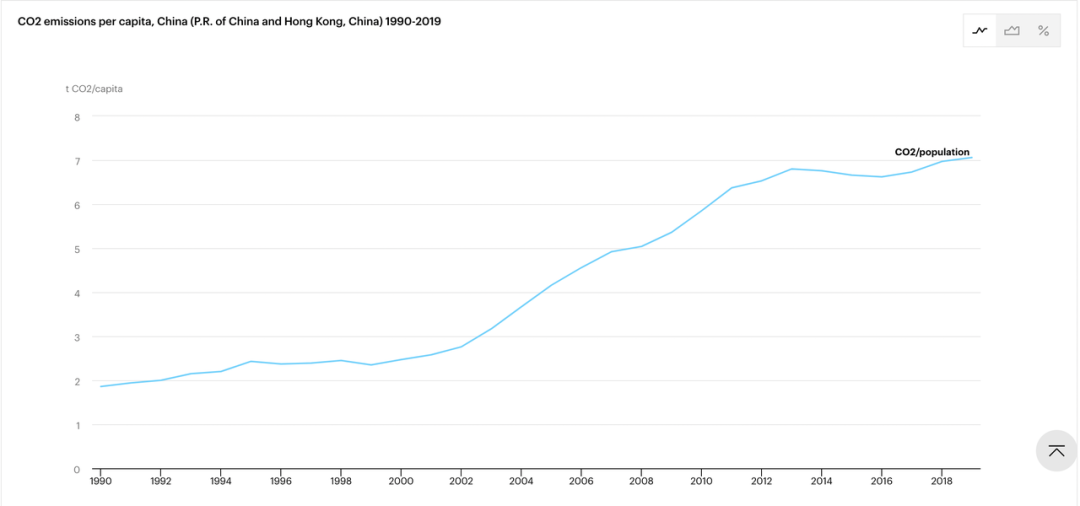
Per Capita CO2 Emission Trends in China, 1990–2019
Data source: IEA
02 Two Methods for Calculating Carbon Footprint
A carbon footprint is like a "footprint" that records all our carbon-emitting behaviors. Carbon dioxide emissions come from fossil fuel use — petroleum, natural gas, and the like. The more fossil fuels we use, the larger our carbon footprint "footprint" becomes. Although calculating carbon footprint is a rather complex process, we can still roughly estimate our environmental impact using certain methods. According to carbon footprint calculation methods published by the Ministry of Natural Resources, two approaches are commonly used:
I. Life Cycle Assessment (LCA) Method
Defined by international standards ISO 14040/44, life cycle assessment can measure the environmental impact of products or services during production, use, and disposal.
Life cycle assessment includes four stages:
-
Goal and Scope Definition — Clearly establishing the purpose and scope of the LCA study to align with intended applications.
-
Inventory Analysis — Compiling an input-output inventory related to the product system under study, including data collection and calculation to quantify relevant inputs and outputs of a product system. These include resource use and pollution emissions to air, water bodies, and land.
-
Impact Assessment — Using LCA inventory analysis results to evaluate potential environmental impacts associated with these inputs and outputs.
-
Interpretation — Combining findings from inventory analysis and impact assessment that relate to the study's purpose to form conclusions and recommendations.
II. Calculation Through Energy and Mineral Fuel Emissions
Since rigorously calculated data may not help us intuitively understand the impact of our "carbon footprint," let's first use an example to describe how a carbon footprint is generated:
You might think that carbon emissions from driving come solely from the engine. In fact, you're overlooking the emissions from transporting fuel to gas stations — from the energy required for initial fossil fuel extraction, to fuel refining, to final delivery to gas stations, all generate carbon emissions. Not to mention the automobile manufacturing process itself, whose emissions far exceed what we might imagine.
So what positive impacts come from reducing our carbon footprint?
| Impact of Reducing Carbon Footprint | Why It Matters |
|---|---|
| Mitigating global climate change effects | Reducing greenhouse gas emissions can slow the pace of temperature and sea level rise, ice melt, and ocean acidification. |
| Improving public health | Reducing greenhouse gas emissions can lower the likelihood and severity of extreme weather events, improve air and water quality, preserve biodiversity, and support healthy food supplies. |
| Boosting the global economy | Reducing greenhouse gases promotes economic development, especially when innovative solutions help protect our planet, address climate change, and are based on clean energy — yielding economic returns. |
| Preserving biodiversity | Reducing greenhouse gas emissions slows climate change impacts, thereby easing adaptation pressures on plants and animals. |
While eliminating carbon footprints is nearly impossible, this doesn't prevent us from reflecting on our behaviors and choices, minimizing our carbon footprint as much as possible, and making a small but meaningful contribution to the planet.
03 What Is Carbon Capture
According to McKinsey & Company's report, at least until 2050, humanity's primary energy sources will still be fossil fuels that generate substantial carbon emissions. Meanwhile, global population growth also means continuously increasing energy demand. In this context, to address climate change, scientists have proposed different approaches: Carbon Capture and Storage (CCS) technology aims to separate CO2 from industrial or related emission sources, sequester it, and isolate it from the atmosphere long-term. However, excessively high costs limit this technology's large-scale application. By contrast, "carbon capture" technology (Carbon Capture and Utilization, CCU) presents a markedly different pathway.
Unlike CCS technology, which permanently stores CO2, "carbon capture" technology aims to capture CO2 and use it as feedstock to produce carbon-containing products (such as fuels). This process may yield three outcomes:
-
When CO2 re-enters the atmosphere as these products are consumed — for instance, when fuels are burned — this creates positive carbon emissions;
-
When CO2 is captured again and stored underground after this process concludes, this creates negative carbon emissions;
-
In the ideal scenario, when captured CO2 has its carbon atoms recycled indefinitely, this forms a circular economy system, achieving net-zero carbon emissions.
However, current carbon capture technology still has a long road ahead, with a series of problems urgently needing resolution: How do we directly collect CO2 from air and purify it? Is the process of capturing and utilizing CO2 itself energy-efficient? Additionally, CCU technology development requires substantial capital investment. These are all issues we need to take action to address.
04 What Can We Do?
China is entering a new stage of comprehensive green and low-carbon development. For enterprises and individuals alike — from food transportation and energy consumption to waste disposal — all aspects are advocating "jointly shaping a sustainable future." Climate change is a global issue; to take effective and economical action, we must consider global emissions. PwC China noted in its report Addressing Climate Change and Helping Companies Become Carbon Neutral [SOE Reform Observatory]: "To implement carbon neutrality goals, enterprises should establish emission reduction targets aligned with national policy and develop feasible carbon neutrality roadmaps based on their own development."
Step 1: Calculate Carbon Footprint
Use scientific methods such as Life Cycle Assessment (LCA) to accurately calculate emissions from the enterprise itself and its product chain;
Step 2: Reduce Carbon Emissions
Based on comprehensive carbon emission assessment, identify major sources of enterprise energy consumption and reduce carbon emissions through scientifically efficient methods to achieve low-carbon operations.
For example, through natural or artificial means — carbon sinks — absorb and remove CO2 from the atmosphere.
Oceans and forests are natural carbon sinks. They can absorb CO2 from the atmosphere through various natural processes. Among these, oceans are considered the primary natural carbon sink, as they can absorb approximately 50% of carbon emitted into the atmosphere. Particularly through photosynthesis by plankton, coral, fish, algae, and other organisms, they can capture and store substantial carbon.
In forests and other woodland areas, carbon sequestration occurs through plant photosynthesis. Plants absorb CO2 from the atmosphere, store some of its carbon, and return oxygen to the atmosphere.
However, natural carbon sinks also have limitations. When their carbon absorption exceeds maximum capacity, it can lead to negative consequences such as ocean acidification.
Through long-term research, Chinese scientific researchers have developed numerous effective artificial carbon sink technologies. However, when facing extreme weather and natural disasters, existing technologies are insufficient to handle emergencies. The stability, effectiveness, and cost-efficiency of carbon sink functions still require long-term experimentation before implementation. Although carbon sinks cannot solve all problems, they remain an important means of addressing climate change. Using renewable energy and gradually abandoning dependence on fossil fuels is the current global consensus.
Step 3: Achieve Carbon Neutrality
Implement a broad portfolio of carbon offset projects, including carbon capture and storage project development, sustainable renewable energy development such as methane control, and more.
Current energy consumption patterns are the main cause of climate change. Carbon neutrality helps change our habits, promoting carbon emission reduction and renewable energy growth. Recently, Source Code Capital's WeChat Channels will continuously update its dual-carbon series, hoping to help you better understand the significance of "dual carbon" and contribute to achieving global sustainable development goals.

After reading this article, is there any "dual carbon" knowledge you'd like to learn more about? Feel free to leave a comment below and share your thoughts with us. We will continue focusing on "dual carbon" and release more popular science content.
References
[1] Al-Mamoori, A., Krishnamurthy, A., Rownaghi, A. A., & Rezaei, F. (2017). Carbon capture and utilization update. Energy Technology, 5(6), 834–849. https://doi.org/10.1002/ente.201600747
[2] Chuang Zhao, Bing Liu, Shilong Piao, Senthold Asseng. (2017). Temperature increase reduces global yields of major crops in four independent estimates. Agricultural Sciences, Sustainability Science, 114(35),9326-9331.Retrievedfrom: https://www.pnas.org/doi/10.1073/pnas.1701762114
[3] Grace Smoot. 4 Main Reasons Why Reducing Your Carbon Footprint Is Important-Impactful Ninja. Impactful Ninja. website. Retrieved from: https://impactful.ninja/why-reducing-your-carbon-footprint-is-important/.
[4] International Energy Agency (April 2021) Global Energy Review: Assessing the Effects of Economic Recoveries on Global Energy Demand and CO2 Emissions in 2021. IEA Publications. website. Retrieved from: https://www.iea.org/reports/global-energy-review-co2-emissions-in-2021-2
[5] Scott Nyquist (Novemebr4, 2016) Energy 2050: Insights from the ground up. McKinsey&Company. website. Retrieved from: https://www.mckinsey.com/industries/oil-and-gas/our-insights/energy-2050-insights-from-the-ground-up
[6] "National Carbon Market's First Compliance Cycle Concludes Successfully" [OL] Ministry of Ecology and Environment, 2021-12-31. https://www.mee.gov.cn/ywgz/ydqhbh/wsqtkz/202112/t20211231_965906.shtml
[7] Lin Yanluan, "From Radiative-Convective Equilibrium to Global Climate Models — Interpreting Nobel Laureate Syukuro Manabe's Work" [OL] Modern Physics magazine, from Physics 2022 Issue 12, 2022-02-05.
[8] National Bureau of Statistics of China, "Communiqué of the Seventh National Population Census (No. 3)" [OL], 2021-05-11. http://www.gov.cn/xinwen/2021-05/11/content_5605779.htm
[9] Ministry of Natural Resources, "Basic Formulas for Calculating Carbon Footprint" [OL], 2010-03-29. http://www.mnr.gov.cn/zt/hd/dqr/41earthday/dtsh/gytpf/201003/t20100329_2055427.html
[10] China Business Journal, "State Council Releases Carbon Peaking Action Plan: Implementing 'Ten Carbon Peaking Actions,' Selecting 100 Cities and Parks for Pilot Programs" [OL], 2021-10-26.https://baijiahao.baidu.com/s?id=1714691927165001393&wfr=spider&for=pc
[11] PwC China, "Addressing Climate Change and Helping Companies Become Carbon Neutral" [SOE Reform Observatory] [OL].https://www.pwccn.com/zh/blog/state-owned-enterprise-soe/addressing-climate-change-and-helping-companies-to-become-carbon-neutral-jan2021.html

Code Brain Issue 25 | Mastering Liu Genghong's Traffic Code
Code Brain Issue 24 | The "Change" and "Constancy" of Equity Financing
Code Brain Issue 23 | Eight Questions on Going Global: Where Are the New Business Opportunities?
Code Brain Issue 22 | Dealing with Supply Chains in "Turbulence"
Code Brain Issue 21 | Clear Despair Is Better Than Vague Hope: On ToB Sales During the Pandemic
Code Brain Issue 20 | Is Your Cash Flow Still Healthy During the Pandemic?
Code Brain Issue 19 | Entrepreneurs Must Learn Appropriate Letting Go
Code Brain Issue 18 | Entrepreneurs' Time Management: "Two Learnings, Three Principles, Four Quadrants"
Code Brain Issue 17 | Your Core Startup Team Needs a "Deep Dialogue"
Issue 16 Three Key Words in Corporate Crisis Management from 3·15
Issue 15 The New Evolution of InsurTech
For more MaHui members, click "Read Original" to view