Code Brain | Three Key Words in Corporate Crisis Management from 3·15

Attitude, Action, Commitment
#Code Brain
Ecosystem connections, cognitive resonance
Another March 15 rolls around.
Since the first 3.15 Gala aired in 1991, 32 years have passed, and this simple set of numbers has taken on increasingly rich meaning and an ever more complex role. The publicity campaign for "World Consumer Rights Day" has become a social phenomenon with broad public impact and far-reaching significance. For companies, March 15 represents an ideal moment to test whether they've adequately prepared for crisis management and reputation management.
This special edition of Code Brain decrypts the 3.15 landscape, bringing together veteran brand marketing consultant Zhuyu Ge with MaHui member companies and entrepreneurial ecosystem partners for an in-depth discussion of corporate public opinion management, crisis PR handling, and employer brand building.
Below are excerpts from the guest presentation.
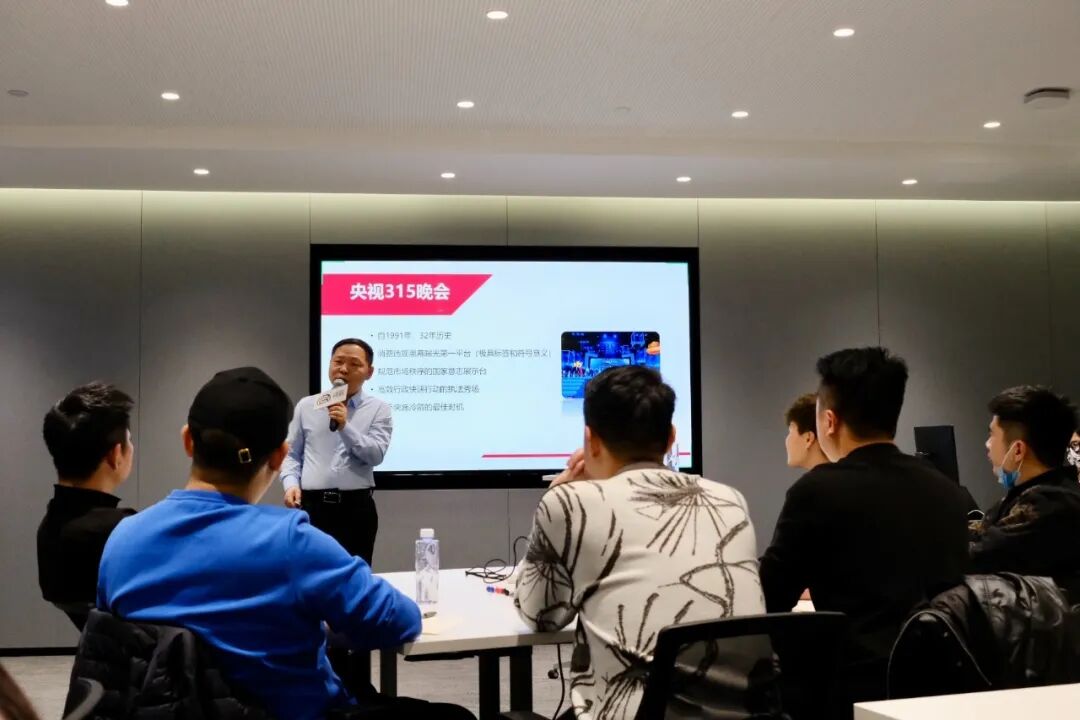
Image: Code Brain event photo
Guest Profile Zhuyu Ge is a veteran media professional and brand marketing consultant who spent eight years at BlueFocus, Asia's largest communications and marketing group. He is now CEO of Shengyu Consulting, which specializes in brand risk management. Ge has extensive experience and deep expertise in brand risk and crisis management, reputation management, CEO PR, CSR, and integrated communications, having served more than 100 well-known brands including Microsoft, Lenovo Capital and Incubator Group, Baidu, Tencent, China CITIC Bank, and China UnionPay.
Article Preview
- Why does 3.15 matter?
- Which companies are most likely to be targeted?
- What are the wrong ways to respond?
- Three keywords for corporate crisis PR
- Recharging your brand equity
Why does 3.15 matter?
CCTV sets an annual theme for the 3.15 Gala, which includes special investigations, consumer warnings, authoritative announcements, and the 3.15 Contribution Award selection. The investigations aired typically follow current consumer hot topics, align with new national policy directions, track hidden "unwritten rules" in consumer life, and expose the layers of "black curtain" behind rights violations.
The 3.15 Gala reflects regulatory winds and demonstrates the state's will to regulate market order, while also creating a social phenomenon of nationwide participation. Because of the 3.15 Gala, everyone has a microphone — consumers speak and make demands with far more confidence than usual. This is the core reason why being exposed on the 3.15 Gala is fundamentally different from being exposed by general media: if mishandled, the fallout can be devastating or even lead to overnight collapse.
This year, the 3.15 program team announced it will innovatively establish a "3.15 Product Safety Lab" and "3.15 Information Security Lab" to collect consumer complaints, categorize and analyze complaint samples, and regularly publish an "information security index" to promote industry progress.
This means the safety labs won't merely serve the 3.15 Gala — they will likely become permanent institutions. In terms of both capability and authority, they are poised to become the ceiling and weathervane of China's "evaluation" ecosystem, potentially serving as a Damocles sword permanently suspended above non-compliant companies.
Another data point warrants attention. Search big data shows that consumer rights-related searches grew 43% year-over-year in 2020–2021, reaching a ten-year peak. In 2022, with the implementation of new auto三包 (three-guarantee) policies, new penalties for wage arrears to migrant workers, and the launch of online litigation, among other new laws, the breadth and depth of rights protection expanded further. This year's 3.15 may see attention reach new heights.
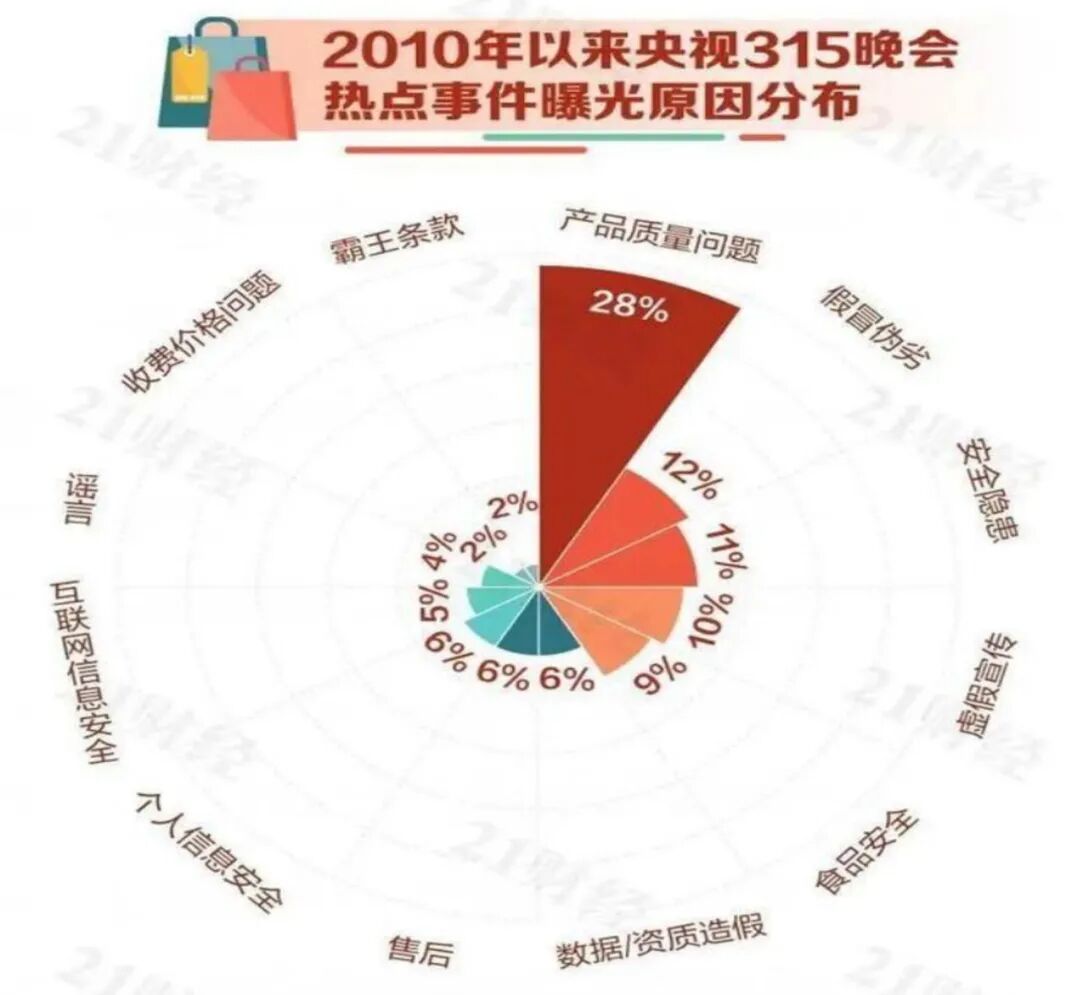
Image: 21st Century Business Herald
Which companies are most likely to be targeted?
**Is there any pattern to 3.15 exposure?
The answer is yes.
The food industry, automotive industry, internet industry, health supplements industry, and internet finance industry have long been disaster zones for 3.15 exposure. Additionally, livestream e-commerce saw numerous "failures" in the past year. In terms of topics, product quality, safety issues, consumer fraud, and data privacy are the four chronic problems that 3.15 consistently targets. Since the Data Security Law of the People's Republic of China took effect on September 1, 2021, multiple companies were penalized for data security issues last year. Data security affects national strategy and will inevitably become an untouchable red line going forward.
Any company named and exposed by the 3.15 Gala, and any problem so exposed, is not newly emerged. Generally speaking, problems that make it onto 3.15 share this characteristic: "widespread public outrage, long unresolved."
According to Heinrich's Law: all crises have warning signs. Every serious accident has precursors; behind each precursor lie 300 incident indicators and over 1,000 hidden risks. To prevent a serious accident, one must keenly and promptly identify hidden dangers and take decisive control measures.
Many companies share a common "blind spot" in crisis management: they focus only on summarizing crises that have already occurred while neglecting to investigate warning signs and risks; those undetected signs and indicators become the seeds of the next crisis.**
When companies experience major crises or a cascade of crises, the root cause often lies in ignoring accident precursors and indicators. We believe the critical factor is: brand risk screening and control.
Synthesizing the high-risk industries listed above, the pattern is clear: in livelihood sectors involving clothing, food, housing, and transportation that attract broad public attention, problems that defy new national policies and initiatives, that persist despite warnings, are precisely what 3.15 targets most aggressively.
What are the wrong ways to respond?
**Being featured on 3.15 will inevitably damage a company's brand reputation. But how each company responds determines the extent of that damage. Appropriate response can quickly turn danger into safety; wrong responses add fuel to the fire and severely wound the brand.
What causes wrong responses, and what forms do they take?
"Confronting head-on" The program exposes facts of corporate violations and illegal acts, but what it ignites is the emotional fire of hundreds of millions of consumers. No matter how powerful the brand, it lacks the capital to "confront head-on" with the 3.15 Gala.
Minimizing the issue In any crisis response process, the official statement is the most critical juncture. A good statement immediately eases the situation; a poor one directly pours oil on the flames. Minimizing the issue becomes many companies' preferred strategy — neither admitting fault nor appearing to take responsibility, while seemingly demonstrating good attitude and quickly producing a response with minimal effort. If consumers buy the explanation, they slip through.
But facts are facts; consumers won't shift focus according to corporate will. The result: the more companies evade, the less consumers accept it, and the greater the damage to brand reputation.
Defending without addressing the real problem is covering up the truth Defending against pointed problems is human nature, and also the most common error in 3.15 responses. Without rapid resolution of exposed real problems, neither CCTV nor consumers will be fooled.
These three are the main common wrong responses; additionally, there are ostrich-like silence, promises without action, and other behaviors that continue damaging the brand. March 15 is a special node; the 3.15 Gala is a special platform. Faced with errors, corporate dominance, minimization, defense, and other花式 (fancy) mistakes will have nowhere to hide.
So what exactly is the right way to respond?
Three keywords for corporate crisis PR
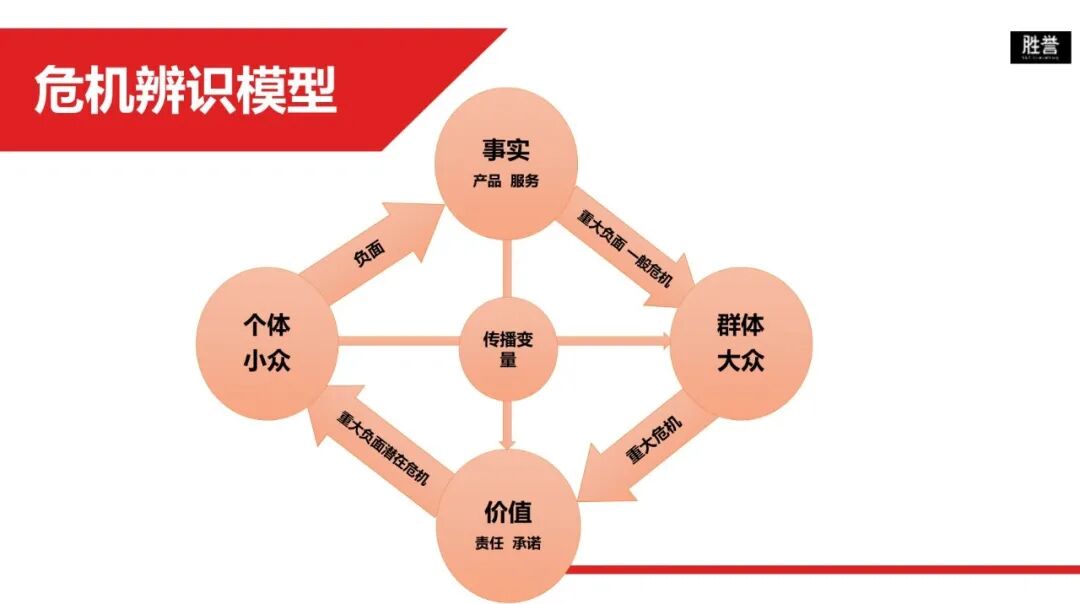
Image: Shengyu Consulting
Before discussing crisis PR, we must first define "crisis."
One common definition: "A special, unpredictable, non-routine event or series of events, or a situation threatening an organization's fundamental goals, that brings high uncertainty and high threat, requiring the organization to make critical decisions and emergency responses in extreme time."
But this definition is incomplete: crises are always triggered by events, yet the event passing doesn't mean the crisis passes.
So crisis is not equivalent to event.
Vice President Hu Baijing of Renmin University of China offers a more precise definition: "Crisis is caused by internal and external organizational factors. It may disrupt normal order, norms, and goals. It requires the organization to make decisions in short time, mobilize various resources, and strengthen communication management — a threatening situation or state."
But this definition has one problem: it doesn't tell us how to conduct crisis management. From the stakeholder perspective, I define crisis as: "An emergency state triggered by internal or external negative information or events, which through widespread dissemination rapidly evolves into stakeholders' sharply declining or shattered trust in the organization. It poses severe threat to organizational development and survival, requiring the organization to respond in short time."
From this definition, we can see that the core of all crisis management: first, controlling negative events or information internally — that is, doing risk management well and promptly screening hidden dangers. Second, establishing mechanisms to maximally delay the transmission path from individual to group. But more importantly, doing everything possible to maintain public trust in the enterprise. This is the starting point and endpoint of crisis management. In other words, everything that helps repair trust is right; everything unrelated to this is wrong.
Any company's brand or product contains two attributes. One is factual attribute; one is value attribute. Factual attribute refers to the product or service provided — the functional aspect. Value attribute refers to the commitments the enterprise should or has already made to the public and stakeholders. From a communications perspective, one is individual/niche, one is group/mass. These four dimensions can transform into each other.
For example, the intersection of individual/niche and factual level is called "negative." What does this mean? I bought expired food at a supermarket and posted about it on my Moments — this is "negative." The intersection of group/mass and factual level is called "major negative" or "general crisis." Not just me, but many people bought expired food at this supermarket, meaning its quality control and management systems have major problems.
Crisis, then, refers to the intersection of group and value levels. In other words, the brand or enterprise has violated the rights of a large group, and in this process exposed the distortion or baseness of the enterprise's values. The correct response method then becomes easy to understand.
First, identify the real problem. If CCTV exposes something, what is the real problem reflected? Don't try to minimize or cover up — the issue the public truly cares about is the real problem.
So identifying the real problem is the first step in resolving crisis. Second, rapid response. Today is March 15; from the moment the gala begins, all media attention converges here. In such a massive public opinion arena, any delay will plunge you into the vast ocean of public sentiment.
How fast is fast enough? Ideally, have an official response before the gala ends; if that's impossible, don't delay past that night; at the very, very latest, don't delay past the morning of the 16th. If you haven't responded by then, you might as well not respond.
Under this framework, I summarize the three keywords of crisis PR management as: attitude, action, commitment.
At the factual level, demonstrate attitude — what is this matter, was I wrong, where was I wrong? Action means rapidly launching action based on your attitude toward the real problem; if due to complexity action cannot be immediately implemented, still demonstrate attitude. What is commitment? It's drawing inferences about other cases from one instance regarding exposed problems. What problems were exposed? How will I systematically improve? The brand must express how it will maintain its brand commitment to society and consumers.
In today's society, if you want to become a good company, you must withstand public and media scrutiny with a magnifying glass. Since someone is holding a magnifying glass, perfection is impossible; in this era, brand mysophobia is unacceptable. As Zhengfei Ren said: "The healthy state of a normal enterprise is seventy-thirty positive-negative public opinion — seventy percent positive, thirty percent negative is normal, is acceptable to me."
But this doesn't mean we should turn a blind eye to this "negative public opinion."
In today's era, to do crisis management well, we need clearer understanding of the media and social environment, and with more pragmatic and resilient mindset, manage development alongside crisis management.
"I may never appear on 3.15 in my lifetime, but that doesn't mean I'm insulated from crisis."
Recharging your brand equity
We need crisis awareness; we need to know the right direction and steps if crisis erupts. We need to establish correct risk management and crisis management concepts, and master their basic principles and techniques.
More importantly, companies must learn to do well in brand risk screening,梳理 (sorting), and management — monitoring, assessing, early-warning, and handling brand risks. Learn to recharge your company's brand equity and persist over the long term.
As the saying goes, "repair the roof while the weather is fine" — but the prerequisite is knowing which cloud will rain. Which cloud brings drizzle, which brings downpours. This requires crisis screening and sorting mechanisms. We need to know the core risks the enterprise faces in the coming period; on this basis, we must establish complete crisis management systems, determining what responses are needed at what risk levels, and manage the enterprise's values compass, including fact management, emotion management, resource management, issue management, and communication management.
At this 3.15 juncture, I'd like to share one more sentence: "In the age of radical transparency, playing ostrich is digging your own grave."
Overall, no company is entirely without problems; the process of enterprise development is the process of continuously solving problems. Encounter new problems, solve new problems — this is the necessary path for all great enterprises. I'll close with a quote from Charlie Munger: "If I know where I'm going to die, I'll never go there."


More Code Brain Content
- Issue 15: The New Evolution of Insurtech
- Issue 14: "Small" Trademarks, "Big" Trouble — How to Effectively Avoid Pitfalls on the Entrepreneurial Journey
- Issue 13: Financial Opportunities in Industrial Internet
- Issue 12: Strategic Thinking on Douyin Marketing for Consumer Brands
- Issue 11: Inclusive Finance Under the New Economic Landscape
- Issue 10: Brand: Meaning, Symbol, Value
- Issue 9: Stoking the Fundraising Fire
- Issue 8: Digging for Gold in India — Battle-Tested Insights