Mining India: Battle-Tested Insights | Code Brain Episode 8

"Code Brain" connects Source Code Capital's entrepreneurs with external experts for private, offline brainstorming sessions.
Code Brain
Issue 08
"Code Brain" is a key component of Source Code Capital's post-investment service system, and also an offline, small-scale gathering of the Ma Hui community. Held monthly, it brings together CEOs from the Ma Hui community with external expert "brains" for private, offline brainstorming sessions based on the topics and sectors entrepreneurs care about most — forming a networked learning environment that strengthens community ties and advances individual founders' growth.
For the 8th Code Brain session, two heavyweights — Benny Chen, General Manager of Ant Group India, and Ma Ji, General Manager of Xiaomi's MIUI International — joined Source Code Capital portfolio companies for an in-depth discussion on entrepreneurial opportunities in India. From e-commerce, fintech and payments, social and content, education, gaming, to offline categories: where are the value pockets in the Indian market, and how should entrepreneurs pick their spots? Below are selected highlights from this session.
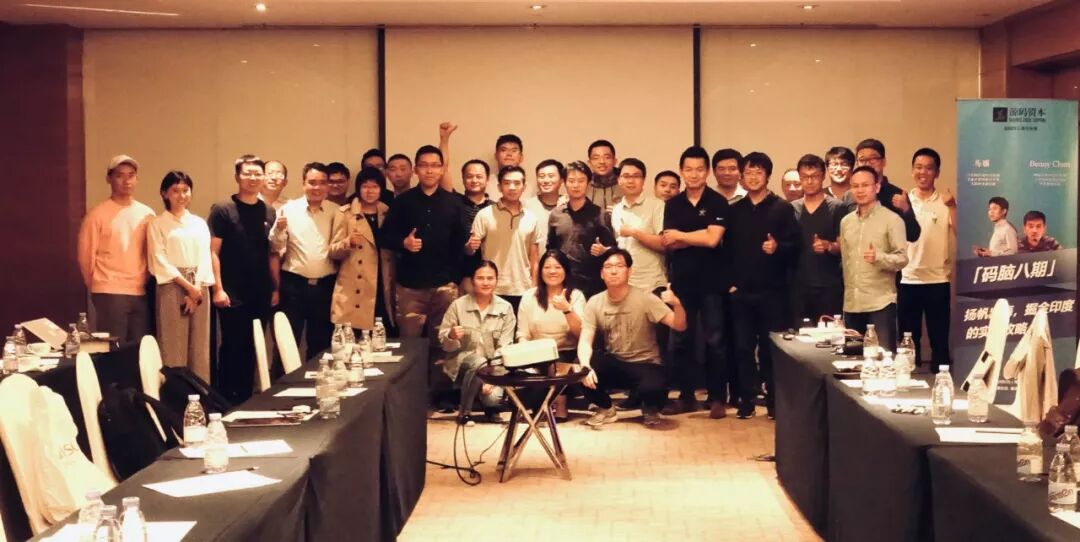
Photo from Code Brain Issue 8
Contents Overview
-
Going to India: Four Major Opportunity Areas
a. Startup infrastructure gradually improving
b. Four major opportunity areas
-
Timing and Opportunities for Internet Entrepreneurship in India
a. India as a country
b. Segment market opportunities
c. Conclusion
Guest Speakers

Benny Chen, General Manager of Ant Group India
Led multiple major Ant Group investments in India

Ma Ji, General Manager of Xiaomi MIUI International
Extensive experience in emerging market internet businesses
Going to India: Four Major Opportunity Areas
Speaker: Benny Chen, General Manager of Ant Group India
Edited by: Source Code Capital
1. Startup Infrastructure Gradually Improving
"From an entrepreneur's perspective, now is a relatively good time to go to India."
India's mobile internet infrastructure has seen several leapfrog developments:
- Rapid 4G network coverage.
- Smartphones. Xiaomi will reach the 200 million unit mark in India within the next two years. All other Chinese manufacturers combined should ship over 150 million smartphones in the coming year.
- Payments: infrastructure improvements. Beyond the Indian government's push for electronic payments, emerging payment companies like Paytm, which we invested in, have appeared. When Ant first invested in Paytm, it had fewer than 10 million users; now it has over 400 million. As we all work together to deepen the payments market and drive down COD (cash on delivery) ratios across all applications, that will be the true beginning of market prosperity.
I believe the next 2-3 years will be when this market can really gain momentum and move forward.
Both networks and phones are now established as viable foundations for user retention. Subsequent entrepreneurship will become easier, as founders can convert more consumption and innovation onto mobile internet.
The uncertainty is whether advertising monetization and e-commerce can truly advance during this phase — these remain unknowns. But the opportunities and success rates are much better than the past two or three years.
Considering the population base, India should be among the easier emerging markets to develop.
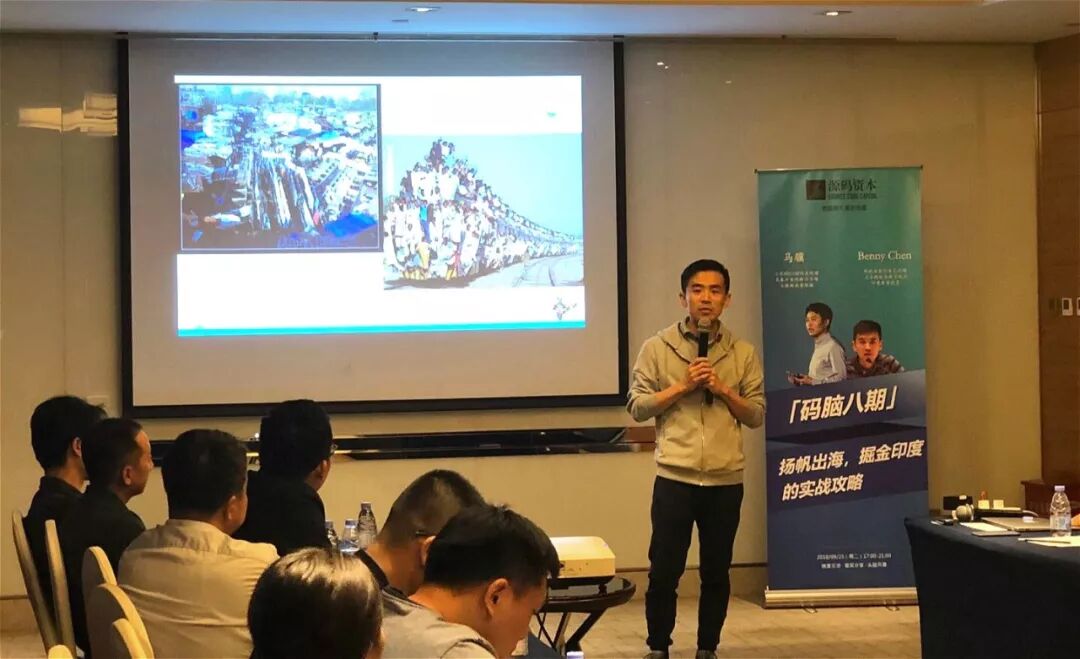
Benny Chen speaking at the event
2. Four Major Opportunity Areas
1. E-commerce
Today's Indian e-commerce is essentially phone-selling e-commerce: Flipkart and Amazon likely derive over 20% of their GMV from phones.
Personally, I think the Indian e-commerce market, if defined as Amazon-style e-commerce, has indeed emerged.
But if defined as "C2C" or "Taobao"-style e-commerce, that battle hasn't even begun.
Many Indian internet startups — like many internet startups everywhere — have only solved the 1.0 problem. They've figured out how to move SKUs from offline to online, but what comes next remains unknown, or they haven't reached that stage yet. So the entire backend — payment experience, merchant operations, and so on — still lags far behind.
On the supply side, 90% of Indian goods come from China; local supply cannot support e-commerce. Today our definition of Indian e-commerce remains at the 1.0 stage of phone and standardized-product e-commerce. So I believe e-commerce opportunity still exists in India.
Whoever can seamlessly connect long-tail, non-standard supply chains to India will need to solve logistics, payments, and returns.
2. Fintech and Payments
India is a country with relatively open yet orderly financial regulation.
India has about 157 banks, but 90% of transactions are still in cash.
To date, India has about 25 million credit cards and roughly 600 million debit cards, though we believe only about 300-400 million are actively used.
India's banking regulation is fully open to foreign capital: with sufficient qualifications, you can obtain licenses. Within regulatory bounds, up to 74% can be directly applied for; 74%-100% requires Reserve Bank of India approval. It's relatively open to foreign banks, though with more capital requirements.
India first opens in terms of functional licensing for banking, and second has relatively advanced regulatory systems.
Today on the Paytm platform, bank card users are just one segment. This year, about 70% of all UPI-based payments in India may occur on the Paytm platform.
UPI, launched by the National Payments Corporation of India (NPCI), is essentially an additional interface layer built on top of real-time transfer systems. This interface allows all banks to connect through a single point.
For example, to transfer money to someone, I only need to know their UPI ID linked to their bank account. Paytm uses UPI as a funding channel — you can bind your own UPI, and regardless of which bank card you use, all payments can still be completed through the transaction scenario.
India leads China in another aspect of financial information infrastructure: the Aadhaar system, India's digital identity system.
Starting in 2009, the Indian government launched large-scale Aadhaar promotion, calling citizens to offline centers for photos, iris scans, and fingerprint recording. To date, 1 billion of India's 1.4 billion people have had their Aadhaar information entered — relatively leading globally.
Today all Paytm users must complete real-name verification through Aadhaar, with real-time validation.
Next, India may further open up fingerprint, facial, and iris recognition, further enriching and improving financial-related data.
3. Pan-entertainment Content
I'm relatively optimistic about the pan-entertainment track. I believe entertainment consumption is a rigid demand for Indian people.
In China, entertainment and content consumption are relatively less of a rigid demand because people have more choices. But due to infrastructure limitations, India has very few offline services. So users have massive space for video and content consumption.
I looked at data from ten years ago, when China's internet was just emerging in the "1,000-yuan smartphone" era. Mobile reading was a hot track then.
Reading payments mostly came from third- and fourth-tier cities, with very low average order values but relatively high repurchase rates — because these people likely had too few consumption choices offline.
Beyond the top 50-60 million people, most Indians are in this state. It's not necessarily that they can't afford it, but that offline channels don't exist.
Data from the Paytm channel also reflects that Indian users' willingness to pay for pan-entertainment like games is gradually improving.
4. Education and Offline Categories
In education, we've also seen some relatively good companies growing quickly.
After meeting basic needs for food, housing, and transportation, many Indian families resemble Chinese families in their high demand for and investment in education.
As mentioned earlier, India's offline consumption supply across categories remains very scarce, with massive zero-to-one opportunities.
Timing and Opportunities for Internet Entrepreneurship in India
Speaker: Ma Ji, General Manager of Xiaomi MIUI International
Edited by: Source Code Capital
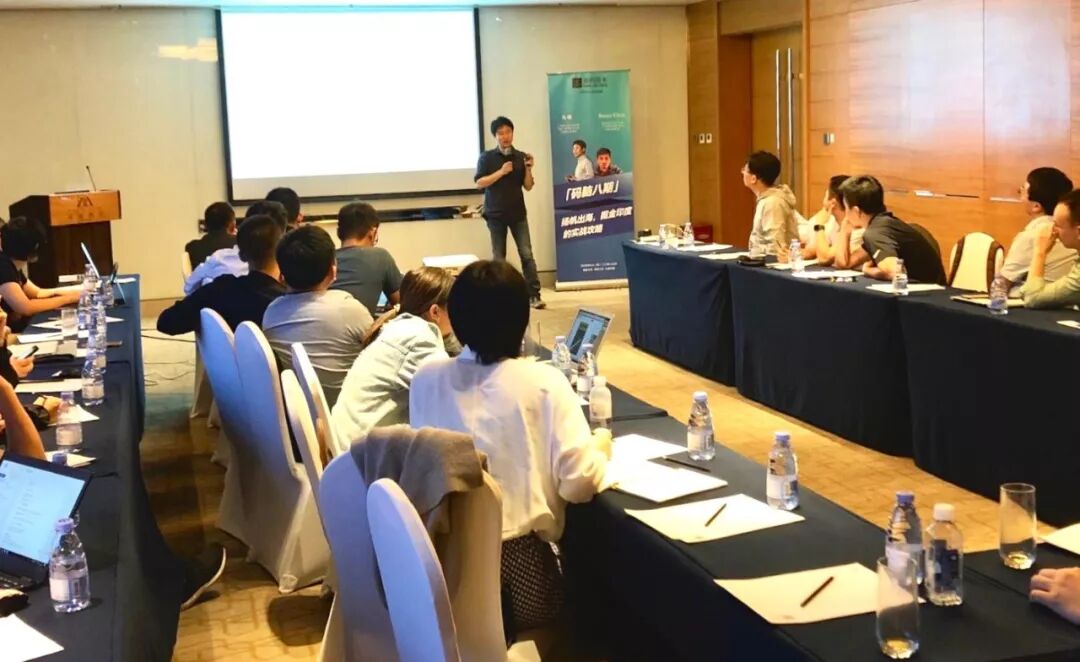
Ma Ji speaking at the event
1. India as a Country
1. Population and Religion
India's population is about 1.34 billion, expected to surpass China's soon. In 2017, India's per capita GDP was about $1,900, roughly one-fifth of China's. With similar population scale, India's total economic output is basically one-fifth of China's.
India's land area is about 3 million square kilometers, and the entire country is habitable. By contrast, much of western China is mountains and desert.
India's population distribution is a very typical spindle shape, and India's average age is only 28 — a young country. First, India hasn't implemented family planning in the past 30 years; second, average life expectancy is actually somewhat lower than China's, so among those over 70, China clearly exceeds India. Therefore China may face greater aging pressure in the future, while India's population distribution is excellent with many young people — better for both labor and consumption.
2. Language
India has 22 languages, while China's language is relatively unified. Different colors on the map indicate different regional languages. India's two main languages: English and Hindi.
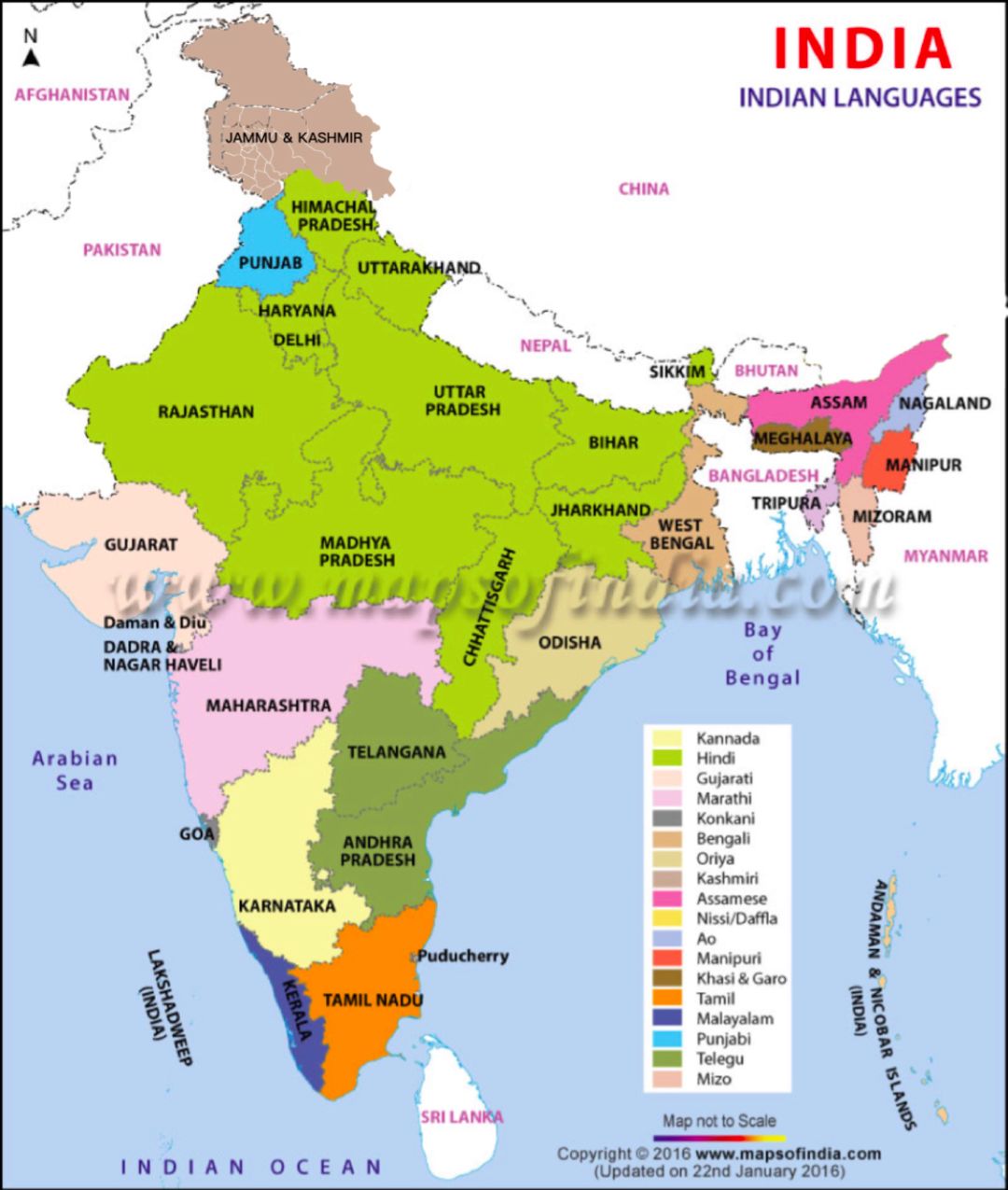
Image source: Internet
Though English and Hindi are the two most important official languages, English penetration isn't actually high — only upper-class society can proficiently master English; ordinary people basically use local languages for communication.
According to Google projections, by 2021, non-English speakers will dominate among Indian internet users — meaning the future explosion of India's internet market lies in non-English markets. The insight for entrepreneurs: you must do localization well and support Indian local languages.
Even now, some Indian apps don't support English at all, only local languages.
Here are the 13 basic languages phone manufacturers need to support.
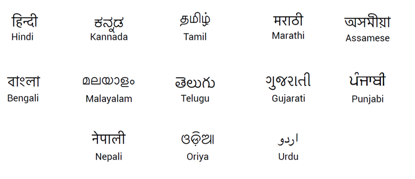
Image source: Internet
3. Mobile Devices
To date, feature phones still dominate the Indian market. The ratio of feature phones to smartphones is roughly 4:3 — about 440 million feature phones and 330 million smartphones. Smartphone growth exploded starting in 2015-2016, developing rapidly.
Looking at mobile phone penetration (including feature phones), India has 88 phones per 100 people, while China has 102.
Here's the manufacturer distribution for smartphone and feature phone shipments in India — smartphones on the left, feature phones on the right.
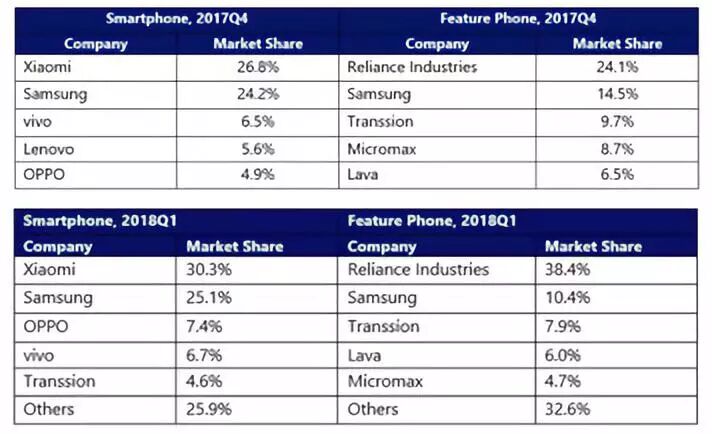
Image source: IDC Quarterly Mobile Phone Tracker
Starting in 2017, Chinese manufacturers rose comprehensively. From Q3 2017, Xiaomi became India's top-shipping company with 26.8% market share, followed by Samsung, then vivo, Lenovo, and OPPO. Reliance Group established a pure 4G operator called Jio, which also pushed into devices. From 2017, it rapidly became the top feature phone shipper.
We can also see traces of Chinese companies in this — it's fair to say the entire Indian phone industry is essentially monopolized by Chinese players.
By 2018, Xiaomi's share continued growing. In Q1 2018, Xiaomi's share reached 30%. Over time, Chinese manufacturers' share will likely increase further.
4. 4G Networks
India is essentially covered by 4G signals nationwide — relatively rare globally, especially for a developing country, and all accomplished within three years.
However, India has far fewer base stations than China, so signal quality is inferior and internet speeds are lower. Mobile internet users as a percentage of total population is currently 33% in India — already relatively high penetration, but still with double the room to grow.
On data pricing: India's average cost is 15 rupees per GB, roughly 1.5 RMB, while in China it's about 20 RMB per GB, with even higher out-of-plan rates. India's data is extremely cheap, essentially considered free.
Indian operators' basic plans run about 30 RMB per month, offering 1GB of 4G data daily for that month, with no overage charges — just throttling. This is quite particular to India.
From data consumption perspective, India saw a major leap in Q3 2016 because Jio launched near-free 4G data services.
In 2016, as Chinese rates declined and internet services enriched with 4G arrival, China's overall data consumption also rose. China's Q1 data this year shows about 3.3GB monthly, while India is around 2.5GB — so the China-India gap isn't actually that large.
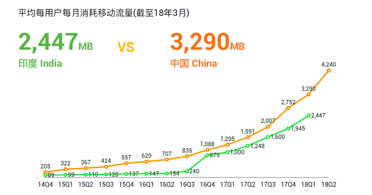
Image source: China's Ministry of Industry and Information Technology and India's Telecom Regulatory Authority (TRAI)
Rapid smartphone coverage, declining data costs, and operator network coverage together provide excellent foundations for India's mobile internet development.
5. Entrepreneurship Environment and Policy
Though India's infrastructure lags behind China's and issues like corruption and inefficiency exist, the Indian government has implemented many policies encouraging internet development.
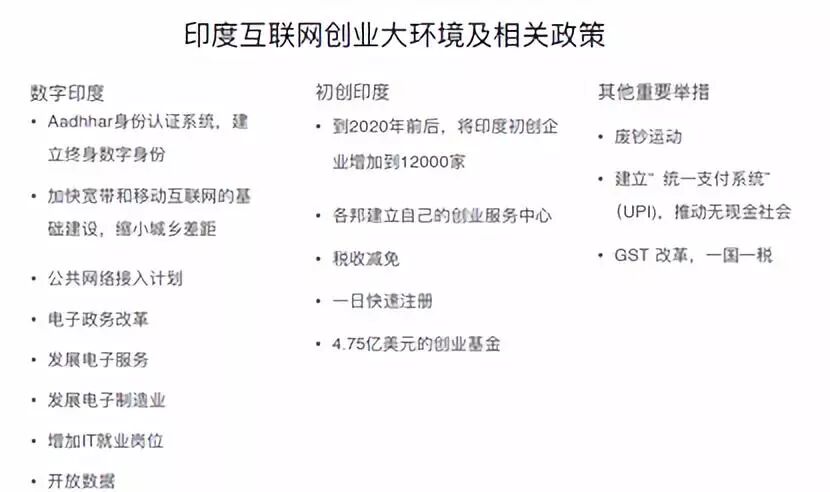
Image source: Guest compilation
"Digital India": India's ID system was previously very incomplete; the country invested heavily in launching an electronic ID system. Also broadband and mobile internet infrastructure — evident from Jio's development.
"Startup India": Government encouragement of entrepreneurship, with a series of policies including tax breaks and one-click fast registration, encouraging internet startup development.
"Uniform Tax System": Previously India's states were quite fragmented. Shipping goods from Province A to Province B required stopping at Province B's toll station to pay taxes — very detrimental to economic development. The government launched a unified tax system with four brackets, improving national economic efficiency and reducing institutional gaps between states.
6. Indian Apps
India is now the world's second-largest country for app downloads.
First, large installed base, and all new users with high demand. Currently traffic costs are also low, so many app developers bought users aggressively when first entering India, creating app download prosperity.
But due to low phone memory and some apps not emphasizing localization, uninstall rates are high and overall retention is poor — something entrepreneurs and internet practitioners in India need to pay special attention to.
On average daily usage time, India is about 3 hours, less than China's 4.2 hours. But Indian users' demand for content is increasingly strong, so time will definitely grow rapidly. India's demand for content and entertainment consumption is very large, possibly even stronger than China's.
Since we're talking entrepreneurship, we must consider revenue. Here I'm only discussing paid app downloads and in-app purchases.
In 2017, India's total app paid downloads and in-app purchases were only $21 million, about 140 million RMB — a very low number. By comparison, China was $33 billion, roughly 215 billion RMB.
According to eMarketer projections, by 2020 India's internet advertising effectiveness ranked near the bottom.
For a considerable future period, India's overall advertising or traffic monetization will remain relatively difficult.
2. Segment Market Opportunities
1. Social Media/IM
For IM, WhatsApp is extremely popular in India. Facebook has essentially won this battle, and it's relatively hard for other companies to enter.
But in new social media formats, there's still opportunity if localization is done well. Because Facebook is after all a global company, while India is a geographically complex country.
For example, Indian local social product Sharechat doesn't support English — all content is in Indian local languages, with a completely different product vibe from Facebook. As long as local content and services are done well, social media still has considerable potential and opportunity.
2. E-commerce and Payments
In India, the vast majority of Xiaomi phones are sold through e-commerce. India's Flipkart, Amazon, and Xiaomi are actually India's three largest e-commerce platforms, with Mi.com as the third-largest.
Though Indian e-commerce has low average order values, the large population gives it ninth place globally in total scale. In compound growth rate, India and Indonesia rank first and second globally.
From online shopping penetration, India is only 10%, while China reached 68% — massive room to grow. So e-commerce has very large potential opportunity in India.
Indian e-commerce is mainly represented by Flipkart and Amazon, with some smaller platforms like Myntra also rising quickly.
But the problem is: Indian female mobile internet users are particularly few, with relatively low female user status. So understanding this country is very important for internet entrepreneurship.
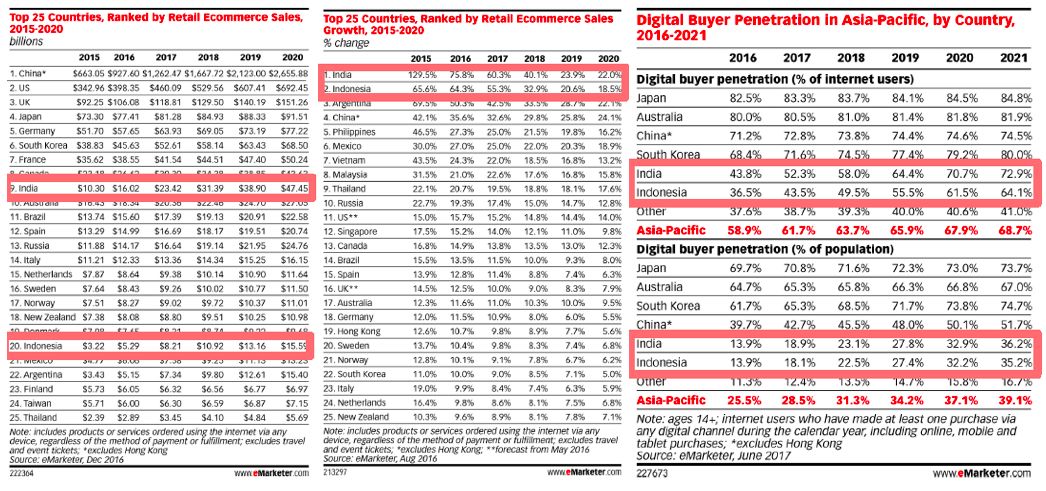
Image source: eMarketer
On payments: today over 60% of users still use cash on delivery for online shopping. And if we break down online payment further, most is still bank card payment, not the third-party payments like WeChat Pay and Alipay that we know today.
Overall, India is a cash society; electronic payments remain relatively backward. One transformation was the "demonetization" in late 2016. Because ordinary people lost security, they began turning to bank savings, greatly promoting electronic payment development. But overall it's still far behind China.
In the chart below, we can see massive changes in mobile payment volume and value — a doubling change brought by the November 2016 demonetization, after which it gradually stabilized. This shows changing ordinary Indian users' payment habits likely still has a long road ahead.
China's process developed relatively quickly, taking about 5 years to basically reach today's wallet-free state. One speculation here: will India skip the bank card era and directly enter mobile payments? I think it's possible.
Bank cards will serve as infrastructure to be popularized, but ultimately users will still complete payments online — and this penetration process may happen faster than in China.
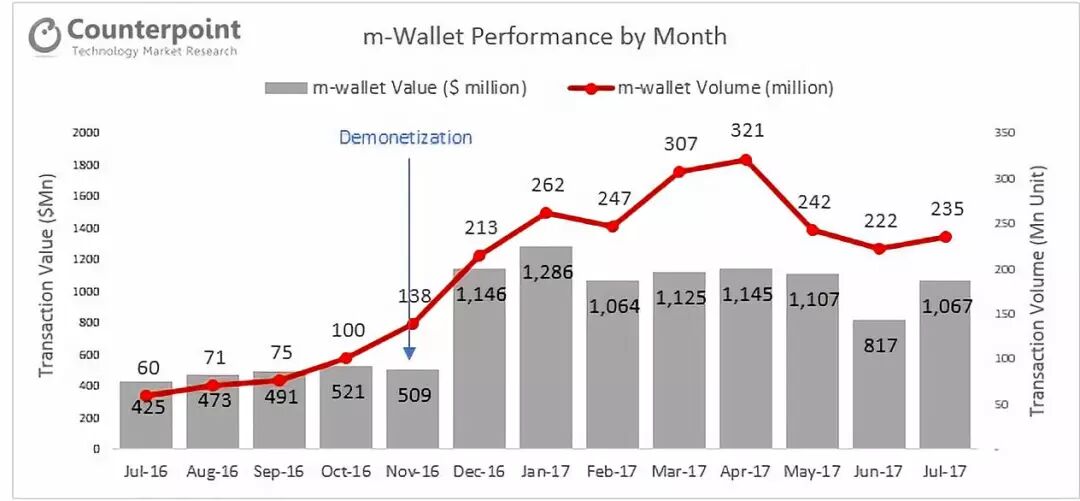
Image source: Counterpoint
3. Video and Live Streaming
Chinese app usage time is highly concentrated in social and video — India is actually even more pronounced in this regard.
In India, YouTube's daily active rate has reached over 70%, even higher than Facebook, reaching WhatsApp's level.
Another good product is MX Player, also with very large volume — one reason Times Internet acquired it. Another notable product is UC's VidMate, actually an underground product. Due to copyright issues it can't be listed on Google Play, but still achieves about 15% daily active rate, so at least from a pure business perspective it's a relatively successful product.
India had almost no short video before 2018, but saw relatively exaggerated growth after 2018, represented by Musical.ly and Vigo Video — both ByteDance products.
Indian entrepreneurs don't really understand content entrepreneurship. Unlike China, where understanding and control of internet influencers, including the entire industry chain, is already very mature. ByteDance's product series currently still leads, but I personally remain optimistic about Indian short video opportunity.
Another branch of video is live streaming — India's live streaming market is currently small.
India's better performers are mainly BIGO Live and live.me. Overall, Indian live streaming hasn't developed much in the past year or two, possibly due to Indian culture and religion. For example, women's status remains relatively low and conservative, unable to support content creation.
Another reason is live streaming requires tipping, and tipping requires payment — but India's market is currently still very difficult for payments. Personally, I think for investors or entrepreneurs, live streaming opportunity in India is not large at the current stage.
Conclusions:
- India's future content consumption will still be video-dominated. Text-and-image consumption is constrained by India's education level and multi-language operation difficulty; the transition from text-image to video consumption that occurred elsewhere will likely be skipped directly in India.
- Sports video still has clear opportunity, not necessarily limited to cricket, though it will show periodic trends related to tournament schedules.
- Short video opportunity is enormous.
4. Gaming
India's currently popular mobile games include Candy Crush, Ludo King (a flight chess game), 8 Ball Pool, Subway Surfers, CallBreak Multiplayer (a card game), etc. — mainly casual mini-games.
PUBG, released this year, has also grown very fast. From the data, a game achieving 4% daily active rate in India is already relatively high.
But casual mini-games have relatively low barriers, so going to India to do small games still has opportunity — though making a hit is difficult, and it's hard to rationally analyze what games will definitely catch fire. From time-spent perspective, if we exclude Honor of Kings as an outlier, Indians are at least as fond of gaming as Chinese. A major difficulty for gaming entrepreneurship in India is monetization, especially in-app purchases — India still has a relatively long road ahead.
3. Conclusion
India is the world's largest emerging market. Its mobile internet is equivalent to China's seven or eight years ago, in a rapid development stage.
India skipped PCs and went directly to mobile internet. Though infrastructure is weak, it's simultaneously improving rapidly, so large numbers of ordinary users, or下沉 market users, can enter this market.
The government has also introduced many favorable policies, so there should be better explosive growth in the future. I'm personally very optimistic about the Indian market.

More Code Brain Content

Issue 7How to Design Mini-Program Virality, Acquiring Users at Low Cost
Issue 6: How to Use Douyin to Acquire Customers?

Source Code Capital
Creating Lasting, Real Value

WeChat ID:
sourcecodecapital
More professional content
Follow our official WeChat