The automotive and mobility sector, shaped by converging waves of transformation, is giving rise to companies worth hundreds of billions of dollars | Source Code Capital Insights

China's automotive and mobility sector is navigating a complex period of multiple overlapping waves.
Source Code Capital Insider
Issue 13
About the Author
Xingshi Wang Executive Director

Mr. Xingshi Wang joined Source Code Capital in 2014, focusing on investments in automotive and mobility, real estate, and e-commerce. Prior to Source Code Capital, he worked at Hanergy Investment Group and TusVenture Capital, providing financing and M&A advisory services to numerous internet companies.
Mr. Wang holds a master's degree from Tsinghua University.
Contact: xs@sourcecodecap.com
[ Editor's Note ]
China's automotive and mobility sector is navigating a complex period of overlapping waves. The massive accumulated vehicle sales have shifted from incremental growth to a vast installed base, while technologies such as mobile internet, new energy, and autonomous driving are reconstructing the underlying logic of the mobility ecosystem. Industry incumbents, new entrants, and the investors backing them all face tremendous opportunities and challenges. We attempt to review how these multiple waves have叠加 (superimposed) in the automotive and mobility track, and explore the investment logic for riding out the cycle. Source Code Capital presents Issue [13] of Source Code Capital Insider, based on our independent analysis and research.
Key Insights
- Wave 1.0: The world's largest emerging auto market
- Wave 1.5: Installed base drives booming aftermarket
- Wave 2.0: Mobility platforms rise rapidly, smart vehicle vision comes into focus
- Wave 3.0: Autonomous driving matures, robot fleets and private spaces
1 Wave 1.0: The World's Largest Emerging Auto Market
In 2009, China's auto production and sales exceeded 13.6 million units, shaking off the economic crisis with a year-on-year increase of 46%. That same year, China became the world's largest auto market for the first time, a position it has held ever since.
China's trillion-dollar auto market naturally became the arena for global automotive giants. Joint-venture brands took the lead, while domestic brands also carved out their place in fierce competition. To date, several OEMs with hundred-billion-RMB market capitalizations have emerged.
Numerous dealers and suppliers with ten-billion-RMB market caps clustered around the OEMs, forming a stable industrial ecosystem. The auto industry also became an economic pillar for multiple provinces.
Almost simultaneously, the internet was developing rapidly, and car owners began to overlap with internet users. Automotive vertical websites appeared around 2000, with product forms iterating through information, shopping guides, communities, and pricing tools. Bitauto and Autohome became the archetypal companies of the "Internet + Wave 1.0" era.
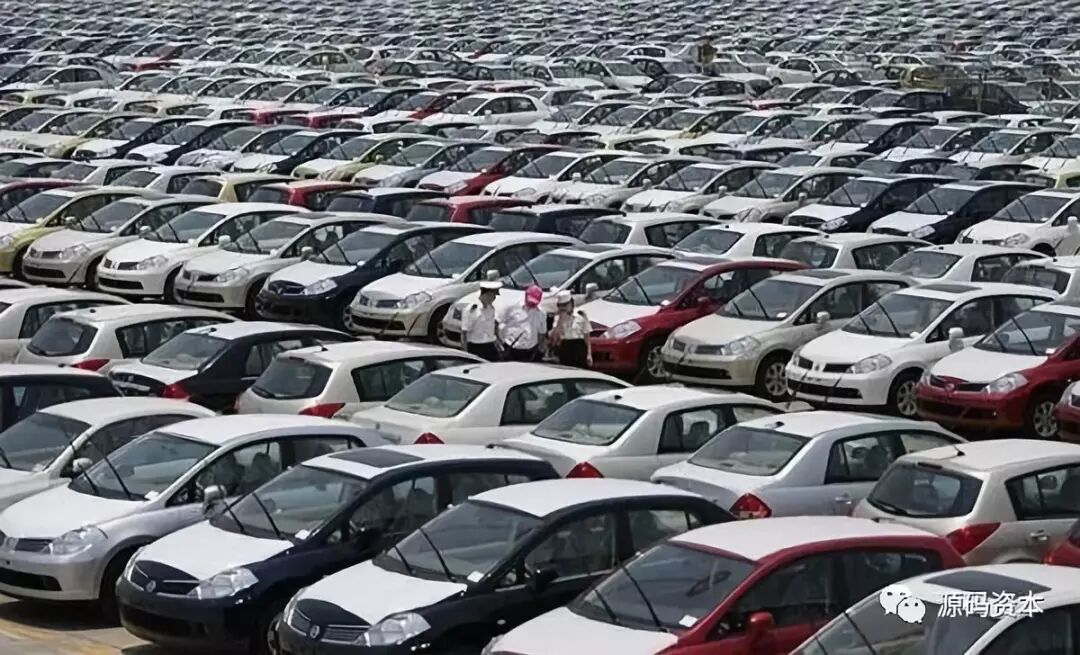
Image source: Internet
2 Wave 1.5: Installed Base Drives Booming Aftermarket
By early 2018, China's vehicle ownership had surpassed 200 million, very close to the United States. Metrics such as the installed-base-to-sales ratio and average vehicle age all indicated that the opportunity in China's automotive aftermarket had arrived. The automotive aftermarket revolves around three attributes of the vehicle: asset, tool, and space.
-
Asset attribute. China's installed vehicle base represents over 20 trillion RMB in assets. Corresponding transactions (used-car wholesale/retail), management (leasing, maintenance and repair, and upstream auto parts), and finance (auto finance, insurance) have each grown into hundred-billion-RMB markets. Moreover, these three areas are closely interconnected, serving as entry points and value-added services for one another.
-
Tool attribute. A vehicle is a mobility tool. Car owners cannot do without location-based services such as navigation, refueling, and parking, nor without data services such as valuation, violation queries, and fine payment.
-
Space attribute. The interior of a vehicle ranks behind only home and office as the private space where owners spend the most time. Many owners are enthusiastic about customizing this space to improve their experience and safety within it, giving rise to a hundred-billion-RMB auto accessories market.
-
Additionally, the owner perspective is shifting. New licensed drivers have already exceeded births, driving school students are getting younger, and driving skills have become ubiquitous among young users. The mobile internet user dividend has ended, and owner users along with much data have been internalized within the ecosystems of internet giants.
Wave 1.5 is the direct result of Wave 1.0's development. Every major auto industry nation has gone through this process; the difference is that in China, it arrived very quickly.
Under Wave 1.5, the influence of the OEM ecosystem is weakening, while the influence of scenarios and owner users is strengthening.
3 Wave 2.0: Mobility Platforms Rise Rapidly, Smart Vehicle Vision Comes into Focus
Uber launched in 2009. Mobility platforms are one of the archetypal applications of the mobile internet era. Globally, mobile internet penetration has far outpaced vehicle penetration. Many countries thus entered the mobility platform phase without going through a period of rising vehicle penetration, and the forms of vehicle supply diversified.
Mobility platforms offer cheaper and more diverse mobility solutions, expanding the user base beyond car owners to all internet users. Mobility platforms may well rewrite the industrial trajectory of the auto industry in many countries, and also affect existing owners' willingness to drive themselves.

Image source: Internet
Tesla was founded in 2003 and has been remarkably successful in its price segment. New energy, high technology, and intelligence — labels that distinguish it from traditional cars — have made Tesla an entirely new species. The progress of Tesla's Autopilot and Waymo's self-driving cars reminds us that the future is already here.
New energy, autonomous driving, and human-vehicle interaction & connected vehicles have become the universally acknowledged development directions for global auto giants. We provisionally call this the smart vehicle.
The interconnection of data across three dimensions — vehicle (condition, trajectory, location), people (driver, passenger, owner), and internet applications — together with greatly optimized interaction modes (voice, gesture, display) and experiences, may give rise to more application scenarios.
Android may replicate its mobile industry alliance model in the auto sector. Existing mobile internet applications will extend to the smart vehicle as a new intelligent terminal.
At first glance, mobility platforms and smart vehicles in Wave 2.0 appear to be two parallel lines, but in the long run, their intersection will grow ever larger.
Both lines are driven by technological innovation and represent the business models with the most synergy with internet giants. More internet giants will embrace Wave 2.0.
The United States saw a 20-year gap between Waves 1.5 and 2.0. In China, Waves 1.5 and 2.0 have arrived almost simultaneously. Global auto giants are actively embracing the changes of Wave 2.0.
Wave 2.0 will have profound effects on derivative scenarios built upon the asset, tool, and space attributes of vehicles.
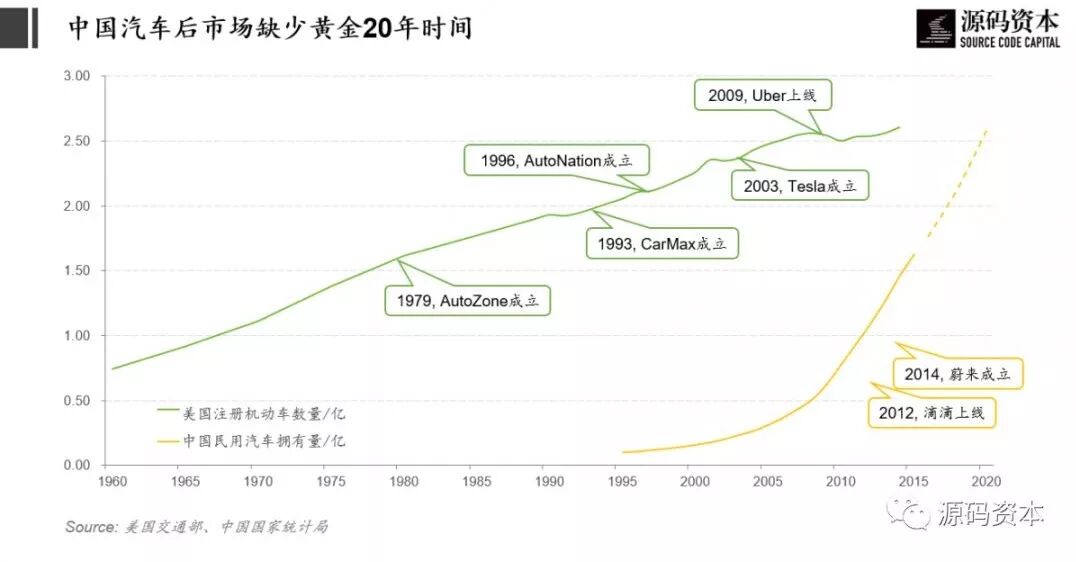
Image source: Source Code Capital
4 Wave 3.0: Autonomous Driving Matures, Robot Fleets and Private Spaces
Thanks to developments in machine learning and other technologies, autonomous driving has advanced rapidly in recent years. Autonomous driving is the biggest variable within Wave 2.0, and will fundamentally transform the entire automotive and mobility ecosystem. Once drivers are replaced by artificial intelligence, the boundaries between mobility platforms and OEM ecosystems become even more blurred.
Vehicle utilization efficiency improves, and data and intelligence allow lifecycle expenditures such as maintenance and energy to be effectively quantified. The business model for mobility services shifts to per-mile billing, thereby redefining the asset and tool attributes.
The space attribute of vehicles is amplified into a private mobile space. Freed from the work of driving, users' time inside the vehicle is greatly released, and the commercial value within that space will be magnified.
We very much look forward to embracing Wave 3.0 together with outstanding entrepreneurs. The evolution path from 2.0 to 3.0 will be exceptionally complex, with various giants competing and gaming; the division of labor in the automotive and mobility track under Wave 3.0 will also change significantly.
We believe three core capabilities will become critically important during this transition:
- First, best-in-class autonomous driving system capability;
- Second, scalable intelligent fleet production capability that can be upgraded and iterated;
- Third, massive capacity operations and dispatch capability based on big data and artificial intelligence.


More from Source Code Capital Insider

Issue 12 Export E-commerce: How to Seize New Opportunities in a Trillion-Dollar Blue Ocean Market
Issue 11 SaaS Business Fundamentals and Value-Add Factors
Issue 10 Where Is the Technology Dividend for New Retail Enterprises in the OMO Era?
Issue 9 Four Dimensions to Position Innovation Opportunities in InsurTech
Issue 8 New Finance Opportunities Through an Asset Management Lens
Issue 7 The Pitfalls of Tech Prophecy
Issue 6 Industrial Internet Investment Landscape
Issue 5 Convenience Stores: What's Next for Domestic 7-Eleven Under the New Retail Wind?
Issue 4 Mobile Going Global: Entrepreneurs Should Keep Their Eyes on Content Product Opportunities
Issue 3 Targeting Unicorns in the Consumer Upgrade Wave
Issue 2 Profile of a "Reliable" AI Startup
Issue 1 Under "New Retail," Where Do Offline Stores Go From Here?

Source Code Capital
Creating Lasting, Real Value

WeChat ID:
sourcecodecapital
More professional content
Follow our official WeChat