MaHui Entrepreneur | From One Universe to Another

Build metaverse worlds with ease.
MaHui Entrepreneurs — Resilient, Bold, and Ever-Exploring
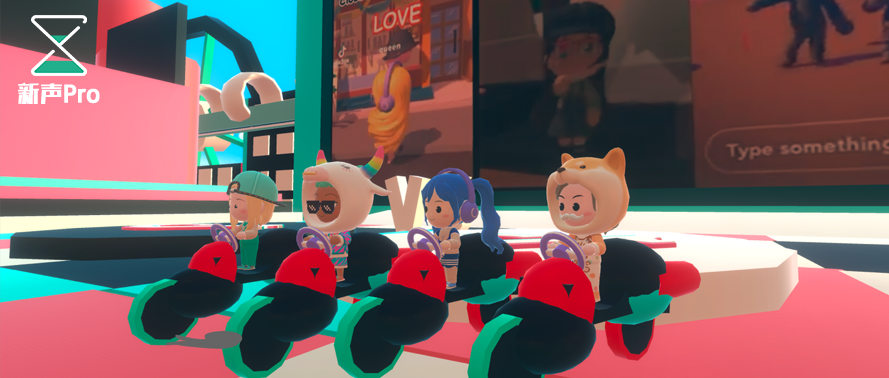
BUD's underlying technology is cross-platform. Through technical innovation and product design, BUD aims to let every user create 3D scenes, thereby lowering the barrier to building metaverse worlds. BUD's product advantage has always come down to "lower creation thresholds plus richer product experiences."
What will the next-generation UGC platform look like? BUD, a new 3D UGC app targeting Gen Z globally with rapid user growth, is attempting to answer that question.
Specifically, BUD lets every user create personalized 3D interactive content using simple, no-code tools. By blending hot topics, fashion, creativity, and aesthetics — elements beloved by Gen Z — BUD is becoming a new social platform of choice for this generation.
According to App Annie data, BUD's iOS international version officially launched on November 5, 2021, with the Google Play version following on October 30, 2021. Within one month of its global release, and with zero marketing spend, BUD ranked in the top 5 social apps on the App Store in multiple countries including the United States. It currently has over ten million registered users.
Xinsheng Pro spoke with BUD's founders, Risa and Shawn. Facing an immature market and the red-hot metaverse concept, Risa believes that BUD's cross-platform underlying technology gives it infinite possibilities as a UGC medium.
As technology matures, gaming, AI, virtual humans, NPCs, and more could all find applications on the BUD platform. BUD's philosophy is to let every user create 3D scenes with low barriers through technical innovation and product design, thereby reducing the threshold for building metaverse worlds.
1. From Passion to Vocation
When asked about what drives his entrepreneurship, Shawn naturally boils it down to: "personal interest + market potential."
BUD's two co-founders, Risa and Shawn, are both post-90s entrepreneurs. In their eyes, 3D creation combines design, technology, art, and other trendy elements — matching both their interests and Gen Z's preferences. In Risa's social circle, experiencing virtual interactive content and games is an important part of daily life.
On one hand, there's their personal love for 3D creation; on the other, its market potential. Risa and Shawn realized they could "turn passion into a career."
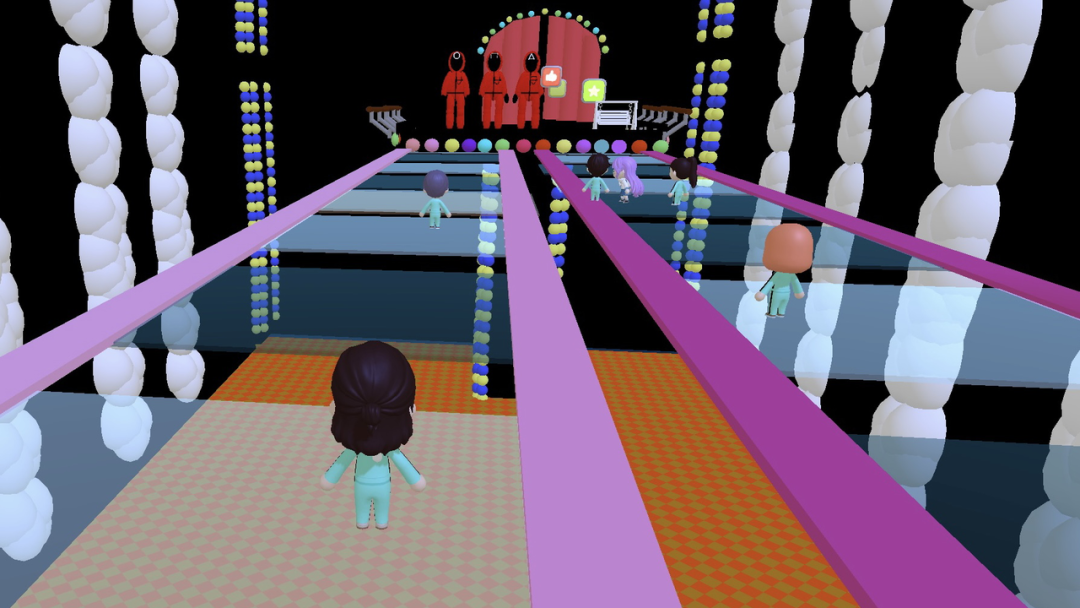
Recreating Squid Game in BUD
Before founding BUD, Shawn worked at Silicon Valley social platforms including Snapchat and Facebook. Early on, he handled technical infrastructure, performance optimization, and Android refactoring. Later, he moved into growth-oriented work, optimizing new user retention and friend recommendations.
Their Silicon Valley experience led both founders to observe: "The next era's media won't be limited to familiar formats like text, images, and video, but could shift toward more virtual, more interactive 3D directions."
This market trend happened to align with their technical capabilities and interests, so the two founders left Snapchat in 2019 and returned to China to start a business in 3D creation.
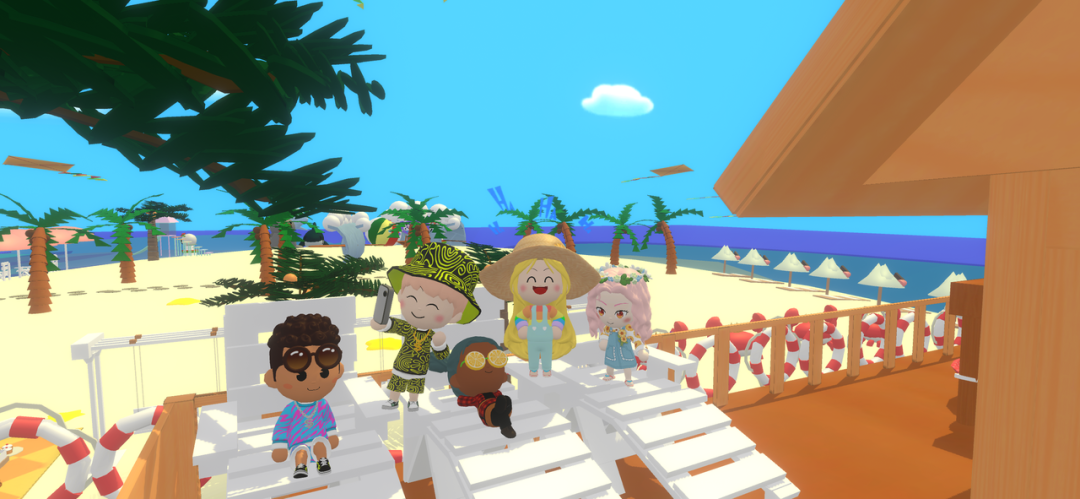
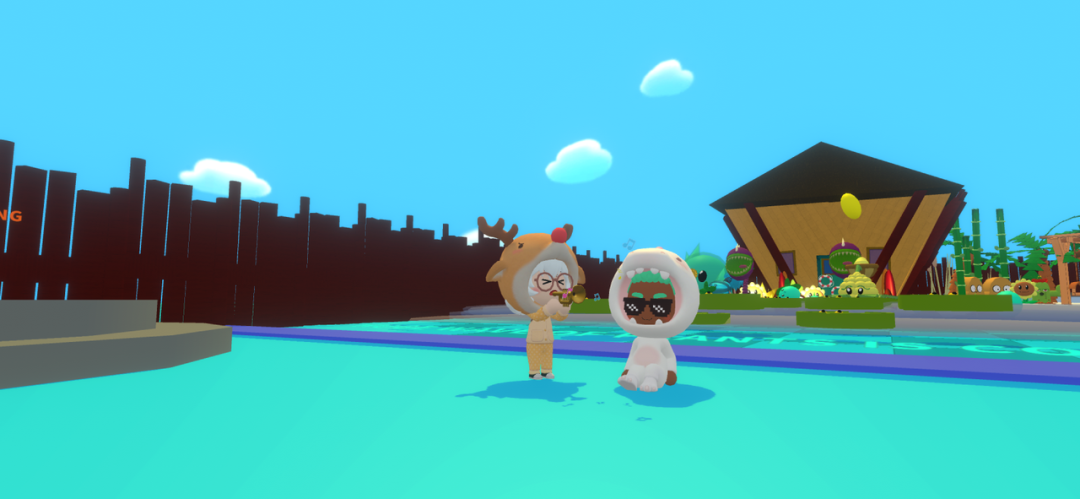
Creating a beach in BUD
Shawn also candidly notes, "3D creation is a completely new direction — interesting but grueling. If you're not a true believer in this direction, it's hard to persist through high-intensity work. Only genuine passion can produce great products."
When building the team, Shawn also put alignment with company values first. "Engineering skills and product sense matter too, but first and foremost, you have to believe in the broad direction of 3D creation."
Under this dual standard of values plus professional skills, BUD currently has over 100 employees and expects to grow to 200 by 2022. Shawn specifically mentioned: "BUD has established a global hub in Singapore, and will deploy localized operations and development teams in core regions worldwide."
2. A 3D UGC Platform
From idea to execution, BUD's path wasn't smooth — there were adjustments along the way.
BUD's early product mainly featured 2D comic avatars with blind box mechanics. The team produced lots of avatar-based content, including avatar comics and interactive games.
But Shawn quickly discovered that the team's content production speed could never match user consumption speed, while the new generation of users was also highly creative — they were "just missing low-barrier tools." So in late 2020, the BUD team pivoted fully toward 3D UGC.
In Risa's words: "Many of BUD's creators are just ordinary girls in everyday life. They can't code or do 3D modeling, and we were the first to give them low-barrier creation tools, letting them produce 3D content that's both fun and highly freeform."
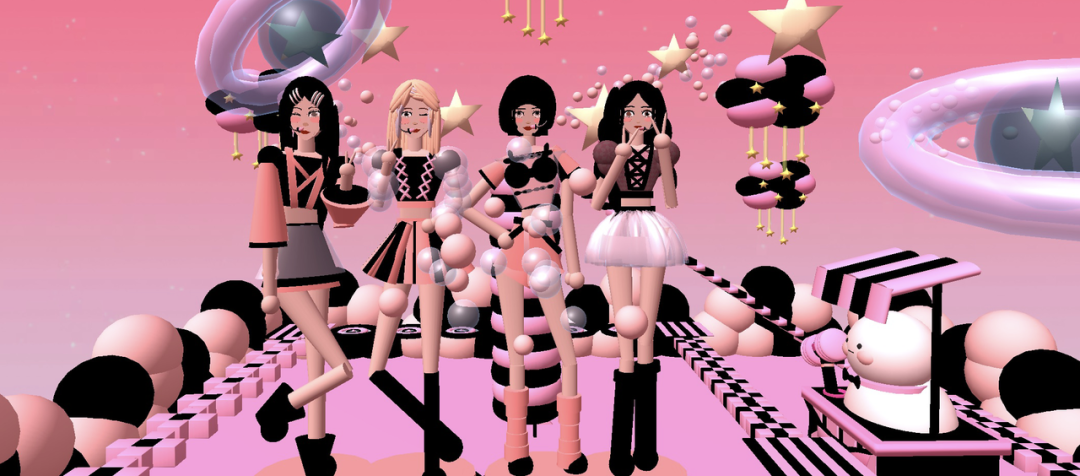
Concert scene
After pivoting to 3D UGC, BUD's global user base grew rapidly thanks to greater openness and freedom. In many countries, BUD ranked just behind Instagram and Facebook among social app downloads.
From a product perspective, BUD users can customize faces, change outfits, and create their own looks; build maps with extremely high degrees of freedom; use music blocks, text boxes, portals, rotation, and other props for personalized creative expression; and play projects created by other users, including music, parkour, architecture, and story-based maps.
"Combine design, 3D technology, art, gaming, social elements, and you end up with BUD," Shawn said with a vivid metaphor.

Creating a space in BUD
BUD's essence is lowering the barrier to 3D creation, making UGC production simpler. People with zero programming background or game development experience can still use BUD to produce a social, playable space, then invite friends to interact.
On the other hand, BUD's control over design aesthetics also gives more users the motivation to share organically.
According to Shawn, the BUD team breaks down product standards across multiple dimensions — art style, modeling, product sense — conducting extensive industry research and analysis of other excellent products to set their own benchmarks.
For specific details — like each character's eye angle, size, and position; hair color and style; body proportions and clothing — the team exercises aesthetic judgment and adjusts in real time based on user feedback.
Shawn told Xinsheng Pro: "To get the most authentic user feedback, Risa and I often immerse ourselves in user communities, talking with them about their product experiences, then iterating specifically based on that."
It's understood that 80% of BUD's users are over 15, and mostly female. On trend-sharing platforms like Xiaohongshu and Instagram, there are numerous experience posts about BUD outfit coordination — covering face shape, hairstyle, eyebrows, skin tone, clothing, accessories, shoes, and more. These both drive BUD's viral spread and indirectly prove the team's attention to aesthetic details.
3. A Broader Market
As the boundaries between gaming, social, 3D production tools, and other platforms blur, under the metaverse concept, new social platform software globally includes Rec Room, Roblox, Zepeto, and others.
On this, Shawn states that BUD's product advantage has always come down to "lower creation thresholds plus richer product experiences."
According to the BUD team's vision, when a new generation of users with DIY creativity and design capabilities has more convenient and handy creation tools, the volume of original 3D works on the platform will explode.
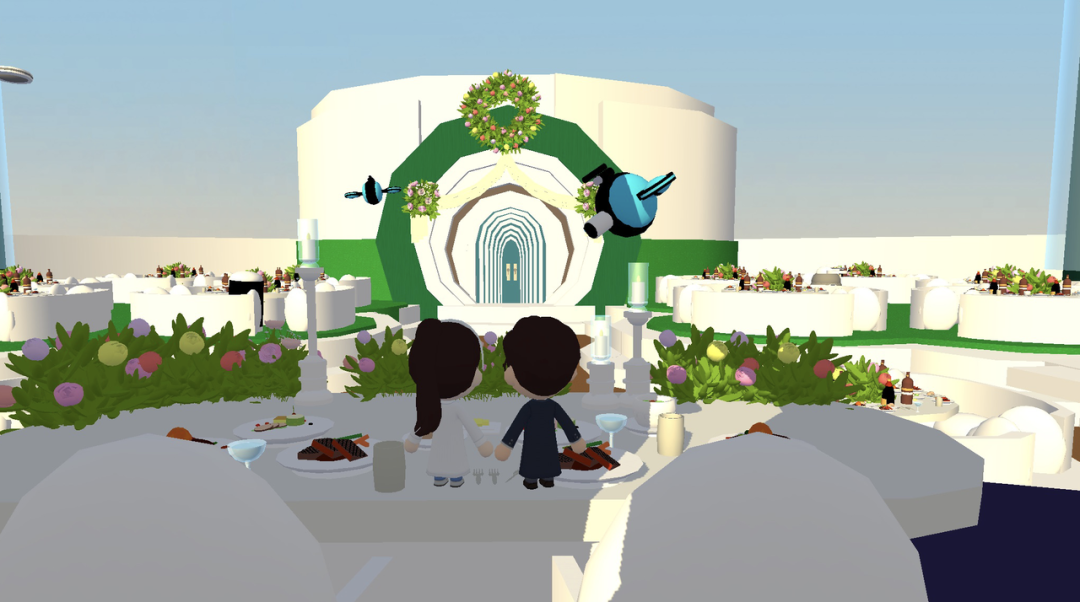
Wedding scene
Facts have proven that by improving the usability of BUD's internal tools and lowering operational barriers, the number of original 3D works in the BUD community has approached ten million, spanning maps, concerts, architecture, outfit coordination, and other types, and is still growing rapidly.
More polished, higher-quality content stimulates users' desire to share. Shawn also believes that beyond social sharing within the BUD community, users' organic posts on external platforms like Xiaohongshu and TikTok undoubtedly amplify BUD's voice, attracting more users to create and share content on BUD, forming a positive cycle. "It's like users are advocating for us."
Therefore, in the near to medium term, BUD will still focus on user growth and product refinement — that is, lowering creation barriers through no-code approaches while improving content quality, thereby acquiring new users and driving retention. Continuous iteration of the core editor is also a priority for the BUD team. "The team hopes that one day users can create very polished 3D UGC works through foolproof operations."
On the other hand, although AIGC is still relatively early, algorithmic recommendation for 3D content is gradually becoming an industry competitive moat. On this, Shawn revealed that optimizing algorithms to improve distribution efficiency for original 3D content will be the BUD team's next strategic direction.
And from a medium to long-term perspective, product diversification and monetization are also inevitable paths. BUD is currently laying groundwork for the nearly ten million digital assets on its platform, aiming to form the commercial ecosystem闭环 that a social platform can encompass.
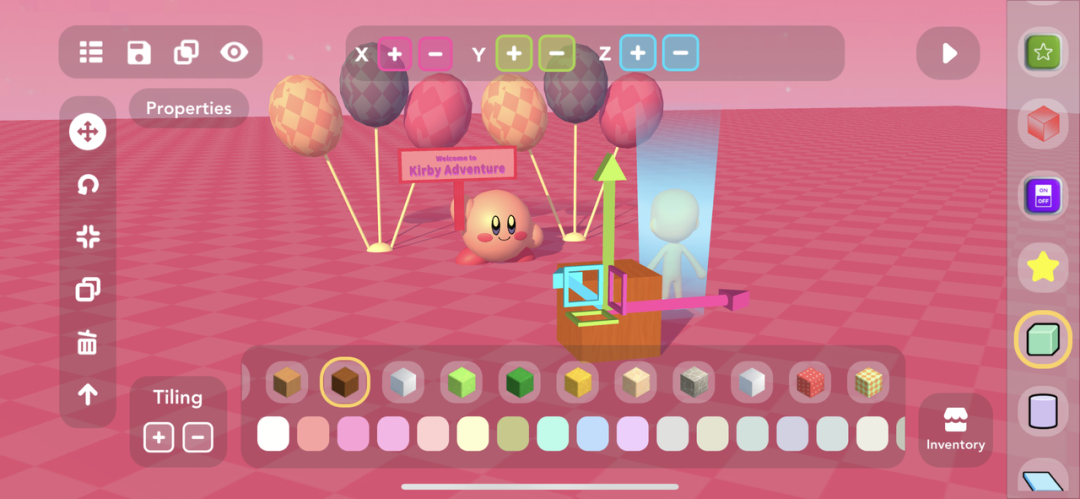
High-freedom adjustments
Meanwhile, as a global company headquartered in Singapore, BUD's vision and monetization path aren't limited to China. According to Xinsheng Pro, BUD has registered users worldwide, with North America, Southeast Asia, and Latin America as its mainstream markets.
BUD investor and Source Code Capital Director Xingchen Zhang also believes, "Gen Z is seeking entirely new ways to connect. The BUD team excels at grasping major trends with a global perspective, and dares to continuously innovate and iterate."
Against the backdrop of traditional social platforms hitting traffic ceilings, a new generation of social platforms is gradually rising. Overseas, there's Rec Room, Roblox, Zepeto; domestically, there's Party Island, Jeli, ZAO, and others, each with their own characteristics. In this wild-growth market with undefined competitive dynamics, BUD's characteristics — decentralization, low barriers, emphasis on UGC content — have already gained preliminary user recognition.
But as Shawn says: "The company is still in its early stages. Grand visions including the metaverse still need to be grounded in actual product iteration."


- MaHui Entrepreneurs | Tenafei: Making a Great Chip Is Only 30% of Success
- MaHui Entrepreneurs | When the Founder of a "Software-Defined Storage" Company Is Also a Race Car Driver
- MaHui Entrepreneurs | Academician Weinan E Proposes a "New Dawn" for Applied Mathematics: AI for Science Deeply Integrates Artificial Intelligence with Fundamental Science
- MaHui Entrepreneurs | From 0 to 1 to 23.4 Reading Week: "Happy Reading Day"
- MaHui Entrepreneurs | From 0 to 1 to 23.4 Reading Week: "The Beauty of Reading"
- MaHui Entrepreneurs | From 0 to 1 to 23.4 Reading Week: "General Knowledge and Big-Picture Thinking"
- MaHui Entrepreneurs | From 0 to 1 to 23.4 Reading Week: "Organization and Talent"
- MaHui Entrepreneurs | From 0 to 1 to 23.4 Reading Week: "Strategy and Operations"
- MaHui Entrepreneurs | From 0 to 1 to 23.4 Reading Week: "Entrepreneurial Mindset"
- MaHui Entrepreneurs | Exploration Never "Extinguished," Saluting the Spirit of Aerospace
- MaHui Entrepreneurs | That Moment of Your "Joy, Anger, Sorrow, Delight" Could Awaken 2 Million Children with Autism
For more MaHui companies, click "Read More"