MaHui Entrepreneur | When the Founder of a "Software-Defined Storage" Company Is Also a Racing Driver

Infinite outward, infinite inward
#MaHui Entrepreneurs# Resilient and Bold, Exploring Without End
Author: Wending Zhai
Xin Xu has a gift: he can take dense technical jargon and render it in plain language. It's a kind of translation in itself. The term he translates most often is SDS: software-defined storage. This is Xu's field of entrepreneurship.
"It's like when you bought an iPhone 8 with iOS 9, and two years later it upgraded to iOS 11. It's the same iPhone 8, but through iterative software updates, you unlocked new features and experiences. That's software-defined."
Speaking in terms people actually understand, and doing so accurately, requires one thing above all: you must be the real deal as an industry expert.
Seven years ago, Xu decided to found XSKY. Storage is an ancient, tradition-bound industry with off-the-charts technical complexity, dominated by giants. As a newcomer, where could XSKY find its place? What unique value could it offer?
Xu gave us a useful frame.
"The storage market is large enough, the industry chain long enough. The auto industry has been around for over a century, and no single manufacturer has ever dominated the entire sector. In that chain, some make steering wheels, others make transmissions. Data infrastructure works the same way — infrastructure, middleware, application systems — any single layer is itself a long enough industry chain." And what XSKY does is the SDS layer of data infrastructure.
This post-90s founder is a technical entrepreneur and also an amateur racing driver. Source Code Capital once externalized its entrepreneurial spirit on MaHui — infinitely outward, infinitely inward. Xu is precisely such a practitioner.
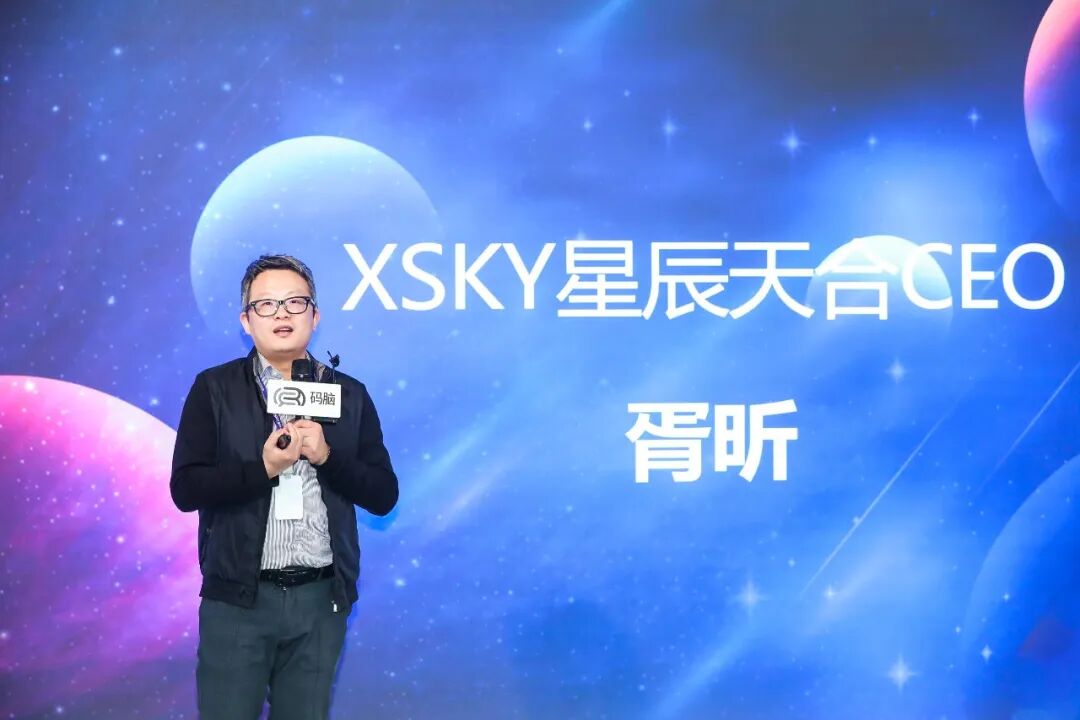
Xin Xu, CEO of XSKY
A New Player's Survival Wisdom
Storage is a classic B2B industry. It may not sound sexy, but its scale and scope are larger than most imagine. In the digital era, storage is merely the first step in ensuring data's lifecycle. Data governance, computation, and mining are all critical components of data infrastructure — and they underpin the user experience on the consumer side.
Storage is also an ancient industry. Storage systems emerged alongside mainframes in the 1950s and 1960s. Even today, its forms keep evolving.
So this is a field with deep historical accumulation and relatively widespread application, crowded with players — all familiar, established tech companies.
First, the giants. Global leaders in storage services like Hitachi, EMC, and IBM serve worldwide markets with general-purpose solutions.
The second category is domestic comprehensive players, represented by Inspur, Huawei, and H3C. They have deep roots, covering everything from networking and storage to computing and security, with rich and mature product lines.
A third force not to be overlooked is cloud service providers. Their advantage is delivering end-to-end solutions to customers, storage included.
XSKY belongs to none of these categories. As a new entrant that appeared seemingly out of nowhere, its first task was self-definition: software-defined storage, personalized and flexible delivery.
In 2015, when Xu decided to start his company, he sensitively detected that user demands for storage were shifting.
One detail: amid the mobile revolution, apps' needs for storing and mining images, audio, and video data grew markedly. Another factor: in many past scenarios, data stored for one or three years would be automatically deleted upon expiration. But as regulatory policies changed and data mining technology advanced, data lifecycles were extended. All of this meant companies needed to build data infrastructure; storage was being reconstructed.
Yiwen Hao of Source Code Capital has noted that Source Code has long focused on industrial digitalization. SDS (software-defined storage) is a domain with high technical barriers and high specialization, and also a segment where domestic substitution demand is urgent. For instance, in the Ministry of Industry and Information Technology's 14th Five-Year Plan for Software and Information Technology Services Development, "software-defined storage" received substantial coverage. Timing likely played a role: as China's largest independent SDS company, XSKY was named a national-level "little giant" specialized and innovative enterprise in MIIT's 2021 announcement of the third batch of such companies.
Change means opportunity. Good companies are products of their times.
Xu knew that as an emerging brand, "We have no accumulated heritage, no legacy — only innovation." On the foundation of meeting baseline industry standards like general requirements and reliable performance, XSKY had to prove its unique value to gain any foothold.
XSKY's first customers, such as large insurance companies, needed to digitize policies and process massive volumes of files — billions of files large and small. This couldn't be solved by a single device; it required software-defined storage technology to schedule and process thousands of internal hard drives.
Banking clients, too, had needs extending far beyond electronic bookkeeping and transactions. Big data storage, computation, and analysis had become critical tools for risk prevention and for precisely matching financial assets with user needs.
These innovative applications may not rely on cutting-edge technology, but they require promptly capturing customer needs and responding quickly. For an established company, meeting the broadest possible general demand is the top priority; personalized or innovative needs might see their timelines stretch indefinitely.
Here, the flexibility of a startup like XSKY showed its value.
They cared deeply about what customers were storing. Xu said, "We are software-defined storage — working with software feels natural to us." Whether storing images or streaming media, they had corresponding recipes and solutions. If a customer raised their hand with a new scenario, and XSKY assessed that other customers might share this interest, they could react immediately. Within months, the customer might have a new product version in hand.
Building Internal Strength
Storage is a peculiar business: at its core, it's selling trust. So the hardest part for a new brand is getting started — without proven success stories, how can customers feel safe entrusting the lifeblood of their business to you? The most basic question: how do you guarantee you won't make mistakes, won't trigger catastrophic events?
Xu said they were betting everything on storage.
"Theoretically, storage could work like other industries — run, polish, revise, and sell as you go. XSKY doesn't do that. Our R&D cycles are long. We must take responsibility for every customer's data security; we can't treat them as guinea pigs."
On the fourth floor of XSKY's office building sits a "compatibility lab" with 11 racks and hundreds of machines. They had just finished deploying a data center in Hohhot with over 500 machines. These fixed assets all serve R&D testing.
With equipment in place, the next step was process discipline. Every feature XSKY releases, every code merge, goes through more than 80,000 tests — including over 10,000 automated test cases. Even in mature infrastructure software, this volume of test cases is rare.
Correspondingly, Xu built the company's technical and R&D team to substantial scale. This is likely the largest department by headcount.
This capacity for "building internal strength" was present even when XSKY was a fledgling startup. For example, XSKY went through a long R&D period of nearly two years before beginning commercialization. This is also why Xu speaks with such conviction and clarity when introducing products to customers.
XSKY's values are quality, breakthrough, resilience, and mutual success. These keywords were distilled by the team after two years of entrepreneurship. The most important thing about a company's values is that someone believes in them, and everyone practices them.
At the time, someone suggested "quality" sounded too plain, that "excellence" had more sophistication. Xu vetoed it. "We'll call it quality — it hits you directly."
Earning seed users' trust is only step one. For a company aspiring to become a leading data infrastructure technology platform provider, rapidly achieving scale effects is equally critical.
Xu understands R&D engineers well. Their most朴素 wish is that every line of code they write delivers maximum value. In other words, the larger the user base, the greater their sense of accomplishment.
While investing heavily in labs and R&D teams, XSKY was simultaneously building out localized service nodes nationwide. Each node consists of three key roles: commercial, technical consultant, and post-sales implementation. On the national map, these people are like an army of ants.
The reason is simple: they couldn't limit their market vision to first-tier cities like Beijing, Shanghai, Guangzhou, and Shenzhen. Xu said, "China's digitalization wave is comprehensive; we can't cherry-pick or play favorites."
On this foundation, they also had to leverage their unique strengths.
While established storage companies define their turf as global, XSKY hoped to focus on the domestic market. While learning and adapting leading technologies, how to tap into white spaces in China.
If XSKY went deep in the most valuable细分 directions, it would achieve a single-point breakthrough effect, which would also help build brand recognition.
Racing and Entrepreneurship
Source Code Capital entered XSKY at the company's Series F round — a late-stage phase that was fairly competitive, with the company holding more leverage. One important reason Xu chose Source Code was that surviving cycles requires kindred spirits.
Source Code's interpretation of entrepreneurial spirit — "infinitely outward, infinitely inward" — resonated deeply with him.
Infinitely outward means constantly expanding boundaries: the entrepreneur must keep breaking through personally, connecting knowledge across disciplines; the company's growth must also expand infinitely outward, broadening scenarios within its domain. Infinitely inward means the entrepreneur must continuously cultivate the self. The founder and CEO should not become the company's ceiling.
Xu has his own method of self-cultivation — racing. He is a super racing fan and an amateur racing driver. When he talks about racing, just as when he discusses storage, he radiates enthusiasm.
Only compared to technology's understated calm, racing delivers a more combustible thrill.
He says racing is different from what most people imagine. Many think racing is about speed, but the real test is control. "When to brake, whether you can brake a little later."
Imagine a race car doing 200-300 km/h, approaching a 90-degree turn. In normal driving, your instinct is to brake through the corner. In racing, you can't. Brake too early, you waste efficiency. You must find the optimal moment — at the last 100 meters, even 80 meters — and slam the brakes. Minimize time lost, minimize speed sacrificed, get through the corner cleanly. Then full throttle to the next straight.
Racing's demand for control mirrors risk management in entrepreneurship. You can't charge ahead blindly without regard for consequences; mastering rhythm is a basic requirement for founders.
When you get in a race car, the coach reminds you: vision matters. Where you look, the car goes. If you stare at a wall, you'll hit it. Xu likes a saying from an industry elder: think long term but deliver short term. In plain terms: watch your step, but keep your eyes on the road.
If a driver's vision is too narrow — staring at the apex through a turn, for instance — it's easy to spin out. This parallels entrepreneurship's need for long-term perspective; limiting your vision to the present or the current quarter will inevitably trap you in short-term temptations.
There are many echoes between racing and entrepreneurship. But what struck Xu most deeply is that in both, knowing what's right matters most.
"If Hamilton and Schumacher know it, and you know it too — you just can't do it yet — that's fine. Every mistake is preparation for doing better next time. What's terrifying is not knowing what's right, yet practicing diligently day after day. No matter how many laps you run, you're running wrong." Xu said the same holds for entrepreneurship: direction must be correct; you must know what's right.
For Xu, whether in racing or entrepreneurship, there is no so-called safe zone. Especially with a company, volatility is normal; embracing uncertainty is a required course for founders.
Xu knows that only when the speed of innovation and growth exceeds the speed of risk can you truly survive cycles.


- MaHui Entrepreneurs | Academician Weinan E Proposes a "New Dawn" for Applied Mathematics: AI for Science Deeply Integrates Artificial Intelligence with Basic Science
- MaHui Entrepreneurs | From 0 to 1 to 23.4 Reading Week: "Happy Reading Day"
- MaHui Entrepreneurs | From 0 to 1 to 23.4 Reading Week: "The Beauty of Reading"
- MaHui Entrepreneurs | From 0 to 1 to 23.4 Reading Week: "General Knowledge and Big-Picture Thinking"
- MaHui Entrepreneurs | From 0 to 1 to 23.4 Reading Week: "Organization and Talent"
- MaHui Entrepreneurs | From 0 to 1 to 23.4 Reading Week: "Strategy and Operations"
- MaHui Entrepreneurs | From 0 to 1 to 23.4 Reading Week: "Entrepreneurial Mindset"
- MaHui Entrepreneurs | Exploration Never "Extinguished": Saluting the Spirit of Aerospace
- MaHui Entrepreneurs | That Moment of Your "Joy, Anger, Sorrow, Delight" Can Awaken 2 Million Children with Autism
- MaHui Entrepreneurs | Sleep Well, Then Go Explore a More Awake Entrepreneurial Life
- MaHui Entrepreneurs | When Entrepreneurship Becomes Their Way of Life
For more MaHui companies, click "Read More" to view