Source Code Capital's Chang Kaisi: How Consumer Brands Achieve Cycle-Crossing Growth

Product is king.
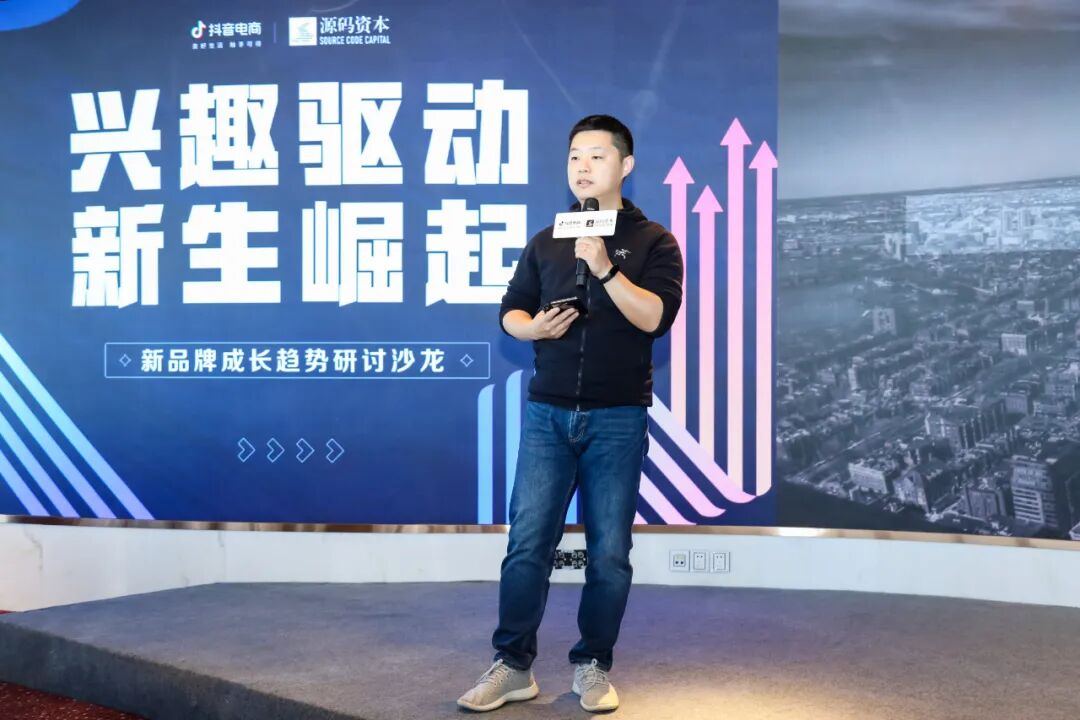
What enduring brands have in common: seizing channel and media opportunities, with product excellence as king.
On November 19, Douyin E-commerce and Source Code Capital jointly hosted the "New Brand Development Trends Seminar Salon," where they released the New Brand Growth Trends White Paper (hereinafter referred to as "the White Paper"). In the White Paper, Douyin E-commerce summarized the development trends of consumer brands around "new brands, new business, new growth" — how brands can use content to connect users with better lives and reshape consumer pathways. Through specific case studies of Source Code Capital portfolio companies in the consumer sector — including Wang Xiaolu, Blank ME, Cloud Whale, PMPM, WonderLab, WANGBAOBAO, and usmile — the White Paper distilled growth strategies for new brands on Douyin E-commerce. Source Code Capital, from an investor's perspective, analyzed the growth paths of new brands, the soil that digital transformation provides for them, and how new brands can build "product excellence" as a competitive moat. At the seminar, Kaishi Chang and Wu Jian, partners at Source Code Capital, Hao Zhang, head of Douyin E-commerce service providers, Tingfu Huang, head of Douyin E-commerce merchant strategy, and representatives from portfolio companies WonderLab, Cloud Whale, and PMPM shared their latest thinking in their respective fields.
The following is the full transcript of the speech by Kaishi Chang, Partner at Source Code Capital
Thank you all for coming to the New Brand Growth Trends Seminar Salon. I primarily cover the consumer sector at Source Code Capital. In the consumer space, Source Code Capital has invested in Cloud Whale, Pagoda, Linji, Blokees, PMPM, moody, usmile, WonderLab, ChaYanYueSe, Wang Xiaolu, Xijiezhachuan, and other new brands, and will continue to identify new brands with technological and product strength in the consumer sector going forward.
What I'd like to discuss with you today is: What do truly cycle-crossing brands have in common?
Pay attention to channel and traffic opportunities, focus energy on refining products
Compared to channels, brands demonstrate stronger power to cross cycles. Summarizing the success of cycle-crossing brands, we find that successful consumer brands have, without exception, seized the channel and media opportunities of their era.
On channel opportunities: Take Procter & Gamble and Coca-Cola as examples. In its development, P&G grew together with Walmart, capturing this super-channel. At its peak, Walmart alone accounted for 8% of P&G's total sales. This strong tie with Walmart helped P&G firmly maintain its leading position, growing to today's $350 billion market cap and over $70 billion in revenue.
On media opportunities: Both P&G and Coca-Cola have been resolute in advertising investment and eager to try the latest advertising formats. Again using P&G as an example — when radio first emerged, P&G was the first to sponsor radio dramas. Because P&G was selling soap at the time, people later came to call radio dramas "soap operas," which is the origin of that term. Today P&G remains the world's largest TV advertiser.
Looking at today's channels and media, Douyin's emergence represents major changes on both fronts. New brands currently have an opportunity on Douyin — a single platform that completes the full closed loop of media advertising and channel transactions. This presents a new challenge for brands and will undoubtedly bring enormous opportunity. Everyone is still exploring what innovations this will bring for brands, but two things are certain: 1. The scale of new platforms will far exceed the past; 2. New platforms will be more thoroughly digital.
1. The scale of new platforms will far exceed the past. Top streamers, including Viya and Austin Li, these two individual hosts already drive tens of billions of RMB in GMV, fully proving the demand for this model. New platforms' GMV will certainly account for a substantial proportion of total retail sales.
2. New platforms will be more thoroughly digital. New platforms bring information沉淀 — funnel conversion at every stage, and finally transaction data, all沉淀 on the same platform, with more direct decision-making pathways.
What impact will such platforms — massive in scale and thoroughly digital — have on the entire business society going forward? This is an important question. There's no definitive answer yet, but what can be certain is that the impact will be profound enough. This is also why everyone is here today, spending considerable time communicating with Douyin.
Beyond that, for consumer goods, beyond channel platforms, product is still king. I want to emphasize again that product is the most important thing — retention is the direct manifestation of product strength.
For example, if we abstract competition between brands: assume only brands A and B exist in the market, with consumers entering randomly. Brand A might have 50% retention, Brand B 30%. We can simulate this with a Markov model and get quite interesting results.
This model has two very interesting characteristics. First, the end state is independent of the starting state. Perhaps initially Brand B is a thousand times, ten thousand times larger than Brand A, or even Brand A starts at zero. But the converged result of the model is that Brand A's user base in the end state is always 1.4 times that of Brand B, regardless of starting conditions. In other words, no matter how large the incumbent's initial advantage, as long as a competitor has an advantage in user retention, it will ultimately win in competition.
Second, the speed of competitive convergence is far faster than people imagine. We also ran a simple model: under the assumptions above, the new and old brands appear to have only a 20 percentage point gap in repurchase rate, but the new brand can complete steady-state convergence in just 6 repurchase cycles. Assuming your product has monthly active usage, the new brand can surpass the old brand in 6 months.
Therefore, to summarize: pay attention to channels, pay attention to traffic, focus energy on refining products — this is how you build lasting competitive advantage and achieve faster competitive convergence. We have consistently emphasized to Source Code Capital portfolio companies that product is king, that you should spend more energy on R&D and product development.
Seize era opportunities, build global brands
Another era opportunity we see is internationalization. Internationalization is our era's trend and opportunity. Consumer brand giants generally derive only 30-40% from their home markets, with overseas markets accounting for 60-70%, of which China represents 20-30%. If Chinese enterprises want to compete head-to-head with these giants, internationalization is the only path. Only by doing internationalization well can they match these giants in scale effects.
Internationalization not only captures international markets, but also enables better learning of advanced productive forces in various countries. Before the pandemic, we would visit one country each year to talk with local companies, especially Chinese companies that had gone overseas there. What impressed me most was Huawei — Huawei truly operates like a multinational corporation, building various capability centers overseas. Beyond sales, it can internalize the strongest local capabilities and沉淀 them into its own organization.
Going forward, when we evaluate companies, we hope to see natively international companies. In the future, when people discuss them, they won't ask whether a company is an overseas company or a domestic one — going overseas, internationalization may simply be the default operation.
Chinese companies have several major advantages in going global:
First, technological innovation. Technological innovation first requires talent. China produces 3 million STEM graduates annually, five times that of the United States — the engineer dividend is very clear. Second, from demand and supply perspectives, China maintains very strong advantages.
Second, supply chain advantages. China's manufacturing has the strongest foundation, especially in the Greater Bay Area, which from demand, talent reserves, and supply chain completeness is the best place globally. Supply chain advantages are particularly evident in electronics manufacturers — for example, Cloud Whale, which Source Code Capital invested in, as well as other electronics manufacturers, smart hardware companies, and new-generation home appliance companies, are all fully leveraging China's supply chain advantages.
Third, channel capabilities. Looking at e-commerce competition, China's e-commerce has developed very rapidly with intense competition, and e-commerce still represents advanced capabilities domestically and internationally. From a channel capability perspective, China's e-commerce operational capabilities lead globally — new operational methods, new methodologies are most advanced in China. From the perspective of channel capability export, China currently has clear advantages.
Fourth, cultural influence. Five thousand years of Chinese cultural沉淀 give us the confidence to stand on the international stage. As China's national power continues to strengthen, Chinese culture's influence in the world will also grow. Li Ziqi's popularity among users from various countries on YouTube is direct proof. In the next stage, Chinese companies going global will certainly need the internationalization of Chinese culture as strong support.
Era opportunities are like collecting seven Dragon Balls to summon Shenron. The foundational conditions for going global and internationalization are becoming increasingly complete. We believe that consumer brands originating from China and going global will emerge soon. These enterprises will combine the best of China and the world, becoming super-species like Shenron. Source Code Capital is also willing to work hand-in-hand with these enterprises to create lasting, real value for global consumers!
Thank you all!


- Source Code Capital Appoints Kaishi Chang as Partner
- Source Code Capital Closes Fifth RMB Fund to Drive Tech Innovation, Empower SMEs
- Reading Source Code Capital's New Consumer Investments Through This Year's 618, Powered by Young People
- Source Code Capital Announced Xingshi Wang as Partner
- 2021: Original Aspiration Is the Future
- Source Code Capital Announced That Wei Wang Has Officially Joined as Partner
- Source Code Capital Completes RMB 3.8 Billion New Fund Raise for Fourth RMB Fund
- Growth Growth Growth Growth Growth Growth Growth Growth Growth
- Source Code Capital Announced Yungang Huang Has Officially Joined as Partner
- Hongjiang Zhang Joins Source Code Capital as Investment Partner