A Deep Dive into Legal Structures and Issues for Domestic and Overseas (VIE) Equity Incentive Plans | ESOP Research

Why does my equity incentive program fail to actually motivate people?
Foreword: Source Code Capital surveyed entrepreneurs on ESOP topics and found that CEOs face many common challenges. How large should the option pool be at different stages of a company's development? How should ESOP grants be structured? Who should receive them? How much should be granted? How can companies communicate with employees to achieve motivational impact? As companies grow, how should ESOP connect with capital markets? When liquidity opportunities arise, how are ESOPs taxed and how can tax burdens be minimized? When employees depart, how should ESOP be handled?
ESOP is not a purely commercial, legal, or tax issue. An expert in one domain may struggle to propose a comprehensive solution. To fully address the concerns of our CEOs, Source Code Capital screened service providers in the ESOP space and invited four expert teams — each having handled multiple TMT industry equity incentive cases in their respective fields. This marks the first time they are appearing together on one platform. They will analyze ESOP from four dimensions — management, legal, tax, and dispute resolution — covering the entire process from multiple angles, to help everyone wield this tool effectively.
Incentivize without stumbling.

Mr. Zhao Menghan
Managing Partner, Private Equity Investment Group, Zhong Lun W&D Law Firm
Designed equity incentive plans for tens of thousands of employees at a major internet company,
Provided specialized legal services on employee equity incentives for numerous internet companies.
[Table of Contents]
1 What equity incentive options are available for domestic and offshore (VIE) companies?
1.1 Equity incentive structures available to domestic companies
1.1.1 Models available for domestic companies' equity incentives
1.1.2 Comparison of various models
1.2 What equity incentive structures are available to offshore (VIE) companies?
1.2.1 Models available for offshore (VIE) companies' equity incentives
1.2.2 Comparison of various models
2 What listing pitfalls and landmines should domestic and offshore (VIE) companies avoid when implementing equity incentives?
2.1 What listing landmines should domestic companies avoid when implementing equity incentives?
2.1.1 CSRC concerns regarding equity incentives
2.1.2 Lock-up period restrictions that equity incentives may trigger
2.1.3 Impact of Announcement No. 17 on equity incentive plan formulation and execution
2.2 What listing pitfalls should offshore (VIE) companies avoid when implementing equity incentives
3 How should subsidiaries of group companies implement equity incentives?
3.1 Structural design
3.2 Conversion mechanism design
4 "Why didn't my equity incentive achieve the desired motivational effect when I put equity on the table?"
[Full Transcript Below]
1 What equity incentive options are available for domestic and offshore (VIE) companies?
1.1 Equity incentive structures available to domestic companies
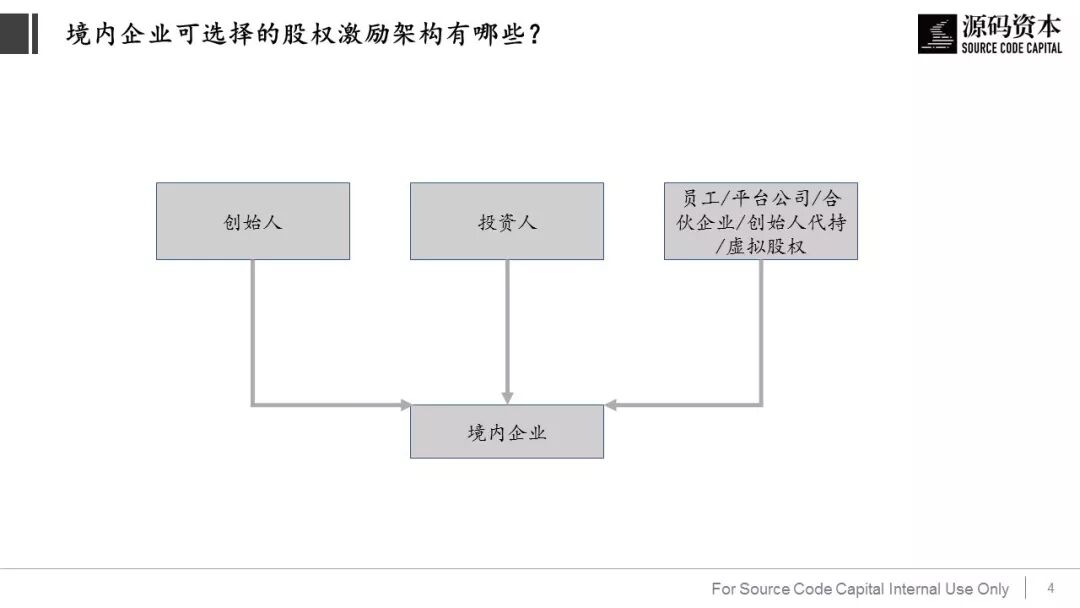
Generally speaking, for domestic companies' equity incentives, several common models are available as shown in the presentation, including: direct employee shareholding, employee shareholding through a platform company, employee shareholding through a platform partnership, founder nominee holding, and phantom equity.
1.1.1 Models available for domestic companies' equity incentives
Which model should a company choose? Direct employee shareholding means employees directly hold company equity through the incentive plan — this is the simplest and most straightforward approach.
Founder nominee holding means employees hold company equity, but this portion is held on their behalf by the founder; employees are not registered shareholders. Platform company and platform partnership holding means establishing an additional layer above the future financing and listing entity, with employees directly holding equity or interests in this layer. In earlier years, corporate forms were used; increasingly, partnership structures are now adopted.
For the platform partnership structure, the founder typically serves as the GP (general partner) of the partnership, with employees as LPs (limited partners). The advantage of this arrangement is that employees can obtain corresponding economic benefits as limited partners, while management rights remain controlled by the GP — a right specifically granted to general partners under partnership law. Through this structural design, the founder secures management and voting rights over the incentive equity, making this a widely adopted practice today.
Another model is phantom equity. Huawei is a classic example: with so many employees, it would be impractical to register each one. Instead, the company sets aside a portion of equity for incentives, dividing it into share units corresponding to the quantities specified in contracts with employees. This is phantom equity — no industrial and commercial registration is required, as it is primarily a notional, rights-based treatment.
1.1.2 Comparison of various models
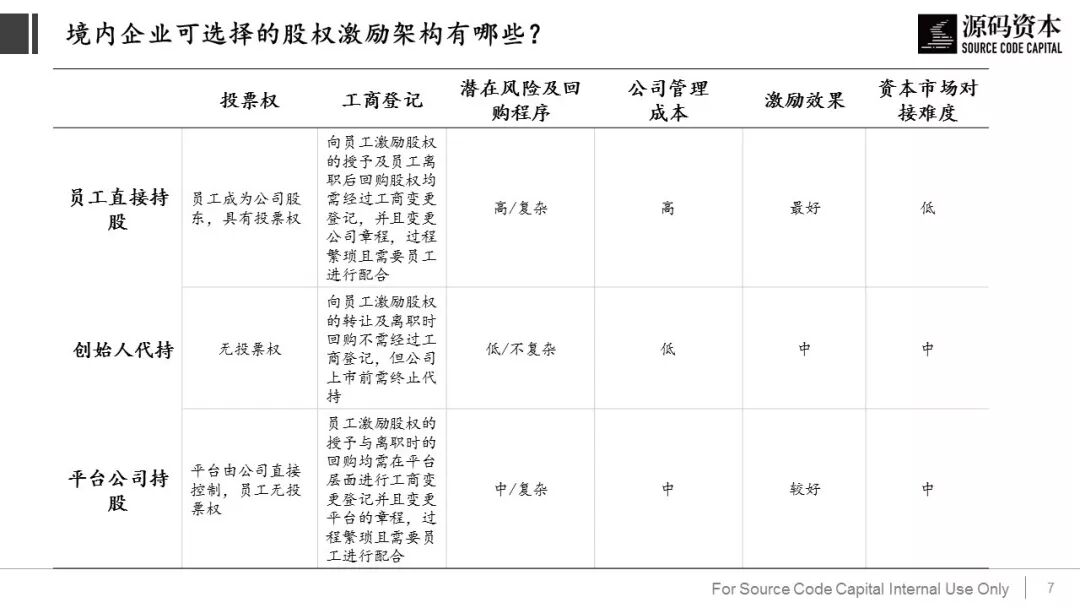
Among these models, which is better or worse? We believe there is no absolute standard. Here we simply share dimensions for consideration: voting rights, industrial and commercial registration, potential dispute risks and repurchase procedures, management costs, incentive effectiveness, capital market interface difficulty, tax, and share-based payments. Companies should evaluate these dimensions to select the most suitable equity incentive approach. Tax and share-based payments will be covered in detail by the Deloitte team; I will focus on the other aspects.
-
First, when companies and founders plan equity incentives for employees, voting rights are a key consideration. If direct employee shareholding is chosen, employees become direct shareholders with voting rights. Under founder nominee holding, employees generally have no voting rights. For platform company-level holding, because an additional layer is established, employees only have voting rights at the holding company level; however, founders typically hold majority stakes in platform companies, enabling control through this design. For platform partnerships, founders generally serve as GP and executive partner, so company voting rights remain in founders' hands. For platform nominee holding (phantom equity), this is entirely a virtual arrangement where all rights are held by the founder or a designated third party on employees' behalf, so employees have no voting rights.
-
Second, industrial and commercial registration must be considered whenever shares are granted to employees. Specifically: direct employee shareholding generally requires registration; founder nominee holding does not require changing employees to registered shareholders; platform company and platform partnership holding generally only requires registration at the platform level — employees are registered as shareholders or partners of the platform entity, but since the platform's holdings in the underlying company remain unchanged, the underlying company avoids registration procedures. Phantom equity, as a nominee arrangement by the founder or designated third party, generally does not require registration before IPO.
-
Third, potential risks and repurchase procedures, management costs, and incentive effectiveness are closely tied to industrial and commercial registration. Specifically, any equity that undergoes registration involves more complex and uncertain repurchase procedures later, with correspondingly higher management costs. For example, in early-stage companies with just one incentivized CTO, repurchase negotiations may be relatively straightforward if they depart, and the registration change is simple. But imagine dozens or hundreds of incentivized employees — while batch granting and registration may be manageable, how does the company repurchase equity when employees leave? Departures are unpredictable: someone leaves today, another tomorrow. Batch repurchase is impossible. The company faces risks of employees refusing to sign repurchase agreements or cooperate with registration changes. Repurchase procedures become complex, management costs rise. This also relates to human nature: employees who believe in the company tend not to leave. Those departing usually harbor some grievances. If grievances accumulate sufficiently, they may refuse to return their shares. If the company litigates based on agreements, this may involve first instance, second instance, and potentially retrial — generating substantial disputes and consuming significant time and energy. Therefore, any equity incentive structure involving registration carries relatively high potential risks and management costs upon employee departure. However, from an incentive effectiveness perspective, registered structures — especially direct employee shareholding — tend to be most effective, as employees directly participate in future financing and IPO. Holding through a platform somewhat diminishes employees' sense of value and participation.
-
Fourth, companies and founders should consider capital market interface difficulty. If incentivized employees directly hold company equity as registered shareholders, this generally does not create substantive IPO obstacles. However, founder nominee holding must be fully cleaned up before IPO to ensure clear equity structure; otherwise it creates substantive listing obstacles. Platform company and platform partnership holding are currently accepted by capital markets, with numerous successful listing precedents. Platform nominee holding (phantom equity), like founder nominee holding, requires cleanup or restoration before listing to ensure equity clarity.
1.2 What equity incentive structures are available to offshore (VIE) companies?
1.2.1 Equity Incentive Structures Available to Offshore (VIE) Companies
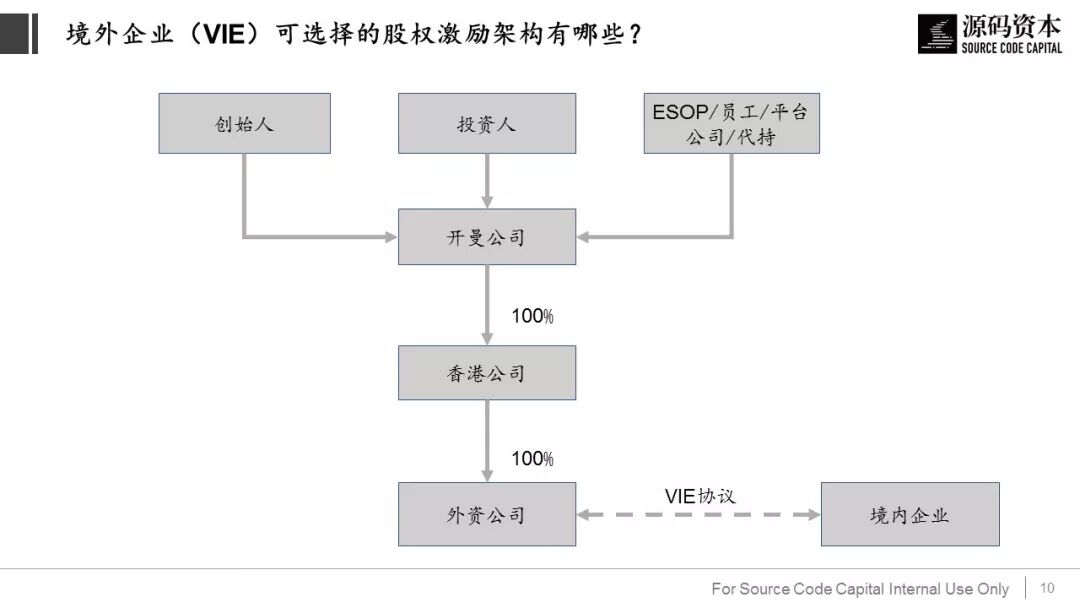
Let's examine the equity incentive structures available to offshore (VIE) companies. In practice, the treatment of equity incentives under offshore structures is broadly similar to domestic arrangements. From an organizational perspective, the main structures to consider are direct shareholding, platform company setups, and founder nominee holding. In terms of available instruments, the common models include ESOP (stock options), restricted shares, restricted stock units (RSUs), and phantom equity. Here's how each works:
Stock options grant employees the right to purchase company shares at a predetermined price upon meeting certain conditions — whether time-based vesting or KPI achievement. Restricted shares,通俗 speaking, are akin to "dry shares" (gratis shares); the "restriction" typically refers to a company repurchase right attached to the grant. For example, if a company issues 100,000 shares to an employee today, but the employee doesn't complete four years of service, the company has the right to repurchase all or a portion of those shares at a pre-agreed price. Restricted stock units work differently: the company promises 100,000 shares, but these only vest and transfer to the employee in tranches after four years of service. Phantom equity involves the company dividing a portion of equity into notional share units and granting employees the economic rights attached to actual shares under certain conditions, without making them registered shareholders.
1.2.2 Comparing the Models
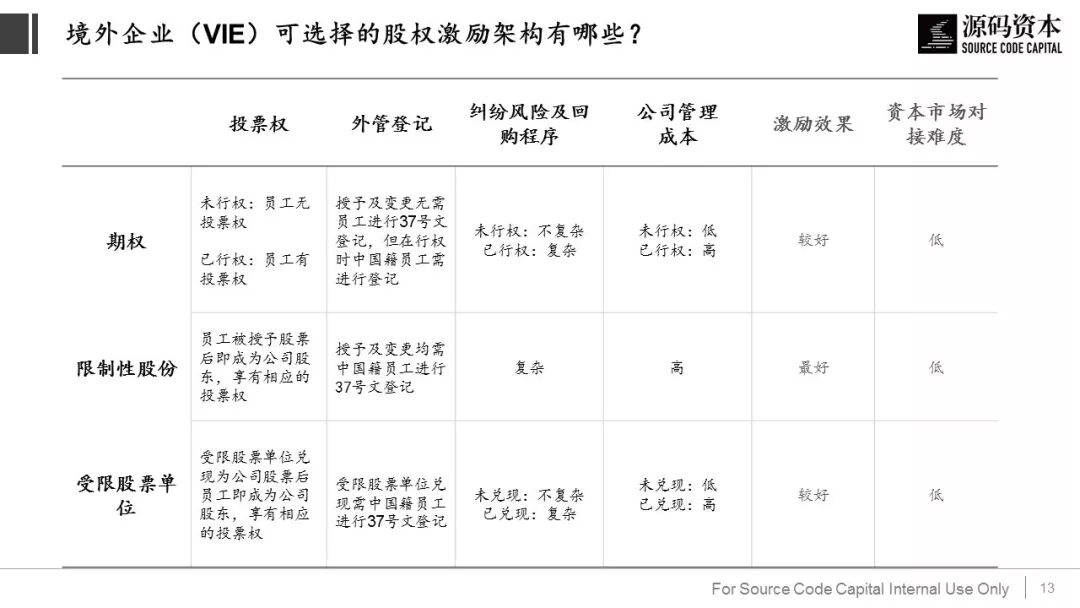
For offshore equity incentives, founders and companies need to evaluate six dimensions: voting rights, foreign exchange registration, dispute risk and repurchase procedures, administrative costs, incentive effectiveness, and capital market compatibility. Compared with domestic equity incentives, only one dimension changes — business registration becomes foreign exchange registration, a specific legal requirement under the VIE structure that we'll address in detail later.
-
First, voting rights. Options have two states: unexercised and exercised. Before exercise, an option is merely a purchase right, so the incentivized employee has no voting rights. After exercise, the employee gains corresponding voting rights. For restricted shares, the employee becomes a shareholder upon grant and generally enjoys voting rights. For RSUs, voting rights attach when shares are actually issued. Phantom equity typically carries no voting rights.
-
Second, foreign exchange registration. This differs from business registration. For founders with VIE structures, you're certainly familiar with SAFE Circular 37 registration. Circular 37 applies not only to founders — employees can also complete it, specifically by registering with SAFE before becoming shareholders of the offshore company. For options, registration is required after exercise. For restricted shares, since shares are granted directly, employees must complete SAFE registration. For RSUs, registration is triggered when shares are actually issued. Phantom equity requires no SAFE registration since employees don't hold actual shares.
-
Third, dispute risk, repurchase procedures, administrative costs, and incentive effectiveness. These are largely identical between offshore and domestic structures. One notable difference: while there's no business registration offshore, shareholders must be recorded in the shareholder register of the offshore entity. Therefore, disputes or repurchases typically require resolution through foreign judicial or local procedures — companies cannot unilaterally strip employee shareholder status based on contractual agreements alone. Once disputes arise, especially offshore, they may involve litigation or arbitration in the agreed jurisdiction. This creates meaningful hassle for companies. On incentive effectiveness, options remain the most common and well-accepted instrument for offshore structures, with strong uptake among internet and TMT employees. As Teacher He noted, however, different seniority levels warrant different instruments — partners and executives often prefer restricted shares over options.
-
Fourth, capital market compatibility. Options, restricted shares, and RSUs are all well-established in offshore IPO precedents, so they generally present no material obstacles. Phantom equity, however, requires restructuring before IPO into actual shares, restricted shares, or options.
I want to specifically address SAFE Circular 37 registration under VIE structures — we discussed this with the Deloitte team just recently.
Circular 37 stipulates that for unlisted special purpose vehicles, offshore employee equity incentives may be registered with SAFE before exercise.
SAFE introduced this policy in response to specific issues it observed. For example, when domestic employees hold options in a Cayman company, the exercise payment must go to the Cayman entity despite the employee being physically in China — creating a cross-border payment situation. This gave rise to Circular 37's foreign exchange registration requirements for incentivized employees under offshore structures. In practice, however, foreign exchange registration for outbound payments remains extremely difficult to execute, whereas registration for employees' offshore capital realization is relatively more feasible.
2 What Landmines and Pitfalls Should Domestic and Offshore (VIE) Companies Avoid When Implementing Equity Incentives?
2.1 What Listing Landmines Should Domestic Companies Avoid?
2.1.1 CSRC Concerns Regarding Equity Incentives
First, for domestic companies seeking listing in China, the CSRC focuses on the following issues regarding equity incentives:
-
First, source of funds. The CSRC generally accepts employees using personal funds to purchase company or platform equity. Therefore, when designing and implementing equity incentive plans, companies should avoid lending money to employees for exercise.
-
Second,利益输送 (interest transfer/self-dealing). Companies should generally avoid granting shares to upstream/downstream suppliers and customers, as this may raise CSRC suspicions of improper利益输送 between the company and these parties.
-
Third, selection criteria for incentivized employees. For example, if a company has 50 incentivized employees, the CSRC may scrutinize the selection standards, positions, and work histories of these individuals.
-
Fourth, incentive quantity. Every company has its own rationale for designing incentive pools. As long as the quantity can be reasonably explained, it generally won't constitute a material listing obstacle.
-
Fifth, changes in shareholders or platform partners. The CSRC typically requires companies to explain reasons for shareholder changes and changes in employee持股平台 shareholders or partners. Generally, if reasonably explained, these won't become material obstacles — but this depends on the incentive structure design. For instance, if all incentivized employees are placed in a dedicated持股平台, partner changes can be readily attributed to employee departures or other contractual triggers. However, if employees directly hold shares in the listing candidate, departures causing share transfers complicate the equity structure and historical evolution, adding disclosure burden and requiring extensive explanations for different types of shareholder changes.
-
Sixth, nominee holding. Since listing rules explicitly require clear equity ownership, all nominee arrangements must be terminated before listing.
Additionally, I've flagged two points requiring particular attention. First, whether shareholders directly or indirectly exceed 200 persons. The 200-person threshold doesn't only count direct shareholders — don't assume a持股平台 counts as a single shareholder. Per regulations,持股平台 participants must be counted on a穿透 (look-through) basis. If a platform has 50 incentivized employee partners, all 50 count as shareholders of the listing candidate. Three such platforms would mean 150 shareholders — plus founders, investors, and unregistered investors — making it quite possible to exceed 200 after full penetration. Exceeding 200 persons becomes a material listing obstacle. This is likely the biggest issue domestic companies face when listing, especially for new economy companies where broad-based employee ownership is standard. Therefore, we recommend keeping pre-IPO equity incentive participants below 200. That said, companies meeting certain conditions may potentially apply CSRC Announcement No. 17 to exceed this threshold. Announcement No. 17, issued to serve new economy companies, provides that under specific requirements, all shareholders or partners behind an employee equity incentive platform may be counted as a single person — a significant positive development. While no successful precedents exist in practice yet, evolving regulatory trends may eventually allow employees to突破 the numerical限制 described above. I'll elaborate on Announcement No. 17 later.
Now back to the CSRC's concerns around equity incentives. Another major focus is the clarity of shareholding. Under previous review standards and interpretations, all equity incentives had to be terminated at the time of IPO filing to ensure clear ownership structure. This created a common dilemma for companies: say a CFO is promised full vesting over four years at 25% annually. In year three, the company is performing well and ready to file for listing — but the CFO still has two years of observation period before the remaining 50% is granted. Because the CSRC does not allow shares to remain in an uncertain state, the company must either grant the remaining 50% to the CFO or terminate the unvested portion entirely. This often creates significant headaches for HR management. However, the CSRC's Announcement No. 17 now addresses this issue: qualified companies may keep pre-IPO equity incentive plans in effect after listing. I'll detail the specifics later.
The last important concern is突击入股 (sudden shareholding before IPO). Simply put, companies should avoid capital structure changes within six months before submitting IPO materials. New shareholders added during this period are considered突击入股, and the CSRC will scrutinize their entry price, rationale, and funding sources. These shareholders also face a 36-month lock-up period.
2.1.2 Lock-up Restrictions for Equity Incentives
Building on the final point above, let's address the lock-up period for incentive shares — a concern particularly relevant to employees.
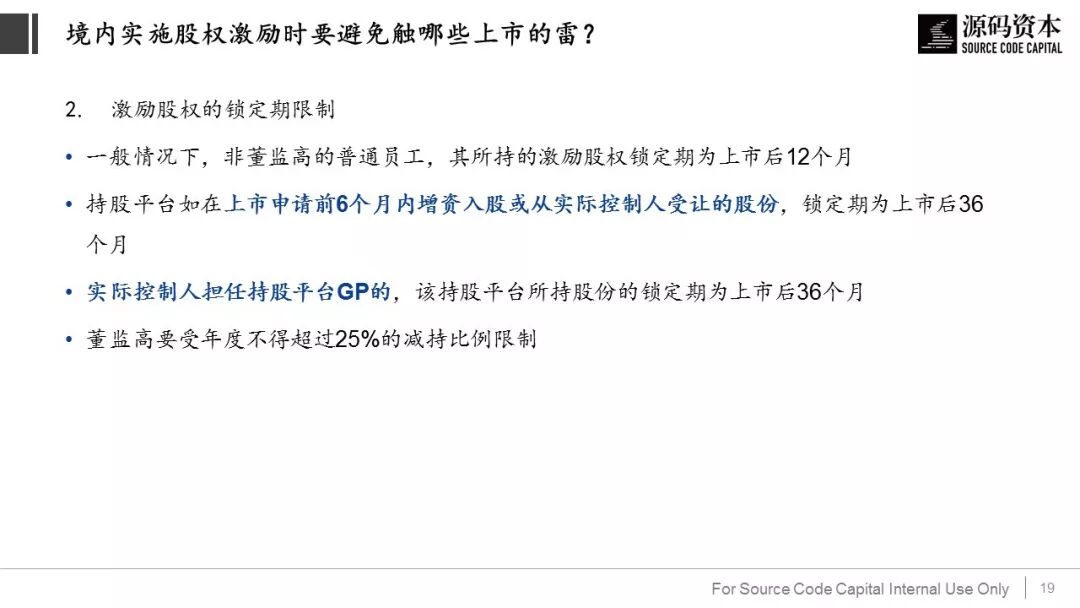
For ordinary employees who are not directors, supervisors, senior executives, or actual controllers, the lock-up period is 12 months post-IPO. After this period, they may transfer their shares. If a shareholding platform突击入股 within six months before the IPO filing, that platform faces a 36-month lock-up.
If the company's actual controller serves as the GP of the shareholding platform, that platform is deemed an enterprise controlled by the actual controller, and its shares in the IPO candidate are locked for 36 months post-listing. In practice, some companies therefore replace the platform's GP with another employee — say, the union chair — before listing to avoid this 36-month lock-up. Additionally, directors, supervisors, and senior executives face an annual 25% reduction cap post-IPO: each year they may only sell up to 25% of their holdings.
2.1.3 Impact of Announcement No. 17 on Equity Incentive Plan Design and Implementation
The CSRC's 2018 Announcement No. 17 — Guidelines on Implementing Employee Share Ownership Plans and Stock Option Incentives at Pilot Innovative Enterprises — represents a major breakthrough. It primarily resolves two issues.
First, the 200-shareholder limit. Under this rule, if an employee share ownership plan meets certain requirements, it counts as a single shareholder when calculating total shareholders. The specific requirements are: (1) The IPO candidate must be an innovative enterprise. Announcement No. 17 does not define "innovative enterprise," but an earlier State Council document — Notice of the General Office of the State Council Forwarding the CSRC's Opinions on the Pilot Program for Innovative Enterprises to Issue Stocks or Depositary Receipts Domestically (the "CDR Pilot Opinions") — provides some definitions. For example, the enterprise must have annual revenue of at least RMB 3 billion and a valuation of at least RMB 20 billion. Most emerging industry companies find these thresholds difficult to meet. However, the CDR Opinions leave an opening: enterprises with rapid revenue growth, proprietary R&D, internationally leading technology, and relatively advantageous competitive positioning may also qualify. Going forward, we should monitor how regulators further define innovative enterprises and observe the review standards and flexibility applied in practice.
The second requirement is the closed-loop principle. Announcement No. 17 requires that the employee share ownership plan not transfer shares at the time of IPO, and commit to a lock-up of at least 36 months from the listing date. During the pre- and post-IPO lock-up periods, if employees wish to transfer or exit their interests, they may only transfer to other employees within the plan or to other qualified employees.
In summary, if a company can satisfy both the closed-loop principle and the innovative enterprise standard, and obtains approval, the regulator may count an incentive pool exceeding 200 people as a single shareholder. This resolves the headcount issue I mentioned earlier — theoretically, even 10,000 people under incentive could be fine. Of course, if the closed-loop principle cannot be met, completing private fund registration is an alternative path to being counted as one shareholder.
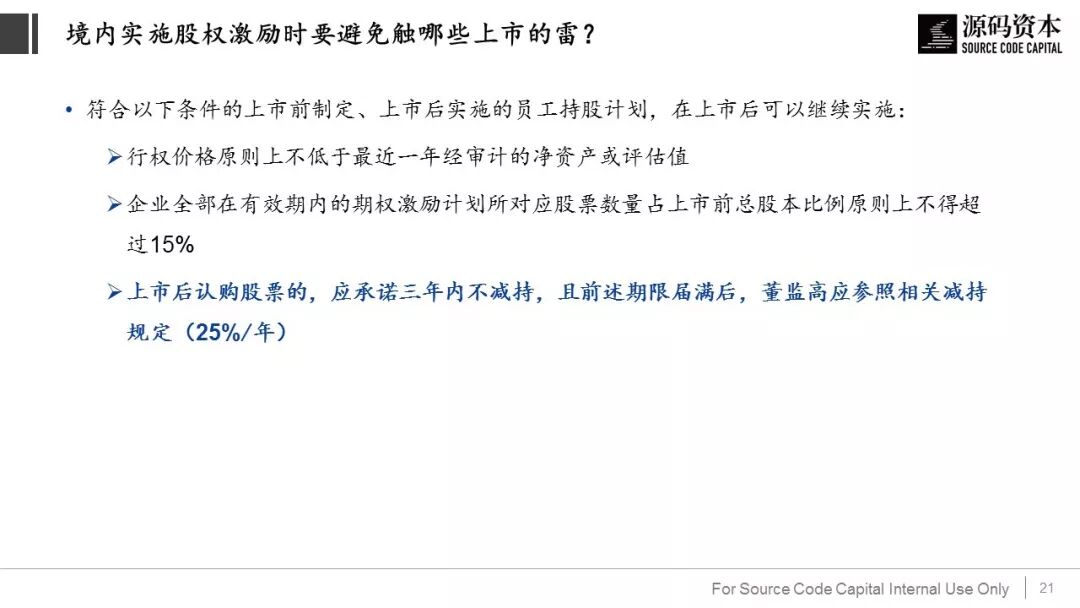
The second issue resolved by Announcement No. 17 is allowing pre-IPO equity incentives to remain effective post-listing. Under the announcement, if a company wishes to continue implementing pre-IPO stock option plans after listing, it must meet the following requirements:
- First, the exercise price should in principle be no lower than the most recent audited net asset value or valuation.
- Second, the total shares underlying all outstanding option incentive plans should in principle not exceed 15% of pre-IPO total share capital.
- Third, for shares subscribed post-IPO, the holder must commit not to reduce holdings for three years. After this period expires, directors, supervisors, and senior executives must comply with reduction rules, transferring no more than 25% of their company equity annually. This means stock granted to directors, supervisors, and senior executives before listing may be locked up for as long as seven years.
2.2 Pitfalls for VIE-Structured Companies Implementing Equity Incentives Ahead of Overseas Listings
Generally speaking, overseas capital markets are more accommodating of pre-IPO equity incentives than domestic markets. In the United States, the approach is primarily disclosure-based. Whether a company uses stock options (ESOP), RSUs, or restricted stock units for incentives, these can be seamlessly carried into a US listing. Equity plans approved before IPO remain valid regardless of whether grants were made by the listing date.
Additionally, US-listed companies typically select a trust institution before listing to handle post-IPO exercise, sale, and other administrative matters for the company and its employees. Hong Kong's requirements are stricter than the US. Incentives already granted before listing remain valid after listing, but ungranted incentives must comply with Hong Kong's rules for listed company equity incentives.
Furthermore, employees participating in equity incentive plans of overseas-listed companies are subject to SAFE Circular 7 — Notice of the State Administration of Foreign Exchange on Foreign Exchange Administration Issues Concerning Domestic Individuals' Participation in Equity Incentive Plans of Overseas-Listed Companies. Unlike Circular 37 discussed earlier, Circular 7 applies after listing.
3 How Should Group Companies Structure Subsidiary Equity Incentives?
3.1 Structural Design
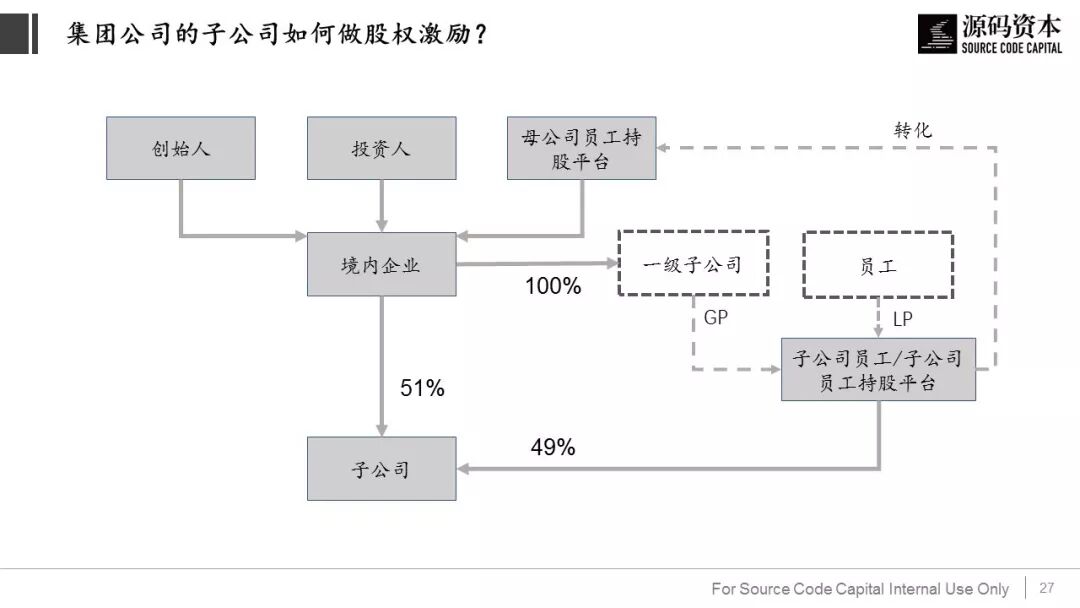
Generally, the most common and typical structure for subsidiary-level equity incentives is: the domestic parent holds 51% of the subsidiary, while subsidiary employees hold 49%. However, this structure presents several problems.
For example, in an M&A scenario, the 49% employee stake in the subsidiary may create obstacles — employees may not cooperate, among other issues. Additionally, under the Company Law, certain major decisions require approval by shareholders representing more than two-thirds of voting rights. Thus, these incentivized employees holding 49% theoretically wield veto power over major subsidiary decisions. If implemented this way, direct employee ownership of 49% may prevent the parent from exercising control over the subsidiary, leading to decision-making and operational difficulties.
We have refined this structure: the parent first establishes a subsidiary to serve as the GP of the employee shareholding platform, with employees as LPs of this platform. This platform (a partnership) becomes the 49% shareholder of the operating subsidiary. Through this design, the parent retains control over subsidiary management and voting rights, while effectively granting economic rights to subsidiary employees — achieving the incentive objective.
3.2 Conversion Mechanism Design
From a legal structuring perspective, we strongly advise focusing on conversion mechanism design. At the subsidiary incentive level, companies must establish a mechanism allowing subsidiary equity to convert into parent company equity. Otherwise, during major capital events, if the 49% minority shareholders do not cooperate, the subsidiary's equity structure enters an uncertain state.
We therefore strongly recommend that regardless of structural design, subsidiary equity must have a mechanism to convert into parent equity — specifically, defining conversion timing and conversion ratios. Conversion timing could be set at the parent board's discretion; if subsidiary and minority shareholders resist, alternative triggers such as IPO or M&A could be specified. The conversion ratio is the core issue. In our discussions with many companies on what the subsidiary's 49% equates to in parent equity, several valuation standards emerged: revenue contribution, profit contribution, or GMV contribution — plus a catch-all clause for board-determined ratios. We also recommend capping the conversion ratio, especially for core subsidiary shareholders, because theoretically, subsidiary shareholders converting their 49% into parent equity could become the parent's largest shareholder. The conversion optionality should, where possible, be retained at the parent company level.
4 "Why Doesn't My Equity Incentive Actually Motivate Anyone?"
After extensive discussions with founders, we've concluded the root cause is opacity — specifically, a lack of perceived value. Employees simply don't feel that the incentive equity has value.
The first specific cause is opacity around ownership percentage and equity pricing. Employees frequently complain that after signing the incentive agreement, they have no clarity on how much equity they've received or what it's worth.
The second cause is opacity around the rules themselves. Employees often feel the company has buried traps in the agreement, with numerous share repurchase clauses that make them feel they'll never truly own the equity.
So how do you dispel this sense of opacity among employees? How do you increase their sense of value? Our recommendation is to be as transparent as possible. For example, valuation is something you can be transparent about. If the company is valued at $100 million in this round, and an employee holds 1% in incentive equity, that's worth $1 million — this is something you can tell employees. A year later, when the company raises its next round and the valuation triples, that $1 million becomes $3 million, and the motivational effect on the employee becomes far more pronounced. If an employee ever considers handing in their resignation, and they see $3 million in book value sitting in their incentive equity, the decision they make at that moment will likely be a more careful one.
Years ago, from a confidentiality perspective, we advised companies not to disclose the value of incentive equity or repurchase mechanisms to employees. But now we advise companies to be as transparent as possible. The more transparent you are, the more motivating it becomes, and the more employees will feel the value. Thank you, everyone!

More ESOP Research

- How to Avoid the Pitfalls of "Equity Incentives" | ESOP Research
- How Effective Equity Incentives Achieve "Fairness, Value, and Participation" | ESOP Research

Source Code Capital
Creating Lasting, Real Value

WeChat ID:
sourcecodecapital
More professional content
Follow our official WeChat